The Youth’s Instructor, Vol. 47, No. 43.

NOVEMBER

The Youth’s Instructor

Nov 2, 1899

Review and Herald Publishing Company · Battle Creek, Mich. · Nov 2, 1899

NOVEMBER
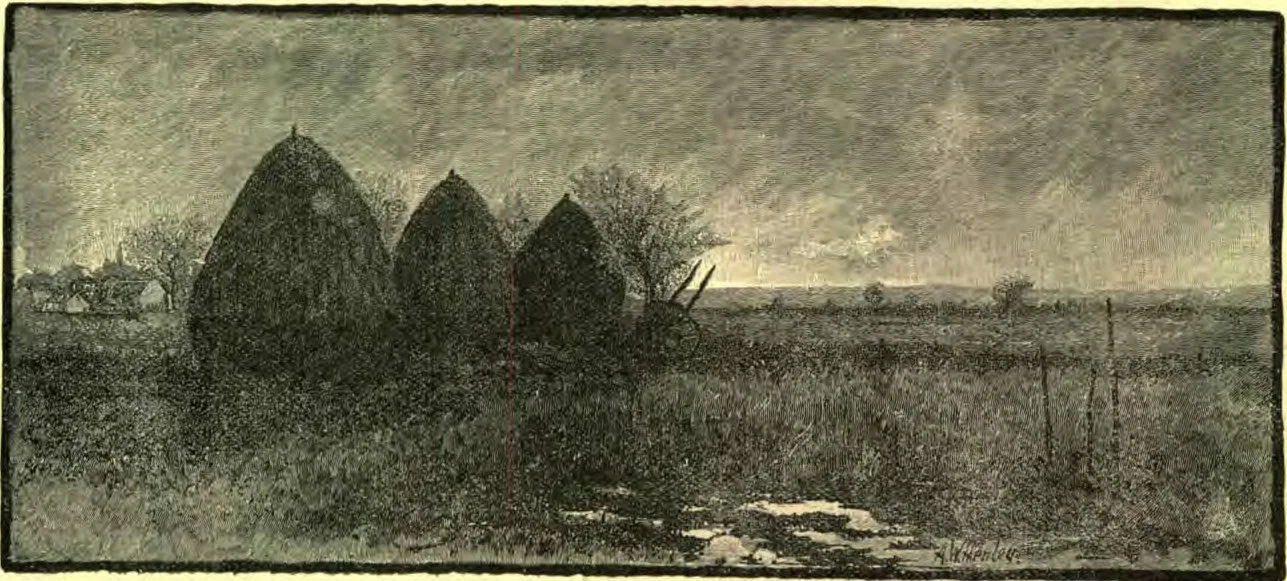
Purple dawns will flood no more Starry asters bending low; Reign of goldenrod is o'er, Lit with sunshine's overflow; Fields, where armied corn has stood, Gold fires flash from spear to spear, Now are left in solitude— 'T is November, dear.
Bees no longer wander through Flowers of autumn growing wild; Where the meadow grasses grew, Faded aftermath is piled; Torrent-hearted birds have flown; And the winds o'er forests drear Sweep with wailing monotone— 'T is November, dear.
“WHERE THE MEADOW GRASSES GREW.”
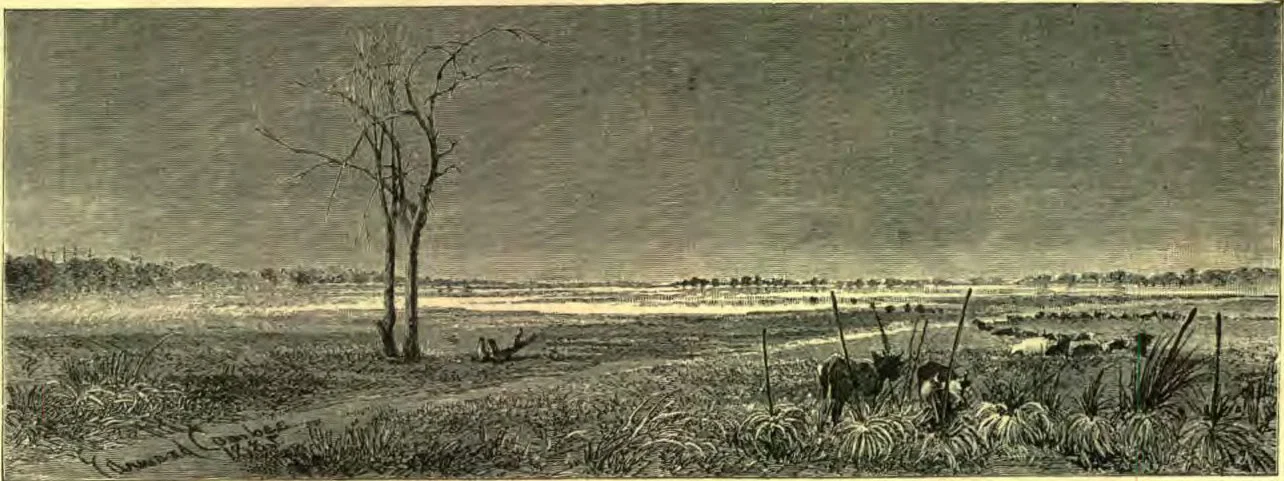
EVENING IN AUTUMN.
EVENING IN AUTUMN.
Now and then the gray sky lets Glimmers of the sunshine through, And, outreaching pale regrets, Shows its azure self anew. Now and then the crow's late call Through the woods breaks sharp and clear, And the dead leaves rustling fall— 'T is November, dear.
'T is November, dear,—what then? You and I can surely wait Till the rose-time comes again, Though these days are desolate: And how beautiful to know, Set in music of God's year, In the symphony's full flow, Comes November, dear.
— Wide-Awake.

THE JOY THAT IS SET BEFORE US

I

God asks the youth to serve him with consecrated minds. The call that he gave to the humble fishermen on the shores of Galilee he gives to each soul. “Follow me,” he says, “and I will make you fishers of men.”
The men of the world are ambitious for fame. They desire houses and lands and plenty of money, that they may be great according to the measure of the world. It is the height of their ambition to reach a place where they can look down with a sense of superiority upon those who are poor. These souls are building on the sand, and their house will fall suddenly. Superiority of position is not true greatness. That which does not increase the value of the soul is of no real value in itself.
The qualities which shine the brightest in the world have no place in the kingdom of God. Birth, position, wealth, and high-sounding titles find no special favor with him. To-day, as when he walked among men, Christ passes these by, and accepts the men and women in the humble walks of life, who have his glory in view. The words he uttered on the mount are truth for all time. “Whosoever therefore shall break one of these least commandments, and shall teach men so, he shall be called the least in the kingdom of heaven: but whosoever shall do and teach them, the same shall be called great in the kingdom of heaven.” Whatever his learning, his wealth and position, heaven estimates the transgressor as the least of all God’s creatures; and the humble and obedient are regarded as of more value than the most exalted and wealthy and honored of earth.
Christ invites the youth to wear his yoke and lift his burdens. “Come unto me,” he says, “take my yoke upon you, and learn of me; for I am meek and lowly in heart: and ye shall find rest unto your souls. For my yoke is easy, and my burden is light.” The reason we do so little in winning souls to Christ is that we have so little of Christ in us. The usefulness of the Christian will depend upon the measure of the grace he has received; and the measure of grace he receives will be proportionate to the use he makes of the blessings that God gives him.
You will have some estimate of your own worth when you become a laborer together with Christ, to fill the world with his righteousness. The Lord expects you to proclaim the message, “The kingdom of heaven is at hand.” You are to work to bless those who have no sense of their need of a new heart, a new life and purpose. Some one must tell sinners of their great need; and those whom God has accepted as his sons and daughters must work as Christ worked. “If any man will come after me,” the Saviour said, “let him deny himself, and take up his cross, and follow me.” Those who heed this call will study the meekness and lowliness of Christ, and will join with him in his efforts to make the world better.
The commission Christ gave to the disciples he gives to all connected with him. We are to make any and every sacrifice for the joy of seeing souls saved. Whatever work is done in the name of Jesus to bless and elevate and restore human beings to the image of God, is as acceptable to the Lord as was the work of Moses or Joseph or Daniel. You who are the elect and chosen ones are to receive the divine commission to yoke up with Christ. You must never grow weary in well-doing. The highest honor that can be conferred upon human beings, be they young or old, rich or poor, is to be permitted to lift up the oppressed, comfort the feeble-minded, and support the weak. The world is full of suffering; go, heal the sick, pray for the hopeless, preach the gospel to the poor.
MRS. E. G. WHITE.

PUBLIC INSTRUCTION IN AUSTRALIA

THE various Australian governments do not fail to appreciate the importance of the instruction of children; and to meet the necessities of the case, have provided systems of education, which, though varying in the different colonies, are sufficiently elaborate in all to provide good facilities. In all the colonies the education of children is made compulsory; and the laws relating to the matter are not allowed to rest as dead letters upon the statute-books. The birth of a child must be registered; and for the fulfilment of this requirement, the parents and attending physician are made responsible, under a heavy penalty. From that moment the child becomes, in a measure, the protégé of the state.
At a certain age the records must show the certificate of his vaccination; and at a proper age, say six years, his name must appear on the roll of the public schools. If it does not, an officer will soon be around inquiring as to the reason. The attendance of the child must be up to the required standard, too, or the same officer will appear on the scene, armed with a serious penalty with which to enforce his command that these truant days be made up.
At the age of thirteen, or having attained a moderate degree of mental ability, the child is relieved from the espionage of his country, and becomes the property of his parents. Too often this time is eagerly looked forward to by the parent, who is impressed with the one idea of his child's being a source of profit with which slightly to enlarge the family income. So the boy or girl is quickly put out to learn a trade, or into a shop, or made to serve with rigor on the farm, or at wood-chopping or some other means of procuring a livelihood. Henceforth his education consists of actual contact with the lowly incidents of a life of toil, and such other associations as he may seek or chance to meet.
As a result of this system, the prevailing standard of education among youth in the Australian colonies is low, although there are few who are allowed to grow up without at least the rudiments of book knowledge. As a rule, the families are large; and the needs of numerous children seem to force the parents to crowd the older ones to an early servitude, so as to meet their own necessities, and, if possible, to help the others.
There are many exceptions to the prevailing rule. The children of parents of even moderate wealth receive a liberal schooling; and even among the poorer classes, there are those who set an adequate value upon education, which leads them to sacrifice in order that their children may continue in school. But these exceptions do not set aside the general rule.
Beyond the common branches, the duty of the government does not extend toward the children, except in subsidies to grammar schools, training-schools, and universities, where the student is expected to contribute toward the expenses of his higher education.
The public schools of Australia are not at all under local control. The entire system is managed by the Government Department of Public Instruction. There are no school boards and no hiring of teachers, providing for the school, or even, as when I was a boy, banking the schoolhouse to keep out the frost. Consequently there is little grumbling, and no quarreling over the teacher; for he or she is a government employee, in for life, and not subject to local criticism or censure. Of course complaints may be lodged; but to be effective, they must go to the government through the inspector. The avenue to teachership is through the government training-schools, and up through the various steps of “pupil teacher,” and assistant.
It is a life-work; that is, the faithful teacher is in the constant employ of the government, with stated seasons of rest, and is subject to the call of the government to go here or there, wherever his services may be required. After having served in his calling about twenty-five years, the teacher is retired on a pension, which continues to his death, thus permitting him, with careful habits, to spend his days in the comfortable assurance of a living.
G. C. TENNEY.

INTO THE LIGHT

As the clock struck four the next day, May came up the walk with her Bible under her arm. After greetings had been exchanged, Grace said, “We were so sorry that your mother was not well yesterday. How is she to-day?”
“She is feeling a little better, and insisted on my coming this afternoon, though I felt almost that I ought not. Hannah left us two weeks ago, and since then mama has been doing the work almost alone. I was so wrapped up in my studies and the evening meetings that I did not realize how tired she must get, although papa has said several times that she was not looking well. I hardly noticed what he said until Jennie Dow’s mother died so suddenly last week. Since then I have been trying to lighten mama’s burdens.”
“Yes; Dr. Hill was here yesterday, and he said Mrs. Dow had overworked so long that she had no vitality with which to rally, even after the disease had left her.”
“And she was sick only a week.”
“Yes; it was a terrible shock to the whole family. Jennie is the only one to take her place, and I do pity the poor girl. She knows almost nothing about housework.”
“Her mother always said that if Jennie never learned to work, she would never have to; and so Mrs. Dow took in sewing to pay for her daughter’s music and drawing lessons.”
“Did you ever notice, Grace, that the very means people use to avoid things often bring upon them the things they fear?”
“Yes; and often when people think they are just ready to enjoy life, they die.”
“So they do; but we must begin our reading, for I must start home by half-past five. Shall I call your mother and aunt?”
In a few minutes May returned, accompanied by Mrs. Conwell and Aunt Jane, and all entered at once upon the study.
“The first thing I wish to tell you,” said May, “is that the Lord does not pronounce sentence upon any one until his life record has been examined. These records are kept by angels, in books set apart for the purpose.”
“Who examines the records—the angels?” asked Mrs. Conwell.
“No; God the Father, the Son, and the angels all take part in the ‘Investigative Judgment,’ as it is called. A picture of this work is given in Dan. 7:9, 10, also in Rev. 20:12, 15. Please read the latter, Aunt Jane.”
“And I saw the dead, small and great, stand before God; and the books were opened: and another book was opened, which is the book of life: and the dead were judged out of those things which were written in the books, according to their works. . . . And whosoever was not found written in the book of life was cast into the lake of fire.”
“Notice that it says they were judged ‘according to their works.’ The Lord leaves all free to choose their leader, but he sets plainly before them the results of a wrong choice. He says that those who confess him before men, he will confess before his Father and the holy angels.”
“We have chosen our Leader; we have confessed his name before men. Now are we sure of a home in his kingdom?” asked Grace.
“Will you please answer that question, Aunt Jane?” said May.
“It seems to me this way,” said Aunt Jane; “we are not to confess him in words only, but by our lives. We are to represent him, to live as he lives. If we do this, we are sure of a home in his kingdom.”
“That must be the meaning; but, May, what is the standard in the Judgment? and what are the ‘books’? The text speaks of other books besides the book of life.”
“I will answer your last questions first. The book of life contains only the names of those who have entered the service of Christ. You remember that when the seventy returned, saying that even the devils were subject unto them, Christ said, ‘In this rejoice not, . . . but rather rejoice because your names are written in heaven.’ You will find it in Luke 10:20. Paul said, speaking of some of his fellow laborers, that their names were in the book of life. Phil. 4:3. Now please turn to James 2:12 to see with what standard our cases are compared. Will you read it, Grace?”
“So speak ye, and so do, as they that shall be judged by the law of liberty. That law is the ten commandments, is n’t it?”
“Yes; the eleventh verse shows that. In Rev. 11:19 we learn that the ark, which contains the law, was seen by the prophet in the temple of God in heaven. We all believe in keeping the law of God because Christ kept it, and he is our pattern. Does that answer your questions, Grace?”
“You have not told us what the ‘books’ are.”
“Elder Barnes says they must be the books that contain the individual records. As the names are called from the book of life, the record, or biography, is investigated from the other books. If the individual has been loyal, his name is retained, and his sins are blotted out. If he has proved unfaithful, his name is blotted out.”
“How do you know that?”
“In Ex. 32:32, 33, the Lord says, ‘Whosoever hath sinned against me, him will I blot out of my books.’ Of course that means those whose sins are unconfessed at the time of the Judgment.”
“Can we know when this Judgment will be?”
“I think so; for Elder Barnes said that at the next meeting he would show us just when it began.”
“Began! It can not be possible that it has begun already!”
“I do not know. That is what he said.”
“Mama, you and Aunt Jane must go to-night, and hear what he has to say,” said Grace. “I wish I could go, too.”
LENA E. HOWE.

THE CLOSING DAY

How sweet to view at eventide The glowing sunset sky, Whose golden-tinted clouds all ride At anchor in an ocean wide Of purest azure dye,— To watch the first bright star appear, And twinkle in the blue; While swallows twitter as they veer And soar and dip, now far, now near, A joyous, happy crew!
When twilight has begun to hush The song-birds, whose glad cry Rang through the trees, there comes a rush Of color to the clouds, which blush To bid the sun good-by. Their blushes slowly fade away From crimson to a hue Of plain and somber ashen gray; And one more fully finished day Meets the eternal view.
William Archer Wright.

OUR DEPARTING MISSIONARIES

The tender light of home behind, Dark, heathen gloom before, The servants of the Lord go forth To many a foreign shore; But the true light, which can not pale, Streams on them from above,— A light divine, which shall not fail,— The smile of Him they love.
A wealth of love and prayer behind, Far-reaching hope before. The servants of the Lord go forth To seek a foreign shore; And whereso’er their footsteps move, That hope makes sweet the air; And all the path is paved with love, And canopied with prayer.
Christ is the fondly loved “behind,” Christ is the bright “before.” Oh, blest are they who start with him To seek a foreign shore! Christ is their fair, unfading Light, Christ is their Shield and Sword, Christ is their Keeper, day and night, And Christ their rich Reward!
— Selected.

A MISSIONARY'S EXPERIENCE IN ARGENTINA
SINCE an intimate knowledge of mission fields increases the general interest and activity in behalf of work in those fields, I will attempt to describe some of the experiences and conditions attending a missionary tour in Argentina. First, however, in order the better to understand the extent of this country, we will suppose it to be laid down lengthwise in the United States. With the northern extremity touching New York City, the southernmost point would reach a little west of Denver, Colo.
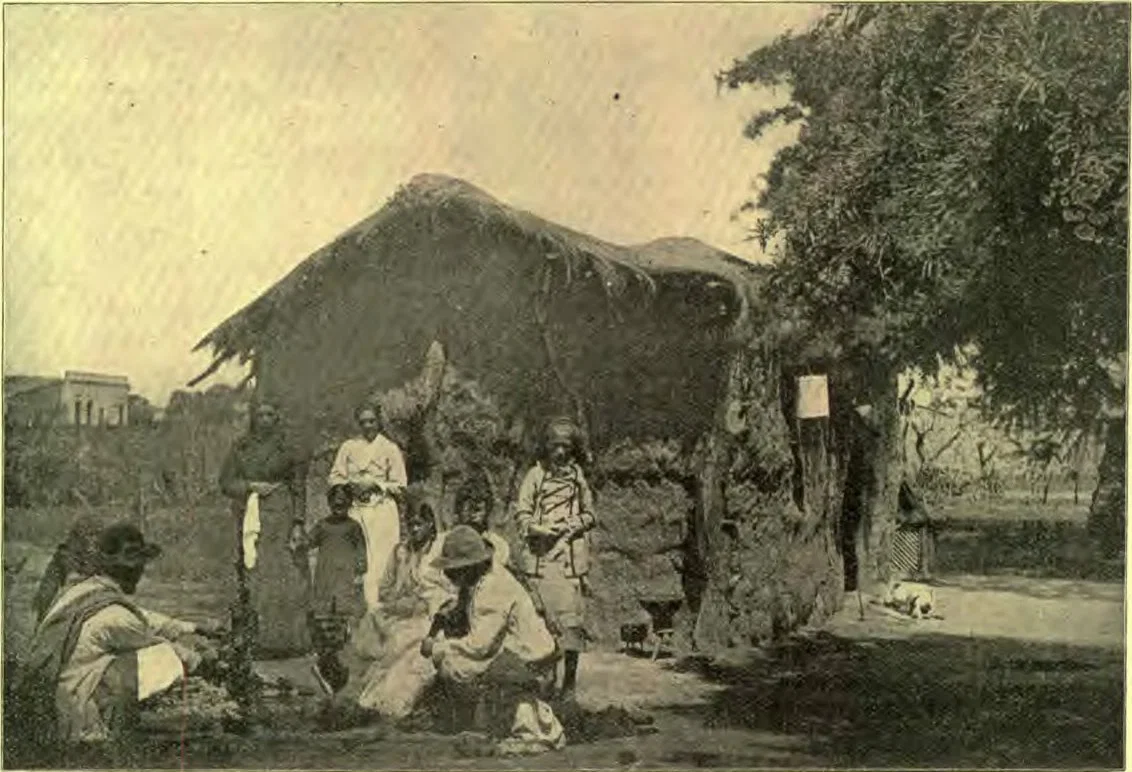
A TYPICAL HOME IN ARGENTINA.
In all this vast country there are only about six and one-half millions of people, one ninth of this number being found in Buenos Ayres, the capital city. If we imagine the population of Pennsylvania to be scattered throughout the States mentioned above, we may get an idea of how sparsely settled is Argentina, and how great are the distances the missionary has to go between towns, villages, and even houses. In setting out from Buenos Ayres, if he has not the money to purchase a cart and horses, he buys two horses, one to carry himself, the other to carry his saddle-bags, filled with books, tracts, etc. After passing the quintas and the gardens of the city’s suburbs, the traveler soon finds himself in an open country, as level as a Western prairie, with nothing to be seen but grass and occasionally a few eucalyptus trees,—mere dots in the expanse,—marking the location of an estancia house, with its galpones, or storehouses. These estancias, or cattle ranches, occupy anywhere from three to one hundred square miles, the main buildings being situated in the center, while the remoter portions are looked after by posteros, or under-shepherds.
The accompanying illustration represents a typical house of one of these posteros. It is usually built by setting in the earth rough posts for the corner and center supports, to which are fastened small poles for framework and rafters. The black earth is then dug up in a circle from two to fifteen feet in diameter. Water is poured on, and thoroughly mixed with the soil by driving mules and horses through it. The addition of fine straw or chaff makes a mud mortar, which is quite adhesive and ready for use. Of this alone the walls are built. On exposure to the sun and air, they become hard and durable. Some, to give the houses a cleaner appearance, apply whitewash. The roof is usually thatched with grass. One of these roofs will last three or four years. The illustration shows a family at their evening meal, consisting of roasted meat, hard biscuit, perhaps a month old, and maté, or Paraguayan tea. The meat, as you will observe, is placed on iron rods set in the earth, around which a fire is made. When the meat is well roasted, each one partakes, cutting it off piece by piece, and eating it without plate or fork.
The missionary, unable to reach the distant estancia house, is glad to find a welcome with the postero; and although his bill of fare is meager, and his bed may consist of nothing more than sheep-skins thrown on bare boards, and his slumbers be often interrupted by the tortures of the too numerous fleas, the hearty hospitality bestowed goes far to atone for the discomforts endured.
On arriving at the estancia house, the missionary may fare better, if entertained by the major domo, or overseer; but frequently the unpopular truth he carries procures for him a cold reception, and he receives no more than the regular fare of the peons, which does not surpass that already described. At sunrise he is on his way toward the next estancia, having perhaps fourteen leagues, or forty-two miles, to travel in order to reach his destination. Passing along the road, which is simply the unbroken ground wired in to the width of eighty or ninety feet, he meets a troop of cattle on their way to Buenos Ayres, five or six mounted peons being in charge. These latter must be out day and night, rain or shine, their only bed being their saddle, which is mainly made up of rugs and sheep-skins bound by girdles to their horses. Proceeding, he soon comes to an almost impassable plan-tana, or immense mud-hole, reaching from fence to fence. The country being so level, rain-water stands in the gullies and low places, and troops of passing cattle churn up the black earth from the bottom, thus making the place impassable, even on horseback. The fence is then opened, and the missionary must pay from ten to twenty cents for the privilege of passing around, over private grounds. For this cause I have paid as much as fifty cents in a single day.
In attempting to reach an estancia house just at nightfall, I once entered by mistake through a gateway leading into a field that gave no outlet to the estancia. Night was coming on apace, so I tied the horses to a fence-post, and set out on foot to the nearest puesto. Fearing the ever-present dogs, I quietly stole up to the door and rapped. A voice from within called out, gruffly, “Who’s there?” Fearing the dogs, I did not reply, but kept on rapping. Finally the door was opened, and I was confronted by a man with a heavy cane in hand and a gun close by. He severely reprimanded me for not conforming to the custom of the country, which is to make your presence known by calling out and clapping the hands; however, on my pleading ignorance, apologies followed, and we soon became good friends.
The missionary has many avenues of usefulness open to him on his route. He may scatter good literature, give advice to the sick, hold meetings, and do what the people need above all,—tell them how to live healthfully, instructing them in the use of fruits, grains, and vegetables. These grow in abundance when cultivated; and it is only through indifference, indolence, and ignorance of their value, that the native subsists chiefly on meat. The missionary must always be cheerful and happy, meeting the people just where they are, without making unfavorable comparisons between their condition and that of those in more favored lands.
May the Lord move on the hearts of many young readers of the INSTRUCTOR to give themselves, with all they possess, to his work in these benighted lands.
E. W. SNYDER.

A MISSIONARY'S SELF-DEDICATION

HERE am I, Lord; send me to the ends of the earth; send me to the rough and savage pagans of the wilderness; send me from all that is called comfort in the earth; send me even to death itself if it be but in thy service, and to promote thy kingdom.—David Brainerd.

MISSIONARY CORRESPONDENCE

II

Perhaps some may think it a very commonplace thing to write a letter. Not so a missionary letter. Like a missionary, it is “one sent on a mission.” It may be sent simply to a discouraged brother or sister; but if that one is encouraged and “comforted of God,” the letter accomplishes its mission—it is a missionary letter.
When writing to a stranger, great care will need to be exercised that the motives of the writer are not misunderstood. State plainly that you wish to call attention to reading-matter sent. Bespeak for it a careful reading. Try to awaken an interest in it rather than in the writer. Let the tone of the letter be frank, and the interest genuine; earnest, but respectful; friendly, but not familiar; cheerful, as becoming one “rejoicing in hope;” short, and right to the point, but courteous, and breathing a true Christian spirit; and withal, clothed with humility. In a prolonged correspondence, let not the Christian standard be lowered by indulging in gossip or sentiment. Let Christ and his truth be ever magnified—self, never.
When introducing unpopular truths, do not crowd them upon your readers. Move carefully and considerately, with Christian kindness. While you may be giving them some new points of doctrine, supplement this, if possible, with something of mutual interest. Sow the seeds of health and temperance. Try to make homes better and purer by your labors. Work for the children and youth. Let the efforts put forth be of so ennobling a character that not only the spiritual, but also the moral and the physical, nature will be fed.
When we consider the wealth of our resources, centered in our various publications, will we not desire to begin at once to place these leaves of leaven in the hearts and homes of the people? We can engage in no higher, holier work than to disseminate the blessed light of truth.
The general appearance of the letter should be neat and attractive. The paper should be free from blots, and should be evenly folded. Unless there is a previous understanding that publications are to be sent to the individual, an introductory card should accompany the first paper, to inform the person who receives it that it is sent free; but he should not be asked to subscribe. With the third or fourth number of the paper, a letter may be sent, and in case no answer is received, the name should be dropped for a time. The character of the answers received will govern future correspondence; but argument should be avoided as far as possible, and the publications should be allowed to answer questions in regard to doctrinal points.
It is doubtless true that we may have a theory of the work, and heads full of “suggestions;” but unless our hearts burn within us with holy fire, and we labor because we love to labor, our efforts will be only as “sounding brass.”
As we engage in a work of love for others, prayer should be the essential element. We should keep uppermost the thought that without Christ we can “do nothing,” but that with him, we can do “all things.” We must not limit the power of God. Let us, as loyal subjects, launch out into the deep, and cast in our nets. MRS. W. C. SISLEY.

MUSIC AND RELIGION

Music is something altogether too vast and beautiful to be expressed in language; it is love in search of a word; it is love seeking to reveal itself. “It is the child of prayer and the companion of religion.” True music is the harmony, melody, and rhythm not alone of sound and tone, but also harmony, melody, and rhythm of the soul itself. Therefore, that which comes from a soul out of harmony with God is not, can not be, true music. Where sin is, there music is not. Sin is not rhythm, it is not melody, it is not harmony: it is vilest discord. And, hence, the farther we remove from sin and the effects of sin, the more closely do we approach to true music, where body and soul blend strangely together, making a true man truer, and a good man better.
Music speaks a universal language, understood wherever there are human minds, felt wherever there are human hearts. And like a rose-lipped shell, “it murmurs of the shores whence it came—the soundings of the eternal sea.” “It is a strange bird, singing the songs of another shore.” “It is one of God’s best gifts to man, the only art of heaven given to earth, the only art of earth we take to heaven.” And it has “such wondrous perfection, such marvelous height of expression, a reach so far above the daily level, that only by transcending earthly capacity could we understand its burden.” It is, we may truly say, not of earth or from earth, but of heaven and from heaven.
The first song of which we know is the song of the morning stars. When the foundations of the earth were laid, the universe sounded forth its joy in one glad anthem of praise, “when the morning stars sang together, and all the sons of God shouted for joy.” That was chorus singing, for the morning stars sang together. It was trained singing under leadership, for they sang together. It was rhythm and melody, musical notes coming in time, for they sang together. It was harmony, chords striking with chords, for they sang together.
And again, when the foundations of the new creation were laid, when the Son of God was born, when the Child of glory lay cradled in a manger, the angels sang above the heaven-blessed plains of Bethlehem, “Glory to God in the highest; on earth peace, good will toward men.” That song was a song of adoration—“Glory to God in the highest.” It was the message of peace—“On earth peace.” It was a song of hope and promised good—“Good will to men.” And so, I take it, our music should be the song of adoration, the song of peace, the music of good will. But adoration, peace, and good will pertain to God, and are the essence of religion. And music, too, coming from heaven, is never so true, so pure, so wholly music, as when it is joined with the thoughts of heaven—when it carries and expresses adoration, peace, and good will.
Blessed are they who with instrument or voice can thus make heaven’s music! But blessed also are they who, if not with instrument or voice, but in the heart, can make melody, as says the word, “singing and making melody in your heart to the Lord.” Such is truest melody, it is truest singing—singing and making melody in the heart. The song and melody of the bare voice and instrument may reach the ear and brain, but the song and melody in the heart and from the heart,—that, and that only, can reach the heart.
Music and religion! Music is of the other life, and it is not truly music unless it be the exponent of that life. How often are we “made to feel with a shivering delight, that from an earthly harp are stricken notes which can not have been unfamiliar to the angels.” As Wagner says, what “music expresses is eternal and ideal.” “O music!” cries Richter, “thou who bringest the receding waves of eternity nearer to the weary heart of man, as he stands upon the shore, and longs to cross over,—art thou the evening breeze of this life, or the morning air of the future?”
The question is not left unanswered. When we read of the glad songs of the life beyond this life, of “the voice of many waters, as the voice of a great thunder, and the voice of harpers, harping with their harps,” singing the grand new song, we know that music is not only the vespers of this life, but the matins of the life to come.
L. A. REED.

Self-Pronouncing S. S. Teachers’ Reference Bible.

CONTAINS the celebrated Teachers’ Helps, comprising nearly 400 pages. Also a complete series of fifteen new maps.
Description. — Imperial Seal Binding, Tuck Edges, known as “Divinity Circuit,” Rounded Corners, Full Red under Gilt Edges.
We offer this Bible, post-paid, for only SIX NEW YEARLY SUBSCRIPTIONS at 75 cents; or TWELVE NEW SIX MONTHS’ SUBSCRIPTIONS at 40 cents.
We will also send it, post-paid, with the INSTRUCTOR one year for $2.25. For 20 cents extra we will stamp your name in gold upon the cover.

QUIZ

  1. What is a missionary letter?
  2. Who can write such letters?
  3. To what details should especial care be given when writing to a stranger?
  4. What about the appearance of a letter?
  5. For whom should work be done?
  6. How should the truth be presented?
  7. Will fine theories insure success?
  8. Whom must we work with?

YOU SAY

You do not believe in foreign missions. Then there are certain other things which you can not believe:—
1. You can not believe that God so loved the world that he sent his Son to save it; or that it is his wish that none should perish, but that all should come to repentance. You deny God’s universal love.
2. You can not believe that the gospel is the power of God unto salvation to every one that believeth. You deny its efficiency.
3. You can not believe that he was the Son of God, or has any claim to your obedience, who said: “Go ye into all the world, and preach the gospel to every creature.” You deny his authority.
For it is clear as noonday that if you believed these things, you would believe in foreign missions.
Unless you find in the gospel something which makes it worthy of being preached to all men, you have not found in it that which makes it of any worth to you. You have missed its meaning. You do not know its power. The root of unbelief in foreign missions is lack of faith in the gospel.—Selected.

Finding God's Will in Times of Perplexity

“Our only business in any perplexity is to find out how God would have us act.”
Continue reading: THE WAY TO SING