JESUS is waiting to be our wisdom. What a precious gift is he! Always near to lead us into truth, to bring to our minds his words, to purify our hearts, to fit us to co-work with himself in saving souls from death.
Filled with his Spirit, we have perfect peace; a comfort in affliction, a joy infinitely more satisfactory than all other pleasures.
Led by our Saviour, we shall be watchful and prayerful, shunning both rashness and timidity. God will not lead us to speak harshly, cruelly, either to or against our associates bought by his divine sin-offering; neither will he uphold us in being ashamed to own himself, his truth, or his work. Let us love to follow Christ, to follow him without cowardice, without presumption, meekly, trustingly in his steps. May we delight to recall his words, his acts, his sufferings!
What a pure language was his! No profane or idle ejaculations, no slang, nothing impure! In his mouth was no guile. No gamblers' expressions, as, “I bet,” “I wager,” “you bet,” could be pleasing to him whose lips “as a fountain of righteousness flow to water, the garden of grace.”
In this life, our Lord leads us into “green pastures, beside still waters.” In the world to come he will lead us forth to “fountains of living waters” through the eternal ages. Glory to him who was given of the Father to be our Leader forever!
Caney, Kan.
When the Birds Come North Again
By Ella Higginson
O, EVERY year hath its winter,
And every year hath its rain;
But a day is always coming
When the birds come North again;
When new leaves swell in the forest,
And grass springs green on the plain,
And the alder’s vein turns crimson—
And the birds come North again.
O, every heart hath its sorrow,
And every heart hath its pain;
But a day is always coming
When the birds come North again.
’Tis the sweetest thing to remember,
If courage be on the wane,
When the cold, dark days are over—
Why, the birds come North again.
—Ella Higginson, in Every Other Sunday.
The Husband and Father as a Companion
By Mrs. M. C. Du Bois
To be happily mated is truly a blessed state; but, alas, how much uncongeniality is seen in married life! A man may be called a good man by those outside his own home. He may also be a “good provider,” but as a companion for wife or child, we may find him sadly wanting in sociability, not at all companionable to her who is to walk life’s journey with him.
The word “companion” suggests a nearness to and for each other that is frequently overlooked. How often a merry-hearted, social, loving girl weds a man to find him cold, glum, unsocial, having no idea of the heart-wants of the one he calls wife! Having provided for her temporal needs, he feels that his duty is done. But as the divinely appointed head of the family, he has social duties which he ought not to ignore.
Let me put before the reader a pen picture from real life: A bright, social, sunny woman marries a man to all appearance as cheerful and social as herself; but she soon finds that she was sadly mistaken. The husband turns out to be a very different man from the wooer. The prize won, he appears in his real nature,—a cold, silent, unsocial man, who will sit for hours absorbed in book or paper, without a word to wife or child. But a neighbor calls, and what a change! He is now all smiles and pleasant words; for he is really a fine conversationalist when he feels it worth while to be agreeable; but with his own family he feels no responsibility to be entertaining. Is it any wonder that the wife is lonely, and that the children wish that they might have company all the while, papa is so pleasant!
Every father ought to find a little time each day to spend with his children, interesting himself in their studies, their amusements, their work. It will not hurt him, whatever his position, to romp and play with the little ones for a few minutes. Have a kiss, a smile, a pleasant word for the children as you pass out to the business or labor of the day.
One of the bright pictures of my early childhood is an evening scene, the open-mouthed fireplace sending out light and warmth, while our father played blind man’s buff with us children. How we would dodge, here, there, anywhere to keep out of his reach! What fun, and how we did enjoy it! Sometimes mother would join in the game, and then was our happiness complete. But when father said, “All now be quiet,” we obeyed without any words; for we knew father meant it, and we were willing to obey him. And when our bedtime came, we were ready, and went to sleep with happy hearts.
Some fathers seem to think any degree of sociability on their part with their children will lessen their power to enforce obedience. I do not think so. A child will obey through fear, but obedience which comes from love and true respect is much better.
There ought to be perfect confidence between father and child, especially between the father and his boy. Boys as a general thing seem afraid of father, and if they have a request to make of him they proffer it through their mother; and too often this is true in the case of the daughter. The children ought never to be afraid of their father. They should have confidence to approach him with love, and not in a spirit of fear.
When this confidence is lacking, it is certain evidence to the father of a serious lack in his treatment of his children. A father should study the disposition of his child; but many a father can tell the fine points of the yearling colt in his pasture much better than he can tell the leading characteristics in the disposition of his ten-year-old boy. Strange, isn’t it? By not being companionable with their children and taking an interest in them, fathers let them drift away from the home moorings, out upon the street, into evil company and sin, and never seem to realize that they have anything to do in the matter.
O fathers, awake to a sense of the responsibility resting upon you! If you have been in the habit of leaving wife and children alone evening after evening, when you could be with them, do so no more. Try to make the evenings at home pleasant. Interest your family, if possible, in entertaining lines of study; sing with them; pray with them; yes, and now and then devote an evening to some innocent amusement; join with them; be one with them. Provide suitable books and periodicals for your family; read with them. Be not so engrossed in business or pleasure that you have no time left to devote to wife and little ones. Make home happy.
With these words from the pen of Mrs. E. G. White, I close this article:—
“There is no danger of belittling the mind by giving due attention to the little things of life. It is of great importance to give attention to acts of politeness. There should be no neglect of speaking soft, peaceable, and encouraging words in the family circle. The habits of the home life stamp an impression upon the character; and if they are after a Christ-like order, they will lead those who possess them to speak words that will be like fragrance, and ascend as precious incense to the throne of God. Where this is not the case, the presence of the angels is not felt in the home.”
—Mrs. M. C. Du Bois.
A Prayer in a Pillow
ONE night the mother of two little girls was away at bedtime, and they were left to do as they would.
“I am not going to pray to-night,” said Lillian, when she was ready for bed.
“Why, Lillian!” exclaimed Amy, with round eyes of astonishment.
“I don’t care; I am not going to. There isn’t any use.”
So she tumbled into bed, while Amy knelt and prayed. The little prayer finished and the light extinguished, Amy crept into bed. There was a long silence; then Lillian began to turn restlessly, giving her pillow a vigorous thump and saying crossly: “I wonder what is the matter with this pillow?” Then came a sweet little voice from Amy’s side of the bed,—“I guess it’s ‘cause there isn’t any prayer in it.”
There is a lesson in this for older ones,— Selected.
The Evils of Drinking
It is a pity that men will put into their mouths that which will steal away their brains, and in the exercise of “rights” be guilty of the gravest of all wrongs. It is drink that makes men mad, and brutal, and vile. It robs and plunders the citadel of the soul of all its precious treasures. It brings man below the level of the beasts of the field, yet men go on drinking and inviting degradation and bestiality. Sam Jones once said, “I’ve seen a man and a dog go into a saloon, and in an hour the man would get beastly drunk and stagger out like a hog, while the dog would come out and walk off like a gentleman.” Even a dog may teach some men wisdom.—Selected.
Teaching Children Hospitality
A CHILD should be so thoroughly imbued with the idea of hospitality that it will be a habit, not a something reserved for special occasions.—Selected.
India
By J. S. JAMES
J. S. JAMES
KNOWING that our brethren are deeply interested in the progress of the work in the mission fields, I take this opportunity to write a few lines. I arrived in this field with my family, Dec. 21, 1906, having left New York November 7. We were favored with a pleasant voyage all the way. Out of the entire month we spent on the sea we were confined to our cabins only three or four days on account of seasickness.
Shortly after our arrival the general meeting convened in Calcutta. The Lord was present by his Holy Spirit at that time in a marked measure, and we all felt drawn closer to him, and to the trust he has placed in our hands. The burden of the meeting seemed to be for the native work and the mastering of the many languages spoken by the millions of this great field.
One item which received serious attention was the circulation of our English literature in this field, of which the Oriental Watchman is the chief representative. While the English-speaking people of this country are but a drop in the ocean compared to the millions of natives, still the Lord has laid upon us the responsibility of carrying the message to them also. This can be done most effectively by our literature, and chiefly the Oriental Watchman, which is our most able minister in India.
It was decided that a special campaign in the interests of the Watchman and British Good Health be carried on from the close of the general meeting till the first of April. This would give us ten or twelve weeks of the best season of the year to cover most of the field with our papers and small books.
Accordingly the field was divided, and fourteen workers were placed in the various parts, and the work was begun. Three workers were sent to the Northwest Provinces and the Punjab, two went into Bengal and western Assam, three went to Burma, two went to southern India and Ceylon, one went into the native province of Hyderabad and south central India, and the remainder took work in and about Calcutta. At this writing (March 3) the campaign is at its height. From the beginning, the Lord’s blessing has been with each worker, especially with those who recently came to this field from America.
From the beginning of the campaign it was my endeavor to issue a weekly letter to all the canvassers, giving their reports and extracts from their letters, in addition to my personal letters. In a field like this, where the workers are so widely separated, these weekly letters prove a source of great encouragement and strength to the workers, and serve to bind us all together in the one great object of the campaign.
I am glad to say that our books find a good sale in this field. In this respect we are not confined to the Europeans, as thousands of the native princes and of the educated classes are able to read English, and subscribe for our books. This field affords opportunity for several earnest, consecrated men to carry on this work on a self-supporting basis. We now have several lady canvassers who are devoting their entire time to this work, and derive their support from it. The time is ripe for a great work to be done in this field with our literature. The message must reach the different tongues spoken in this land in this generation.
Mrs. James and our two boys have been in southern India for two months now. We have been asked to locate at Bangalore, the chief city of the Mysore Province, fourteen hundred miles south of Calcutta. I expect to join them there in a few days, the Lord willing.
As soon as the campaign is over, some of the canvassers will take up the study of the vernaculars in the various parts of India, and some will continue their canvassing work. I will begin on the study of the Tamil language in southern India about April 1. I never enjoyed better health in my life than at the present time. Our children are getting along nicely, and are attending a good school at Bangalore. We are beginning to love India dearly, and we thank God that he has given us a part in the work in this needy field. Our great desire is to learn the language that we may thus be enabled to come in close touch with people as they really are. We desire to be remembered in your prayers.
The Scandinavian Union Committee Meeting
By L. R. CONRADI
L. R. CONRADI
The Scandinavian Union Committee held its annual meeting in connection with the Scandinavian Philanthropic Society at Skodsborg, February 22-25. Besides the leading brethren in Denmark, we were glad to have with us Brother E. Lind, of Sweden; and Elder P. A. Hansen, president of the Scandinavian Union Conference.
As we look over the annual report showing the growth of this field, we surely have every reason to be thankful for the good news we hear concerning it. For years we had not seen any material growth in our most northern field in Europe, that is, in Iceland; but we are glad to report a change this year. Seventeen were baptized in that country during 1906, increasing its membership to twenty-five. Besides these, there are several others who are keeping the Sabbath. Finland also reports twenty-seven additions, and for the first time its membership is over one hundred—103. Norway reports 102 additions, raising its membership to 917; and Sweden had seventy-two additions, making its membership 845; while Denmark had fifty-two added, giving it a membership of 750. The total additions for the Scandinavian Union for 1906 were 270, and the membership of the union, as such, increased from 2,493 to 2,640; and their tithe sprung from $17,037 in 1905 to $20,151 in 1906. Their First-day offerings arose from $227 to $677, in view of their being set apart to the proposed Abyssinian Mission.
There are now in the Scandinavian Union seventeen ordained ministers, twenty-three other gospel workers, and eighty-nine canvassers. The book sales for 1906 amounted to over $44,200.
Last year it was decided to organize the most northern countries in Norway and Sweden into the Northlands Mission field, beginning with Jan. 1, 1907, so that we now have another field started in the Scandinavian Union Conference.
At the time of our union committee session in Skodsborg, we also further considered the opening of the work in Abyssinia, and the cases of several young men were considered as prospective workers in that field. We hope that by the autumn of the present year, definite steps may be taken to open up that large country to the third angel's message. Thus will be added to the mission fields of Iceland and Finland two more missions under the direction of the Scandinavian Union—the Northlands Mission and the Abyssinian Mission. We were very glad that not only was it possible to set aside six hundred and forty dollars for the Abyssinian work from the First-day offerings, but that besides this there was a surplus in the union treasury from tithe that may be devoted to that work.
The union has taken another important step the past year, in opening up a union school, conducted by Elder O. A. Johnson, at Nyhyttan. Judging from the favorable reports we receive, we believe this will undoubtedly lead to an arrangement for a permanent school in this growing union.
As to the institutional work throughout the union, we are glad that there have been general omens of prosperity. The Christiania House has been able to hold its own, and the Swedish and Danish depositories have shown a gain. The Frydenstrand Sanitarium had a slight gain, while the Skodsborg Sanitarium shows a gain of about forty-five hundred dollars.
Considerable time during our session was given to the consideration of the Scandinavian Philanthropic Society, which holds the Skodsborg property; and the by-laws were so changed as to make Skodsborg virtually a Scandinavian Union institution. The committee carefully considered the interests connected with this institution, and we are14thankful to say that the much-needed building at Skodsborg is nearing completion, and it will be open this spring. As there was danger of an objectionable building being erected on a lot too near our Skodsborg premises, it was decided to buy the land that might be used for such a purpose, for it was offered very reasonably to us, and, under the circumstances, we felt free to secure it. This plot of ground will give us ample room to enlarge the sanitarium still further, so that its influence and patronage may be materially increased. The sessions of the committee were conducted in the kindest and most brotherly spirit, and we feel sure that the prospects of the Skodsborg Sanitarium were never brighter than now.
We feel much encouraged at the hopeful outlook for the Scandinavian Union work. The Scandinavian brethren, looking forward with pleasant anticipation to the visit of the delegates from the States, decided to hold their annual session of the Danish and Scandinavian Union Conferences at Aalborg, Denmark, April 24-30.
The Republic of Uruguay
By JUAN MC CARTHY
JUAN MC CARTHY
Some time has passed since we sent in any report of our work; not because we have not had precious experiences, and enjoyed the blessings of God, but because of our being pressed for time.
Since I have been superintendent of the Uruguay Mission, I have had reason to rejoice, and be thankful to our Heavenly Father, for the manner in which he has blessed the efforts of his servants. The results go to prove that God is not dependent upon great talents for the success of his work, but that he can powerfully operate in those who will walk humbly and obediently in the paths which he has laid out for them.
During the year twenty have been baptized, while about thirty have determined to obey the truth. In all our trips we have seen the power of the Lord working upon the hearts of his people, constraining them to embrace present truth. Upon one occasion, while I was visiting a Methodist family, the minister dropped in upon the scene, so I requested him to take a seat and study the Sabbath question with us. This he most energetically refused to do, using as his arguments most unkind words. At last he went away indignant, leaving Gamble's book with his church-member, with which to convince him of the error of Adventism. I also left with this same person a small booklet which I had written and published, entitled, "The Deceit of the Christian Age; or, Is Sunday the Sabbath?" I told him to study
Gamble well, and when through with Gamble, to study this pamphlet, in conjunction with the Holy Scriptures. When I returned in company with one of our brethren, he told me of his determination to keep the Sabbath, since the bottom had fallen out of Gamble's theories, as they were studied in connection with the Bible and Adventist literature. In Mercedes upon that occasion about five persons began keeping the Sabbath.
From there Brother Schimpf and I went to Dolores. There we held meetings day and night, studying with the people often into the early hours of the morning. But hard work done in the strength of the Lord seems sweet, and always brings forth precious results. After a short time, we had the joy of seeing ten souls take their stand upon God's immutable law and Sabbath.
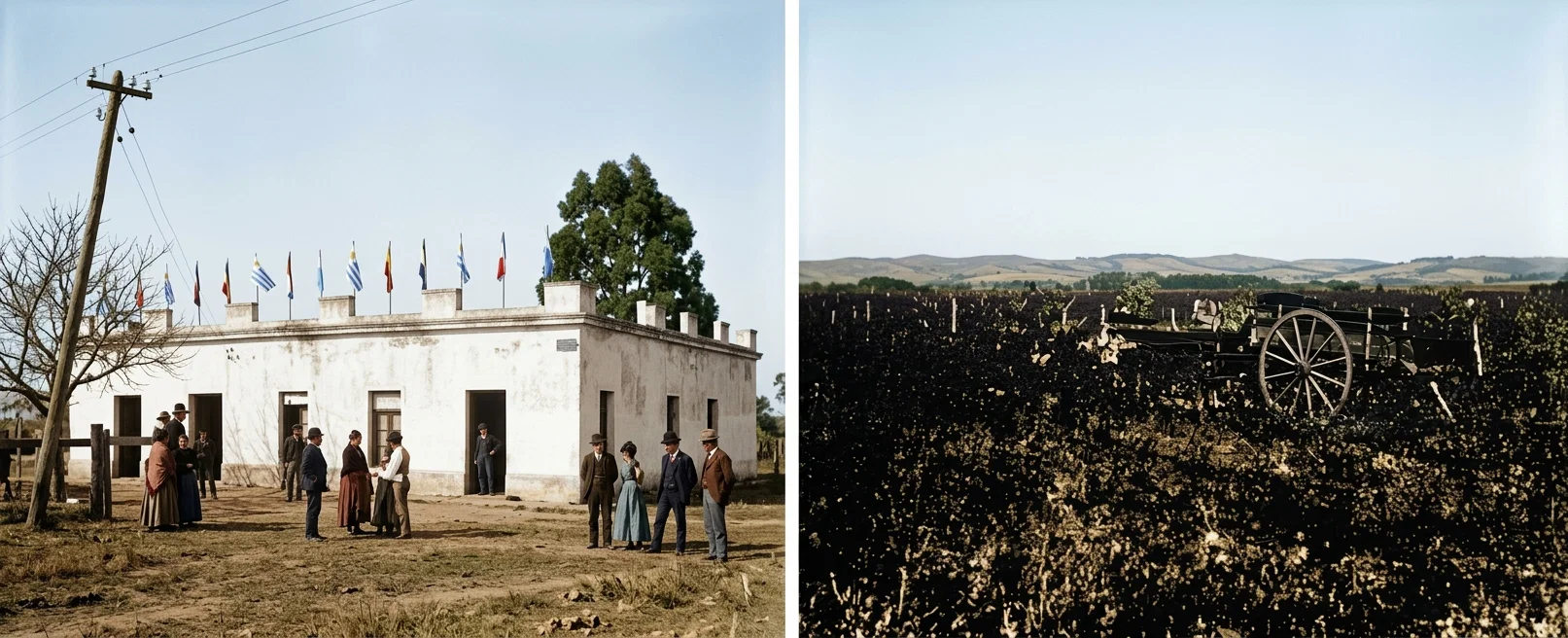
SCENES IN URUGUAY
From here I went to the camp-meeting of the Argentine Conference, at the invitation of Brother Westphal. There the blessing of God came into our midst from the very beginning, and little by little souls were convinced of the solemn truth of the third angel's message preached day after day.
While there, I made the acquaintance of a professor of the Montevidean University. We studied together several points of truth, sometimes until past midnight. He was especially opposed to our position in reference to the soul. Finally he received a tract in Spanish, "The Conflict of the Centuries; or, Is the Soul Immortal?" The next evening, after service, he sent for me, and said that he thanked God for the truths he had found in that booklet; for it had led him to understand the nature of the soul, as taught by God and reason. And he told me that from now on he would make it his business to teach this truth in the university to the students. He is now studying a tract upon the Sabbath. May God open his eyes, is my prayer, since he is one of the most renowned authors in South America, and could do a great work in the cause of truth should he take an uncompromising stand for God.
The other day I met another professor of the normal school here, to whom I had forwarded "The Conflict of the Soul." He told me he was convinced of the truth of our teaching upon the soul, and requested me to send him more literature. Thus we see that little by little the message is finding a place in the hearts of many, and especially of some of the talented and intellectual classes.
Through the sending out of literature and missionary letters many have become interested in the truth, and several have accepted the message.
I received a letter the other day from a young American, whom I baptized at the beginning of the year, but who is now in the Argentine Republic. I had sent him some tracts, which he loaned in the district where he lived. Now he writes to tell me that the Lord has blessed their reading to the salvation of some precious souls. The Methodist minister in that place had read them, after which he wrote me, requesting me to send him all the Adventist tracts I had on hand, which I joyfully did.
We find it sweet indeed to labor for the salvation of benighted souls. The Lord comes so nigh to us, and cheers and illuminates the dreary path.
Thank God, the Uruguay Mission is participating in the bounty of heaven. There has been an increase of seventy per cent in membership; in tithe of one hundred and fifty per cent; in offerings of nearly four hundred per cent. Instead of receiving help from North America, the Uruguayan Mission has been able to hand over to the union conference of South America—independent of Sabbath-school and annual offerings—the sum of two hundred and seven dollars, to be used in the sending out of missionaries to fields where we have no laborers at the present time.
The brethren in Uruguay have large hearts for God's message, and make every sacrifice possible to send the gospel chariot forward. We can not do less than rejoice, because of the victories the Lord is giving his servants. Certainly these are the surest signs that the coming of the kingdom draws near. May God help us to get ready for that day, and so labor as to bring sheaves with us into the heavenly garner is my fervent prayer.
Nueva Helvecia.
The Valley of the Nile
By JAY J. NETHERY
JAY J. NETHERY
WE are still learning more about Egypt. We came to Luxor about three weeks ago, to connect with Brother Awada in helping some of the interested ones. The people in this part of the field have had an opportunity of hearing the truth, since for five years we have had a representative of the message located here. We are glad to report that the seed sown is beginning to grow, as there are four or five who have lately declared that they are going to obey the Lord. Others are still studying, and we are sure they, also, will obey before long. We have been endeavoring to help all to see that the acceptance of the message means a separation from the world and its customs, and that it is most essential for us to understand the reason of our faith from the Scriptures alone.
The needs of the cause are many, as in other places of the earth. The greatest need at the present time is a representative for the medical work. A young man, a clerk in the National Bank of Egypt, told me the other evening that we should have medical workers in different places, as he was confident this was the way to reach the people. He has been reading the London Good Health, and is very favorable to our work, having been acquainted with Elder Wakeham’s efforts.
One afternoon we went to a village up the Nile, to visit a young man and his wife, who are excellent people. He is the station-master, and, of course, is expected to work every day. After studying with them, they felt moved to obey. The wife declared that she would keep the Sabbath, and the husband, with tears, told us that his conscience had been troubled, but if he obeyed God, he would lose his position. It means much here to some to leave the positions for which they have educated themselves; nevertheless we are glad to be able to tell these poor souls that God, who cares for them while in disobedience, will do so for them if they obey. It truly takes faith in God to obey. I am sure the Lord will open the way for these earnest people. They desire to take the nurses’ course, and talked very earnestly about the need of being prepared for the Lord’s coming. I was much encouraged by this visit. The man speaks English quite well. The government schools have done much for the Egyptians, in the way of enlightenment.
On the way to this village, we met a man who speaks and reads English well. He wants to hear more about the truth. As he is a very busy man, being a contractor, he asked if we had some good book explaining our views, as he would like to buy it. I promised to send him “Great Controversy.” This makes me think of the many opportunities there are in more easy fields of putting out our books. I hope our people may continue to take advantage of them while they last. It is not an easy matter to sell books here. Only a very small per cent of the people can read. In this time of the latter rain, we are praying for showers to fall in Egypt.
It is a beautiful sight at this time of the year to see so many green fields. Egypt looks best during the first two months of the year. The air is perfumed by the great quantity of blossoms on the orange, lemon, and other trees. Upper Egypt is very hot during the summer months. Even now the weather is getting quite warm. It was really uncomfortable the other day.
The temples of Egypt are the attraction now. These have been discovered in a state of preservation almost entire. Innumerable are the columns and statues. One palace is especially admired—the temple of Karnak, on the site of ancient Thebes, on the east bank of the river—which may be approached by different avenues. On either side of these avenues are large sphinxes of rare material and of remarkable size.
RUINS OF TEMPLE AT LUXOR, EGYPT
The old temple, with its mammoth pylons, inner courts, most holy places, obelisks, and columns, is beyond description. A hall which, from all appearances, stood in the middle of the temple, was supported by one hundred and twenty columns nine feet in diameter and about fifty feet high. It is impossible to describe the impressions received by one as he passes through these ancient monuments of the work of man. The work of man is nothing, as compared with that of God; but here we have a telling testimony of what the great men are able to achieve, their works remaining century upon century after the builders have passed away.
We visited the tombs of the kings, in the Libyan Hills, across the river from Luxor, which are hewn out of the solid rock, in a valley reached by a winding road. This valley, about four miles from the river, contains the tombs of the kings of the nineteenth and twentieth dynasties, and is called the Eastern Valley. A smaller—the Western Valley—contains the tombs of the last kings of the eighteenth dynasty. These tombs consist of long inclined planes, with a number of chambers receding into the mountain sometimes to a distance of five hundred feet. The most important are those of Seti I, Rameses I, III, IV, VI, IX, also that of the king ruling at the time of the exodus of the children of Israel. We must understand that these tombs were generally prepared by the kings themselves, years before their death. So this latter tomb is no evidence to show that the king was not drowned in the Red Sea, as the Scriptures say. Critics have taken this as an evidence against the inspiration of the Bible, without any reason. New tombs are being unearthed by English and American excavators. On our way back, we reined in our donkeys, and had a look at the Colossi of Memnon. These statues are sixty feet high, each weighing eleven hundred and seventy-five tons.
The temple of Luxor is also very interesting, although not so large as that of Karnak. From here was taken the large obelisk now in Paris. These obelisks are one solid stone, brought down the river from Assuan. The large one at Karnak is ninety-seven feet high. The one in Paris is about seventy-five feet in height.
The glory of Egypt has faded since the erection of these famous works, and nothing can restore it; but, thanks to God, individuals out of such nations can be accepted as subjects of that kingdom which is to be an everlasting kingdom.
Mission Notes
Mission Notes
IN New Zealand, missionaries toiled eleven years for their first convert, but soon could tell of the conversion of an entire nation.
IN August, 1906, an isolated sister living in far Alaska, promised the Lord that she would give one hundred dollars to foreign missions if he would prosper her so as to enable her to give this amount. Since that time Sister Mallory has been sending in small sums, until now the whole amount is paid. She writes that the Lord has been blessing her in this effort, and she already feels amply repaid for the sacrifice she has made.
OF the school in Freetown, Sierra Leone, West Africa, Elder D. C. Babcock says: “Our prospects are bright. Without the least solicitation on our part, the school has grown to over twenty students. Persons at a distance have asked us to take their children and board them. With the addition of several new ones—and some of these advanced students—we have been compelled to get some assistance. A young sister who came from America, and who has had some experience in teaching, will assist Mrs. Babcock, beginning Jan. 1, 1907.”
The Honan Council Meeting
By F. A. ALLUM
The local council meeting for the Honan province was held at Sin Yang Cheo from January 30 to February 5. All the Honan workers were in attendance, and in addition Elder J. N. Anderson and Brother Wilbur were present from Canton. All were glad to welcome Elder W. W. Prescott, who had come to counsel with the workers, and to plan for the extension of the work in this land.
During the time allotted for the meeting, Elder Prescott conducted some excellent Bible studies, setting forth the truths of this message in a new light to most of the workers. Studies on the divine plan of organization were also given, and these were much appreciated. The remainder of the time was given to considering local interests. Reports from the different stations were given and listened to with great interest. It was encouraging to hear the workers recount the varied experiences they had passed through to get this truth started in this dark land. All were of good courage, and eager to press on in the battle until Jesus comes.
Dr. Selmon, in reporting for the Siang-cheng station, stated that during the last month they had treated three hundred cases and five opium suicides, which was the record number for any one month. He also reported an increasing interest on the part of the Chinese to come and hear the truths of this message. Some of those who have recently accepted the truth at his station are those who came there from other missions with the idea of overthrowing the truths of the third angel's message. The result was that they had an experience similar to that of Paul, and now they are rejoicing in the truth which they once tried to overthrow. Thank God for the power there is in the truths of this message.
Brother Pilquist, in reporting for the station at Lo Shan, stated that there were quite a goodly number at his station keeping all the commandments of God. Brother and Sister Pilquist also reported that good work was being done in the boys' and girls' schools which are conducted at their station. After fifteen years of mission work in China, they were of good courage, and anxious to return to their station to take up their duties again.
Elder Westrup reported for the Shang-tsai station. As he had been there only a few weeks, he spoke but briefly, but stated that there was a good interest there, which he and Sister Westrup intended to follow up.
Dr. Miller reported on the publishing work and the opening up of the new station at Sin Yang Cheo. At this place, after a great deal of opposition on the part of the Chinese officials, a good site has been secured for a press building. Building operations have been begun, and we trust that the building for which we have waited so long will soon be completed. The additional needs of the publishing work were also presented, and recommendations were made to the Mission Board for the extension of this branch of the work. These were passed on for the consideration of the general meeting, and will appear in the recommendations passed by that assembly.
As it was understood that the Chinese Mission field was to be reorganized, preliminary steps of a local nature were taken, and a committee of three to deal with local matters was recommended to the Mission Board in America. Dr. A. C. Selmon was asked to be chairman, the other members being Dr. H. W. Miller and Brother F. A. Allum (secretary and treasurer).
This profitable meeting closed on February 5. All the Honan workers then proceeded to Shanghai for the general meeting of the China field which was convened at that place, and the feast of good things was continued for ten days further. F. A. ALLUM.