Your ShelfYour Projects

Review and Herald, Vol. 84, No. 19.

Publishers' Page
Earlier text: The Lord Our Leader

The Outlook

THE outlook for the work in the South is promising. Never before in the history of the Southern Missionary Society were there so many mission schools in operation under its auspices; nor were there ever before so many pupils enrolled in our schools. The work of the mission schools is being unified, and the standard of qualification to teach in them is being raised.
Last year a short institute for mission-school teachers was held in Vicksburg, Prof. J. E. Tenney, of the Southern Training-school; Prof. Alden and wife, of the Nashville Normal and Agricultural College; and Prof. O. R. Staines, of the Oakwood Manual Training-school, assisted Prof. F. R. Rogers, of the Southern Missionary Society, in the work of the Vicksburg institute.
In harmony with a recommendation by the union conference committee, an institute for colored mission and church-school teachers will be held this year at Oakwood, June 6 to July 17. It is believed that this institute will be of incalculable value to the mission and church-school work among the colored people.
The institute will be in charge of Prof. W. J. Blake, principal of the Oakwood Manual Training-school, assisted by Prof. F. R. Rogers, superintendent of mission schools, and a strong corps of experienced teachers. The occasion can not fail to be one of great profit to every one who attends with a sincere desire and earnest purpose to excel in the work of the Lord.
The Oakwood institute will be financed by the Southern Missionary Society. This will be quite an additional burden to be borne by the Society, but it is believed that the results will justify the expense.
So far this year the amount of money coming to the Southern Missionary Society from all sources is much smaller than formerly. Urgent calls for means for other branches of the cause have occasioned a falling off in donations for mission schools and other lines of field work for the colored people. We hope, however, for an increase in the amount coming to this Society through the Self-Denial boxes. It is to these that we must look, largely, for funds to carry on this branch of the Lord's work.
In view of these facts we would urge upon all the importance of assisting the Southern Missionary Society by means of the Self-Denial boxes.
If you have a box, please use it; if not, be so kind as to drop us a card, giving name and address, and we will send you a box and calendar by return mail. We need your help, and you need the blessing that will come to you as a result of assisting this needy branch of the Lord's cause. Address us at North Station, Nashville, Tenn.
SOUTHERN MISSIONARY SOCIETY.

The Beginning of Our Island Work

To-DAY as I was leaving Manila harbor, Philippine Islands, I saw a sight of considerable interest to me—the old “Pitcairn” (“Florence S.,” she is now called), on which I sailed more than sixteen years ago to begin work in the Polynesian mission field. I had heard that she was running among these islands, but as she was away from Manila, I had not been able to see her before. As I passed out of the harbor on the launch, to begin my trip to China, I saw her moored to a wharf on the opposite side of the river.
With the exception of having had her forecastle removed, she appeared just the same as when I last saw her in 1899. My thoughts went back to the many interesting incidents connected with the building, fitting out, and sailing of this ship. Though this enterprise was not so important a move as some others connected with the third angel's message, it was considered at the time as marking an important era in our work. Since the first voyage of this ship in 1899, the truth has been planted in many islands, and to-day there are Sabbath-keepers scattered all the way from Pitcairn in eastern Polynesia to the island of Sumatra, in the same longitude as Bangkok, the capital of Siam. The last two important moves are the location of missionaries in the Philippine Islands and in Java. As I write these words on shipboard in the China Sea, I am on my way to attend a council in Shanghai, China, where the matter of providing literature and helpers for the many thousands of China's sons in the Eastern Archipelago will be one of the subjects considered.
Since the first voyage of the “Pitcairn,” beginning Oct. 20, 1899, several of that missionary company have been laid to rest, and others are scattered as laborers in many lands. Of the first six missionaries, two are in their graves. Of the first crew, the captain (also his wife), two sailors, and the cook are at rest. One of the missionaries is now a doctor in America. The first mate is a successful ship missionary in Rotterdam, Holland. One of the sailors is a devoted laborer in one of the Scandinavian countries; while the remaining sailor is connected with the Loma Linda Sanitarium. The two missionary ladies still living are in America, the location of one being uncertain to the writer, while the other is caring for aged parents in California.
May this good ship long survive the buffetings of winds and seas, because of what she has done in carrying God's last message to the isles that “wait for his law.” E. H. Gates.
On China Sea.

Reminiscences of an Aged Laborer

ALMOST fifty years ago Brethren Sperry and Hart held meetings in the State of Iowa, giving the solemn message of Revelation 14. Afterward some one spoke against their views, so they remained and gave a review of the discourses against them. That review was the first Seventh-day Adventist sermon I heard. Before they had spoken thirty minutes, I settled the question of the Sabbath. I went home and told my wife of the good news, and we kept the very next Sabbath, or at least three fourths of it. For three months we kept the Sabbath from midnight till midnight, not having had the light that the day begins at sundown. In a short time nine accepted the Sabbath. Most of that company are sleeping in Jesus.
A few weeks ago I had the pleasure of visiting Sister Mary Ann Graham Morrow, at Ligonier, Ind., now in her eightieth year, well preserved and strong in the message. As we looked back over the fifty years and saw the progress of the message, the fulfilling of the prophecies connected with these solemn truths, our hearts were filled with gratitude. At that time the good old REVIEW and the Instructor were the only papers we had; the Good Health was next to be printed, then the Signs of the Times. We had no bound books, and only a few tracts. Now we have millions of pages of reading-matter scattered all over the world in many different languages. Then we spent the Sabbath from morning till night studying the Bible. Now the message is made so plain that any intelligent person can learn all these truths in a few weeks, while then it took us years to learn them. Yet, sad to think, the greater the light flashing onto the world, the darker the people of the world are getting, and the more hopeless is their case. The awful increase of crime is because they refuse the light, and the Spirit of God is leaving men. O how sad the thought, in a little while Satan will have the whole world deceived!
My hard-working days are past. I have done what I could in placing this truth in many different places, many times in deep poverty. My wife and six children are buried in five different burial places, many miles apart, waiting for the trumpet call. O blessed hope! We soon shall meet again with many before whom we have placed these precious truths. It would be a real comfort to me to hear from those who are still living and holding onto the message. The only way to keep alive in the truth is by giving it to others. To wear out is better than to rust out. Soon, yes, very soon, the work will close, and while the Lord gives me strength and health, it shall be used in helping the helpless and needy. I thank God for the blessed privilege I have had to work for him.
D. T. SHIREMAN.
Toluca, N. C.

A Visit to Sapucaia, Brazil

JANUARY 31 the writer, in compliance with requests that had been coming for some months, and that had recently become more urgent, started for Sapucaia, a small town in the northern part of the province of Rio de Janeiro, about one hundred and fifty-five miles north of Brazil's capital. A five-hours' ride, made mostly on the Rapids, the through express, brought me to the place, and was rather an agreeable change, as compared with the manner in which I had generally been traveling—on muleback—for the last few years.
Arriving at Sapucaia, a brother who had accepted the Sabbath in Nichteroy, and some friends, met me at the station, and in a little while I got quite an idea of the situation in this new field. I could here see what a blessing our Portuguese Sabbath-school lessons had been to the people, as these lessons during the past year had treated the cardinal features of the message. The people not of our faith studied them with great interest, and, as it were, grew right into the truth.
Arriving at Sapucaia on Thursday at 10:30 A. M., I remained until the following Tuesday. I was sorry then that I was compelled to leave the place so soon; but as the date of the Curityba conference was nearing, and I had been appointed to attend this gathering, I could not remain at Sapucaia longer. I found there a number of persons ready to listen to the preaching of the truth.
Baptists, Presbyterians, and Catholics attended our meetings, all eager to listen to the important truths for these days. During my stay there the time was generally spent—from early morning until late at night—conversing upon the truth, preaching, visiting, and answering questions and objections.
My duties will not permit me to return to this place to do any extended work for months. We hope a native brother, who is planning to shape his work so as to dedicate himself to giving the message, may go there and reap; for certainly the harvest is ripe. Several have already decided to keep the Sabbath; in fact, one brother, a Baptist, was, while I was there, disfellowshipped from the Baptist Church for this reason. A goodly number are deeply interested, and it seems that not only Sapucaia, but other places near by, are ripe for the message; while the brethren in the provinces of Espírito Santo, Minas Geraes, and Bahia are growing impatient to have workers come to their fields and engage in the harvest that is on all sides ready to be gathered in.
Our needs are great, and are ever the same—consecrated men and means. May the Lord send them. To-morrow (February 9) we expect to have another baptism here at Rio, when four souls will be buried with their Lord in the watery grave.
F. W. SPIES. Rio de Janeiro, Brazil.

South Russia

The work here is onward, thank God. The interest is fast increasing among the German-speaking people, and even more so among the native Russians. The South Russian Mission field has now a membership of more than four hundred. The increase of last year was one hundred and forty-six, this mostly from the natives, among whom there is always much work to be done, even after their conversion and baptism. We find many very low morally and physically, in uncleanliness and ignorance, and many can not even read. If we did not have the promise that the mighty Word of truth will cleanse from all unrighteousness, and also the evidence at quite a few places that it can do its work here too, we should feel much discouraged. But by leaning on the everlasting and almighty arm of Jesus, we see the promise of his living Word fulfilled. There is a great work to be done yet in Russia. We need more consecrated workers, to labor especially for the natives.
We do not expect any more liberty than we have at present, and now is our time to work, before harder times shall come. We have religious liberty, but not all the people seem to know it yet, nor to comply with it. A company of thirty believers were stoned and beaten with sticks by a mob of one hundred men, as they were holding their Sabbath meetings recently.
A Sunday law has also been enforced here, since Jan. 1, 1907. Before this, Sunday was always the greatest bazaar (market) day, and stores were open most of the day; but since the first of January there is no bazaar open in all Russia, and stores are open only a few hours on Sunday. Every inhabitant is forced to comply with this. The people in general hail it, as well as religious liberty, with joy, but to us it looks like a queer combination. They say it is order we are going to have now, though we know what the “order” of a Sunday law will end in.
The killing of officers and others by throwing bombs and by shooting, also robbery and theft, are still every-day occurrences. We are not afraid, however; for our lives are in the hands of Him who can subdue even the strongest of our foes.
The Lord must do a mighty work here in preparing his people to stand in the near and severe struggle, which will also be experienced in this country also. Dear brethren, pray for the work in Russia. DANIEL ISAAC.

Spain

At present we are having lively times here in old Spain. One of Valencia’s best dailies, in yesterday’s issue, says: “It is very difficult to picture the social and political state of Barcelona at present. The crisis which exists there is very severe, so much so that we do not remember another like it in the picturesque history of Spanish regions.”
Just last Sunday there was a great demonstration between the Carlists, headed by armed priests, and the Liberals. Quite a number in both parties were wounded.
How clearly these armed priests in politics demonstrate the character of many of those who profess to be Christ’s representatives on earth! It reveals the terrible results of the union of church and state. Jesus declared, “My kingdom is not of this world: if my kingdom were of this world, then would my servants fight, . . . but now is my kingdom not from hence.”
On account of a recent raise of taxes on various taxable products, Valencian customs officials went on a strike. Twenty-five men were brought in from Andalusia, southern Spain, to fill the vacancies. This enraged the Valencians, and as a result, just yesterday the principal custom-houses of this city were burned to the ground.
Strife, commotion, and unrest are the principal characteristics of these times. I am so thankful for that promise, “Lo, I am with you all the days, even unto the end of the world.”
Another of our readers, a Baptist, expects to begin to keep the Sabbath this week. He has given up the use of tobacco. He will lose his present position. Pray that he may prove faithful. Two more of my gentlemen readers told me yesterday that they are determined to obey the truth. May the Lord help them to begin to do so soon, is my prayer.
We are more than ever persuaded that now is the time to herald this message to the eighteen millions of Spain. Who will help us? FRANK BOND.

Help

In behalf of the Young People's Society of Hagerman, N. M., I appeal to our brethren and sisters to whom the Lord has intrusted means for the advancement of his cause in the earth, asking that they help us in our efforts to give the message to the people of this mission field.
We are on the firing line. We are willing to fight; but we are out of ammunition, and more than that, we are out of means with which to get more.
We wish our brethren and sisters to send us clubs of the Signs of the Times, Watchman, or Liberty. We could also use some sets of The Family Bible Teacher, and tracts.
There are thousands of people in New Mexico who are miles from any religious influence. So we ask our brethren to share with us the burden of this great work, that they may also have a part in the reward. Our address is Hagerman, N. M. P. W. Atkinson.

Alabama

BIRMINGHAM.—Four months have now passed since we came to this place, and I am sure that if the brethren of our more favored conferences understood the great need of work and the scarcity of workers here, they would do more for this needy field.
I can truly say the half has never been told. We have all read, no doubt, what the servant of the Lord has said in regard to this field, that the doors are already being closed, and the work is becoming more difficult each year, and that we can not do the work now that might have been done once. Can we rest contentedly while our neighbors, right at our very doors, are going down to eternal death without hearing the message of warning?
We have been told that the time has come to work the cities, and right here in Alabama, as well as in other conferences of the South, are large growing cities that have scarcely been touched. For instance, Birmingham is a large, rapidly growing city—large enough with its suburbs to keep a tent company busy until the Lord comes, and we have no tent at liberty suitable for city work.
Elder Haysmer, president of the conference, has promised to man a tent if we can raise the money to buy it; this will cost at least one hundred and fifty dollars, but the conference is burdened already beyond its resources. Are there not those of our brethren whom God has blessed with means, who have a burden for the Southern work, and who will come forward now and send money to help buy this tent? I believe there are such. Please send all money for this purpose to Helen McKinnon, 1217 Alabama St., Selma, Ala.
C. C. WEBSTER.

The Great Peace Movement

The second meeting of the National Arbitration and Peace Congress consisted largely of addresses of welcome from Mayor McClellan, in behalf of Greater New York, and Governor Hughes in behalf of New York State; also addresses by President Roosevelt and Elihu Root. Among other things Mayor McClellan said, “You can no more secure universal peace by resolution than you can make mankind perfect by legislation.” These are certainly noble sentiments, and should be burned into the hearts and minds of every citizen. The extent that peace is secured in this land, or in any other, will be only to that extent that each citizen will permit the principles of peace to prevail in his life. All true reform must begin with the individual.
The mayor was doubtless speaking from observation when he said that perfection could not be secured by legislation, for the repeated efforts which he has seen exerted to secure moral reforms by legislation have not proved a success. What a blessing it would be if those who are deceived into the idea that moral reforms can be produced by legislation, could be brought to realize the force of the statement made by this prominent mayor!
The address of President Roosevelt, which was read upon this occasion, was doubtless the most important feature of this session of the congress. Although the President is regarded as one of the foremost leaders in the world in the movement to settle international difficulties by arbitration, yet he made it very clear in his address that he does not believe that disarmament would be a feasible thing. The following significant paragraph voices the warning that he gave to the congress against the idea of disarmament at the present time:—
“Harm and not good would result if the most advanced nations, those in which most freedom for the individual is combined with most efficiency in securing orderly justice as between individuals, should by agreement disarm and place themselves at the mercy of other peoples less advanced, of other peoples still in the stage of military barbarism or military despotism. Anything in the nature of general disarmament would do harm and not good if it left the civilized and peace-loving peoples, those with the highest standards of municipal and international obligation and duty, unable to check the other peoples who have no such standards, who acknowledge no such obligations.”
The foregoing words from one who is familiar with the vast preparations for war which are being continually made in this and other countries, certainly does not impress one with the idea that the day is dawning when there will be war no more. The reader can imagine the impression that such statements from a recognized leader in the peace movement would make upon those in attendance at the Peace Congress.
Mr. W. J. Bryan, in a subsequent address, said, in substance, that King Edward of England is a leader in the peace movement, and at the same time England has the largest navy in the world; that in Germany, the emperor is also strongly committed to the interests of universal peace, yet Germany is burdened with its large standing army; and that in the United States, where President Roosevelt is an acknowledged leader in the interests of arbitration and peace, there exists a large navy, which is being annually increased. The speaker confessed that he could not see the consistency of some things. Indeed, these things must appeal to every thoughtful mind as strange and inconsistent; but to those who understand God's Word, they are plain and clear. The Bible plainly teaches that these contradictory conditions would exist, and they are signal illustrations of the fulfilment of God's Word.
Andrew Carnegie, the president of the National Arbitration and Peace Congress, was very pronounced in his opinion that if peace can not be secured in any other way, the nations should be policed and forced to be peaceful.
The prevailing idea throughout the entire congress was not in favor of disarmament, but for less armament. From all that one could gather from the addresses given at this celebrated congress of peace by distinguished speakers from many nations, the outlook for universal peace was not encouraging to those who had been so fondly dreaming of its consummation.
The following paragraph, from the speech of Secretary Root, does not present a very optimistic view as to the results of the coming Hague Conference, which is to convene June 15, 1907. He says:—
“Many lovers of their kind, certain that the principles which they see so clearly ought to be accepted of all men, are unmindful of the many differences which divide the nations in the competition for trade and wealth, for honor and prestige; unmindful that the selfishness and greed and willingness to do injustice which have marked all human history still exist in the world; unmindful that because of these the instinct of self-protection engenders distrust and suspicion among the nations; and they will be sadly disappointed because The Hague Conference of 1907 does not realize their dreams and usher in the parliament of man—the federation of the world.”
It is evident from the foregoing that this great statesman is keenly conscious of the fact that those who are expecting that the coming Hague Conference will usher in the dawn of universal peace will be doomed to disappointment. He realizes full well that there is little hope for a reign of universal peace while selfishness and greed are prevailing in the hearts of men and women everywhere.
One can but feel, when he reads the accompanying statement regarding the true condition of the world, that the Holy Spirit is also impressing statesmen with the meaning of the trend of events in these most strenuous times. It is not strange that people in all classes of society are searching everywhere for peace, for they realize that this world is filled with trouble on every hand.
The people need peace; but they need teachers who will teach them where genuine peace can be found, and the conditions upon which it can be obtained. The words of Jesus should be sounded forth by his servants, that all may hear: “Peace I leave with you, my peace I give unto you: not as the world giveth, give I unto you. Let not your heart be troubled, neither let it be afraid.” The peace which Christ gives can come only with an unconditional surrender of our own will to his.
Another condition of peace is outlined in the words of the apostle Paul, found in Rom. 5:1: “Therefore being justified by faith, we have peace with God through our Lord Jesus Christ.” These conditions are fundamental, and can be brought about only by the regenerating power of the Holy Spirit in the lives of men.
The question, then, of vital importance is, Will you comply with the conditions of peace, and thus hasten the coming of the Prince of Peace, when all sin, selfishness, strife, and war will forever be over? “Wherefore, beloved, seeing that ye look for such things, be diligent that ye may be found with him in peace, without spot, and blameless.”
K. C. RUSSELL.

Buresala, Fiji

On the death of Malachi, Alipati, his step-father, went out canvassing with Matthew, a native preacher, who has lately accepted the Sabbath. Matthew’s people, because he accepted the truth, drove him away from his town, and he and Alipati sold books and preached in a town called Ravi Ravi. After two or three meetings and some visiting, thirty-one decided to keep the Sabbath. Leaving another of our brethren to strengthen the work at Ravi Ravi, Alipati and Matthew then returned to Matthew’s town, Nasukamai. The result was that after a day or two of visiting and preaching, this town, together with two local preachers and some Catholics, also decided to accept the truth. Several in another town have decided, and Matthew is remaining with them to establish them in the message. S. W. CARR.

Portugal

I FIND in sowing the seed in Portugal that it requires some time for the fruit to appear. In Brazil we found everywhere open doors among rich and poor. Men may not accept the truth, but they are willing to hear it. But in Portugal it is not so. It is difficult to get into the homes of the people. They are either fanatically Catholic in religion, or scoffers and unbelievers. It is generally only in the streets and open places that one has opportunity to speak with people and to give out literature.
Recently Brother Rentfro sent for me to come to Lisbon. One young baptized brother had been confused by the opposition of the preachers. The Lord helped us in re-establishing the young man in the truth, and he is working with Brother Rentfro as colporteur. The young man's father and family had been receiving Bible readings from Brother Rentfro, and during our meetings together both father and mother took their stand for the truth. So in December we baptized these two souls in the ocean, at Carcavellos.
Others are deeply interested and are studying the truth, one a Protestant professor, who is studying with Brother Rentfro; and another, a Protestant preacher, who is reading our French publications with the greatest interest. These are some of the interests in Lisbon.
Here in Oporto we hear encouraging words also. A man, wife, and only daughter, who have been Protestants for six years, have accepted the truth. The mother and the daughter have been a special help in our meetings, as both are musicians. We hope soon to see these precious souls buried with their Saviour by baptism. Others deeply interested are attending our meetings and Bible studies. The Lord is at work, and to him we give all the glory.
ERNESTO SCHWANTES.

British Columbia

THIS is an important mission field, being the gateway to the great Northwest Territory of Canada. It was organized into a conference about four years ago, and during the year just ended, has been generously assisted by the Pacific Union Conference. The tithe has increased threefold over the previous year, and the prospects are that the mission will soon be self-supporting. The small band of faithful workers have toiled unceasingly, and there are now about one hundred and fifty Sabbath-keepers scattered over this vast region.
Vancouver is the principal city, with a population of about fifty-five thousand; representatives from all nations are there eagerly seeking the “almighty dollar,” as there is a great boom in real estate.
A good work is being done in house-to-house canvassing. The saloons and restaurants are visited regularly every Saturday night, and an average of fifty periodicals are sold. Personal talks are given, and tracts, embracing points of the message, are distributed. Then every office in the city is canvassed once a month, with Life and Health, Liberty, and Bible Training School.
We also have a missionary society in connection with the church. Much of our valuable literature is being put in boxes in railway depots and car barns, and in other public places. These efforts, watered by prayer, will surely bring a harvest of souls.
One circumstance is worthy of note: Two young men who were driven out of San Francisco by the earthquake, came here, evidently led by the Spirit, as they came to the home of one of our sisters to board. She brought them to church, and eventually they accepted the truth, and to-day are earnest workers.
For several years, those in charge of the conference affairs have had their attention drawn northward. After an investigation was made, a broad and needy field presented itself, the Indian work giving evidence of being no small factor.
Brother O. E. Davis was invited to connect with this department of the work, he being the pioneer seventh-day representative in that section—Port Simpson and Skeena River districts. He made a careful study of the native life and language, and soon was in a position to instruct the many who came to him for help.
The Spirit of God had been working, however, far in advance of any earthly agent, and an interesting history could be written, and perhaps will be in the near future, by the workers themselves. Suffice it to say that at this writing, Henry D. Pearce, a young and influential native, being a lover of God’s Word, was led by the Spirit into the truth on the state of the dead, and with earnestness he began to preach it among the various tribes. Being faithful in the first step, God helped him to take the next, and the Sabbath was to him a precious truth. Now with consecrated zeal, he is preaching the full message, and is a strong support to the other laborers.
Steadily the interest in this field has been increasing; consequently, at our recent conference, plans were adopted that promise rapid development. Industrial enterprises for the education of the natives was the leading feature of these plans. Elder Watson was invited to connect with the work. He has gone to the field, and we believe success will attend this undertaking.
EDWARD C. WIDGERY.
Hammond, B. C.

Field Notes

FIVE young people in Grand Rapids, Mich., were baptized the first Sabbath in April.
THERE were nine admissions to the St. Louis (Mo.) church Sabbath, April 6, five of them by baptism.
ON Sabbath, April 6, the church in Baltimore, Md., received several new members, six by baptism.
A CHURCH of twelve members, recently organized, is the result of meetings held near Temple, Okla., by Brother W. E. Baxter.
BROTHER A. E. FIELD, at work in Oklahoma, reports the baptism of two adults at Bartlesville, and one at Jennings. One of these had accepted the truth wholly through reading.
FROM Denver, Colo., the word comes through Brother G. W. Anglebarger that “the interest in our work is greatly increasing. We have all that we can do in the Bible work, and our services are being largely attended. New ones are constantly taking their stand for the truth.” Several will soon be baptized there.
MERRITTSTOWN, Pa., was recently favored with a two weeks’ meeting by Brother Ned S. Ashton. Knowing that the room could be had but a short time, Brother Ashton endeavored to give the truth clearly from the beginning. The Spirit carried conviction to hearts, and as a result four have begun the observance of the Sabbath.
BROTHER J. R. BAGBY, reporting the close of meetings held by him at Addington, Okla., says: “Fifteen were added to the church—ten upon profession of faith, one who had drifted and had renewed her covenant with God, one who had been baptized but had no opportunity to unite with the church, and three by letter.”

Findings

Brother L. V. Finster, writing from Perth, West Australia, says: “There is a very favorable opening for medical work in this State. If we had a qualified man, we could start the medical work at once. We have one nurse, who is doing Bible work. A doctor must pass through some English or Scotch school to practise here. We would like first to start treatment rooms, and then a small sanitarium.”
Dr. A. R. Satterlee writes regarding the work in the Buffalo (N. Y.) Sanitarium: “We have about twice as many applications as we can receive, and patients are waiting to be entered, one of whom is our nearest neighbor. We are planning to keep the work going as best we can because we must have a full house, where we have so small capacity, to pay expenses. Several who have recently gone home have given us a good reputation, and three we have heard from incidentally of late with a good report. They promise to do their utmost to send others. We are looking for a suitable place in the country, and when we have that accomplished, we hope to have more room and better equipment.”
The following from Dr. A. J. Hoenes, who has been practising medicine for some time in Germany, may be of interest to those who have thought of medical practise in the German territory. I quote from a letter lately received from him: “I would say that an American physician can practise in most parts of Germany as an American physician. He must write upon his sign, name cards, etc., ‘Grad. in America,’ so that he may never be taken for a German graduate. You will see in my letter-head, after my name, ‘In Amerika promov.’ I have often found this epithet rather an advantage. I sign death certificates, perform smaller operations, conduct confinements, etc., and have almost as much freedom as recognized physicians, and in some respects more. Much also depends upon the personal relations, the confidence of the people, and the country medical officer.”
Dr. D. H. Kress and family arrived in Victoria Thursday, April 11, and then went by the way of the coast line to San Francisco, thence by rail to St. Helena, where he was met by Sister White and Brother W. C. White. Here he spent two days with Sister White and family, looking over the work of the St. Helena Sanitarium, then he went to the Glendale Sanitarium, where he spent Sabbath. After that he occupied several days in visiting Paradise Valley and Loma Linda Sanitariums. They then started East, and stayed a few days at the Nebraska Sanitarium and two days at Hinsdale Sanitarium, arriving in Washington Thursday evening, May 2. Dr. Kress will at once take up the work in arranging for the opening of the new Sanitarium, which we hope to be able to dedicate early in June. W. A. R.

Iowa Sanitarium

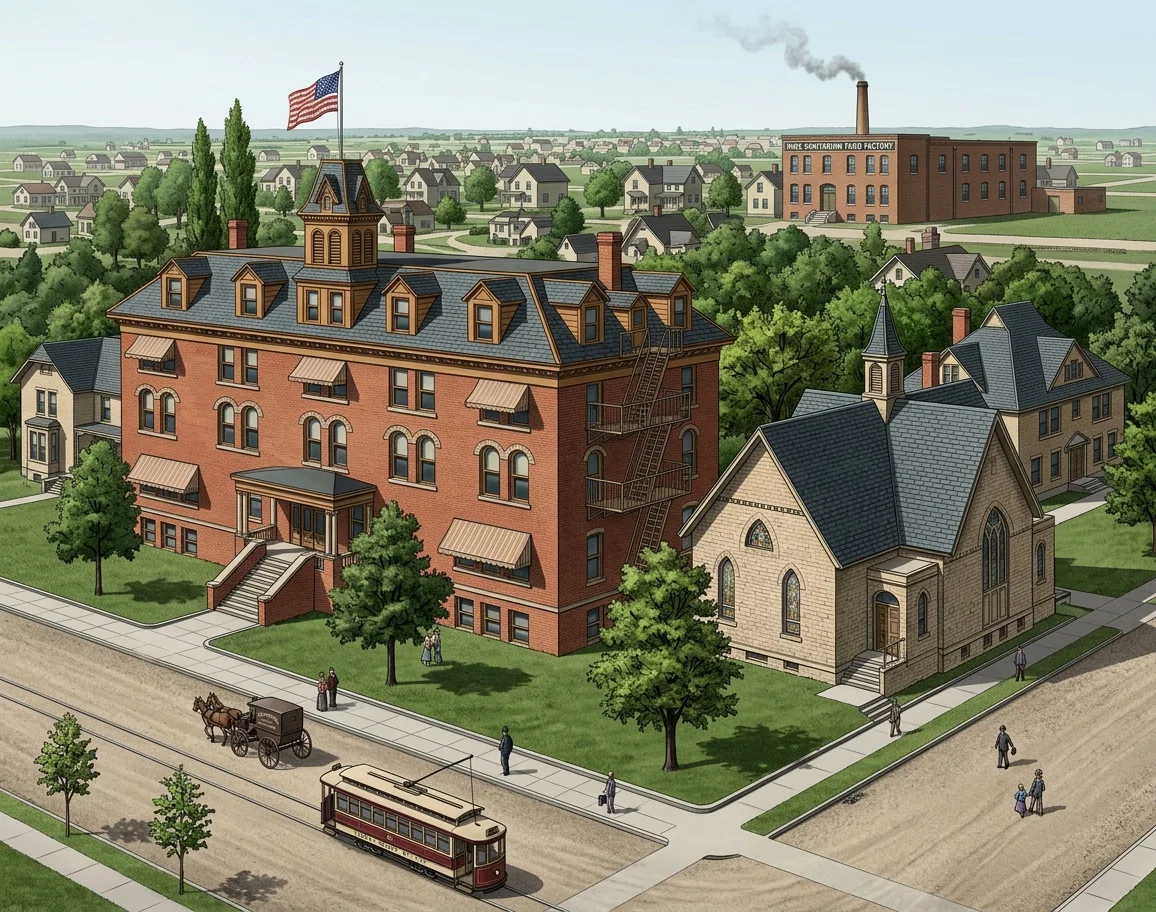
The Iowa Sanitarium, located in Des Moines, Iowa, was built in 1898-99, and opened for work in October, 1899, with Dr. R. H. Habenicht as superintendent. The work looked favorable from the start; and in 1899 the manufacture of foods was begun in the basement of the church, which continued there until 1902, when a new food factory was built.
The work has continued with varied degrees of success, and with several different physicians in charge. Our work has so grown and the “sanitarium idea” become so prevalent that during the past year we have hardly been able to care for our patients. We have been perplexed at times to know what to do, as we could not do our work under present conditions, without overworking our faithful help.
IOWA SANITARIUM
IOWA SANITARIUM
The year just past has been the best in the history of the institution, and the months of this year have been better still.
Very many cases of surgery have come to us; these we have been able to relieve without a loss of life more than one per cent. Many of these cases have been of the most perplexing kinds.
We hope to be able to build a new sanitarium very soon, to care for our work properly, and we are confident that it will be full from the start.
We are very grateful for the blessings experienced and for the success granted us, and wish to give credit to Him who worked for us.
The following is a list of the officers and nurses of the institution:—
H. A. Habenicht, M. D. (superintendent), L. C. Christofferson (manager), Mrs. L. C. Christofferson (matron), Esther Allen, Ethel Boyle, Vera Bowes, Vernon Carnahan, Marie Christenson, Hannah Ferguson, Charles Jones, Tracy Lytle, Agnes Nelson, Cort Nelson, Harry Newman, Austie Pellymounter, Maud Perrin, Meckie Pollard, Annie Rasmussen, Minnie Rasmussen, Lawrence Thompson, Bertha Van Buren, Rhoda Warner, Maud Weller.
H. A. HABENICHT, M. D.

Notice!

SEVERAL hundred information blanks have come into the office in response to a notice inserted in the REVIEW a few weeks ago, but lest some isolated ones should have neglected to report, we ask again that all Seventh-day Adventist medical missionary workers will please correspond with the office and secure information blanks, which they may fill in and return to this office. We wish to keep in touch with all medical missionaries, that we may co-operate with them and receive their co-operation in the great work in which we are engaged. W. A. R.
Continue reading: Nashville (Tenn.) Sanitarium