Your ShelfYour Projects

Signs of the Times, Vol. 34, No. 29.

TAUGHT IN MANY SERMONS TO-DAY
Earlier text: TAUGHT IN MANY SERMONS TO-DAY

The Beginning of the Inquisition in Portugal, No. 4

[The following article in four parts is not from some ancient tome written by some prejudiced Protestant; it is from the Illustracao Portugueza of June 18, 1906, a popular magazine of Lisbon, Portugal. We do not print it because we have aught of enmity or ill-feeling against one single Roman Catholic in this world. We have warm friends among them; we pray for them all. Many of them are Christians, far better than their creed. We publish the article to show a logical outworking and legitimate fruitage of the union of church and state. The members of the Roman Catholic Church are like other men and women by nature—neither better nor worse. If that church had not assumed to legislate and execute for God and demand that the state should submit to her creed, she would not have authorized the Inquisition. The Inquisition was but the logic of the church's claim and demand for power to punish heresy. Let all men take heed. Let those "Protestants" who are seeking religious legislation in behalf of Sunday learn the lesson. The translation of the article is not finished English; it has too much of the idiom of the Portuguese, but it does not misrepresent the original.]
F the person confessed the crimes that he did not commit and asked reconciliation with the church, he saved himself from death when these crimes were not of formal heresy; he remained subject merely to infamy, confiscation of goods, inability to obtain employment in public charges, and appeared in the first auto de fe in a yellow garment with an aspa, or large X marked on the front if he was violent; with half aspa colored dark-red, or cross of St. Andrews if he was vehement; and without an X if he was light suspect.
This sambenito, or escapulario, was the penitential "habit" of the heretics, and differed from that of those who were reconciled or those released to the secular arm. These last, the relapses, the feigned confessed, impenitent negatives, and formal impenitents, appeared in the auto in corocha, or miter, and yellow sambenito with designs of flames of fire pointing downward, if the person was hanged, and burned after death; with flames ascending and figures of devils painted on the "habit" if the person was to be burned alive.
In any of these hypotheses, whether he was reconciled or released to the secular arm, the culprit walked barefoot and with lighted torch in his hand in the procession of the auto de fe. This mournful procession was made with the greatest pomp and display above everything in the sixteenth and seventeenth centuries.
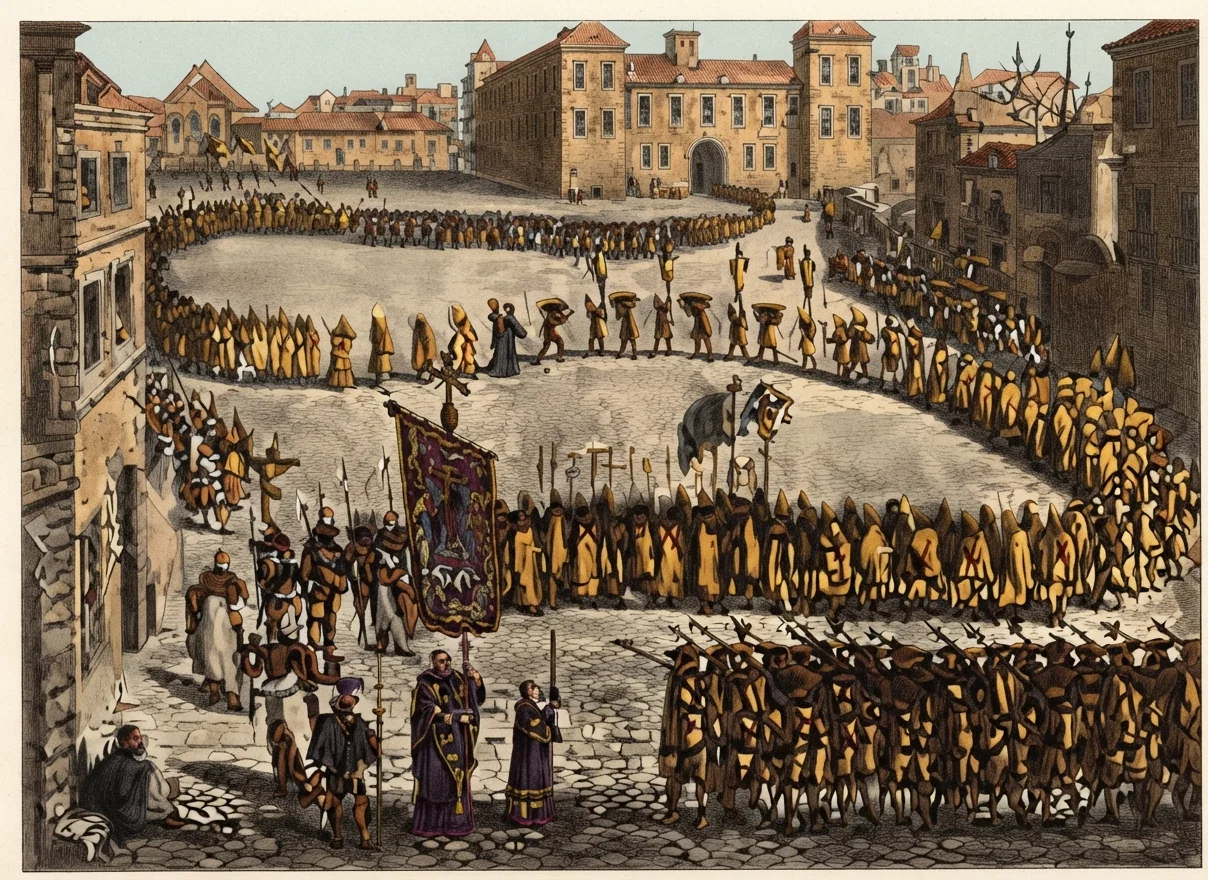
In Lisbon the procession went out of the palace of the estaos, where was installed the tribunal of the Holy Office, and directed its way to the open space of the palace of the Ribeira, where frequently the platform was set up for the reading, by the solemn relator, of the summaries of the processes, in the presence of the king, inquisitor-mor, nobility, familiares, and ordinary judges who had to receive and order the released impenitents to be executed.
A Heretic Going to Die at the Stake.
The cortege was preceded by an escort of harquebusiers and halberdiers, who in the cremating act served to carry wood; following them were the Dominican monks, with raised cross—an enormous crucifix with a bloody and contorted image of Christ; immediately after went the standard of St. Domingos, red, with a figure of the Holy One with a flaming sword; after the standard another crucifix, covered with crepe; the familiares of the Holy Office in black and white, with their long mantles and crosses of the order bordered with gold; the attendants in cloaks and hoods; barefoot penitents in ecclesiastical tunics and corocha bound to the confessors; and last, closing the cortege, the statues of the absent fugitives condemned by the inquisition, and of the relapsed impenitents, or fictitious confessed, dead in prison or in the torture, whose bones, conveniently cleaned of all flesh, followed in small tumbas behind the effigies to be consumed in the fire.
Another View of the Pompous Procession of the "Auto de fe" from the Palace of Estaos in Lisbon.
It was the 20th of September, 1540, in Lisbon, in the square of the palace of the Ribeira, that the first regular auto de fe took place. D. John III and the Cardinal D. Henrique, then inquisitor-mor, assisted. Mass was said. The king, putting his hand upon the Gospels that the cardinal presented to him, purpled and trembling, swore to defend the faith and annihilate heresy. Then commenced the lugubrious ceremony.
The formal heretics and the repentant relapsed, with their yellow samarras, where the cross of St. Andrew opened its bloodied arms, were compassionately hanged, and their bodies thrown into the fire. The final impenitents, non-reconciled, tied to wooden posts upon immense fogueiras, which the soldiers kept stirred up with long pokers and lances, writhed and hoarsely screamed in the flames—to the manifest enjoyment of the king, inquisitors, monks, and people.
There was wind on this afternoon, and the smoke blew away from the sufferers, robbing them of the merciful asphyxia; the unfortunates already had their legs carbonized,—the iron ring that imprisoned them to the post was red-hot,—and still they cried and still they screamed, still they writhed and still they lived!
Finally everything was finished. The last ashes flew over the river Tagus; the last curious one dispersed; the night fell like a black pall upon the feasting city; and among the tapestries of the palace, after the solemn banquet, the king, a bloated and imbecile fanatic, illuminated with evangelical rejoicing, kissed the hand of the chief inquisitor, thanking him for the delight that the first regular slaughter of the new Christians was to the kingdom: "Very contented I was, brother and lord cardinal, for the first auto de fe that thou orderedst."
The Dress Turned Wrong Side Out, Worn by One Who Was Garroted First and Afterward Burned.

A Prophecy Fulfilled.

NOT the least important factor in convincing men of the existence and overruling power of Deity, is the answer of history to the utterance of prophecy. Heaven-inspired prophecy, or the power to foretell correctly future events, is history, written in advance of the occurrence of the events recorded. To dictate true prophecy requires foreknowledge, and not only this, but also power to "work all things according to the counsel" of the One who inspires the prophecy.
Dr. Cyrus Hamlin tells the following story. While he was in Constantinople, soon after the Crimean War, a colonel in the Turkish army called to see him, and said:
"I want to ask you one question. What proof can you give me that the Bible is what you claim it to be—the word of God?"
Dr. Hamlin evaded the question for a purpose, and drew him into conversation, during which he learned that his visitor had traveled a great deal, especially in the East, in the region of the Euphrates.
"Were you ever in Babylon?" asked the doctor.
"Yes, and that reminds me of a curious experience I had there. I am very fond of sport, and, having heard that the ruins of Babylon abound in game, I determined to go there for a week's shooting. Knowing that it was not considered safe for a man to be there except in the company of several others, and money being no object to me, I engaged a sheik with his followers to accompany me for a large sum. We reached Babylon, and pitched our tents. A little before sundown I took my gun and strolled out to have a look around. The holes and caverns among the mounds which cover the ruins are infested with game which, however, is rarely seen except at night. I caught sight of one or two animals in the distance, and then turned my steps toward our encampment, intending to begin my sport as soon as the sun had set. What was my surprise to find the men striking the tent! I went to the sheik and protested most strongly.
The Penitential Dress of Those Burned Alive.
I had engaged him for a week, and was paying him handsomely, and here he was starting off before our contract had scarcely begun. Nothing I could say, however, would induce him to remain. 'It isn't safe,' he said. 'No mortal flesh dare stay here after sunset. In the dark, ghosts, goblins, ghouls, and all sorts of things come out of the holes and caverns, and whoever is found here is taken off by them, and becomes one of them himself.'
"Finding that I could not persuade him, I said, 'Well, as it is, I am paying you more than I ought to, but if you'll stay, I'll double it.' 'No,' he said, 'I couldn't stay for all the money in the world. No Arab has ever seen the sun go down on Babylon. But I want to do what is right by you. We'll go off to a place about an hour's distance and come back at daybreak.' And go they did. And my sport had to be given up."
"As soon as he had finished," said Dr. Hamlin, "I took my Bible and read from the thirteenth chapter of Isaiah: 'And Babylon, the glory of kingdoms, the beauty of the Chaldee's excellency, shall be as when God overthrew Sodom and Gomorrah. It shall never be inhabited, neither shall it be dwelt in from generation to generation; neither shall the Arabian pitch tent there; neither shall the shepherds make their fold there; but wild beasts of the desert shall lie there; and their houses shall be full of doleful creatures; and owls shall dwell there; and satyrs shall dance there. And the wild beasts of the islands shall cry in their desolate houses, and dragons in their pleasant palaces; and her time is near to come, and her days shall not be prolonged.'"
"That's it exactly," said the Turk when I had finished, "but that's history you've been reading."
"No," answered Dr. Hamlin, "it's prophecy. Come, you're an educated man. You know that the Old Testament was translated into Greek about 300 years before Christ." He acknowledged that it was. "And the Hebrew given at least 200 years before that?" "Yes." "Well, wasn't this written when Babylon was in its glory, and isn't it prophecy?"
"I'm not prepared to give you an answer now," he replied, "I must have time to think it over."
"Very well," Dr. Hamlin said, "do so, and come back when you're ready, and give me your answer." From that day to this he has never seen him, but what an unexpected testimony to the truth of the Bible in regard to the fulfilment of prophecy did that Turkish officer give.—Selected.

There Is Hope for the Outcast.

IN the more common use of the term "outcast," it is one who has become an adulteress and by her life cut herself off from general society; or, in the case of men, those who have been guilty of murder, theft, rapine, and the like, until they have come to be looked upon as unfit for society.
Custom makes some sins and crimes appear much worse than others. What man looks upon as the worst may not be so sinful in God's sight; for He judges by the motive that prompted the act, rather than by the overt act alone.
There may be violations of the laws of the civil government which are crimes, yet not sins. And people may commit sins yet not be guilty of any crime in the eyes of man.
"Sin is the transgression of the law"—God's law. 1 John 3:4. It may be a wilful sin, or a sin of ignorance. It may be apparently a very small thing; yet it is sin: "For whosoever shall keep the whole law, and yet offend in one point, he is guilty of all"—condemned by the law. James 2:10.
Our sinful words and actions proceed from the heart. Mark 7:21. The apostle John says, "Whosoever hateth his brother is a murderer." 1 John 3:15. And Jesus said, "Whosoever looketh on a woman to lust after her hath committed adultery with her already in his heart." Matt. 5:28.
Thus we see that these things touch the thoughts and intents of the heart. And naturally "the heart is deceitful above all things, and desperately wicked: who can know it?" Jer. 17:9. None but God, whose word is quick and powerful, and sharper than any two-edged sword, which pierces to its very depth and reveals all its hidden springs." Jer. 17:10; Heb. 4:12. Hence let all come to this word and Saviour; and with the psalmist cry:
"Have mercy upon me, O God, According to Thy loving-kindness: According unto the multitude of thy tender mercies Blot out all my transgressions. "Wash me thoroly from mine iniquity, And cleanse me from my sin. For I acknowledge my transgressions: And my sin is ever before me." "Purge me with hyssop, and I shall be clean; Wash me, and I shall be whiter than snow." "Hide Thy face from my sins, And blot out all mine iniquities. "Create in me a clean heart, O God; And renew a right spirit within me. Cast me not away from Thy presence; And take not Thy Holy Spirit from me." Ps. 51: 1-3, 7, 9-11.
The Saviour says, "Ye must be born again." John 3:7. And when this change takes place, we become "new creatures" (2 Cor. 5:17), and our desires and aspirations are changed.
Many persons in this world have not been so unfortunate as to be overcome by the greater crimes, and thus be thrown behind the bars, or be ostracized by society; and such are inclined to point the finger of scorn at the ones that are down, instead of lending a hand to help them up. And a shame it is, too, that this is especially the case with women toward their fallen sisters, and often with parents when their daughters have been disgraced.
Let me appeal to you, fellow beings and Christians, when you see one "sin a sin not unto death," do not give him a slur and a kick; but with a kind word and a lift help such a one up; knowing "that he which converteth the sinner from the error of his way shall save a soul from death, and shall hide a multitude of sins." James 5:20. Jesus came not to "call the righteous, but sinners to repentance." Matt. 9:13.
And I assure you, dear fallen ones, that even when your father and mother forsake you, the Lord will take you up if you will only seek Him and cast yourselves and your cares upon Him; for "He careth for you." Read Ps. 27:10; 1 Peter 5:7; John 6:37.
God is no respecter of persons. Acts 10:34. But He does respect character, for He "resisteth the proud, but giveth grace unto the humble." James 4:6; Ps. 51:17.
Read the parable of the man that had two sons (Matt. 21:28-32), who represent the two classes: the self-righteous, which pretend to obey God; and the other, which disregard the Lord, but afterward repent and obey. Some who condemn the harlots and other sinners shall at last lose eternal life, while the harlots and publicans who repent will be saved.
"As I live, saith the Lord God, I have no pleasure in the death of the wicked: but that the wicked turn from his way and live: turn ye, turn ye from your evil ways; for why will ye die." Eze. 33:11. "Return, ye backsliding children, and I will heal your backslidings." O, sinner, join in the response, "Behold, we come unto Thee; for Thou art the Lord our God." Jer. 3:22.
In that day when the Lord shall come with the sound of the trumpet, He shall assemble the outcasts of Israel—all those that have made a covenant of peace with Him by a living sacrifice thru faith. Isa. 11:12; 27:13; 1 Thess. 4:16, 17. "Behold, now is the accepted time; behold, now is the day of salvation." 2 Cor. 6:2.
S. H. CARNAHAN.

Liquor Traffic and the State

I VIEW the uncontrolled condition of the liquor traffic as a serious danger. . . . If the state does not control the liquor traffic, the liquor traffic will control the state.—Lord Roseberry, former Premier of England.

Finding Fault

If you find a great many faults, be on the lookout; but if you want to find them in unlimited quantities, be on the look in. -Selected.

A Good Test.

CHRIST presents a perfect life. Now, if when one looks upon that perfect life of Christ, it inspires him with a desire to make his life as nearly like that life as possible, and he strives each day to approximate to that perfection, sorrowing when he sins, not merely when he is caught at it; I say if that is his attitude toward Christ, then I believe that he has been born again. But if when he looks at that perfect example, he tries to find some excuse for not changing his own life, tries to get rid of the authority, tries to get rid of the example, tries to find some excuse for not allowing it to be binding on him, no matter to what church he belongs, he needs a new birth. —W. J. Bryan.

Tearing Down Reputations

“The man who tears down reputations always gets most of the dirt himself.”

Which Shall It Be?

WHICH shall it be, reader,—for you have the power to decide that for yourself,—the word of God or human conclusions?
The Bible is on trial in the house of its friends. Will you witness for it or against it?
In its behalf stand the centuries, filled with witness for the Old Book. Not an empire which has molded the world but is predicted in origin, career, and end, in its inspired pages. Call the roll. Let Babylon, Assyria, Egypt, Tyre, Syria, Media, Persia, Grecia, Rome, America, answer. Each and all have borne witness to the truth of the Bible.
Written in black characters of hopeless doom on the pages of history are the names and fate of those who lifted puny hands against its mighty plans and precepts. Many of these names would have been lost in oblivion had they not been associated with opposition to truth; and now they live only in infamy. Where are Nimrod, and the Pharaohs, and Sennacherib, and Agag, and Belshazzar, and Alexander, and Antiochus, and Herod, and Judas Iscariot, and Pilate, and Nero, and Julian, and Constantine, and the Gregorys, and Voltaire, and Ingersoll? In some way or another all these, and many more, have set themselves against the Rock of the word, but the men are dead; the Rock stands.
On the contrary, there are thousands of mighty witnesses to the efficacy and power of the Book. Many of them did not have all the light; some of them but a few rays; yet the little or much light they had was dominant in their souls, and made them mighty in God. Call a few names from the long roll of the ages: Abel, Enoch, Noah, Abraham, Moses, Joshua, Samuel, David, Hezekiah, Josiah, Nebuchadnezzar, Cyrus, and Daniel, and Nehemiah, and John the Baptist, and JESUS OF NAZARETH, and Paul, and Peter, and John, and Huss, and Luther, and Wesley, and the millions of souls lifted from the sloughs of sin, and cleansed and washed and saved.
Take down the old geography; open to a world-map on Mercator's projection; trace with your finger the countries and zones where the Bible has had free course, and find them all of the best that life on a sick and dying world affords,—enlightenment, equality, beneficence, advancement in all that makes for better, higher living, in contrast with the nations and peoples whose darkness the light has not penetrated, or those other lands where human tradition is preferred to the open Bible. Behold the powers of the Book of God!
In these last days rationalism and "science falsely so-called" are undermining faith in the Old Book. Under the guise of Christian scholarship and higher criticism they are substituting in the minds of men human reason for faith, and human effort for the power of the Spirit of God. Protestantism is losing its power to protest against even the enemies within its ranks.
On the other hand, there are souls longing for something human and certain who are turning to ritualism, tradition, and thru these to Roman Catholicism, in which the word must needs be subverted to the yoke of human decree.
Better the latter than the former. We say it advisedly, better Rome with her consistent, awful creed than anarchy in the religious life, which teaches that God's word means anything or nothing; that the Christian life is the following of the lusts of the flesh, that man is in himself divine, and therefore in himself his own guide.
Thank God, we are left to the mercy of neither of the great human currents. We may reject the hoary tradition of the centuries, sanctioned by a hundred popes tho it be; or the rationalism of German skeptics, tho buttressed by great scholarship; and we may clasp our arms around some mighty crag of the word, pull ourselves from the swirling currents, and stand secure on the Rock of Ages. We may find in Jesus Christ its Giver a personal Saviour, ever near to save and succor, ever with us to the end.
O soul, stand by the Old Book.

Studies in Romans

Christ the End of the Law.

IN the ninth chapter of Romans, Paul has been telling of the failures of Israel, his people according to the flesh, because they had not appropriated God's plan of salvation. Continuing to speak of them, he says:
"Brethren, my heart's desire and my supplication to God is for them, that they may be saved. For I bear them witness that they have a zeal for God, but not according to knowledge. For being ignorant of God's righteousness, and seeking to establish their own, they did not subject themselves to the righteousness of God. For Christ is the end of the law unto righteousness to every one that believeth. For Moses writeth that the man that doeth the righteousness which is of the law shall live thereby. But the righteousness which is of faith saith thus, Say not in thy heart, Who shall ascend into heaven? (that is, to bring Christ down:) or, Who shall descend into the abyss? (that is, to bring Christ up from the dead.) But what saith it? The word is nigh thee, in thy mouth, and in thy heart: that is, the word of faith, which we preach: because if thou shalt confess with thy mouth Jesus as Lord, and shalt believe in thy heart that God raised Him from the dead, thou shalt be saved: for with the heart man believeth unto righteousness; and with the mouth confession is made unto salvation. For the scripture saith, Whosoever believeth on Him shall not be put to shame. For there is no distinction between Jew and Greek: for the same Lord is Lord of all, and is rich unto all that call upon Him: for, Whosoever shall call upon the name of the Lord shall be saved." Rom. 10: 1-13.
"They have a zeal for God, but not according to knowledge." Verse 2. This lack of knowledge kept them in ignorance of God's righteousness; and not having God's righteousness, they sought to establish their own righteousness. That is, they sought to make it appear that they were righteous, when in reality they were not. And this effort to make it appear that they were righteous only led them into hypocrisy. Hence we have the oft-repeated warning of the Master to the self-righteous Jews of His day (and they were the same generation of Jews that lived in Paul's day), "Wo unto you, scribes and Pharisees, hypocrites!"
The continued effort to justify ourselves in any course we are pursuing results in the hypocrisy of self-righteousness, and this course is adhered to only when we are ignorant of God's plan, that we should see our righteousness in Him, and not in ourselves. It is so very easy for self-loving man to try to make himself out all right that he is much more than apt to exaggerate his supposed virtues into a very exalted kind of goodness; and then the way is prepared for him to become the bitterest kind of a persecuting hypocrite. It was such a condition as this that produced the men who were the persecutors of Christ and who finally crucified Him.
The same principles work the same in all ages. If we of to-day neglect God's plan for giving us righteousness thru Christ Jesus, and give ourselves to some human scheme of developing righteousness within ourselves, we will become just like the Jews of old; we will stand ready to destroy Christ and His followers because the Christ-life condemns us. And we will do all this persecuting work while professing in the most pronounced manner that we are the disciples of the Master Himself.
"Christ is the end of the law unto righteousness to every one that believeth." Rom. 10: 4. Murdock's Syriac translation renders this text, "For Messiah is the aim of the law, for righteousness, unto every one that believeth in Him." The Greek word translated "end" is telos, and Liddell and Scott give as their first definition of the word "an end accomplished." Thus do we see that Paul plainly teaches that the end to be accomplished by the law is to lead to Christ, and looking at the subject from the opposite standpoint, Christ is the revealing of the law.
The law demands the perfect life of Christ; nothing short of this will meet its requirements. And so the end, or the object, or the aim, of the law is to have the life of Christ revealed in men. When we see a man doing some piece of work that we may not understand, we often ask the question, What end does he have in view? We mean by this, What does he expect to accomplish? And this text in Romans is just as tho some one had raised the question, What end does the law have in view? and the answer comes quickly that it is Christ for righteousness. See Gal. 3: 24.
The following texts, where the same Greek word telos is translated "end," will serve to show more fully the meaning of the text in Romans:
"Now the END of the commandment is charity out of a pure heart, and of a good conscience, and of faith unfeigned." 1 Tim. 1: 5.
"Ye have heard of the patience of Job, and have seen the END of the Lord; that the Lord is very pitiful, and of tender mercy." James 5: 11.
The "end," or object, "of the commandment is charity out of a pure heart." This is the result that the commandment demands. And to have this charity from a pure heart it is necessary for one to have the indwelling Christ; it is in this way that we meet the aim or object of the law.
Then again: we "have seen the end of the Lord" in His dealings with Job. Not that the Lord came to an end when He had finished with Job, but we see the object that the Lord had in dealing with Job as He did.
It is necessary for us to take an honest and comprehensive view of the Scriptures, else we might reach the hasty conclusion, as some have done, that the text in Romans teaches that the law came to an end in Christ and that we are not bound any longer to observe it. But the same logic that would teach the abolition of the law from Rom. 10: 4 would also teach from James 5: 11 that the Lord came to an end in the days of Job. The Bible is plain enough when we seek to know its teaching rather than to try to make it prove something that we have already in our minds as a cherished theory.
"Whosoever believeth on Him shall not be put to shame." This is a most blessed promise. Believing in Christ will cause us to run counter to many obstacles in this life; we will meet with many trials and difficulties. But in it all we may know that the word that can not fail has decreed that we "shall not be put to shame." This is one of the exceeding great and precious promises that will carry us thru many a dark and trying hour.
T.
Our Bible Band
Our Bible Band

Schedule for Week Ending July 25, 1908.

Sunday July 19 Job 16, 17 Matt. 18 Monday “ 20 “ 18, 19 “ 19 Tuesday “ 21 “ 20, 21 “ 20 Wednesday “ 22 “ 22, 23 “ 21 Thursday “ 23 “ 24, 25 “ 22 Friday “ 24 “ 26, 27 “ 23 Sabbath “ 25 “ 28-31 “ 24

Suggestive Notes.

In this week’s reading we are brought to the close of the interesting discussion between Job and his three friends. They themselves condemned him because of his seeming self-righteousness, but he had no use for their words because he felt that they were condemning him unjustly. Very beautiful indeed are some of these passages in Job. Take for instance a portion of the 26th chapter where God’s greatness and power and wisdom are described. What a grand conception Job had of God’s greatness: “By His Spirit the heavens are garnished; His hand hath pierced the swift serpent. Lo these are but the outskirts of His ways: and how small a whisper do we hear of Him! but the thunder of His power who can understand?” We find no such conception of God’s greatness among heathen writers. Then, too, the 28th chapter is a wonderful panegyric on wisdom. The first part of the chapter speaks of things which man knows more or less about—iron and copper, and silver and gold. These things he can search out; he can cut out channels among the rocks, and the streams that they flow not, but he knows not the place of wisdom. He can neither find it in the sea, nor can he get it for gold. No wealth of the world can equal it. God understands the way thereof, and yet He brings it within reach of man and reveals its secret in that wonderfully simple truth stated over and over again, “Behold, the fear of the Lord, that is wisdom, and to depart from evil is understanding.”
Our readings in Matthew cover from chapters 18 to 24 inclusive. What a wonderful lesson of forgiveness in chapter 18; of the necessity of humility, that humility shown in the person of Christ, in chapter 19; of His longing for fruit from His own people in chapter 21; of the wonderful teaching which all the wisdom and craft of the Jewish doctors could not gainsay in chapter 22; the fearful words pronounced upon those who had rejected all the light and blessing in chapter 23; the great discourse concerning the destruction of Jerusalem, and of His second coming in chapter 24. These are marvelous themes, to which we can not give too careful reading or study.
One of our readers has suggested that our Bible Band members send to the SIGNS just a word stating what passages they have found in the ground they have covered which have helped them most. The editor would like to second this suggestion. It will take no more than a postal card. Send us postal-card testimonies of scriptures which have really helped you and lifted in Christian experience in the ground that we have already covered. How many of our Bible Band that started out in the beginning are continuing and finding blessing all the way? We shall be glad to have some experience meetings in the SIGNS OF THE TIMES a little later in the year. So as we say sometimes in meetings of this kind, let not one wait for another, but let us hear from you, but be short.

The Hope of His Coming.

THIS hope of Christ’s coming purifies the heart of him who truly holds it. So it is expressly declared: “We know that, when He shall appear, we shall be like Him; for we shall see Him as He is. And every man that hath this hope in Him purifieth himself, even as He is pure.” I John 3:2, 3.
It could not be otherwise than this. We will seek to please those we love unless we love self better. The wife who loves her husband will seek to please her husband. She will endeavor to make home pleasant when he comes. She does this almost involuntarily. So it will be with that Christian who loves his Lord. He will not scoff at His coming, he will rejoice to know that Christ will return. He will search the evidences to know whether that coming is near at hand. As evidences multiply, his heart will rejoice as he sees his redemption draw nigh. Luke 21: 28.
He will watch for that coming. He will prepare himself to entertain such a guest. As a loyal subject would renovate, repair, cleanse, and beautify his house, and furnish his best rooms for guest-chambers, if he expected a visit from his prince, so will the Christian prepare his character who looks for his Lord. As he contemplates His coming, his heart will grow purer in his contemplations. The hope of that coming will hallow his joys, and sweeten his cups of trial; and his every fiber will thrill with joy and life at the anticipated meeting.
Weary pilgrim in life’s rugged way, let thy heart be cheered, thy Lord is coming. Soldier on the battle-field, fight on, thy King will soon appear. Not “distant hope nor dim” is thine. The rays of coming morn already streak the east; the Sun of Righteousness is about to rise with healing in His beams. Does the world—worse, do worldly church men—laugh at thy faith, and mock thy hope? hold it fast. Believe still, hope on, love on. In “a little while” “thine eyes shall see the King in His beauty,” thy Friend, Redeemer, Lord. Happy those who can say at that time: “Lo, this is our God; we have waited for Him, and He will save us; this is the Lord; we have waited for Him, we will be glad and rejoice in His salvation.” Isa. 25: 9.
Continue reading: Twice Written