Your ShelfYour Projects

Signs of the Times, Vol. 34, No. 29.

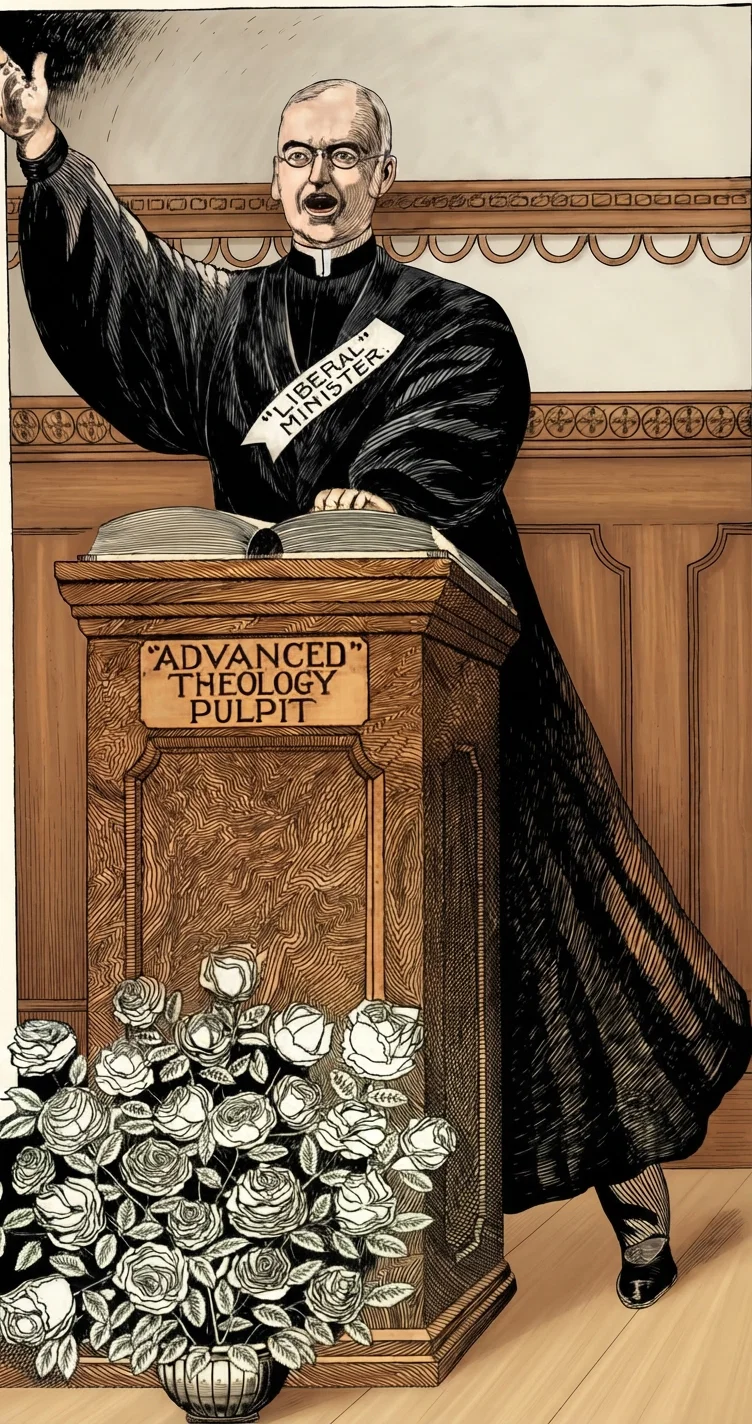
TAUGHT IN MANY SERMONS TO-DAY
Earlier text: Twice Written

Christian Science in the Light of Reason and Revelation.

“If the claims of Christian Science are founded on the doctrines of Christianity and the facts of science, then every lover of Christianity and science should hail the teachings of Mrs. Mary Baker G. Eddy with delight, and accept the claims of Christian Science. If it is not founded upon the word of truth, it should be rejected and exposed.”
With this fair and impartial statement the writer of the pamphlet named above opens a very interesting and instructive discussion of the doctrines set forth in “Science and Health with Key to the Scriptures,” the text-book for all true believers in Christian Science. In parallel columns many full and complete quotations from this book are compared with quotations from God's holy word, the only rule of faith for the followers of Jesus Christ.
Such fundamental truths as “The Creation of Man and the Universe,” “The Existence of Sin,” “The Atonement for Sin,” “The Gospel of Salvation,” “The Miracles of Jesus,” “The Existence of Material Matter,” “Sickness and Suffering,” “Death and the Judgment,” are candidly considered in a way that will please every lover of truth and fair play.
Every one who has any question as to the truth or falsity of the doctrines of Christian Science, in fact, every seeker after truth and light, should give this pamphlet a careful reading.
Fifty pages, printed on fine egg-shell paper, with attractive colored cover. Issued as No. 197, Bible Students' Library. Price, ten cents.
Order now of your state tract society, or Pacific Press Publishing Co., Mountain View, Cal., 61 Park St., Portland, Ore.; 1109 E 12th St., Kansas City, Mo.; Box 666, Regina, Sask., Canada.

The LORD'S DAY

A Brief but Comprehensive Treatise covering the History and Doctrine of the Sabbath and Sunday Controversy from Creation to the Present. Truth supported by Scripture, Historical fact, and Argument. A Multum in Parvo on the Sabbath Question. Illustrated; 128 pp; price, 10 cents post-paid.

The LORD'S DAY

The Test of the Ages

PACIFIC PRESS Mountain View, Cal.

Helps to Bible Study

Helps to Bible Study. A series of Bible-readings, simple and easy, designed as an aid to the personal study of the Scriptures, and adapted to the use of individuals or families; also a valuable assistant for Bible workers. 125 pages. Paper covers, 25 cents; cloth, net, 50 cents. Address this office.

Value of a Father's Companionship

By Emma Hildreth Adams
To the young child there is no pleasure quite equal to that of roaming thru the fields and woods, of taking a trip on a railway, of walking "down town" at evening, of taking a look at the varied animals in a menagerie, of visiting some center where machinery almost thinks and speaks, of turning footsteps toward the house of worship on a lovely Sabbath morning, indeed, of going anywhere or doing anything by the side of a manly, communicative father.
For the father, one half, probably, of life's changeful pathway lies behind him, among the lengthening gray shadows. Before the other it stretches out, and out, now over the flower-carpeted mesa, now up the billowy, green hills, limiting the view before him, now amid tempting orchards and gardens, laden with fruits ofttimes deceptive and destructive.
The one has studied a copious and many-hued lesson-book, with results as lasting as life. By the other, life's lesson-book has barely been opened.
The boy feels this difference distinctly. The broader knowledge, the larger experience, the wiser judgment, of the father draw him, awaken his confidence. The father has learned where are the dangers, the pitfalls and snares, the worse than wild beasts lying in wait for prey. Among them all he is a devoted guide and companion to his child—son or daughter.
And what stands at the doorway of all this care and caution?—It is parental love, which, to the end of life, makes childhood memories as fragrant as sweet violets. It is sympathy, too, welcome to young hearts long before the word mirrors to them the sweet fellow-feeling it expresses.
The father who deprives his children of his society because he is too busy to give time to them, because he dislikes to be annoyed, because he craves leisure, because he finds other company more agreeable, robs them of an inestimable natural right.
As well attempt to foretell the number of blossoms a plum-tree will put forth next year as to forecast the consequences—to children—of dereliction so unmanly. Some of these results, like first-ripe oranges, come early in the season. Others, like the blossoms of the poinsettia—Mexican Flame leaf—may not blaze forth until life's winter sets in. Certain of them may recur daily as does hunger.
Compared with a father of that type, the armed burglar who relieves a casket of its valuable jewels, or a trusted bank president who steals from depositors thru years of unquestioned confidence, were innocent men. Mere theft of money or of rich gems would seem but light criminality beside pillage so heartless.
It is subtracting moral support while the pliant twig of character is making woody fiber. It is depriving a child of that indefinable satisfaction which ever springs from being the companion of one older than himself. It is removing strong example—thru knowledge and experience—before steadiness and firmness of conduct have become the child's own habit.
F. Ittenbach. Madonna and Child Representing Parental Love.
Many fathers omit these prized attentions to their children in their younger years, thinking them too infantile to appreciate such services, but fully intend to be more dutiful in that respect as the little ones become older. This is simply failing to sow seed in spring-time. Can a harvest follow?
Before such fathers are aware, their grave omission becomes a perilous fault. Their unwise course continues until their children have passed childhood and youth. Then, having lived in poverty of fellowship at home, they welcome a life out in the world, and, in some cases, will return to the old fireside only from a sense of duty, or because the mother, with larger foresight, has made herself doubly companionable, and thus draws them with a force stronger than that of the magnet.
Men are not as scarce as cherry blossoms in winter, who think that, having toiled all day in shop, factory, store, or bank, they are free to pass the evening at some hotel, saloon, club room, public reading-room, or at some place of amusement. And this they suppose they do "for the development of their social nature"! Scarcely an hour of the week—except those spent in eating and sleeping—is passed at their own fireside, the one place best adapted, in most instances, to the cultivation of one's social nature.
What is the outcome of such a course?—First, as to the man himself: He turns from the pure joy which should spring from his relationship to wife and children, to the dangerous alloy found in the tempting resorts; he turns away from fine gold to accept baser metal. Just as the hop-vine twines away from the sun, so he winds away from home, the very center, or should be, of social light and warmth.
Yes, and such men, grasping freedom from care for themselves, forge all the more closely strong fetters for their wives. Married life, even when rightly lived, brings burdens heavy enough for the shoulders in partnership. If one pair withdraw from under them, the greater becomes the weight upon the other.
Still more serious is a third aspect of the case: There are children in these homes. The very fact of their presence entails momentous responsibilities. They have set out upon a sea wide and subject to storms. Not one of them understands the art of vital navigation. Each one needs to be taught how to handle an oar or how to manipulate a sail; how to steer by the infallible compass, God's word; how to discern where lie the hidden rocks, and where the devouring whirlpools, and what to do to insure entrance to the haven of havens on life's final shore.
Dropping all figures and illustrations, let us inquire: Have not the children of a household an inherent right to all the help and companionship which the necessary occupations of the father will permit? Have they not a right to the happiness which his added presence makes complete?
The imparting to the young travelers of joy, sympathy, training, example, and support, is the labor and duty of two. It requires the total right influence of father and mother to guard and guide successfully son or daughter. Children are equally the treasure of husband and wife.

California Dates.

About three years ago date-palms procured from the Sahara Desert were planted on the United States farm at Mecca in the Colorado Desert. Already the palms have produced branches bearing twenty poundsor more of the valuable fruit. Last year it was feared that the Salton Sea would overwhelm the date-farm at Mecca, and preparations were made to remove the palms to the vicinity of Indio, where the government bought ten acres of desert land. This, however, proved unnecessary, the flood waters not reaching the Mecca farm. New suckers from the palms at Mecca will be planted at Indio, and, as soon as the trees come into full bearing, a packing-house will be established, and the dates will be marketed.—News Letter.

I Won't Hear Bad Words.

A LITTLE boy in the city who had no nice playyard was sometimes allowed to play in the street. His mother always told him to have nothing to do with boys who used bad words, and Johnny felt as if he must be good when trusted alone.
One day another boy, to whom he had lent his drum, got vexed, and broke out in rude and disagreeable language. Johnny marched right up to the boy and asked for his drum, saying, "I must go to my mother."
"Why? What for?" the children all inquired.
"Mama never lets me play with boys who use bad words," said Johnny.
"Well, I won't use any more bad words if I may play with you," said the boy, sorry to lose the music of the drum.
"I'll ask my mother," said Johnny, "and if she says I may, then I will; but I shouldn't like to learn such words."
"Tell your mother," answered the boy, "I'm done now; she needn't ever be afraid any more of my using bad words, for I won't—if she thinks so."
Johnny's mother watched the children at their play for a time afterward, and she never learned that the boy broke his promise not to use bad language any more.—Philadelphia Methodist.

What a Catholic Paper Says.

DRINKING for the mere exhilaration is madness. We are becoming a nation of paranoics, because we persist in stimulating the mind while leaving the body in languid inactivity. We are getting off every beaten track. We are developing criminals at a tremendous rate. All are graduates of the barroom. We are multiplying our schools; but for every school we put up, there are opened ten barrooms. We are building churches; but for every church that is erected fifty barrooms fling open their doors. We are adding new factories and opening up new branches of industry at an unprecedented rate; but opposite every entrance to a factory, along all the lines and avenues of industry, you see the barroom. These are centers of crime, resorts of the vicious and indolent, the breeding places of riot and lawlessness, the vestibules of the penitentiary. The barroom must go!
The laws are impotent to deal with the evil. We have asylums for the chronically insane. We house and keep them at an enormous cost. But for one person who is chronically and naturally mad, there are ten thousand who make themselves temporarily idiotic and throw themselves into a voluntary and artificial insanity, far more terrible while it lasts than the worst form of mental aberration treated in our asylums. The world is full of widows and orphans, made so by the barroom. The world is full of wife-beaters and murderers, made so in the barroom. The whole moral and industrial world is kept in turmoil and convulsion by men whose parliament is the barroom. The barroom must go.

It Is Not Easy.

To APOLOGIZE. To begin over. To be unselfish. To take advice. To admit error. To be charitable. To be considerate. To avoid mistakes. To keep on trying. To endure success. To obey conscience. To be a clean man. To profit by mistakes. To keep out of a rut. To forgive and forget. To think and then act. To recognize a silver lining. To despise underhandedness. To make the best of a little. To shoulder a deserved blame. To subdue an unruly temper. To maintain a high standard. To accept just rebuke gracefully. To smile in the face of adversity. To value character above reputation. To discriminate between sham and real. But it always pays.

A Plea for an Overworked Organ.

SOME men wonder why they are ill. If they would pause for a few moments before a meal, and consider that the stomach is after all a sensitive organ, and not a mere receptacle into which we may dump anything and everything, possibly they would make such a change in their combinations of foods as would save them many aches and pains. In conversation with a portly looking gentleman one day on the question of diet, we elicited the fact that he had partaken of the following items that day for dinner.
This is not a copy of a menu, but a list of the items selected from a menu by one individual:
Anchovies and oil, macaroni soup, whiting fillet, grilled chicken and mushrooms, peas and potatoes, stewed pears and jelly, four wines, cheese and salad, fruit, cup of coffee, and a cigar.
This was not an extraordinary meal, but a fair, average sample of his every-day dinner, and from personal observation we have no hesitation in saying that such a program forms the average dinner of thousands of city men, who wonder why they suffer so much torture from dyspepsia.
Is it any wonder a poor stomach rebels when it is forced to receive such an incompatible mass of ingredients? The simpler the diet, and the smaller the variety of dishes, the greater will be the happiness and health of the individual.—Selected.

Three Working Rules.

Dr. Edward Everett Hale in his June page in Woman's Home Companion gives three working rules for conduct of life:
  1. Live in the open air as much as you can.
  2. Touch elbows with the rank and file.
  3. Speak every day to some one whom you know to be your superior.

Inasmuch.

BREWERS, saloon-keepers, together with all the agents and advocates of the rum traffic, are unanimous in the assertion that "Prohibition does not prohibit." They ought to know. But inasmuch as Prohibition does not prohibit, why should they bother about it? Why not let the temperance fanatics go their way and do their do? What earthly use is there for them to fight Prohibition, a thing that has in it no harm to them? Why organize, hire lawyers, and spend large sums of money to defeat the enactment of Prohibition laws when the laws can not be enforced? Why did the brewers pull up stakes and leave Kansas? Why are the saloons quitting business in the towns and counties in Missouri where local option has carried?
Inasmuch as Prohibition does not prohibit, it seems so strange that the liquor interests should hate Prohibition so cordially, fear it so tremblingly, and fight it so desperately. —Word and Way.

Contributions and Kicks

"A MAN's contributions are apt to be in the inverse ratio to his kicks."

Editorial and Mission News

The cartoon on the first page and the first editorial article, "Which Shall It Be?" will speak for themselves. We hope the cartoon will be carefully studied. The quotations under the heading "Taught in Many Sermons To-day" are not expressions made up for the occasion, but are taken from sermons actually preached.
He who is in the right can leave the vindication of his cause with God. It matters not what his enemies or friends may think, or say, or do. He may not be able to explain to them his motives, and the very doing of it might place him in a selfish attitude. The safest way, then, at such a time is to let God work out the ultimate and vindicate His own cause, and he who is with God can certainly trust Him to do it.
Despatches from Rome declare that the pope has sent his congratulations to Secretary Taft, wishing him success in his Presidential aspirations. They refer to his pleasant relations to the Vatican in the past, and hope that if he is elected President more cordial relations may prevail in the future. We have not the exact words of the papal message at hand. If any of our readers can give it, in its exact terms, we would like to get it.
A letter from Dr. H. W. Miller reveals the fact that our new mission press in China is fully organized with H. W. Miller, manager; B. A. Roberts, superintendent, and Mrs. Louise Roberts as treasurer. They have gotten out one regular job, besides a few letter-heads; announce themselves as the publishers of The Fuh In Hsuen Pao, which, Englished, is The Gospel Herald. A letter just previous to this tells us that the press has reached there safely, packed in eight boxes; has been put together and is doing good work. Of this we are indeed glad. We believe those whom the Pacific Press gave up for mission service will do good work for the Master.
We have a plethora of matter for our new monthly issue; more, I am sure, than we can possibly use, even tho much of it has been solicited on purpose for that issue. Among the articles we note the following: A striking article on war by the associate editor; "Justice Brewer on War;" "Against Themselves;" showing the reactive influence of religious legislation; a missions article entitled "Toward the End at a Breathless Pace;" "Man's Condition and Need;" "After Death—What?" "Demoralizing Effects of Alcohol;" "The Sabbath in Prophecy;" "Cry of Humanity Against War;" articles on the second coming of Christ and the Sabbath. All these are excellent, helpful, and timely. The cover is a beauty, representing the different phases of truth which lead into the great path of righteousness. We are sure that our readers will be pleased with the number and it ought to have a large sale.
Under date of May 28, Prof. J. L. Shaw, superintendent of our India Mission, sends a most encouraging letter, and tells us how much they appreciate the Mountain Mission Rest-Home, which is not merely a rest-home, but a center of activity for missionary work. The establishment of the rest-home at Mussoorie has made quite a change in the Indian work. They have opened a new sanitarium in the central part of the station, about a mile from the rest-home; and it is meeting with success from the start. They are not able to accommodate those who apply for admission. How much better this will be than to bury workers in the unwholesome atmosphere of Calcutta. It is much easier to invite the sick away from the hot, humid climate to the cooler mountain regions. He writes that they are also holding meetings in the central part of the station three times a week and have a good interest, so that the Mountain Mission Rest-Home is one in which the rest is chiefly found in change of labor. Brother Burgess, he writes us, has had a very serious attack of typhoid fever, temperature running to 105, and life despaired of, but he was brought to the Home and is now improving. Brother Shaw refers to the workers who have gone out from here,—a printer to Mexico, and another to China,—and pleads for a printer for India. He tells us that the workers there are praying for help in this respect. We hope that their prayer may be answered. India is a great field and we know of no place where the consecrated ambition of a good young printer could find a greater field for advancement and service.
The God of the Bible speaks disparagingly of the men who delight in war; men who love to fight their fellows, who desire to destroy and tear down and kill. Some men manifest this with carnal weapons, the use of guns and swords. So the nations in these times, each and all, are preparing themselves for war and battle. But the same principles obtain in the heart of those who desire to combat their fellow men, who war not with principles but with men, who thru fancied slight or grievance, feel that some man or men are responsible, and who are determined to "get even" in some way with those whom they count their enemies, or who have placed obstacles in the path of their ambitions. This may not have been the case with those counted enemies, they may not have had one single thought along this line; they may have simply gone on doing their duty just as they have been during all the years of the past. It is an awful thing to make ourselves the judge of men's motives, and a still more awful thing to place ourselves on God's judgment-seat in administration of punishment. It is much better, and brings, O, so much sweeter satisfaction, to believe that "vengeance is Mine, I will repay, saith the Lord." We commend this text to those who have hard feelings against some one who they fancy has wronged them; and to those who are wronged, we commend that other text: "When He was reviled, reviled not again, when He suffered, threatened not, but committed His cause to Him that judgeth righteously."
The Printed Page in Foreign Lands.—For many years missionaries have realized that one of the most effective ways for spreading the Gospel is by means of the printed page. The living preacher can reach but a limited number of people, but with the Scriptures and books and tracts, one devoted colporteur can place the good news into the hands of thousands every year. The publishers of the SIGNS OF THE TIMES, the Pacific Press Publishing Company, are doing all in their power to extend the knowledge of a soon-coming Saviour in the home field and in the regions beyond. As an indication of progress, note these book shipments: June 29, three thousand Spanish books to Mexico City, Mex.; June 30, thirteen hundred Spanish books to Valparaiso, Chili; July 1, thirteen hundred Spanish books to Guayaquil, Ecuador; July 2, several boxes religious and health books to Shanghai, China, and five hundred Spanish books to Buenos Aires, Argentina. Besides this, tons of books are shipped every week to all parts of the United States and Canada. And it is thus that the message is going.
Health Rules.—Dr. Harvey W. Wiley, chief chemist of the Department of Agriculture, has given out the eight following precepts for the preservation of health during the summer weather. They are as follows: "Eat one fourth less in summer than in winter." "Eat meat in moderation." "Banish all alcoholic beverages." "Eat most largely of cooked fruits and vegetables." "Drink nothing below sixty degrees in temperature, and drink sparingly." "Be careful, and seek the society of cheerful friends." "Practise moderation in eating, drinking, and open-air exercise." "Don't fret; don't worry." He remarks that thousands of persons are made sick in summer because they do not know how to eat; but the same criticism applies to the winter season as well. These rules contain good, common sense. If we were to criticize at all, we would say of the second, Eat no meat at all. It is absolutely not necessary, unless one is ill or needs prescribed diet. Rule five will be criticized by many who think there is nothing like ice-water, which, after all, rarely quenches thirst. The doctor well remarks that moderate eating, moderate drinking, moderate exercise in the open air, and cheerful friends, will keep any good man alive thru the summer; and yet it is better for a man to be cheerful toward others, than to expect the cheerfulness of others to sustain him.
The Priesthood of Christ.—Our Lord is said to be a Priest "after the order of Melchizedek," but never after the order of Aaron or Levi. In other words, He is not a Levitical priest, but a Melchizedek priest. The Melchizedek who met Abraham was not a type of Christ, in the sense of a shadow or figure, but he was a priest in that order, even as is Christ. The Levitical priesthood was a type of Christ's priesthood in service for a sinful world, existing wholly because of man's necessities, having to do with the putting away of sin only, with all that implied, while the Melchizedek priesthood is adaptable to all conditions, times, exigencies. It has respect to conditions and principles, not only as regards the future and past, but all that are to come. Christ hath an everlasting priesthood, and His sons and daughters are kings and priests unto Him forever.

You have reached the end of this edition.

Signs of the Times · Jul 15, 1908