THERE has been much discussion as to the word rendered bittern in the Bible. Some have supposed it referred to a different bird than the one usually known by that name; but the prevailing opinion is that the common bittern is the one referred to. The bittern resembles the heron, but is only four inches in length, and has a less powerful bill. It is pale yellow, spotted with black. It lives by the margins of streams, and builds its nest amid the rushes. It lays seven or eight eggs, of greenish tinge, and the young develop so rapidly that in three days after hatching they are able to follow their parent in search of food. It feeds on frogs and insects, and on vegetables when other food is scarce.
The voice of this bird is something remarkable, considering its size, and is mournful and desolate in the extreme. The lower part of the windpipe, dividing into the lungs, is fitted with a loose membrane, capable of holding a large quantity of air, the sudden explosion of which produces this hollow booming, like the booming of cannon heard through water. It may be heard at the distance of a mile; and so baneful is this sound that by some ignorant people it is regarded superstitiously as the forerunner of evil.
The prophet Zephaniah refers to the bittern in connection with the ruins of Nineveh: “I will make Nineveh a desolation, and dry like a wilderness, and flocks shall lie down in the midst of her; all the beasts of the nations, and both the cormorant and the bittern shall lodge in the upper lintels of it; their voice shall sing in the windows.” Critics have been disposed to dispute the right of the bittern to occupy this place, saying that some other bird or animal must have been intended; but Nineveh was built on the left bank of the Tigris, and from information given by travelers, we know the ruins to have been not without subterranean canals, by which water could be conveyed, making it a suitable lodging place for the bittern. The ruins, now scarcely above ground, might afford lodging places for the bittern upon the upper lintels and windows. Isaiah refers to the bittern as finding habitation amid the waste places of Babylon, whose garden canals, leading, no doubt, from the river, may well be imagined to have watered the country long after it had been made desolate, and afforded nourishment to vegetation and attractions for the bittern: “I will also make it a possession for the bittern.”—N. Y. Observer.
A SHINING LIGHT.
The Bible says, “The path of the just is as the shining light.” In the vaults of the Pantheon, in Paris, there is a monument to the memory of a learned man of the last century. The design is that of a coffin, through the half-open lid of which appears a hand holding a light.
What meaning do we gather from this symbol?
Surely that the good and wise leave behind them a light to guide others.
Nor is it the great alone who can leave this light behind them; a little lamp may beam from many a grave, where lies perhaps only a humble person, or a little child,—the smallest of God's servants, who has tried faithfully to do his will on earth.
The Virtue of Cheerfulness
There is no greater every-day virtue than cheerfulness. It is like sunshine to the day, or gentle, renewing moisture to parched herbs. Be cheerful always. There is no path but will be easier traveled, no load but will be lighter, no shadow on heart or brain but will lift sooner, in the presence of a determined cheerfulness.
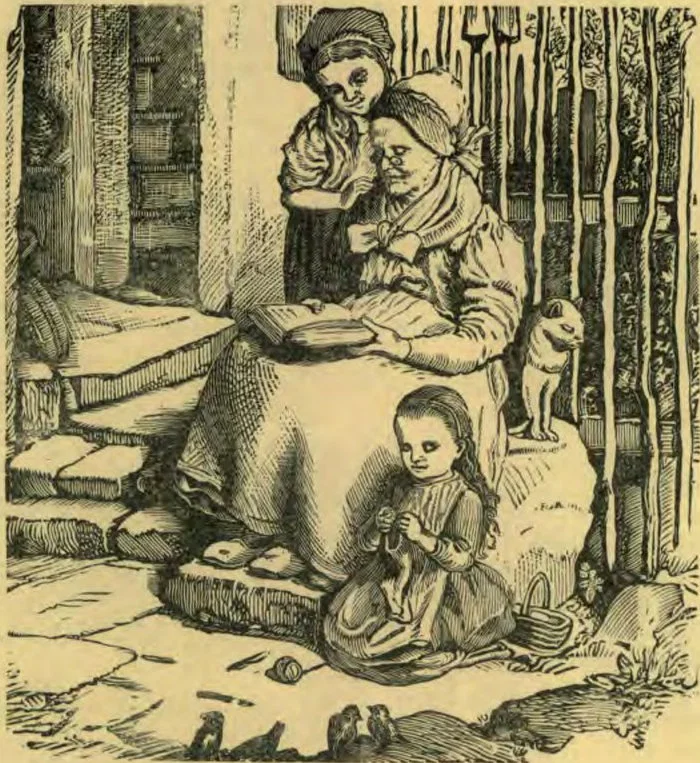
WHO FEEDS THE SPARROWS.
Little brown sparrows upon the tree,
Sweetly chirping in your glee,
Where will you get your breakfast, this morn?
“Tu-wee! tu-wee!
Tu-wee! tu-wee!”
Frozen the meadows, this wintry day,
Not a worm nor a bug do I see.
Where will you get your dinner, at noon!
“Tu-wee! tu-wee!
Tu-wee! tu-wee!”
Not a crumb anywhere, nor a leaf;
Stripped of fruit is every tree.
Where will you get your supper, at night?
“Tu-wee! tu-wee!
Tu-wee! tu-wee!”
Then with a rush, with a whir of wings,
Every breast from worry free,
Rising they soar, and each one doth sing,
“My Heavenly Father,
He feedeth me!” —Our Little Ones.
The Spring Is Come: A Poem of Renewal
THE spring is come, the spring is come;
Tell it out o’er earth and sea,
Until it wake the dead to life,
And set the ice-bound captive free.
Sound it out in joyful strain
That merry spring is come again.
Over meads and rocky mountains,
By the river, by the rill,
Out among the forest depths,
Where all around is sere and still;
Tell it loud, in joyful strain
That cheerful spring is come again.