The Youth’s Instructor, Vol. 30, No. 13.

THE SHIP OF THE DESERT

The Youth’s Instructor

Mar 29, 1882

S. D. A. Publishing Association · Battle Creek, Mich. · Mar 29, 1882

THE SHIP OF THE DESERT.
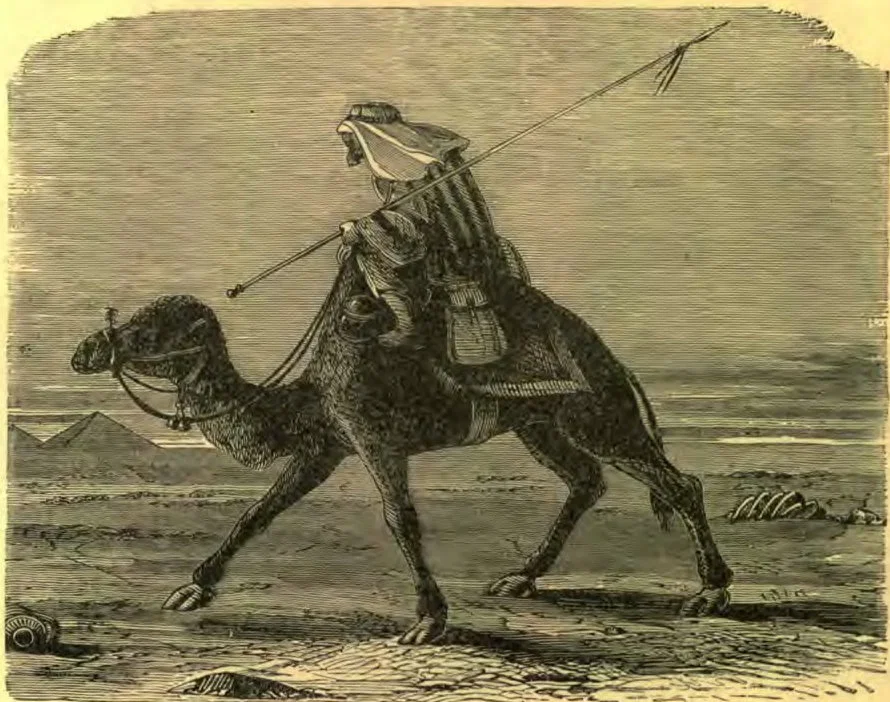
Ships that make long voyages have rooms in which to lay up food, and tanks to contain water for use on the voyage. So has the desert ship, a picture of which you see. This ship crosses land instead of water. A country of plains of burning sand, and of mountains just as parched, with only rocks instead of trees, without water and without grass, over which you might look as far as you could see, and not meet with a single living being or anything to show that any one had been there, save, perhaps, some scattered bones, telling a story of hunger and thirst and death! Over such a land as this, the ship of the desert takes its way.
The Arabs gave the camel this name, for without him they could not safely cross the deserts, nor escape their enemies when attacked. The camel was born for the desert, and its features, that look so homely to us, when we study them, seem beautiful in their usefulness. That strange-looking hump is, when the animal is well fed, filled with fat; and when he has been traveling for many days with but little to eat, he draws food from this store-house enough to keep him alive for some time; so that, at times, on long and painful journeys, the fat is used up and the skin falls over like bags on each side, and there is hardly any hump left. He has also, it is said, the power of laying in store, at one time, enough water for thirty days. For this purpose there is a large cistern within him, from which, when he wishes, he draws what he needs, and pours it into his stomach. He feeds on the coarsest food, that a horse would not touch, such as thistles and thorns.
In Turkey, Persia, Egypt, Arabia and Barbary, all kinds of goods are carried by camels. The wild Arabs often attack travelers, and to avoid them, merchants and others about to cross the deserts, join themselves together in caravans. These caravans have always more camels than men. Each camel is loaded according to his strength; the larger ones carrying from a thousand to twelve hundred pounds weight, and the smaller ones from six to seven hundred.
The Arabs say that the dromedary will keep up a hard trot for twenty-four hours, and then having swallowed a ball or two of paste made of barley, and a little powder of dry dates with a bowl of water or camel’s milk, will seem as fresh as ever.
If the camel’s feet had hoofs like those of the horse, they would soon become parched and cracked while going over the desert; but the feet are very large, and the under part is covered with a long, tough, and yielding skin, which helps them to go easily and safely over dry, hot, stony, and sandy places. On top, the feet are divided into two parts, the ends of which are guarded by small hoofs. There are seven different kinds of camels, but the Bible speaks of but two,—the Arabian camel, or dromedary, of which we have a picture, and the Bactrian camel, which, unlike the dromedary, has two humps instead of one.
The dromedary is the swiftest, but not so strong as the two-humped camel, which is used more for burdens. The height of the dromedary, from the top of the bunch to the ground, is about six feet; and from the head, when it is raised, to the ground, is about nine feet.
The camel is trained to hard work when very young. His master throws a stout cloth over his back when he is kneeling, and on each corner puts a heavy stone. When the young camel can lift this easily, heavier weights are put on; and when he is used to these, the trainer places a large saddle on his back, loads it, and takes him out into the desert.—Little Christian.

A BITTER MEMORY.

A LITTLE more than a hundred years ago, a strange spectacle was presented in the market-place of the small town of Uttoxeter, England. A venerable man—a man whose ability and learning were the glory and pride of the English nation, and whose fame was world-wide—was seen standing an hour, with his gray head uncovered, while the rain poured down upon him.
Those of my young friends who have read the life of the famous Dr. Samuel Johnson will perhaps recollect this circumstance, and understand its meaning; but for the sake of those who do not, let me say that Dr. Johnson was the son of a poor book-seller. This father labored very hard to provide for his family. On market days he was accustomed to carry a package of books from his home in Litchfield, to Uttoxeter, and to sell them from a stall in the market-place. One day he was sick, but knowing he could ill afford to lose the profit he had hoped to make, he requested his son Samuel to go and sell the books in his place. Samuel, like many another silly boy, thought himself too much a gentleman to do the work his father had been willingly doing in order to keep him in school, and he refused to obey.
Fifty years afterward, when he had become a distinguished author, the compiler of the English Dictionary, and the greatest scholar in England, he remembered this act of disobedience and unkindness to his affectionate and hard-working father, with so much shame and sorrow that he determined to give a public proof of his penitence, that might be a lesson to the young wherever his name should be known. He accordingly went to the market-place on a market-day, and on the very spot where the book-stall had been, he stood with head uncovered, in the pouring rain. “This,” he says, “was an act of contrition for disobedience to a kind father.”
We hope the time may never come to any of our young readers when the memory of disobedience and ingratitude will embitter every earthly joy. Fame and fortune may be offered in vain as an atonement for a careless word.—Little Star.

HE LEADS US ON.

He leads us on By paths we did not know; Upward He leads us, though our steps be slow. Though oft we faint and falter by the way, Though storms and darkness oft obscure the day, Yet, when the clouds are gone, We know He leads us on.
He leads us on Through all the unquiet years; Past all our dreamland hopes, and doubts, and fears, He guides our steps; through all the tangled maze Of sin, of sorrow, of o'erclouded days, We know his will is done; And still He leads us on.
And He at last, After the weary strife,— After the restless fever we call life, After the dreariness, the aching pain, The wayward struggles which have proved in vain, After our toils are past, Will give us rest at last.
— Rock of Ages Library.

A WOOLEN FACTORY.

Not long since, while passing down Front Street of one of our beautiful Western towns, the noise from a large four-story brick building attracted my attention. I found it to be a woolen factory, where all kinds of woolen goods are manufactured. One hundred men, women, and little boys are daily employed. The building is situated on the Des Moines River, across which, just above the factory, is a large dam affording the water power. Just below the factory a bridge 900 feet long gives the country people on the other side of the river town privileges.
But about the building. As I said before, it is four stories besides a basement; and in one room of this is the monstrous engine, which keeps all the machinery in the building in motion. Into one of these basement rooms the wool is brought just as it comes from the sheep's back; and here two men were employed in washing, drying, and dyeing it.
In another room a man was sprinkling the wool with oil, in preparation for carding. Great baskets full of this prepared wool were carried above, where little boys from ten to fourteen were picking, sorting, and weighing the wool, then placing it upon large rollers which, in turning, passed long cards. These soon passed it off in long rolls, which, after being wound upon great spools, were carried to another room, where they were put upon large spinning machines. Upon each machine were from two hundred to two hundred and twenty small spools. Each machine was tended by a young man, and there were seven machines; so that while the old-fashioned spinning wheel was turning off one spindleful of yarn, these seven machines would fill over fourteen hundred. These spools, after being filled, were piled in a large basket, and part of them carried to the third, and part to the first, floor.
In the third story the yarn was taken from the spools and reeled upon a mammoth reel, where about twelve skeins were reeled at once. These skeins were then handed to another woman, who twisted them, packed them in bunches, and tied them ready for sale.
The yarn taken to the first floor was for the warp and filling of woolen goods. Here were three long rows of looms just like the old-fashioned looms, only all of iron, and the shuttle was thrown back and forth by the machine. A woman stood before each loom, to see that all was right, and change the yarn for the different colors. One woman had made a mistake which was causing her much trouble, and wasting much material. As I watched her busy fingers rectifying the mistake, I thought, How like life! Often on account of carelessness we make mistakes that it takes many days of sorrow to correct. In another room there were three machines for stretching, drying, and dressing the cloth, after it was taken from the loom. In this room were two desks at which young women were picking knots from the cloth before it was dressed. Here also the cloth was folded in great bolts, tied with pink tape, and piled up ready for transportation. Just across the street is a large building where the goods are stored.
This is only a poor description of all we saw as we passed through the buildings, but it perhaps will give some idea of how much work it takes to make the nice woolen cloth that we wear so much.
MRS. I. J. HANKINS.

WINTER IS OVER.

UP in the tree tops the young buds are blushing; They doff their green caps in the presence of Spring, Bending like children with smiles on their faces, To hear the sweet message her errant winds bring. Robin sings bravely, and where the pool sparkles, Shimmers and shines through its fringes of fern, The chatterbox black-birds are noisily splashing; Like stars in the marshes the buttercups burn.
The leaves on the boughs softly whisper together, The brown fields in furrows expectantly lie; They wait till the tiny germs, under them stirring, Shall break from their prison and laugh at the sky.
Now in the sunshine, and now in the shadow, On airy wings glancing, the glad swallows soar; The gold burdened bee, tired of winter’s long dreaming, Tells all the flowers that the winter is o’er. —Mary H. Krout.

THE YEAR 1844.

Among Adventists, the year 1844 is a very important year; and our youth often hear those who lived at that time allude to the ’44 movement as a time of intense interest. It was during the same year, in a land for various reasons entitled to a place among the first of the civilized nations, that a movement of an entirely different character took place, which I will very briefly describe.
From the 8th of August to the 6th of October, 1844, there was exhibited in Trèves, Rhenish Prussia, what is pretended to be the seamless coat of our Saviour, mentioned in John 19: 23, 24. This was said to have healing virtue, so that sick and impotent folk need but to look upon or touch it in order to be healed. This exhibition occurs only once in fifty years.
At this time, at least ten hundred thousand believers came from all parts of the world, especially from Germany and France, to worship by doing homage to the garment, or to be healed. Daily you might have seen the streets crowded by processions of pilgrims, usually marching two by two, and chanting, in monotonous measure, some litany of the church.
Day after day, too, in the square in front of the cathedral are congregated eager throngs, who are seeking a blessing. The priests tell them that articles of wearing apparel, such as ribbons, hoods, aprons, handkerchiefs, etc., having come in contact with the holy coat, are consecrated and sanctified thereby, and become of virtue in effecting cures or as a protection against disease. Representations of the coat in silk or on paper are at hand also, for which the same virtue is claimed as for the holy coat itself. Medals are struck, with the image of the coat on their face. These various trinkets, as well as the privilege of touch, are sold for money. Probably as much as $500,000 has been realized from the sale of these articles alone, not to mention the free-will offerings of the faithful, which are estimated at $100,000.
Thousands of people in nearly all countries have implicit faith in these things, and in many families of those countries you may now find these trinkets treasured up as amulets of sacred value.
Whilst the ’44 movement in our own country was the result of the light of truth making its way into the human mind, this movement in Germany, which aroused over a million of deluded people to trust the blasphemous claims of a covetous priesthood rather than their own reason, was the outgrowth of that darkness and error which the enemy of all truth has sown in minds willing to receive it, ever since man lived on the earth.
How thankful ought we to be that God has preserved us from such dark superstition, and has given us the light of his truth, whereby we may be guided into the way everlasting! Let us pay good heed to it. A. KUNZ.

SCENES IN THE LIFE OF CHRIST.

LESSON 62.—REVIEW.

1. How did the Saviour answer Peter when he asked how many times he should forgive one who had sinned against him? Matt. 18: 22.
2. What do you suppose led Peter to ask this question?—Probably he was thinking of the way Jesus had just taught them to treat one who was doing wrong. Matt. 17: 15, 16.
3. What did Jesus mean to teach by his answer?—That just as often as any one wrongs us, and humbly asks our forgiveness, we are to forgive him.
4. How did Jesus go on to illustrate this duty of forgiving others?—By relating a parable.
5. How much did a certain servant of a king owe his master?
6. Can you tell how much this would be of our money?—More than fifteen million dollars.
7. What did the king intend to do with this servant, when it was found that he had nothing with which to pay his great debt?
8. What caused him to change his mind?
9. How did this servant to whom the king had forgiven so much show himself to be a hard and cruel man?
10. What did the king do when he heard of the unjust course taken by this servant?
11. What did Jesus mean to teach by this parable? Verse 35.
12. What feast was to be held at Jerusalem soon after this? John 7: 2.
13. When and why was the Feast of Tabernacles held?
14. How long did it last?
15. Where did the people live during this time?
16. What were they thus to keep in mind?
17. Why did the brethren of Jesus want him to go up to this feast?
18. To what disciples did they refer?—Probably to those he had made while preaching in Judea.
19. What did the brethren of Jesus think about his being the Messiah?
20. Why did he not go up to this feast at the beginning?
21. How did the people of a certain Samaritan village receive him, as he was on his way to the feast? Luke 9: 52, etc.
22. Why did the fact that Jesus was going to Jerusalem make these Samaritans feel as they did?
23. How did Jesus reprove his disciples when they wanted to call down fire upon these people as a punishment for their rude treatment?
24. How did Jesus teach a certain one that he must not expect by following him to gain the comforts of this life?
25. How did the Saviour further teach that our first business should be to follow him and do his will?
26. What way did he take to give a knowledge of himself and his gospel to those whom he could not visit? Luke 10.
27. What instructions did he give to the seventy before sending them out?
28. Why was so much haste necessary at this time?
29. What did Jesus say about some of the cities which had rejected his preaching?
30. Who met him as he went on his way to Jerusalem? Luke 17: 11, 12.
31. What did he do for these men?
32. Who alone returned to give thanks?
33. About what time of the feast does Jesus seem to have reached Jerusalem? John 7: 14.
34. What effect did his words have upon the people, as he taught them in the temple?
35. What words of comfort did he speak to those that believed on him?
36. Why were some angry with him?
37. How did the words of Jesus affect the officers sent by his enemies to take him?
38. How did he reprove these wicked and envious men who sought to take his life?
It is only when we have studied a lesson or a subject long enough to really understand it, that we can possibly be brief, clear, and pointed in our teaching.

NEW-TESTAMENT HISTORY.

LESSON 75.—THE RAISING OF LAZARUS.

“Now a certain man was sick named Lazarus, of Bethany, the town of Mary and her sister Martha. (It was that Mary which anointed the Lord with ointment, and wiped his feet with her hair, whose brother Lazarus was sick.) Therefore his sister sent unto him, saying, Lord, behold, he whom thou lovest is sick. When Jesus heard that, he said, This sickness is not unto death, but for the glory of God, that the Son of God might be glorified thereby. Now Jesus loved Martha, and her sister, and Lazarus. When he heard therefore that he was sick, he abode two days still in the same place where he was. Then after that saith he to his disciples, Let us go into Judea again. His disciples said unto him, Master, the Jews of late sought to stone thee; and goest thou thither again? Jesus answered, Are there not twelve hours in the day? If any man walk in the day, he stumbleth not, because he seeth the light of this world. But if a man walk in the night, he stumbleth, because there is no light in him. These things said he; and after that, he said unto them, Our friend Lazarus sleepeth, but I go, that I may awake him out of sleep. Then said his disciples, Lord, if he sleep, he shall do well. Howbeit, Jesus spake of his death; but they thought that he had spoken of taking of rest in sleep. Then said Jesus unto them plainly, Lazarus is dead. And I am glad for your sakes that I was not there, to the intent ye may believe; nevertheless let us go unto him. Then said Thomas, which is called Didymus, unto his fellow-disciples, Let us also go, that we may die with him. Then when Jesus came, he found that he had lain in the grave four days already. Now Bethany was nigh unto Jerusalem, about fifteen furlongs off; and many of the Jews came to Martha and Mary, to comfort them concerning their brother. Then Martha, as soon as she heard that Jesus was coming, went and met him; but Mary sat still in the house. Then said Martha unto Jesus, Lord, if thou hadst been here, my brother had not died. But I know, that even now, whatsoever thou wilt ask of God, God will give it thee. Jesus said unto her, Thy brother shall rise again. Martha said unto him, I know that he shall rise again in the resurrection at the last day. Jesus said unto her, I am the resurrection, and the life: he that believeth in me, though he were dead, yet shall he live; and whosoever liveth and believeth in me shall never die. Believest thou this? She said unto him, Yea, Lord, I believe that thou art the Christ, the Son of God, which should come into the world. And when she had so said, she went her way, and called Mary her sister secretly, saying, The Master is come, and calleth for thee. As soon as she heard that, she arose quickly, and came unto him. Now Jesus was not yet come into the town, but was in that place where Martha met him. The Jews then which were with her in the house, and comforted her, when they saw Mary, that she rose up hastily and went out, followed her, saying, She goeth unto the grave to weep there. Then when Mary was come where Jesus was, and saw him, she fell down at his feet, saying unto him, Lord, if thou hadst been here, my brother had not died. When Jesus therefore saw her weeping, and the Jews also weeping which came with her, he groaned in the spirit, and was troubled, and said, Where have ye laid him? They said unto him, Lord, come and see. Jesus wept. Then said the Jews, Behold how he loved him! And some of them said, Could not this man, which opened the eyes of the blind, have caused that even this man should not have died? Jesus therefore again groaning in himself cometh to the grave. It was a cave, and a stone lay upon it. Jesus said, Take ye away the stone. Martha, the sister of him that was dead, said unto him, Lord, by this time he stinketh; for he has been dead four days. Jesus said unto her, Said I not unto thee, that, if thou wouldst believe, thou shouldest see the glory of God? “Then they took away the stone from the place where the dead was laid. And Jesus lifted up his eyes, and said, Father, I thank thee that thou hast heard me. And I know that thou hearest me always; but because of the people which stand by I said it, that they may believe that thou hast sent me. And when he thus had spoken, he cried with a loud voice, Lazarus, come forth. And he that was dead came forth, bound hand and foot with graveclothes; and his face was bound about with a napkin. Jesus said unto them, Loose him, and let him go.”

QUESTIONS.

  1. Where was the home of Lazarus? John 11:1.
  2. Where is this place situated?
  3. Who were the other members of his family?
  4. For what worthy deed was one of these sisters noted? Verse 2.
  5. What caused the sisters to send for Jesus?
  6. Where was the Master at this time?
  7. What remark did Jesus make when he received the message from Martha and Mary?
  8. How did our Lord regard this family?
  9. How long did he wait before starting to go to the relief of Lazarus?
  10. What did he then say to his disciples?
  11. What reply did they make?
  12. By what remark did Jesus intimate that he was enlightened from above in regard to the course he ought to pursue? Verses 9, 10.
  13. What did he then say about Lazarus?
  14. What did the disciples say to that?
  15. How did they misunderstand him?
  16. How did he explain his meaning?
  17. Why was Jesus glad for not being at Bethany before Lazarus died?
  18. What remark did Thomas make?
  19. What did Jesus learn when he came to Bethany?
  20. Who were at the house of the bereaved sisters?
  21. For what purpose had they come?
  22. Who first went out to meet Jesus?
  23. What did she say to him?
  24. What conversation then followed? Verses 23–27.
  25. What did Martha then do?
  26. How did Mary respond to the call?
  27. Why did her Jewish friends follow her?
  28. Describe the meeting between Mary and her Lord?
  29. How was Jesus affected by the grief of Mary and those who were with her?
  30. What did he say?
  31. How did he manifest his compassion?
  32. What remarks did this call forth from the Jews?
  33. Describe the place where Lazarus was laid?
  34. What command did Jesus give when he came to the spot?
  35. What remonstrance did Martha make?
  36. How did Jesus reply to her?
  37. What was then done?
  38. When Jesus had lifted up his eyes to heaven, what did he say? Verses 41, 42.
  39. What did he do after having thus spoken? Verse 43.
  40. What then followed? Verse 44.

BETHANY

Bethany is a small town, or village, on the eastern slope of the Mount of Olives, fifteen furlongs (two Roman miles) from Jerusalem. It is near the point where the road to Jericho begins to descend more steeply to the Jordan valley. The following description of the little town, given by Mr. Porter in his “Giant Cities of Bashan and Syria’s Holy Places” is the most pleasant and interesting we have read:—
“What particularly struck me in all my visits to Bethany was its solitude. It looks as if it were shut out from the whole world. No town, village, or human habitation is visible from it. The wilderness appears in front through an opening in the rocky glen; and the steep side of Olivet rises close behind. When Jesus retired from Jerusalem to Bethany, no sound of the busy world followed him—no noisy crowd broke in upon his meditation. In the quiet home of Martha, or in some lonely recess of Bethany’s secluded dell, he rested, and taught, and prayed.
“How delighted I was one evening, when seated on a rocky bank beside the village, reading the story of Lazarus, to hear a passing villager say, ‘There is the tomb of Lazarus, and yonder is the house of Martha!’ Most probably they are not the real places; but this is Bethany, and the miracle wrought there still dwells in the memory of its inhabitants. And when the unvarying features of nature are there too,—the cliffs, the secluded glen, the Mount of Olives,—few will think of traditional ‘holy places.’ From the place where I sat, I saw—as Martha and Mary had seen from their house-top—those blue mountains beyond Jordan, where Jesus was abiding when they sent unto him saying, ‘Lord, behold, he whom thou lovest is sick.’ John 10:40; 11:3. I also saw the road ‘from Jerusalem to Jericho’ winding past the village, and away down the rocky declivities into the wilderness. By that road Jesus was expected; and one can fancy with what earnest, longing eyes the sisters looked along it—ever and anon returning and looking, from the first dawn till waning twilight. And when at last he did come, and Martha heard the news, one can picture the touching scene,—how she ran along that road, and with streaming eyes and with quivering lips uttered the half-reproachful and still half-hopeful cry, ‘Lord, if thou hadst been here, my brother had not died.’”
“Bethany is now, and apparently always was, a small, poor, mountain hamlet, with nothing to charm except its seclusion, and nothing to interest save its associations. It is a remarkable fact that Christ’s great miracle has conferred upon it a new name. It is now called El-Azariyeh, which may be interpreted, ‘The Place of Lazarus.’ The ‘Palms’ are all gone which gave it its old name Bethany, ‘House of Dates;’ but the crags around, and the terraced slopes above it are dotted yet with venerable fig-trees, as if to show that its sister village, Bethphage, ‘House of Figs,’ is not forgotten, though its site is lost. The houses of Bethany are of stone, massive and rude in style. Over them, on the top of a scarped rock, rises a fragment of heavy ancient masonry—perhaps a portion of an old watch-tower. The reputed tomb of Lazarus is a deep narrow vault, apparently of no great antiquity.”

Teachers' Influence Extends Far Into the Future

TEACHER, what you do, and more than all, what you are, to-day, is to have power over others, not only to-day, but in the long-distant future.

GENERAL SUMMARY OF S. S. REPORTS

For Quarter Ending Dec. 31, 1881.
Names of States Names of State Secretaries No. Schools Reported Membership Average Attendance New Members Enrolled Dropped from Record Number Under 14 Number Over 20 Church Members Number of Classes Number of Members in Primary Division Intermediate Division Senior Division Keep Complete Records Number of Instructors Taken Contributions Received Amount Sent State Association Amount Sent General Association
California E. A. Chapman 24 915 644 127 87 347 398 340 119 196 257 399 22 626 $127.50 $11.82 $2.00
Colorado M. M. Olsen 10 266 176 21 36 108 114 128 35 72 67 127 10 98 $10.65 $1.02 $0.60
Indiana Leanna Morrell 35 711 451 46 30 248 364 394 94 147 173 294 13 252 $31.44 $3.53 $0.35
Illinois Lizzie S. Campbell 34 1061 705 72 120 387 436 400 128 264 267 413 26 411 $50.82 $2.20 $0.22
Iowa J. H. Darland 28 700 459 61 62 343 329 64 181 149 307 215 $17.74 $0.95 $0.10
Kansas Mrs. Clara A. Gibbs
Kentucky
Michigan Eva Bell 65 2203 1418 225 167 654 1124 1339 801 461 394 1111 63 1148 $184.12 $16.26 $2.00
Missouri D. E. Jones 13 511 197 57 32 109 134 169 39 105 40 144 11 157 $26.46 $4.83
Maine Hattie Gifford 10 275 206 23 8 109 135 98 32 48 51 134 5 89 $14.17 $1.21
Minnesota H. S. Babcock 50 1242 704 67 63 418 534 633 159 293 211 576 36 463 $61.35 $3.96 $1.36
New York Mrs. N. J. Walsworth 10 310 176 17 15 69 174 172 48 55 44 152 13 103 $8.69 $1.27 $0.12
North Pacific R. D. Benham 6 140 97 28 16 49 68 48 19 36 33 59 5 73 $2.25 $1.10
Nevada C. M. Kinney 1 9 7 1 1 7 12
New England Mrs. E. D. Robinson 23 447 302 22 21 120 272 182 55 67 55 295 18 345 $48.21 $5.07 $0.75
Nebraska Mrs. Mary Clausen 16 482 348 55 22 188 222 211 66 122 155 148 15 171 $12.47 $0.71
Ohio Verna Null 32 671 424 39 21 223 346 335 94 161 122 343 22 356 $43.47 $3.47 $0.35
Pennsylvania Mrs. F. C. Oviatt 21 331 199 12 24 117 141 134 54 71 56 136 13 139 $13.35 $1.74 $0.12
Tennessee & Va. Mrs. Mary Renley
Texas Sue Dickerson
Vermont Ann E. Smith 13 324 201 10 35 95 178 191 38 53 57 181 10 117 $17.45 $2.11 $0.21
Wisconsin Mrs. Nellie Taylor 49 1026 687 109 91 356 382 408 144 159 247 349 18 333 $46.12 $3.59 $0.39
Upper Columbia Mrs. M. O. Beck 3 92 52 7 7 32 70 61 11 19 28 27 3 38 $7.70 $1.00
Totals 449 11546 7431 1000 858 3473 5427 5248 1471 2510 2406 5198 323 6146 $716.96 $65.84 $8.57
EVA BELL, Secretary General Association.

VISIT TO GRANDMA'S.

WHO do you s'pose is coming?” called Gertie from her perch on the gate-post. Little Emma looked up from playing with her kitten to see Gertie clambering down as fast as she could.
“Oh! I know,” cried Emma, “it's Grandma Kline; mamma said maybe she'd come to-day.” And away the two children ran, down the country road, leaving a cloud of dust behind them.
“We're so glad you've come, 'cause mamma's got the headache, and we're so lonesome!” cried they both in a breath. And taking grandma by the hands, the little girls trudge along by her side, both talking so fast that she must do well to understand anything they say.
Now Grandma Kline, as the children call her, is not really their grandma, but is a dear old German woman who has lived near them ever since they can remember, and has always been just as good to them as any own grandma could be. When they or their mamma are sick, it is always Grandma Kline who comes to take care of them; and there is no place the children like to go so well as to her quaint little cottage. I am sure they love her as well as if she were their “really own grandma,” as little Emma says.
This afternoon Grandma Kline found mamma with a hard nervous headache. She said she did not need anything done; only if she could have the care of the children off her mind a little while, she thought she could sleep, and that would almost cure her. So after tidying things up a bit, Grandma Kline put on the children's pink sunbonnets, and told them she was going to take them home with her for the rest of the afternoon. This pleased them very much, and away they went with Grandma Kline to her humble cottage, where she lived all alone with her old tabby cat.
Now there was nothing the children liked better than to have grandma read to them from her old German Bible. To be sure, they could not understand much of it; but it was funny to hear her read; and then when she had read a few verses, she would stop and tell them what she had read, and in her quaint German way explain its meaning to them; for grandma was a good Christian woman.
This afternoon they went out by the shady side of the cottage, and grandma read to them about Jesus, who was once a little child, and lived here on this earth, and how he always obeyed his parents, and was so kind and gentle to his playmates.
They had heard the story many times before, but it was always new to them when Grandma Kline told it. And so you see them in the picture, Gertie leaning over grandma's shoulder and looking at the queer German letters; little Emma sitting on the ground learning to sew, while she feeds the tame birds, which the sleepy old cat does not see. But the little girl does not look as if she knew anything grandma was saying, does she?
After awhile Grandma Kline goes into the cottage, and brings the children some nice bread and milk; and while they are eating, she tells them stories of her dear old German home across the seas. Then it is time for them to go home, and Gertie and Emma walk very quietly hand in hand along the dewy road. At last little Emma says to Gertie, “Let's always be good, and mind mamma, like the little boy Jesus that Grandma Kline told us 'bout out of the big book.” So you see she did know what grandma was talking about, after all.
And now they have come to the gate, where papa, who has just got home, is waiting to take his tired little ones into the house. Mamma is better, too, and able to hear them tell of their visit, and the nice stories Grandma Kline has told them.
E. B.
Continue reading: THE BITTERN