The Youth’s Instructor, Vol. 47, No. 36.

CANTERBURY AND ITS CATHEDRAL

The Youth’s Instructor

Sep 14, 1899

Review and Herald Publishing Company · Battle Creek, Mich. · Sep 14, 1899

CANTERBURY AND ITS CATHEDRAL.
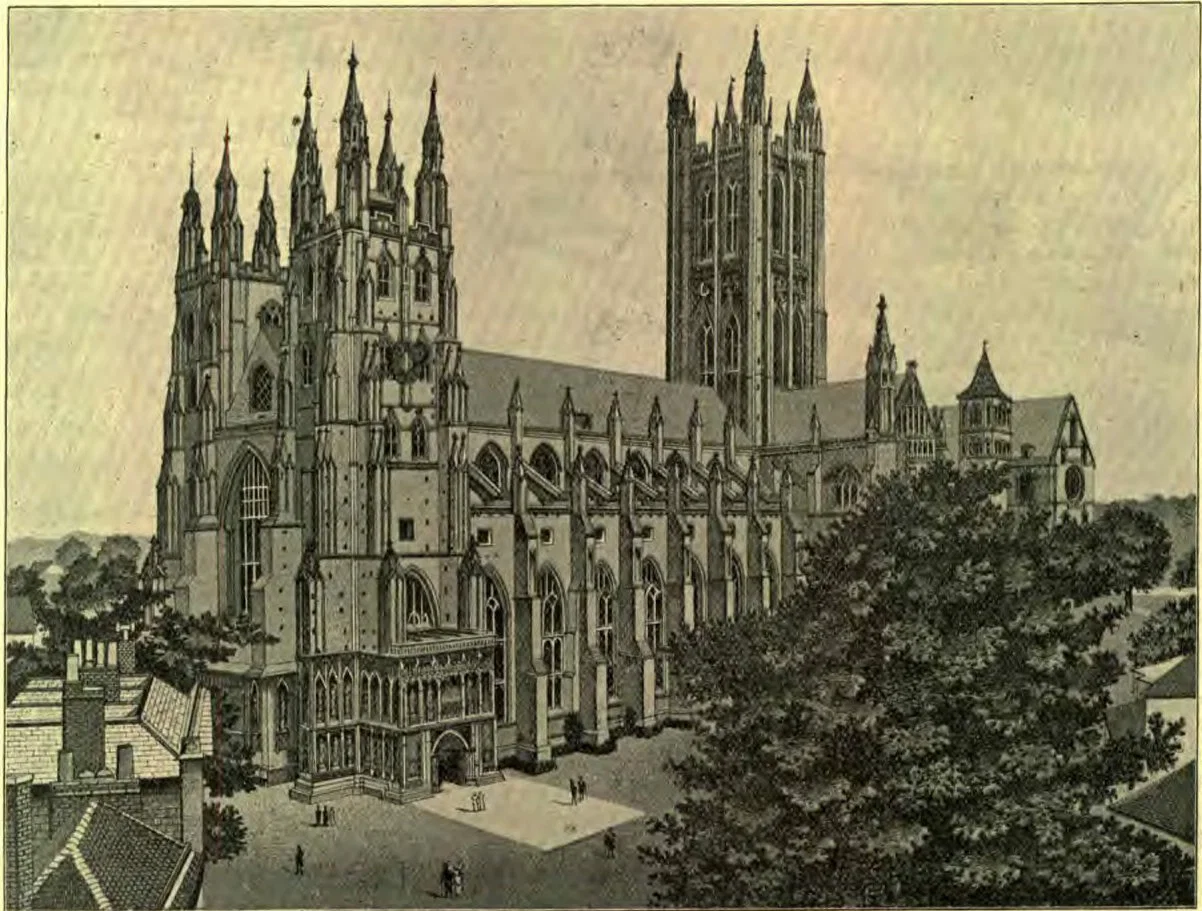
CANTERBURY CATHEDRAL.
In the year 560 Ethelbert ascended the throne of Kent, the southeastern part of England. For a time his authority was limited to that section, but afterward he extended his rule as far north as the Humber. Fifteen years after he became king, he married Bertha, a French princess of Paris. The French had previously accepted Christianity, and Bertha is said to have brought a knowledge of the gospel with her, being the first representative of the Christian religion in England. The king, doubtless prompted by Bertha, received with kindness and hospitality some missionaries who came into the country soon after this. He even gave up for their use his own house in the Roman city Durovernum, afterward called Canterbury. Adjoining the house he built a church, and on the site of this early church the cathedral was in later years erected.
Augustine was one of these first missionaries who shared Ethelbert’s hospitality. He was later appointed the first archbishop of Canterbury, which office to this day includes the highest authority in the English Church. Including Augustine, there have been ninety-five archbishops in the succession to the present time. One of the duties of these ecclesiastical officials is to crown the heir apparent to the throne when England’s sovereign dies.
After the death of William the Conqueror, in 1087, as mentioned in a former article, the throne of England fell to his son, William II, surnamed Rufus, because he had red hair. He was accidentally killed by an arrow, while hunting in the New Forest near Southampton. Henry I, another brother, then took the throne, and at once made war with a third brother, Robert, duke of Normandy, whom he defeated, and imprisoned in the castle of Cardiff, Wales, until his death, twenty-eight years later. After visiting France, and making peace with the king, Henry sailed for England. His only son, William, with his sister, remained a short time on shore after their father’s boat set sail. The captain and crew of their boat drank so freely before starting that they were unable to manage the ship, which was driven upon a rock, with the result that all on board were drowned except one man, a butcher of Rouen. After this another daughter, Matilda, married Goeffry Plantagenet, a Spaniard; and their son, as Henry II, became the first heir to the throne representing both the Norman and the Saxon line. He received this inheritance through his mother, as her father (Henry I) was a Norman, and her mother (“good Queen Maud”) was a Saxon.
The reign of Henry II brings to our notice Thomas à Becket and the Canterbury Cathedral, with which the name of à Becket is always associated. Just what nationality he represented is now uncertain. One historian says that he was “the first Englishman who emerged from the obscurity to which his race was consigned when the Normans seized all the higher offices of the church and state.” Another says: “His parents were both, there can be little doubt, of Norman extraction.” However this may have been, he certainly assumed a state in which no Englishman had lived before his time. When Henry became king, à Becket, who was then archdeacon of Canterbury, was given the office of Lord Chancellor. He was entrusted by the king with the education of his son, and was given much wealth. He was installed archbishop of Canterbury in 1162, and at once sent a resignation to Henry in these words: “I desire that you will provide yourself with another chancellor, as I find myself hardly sufficient for the duties of one office, much less two.” From this time à Becket gave himself entirely to the work of the church, trying to extend the authority of the pope. It was a fierce conflict between the church and the state, and resulted, as such conflicts almost always have resulted, in bloodshed.
The question whether clergymen were amenable to the civil courts was one on which there was much disagreement between à Becket and the king. One day, while in a passion, Henry said something expressing wonder that some of his household did not free him “from this turbulent priest.” At this four of his courtiers at once went to Canterbury to do away with à Becket. When the king learned their intention, he tried to recall them, but too late. The archbishop took refuge in the cathedral. His assailants demanded that he revoke certain excommunications. This he refused, whereupon he was violently murdered in the building, the sacredness of which he had hoped would secure his protection. This occurred in December, 1170. Two years later he was canonized as a saint by Pope Alexander III. From that time until the Reformation his shrine in the cathedral, called the Shrine of St. Thomas, was annually visited by troops of pilgrims, the number one year amounting to one hundred thousand. The superstitious reverence and wicked idolatry shown by these pilgrims to this dead man are attested by the official records of the offerings made at three altars there. In one year the offerings at God’s altar were nothing; at that of the Virgin Mary, £4 1s. 8d. (about $20); at St. Thomas’s shrine, £954 6s. 3d. (about $4,770). The enormous amount of this sum is better appreciated when the purchasing power of money in those times is considered. Henry VIII, more than three hundred years later, pillaged the shrine and destroyed it; and according to a foolish custom of those days, caused the saint himself to be cited to appear in court, where he was tried, and condemned as a traitor.
The connection of Canterbury with the early introduction of Christianity into England, and also this history of Thomas à Becket, led me to visit the quaint old town while spending a vacation at Margate, a seaside resort near by. While there, I obtained the photograph from which the accompanying illustration was made. The place is one of the few in which is still preserved one of the old Roman stone forts, with its gates to the main street of the city. In these forts are holes made to fit bows for shooting arrows at attacking foes. The cathedral and its surroundings are still held in great veneration. In an old church not far away it is said that Ethelbert must have been baptized. In it a baptismal font is pointed out, supposed to be of that age. The older portion of the cathedral was erected in 1070, to which various additions have been made. Services are held twice daily, consisting mostly of music by the large choir, which I was fortunate enough to hear. Several monuments to noted persons have been erected in different places in the building, the most striking of which is that over the tomb of the Black Prince. Above this hangs a coat, torn and stained, which was worn by the prince in battle.
The records of the city for hundreds of years are still preserved, and contain many curious things. Among these may be found the cost of entertaining the king and his servants during a visit to the place. It includes a detailed account of provisions purchased,—cheese, wine, rabbits, etc.,—and throws considerable light on the diet of the people of those times. Mention is made of a machine called a “cucking-stool,” in which women who did not obey their husbands, or who were given to undue gossiping, were placed, and ducked into the water till sufficiently punished. A record is also preserved of the cost of burning a heretic. The items of the wood, ropes, fees, etc., are given in detail, the whole amounting to less than a dollar.
It is sad to think that this place, where the gospel was first preached in that country, afterward became a place of persecution for the followers of the same religion. In this it was like Jerusalem itself, which turned from teaching of the Messiah to come, to the wicked act of putting him to death when he did appear. All these evils come from following the words and teachings of men instead of those of the Lord himself. H. E. SIMKIN.

HOW NAUPLIA RECEIVED THE KING.

June 12, 1899, was an eventful day for Nauplia, a pleasant little city of five or six thousand inhabitants, built on the side of an immense rocky cliff extending into an arm of the Mediterranean Sea. It was once the capital of Greece, and its history dates back to long before our Saviour came to this world. It overlooks the plains of Argos, upon which are several cities and villages, each having peculiar points of interest.
For three days before the twelfth, many flags were waving from the windows and balconies. Arches were built over the principal thoroughfares, and decorated with blue and white, the national colors, and with laurel branches. A continuous line of small three-cornered flags, interspersed with many small, colored lanterns, extended the entire length of the quay. Each day new decorations were added. The Platea, a large public square in the midst of the city, having streets bordered by small trees on three sides, with the soldiers' barracks on the fourth, was completely surrounded by a line of colored flags and lanterns; and the ever-present bootblacks, who shine one's shoes for less than a penny, had swept it like a floor.
On the afternoon of June 12, the object of all the excited preparations that had been going on for some days seemed near at hand. From our balcony, which overlooks the Platea, we saw the soldiers forming in line. The waving plumes and gay uniforms of the officers, with the clanking of their side-arms, made an interesting scene. A regiment of soldiers is stationed at Nauplia, because of the government prisons situated here. At last all was ready; and the soldiers, headed by the band and followed by a great concourse of people, large and small, rich and poor, proceeded toward the station, at the outskirts of the city. Joining the crowd, we also reached the station, which was besieged by thousands of persons. A passage about ten feet wide was opened by the soldiers, and strewn with laurel branches. Pushing our way through the throng, we at last reached the platform, where the police were trying to keep the people back.
At length we heard the warning whistle of the engine,—a sound very much like that produced by the willow whistle dear to the heart of American boyhood. However, this was quite in keeping with the tiny engine, which appeared but a mere toy in mental comparison with the engines of our own country. As the train pulled slowly into the station, and passed the people, they became almost frantic, waving their hats or handkerchiefs, and shouting, in Greek, “Long live the king! Long live the king!” Our position was fortunately chosen; for as the train stopped, a compartment was opened near us, and King George, accompanied by his son Nicholas and a few officials, stepped to the platform. Although the king is fifty-six years old, and has several sons, among whom are Constantine, the heir apparent, and Prince George, the governor of Crete, he is still a young-looking man.
Escorted by the officers, the king and his company marched out between the soldiers, and the procession again formed, and followed him to his stopping-place, a house fronting the beach. After dinner, which is served here about half-past eight in the evening, the people gathered along the shore in front of the house where the king was staying. Back of a large stone promenade there was a level place, where little tables were set, and refreshments served. There was music on the land and on the water; while cannon and fireworks displayed from the boats and from the remains of an old castle built in the harbor, made the scene an impressive one. The mountains back of the city were ablaze with countless bonfires. These eminences are great forts, on which are cannon two and three centuries old.
At last the king appeared on the balcony, and a silence fell over the crowd, as they pressed nearer to hear him. He spoke in Greek, and the following is a free translation of his brief address:—
“Now nothing more remains except for me to thank each one of you separately for the cordial welcome that you have given me this year, and to wish happiness for the future of this ancient city, Nauplia. Long live the nation!”
These few words were received with enthusiasm, and soon the large company escorted the king back to his train. The narrow streets, barely wide enough for two carriages to pass, were again crowded, while from windows and overhanging balconies the enthusiastic subjects burned red candles.
Soon the king departed, the illuminations went out, and the people quietly sought their homes. As we looked upon the scene, we wondered who in this old city will be ready to welcome the King of kings when he shall come to claim his own.
H. A. HENDERSON.

TEACHING FROM NATURE.

Christ employed the things of nature to illustrate divine truth. He bade them speak that men might heed the voice of God. He used as object-lessons the flowers he had created and the things of the animal world. Under his teaching, nature utters her voice to declare the wonderful works of God, and to reprove man's unbelief and his forgetfulness of his constant dependence upon the Creator.
“Take no thought for your life,” Christ said, “what ye shall eat, or what ye shall drink; nor yet for your body, what ye shall put on. Is not the life more than meat, and the body than raiment? Behold the fowls of the air: for they sow not, neither do they reap, nor gather into barns; yet your Heavenly Father feedeth them. Are ye not much better than they?” Consider the ravens. They neither sow nor reap; but they act the part God designed them to act, and he takes care of them. And will not that God who has given man all that he has, keep him in health and strength if he complies with the conditions by obedience to the laws of his being?
“Which of you by taking thought can add one cubit unto his stature?” Christ asked. “And why take ye thought for raiment? Consider the lilies of the field, how they grow; they toil not, neither do they spin: and yet I say unto you, ‘That even Solomon in all his glory was not arrayed like one of these.’” Let the lily, beautifully tinted and gracefully formed by the great Master Artist, surpassing in its loveliness the artificial adorning of Solomon, teach us the lesson of simplicity and faith.
The lesson-book of nature is open to all. When men and women cease trying to counter-work the purposes of divinity, when they place themselves under the discipline of grace, they will see that they have a work to do in becoming conversant with plant and animal life. If less time were devoted to the preparation of elaborate meals for the gratification of appetite, and more in the contemplation of God's works in nature, men and women would be better fitted to serve their Creator.
God has entrusted human beings with talents. He has given men and women intellect, that they may study his dealings with them. All have the privilege of knowing the only true God, whom to know aright is life eternal. Shall we, then, follow our own inclinations, and indulge our inherited and cultivated tendencies to wrong, without reference to God's word? The birds of the air, guided by instinct, are obedient to the laws that govern their life; but the beings formed in God's image fail to honor him by obeying his laws. By disregarding the laws that govern the human organism, they disqualify themselves for serving God. God warns them to beware how they dishonor him by breaking the laws that govern their bodies; but habit is strong, and they will not heed.
The swallow and the crane observe the changes of the season. To find a suitable clime, they migrate from one country to another, as God designed they should. But men and women sacrifice life and health in seeking to gratify appetite. In their desire to accumulate earthly treasure, they forget the Giver of all their blessings. They abuse their health, and use their powers to carry out their unsanctified, ambitious projects. Their days are filled with pain of body and disquietude of mind because they are determined to follow wrong habits and practises. They sacrifice health, peace, happiness, to their ignorance.
The wise man addresses the indolent in these words: “Go to the ant, thou sluggard; consider her ways, and be wise: which having no guide, overseer, or ruler, provideth her meat in the summer, and gathereth her fruit in the harvest.”
The habitations that the ants build for themselves show wonderful skill and perseverance. Only one little grain at a time can they handle, but by diligence and perseverance they accomplish wonders. Solomon points to their industry as a reproach to those who waste their hours in sinful idleness, or in practises that corrupt soul and body. The ant prepares for future seasons. Many who are gifted with reasoning powers entirely disregard this lesson, and fail entirely to prepare for the future life.
Stones have frequently been used as memorials of God's dealing with his people. Joshua, knowing that the time of his service as the visible leader of the children of Israel was about to end, gathered the people together, and caused them to renew their covenant with their Maker. Then he “wrote these words in the book of the law of God, and took a great stone, and set it up there under an oak, that was by the sanctuary of the Lord. And Joshua said unto all the people, Behold, this stone shall be a witness unto us; for it hath heard all the words of the Lord, which he spake unto us. It shall be therefore a witness unto you, lest ye deny your God.”
None have an excuse for misusing their powers. Such misuse robs God of the service he demands. By creation and by redemption, man is the Lord's. The qualities with which he has been endowed show how high an estimate the Lord places on human beings. He has given every man his work. Every youth, every child, has a work to do in accordance with the Lord's revealed will. No one can waste his opportunities and privileges without robbing God. How can we ignore the responsibilities that rest upon us? The sun, the moon, the stars, the rocks, the flowing stream, the broad, restless ocean,—all teach lessons that we would do well to heed. Shall we not learn from God's great book of nature that he bestows his love, mercy, and grace on us every moment of our lives, that we, in turn, may serve him and our fellow men?
MRS. E. G. WHITE.

Strength of Rudder and Will in Life's Storms

“Some day you will launch your ship, my boy, on life's wide, treacherous sea: Be sure your rudder is wrought of strength, to stand the stress of the gale; And your hand on the wheel,—don't let it flinch, whatever the tumult be; For the will of man, with the help of God, shall conquer and prevail.”

THE STARS.

Ye stars of night, why look ye down So calmly on a careworn world? Can ye not see the tear, the frown, The bloody flag of war unfurled? Do ye not hear the orphan's cry, The plea for justice, stifled low, The wail that marks misfortune's blow, The groan of pained humanity? And still your twinkling eyes of light Gaze on us through the weary night Serenely till the shadows flee,— Then fade before the blush of morn. So may my soul, when tempest-torn, Look onward to eternity.
William Archer Wright.

ONE HOUR.

The great clock in the church steeple struck three; the afternoon sun slowly waned, and the shadows lengthened in the streets. The clock struck four.
It was only an hour. The children playing on the sidewalk did not know that it had gone; but in it a great-hearted man had written down some strong, true words, which will live long in the world, and give courage and help to many struggling souls.
In it a chemist, working with brain and hand over carefully prepared compounds, had discovered one of the secrets of nature,—how the atoms of elements group themselves to form a molecule of organic matter.
In it four women, sitting with their sewing on yonder porch, had brought out old, forgotten scandals, and set them loose again in the world, like flying scorpions, to poison and to kill.
In that hour a young man in the next house to them, yielded to a temptation which will never lose its grip on him while he lives.
In the same time a woman, with a child on her lap, told a story with a high, pure meaning, which will be a lamp to the child’s feet all the days of his life.
Another woman, watching silent and motionless by a sick-bed, filled the hour with prayer and high thoughts, which will serve as food for her soul in the trouble that is coming upon her.
How many of us remembered that the hour—a servant, laden with the report that we should give to it—was passing up to God?
What report did it carry of us? What burden are we making ready at this moment for the hour that is passing now?
“Only an hour! Yet the despised slave,” says Antigonus, “may be laden with treasure that would ransom a Cæsar.”—Selected.

INTO THE LIGHT.

ABOUT eight o'clock the following morning, Grace was surprised to hear May's voice at the door. The next moment she had entered, and after a cheery “Good morning, Grace,” proceeded to make known the reason for her early call.
“Last night after meeting, Elder Barnes asked if you were going to be able to get out to any of the meetings. I told him you were improving quite rapidly, and hoped to be able to walk in about two weeks. He said he would like very much to meet you, and asked if I thought it would be agreeable if he should call.”
“Why, of course. I have often wished I could talk with him, and mama and Aunt Jane are becoming so interested in what I tell them of our readings that they have expressed a desire to be present to-night. You are becoming quite a Bible teacher.”
“Well, tell them to come, and if Elder Barnes is at liberty, why not have him come at the same time?”
“I am sure that would be pleasant for us all; but how are things going at school? I have been so taken up with our Bible readings lately that I haven't asked you anything about our school work. I have been trying to keep up with the class, however. Georgia and Myrtle stopped last night on their way home, and we compared our Latin translations.”
“Things are going about as usual. I met old Mr. Davis at the tent last night, and he asked when I was coming to teach school for them. You know he has always said that I should teach in their school as soon as I am graduated.”
“Yes, I heard him speak to you about it once. Does he really mean it?”
“Certainly; I met him at one of the Christian Endeavor conventions two years ago, and we renewed the acquaintance begun when I was a little child. He is an old friend of the family. But I must go. Look for us, or for me at least, about the usual time.”
At four o'clock everything was in readiness for the expected visit. Chairs, tables, and Bibles had been brought to the shady front porch, and a large pitcher of lemonade was cooling in the ice-chest.
Soon the click of the gate told Grace that her visitors had arrived, and the next moment she was being introduced to Elder Barnes, a genial, pleasant man, whom children and youth instinctively loved and trusted. Mrs. Conwell and Aunt Jane each gave him a cordial welcome; and after a few general remarks, the conversation turned upon the work at the tent.
“They tell me, Elder Barnes,” remarked Mrs. Conwell, “that you are preaching some strange new doctrines. My girls here can think and talk of nothing else.”
“Why, no, Mrs. Conwell, the doctrines are not new. Many of them were given to Adam in the garden of Eden, and the only reason they are strange is that man has perverted the word of God. To what in particular do you refer?”
“The idea that man sleeps in the grave until the resurrection. I have always believed that Christ comes at the death of his saints, and receives them to himself.”
“Why no, mama! Don't you remember that he says, in Matthew 24, that if some one shall say, ‘He is in the secret chambers, believe it not,’ and that his coming will be like the lightning, which shines from the east even unto the west?”
“Yes,” said May, “and Rev. 1:7 says, ‘Behold, he cometh with the clouds; and every eye shall see him.’”
“The Bible plainly teaches that the righteous dead, with the righteous living, will all be made perfect at the same time, and will all receive their reward together,” said Elder Barnes.
“I confess that the texts Grace read to us last evening seem plainly to teach that man is composed of but two things,—spirit, or breath, and dust,—but are there not other texts? Grace, please give him a list of those we studied.”
After glancing over the list, Elder Barnes said: “Other texts?—Oh, yes, many of them. Job was interested in this same subject. Please turn to the fourteenth verse of the fourteenth chapter of his book. Miss Grace, you may read it.”
“‘If a man die, shall he live again? all the days of my appointed time will I wait, till my change come.’”
“Job 17:13 tells where he expected to wait. Will you read it, Mrs. Conwell?”
“‘If I wait, the grave is mine house: I have made my bed in the darkness.’”
“The twelfth verse of chapter 14 tells how long he must wait.”
“‘So man lieth down, and riseth not: till the heavens be no more, they shall not awake, nor be raised out of their sleep,’” read Aunt Jane.
“Rev. 6:14 shows when the heavens shall be no more. Mrs. Conwell will please read.”
“‘And the heaven departed as a scroll when it is rolled together; and every mountain and island were moved out of their places.’”
“If you notice the preceding verse, you will see that the heavens depart after the falling of the stars.”
“Oh, yes, and that took place in 1833, did it not?”
“Yes. Now turn to 1 Cor. 15:51-53, and see when Job will experience the ‘change’ of which he spoke in the fourteenth chapter.”
“‘Behold, I show you a mystery: we shall not all sleep, but we shall all be changed, in a moment, in the twinkling of an eye, at the last trump: for the trumpet shall sound, and the dead shall be raised incorruptible, and we shall be changed. For this corruptible must put on incorruption, and this mortal must put on immortality.’”
“This is the change to which Job looked forward,—a change from corruptible to incorruptible, from mortal to immortal.”
Here Elder Barnes looked at his watch, and said: “I will give you one more text, and then I must say good-by for this time. You will find it in 1 Thess. 4:15-18.”
After reading the verses, and talking of them for a few moments, Elder Barnes rose to go. Mrs. Conwell thanked him for the visit, and invited him to come again. She also expressed great interest in what they had read, to which he replied: “God's word is full of good things, for which he says we should search as for hid treasures.” LENA E. HOWE.

Patience Wins More Races Than Haste

“PATIENCE wins more races than haste

INTIMACY

No distant Lord have I, loving afar to be; Made flesh for me, he can not rest until he rests in me.
I need not journey far this distant friend to see, Companionship is always mine; he makes his home with me.
I envy not the twelve: nearer to me is he; The life he once lived here on earth he lives again in me.
Ascended now to God, my witness there to be, His witness here am I, because his Spirit dwells in me.
O glorious Son of God! incarnate Deity! I shall forever be with thee, because thou art with me.
— Sunday-School Times.
Continue reading: Chapter XIII