SHIRLEY had gone as fast as her feet could take her until the depressing gloom of Pacific Avenue arrested her progress. Her feet shrank from the lonely stretches of shadows, her spirit shrank within her, the bravery of her nature forsook her. Every dark corner was alive with horrors, and the lights made more terrible spaces. Anger, pride, independence, were forgotten; and with a low cry she dropped upon a wooden step, put her face into her hands, and moaned, “Father, father, I must have been crazy! If I live till morning, I’ll take the first train home.” Then with an awful sense of desolation she remembered, and cried out, “But I haven’t a penny, not one, even for a postal card.” She sat like a statue for a second, while a glimpse of the dangers to which she had exposed herself flashed before her; then, springing to her feet, she said, “Well, then, I’ll walk. I’ll get out of this horrid city. I’ll go home,” when the thought came that she had run away from home, and maybe her father would not allow her to come back. She would go,—but where? She started rapidly forward, but this thought brought her to a standstill. She must get somewhere, that was certain; and turning quickly about, she hastened on.
She was completely bewildered, but terribly in earnest, spurred at every step by that strange, ever-increasing fear that waits on hurrying steps. To any one watching her, she would have appeared guilty or irresponsible.
Officer Mc Farlan had not been long in getting his eyes on Shirley, nor was he slow in arriving at a conclusion about her. She was not fit to be left at large at that time of night, that was sure. He strode toward her, and confronted her with his tall, imposing figure in uniform, and “flashed” his star.
She had the country-bred fear of the police, and at sight of him her only instinct was to flee, and thus to escape this new terror. She accordingly made a leap that landed her in the gutter, and would have fallen flat if he had not caught her.
“There, now,” he said, as he set her on her feet, “what are you doing on the street at this time of night?”
Shirley was too frightened to speak, but in the dim light looked only sullen.
“Will you answer?” he asked. “What are you doing?”
“Nothing.”
“Well, this is a bad time and place to be doing nothing. Where do you live?”
Where, indeed? No answer.
“Well, you will have to come with me, then. I will see that you are taken care of.”
This was said not unkindly; but Shirley drew back, and would have pulled herself away from him if it had been possible; but the experienced officer knew how to keep hold of her, and how to keep her moving at his side. She tried to speak, but her terror was too great; and so, without another sound, she was led on into the Harrison Street Station, which was a howling pandemonium, an unusual number of drunks being in attendance. Shirley, moaning as in a terrible nightmare, was ushered to the desk of the lock-up keeper, who proceeded to “book her.”
“Name?” he asked.
Name!—her name in such a place?—Never! So she stood dumb, with compressed lips and flashing eyes.
“Very well,” thought the keeper, “any name will do. One more alias makes no difference,” so he wrote, “Sally Jones, disorderly,” and turned her over to the police matron.
Seth Adams had haunted the post-office early and late for five days, and had walked the streets before opening, and after closing, time; but he had found no trace of Shirley.
Upon his first arrival at the city, he had gone directly to the mission about which he had read in his mother’s church paper. In this he had stowed his belongings; but as for sleeping, that had been out of the question, nor had he made more than an occasional pretense at eating. At the beginning of this sixth day, he left his lodging, where he had tried to rest a little, and hurried toward the big, old government building on Clark Street, intent on being in with the first post-office officials. All the while that he stood watching the women who came to the general delivery, he felt that he was almost wasting precious time; but what else could he do?
At last he took a turn outside, and looked about, and chanced to see a fine blue-coated figure standing at a crossing.
“Why not ask the police? they see everybody,” thought Seth, “and I know they’d any of ’em help a fellow, if they knew. There isn’t one of ’em to whom some woman isn’t dearer ’n life. If I can make ’em understand, there isn’t one of ’em but’d give me his best, as man to man, I know. Man is man anywhere, and it won’t take much talking to make them understand, neither. I must pick my man—find one who isn’t so rushed he can’t listen to me. Haunting the post-office hasn’t done anything. I’ll take this now for a change, for time’s passing, and it isn’t any place for a dainty young creature like Shirley to be roaming around. She’s got to be found, and that right quick, please God and the holy angels.”
Seth was not what one would call a religious man, but he had been reared in the truth, and had never really set out to quarrel with it. Now he had been lifted, by the greatness and purity of his love and the suffering of these last days, to a spiritual level from which he instinctively reached out after all that he had been taught by his mother. At this altitude, under stress of such a need, with his physical nature refined by abstinence until it began to tell on every feature, prayer had come to be as his natural breath. He had been walking in its atmosphere all that morning; and now, stopping a moment, and looking up to where the spring day was shining above the swelling roar of the awakening city, he let his heart speak as it had never spoken before into the ear of Him whose name is Love.
As he stood thus gazing upward, he soon became the center of a skyward-gazing group that was growing every second. It was a moment before he noticed it; but when he did, the humor of it struck him so that he laughed his old, hearty laugh,—the first in days,—and it did him good. He turned, and walked rapidly away, leaving a mystified, gaping crowd behind him; but his step was confident, and his heart was wonderfully lightened of its load. He had gone but a few blocks when he met a policeman slowly walking his beat, with his club held in both hands before him. He was a fine specimen of a man, about Seth’s age; and his frank, genial face commanded confidence. He was evidently busy with pleasant thoughts, and not in a hurry.
“That’s my man,” said Seth, to himself; and stepping up before him, he said: “If you are on duty now, maybe you will let me take a turn with you. I have something to say.”
“All right, sir, come on.” He swung himself about on his heel, and Seth came alongside, and fell into the same easy stride, as he said: “You see, I’m a countryman, but I calculate that men generally understand one another, even if one of them does wear a policeman’s star, and the other a granger’s uniform; and I calculate that we all have about the same kind of feelings toward some kind of womankind.”
The officer turned his eyes around at Seth’s face quickly, then back to the stick he carried, while a thoughtful tenderness came over his face. There was no excuse in Seth’s manner for lightness of thought or word, if his words were peculiar and abrupt. Seth went on:—“I’m in trouble, and must have help,—police help, I suspect,—and I calculate on a man’s understanding me.”
The officer looked encouragingly at him, and bowed. Seth then proceeded to tell the story of Shirley, as far as he knew it. He did not stammer nor hesitate over his own relation to it, although a color came to his cheeks that looked almost hectic on their pallor, and he had the satisfaction of seeing that the man in the uniform was not only able to understand what he heard, but was of a nature fine enough to interpret more than the spoken word, and appreciate the deeper story that must remain forever unsung and untold. The same sublime impulse that set the whole Scottish army to singing “Annie Laurie,” moved the officer to take Seth’s arm and say: “I understand; count on me for anything,—and I can speak for the force to a man. But we must have something to go by,—a photograph, a description, or both.”
“She wore a gray dress and white sailor hat. Here’s a picture, just like her,” taking a dainty satin photograph case, wrapped in tissue-paper, from his pocket. “She gave me that last Christmas.” The officer did not touch it, he did not attempt to do so; but with the most delicate tact left Seth to hold it before him. One quick, startled glance, and he said, as quietly as possible, which was not, however, saying much for his self-possession, “A gray dress and white sailor hat, did you say?”
“Yes,—why? have you seen her?”
“I have; and I must prepare you for a shock, I fear, my dear fellow—I took that girl to the Harrison Street Station last night.”
“What in—! you!” and Seth reeled. Officer Mc Farlan caught and steadied him, saying: “I told it bluntly, I am afraid. One can’t say some things soft-like, they are so hard in themselves. It was this way,” and he told all that had occurred, as he knew it; while Seth stood, every muscle tense, in an attitude that was, to say the least, threatening. The officer continued, “The police court sits at nine; she will have to come before it, and—”
“She must not go before it!” cried Seth; “you must get her out without that. How long—what did you take her there for?” Seth’s face was white as death. “I tell you she had no business being arrested, poor little girl! What hurt could a slip of a girl do? You must be mighty ’fraid of this big city of yours.”
“Poor little chickabiddies!” said Officer Mc Farlan, with a lump in his throat. “I agree that they could not do much harm, if they were let alone, any of them. It’s we ‘lords of creation’ that ought to go to the stone floors and hard benches. You can’t get up a quarrel with me on that, my good fellow; but, unfortunately, we can’t have things just as they ought to be; and this girl, since she was booked, you see, will have to come before the court, as I said, but you may count on me to —”
“But what for? What under heaven did she do? By your own story she resisted an insulting coward, and then tried to hide from folks in the dark—poor little girl! Is that a thing to be hauled up in court for?”
“If I had only known then what I do now,” said the officer, “I should not have taken her in as I did; but her actions were, to say the least, suspicious, considering the class we have to deal with. Anyhow, what’s done can’t be undone, and time is slipping. Come with me to breakfast, and then we will go over and see what can be done. She will be cared for by the matron—a kind, motherly woman.”
“Breakfast!” cried Seth, angrily. “Breakfast for me?—not till she’s out of that place.”
“Very well, I understand; when her case is called, you can be ready with your evidence, and get her off, I am sure.”
“I,” gasped Seth, “I’ll do anything, of course, to make it easier for her; but you see it would kill me deader ’n a door-nail as far as she is concerned. She is proud,—you haven’t an idea. She’d never let me come within a thousand miles of her again if she supposed I knew a thing about this. So you will understand, if it can be done with me left out,—means everything to me how she looks at me when she gets on her feet again.”
MRS. S. M. I. HENRY.
Not Altitude but Attitude Makes the Great Man
“Not altitude, but attitude, makes the great man.”
MAKING UP.
By Mrs. L. D. Avery-Stuttle
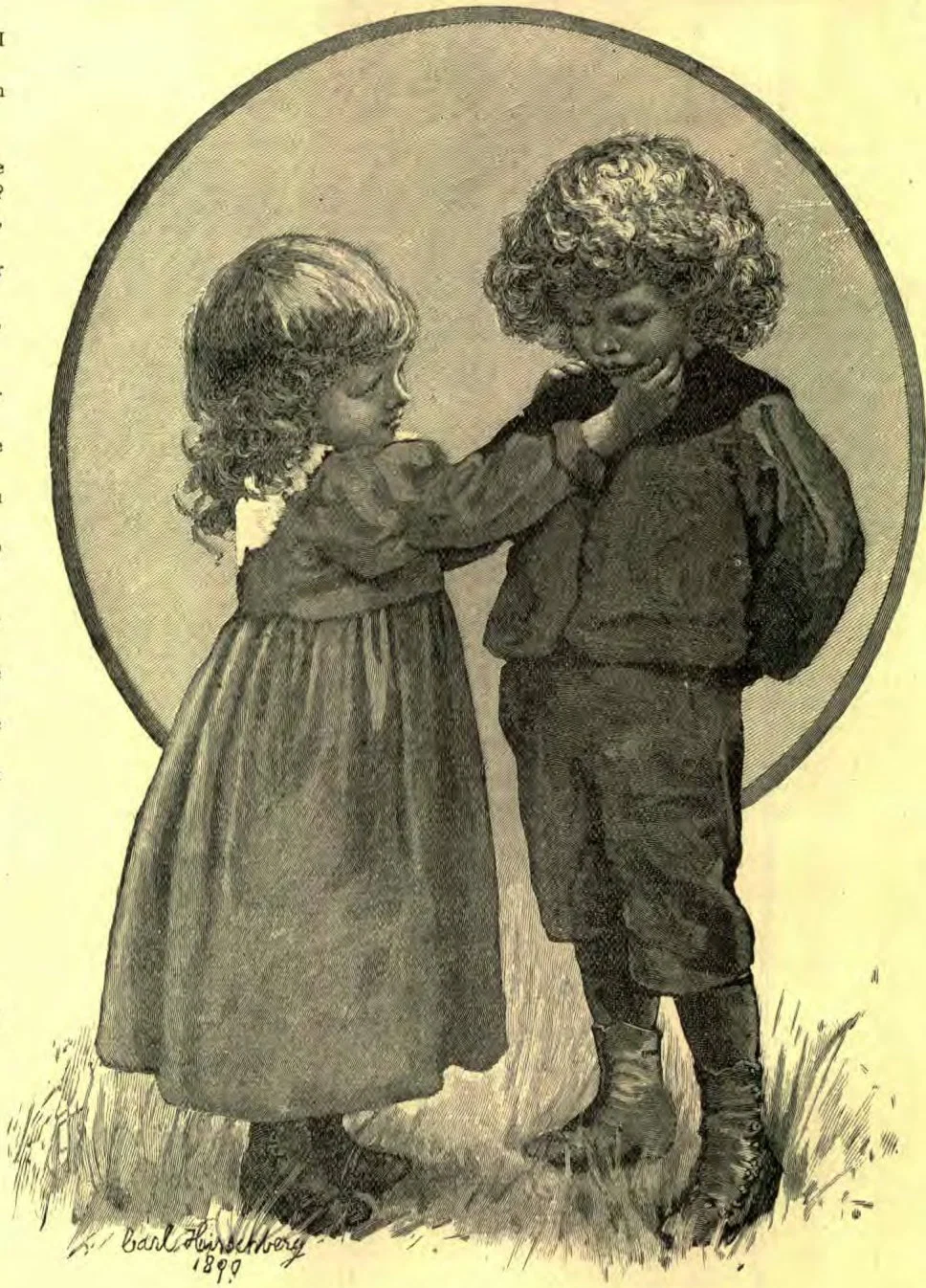
I sat beside my window one pleasant summer day, And watched two little children, a boy and girl, at play. Dear little Bess, with dimpled cheeks, and eyes like heaven's blue, And curling hair like threads of gold with sunshine flickering through, Was playing tag with brother Ned; and through the morning air Their childish voices sounded sweet, like music rich and rare; When, sudden, like a jarring note, I heard a childish cry, And little Ned defiant stood, with angry, flashing eye.
O BROTHER, BROTHER! LET'S MAKE UP.
“You naughty, naughty Bess!” he said, “what makes you act so bad? You are the worstest sister I ever, ever had; I'll go and tell my mama, I'll tell her right away; And now, unless you're awful good, I'm not a goin' to play! “O brother, brother! let's make up; I'm awful sorry, Ned; I won't be bad again all day,” the little maiden plead; “Let's both be good, because, you see, we'll make our mama cry, And all the pretty angels, who live up in the sky.”
O sweet, forgiving childhood! how beautiful thou art! How true and pure and innocent the gentle, loving heart! What wonder that the Master gave the invitation free: “Forbid not little children, but let them come to me”!
MRS. L. D. AVERY-STUTTLE.
ONE DOLL'S MISSION—A TRUE STORY.
It was such a pretty doll, with its golden hair and pink-and-white cheeks and red dress, that I knew some little girl had loved it dearly. I was sure there were tears in her eyes when she kissed it good-by, and packed it away in the box for China. It proved so helpful in our work that I often wish I had the child's name, and could write and tell her of her doll's beautiful mission in Peking.
If you have lived in the country, you have often seen an old sheep follow a little lamb. You know, too, that children the world over are “Jesus' little lambs,” and we desire to save them, for they are very precious. The missionaries have found that when they gather in the children, the fathers and mothers come also, just as the sheep follow the lambs. So we open boys' and girls' schools. One was opened in the southern city of Peking; and when I learned to speak the queer language, the school was given to me. It was small, and I was disappointed and almost discouraged because it grew so slowly.
Meanwhile the pretty doll lay in the box in my closet, waiting to be used. One day some good spirit whispered to my heart to take the doll down with me, to see what it could do.
None of the girls had ever seen such a doll before. How their black eyes did shine! “Ai yah!” they exclaimed; “che ko has kan. Shih shni ti hsiao jeur'h? Kei wo pa! kei wo pa!” meaning, “Ai yah! this is good to look upon. What small man is this? Give it to me! give it to me!”
So I gave it into their hands. They examined it closely, looked for a long time at its blue eyes, and finally smelled of it. Then I knew they loved it; for Chinese smell their babies when they love them, instead of kissing them, as we do.
I took it back, and held it up before them, and said, “If you will get a new scholar to come to school, I will give you this doll or another when she can read one little book.”
They were eager to go on the search; and as I mounted my donkey, and jogged back to the mission, there was new hope in my heart that the school would grow at last.
Chinese children study aloud in school; and as I drew near the schoolhouse on my next visit, I heard voices, loud and strong, ringing out:—
“Chi tou hsi, e chun shun
Tsao tien ti, yu tsao jeu,”
which means—
“In the beginning, one true God
Made heaven and earth, also made man,”
and I knew by the noise that new voices had been added.
How glad I was to find the little room nearly filled with new, strange girls, whom I had never seen!
The old girls gave me their best bow,—an old-fashioned courtesy,—and the new girls followed suit, so that the whole school was in motion, bobbing up and down, and inquiring, in general chorus, if I were at peace, and had eaten my rice.
Then how proud the older pupils were to tell me which of the new girls each had brought in! The teacher was happy, too, and told me frankly, as Chinese do, which were bright, and which were “small idiots.”
The busy days flew quickly by, and one day a new girl recited correctly her whole book. “Yu Lau brought me in,” she said; so the pretty doll was given to Yu Lau. Ah! where in all China was another girl so happy as Yu Lau? She hugged her “small man” tightly, fondled it tenderly, smelled it again and again, and could hardly let the other girls look at it. When school was out, she marched down the street, prouder than any mandarin in the city.
Now the story grows sad; for that very night Yu Lau was taken sick with the diphtheria. Her throat swelled so badly she could not hear, and she grew so crazy she did not know her mother or grandmother or little sister; but through it all she clung to the dolly. Her mother told me afterward that as she moaned and tossed on her brick bed, she murmured snatches of the lessons she had learned; that with almost her last breath she sang, “Jesus loves me;” and when she died, her little arms were pressed tightly around her doll.
And the school grew until the little room was so full we could hardly turn around to kneel down. When meetings were held, the girls all came to the chapel, and naturally the fathers and mothers and grandfathers and grandmothers and uncles and aunts and cousins began to come. And the church grew, and prospered greatly.
Are you not glad with me that some little girl—God knows who—gave her pretty doll? and do you not think she did good work in Peking?
Perhaps some beautiful mission, somewhere, is awaiting your best doll. Will you not let it go for the sake of some little girl, and for Christ's sake?—S. S. Advocate.
OUR SEWING CIRCLE.
By Nellie V. Dice
Our apron is put together, and the hem is turned. Begin to hem at the right-hand corner, putting the needle under the hem, so the knot will not show. Take up one thread in the apron; slip the needle in under the hem, and bring it out between the hem and the turn-under, about three threads to the right; draw the thread through closely, but not too tight. Repeat till the hem is finished. Divide the top of the apron in the middle, marking the place by a thread. Begin to gather at the right-hand corner, taking even stitches. Fold the band in the middle, and pin the mark in the apron to the mark in the band. Take the size of the waist for which the apron is intended, allowing half an inch for the lap on each end, and cut the rest off. Pin the side of the apron to the band about four inches from the end. Baste the apron to the band, first evening the gathering all the way to the center. Sew firmly by backstitching. Turn under the other side of band, baste to the apron, and hem it down. Turn the ends in, and overcast neatly.
NELLIE V. DICE.
Rise! The Day Is Passing
“Rise! for the day is passing,
And you lie dreaming on;
The others have buckled their armor,
And forth to fight have gone;
A place in the ranks awaits you,
Each has some part to play;
The past and the future are looking
In the face of the stern to-day.”
Time: A. D. 30. Places: Perea and Judea. Persons: Jesus and disciples.
Questions
1. What beautiful parable was given for the special benefit of his disciples? Luke 15:11–32. How many sons were there? V. 11. Which one made a request? What was it? V. 12. What did the father do? Id. What course did the young man pursue? V. 13.
2. What circumstances soon overtook him? V. 14. To make a living, what work did he take up? V. 15; note 1. What humiliating condition did he finally reach? V. 16.
3. Realizing his wretchedness, what did he say to himself? V. 17. What did he then resolve to do and say? Vs. 18, 19. Did he carry out his resolve? V. 20, first part.
4. How great was his father's willingness to receive him back? V. 20, last part. True to his determination, what did the son say? V. 21. Did he say all that he intended? Compare verse 21 with verses 18, 19. Instead of being made as a servant, what treatment did he receive? Vs. 22, 23. What reason did the father give for thus doing? V. 24.
5. As the elder son came from the field, what did he ask? Vs. 25, 26. What did the servant answer? V. 27. What were this son's feelings, and what did he say to his father? Vs. 28–30.
6. With what spirit did the father seek to quench his spirit of jealousy? Vs. 31, 32; note 2.
Notes
1. To the Jews, to whom Jesus was speaking, no work was lower or more degrading than caring for swine. By taking this as an illustration, Jesus shows to his disciples that no matter how low in sin one may have gone, he is not so degraded but that God will still accept him.
2. The parable of the prodigal son was given by Jesus to make plain to his disciples why he mingled so freely with publicans and sinners. The Pharisees had murmured at him for so doing, and the twelve disciples were by no means free from such prejudices. “The force of these lessons [of the lost piece of silver and the prodigal son] the disciples could not then fully appreciate; but after the outpouring of the Holy Spirit, as they saw the ingathering of the Gentiles and the envious anger of the Jews, they better understood the lesson of the prodigal son, and could enter into the joy of Christ’s words, ‘It was meet that we should make merry and be glad;’ ‘for this my son was dead, and is alive again; he was lost, and is found.’”—The Desire of Ages, pages 495, 496.
3. Where, in the entire range of human literature, sacred or profane, can anything be found so terse, so luminous, so full of infinite tenderness; so faithful in the picture which it furnishes of the consequences of sin, yet so merciful in the hope which it affords to amendment and penitence, as this parable? How it does summarize the consolations of religion and the sufferings of life! All sin and punishment, all penitence and forgiveness, find their best delineation in these few brief words. The radical differences of temperament and impulse which separate different classes of men; the spurious independence of a restless will; the preference of the enjoyment of the present to all hopes of the future; the wandering far away from that pure and peaceful region which is indeed our home, in order to let loose every lower passion in the riotous indulgence which wastes and squanders the noblest gifts of life; the brief continuance of those fierce spasms of forbidden pleasure; the consuming hunger, the scorching thirst, the helpless slavery, the unutterable degradation, the uncompassionated anguish that must inevitably ensue,—where have these myriad-times-repeated experiences of sin and sorrow been ever painted, though here painted in a few touches only, by a hand more tender and more true than in the picture of that foolish boy demanding prematurely the share which he claims of his father’s goods; journeying into a far country, wasting his substance with riotous living; suffering from want in the mighty famine; forced to submit to the foul infamy of feeding swine; and fain to fill his belly with the swine-husks which no man gave? And then the coming to himself; the memory of his father’s meanest servant, who had enough and to spare; the return homeward; the agonized confession; the humble, contrite heart-broken entreaty; and that never-to-be-equaled climax, which, like a sweet voice from heaven, has touched so many million hearts to penitence and tears: “And he arose, and came to his father. But when he was yet a great way off, his father saw him, and had compassion, and ran, and fell on his neck, and kissed him. And the son said unto him, Father, I have sinned against heaven, and in thy sight, and am no more worthy to be called thy son. But the father said to his servants, Bring forth the best robe, and put it on him; and put a ring on his hand, and shoes on his feet: and bring hither the fatted calf, and kill it; and let us eat, and be merry: for this my son was dead, and is alive again; he was lost, and is found.”—Farrar.
Lessons for July.—Who gave the invitation? Through whom? To whom? What was enjoined, and what promised? What four Hebrew youth were taken to the Babylonian court? How did they stand amid temptation? Who were cast into the fiery furnace? For what principle? How were they delivered? Under what circumstances did the supernatural writing appear? What was its import? By whose plotting was Daniel cast into the lions’ den? How was his case vindicated?
Lessons for August.—Who speaks in this lesson? Through whom? To whom? What results follow compliance to conditions? Where did Ezekiel see the vision of dry bones? What did the vision signify? What effect did the river of salvation have on desert and sea? What was symbolized? What king issued a decree for the return from captivity? Under whose leadership did fifty thousand Jews return? What was their purpose in returning?
Lessons for September.—When did they set up the altar? How was the work of rebuilding the temple hindered? Who encouraged the builders? How was the second temple to surpass the first? What source of power was supplied to Zerubbabel? Describe the vision. What does oil symbolize? Do the Spirit and the Word always stand together as the two olive-trees?
NOTES.
1. The first lesson of the quarter, under the title “Gracious Invitations,” presents one of the most tender and beautiful calls to repentance, and pictures the flourishing condition of the soul that abides under the shadow of the Almighty in similes of the rarest beauty and attractiveness. Beholding the significance of harmony with heaven, who could refrain from re-echoing the prophet’s words, “O Israel, return unto thy God”?
2. The second lesson, “Daniel in Babylon,” introduces one of the three unblemished human characters of the Bible. Of Job, Joseph, and Daniel no record of sin is found. It is not to be understood that they never sinned, but the honest purpose of the heart, not to defile themselves, was backed up by the power of heaven, and they are numbered among those who are blameless, and who will be presented faultless before the presence of His glory with exceeding joy.
3. The third lesson, “The Three Hebrews in the Fiery Furnace,” shows that the true kings are those who stand for right in the face of an earthly monarch’s unjust decree. The three Hebrews were not careful to answer the king, but committed themselves to the living God. The reckless believer is the abundant receiver. They were clothed with the panoply of heaven, and the form of the Fourth was with them in the furnace, even as he will be with his loyal followers unto the end of the world.
4. The fourth lesson, “The Handwriting on the Wall,” lifts the veil from one of the most sublime chapters in human history. Belshazzar had disregarded the lesson given to his great-grandfather, and followed a course of pride and lasciviousness. The writing on the wall was only the writing of his life—“Weighed in the balances, and found wanting.” The success of Cyrus was likewise a reaping of what he had sown; for skill, courage, victory, are not matters of chance. Cyrus and Belshazzar both recognized the hand of God—one for joy, the other for grief.
5. Lesson five, “Daniel in the Lions’ Den,” teaches the lesson that he who is faithful in that which is least is faithful also in much. The youth who resisted the defilement of the king’s meat was the man who could calmly face death for the sake of principle. These things are written for our admonition, upon whom the ends of the world are come. Are we heeding them?
6. Lesson six, “The New Heart.”—“The Father of mercies, and the God of all comfort” raised up for the children of the Captivity a teacher of righteousness. Their land lay in desolation, their temple in ruins. Then God promised their emancipation from temporal bondage, the restoration of their cities, the rebuilding of their temple, and the renewing of the very face of nature.
7. The seventh lesson, “Ezekiel’s Great Vision,” describes the vision of the resurrection, when God will bring up his people out of their graves, and place them in their own land. Spiritualized, it may also represent the quickening of the church, and the inheritance of the Canaan experience.
8. Lesson eight, “The River of Salvation,” shows the progress, and process, and effect of the gospel, represented by holy waters issuing out of the sanctuary, and healing the waste places.
9. Lesson nine, “Returning from Captivity.”—Cyrus issues a decree for the return of all captives who wish to go back to Jerusalem. God remembers and performs his word.
10. Lesson ten, “Rebuilding the Temple,” shows how Joshua and Zerubbabel lead in the work. The people are zealous to labor with God in restoring his worship. Their zeal arouses the enmity of some, who seek to hinder the work.
11. Lesson eleven, “Encouraging the Builders.”—The second temple was to be filled with more glory than the first; for He who is the desire of nations was to come. The Spirit with us is not so glorious as the Spirit in us.
12. Lesson twelve, “Power through the Spirit.”—The word of the Lord to Zerubbabel is also to us. The olive-trees, whose oil welled through the golden pipes into the candlestick, live for us. The Word and the Spirit must constantly supply our vessels with oil, that we may shine for God and man.
MISSIONARY MONEY IN FREESIAS.
By W. S. Chapman
A FREESIA bulb is so insignificant in size and appearance that the uninitiated would never dream of the marvelous capacity for perfume the plant possesses. Nothing cultivated has the exquisite aroma of freesia blooms, or a perfume that, while very powerful, is never offensive or excessive, even though many plants are blooming at the same time. While the freesia is one of the simplest and easiest plants to cultivate, it is possible to fail if proper attention is not given at the right time. If the following directions are carried out, and nothing unforeseen occurs, however, it is almost a certainty that early in February, pots of bloom may be had that will readily sell for a good price, as there will then be scarcely any sweet-scented flowers on the market, certainly nothing more fragrant or desirable.
As a quick seller, the Refracta Alba, or white freesia, is the best, and the bulbs should be sent for and potted at once. Every day that a bulb is kept out of the ground decreases its vitality. Ask your florist to send you only large bulbs, that are two or more years old. Good & Reese, of Springfield, Ohio, will send you twenty fine bulbs for twenty-five cents. Most of these, and perhaps all, will bloom. To insure success, however, use only the large ones, putting not fewer than eight or ten of them in a six-inch pot. Plant the smaller ones in a pot by themselves.
The soil must be rich. It is useless to try to raise the plants unless this is attended to. It should be mixed with some well-rotted manure, some sand, and a little bone-meal. If you can find some old, decaying sods, add the fine soil from these. Be sure to have not less than two inches of drainage in the pot. Pound up broken crockery for this purpose.
Plant the bulbs an inch and a half below the surface, and an inch or so apart, and then put the pots into a tub of water up to the rims, for an hour or more, or until the earth and the pots are thoroughly soaked. Prepare a place on the north side of the house, or some spot where the sun never shines, and bury each pot to the rim in475the soil. No further care is necessary until cold weather, except to water thoroughly when the ground appears to be drying out. Never allow the soil to become dry, but do not water so frequently as to make the ground “sloppy.” The bulbs are now making roots for use in blooming time; and if water is withheld in this growing season, the blooms will be deficient, and the result unsatisfactory. Stir the surface soil occasionally, about an inch deep, with a kitchen fork, to let the air in, or the ground will become sour, and thus affect the growth of the plant.
Do not fear light frosts or early cold nights (these will give the plant vigor); but do not become overconfident, and allow the plants to remain out too long, and freeze. As soon as danger threatens, remove them to a cool room, and allow all the air during the day that is safe. Gradually accustom them to sunshine, and be sure to turn them daily, that a symmetrical growth may result. If this is neglected, the plants will have a ragged appearance, and will not be so salable.
Before winter comes on, procure a quantity of sticks about eighteen inches long, and a quarter of an inch in diameter; and as the plants grow, place three or four around the edge of each pot. Tie strings a short distance above the rim, to make a support for growing stems; and as the plants shoot up, place other strings above, so that the plants will have adequate support at all times. Otherwise the stalks will be damaged, and the appearance of the plants materially altered. When fully accustomed to the light, give all the sunshine possible, and water as required. Pour the water into the pot, but never let it touch the foliage, as blisters and decay will result.
In February, at the latest, a mass of bloom and a wealth of delicious perfume will reward you for your care and trouble, and possibly a satisfactory sale will remunerate you, and give a contribution to the missionary fund.