The Youth’s Instructor, Vol. 35, No. 36.

NATURAL SCENERY OF SCANDINAVIA
Earlier text: INDIANA

TEXAS

*Corsicana, 35 28 6 $1 20 $1 35
Clifton, 22 21 3
*Dallas, 26 15 4 1 00 2 60
*Derden, 58 59 8 3 20 60
*Waketon, 25 20 2 50
Rockwall, 29 14 3
*Peoria, 105 67 9 1, 15
Gainesville, 15 9 3 .96
Cleburne, 6 6 2
*Denton, 5 4 2 50 60
No. report'd, 10 326 238 42 5 90 7 76
Savoy, Plano, and Ferris failed to report.
Waxahachie has united with Corsicana.
MRS. LEE GREGORY, SEC.

NEBRASKA

*Bloomington, 25 23 3 2 00 4 54
*Blair (City), 24 16 4 1 56 5 33
*Fremont, 37 29 7 6 42
*Red Cloud, 46 30 5 97
Shelton, 47 16 3 2 00 4 51
Cedar Rapids, 14 10 2 2 11 2 11
Hay Springs, 11 9 2
Albion, 6 6 3
*Dunbar, 35 28 4 4 83
*Silver Creek, 34 30 5 2 62
Brewer, 8 8 2
Omaha, 15 8 2 2 75
*Franklin, 14 12 3 4 00 6 17
*Waco, 24 20 3 3 19 3 60
Rushville, 25 16 3 10 50 6 00
Madison, 14 12 3 4 00 2 21
Stromsburg, 20 17 3 1 06
*Lincoln, 78 38 10 22 00
Humbolt, 18 10 2 52
Decatur, 98 75 10 3 45 3 17
East Valley, 31 16 3 4 35
Richmond, 23 17 4 2 64 2 64
Blue Valley, 43 32 5 2 35
Twing, 16 11 2
*Columbus, 14 9 2 4 23
*Jackson, 27 18 5 1 95
No. rep't'd, 24 739 516 100 37 80 92 08
W. D. CHAPMAN, Sec.

GENERAL SUMMARY OF S. S. REPORTS

For Quarter Ending June 30, 1887.
Names of States Names of Secretaries No. Schools reported Membership Average Attendance New Members Enrolled Dropped from Record Scholars Church Members Number of Classes Number of Members in Senior Division Lesson Book No. One Number Two Number Three Number Four Number Five Number Six Number Seven Number of Instructors Taken Contributions Received Missions Amount Sent State Association Amount Sent Inter. Association
Canada Emma Dingman 6 137 98 6 51 22 86 20 12 9 61 8.64 4.35 62 .05
California Jessie F. Waggoner 68 2320 1623 543 478 997 342 1048 311 207 100 29 174 42 1564 706.25 340.29 73.28 7.33
Colorado Cora M. Jones 10 321 257 53 30 145 46 142 67 29 23 16 14 6 158 97.40 54.85 7.93 .80
Dakota Is. L. Ransom 27 797 599 83 41 328 110 371 143 87 63 41 9 24 240 81.54 63.08 4.09 .50
Brit. Mis’n Mrs. J. H. Durland
Indiana Allie Lewis 49 1345 704 134 146 769 198 629 284 140 97 28 22 746 189.29 62.36 19.83 1.16
Illinois Mrs. A. B. Tait 41 1015 704 166 121 456 146 474 213 56 43 42 13 18 415 175.62 116.85 14.31 5.00
Iowa Mrs. L. T. Nicola 71 2054 1477 242 163 1008 256 1008 308 155 109 48 27 21 738 272.47 165.08 13.73 1.31
Kansas Josephine Gibbs 74 9294 1535 272 242 1205 320 1214 436 221 95 47 11 625 257.40 144.92 16.16 1.62
Kentucky S. M. Bradford 9 64 46 4 3 36 13 32 22 9 1 24 2.44 1.00 .50
Michigan Vesta D. Miller 125 4541 3525 513 580 1996 634 2205 731 387 303 138 176 79 35 2612 1020.53 602.67 55.86 5.58
Missouri Vita Morrow 34 969 716 104 117 465 129 480 189 93 27 29 33 429 139.60 23.93 8.04 .81
Maine A. K. Hersum 15 272 151 4 144 37 135 32 22 9 116 18.91 9.80 3.07
Minnesota Mrs. S. L. Strong 67 1792 1198 214 202 813 342 832 248 112 150 43 35 42 357 221.33 134.60 15.79 1.00
New York Mary W. Keim 22 413 305 29 52 210 68 212 48 38 15 20 8 6 213 81.23 38.97 3.02 .30
N. Pacific Carrie L. Brooks 22 608 426 218 78 114 88 270 134 67 34 11 26 10 209 126.43 78.92 4.41 2.25
N. England Ella M. Graham 27 632 506 147 158 319 96 361 59 30 30 23 5 5 485 277.42 191.43 15.15 1.43
Nebraska W. D. Chapman 24 739 516 97 57 276 100 374 144 50 68 24 3 7 7 238 92.08 37.80 6.10
Ohio Nellie L. Beebe 48 1249 827 162 119 673 179 587 249 144 68 53 14 3 33 605 220.20 107.70 14.09 1.40
Penn. Mrs. F. C. Oviatt 45 749 485 53 60 358 134 396 109 84 55 22 4 8 344 132.12 60.09 10.11 1.01
Switzerland E. H. Whitney
Tennessee W. D. Dortch 4 120 82 6 5 73 15 105 12 10 46 10.09 3.00 72
Texas Mrs. Lee Gregory 10 326 238 28 13 132 42 125 75 17 38 11 25 3 105 7.76 5.90 7.97 .10
Vermont Mrs. F. S. Porter 21 466 298 88 46 241 61 282 53 32 32 30 5 15 166 83.59 64.41 5.96 .60
Virginia Amy A. Neff 5 115 79 6 2 63 13 37 12 13 8 33 7.57 2.90 3.47
Wisconsin Nellie C. Taylor 73 1583 1161 192 159 790 298 708 251 193 98 63 38 31 5 596 282.63 205.44 17.11 1.71
U. Columbia Mrs. M. A. Kerr 11 298 144 28 23 94 37 120 70 34 32 1 8 109 44.26 25.90 2.81
Isolated 7 175 135 24 27 61 22 77 24 18 19 5 76 30.51 20.85
Totals 915 25294 17978 3561 2916 11849 3538 12961 4274 2340 1522 724 653 312 88 1360 4577.25 2565.09 316.60 38.96
WINNIE E. LOUGHBOROUGH, Secretary International S. S. Association.

PRAYER

LESSON 5.—FOR WHAT SHOULD WE PRAY?

1. For what does David pray in Psalms 25:11?
2. What is implied by the last words of this verse? —That David had a deep sense of his own sinfulness.
3. In what words does Job pray for the convicting power of the Spirit of God? Job 13:23.
4. As David saw himself a sinner, and entangled in the net of Satan, to whom did he look for deliverance? Ps. 25:15.
5. How does he describe his feelings? Verse 16.
6. Was he so cast down by outward troubles, or was it troubles of the heart? Verse 17.
7. How did he expect to be delivered from this state of misery? Verse 18.
8. How far back do David’s convictions take him? Verse 7.
9. Of what depths of sin did he confess himself guilty? Ps. 51:14.
10. In what words did he plead for the mercy of God? Verse 1.
11. Unto what state did he hope to be brought? Verse 8.
12. How did he hope to be brought into this state of rejoicing? Verse 9.
13. How are the longings of the Christian heart set forth in Ps. 85:7?
14. In whose name did David pray for salvation? Ps. 54:1.
15. In whose name do we now plead for the same? John 14:6; Acts 4:10, 12; 1 Tim. 2:5.
16. What is the sentiment of every penitent heart? Ps. 51:2.
17. If the petitioner would receive an answer to such prayer, how should he be prepared for making his petition? Verse 3.
18. What state of purity should we pray for? V. 7.
19. How did David pray for the regenerating power of God to be exercised upon him? Verse 10.
20. When God has forgiven our sins, what should be our prayer? Ps. 25:5.
21. With what determination should such a prayer be made? Ps. 86:11.
22. With what view should we pray for an understanding of God’s word? Ps. 119:33, 34.
23. How does David show that he felt the need of God’s help in understanding his commandments? Verses 73, 125.
24. What did David pray God to teach him by his good spirit? Ps. 143:10.
25. How far did he expect to be led by that Spirit?—Into the land of uprightness. Last part of same verse.
26. What assurance have we that God will give true wisdom to those who ask for it in sincerity? Jas. 1:5.

NOTES.

Few exercises in connection with Sabbath-school work are more profitable than taking a bird’s-eye view of the ground over which we have passed. To this end we will briefly notice the lessons we have already had on the subject of prayer.
Lesson 1.—Prayer is prompted by a sense of our need and a consequent yearning after God. When these yearning desires are expressed in words, they constitute oral prayer; when unexpressed, mental prayer. They are often too deep to be uttered. Rom. 8:26. David at times tries to find expression for such yearnings. Ps. 42:1; 63:1. Job also manifests strong desires to draw near to God that he might present his case, and learn the Divine will concerning him.
God, through his Spirit, has given many sweet invitations to prayer. Hosea 14:2; Phil. 4:6; 1 Tim. 2:8; Isa. 55:6; 1 Chron. 16:8. He also warns us against neglect of prayer (Prov. 1:28), and exhorts to faithfulness and constancy in the exercise. 1 Chron. 16:11; Col. 4:2; 1 Thess. 5:17; Luke 18:1–5.
Our Saviour recommends prayer as a safe-guard against temptation (Matt. 26:41; Luke 22:46), and urges it especially upon those who are to live in the last generation, and see heaven and earth pass away. Luke 21:36; Mark 13:33. Such are to be sober and watch unto prayer; for the wrath of God will be poured out upon the kingdoms that do not call upon the name of the Lord. 1 Pet. 4:7; Ps. 79:6.
Lesson 2.—Encouragements to prayer are numerous both in promises and in prayers that have been answered. Matt. 7:7, 8; Luke 11:9; John 14:13, 14.
These promises, however, are based upon the conditions of faith and obedience. Matt. 21:22; Mark 11:24; 1 Jno. 3:22. In the book of Psalms we have many strong assurances that God will both hear and answer prayer (Ps. 3:4; 6:9; 66:19; 34:4; 40:1–3); and the Saviour says: “I knew that thou hearest me always.” John 11:42. But God is as ready to hear the prayers of the oppressed, the poor, the destitute, and those that are in trouble, as he is to hear the prayers of kings and princes. Ps. 34:6; 10:17; 102:17; 50:15. Those that call upon the Lord for wisdom have the promise that they shall receive liberally, and shall be shown great and mighty things. Jas. 1:5; Jer. 33:3.
All who would obtain salvation must call upon the name of the Lord (Rom. 10:13); and those who join in social prayer have the promise that whatever they shall unite in asking, shall be given them if they ask according to his will. Matt. 18:19; 1 John 5:14, 15. The Lord is especially ready to hear the prayer of those who are generous to the poor, kind to the afflicted, and merciful to the oppressed (Isa. 58:9), and allows a near kinship to those who shall be refined as silver is refined, and tried as gold is tried. Zech. 13:9.
Indeed, the Lord is a prayer-hearing God, and unto him must all flesh come. Ps. 65:2. He is good to them that wait for him, and to the soul that seeketh him. Lam. 3:25. To such it may be said, “He will be very gracious unto thee at the voice of thy cry; when he shall hear it, he shall answer thee.” Isa. 30:19.
Lesson 3.—To the righteous the Lord has promised that his eyes shall be upon them, and that his ears shall be open unto their cry. But the wicked shall cry in vain, unless they humble themselves and forsake their sins. John 9:31; Prov. 15:29; 1 Pet. 3:12.
God will not regard the prayer of vain persons, of the hypocrite, nor of those who cherish iniquity (Job 35:13; 27:8, 9; Ps. 66:18); and of those who turn away from his law he has said that even their prayer shall be abomination. The consequences of refusing to heed God’s law are set forth in Zech. 7:11–14.
The Lord will not hear the prayers of those who are guilty of bloodshed, or of those who cherish hatred or iniquity in the heart; for the way of the wicked is an abomination unto the Lord. Isa. 1:15; 1 John 3:15; Isa. 59:1, 2; Prov. 15:9. But to the sinner God has given gracious counsel and a precious promise in Isa. 1:16–19. Further assurance is given in 2 Chron. 7:14; etc.
Lesson 4.—The duty of confessing is set forth both by precept and by example. Num. 5:6, 7; Dan. 9:3–21; Prov. 28:13. Our prayers should be addressed to God the Father and in the name of Jesus Christ our Mediator. Ps. 5:1, 2; Phil. 4:6; John 14:6; 16:23. But in order to make prayer effectual, we must not only confess our sins, and present our requests in the name of our Redeemer; but we must exercise faith, and practice obedience. Heb. 11:6; Mark 11:24; John 15:7. We must also come in a humble, forgiving spirit. 2 Chron. 7:14; Luke 18:9–14; 22:42; Mark 11:25, 26.
But in order to prevail in prayer, we must seek God with the whole heart. Deut. 4:29; Jer. 29:13; Ps. 119:10, 145. We must also be patient and persevering in prayer. Ps. 40:1; Luke 18:1–7; Gen. 32:9–12; 24–26; Dan. 10:2, 4, 5, 12. Having sought to fulfill all these conditions of acceptable prayer, we should “come boldly to the throne of grace, that we may obtain mercy, and find grace to help in time of need;” for “we have not an High Priest which cannot be touched with the feeling of our infirmities, but was in all points tempted like as we are, yet without sin.” Heb. 4:16, 15.
Lesson 5.—The sinner should pray for thorough conviction, that he may understand his sins and know his true condition before God. Even those who have been long in the way need to pray for a deeper work of this kind. Job 13:23; Ps. 25:11. When David found himself in deep affliction on account of his sins, he turned to God and sought relief by asking forgiveness. Ps. 25:15–18. David seems to have been very thorough; for his convictions take him back even to the sins of his youth, and he confesses himself guilty of murder. Ps. 25:7; 51:14. He pleads very humbly for the mercy of God; and, sinful as he is, believes that God will hear his prayer, since it comes from a broken and a contrite heart. Ps. 51:1, 17.
He confidently hoped to be brought into a state of rejoicing through the blotting out of all his iniquities. Verses 8, 9. He recognized that the power of God was necessary to give him a clean heart and a right spirit. Verse 10. Like David, the prayer of every true Christian should be, “Wash me thoroughly from mine iniquity, and cleanse me from my sin;” and like him, we should be ready to acknowledge our transgressions. Ps. 51:2, 3. Through the blood of Christ we may become whiter than snow. Verse 7. Having obtained forgiveness, we should pray to be led into all the truth of God. Ps. 25:5. And this prayer should be made with a full determination to walk in the truth. Ps. 86:11; 119:33, 34. Even the inspired psalmist felt the need of God’s help in understanding his word. Verses 73, 125. He prayed for power to do the will of God, to be quickened by the Holy Spirit, and led by it clear through to the “land of uprightness.” Ps. 143:10, 11.
We are to pray, then, for conviction, forgiveness, purity of heart, a knowledge of the truth, an understanding of God’s word, the power to do his will, and for final salvation through Christ; and we are to come confessing our sins, possessed of a humble, forgiving spirit, yet in the full assurance of faith, and with a strong determination to do all that God requires of us.

Our Scrap-Book.

TOO NEAT.

Miss Gordon Cumming reports some of the “acute and pithy remarks” of the native Christian teachers at the Samoan Islands. Among the rest is a trait of the crabs of the island, which was brought forward as an illustration of the commandment to cut off a right hand or a right foot, or to pluck out a right eye, rather than to be led into sin.
One of the teachers told how often he had watched the malio, or land-crab, which by day burrows deep in the soil, but by night hurries down to the sea to feed and drink.
It is a wondrous cleanly creature, and the Samoans declare that if on its seaward way, as it presses through the tall grass, it should chance to come in contact with any filth which adheres to its legs, it will deliberately wrench them off, and thus, self-mutilated, hobble back to its hole, there to hide till its legs grow again.
It is positively affirmed that this extraordinary crab has been known thus to wrench off its eight legs in succession, and then drag itself home with the greatest difficulty by means of its nippers.
I must confess that it would have shown more common-sense had it gone to the sea or the nearest stream and washed its dirty limbs; but it must be allowed that the illustration is an apt one.—Youth’s Companion.

CURIOUS CUSTOMS AMONG THE CHINESE.

The Chinese have two very curious customs when a boy falls sick. Sometimes the child is made a priest, and dressed in priest’s clothes. His parents think the gods will not make him die, when he is dedicated to their service. But they may not want him to be a priest, as he would have to change his name and leave his family. After a time they take him to a temple, and get the priest to burn incense to the idols and chant prayers. When he has finished, the boy goes home and puts on ordinary clothes.
Others try to cheat the gods. They put a silver wire round the boy’s neck, and leave off mentioning his name, calling him a pig or dog. They imagine the god, who is looking for a boy, will not search their house for one when he hears them speaking only to a dog.
All the children have old coins and charms tied to their clothes to keep off the evil eye and drive away wicked spirits.—Mission Record.

A GREAT HIVE OF HONEY.

ACCORDING to the Revue Horticole, the French National Society of Acclimatation has lately published the following astonishing fact:—
“Dr. E. Guilmeth, during an exploration which he was making in Australian forests, in 1884, perceived, one day, at the summit of a Eucalyptus tree, which measured twenty-three feet (seven metres) in diameter, and three hundred and ninety-five feet (one hundred and twenty metres) in height, a sort of hut rounded at the top. Almost immediately he noticed a multitude of black insects, which were flying and buzzing around this mass, in which he then recognized a hive of the black bees of Tasmania. After having felled the tree, the doctor extracted from the hive seven thousand seven hundred and sixteen pounds (three thousand five hundred kilogrammes) of honey, the empty hive still weighing about twenty-two hundred pounds (one thousand kilogrammes). This honey is said to possess some particular medicinal qualities.” —Vick’s Magazine.

SWIFT BIRDS.

Thomas Alexander, in his book entitled “Game Birds of the United States,” says that wild ducks, unaided by the wind, fly from sixty to one hundred miles an hour, and that the blue-winged teal, “going down the wind at the top of his speed, will make fully one hundred and fifty miles an hour, possibly more.” The swiftest bird on wing is the frigate bird, a sort of nautical bird of prey. Sailors believe that it can start at the peep of dawn from the coast of Africa, and, following the trade winds, land on the American coast before sunset. It can undoubtedly fly more than two hundred miles an hour, but we do not know of any trustworthy record of the speed of which it is capable.—Golden Days.

A CHAT WITH OUR LITTLE ONES.

It may be you have seen the little poem which names some of the blessings of each season in the year, and then asks, “Which season would you rather be without?” What answer would you give to the question? We think you like all the seasons; for each one has some charms that the others have not. You love the winter for the coasting and skating it brings; and so you can name some pleasures that only the spring and the fall bring about.
But do you not think the summer is a little the finest season of all the year? Or rather, do you not think the loss of the “growing season” would be most felt? It has so many pleasures and blessings that the others have not, and more than can be named.
The lovely woods, the singing birds, the green fields, the babbling brooks, the fragrant flowers, the bright sunshine, and, in turn, the gentle shower; oh, who could spare any of these? Who is not glad when summer comes, and sorry when Jack Frost spoils its beauty, even though it is followed by the next season’s treasures? Can we help but feel sad when we see the signs hung out that the summer must die?—the time when—
“By the lengthening twilight hours; By the chill and frequent showers; By the flowerets pale and faded; By the leaves with russet shaded; By the gray and clouded morn; By the drooping ears of corn; By the meadows, overspread By the spider’s wavy thread By the soft and shadowy sky; By the thousand tears that lie Every weeping bough beneath,— Summer, we perceive thy death?”
But as long as time lasts, the seasons will change in this way, so the next best thing we can do is to make summer and sunshine in the home. Little boys and girls in the poorest homes can do this if only they have sunny spirits shining out of their hearts. The brightest and best of the seasons do not make sour spirits glad. Love is the root of happiness, and upon this foundation you can build a little paradise.
You can be neat, orderly, and helpful, and thus save mother and the other home friends a great deal of care. You can be cheerful and obliging, giving others a chance to reflect good traits of character.
The Lord told our first parents to “dress and keep” their home; and so he expects we will do,—make our homes pleasant and inviting to friends and strangers. With a few flowers in the summer season one can make a very plain home charming as a palace. And so, in the winter time, one tiny plant, in a cheap pot, will add a charm which hardly anything else will, and make the heart cheery as you watch its growth, its buds and blossoms. Have you ever tried it?
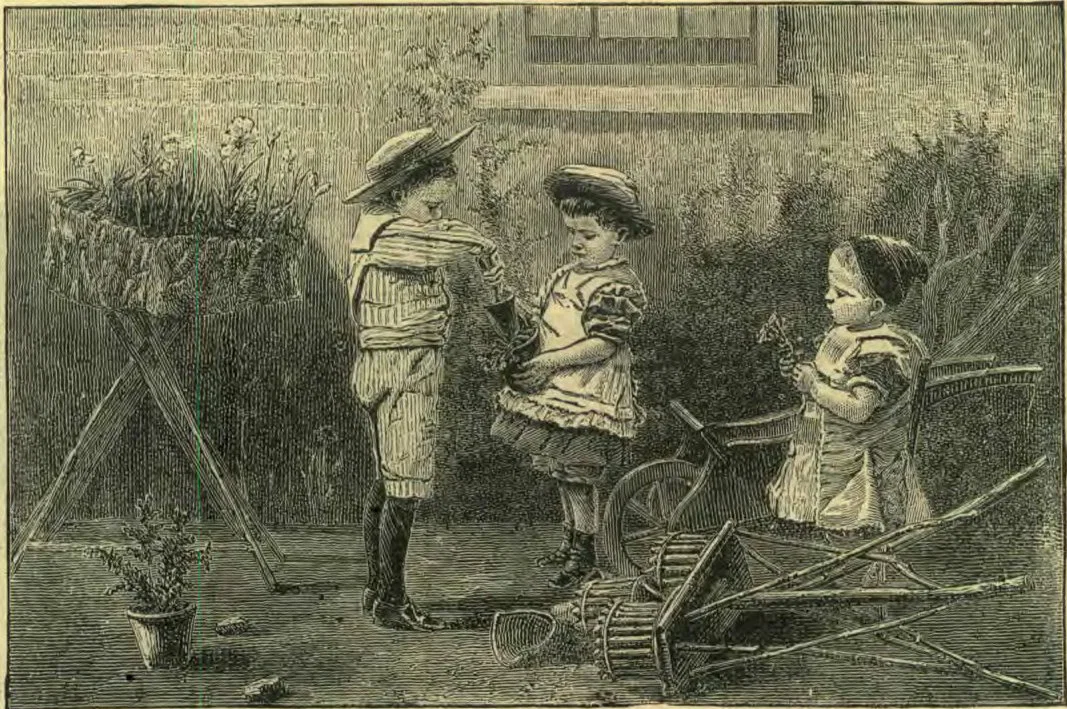
In the picture on this page, some little people are preparing their winter garden, may be on a larger plan than many of you can. They have, all ready for the window, a stand on which is a box full of growing plants, and they are filling pots besides. Even the youngest child has his plant ready to be set out. May be this little fellow upset the plant-stand, and broke his pot; but they will not refuse to give him something in which to place his plant.
By lining a box with old zinc or tin, so that it will not leak, and then filling it with good earth and a few plants, one can, with no expense but a little time, have a small flower garden in the house. On dark days it will drive dull care away, and it will give us some of God’s works to admire every day.
Some may not be able to have even this; but any one can have as much as one plant to look at, even if it is set out in a broken mug or dish. One plant can be easily protected from the cold, for, when the nights are very severe, it will not be much trouble to carry it to the cellar. If the weather is not too cold, you can save the plants from the frost, by pinning paper, one or more thicknesses, around them.
What if you do fail the first time, and do not keep your flowers through the long, cold winter? They will be a comfort while they last, and pay you well. Please tell us if this is not so. M. J. C.

KEEP YOUR HANDS CLEAN.

“Yes, I want some of those flowers,” said Joe, as he walked along by a fence, and saw some beautiful lilies in a garden inside. “I can put my hand in and pick some just as well as not.”
“But they’re not yours,” said a voice within his heart.
“I don’t care. I don’t think it’s fair that some folks have so many nice things, and other folks haven’t. We haven’t a single lily at home. Nothing but a few pinks and bachelor’s buttons. I don’t want ’em for myself, but for little Kitty, ’cause she’s sick.”
“And do you think Kitty would want flowers that were stolen?” said the voice.
“Pshaw! They don’t call it stealing when it’s just flowers,” said Joe very positively. “I’ll only get one stalk.”
He put his hand inside the paling.
“Quit it! quit it! quit it! quit it!” cried a sharp voice above his head.
Out came the hand with a jerk, and Joe sprang back, and looked up.
“Quit it! quit it! quit it!” cried the voice again. “Quit it! quit it! quit it!”
“I ain’t touching nothing,” said Joe, trying to see who might be among the thick leaves of the tree.
He could hear a little flutter of wings, and presently a bird came into sight, still twittering out its— “Quit it! quit it! quit it!”
“Well,” said Joe, laughing. “I think it’s time for me to quit, if a bird’s got to tell me to.”
“And I’m glad you told me in time,” he said, more seriously, looking back as he went on. “I’ve never taken a thing, even a flower, that didn’t belong to me. I can say that yet, but if you hadn’t stopped me, little bird, I never could have said it again. Mother says it leaves a blot on your hands if they ever take anything they ought not to,—a blot that only Jesus’ blood can wash away. I’m glad my hands are clean yet, and I’m going to try to keep ’em so.” —Little Star.

Letter Budget.

ALMA and LOTTIE THINIUS write from Johnson Co., Mo. They say: “We are two little girls, aged eight and six years. We live on Eld. Dan Jones’s place. It is lovely here. We can see all over the country. We have such beautiful flowers, and such nice fruit. We attend Sabbath-school when possible. I am in Book No. 4, and Lottie is in No. 3. We recite in the books at home, and in the INSTRUCTOR at the church. We never went to school; mamma teaches us at home. We have a blackboard, and study arithmetic, geography, and writing. We have both been through the ‘Story of the Bible.’ We have a little sister Olive, and a brother Eddie. We had three or four little gardens this summer, but the dry weather has hurt them some. We have sold over two dollars’ worth of vegetables out of them. We help mamma in the house, and take care of little Eddie. We take part in family worship, and try to serve God. Pray that we may be overcomers.”
LIZZIE M. HEPPE, of Butte Co., Cal., says: “I am staying with my uncle, aunt, and cousins. We are the only Sabbath-keepers here. Our Sabbath-school is about fifteen miles from here. As we cannot go to it, we have a Sabbath-school at home. We have a good teacher. Our lesson now is about crossing the Red Sea. One of my cousins is at Healdsburg, where she has a good chance to attend Sabbath-school. I milk the cows every night. We have seven head of cattle. I am making rag carpet. I have nine balls made, and have the tenth begun. My aunt says she will give me ten cents per pound for making it. It is not very hard work. I have a chicken which I call my missionary chicken. We are all busy cutting plums. The pits come out so easy it is just fun to eat them. The summer so far has not been very warm. Everybody likes the INSTRUCTOR very much. How is our letter box getting along now? I am in my fifteenth year. I am trying to be a good girl so I may meet you all in the resurrection.”
CLARA M. BYRD, of Cass Co., Iowa, says: “I often read the Budget, and thought I would like to write a letter. I have kept the Sabbath with my mother and sister since Christmas. I am twelve years old, and my sister is eight. We both go to school and study in the sixth reader. In Sabbath-school I study in Book No. 2, and my sister in Book No. 1. We live two miles from both the Sabbath and the day school. My mother was baptized last April. There is a church here of fifty members. I have a garden and twenty-four chickens. I am going to sell these, and give one tenth of it to the Lord. I want to keep all the commandments of God, and do good, that I may be saved.”
CLARA DEVENPORT writes her first letter, from Muskegon Co. She is ten years old, attends Sabbath-school and day school. She says: “I knit two pairs of socks, two pairs of mittens, and one pair of stockings last winter, and did it all myself. My two sisters and my brother were baptized last fall. I want to be a good girl, and meet all my good friends in heaven.”

THE SONG OF THE BEE.

Buzz, buzz, buzz! This is the song of the bee. His legs are of yellow, A jolly good fellow, And yet a good worker is he.
In days that are sunny, He's getting his honey; In days that are cloudy, He's hoarding his wax; On pinks and on lilies, And gay daffodilies, And columbine blossoms, He levies a tax.
Buzz, buzz, buzz! The sweet-smelling clover He humming hangs over; The scent of the roses Makes fragrant his wings.
He never gets lazy, From thistle and daisy, And weeds of the meadow Some treasure he brings.
Buzz, buzz, buzz! From morning's first gray light Till fading of daylight, He's singing and toiling The summer day through.
Oh! we may get weary, And think work is dreary; 'Tis harder by far To have nothing to do. —St. Nicholas.

You have reached the end of this edition.

The Youth’s Instructor · Sep 7, 1887