Your ShelfYour Projects

Signs of the Times, Vol. 24, No. 49.

OUR SACRIFICE

Signs of the Times

Dec 8, 1898

Pacific Press Publishing Company · Oakland, California · Dec 8, 1898

OUR SACRIFICE.
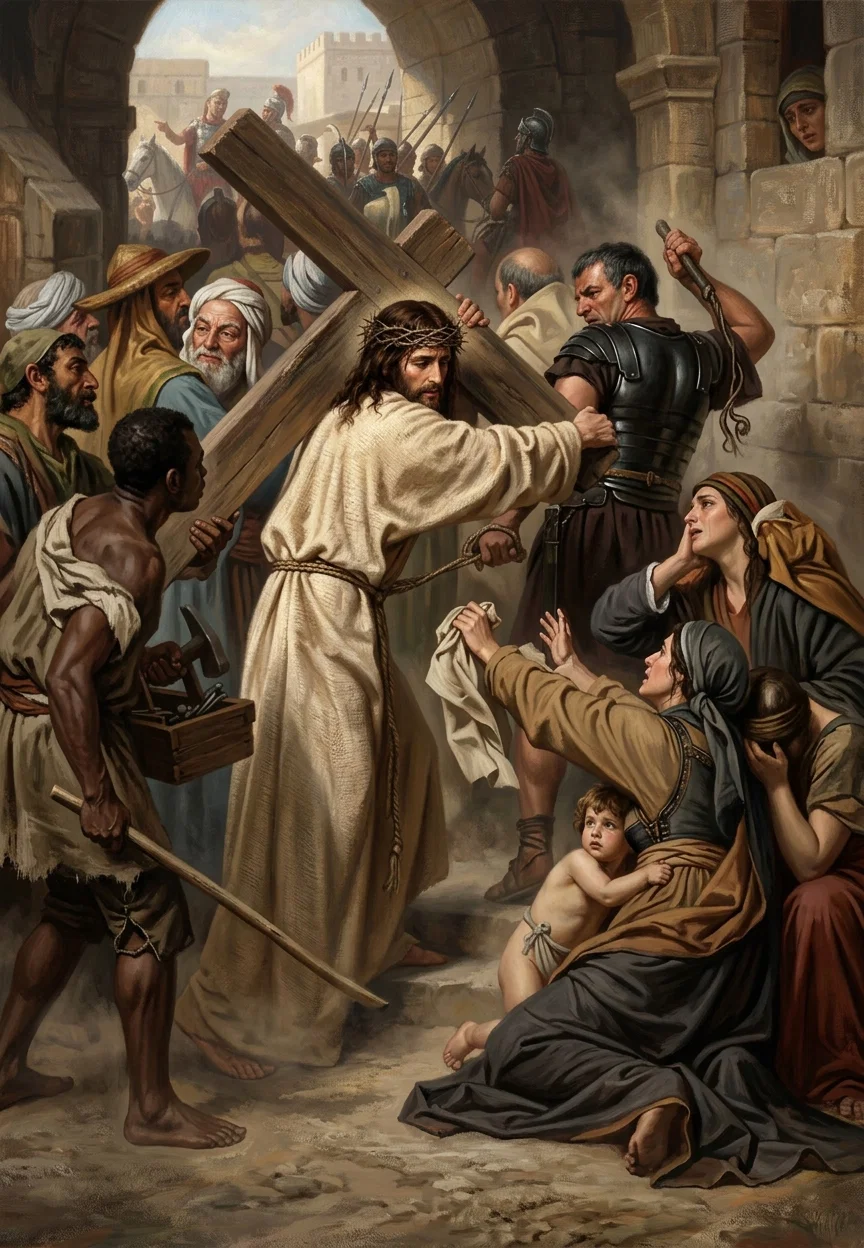
While the death of Christ appeared to be a hellish triumph over His humanity, it was a victory so full and broad and deep that it encompassed the world. Christ was cut off, but not for Himself. He died the just for the unjust, that He might bring many sons and daughters to God. Tho innocent and undeserving of punishment, our Substitute and Surety was brought under the curse and condemnation that should have been ours. He, the perfection of holiness, was arrayed in our defiled garments, that we might be clothed with His glorious righteousness.
“And there followed Him a great company of people, and of women, which also bewailed and lamented Him. But Jesus turning unto them said, Daughters of Jerusalem, weep not for Me, but weep for yourselves, and for your children.” Luke 23: 27, 28.
For three hours Christ hung upon the cross, gazed upon by thousands. Thousands heard the revilings of the priests and rulers; they heard the challenge, “Let Christ the King of Israel descend now from the cross, that we may see and believe.” They heard the taunt, “He saved others; Himself He can not save.” But, altho dying the ignominious death of the cross, Christ died as one who had endured the test and proving of God. He lost none of His divine power as a sin-pardoning Saviour. When the dying thief said, “Lord, remember me when Thou comest into Thy kingdom,” Jesus manifested His divine attributes. The repentant sinner need not wait until Christ shall receive His coronation. Before the spectators about the cross, Jesus shows that even in His suffering humanity He has power to forgive sin. Tho nailed to the cross, His hand is not weakened that it can not save. His ear is not heavy that it can not hear. Divinity flashes through humanity. From those pale and quivering lips the words are distinctly heard by the dying penitent and by all surrounding the cross, “Verily I say unto thee to-day, Thou shalt be with Me in paradise.” Through the veil of suffering humanity break forth the beams of the Sun of Righteousness to that poor, repentant soul. The dark cloud that has vailed Christ’s humanity is rent away, and mercy, love, and pardon, His power to save unto the uttermost all that come unto Him, are made manifest.
This was a rebuke to His crucifiers and the apparently heedless mob, who were taking up the words of mockery of the priests and rulers.
While in the power of deceived religious zealots, who were closing the door of paradise to themselves, He, the sin-pardoner, opened the door for the entrance of the thief when he should rise from the dead with those who believe on Christ. At the very time when Satan and all his synagog united with priests and rulers to humiliate Him who made the earth and all that is therein, He revealed His Godhead, His redeeming power, and bestowed the most precious gift that can come to mortal man. He spoke the words of life-giving power at the very time when principalities and powers and the rulers of the darkness of this world thought that they had laid His kingly claim in the dust. His kingly power is not exercised in coming down from the cross to give proof that He is the Son of God; but He shows that in His death is life-giving power for all who will believe in Him. He asserts His divine prerogative, and assures the poor sinner, “Verily I say unto thee to-day, Thou shalt be with Me in paradise.”
The stubborn priests and rulers may taunt Him, and ridicule His claims of sonship with God. They may mock Him in His dying agony, and forever close to themselves the gate of paradise, notwithstanding their claims to piety and knowledge; but the thief who has received Him, who has believed on Him in His humiliation, shall have life with Christ in the paradise of God.
“And when the sixth hour was come, there was darkness over the whole land until the ninth hour.” Not only did the darkness enshroud the immediate vicinity of the cross, but “there was darkness over the whole land.”
God dwells in the thick darkness; He hides His glory from human eyes. The Father, with His heavenly angels, was inclosed in that thick darkness. God was close beside His Son, tho not manifesting Himself to Him or to any human being. Had one ray of His glory and power penetrated the thick darkness that enveloped Him, every human spectator would have been destroyed. And in that thick darkness God hid from prying eyes the last human agony of His Son. He clothed nature with sackcloth, that she might not look upon her suffering, dying Author in His last humiliation.
All who had seen Christ during His trial had been convicted of His loyalty and royal character. That face, once beheld by humanity, was never forgotten. As in Cain’s face was expressed his guilt as a murderer, so in the face of Christ were revealed innocence, serenity, benevolence, the image of God. But His accusers would not heed the signet of heaven, and that countenance was hidden by the mantle of God.
“And at the ninth hour Jesus cried with a loud voice, saying, Eloi, Eloi, lama sabachthani? which is, being interpreted, My God, My God, why hast Thou forsaken Me? And some of them that stood by, when they heard it, said, Behold, He calleth Elias. And one ran and filled a sponge full of vinegar, and put it on a reed, and gave Him to drink, saying, Let alone; let us see whether Elias will come to take Him down.” “And when Jesus had cried with a loud voice, He said, Father, into Thy hands I commend My spirit; and having said thus, He gave up the ghost.”
The conviction forced upon many at the time of Christ’s trial, at the time when the three hours’ darkness enshrouded the cross, and when His last words were uttered, was as seed sown that ripened into harvest, when, after His ascension, the Gospel was proclaimed by His disciples. The shaking earth, the piercing cry, the sudden death, forced from many the words: “Assuredly this was a righteous man.” “Truly this was the Son of God.” Many who had scoffed and jeered at the Son of God were now terribly afraid. They hastened from the scene, stumbling, falling, in awful terror lest the shaking earth, the rent and trembling rocks, should put an end to their own lives.
When Christ on the cross cried out, “It is finished,” the veil of the temple was rent in twain. This veil was significant to the Jewish nation. It was of most costly material, of purple and gold, and was of great length and breadth. At the moment when Christ breathed His last, there were witnesses in the temple who beheld the strong, heavy material rent by unseen hands from top to bottom. This act signified to the heavenly universe, and to a world corrupted by sin, that a new and living way had been opened to the fallen race, that all sacrificial offerings terminated in the one great offering of the Son of God. He who had hitherto dwelt in the temple made with hands, had gone forth never again to grace it with His presence.
In the light and assurance of His Word, and through His atoning sacrifice, we may see how God can vindicate His justice. He opens our eyes to behold His holiness in its true luster, and yet justifies the sinner who comes to Him by Christ. In the pardon given to the dying thief, it was made manifest that Christ bore our sins in His own body on the tree. He bore our griefs and sorrows. That heart of human and divine love was exercised for the relief of the woe of the world.
The Father laid our sins where none but His own eyes could discern them. And as He hid His face from the innocence of Christ, so He will hide His eyes from the guilt of the believing sinner, because of the righteousness imputed to him. The righteousness of Christ laid upon us will draw upon us the most precious blessings in this life, and will bestow upon us everlasting life in the kingdom of God.
MRS. E. G. WHITE.

A Zealous Persecutor Arrested

Chapter I: 13–24.

A Zealous Persecutor Arrested.

The two lessons already studied, embracing Gal. 1:11–12, have shown us the subject of the epistle and the gravity of the situation that called it forth. The epistle itself, we have seen, deals with nothing less than the whole Gospel, perfect and complete, namely, Jesus Christ, the crucified and risen Redeemer, “mighty to save” from the evil of this present world. That which called for a clear, forcible, and direct statement of the Gospel, was the fact that some were perverting it, doing the accursed work of leading the Galatian brethren away from God and Christ, and causing them to rest in a false hope of salvation, which could end only in their destruction. As a contrast to the false gospel which the Galatians were receiving from men, the apostle assures them that the Gospel which he preached did not come from men, but that he received it by the direct revelation of Jesus Christ. As proof of the statement that he was not indebted to any man for the Gospel, he proceeds, in the verses which follow, to give an outline of his history before and after he became a Christian. Read them in connection with the preceding portion of the chapter:—
“For ye have heard of my conversation [manner of life] in time past in the Jews’ religion, how that beyond measure I persecuted the church of God, and wasted it; and profited in the Jews’ religion above many my equals in mine own nation, being more exceedingly zealous of the traditions of my fathers. But when it pleased God, who separated me from my mother’s womb, and called me by His grace, to reveal His Son in me, that I might preach Him among the heathen; immediately I conferred not with flesh and blood; neither went I up to Jerusalem to them which were apostles before me; but I went into Arabia, and returned again unto Damascus. Then after three years I went up to Jerusalem to see Peter, and abode with him fifteen days. But other of the apostles saw I none, save James the Lord’s brother. Now the things which I write unto you, behold, before God, I lie not. Afterwards I came into the region of Syria and Cilicia; and was unknown by face unto the churches of Judea which were in Christ; but they had heard only, That he which persecuted us in times past now preacheth the faith which once he destroyed. And they glorified God in me.” Gal. 1:13–24.
“Concerning Zeal, Persecuting the Church.”—This is what Paul said of himself, in his Epistle to the Philippians. How great his zeal was he himself tells in several places. In the text before us, we read that he persecuted the church of God “beyond measure,” and “wasted it,” or, as in the Revision, “made havoc of it.” Before Agrippa he said, “I verily thought with myself, that I ought to do many things contrary to the name of Jesus of Nazareth. Which thing I also did in Jerusalem; and many of the saints did I shut up in prison, having received authority from the chief priests; and when they were put to death, I gave my voice against them. And I punished them oft in every synagog, and compelled them to blaspheme; and being exceedingly mad against them, I persecuted them even unto strange cities.” Acts 26:9–11. In an address to the Jews in Jerusalem, who knew his life, he said, “I persecuted this way unto the death, binding and delivering into prisons both men and women.” Acts 22:4. This he did because, as the previous verse says, he was “zealous toward God.” So full of this sort of zeal was he that he breathed nothing else but “threatening and slaughter.” Acts 9:1.
It seems almost incredible that any one professing to worship the true God, can have such false ideas of Him as to suppose that He is pleased with that kind of service; yet Saul of Tarsus, one of the most bitter and relentless persecutors of Christians that ever lived, could say years afterward, “I have lived in all good conscience before God until this day.” Acts 22:1. Altho kicking against the pricks (Acts 9:5), and endeavoring to silence the growing conviction that would force itself upon him as he witnessed the patience of the Christians, and heard their dying testimonies to the truth, Saul was not wilfully stifling the voice of conscience. On the contrary, he was striving to preserve a good conscience, and so deeply had he been indoctrinated with the Pharisaic traditions, that he felt sure that these inconvenient prickings must be the suggestions of an evil spirit, which he was in duty bound to suppress. So the prickings of the Spirit of God had for a time only led him to redouble his zeal against the Christians. Of all persons in the world, Saul, the self-righteous Pharisee, had no bias in favor of Christianity.
Paul’s Profiting.—Paul “profited,” made advancement, “in the Jews’ religion” above many of his equals, that is, those of his own age, among his countrymen. He had possessed every advantage that was possible to a Jewish youth. “An Hebrew of the Hebrews” (Phil. 3:5), he was nevertheless a free-born Roman citizen (Acts 22:26–28). Naturally quick and intelligent, he had enjoyed the instruction of Gamaliel, one of the wisest doctors of the law, and had been “taught according to the perfect manner of the law of the fathers.” Acts 22:3. After the “straitest sect” among the Jews, he lived a Pharisee, and was “a Pharisee of the Pharisees,” so that he was “more exceedingly zealous of the traditions” of the fathers than any other of his class. Grown to manhood, he had become a member of the great council among the Jews,—the Sanhedrim,—as is shown by the fact that he gave his vote (Acts 26:10, R.V.) when Christians were condemned to death. Added to this, he possessed the confidence of the high priest, who readily gave him letters of introduction to the rulers of all the synagogs throughout the land. He was, indeed, a rising young man, on whom the rulers of the Jews looked with pride and hope, believing that he would contribute much to the restoration of the Jewish nation and religion to their former greatness. There had been a promising future before Saul, from a worldly point of view; but what things were gain to him, those he counted loss for Christ, for whose sake he suffered the loss of all things. Phil. 3:7, 8. What caused this great change?—Nothing less than the power of the everlasting love and patient forbearance of God.
“Separated unto the Gospel of God.”—These are the words with which Paul described himself in the Epistle to the Romans. “Called to be an apostle, separated unto the Gospel of God.” Rom. 1:1. So here he says that God “separated me from my mother’s womb, and called me by His grace.” Gal. 1:15. That God chose Saul to be an apostle, before Saul himself had any thought that he should ever be even a Christian, is evident from the sacred narrative. On his way to Damascus, whither, “breathing out threatening and slaughter,” he was proceeding with full authority to seize, bind, and drag to prison all Christians, both men and women, Saul was suddenly arrested, not by human hands, but by the overpowering glory of the Lord. Three days afterward the Lord said to Ananias, when sending him to give Saul his sight, “He is a chosen vessel unto Me, to bear My name before the Gentiles.” Acts 9:15. God arrested Saul in his mad career of persecution, because He had chosen him to be an apostle. So we see that the pricks against which Saul had been kicking, were the strivings of the Spirit to turn him to the work to which he had been called.
But how long before this had Saul been chosen to be the messenger of the Lord?—He himself tells us that he was separated from his mother’s womb. From his birth Saul had been “separated unto the Gospel of God.” This was no new thing. The work of Samson and of John the Baptist was laid out for them before they were born. See Judges 13:2–14; Luke 1:13–17. Jeremiah was chosen before his birth to be a prophet of God. Jer. 1:4, 5. Pharaoh, the haughty, defiant king of Egypt, had also been chosen to make the name of God known throughout all the earth (Ex. 9:15, 16, R.V.), but he refused to do it as the acknowledged servant of the Lord, and so the work had been accomplished through his obstinacy.
These things but remind us that chance does not rule in this world. It is as true of every soul of man born into this world, as it was of the Thessalonians, that “God hath from the beginning chosen” them “to salvation through sanctification of the Spirit and belief of the truth.” 1 Thess. 2:13. It rests with every one to make that calling and election sure. And He who willed that all men should be saved, and come to a knowledge of the truth (1 Tim. 2:3, 4), has also appointed “to every man his work” (Mark 13:34). He who leaves not Himself without witness even in the inanimate creation (Acts 14:17; Rom. 1:20), would fain have man, His highest earthly creation, willingly give such witness to Him as can be given only by human intelligence. All men are chosen to be witnesses for God, and to each is his labor appointed. All through life the Spirit is striving with every man, to induce him to allow himself to be used for the work to which God has called him. Only the judgment day will reveal what wonderful opportunities men have recklessly flung away. Saul, the violent persecutor, became the mighty apostle; who can imagine how much good might have been done by the men whose great power over their fellows has been exerted only for evil, if they had yielded to the influence of the Spirit? Not every one can be a Paul; but the thought that each one, according to the ability that God has given him, is chosen and called of God to witness for Him, will, when once grasped, give to life a new meaning.
The Revelation of Christ.—“When it pleased God, . . . to reveal His Son in me.” Note the exact words. The apostle does not say that it pleased God to reveal His Son to him but in him. Moreover, he does not say that it pleased God to put His Son into him, but to reveal His Son in him. There is a great truth in this, which stands out very plainly in connection with some other texts.
Read the whole of Deuteronomy 30. There we see that two things were placed before the people for them to choose between, namely, life and good, and death and evil. This, together with the fact that they were exhorted to keep the commandments of God, shows that they had not yet attained to righteousness. Then in verses 11–14 we read that the commandment is not far off so as to make it necessary for some one to bring it to them, in order that they might do it; “but the Word is very nigh unto thee, in thy mouth, and in thy heart, that thou mayest do it.”
We see, therefore, that the Word is in the hearts of men before they do it, and that it is there in order that they may do it. But what is the Word?—Read John 1:1–14, where we learn that the Word is God, because the only-begotten Son of God. “And the Word was made flesh.” That this is what is meant in the passage just quoted in Deuteronomy, is seen from Rom. 10:6–9, where it is quoted, and the Word is plainly declared to be Christ. Christ, then, dwells in the heart, in the flesh, of every man, and has come thus near to all men in order that they may be made the righteousness of God. Most men are ignorant of this divine presence, and live as tho God were not, and that they were their own creators and preservers. But when the Spirit of truth brings a man to the knowledge of the truth, then Christ dwells in his heart, not as hitherto, unappreciated and unrecognized, but “by faith.” Eph. 3:17. Then is Christ revealed in him, and he fulfils the divine purpose of showing forth the excellencies of Him that called him out of darkness into His marvelous light. 1 Peter 2:9. Only by such a revelation of Christ in a man can he preach Him among the heathen; with that revelation, his whole life is a Gospel sermon, even tho he does not utter discourses. So we see that the work of the human preacher is exactly the same as that of the heavens: to declare the glory of God (Ps. 19:1–5)—and it is to be done in the same manner.
Conferring with Flesh and Blood.—“Immediately I conferred not with flesh and blood.” This statement is made for the purpose of showing that the apostle had not got the Gospel at second hand. He saw Christ, and accepted Him; then he went to Arabia, and came back to Damascus; and not till three years after his conversion did he go up to Jerusalem, where he stayed only fifteen days, and saw only two of the apostles. Moreover, the brethren were afraid of him, and would not at first believe that he was a disciple, so that it is evident that he did not receive the Gospel from any man.
But there is much to learn from Paul’s not conferring with flesh and blood. To be sure, he had no need to, since he had the Lord’s own Word; but such a course as his is by no means common. For instance, a man reads a thing in the Bible, and then must ask some other man’s opinion before he dare believe it. If none of his friends believe it, he is fearful of accepting it. If his pastor or some commentary explains the text away, then it goes; flesh and blood gain the day against the Spirit and the Word.
Or it may be that the commandment is so plain that there is no reasonable excuse for asking anybody what it means. Then the question is, “Can I afford to do it? will it not cost too much sacrifice?” The most dangerous flesh and blood that one can confer with is one’s own. It is not enough to be independent of others; in matters of truth one needs to be independent of one’s self. “Trust in the Lord with all thine heart; and lean not unto thine own understanding.” Prov. 3:5. “He that trusteth in his own heart is a fool.” Prov. 28:26. When God speaks, the part of wisdom is to obey at once, without counsel even of one’s own heart. The Lord’s name is “Counsellor” (Isa. 9:6), and He is “wonderful in counsel.” Hear Him.
Paul’s Visit to Arabia.—In the record of Paul’s conversion, in Acts 9, we are told that as soon as he was baptized he began to preach in the synagogs, “proving that this is very Christ. And after that many days were fulfilled, the Jews took counsel to kill him,” but, being let down over the wall by night in a basket, he escaped them, and came to Jerusalem. Verses 22–26. If we had no other record than this, we should not know but that Paul spent all the time in Damascus until he returned to Jerusalem; but in Gal. 1:17, 18 we learn how long a time those “many days” cover, and that in the three years Paul visited Arabia. Returning to Damascus from Arabia, he continued preaching until his earnestness and power called down on him the wrath of the Jews, and he was obliged to flee for his life. Yet in all this three years’ preaching, Paul never saw any other apostle.
Paul’s Miraculous Conversion.—There is no question that Paul’s conversion was a miracle; but so is every conversion. Men seem to think that Paul’s conversion had something more of the miraculous in it than ordinary conversions; but the fact is that exactly the same elements entered into Paul’s conversion as in all other conversions. It was more than ordinarily striking, to be sure, because Paul was a more than ordinarily hard case to deal with, and was called to, as he was fitted for, an extraordinary work. Paul saw the Lord, and thereby learned his own wretched condition; this at once humbled him, and he accepted the Lord. That was the whole of it, and it is the same thing that occurs in every conversion, altho not necessarily with the same outward manifestations.
“But was it not marvelous that Paul should have been able at once to preach Christ so powerfully and convincingly?”—Indeed it was, as it is marvelous that any man can preach Christ. That anybody should be able to preach Christ in very truth, involves no less a mystery than Christ manifest in the flesh. But do not let anybody suppose that Paul got his knowledge instantaneously, without any study. Remember that he had all his life been a diligent student of the Scriptures. It was not an uncommon thing for a rabbi to be able to repeat the greater portion or the whole of the Hebrew Scriptures from memory; and we may be sure that Paul, who had made more advancement than any others of his age, was as familiar with the words of the Bible as an ordinary schoolboy is with the multiplication table. But his mind was blinded by the traditions of the fathers, which had been drilled into him at the same time. The blindness which came upon him when the light shone round him on the way to Damascus, was but a picture of the blindness of his mind; and the seeming scales that fell from his eyes when Ananias spoke to him, indicated the shining forth of the Word within him, and the scattering of the darkness of tradition. Paul’s case was very different from that of a new convert who had never read or studied the Bible.
The Persecutor Preaching.—Compare the statements in Gal. 1:18–22 with Acts 9:26–30; 22:17–21. Circumstances rendered it impossible that Paul should get any teaching from the Jewish Christians. It was not necessary, to be sure, and it was so ordered that all could see that he was taught of God, and not of man. So for years after his conversion he was “unknown by face unto the churches of Judea which were in Christ; but they had heard only, That he which persecuted us in times past now preacheth the faith which once he destroyed,” or, “of which he made havoc.” And they glorified God in him. That is what God designs shall be done in each one of us.
In view of the case of Saul of Tarsus, let no one look on any opposer of the Gospel as incorrigible. Those who make opposition are to be instructed with meekness; for who knows but that God will give them repentance to the acknowledgment of the truth? One might have said of Paul: “He has had the light as clearly as any man can have it. He has had every opportunity; he not only heard the inspired testimony of Stephen, but he heard the dying confessions of many martyrs; he is a hardened wretch, from whom it is useless to expect any good.” Yet that same Saul became the greatest preacher of the Gospel, even as he had been the most bitter persecutor. Is there a malignant opposer of the truth? Do not strive with him, and do not reproach him. Let him have all the bitterness and strife to himself, while you hold yourself to the Word of God and to prayer. It may not be long till God, who is now blasphemed, may be glorified in him. E. J. Waggoner.

THE PROMISES.

PRECIOUS are the promises of God. They are like pure, sparkling fountains that He has placed along our way as we journey to the heavenly land.
It is said that there are more than thirty thousand Bible promises. They meet every condition in life, and if we search, we shall find those adapted to our individual needs. One who sustained a physical injury, maiming him for life, remarked that no promise gave him such a thrill of joy as this, “The lame” shall “leap as an hart.” More than thirty years of suffering and blindness taught a sister to lean upon the promise, especially comforting to her, “Thine eyes shall see the King in His beauty.”
In the great battle against sin we may lean upon the strong promise, “I the Lord thy God will hold thy right hand, saying, Fear not; I will help thee.”
It is our high privilege to live by “every word that proceedeth out of the mouth of God.”
ANNIE F. CLARK.
Cambridge, Maine.

THE DIVINE HUMANITY.

“This Golden One, This spotless, stainless, sinless, blameless Christ, Whom none did once convince of one small severance From perfectness, nor ever shall, so strong The elements obey Him; so divine The devils worshiped; so with virtue charged The touch of Him was health; so masterful The dead came back upon His call; so mild The little children clustered at His knee, And nestled trustful locks on that kind breast Which leans to-day on God’s!” —The Light of the World.

THE PUNISHMENT OF THE WICKED.

The Rev. Dr. Theodore Clapp, in his autobiography says he had preached at New Orleans a zealous sermon for endless punishment. After the sermon, Judge W. (who, he says, was an eminent scholar, and had studied for the ministry, but relinquished his purpose because he could not find the doctrine of endless punishment and kindred dogmas) asked him to make out a list of texts in the Hebrew or Greek on which he relied to prove the doctrine.
The doctor then gives a detailed account of his studies in search of texts to give to the judge. He began with the Old Testament in the Hebrew, and prosecuted his study during that and the succeeding year; and yet he was unable to find therein so much as an allusion to any suffering after death. In the dictionary to the Hebrew language he could not discern a word signifying hell, or a place of punishment in a future state; and to his utter astonishment it turned out that orthodox critics of the greatest celebrity were perfectly familiar with these facts. He was compelled to confess to the judge that he could not produce any Hebrew text; but he was still sanguine that the New Testament would furnish what he had sought for without success in Moses and the prophets. He prosecuted his study of the Greek of the New Testament eight years, with the result that he could not name a portion of it, from the first verse in Matthew to the last of Revelation, which, fairly interpreted, affirms that a portion of mankind will be eternally miserable.
The doctor concludes by saying that it is an important, most instructive fact, that he was brought into his present state of mind (the repudiation of the dogma) by the Bible only—a state of mind running counter to all the prejudices of his early life, of parental precept, of school, theological seminary, and professional caste. —Judge Halsted, in Theology of the Bible.
Continue reading: THE DECALOGUE