Golden Text.—“Return unto Me, and I will return unto you, saith the Lord of hosts.”Mal. 3:7. “Humble yourselves in the sight of the Lord, and He shall lift you up.”James 4:10.
Lesson I.—Reformation under Asa.2 Chron. 14:2–12. Parallel account, 1 Kings 14:2 to 15:24. Asa was the third king of Judah, being the son of Abijah, and grandson of Rehoboam. He reigned forty-one years, and the general character of his reign was that “he did that which was good and right in the eyes of the Lord his God.” He tried to overcome the influence of the idolatry that had been encouraged by his father and grandfather, and acted so wisely that God smote his enemies before him and delivered the kingdom.
Lesson II.—Jehoshaphat’s Good Reign.2 Chron. 17:1–10. Of Jehoshaphat, the son of Asa, it is said that the Lord was with him, “because he walked in the first ways of his father David, and sought not unto Baalim; but sought to the Lord God of his father, and walked in His commandments, and not after the doings of Israel.” But he made the fatal mistake of having his son and successor, Jehoram, married to Athaliah, daughter of Ahab and Jezebel, of Israel.
Lesson III.—The Temple Repaired.2 Chron. 24:4–13. Joash was the grandson of Jehoram and Athaliah. When his father Ahaziah died, Athaliah usurped the throne, and thought to put to death all her son’s children, so they would be out of her way. She supposed she had succeeded, but the infant Joash and his nurse were hidden in the temple by his aunt, who was the wife of Jehoiada, the high priest. By the time Joash was seven years old, his grandmother’s reign had become so corrupt that the people revolted. Joash was then brought out from his hiding-place, proclaimed king, and Athaliah was slain. While Jehoiada lived the young king was under his influence. So the house of the Lord was repaired, and the worship of the true God was well established once more.
Lesson IV.—Isaiah Called to Service.Isa. 6:1–13. The time of this vision of the prophet Isaiah was in “the year that King Uzziah died,” only a few years from the founding of Rome and the rise of Corinth. Hosea in Israel and Nahum and Micah in Judah were contemporaneous with Isaiah, whose home was in Jerusalem. His father’s name was Amoz, and his prophecies were “in the days of Uzziah, Jotham, Ahaz, and Hezekiah, kings of Judah.”
Lesson V.—Messiah’s Kingdom Foretold.Isa. 11:1–10. This vision covers the first advent of our Lord, and also His second coming and reign of righteousness in the new earth. See also 2 Peter 3:9–13.
Lesson VI.—Hezekiah’s Great Passover.2 Chron. 30:1–13. Hezekiah was the good son of a bad father, King Ahaz. “He trusted in the Lord God of Israel; so that after him was none like him among all the kings of Judah, nor any that were before him.” 2 Kings 18:5. The extensive spiritual revival under his reign was inaugurated by a great Passover; “for they had not done it of a long time” according to directions. He sent out invitations not only through his own kingdom, but also into the kingdom of Israel, and there came “a very great congregation.”
Lesson VII.—The Assyrian Invasion.2 Kings 19:20–22, 28–37. This lesson teaches in a forcible manner that God answers the prayer of faith, and that He sometimes uses the enemies of His people as a rod wherewith to chastise His erring children and bring them back when they go astray. Even when that enemy thinks he is working against the God of Israel, God is, through him, working out His own will. He makes the wrath of man to praise Him.
Lesson VIII.—Manasseh’s Sin and Repentance.2 Chron. 33:9–16. Manasseh was the fourteenth ruler of Judah. Altho he was the son of the good Hezekiah, yet he “made Judah and the inhabitants of Jerusalem to err, and to do worse than the heathen, whom the Lord had destroyed before the children of Israel.” His was a striking instance of reaction from the example of a pious father, of sin, chastisement, repentance, personal reformation, and effort to repair evil, with partial outward success, but leaving a substratum of evil results to be uncovered at a later day.
Lesson IX.—The Two Paths.Prov. 4:10–19. “The path of the just [or ‘way of wisdom’] is as the shining light, that shineth more and more unto the perfect day.” “The way of the wicked [or ‘path of the wicked’] is as darkness; they know not at what they stumble.”
Lesson X.—The Book of the Law Found.2 Kings 22:8–20. Josiah began to reign at the age of eight years. At sixteen he gave his heart to the Lord. Four years later he set about repairing the house of the Lord, and in some hidden nook the book of the law was found. The king told the high priest and others to inquire of the Lord concerning the matter. So they went to Huldah, a prophetess, to make the inquiry. The Lord answered through this humble instrument, and assured Josiah that He would bring evil upon the people because of their sins; but because he had humbled himself before the Lord, the evil should not come in his day.
Lesson XI.—Trying to Destroy God’s Word.Jer. 36:20–32. In the days of Jehoiakim king of Judah, the wickedness of the king and people became so great that God sent a special warning by Jeremiah the prophet. This was written on a roll by Baruch the scribe, and read to the people. Some princes heard the reading and told the king about it. He had the roll brought into his palace to be read to him; but when three or four leaves had been read, the king took the roll and cut it in pieces, and threw it into the fire. But it could not be destroyed, for the Lord directed the prophet to rewrite it, and add more to it. “The Word of the Lord endureth forever.”
Lesson XII.—Captivity of Judah.Jer. 52:1–11. The captivity of Judah in Babylon, which began in the reign of Jehoiakim, was completed in the reign of his brother Zedekiah, who was the last king of Judah. At this time the city of Jerusalem was utterly destroyed, and Zedekiah’s eyes were put out, and he was made a prisoner in Babylon until the day of his death.
THE YOUNG CHRISTIAN
will find “Steps to Christ” one of the most instructive and precious volumes he has ever read. Its object is to trace the different steps necessary to “rejoicing in the Lord,” which is the title of the last chapter. It has enjoyed an enormous circulation, and is now published in ten different languages.
PRICE, 50 Cents
Post-paid
We have a few copies of the original Presentation Edition, bound in white with silver edges. Price, $1.00, post-paid.
PACIFIC PRESS PUBLISHING CO.
New York City OAKLAND, CAL. Kansas City, Mo.
The Winning of Margaret
How Margaret and her skeptical friend Ralph were converted. A well-told story. Price, $1.00 per 100.
PACIFIC PRESS PUBLISHING CO.
New York City Oakland, Cal. Kansas City, Mo.
PRAYER
By A. T. Pierson
By A. T. Pierson, will bring new life and light into your church, missionary society and home. Price, $1.00 per 100
PACIFIC PRESS PUBLISHING CO.
New York City Oakland, Cal. Kansas City, Mo.
SABBATH SCHOOL Maps
4 A. Lands of the Bible, especially the travels of St. Paul, 52x71 inches . . . . . . . . . . . . . . . . . . . . $5 00
4 B. Same as above, reduced to one-half size . . . 3 00
4 C. Same as above, but reduced to 36x26 inches . . 1 00
Pacific Press Pub. Co., Oakland, Cal.
39 Bond St., 14 to 18 West Fifth St., New York City. Kansas City, Mo.
CALIFORNIA SCENERY, No. 31.—Presidio of San Francisco. The Presidio (garrison) of San Francisco was established in 1776. The formal celebration of the founding was held September 17, the day known in the Catholic calendar as that of the Impression of the Wounds of St. Francis, the chosen patron of the Presidio. The establishment of the place was in the name of Charles III., king of Spain. It is situated on a beautifully-sloping site on the north end of the San Francisco peninsula, commanding the bay, and about two miles inside the Golden Gate. It is now a well-improved garrison, with accommodations for several thousand troops, and ample parade and drill grounds.
THE SOCIABLE TO DEACON PEASLEY’S.
By Priscilla Ann Baker
(Concluded.)
Baker churned fur me in the mornin’, an’ I baked the bread I had started, an’ a big crockful of cookies, an’ about half past nine we wus to Hugh’s ag’in. Him an’ Nathan (he’s next to Ruth) wus liftin’ their late pertaters, an’ so Baker fell to an’ helped ’em. I went in an’ foun’ Ruth powerful weak an’ pale, but up tryin’ to make beds what time Robbie didn’t have her tyin’ strings to cheers or somethin’ else fur him. Sive an’ Janie’d gone to school. I give her my bunnet, an’ nursed Robbie a bit, an’ then I wanted her to lay down an’ let me finish; but she said she wouldn’t have no chill that day, an’ I couldn’t coax her to give up.
I swep’ the house all over, tho, an’ we made some crab-butter she’d ben wantin’ to, an’ I ironed too—they’d hired the wash done.
She looked a heap brighter when she see the cookies an’ a couple of loaves I’d brung along, an’ says, “I hain’t be’n so I could bake raised bread, bein’ down so much, an’ I jest can’t make good biscuit. How do you make ’em, Mis’ Baker?”
Pore little thing! I told her I’d do their bakin’ till she got well ag’in, an’ she must come over an’ take some receipts outen my new cook-book that was give me; an’ then I fell to an’ made a mess of biscuits jest to show her. We never said nothin’ about the sociable till I wus washin’ dishes. (I’d made Ruth lay down an’ rest.)
Then Hugh tol’ us as how they’d writ frum the ’sylum his wife wusn’t no better, nur likely to be fur a spell. He seemed wonderful hurt over that sociable, sayin’ he didn’t see what pleasure it could be to the parson an’ Deacon Peasley an’ all of ’em to act so. He wusn’t mad towards none of ’em, but ’peared to be mighty creshed.
We p’inted him to the God of all comfort, an’ after talkin’ awhile longer went acrost town to see Mis’ Bailey an’ her two. Her boys is nine an’ ’leven, an’ powerful bad if all we hear’s so. She tries to teach ’em better, but their pa bein’ away, an’ Mis’ Bailey gone nigh about all the time earnin’, it hain’t much wonder they run on the street an’ learn every meanness that’s a-goin’—an’ there’s always a plenty a-goin’, ’pears like.
Mis’ Bailey’s man wus a lawyer, an’ the cleverest, best-heartedest fellow you ever see; as sharp as chain lightnin’, too; fur them as could jedge said he’d go to Congress some day. But, land! he never; he would drink so. He wus always good to her, tho, an’ would quit now an’ ag’in to please her; but he never asked God’s help, an’ ’twouldn’t be long till he’d go down ag’in, the other lawyers an’ jedges bein’ always at it, you know. Well, doin’ so much head-work (fur he wus jest reshed all the time), an’ drinkin’ by spells all along too, kinder fired his brain, an’ he got powerful crazy. By the time he wus took away to the ’sylum (she wouldn’t let ’em at first) they’d run through about everything, even sellin’ the pianner; fur his money’d be’n as free as water fur every pore or sick body.
Mis’ Bailey hain’t one to set an’ warm her hands to somebody else’s fire, tho, if she wus brung up in New York, so she went to givin’ paintin’ an’ music lessons, not only to Bean Blossom, but to towns all ’round; an’ that’s what took her from home so much. As it wus a Wednesday, Baker went home, an’ left me till after prayer-meetin’, so Mis’ Bailey an’ me had a good long talk. She’d be’n to home all that day, washin’ an’ cleanin’ an’ bakin’ to do till another spare day. I had her not to stop her work fur me, an’ I set in the kitchen, an’ we talked away till about 5 o’clock, when she got through, an’ set down by me a spell. Then I brung up about the sociable, an’ I see right away that that wus what had made her so sober-like, tho she’d tried to be entertainin’ to me.
I hadn’t said much till she jest grabbed me round the neck an’ broke out: “You blessed old woman! I thought last night I didn’t have a friend in this town. I didn’t sleep a bit till after 3 o’clock, thinkin’ about poor Frank, an’ prayin’ fur him,” says she. An’ then she laid there on my bosom an’ sobbed like her heart wus broke.
I quieted an’ talked to her a spell about it all, an’ then told her how I’d be’n layin’ by some money along outen the butter, an’ havin’ a right smart sprinklin’ of turkeys an’ chickens to sell about Thanksgivin’ an’ after, I’d be’n ’lowin’ to have her paint me a good-sized pictur’ to hang over the sofy into the front room. That he’ped her furgit, you know, an’ she promised to put some big mountains an’ pine trees an’ a waterfall into it, an’ have it done anyway by the 5th of December, Baker’s birthday.
When the boys come in we e’t supper, washed dishes, an’ all went to prayer-meetin’. They wus singin’ when we went in, an’ Parson Jones read a chapter, explainin’ it along, an’ then he said that after Deacon Williams would pray, anybody that felt moved to sing or speak should be free to do so. Deacon Williams prayed, an’ after we’d sung ag’in, I riz up to speak, fur I couldn’t wait no longer.
“I’ve got a burden onto my mind,” I begun, “an’ as it concerns the hull church, I feel to mention it. It’s be’n a-weighin’ onto me ever sence last night,” says I, “an’ it’s about that sociable to Deacon Peasley’s.” At that Mis’ Bailey laid her head onto the back of the next seat, an’ folks looked at me kinder wonderin’; but I wanted ’em to look, an’ listen too, so I went on. “I s’pose it wus got up fur some good end, but it’s ended in grievin’ an’ discouragin’ two of as good an’ faithful members as is in this church,” says I. “You all13know we hain’t got a more prayin’, workin’ man than Hugh Brown, bringin’ up his own children in the fear of the Lord, getherin’ ev’ry neglected child into the Sunday-school, an’ superintendin’ it right along fur years, besides helpin’ at the Y. M. C. A. meetin’. Then here’s Mis’ Bailey, workin’ away an’ providin’ fur hern, alwus to prayer-meetin’, rain or shine, teachin’ a class in Sunday-school, takin’ half days to help the sewin’ circle, an’ never havin’ no time to visit nur nothin’ fur herself,” says I. “Hugh Brown nur Mis’ Bailey wusn’t to Deacon Peasley’s last night, where their brethren an’ sisters wus playin’ they wus lunatics an’ laughin’ an’ actin’. No,” says I, “they wus to their homes prayin’ (you all knows why) fur sweet little Mis’ Brown an’ Frank Bailey, as wus everybody’s friend. I’m as sure as that I stand here that the Lord’s angels wus at them homes, an’ carried them tears an’ prayers up to the great white throne. I b’lieve it, becuz they’ve both got furgivin’ sperits,” says I. “If the money that wus took in is fur to convert the heathen, I think we’d best to not send it outen Bean Blossom. I never heerd tell of no furriners to ‘Greenland’s icy mountains,’ nur nowhere, carryin’ on that a-way,” says I.
“I don’t lay this onto no one person; Baker an’ me wus there along with the rest; I don’t want to misjedge nobody; fur I’m most sure it wus more unthoughtedness than it wus meanness; but ’pears to me like the time fur fastin’ an’ sackcloth an’ ashes has come to the Peniel church.”
Then I set down, an’ it wus that still fur a spell you could have picked up a pin. Parson Jones got up then, an’ the first thing he says wus: “Praise the Lord! I’m glad Sister Baker’s ben given light, an’s not afraid to let it shine.” Then that man went on an’ jest talked the nicest I ever heerd him. He said he knowed nobody took no time to think jest what that sociable would mean. It had led us into sin. It looked very heartless an’ cruel to him now, tho he had thought nothin’ about it previous; an’ he blamed hisself more than the people, bein’ the pastor, fur not thinkin’. This wus a unintentional offense to Brother Brown an’ Sister Bailey, but he wanted to ask their furgiveness in God’s presence an’ before the people, an’ asked all of us that felt as he did to rise up. We all did, an’ then, kneelin’ down, the parson made such a prayer as we hadn’t listened to fur many a day, ownin’ our carelessness an’ sins, an’ prayin’ fur pardon, an’ fur “our dear sad brother an’ sister, their families, an’ specially the ones who must live apart from them an’ in so much distress.”
When we got still enough (we couldn’t keep from cryin’), Baker sung, “From every stormy wind that blows;” an’ then meetin’ wus out.
Well, a crowd come roun’ Mis’ Bailey, shakin’ hands (she couldn’t speak, pore thing!), an’ when I got to the lobby, all the men wus speakin’ to Hugh, an’ I went home happy; fur I’d got a burden offen my min’, an’ I never waked the next mornin’ till Baker’d come back in from milkin’.
PRISCILLA ANN BAKER.
THE VOICE OF THE HELPLESS.
By Carlotta Perry
I HEAR a wail from the woodland,
A cry from the forests dim,
A sound of wo from the sweet hedgerow
From the willows and reeds that rim
The sedgy pools; from the meadow grass
I hear the fitful cry, alas!
It drowns the throb of music,
The laughter of childhood sweet;
It seems to rise to the very skies,
As I walk the crowded street;
When I wait on God in the house of prayer,
I hear the sad wail even there.
’Tis the cry of the orphaned nestlings,
’Tis the wail of the bird that sings
His song of grace in the archer’s face,
’Tis the flutter of broken wings,
’Tis the voice of helplessness—the cry
Of many a woodland tragedy.
O lovely, unthinking maiden,
The wing that adorns your hat
Has the radiance rare that God placed there,
But I see in place of that
A mockery pitiful, deep, and sad,
Of all things happy, and gay, and glad!
O mother, you clasp your darling
Close to your loving breast;
Think of that other, that tender mother,
Brooding upon her nest!
In the little chirp from the field and wood,
Does no sound touch your motherhood?
That little dead bird on your bonnet,
Is it worth the cruel wrong?
The beauty you wear so proudly there
Is the price of a silenced song;
The humming-bird on your velvet dress
Mocks your womanly tenderness.
I hear a cry from the woodland,
A voice from the forests dim;
A sound of wo from the sweet hedgerow,
From the willows and reeds that rim
The sedgy pool; from the meadow grass
I hear the pitiful sound, alas!
Can you not hear it, my sister,
Above the heartless behest
Of fashion that stands, with cruel hands,
Despoiling the songful nest?
Above that voice have you never heard
The voice of the helpless, hunted bird?
—Carlotta Perry.
BRAVE, THOUGHTFUL BLAIR.
BLAIR, a regular, said to be of the Seventeenth, was shot through the groin at El Caney, July 1. Two wounded men of the Seventy-first New York fell beside him in worse shape than he. They could not move. He could a little.
A Spanish sharpshooter on their right had the range of them as they lay there, their comrades having pushed on. Altho down, the three men were his target.
“Spit,” and one of the bullets cut a lock of hair from Blair’s forehead.
“Spit” again, and one of the New Yorkers winced as his shoulder was cut.
Blair for a time could not locate the fellow, but finally discovered him 200 yards distant up a tree. He was incautious, and displayed himself, in taking aim. Blair had a gun beside him, and with one shot brought him down.
Then, wounded in the groin as he was, he crawled 900 feet to his enemy to get his canteen of water, and 900 feet back, not touching it himself, and poured it down the throats of the two New Yorkers.
He died holding the drink to the lips of one of them. His only remark as to his journey was:—
“I’m a regular. You fellows have homes.”
One of the New Yorkers survived to return home and tell the story of this hero’s end. —Anon.
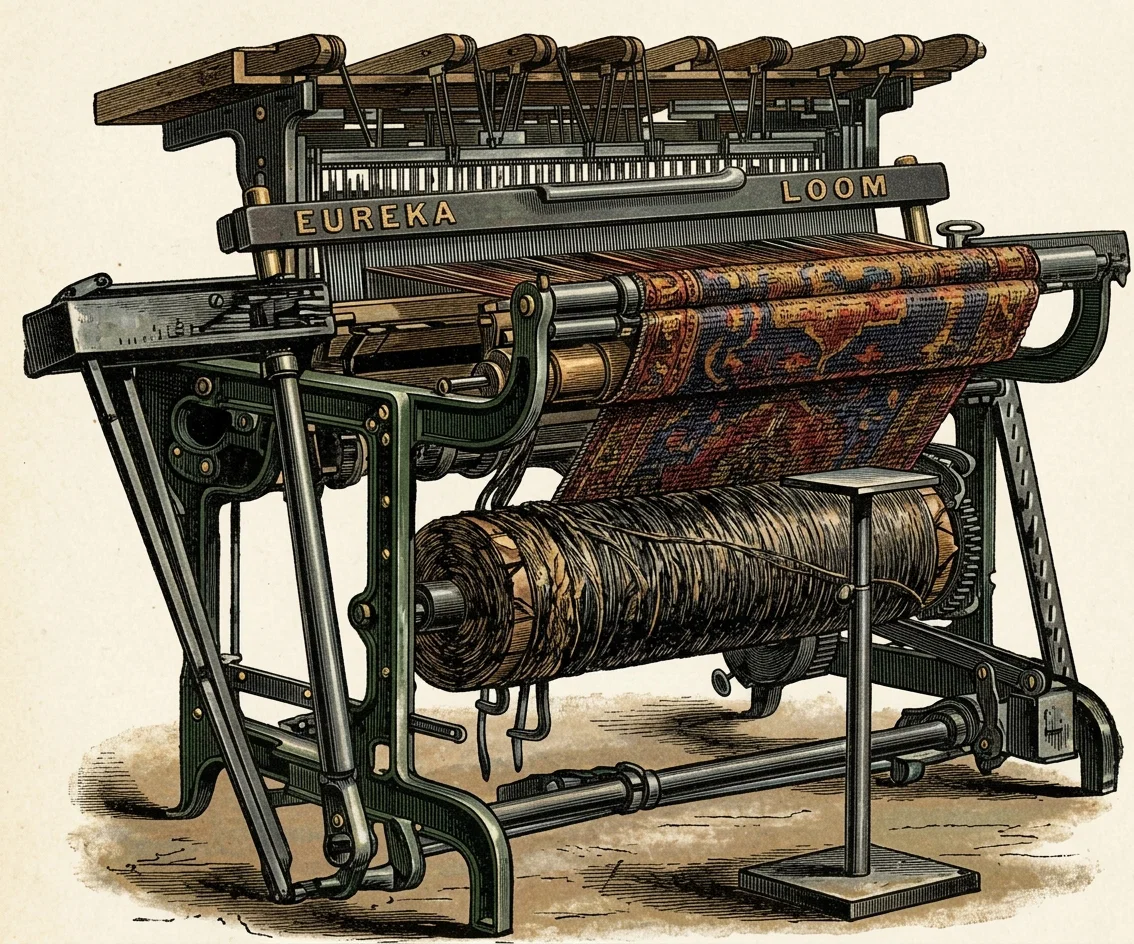
FLY SHUTTLE CARPET LOOM
The best, handiest, easiest running, cheapest, and most durable
FLY SHUTTLE CARPET LOOM
In the world,—100 yards a day. Catalogue free.
EUREKA LOOM CO. 5018 Main St., Battle Creek, Mich.
When you write, please mention the SIGNS OF THE TIMES.
When you write, please mention the SIGNS OF THE TIMES.
AN INEXPENSIVE VOLUME OF REAL WORTH FOR A HOLIDAY GIFT
Such is “Battle Hymn of the Kingdom,” by Miss Fannie Bolton
Its subject matter is an inspiring poem. Its fifteen half-tone engravings are all original, and as fine as can be produced. The cover design is by a professional New York designer, and is unique and attractive. It is printed on rich enameled paper, and the text is all hand-drawn. In short it is a 36-page booklet in which author, artist, printer, and binder have seemingly vied with one another in their attempts to please the lovers of dainty volumes.
PRICES
ART VELLUM CLOTH, GILT TOP, 50C EACH, $25.00 PER 100 HEAVY LEATHERETTE, 25C EACH
OAKLAND, CAL.
Size 5x7½ inches
39 Bond St., New York City
PACIFIC PRESS PUBLISHING CO.
18 W. 5th St., Kansas City, Mo.
A Beautiful Holiday Present
Our new book, “MAKING HOME HAPPY,” By Mrs. L. D. Avery-Stuttle is now ready for delivery. It is just the book you should present to your friend. A charming volume for both young and old. The following words from the preface set forth in a clear light the true purpose of the book:—
“The title of this book is ‘MAKING HOME HAPPY.’ It might be ‘MAKING HOME, HOME!’ for home is no home unless it is happy.” The home lies at the basis of all society. This work “pictures before the reader, in consecutive narrative, the relations that should exist, and the lines of influence that should be guarded and cultivated,” in every home.
“MAKING HOME HAPPY” contains 17 chapters, 206 pages, with four full-page illustrations besides smaller ones.
PRICES
CLOTH, with cover design in 3 colors, 50c
PAPER COVERS - - 25c
Address the
Review & Herald Publishing Co.
Battle Creek, Mich.
NOTICE TO CREDITORS.
By Josephine L. Jones
Estate of Eliza W. Mattingly, deceased.
Notice is hereby given by the undersigned Administratrix of the estate of Eliza W. Mattingly, deceased, to the creditors of and all persons having claims against the said deceased, to exhibit them with the necessary vouchers within four months after the first publication of this notice, to the said Administratrix, at the office of Sam Bell McKee, 957 Broadway, Oakland, California, which said office the undersigned selects as her place of business in all matters connected with said estate of Eliza W. Mattingly, deceased.
JOSEPHINE L. JONES, Administratrix of the estate of Eliza W. Mattingly, deceased. Dated Oakland, Nov. 1, 1898.
Sam Bell McKee, Attorney for Administratrix.
Lessons by Mail on Medical Electricity or How to Use the Battery
By G. L. Abell
By Prof. G. L. Abell
Member of the Board of Directors of the Electro-Medical Society of San Francisco.
Learn how to use the battery and treat yourself. Many diseases are quickly cured by the proper application of electricity. The course embraces the treatment of every organ and part of the body. The lessons are written in plain language and are illustrated. Course, five dollars. Send for circular. Address,
PROF. G. L. ABELL, School of Chemistry and Electro-Therapeutics. 22½ Geary St., San Francisco, Cal.
Pianos and Organs at Lower Prices
Brother L. L. Sage, of Ventura, California, has opened a music house at that place, and has agreed to furnish pianos or organs to all readers of THE SIGNS OF THE TIMES, from Seattle, Washington, to San Diego, California, at a much lower price than outside dealers will furnish them, handling all grades of pianos and organs, and selling for cash or on easy terms.
Those desiring an instrument should correspond with him at once.
When you write, please mention the SIGNS OF THE TIMES.
Wonders OF THE 19TH CENTURY
Is a 32-page tract. Its object is to recount and describe some of the principal inventions of this closing century, and to show their significance.
It contains fifteen illustrations. Is an easy seller. Price, 5c each or $2.00 per 100.