The coasts of England and Ireland have just been swept by a severe storm. The Eastern portion of this country has also been visited by one of the worst storms in many years. Many lives were lost and over one hundred vessels of various descriptions driven ashore.
Have you not observed how greatly storms are increased over former years? And do you know what it portends? The prophet points forward to a time when “the earth is utterly broken down, the earth is clean dissolved, the earth is moved exceedingly. The earth shall reel to and fro like a drunkard, and shall be removed like a cottage; and the transgression thereof shall be heavy upon it; and it shall fall, and not rise again.” Isa. 24: 19, 20.
Meditate upon the words of God, and as you do so, His Spirit will give you the conviction of this important truth. And see to it that Satan does not stifle the conviction and keep you away from the tender care of Him who commands the boisterous elements, “Peace, be still,” and they obey Him. He is an “ever-present” help. Only call upon Him and He hears you. T.
THE LOGIC OF IT.
By W. N. G.
The churches are going into politics in order to get politicians into the church, and they are succeeding. The excuse of the churches for becoming political is that political circles have become so corrupt that the church must also enter, in order to purify them. But it should be remembered that no man, however clean he may be, can cleanse a filthy pool by simply going into it and wading around in the slimy water. On the contrary, he partakes of the corruption. The pure pond-lily will grow out of the stagnant water; but the substances that form the lily have to come out of and above the water in order to become a pure white flower. And in order to remain a clean white flower it must remain out of the stagnant water. Should it turn its head downward and again grow into the filthy composition from which it had emerged, it would not long continue to be clean and white.
There is one other thing in this connection that should not be forgotten: While the political ministers are complaining of corruption in political parties, and are making this an excuse for entering the same field, it is a fact that most of the leading officials are now either members or prominent supporters of the churches. And those officials at whose doors are laid the worst criminal and immoral charges, are the advocates of such religious legislation as is being demanded by religious men and societies as the essential agency for purifying the State.
Church politics is always pharisaical and tyrannical; a political church never is a spiritual church. It can not have the power of God with it while it persistently seeks power from the world. “If any man love the world, the love of the Father is not in him.” Why turn away from the law of Him who has all power “in heaven and in earth,” and seek such inefficient law as puny man can give through a corrupt political agency? W. N. G.
RIOTING
By T.
With the rioting in Corea, rioting in China, rioting in Uruguay, and rioting in Italy and Austria, and elsewhere in Europe, but feebly suppressed; and with striking and rioting and mob violence in Ohio, Illinois, Georgia, the Carolinas, and elsewhere in this country, it must be evident that this is no time to dream of peace and quietness. The Lord’s Word shows that the time just before the second coming of Christ will be marked by great “violence” in the land. This may be contrary to what you have been taught, but, nevertheless, it is the statement of God’s Word.
You have observed the violence that is filling the world. You have been led to fear because of it. But fear no longer. This violence is but the manifestation of Satan’s final effort in these last days to destroy as many as possible. But be assured that he can destroy no one who is under the shelter of the almighty Father.
The Word of God not only tells the meaning of these perils in our time, but it tells of the perfect shelter that our Father has provided against every threatened danger. God’s Word is a firm foundation. Everything else in these times is rocking and tottering, ready to fall. Look well to your feet. Where are you standing? T.
THE TWO KINDS OF HEART FAILURE.
We often read of men dropping dead from “heart failure.” This is occasioned by the physical organ we call the heart, ceasing to beat. But there is another kind of “heart failure” in which the individual still lives. The Saviour tells of a time when “men’s hearts” will be “failing them for fear, and for looking after those things which are coming on the earth.”
In the time of this failing of heart for fear, all will be afflicted with the malady, unless they are hid in the Rock of Ages. Do you not see the premonitions of the calamities that will soon and surely overspread this whole world? If you do, you need not give yourself up to “heart failure.” The Master says, “Come unto Me.” And to all who will come He says, “Thou wilt keep him in perfect peace, whose mind is stayed on Thee; because he trusteth in Thee. Trust ye in the Lord forever; for in the Lord Jehovah is everlasting strength.”
How good it is that the strength of our Father is not only all-powerful, but everlasting! He will never weaken through weariness in protecting us.
YE SHALL BE WITNESSES.
By T.
Much is said among Christian workers about plans. Conferences are called to discuss plans, and committees are appointed to formulate resolutions, and whole days and sometimes weeks are spent in discussing them. And certainly no fault can be found with the idea of Christian workers coming together for conference. For the Word of God says, “Where no counsel is, the people fall; but in the multitude of counselors there is safety.” Prov. 11:14.
But is not a mistake made in failing to study the Bible in our planning for the Gospel work? Plans of work are quite as clearly presented in the Word as is the Gospel of salvation itself. And, like the Lord’s plan of salvation, His plans for work are exceedingly simple. No complicated machinery whatever is needed.
When the Saviour was about to ascend to His Father’s throne, he imparted to His disciples the following simple plan: “Ye shall receive power, after that the Holy Ghost is come upon you; and ye shall be witnesses unto Me both in Jerusalem, and in all Judea, and in Samaria, and unto the uttermost part of the earth.” Acts 1:8.
These words from the Master show that first of all His workers must have the Holy Ghost upon them. Then after their baptism by the Holy Ghost they are to go everywhere—even to “the uttermost part of the earth,” but simply as “witnesses” unto Jesus. The work of a witness is to tell what he knows. Then learn of the Saviour, receive His Spirit, and go tell others what you know of His free salvation, his love, and His joy. Men are not truly converted to Christ by finely-drawn arguments nor through the intricacies of complicated plans. His method is for us to receive power from Him, and then witness to His saving grace. How simple the plan is! Yet it is wonderful in working. Cease not to seek Him for the power, and then witness for Him everywhere.
T.
The Wise Lived Yesterday
By Young
TO-MORROW I will live, the fool doth say!
To-day itself’s too late,—the wise lived yesterday.
—Young.
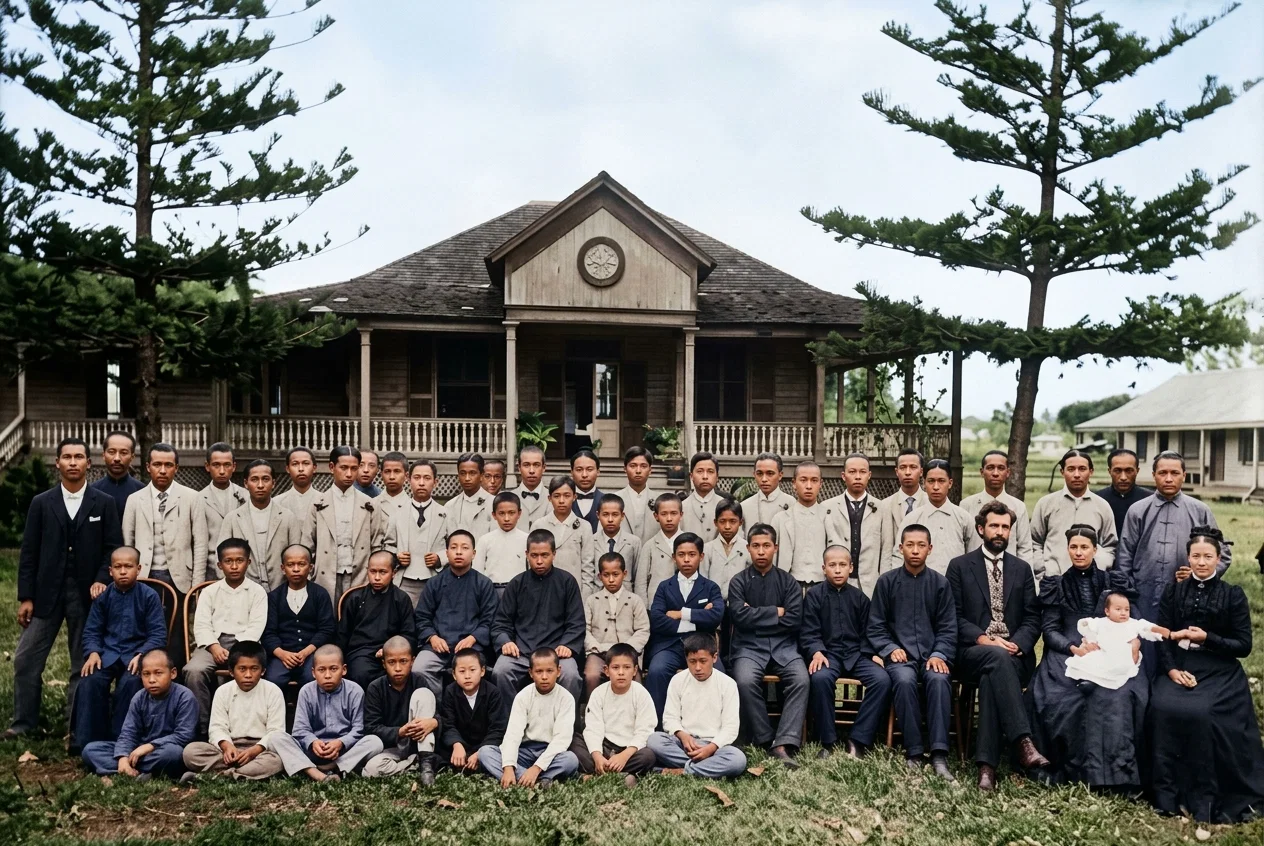
PROF. W. E. HOWELL AND HIS CHINESE SCHOOL, HONOLULU, HAWAII.
CHINA, A NATION WITHOUT GOD
By W. E. Howell
To-day the eyes of the whole civilized world are turned toward China. The grasping greed of nations finds here one more, and it may well be said the last, great territorial opportunity to sate itself on a grand scale; one more country rich in resources, weak in political power, of which to take advantage; one more bone of contention over which there may be a general scramble. With Russia, a military autocracy, intruding from the North and West; with England, the peerless trader, urging her demands and privileges from the South and West; with these two great powers, and also Germany, France, and Japan, having so strong a foothold on the seaboard that China has not a single respectable harbor left for herself; with “Imperial America” approaching; and with internal dissensions gnawing at her vitals, the ultimate fate of China seems fixed. If the Turk “must go,” the Chinaman will follow hard upon him.”
But the eyes of the Lord of lords and King of kings, as they run to and fro throughout the earth, are also upon China, beholding the evil and the good; and He in whose hands are the destinies of nations, while He may permit the hand of greed and oppression to enthral, is sending His silent messengers with good tidings unto the meek, to loose the bands of wickedness, to undo the heavy burdens, to let the oppressed go free, to break every yoke—moral, social, political. The Gospel, this good tidings of the power of God, while it makes no “demonstration” or “parade,” is yet unto salvation; and it is exercised purely in behalf of “humanity.” It will be ultimately successful; and officers and privates and recruits will be impartially “promoted.”
That which will be the downfall of China, considered internally and externally, is described in the Scriptures as “the root of all evil,”—inordinate love of gain. While this has become emphatically the national sin, if there be such, probably in no nation has it become more universally the individual sin than in China. Other nations of importance have preserved at least the form of worshiping the true God; but the Chinese have so far departed from the principles of righteousness that noted writers and thinkers disagree as to whether they ever possessed a knowledge of the true God. One thing is perfectly evident, they are now faithful devotees of Mammon; and since no one can serve God and Mammon, God is the one neglected—they are “without God.” And being without God, they have no hope.
Accepting the Scripture statements applicable to these as well as to all others who have no hope, “Your iniquities have separated between you and your God,” and, “The love of money is the root of all evil,” let us notice briefly some of the results of such separation upon this vast portion of the human race “given to filthy lucre.”
1. “They speak lies.” Perhaps nothing will lead more directly and certainly to lying than greed of gain. In speaking of sincerity, which the Chinese class as one of their five national virtues, one writer says, “If this virtue had been chosen as a national characteristic, not only to be set at defiance in practise, but to form the most striking contrast to existing manners, a more appropriate one than sincerity could not have been found.” Another, of long residence among them, writes: “In China it is literally true that a fact is the hardest thing in the world to get.” And the Chinese themselves frequently say, “As soon as we open our mouths, a lie is born.” So confirmed has the habit of speaking lies become that in detection the speaker evinces no shame, even in “conceiving and uttering from the heart words of falsehood.” It arouses no indignation in a Chinaman to call him a liar.
2. None “pleadeth for truth.” As a result of habitual lying and deceiving, “truth is fallen in the street.” It is painful to see with how little seriousness a lie is regarded. When one of their own number, even a brother, son, or friend, is detected in a lie, it is passed by with some light remark, as a trivial matter. While truth lies prostrate, no one pleads for her, no one tries to lift her up; there is none to rescue—“yea, truth faileth.”
3. “None calleth for justice.” Where truth faileth “equity can not enter,” “and justice standeth afar off,” “neither doth justice overtake us.” Government officials, almost without exception, resort to the selling of justice and so extorting for personal enrichment the substance of their subjects and subordinates ; and they bribe their superiors for self-aggrandizement. Any remonstrance from the victimized is regarded as rebellion against authority, and instantly suppressed.
4. He “shutteth up his bowels of compassion.” Of whom can this be more emphatically said than of those “that will be rich”? Job says of this class: “Thou hast taken a pledge from thy brother for naught, and stripped the naked of their clothing. Thou hast not given water to the weary to drink, and thou hast withholden bread from the hungry.” “Thou hast sent widows away empty, and the arms of the fatherless have been broken.” Among the Chinese, indifference to the sufferings of the sick; desertion of those afflicted with contagious disease, or helpless from any cause; unwillingness to aid, without pay, those in misfortune or distress; derision of the physically or mentally deformed and the childless; rude treatment of the young bride; the woes of daughter-in-law and concubine; inhuman methods of punishing prisoners unable to buy their exemption; and ruthless cruelty in general—all attest, as one writer puts it, that, “tho the10Chinese have ‘bowels,’ they certainly have no ‘mercies.’”
5. “My Sabbaths they have greatly polluted.” The extreme of Sabbath pollution is found in total disregard of its sacred character. The Chinaman knows no Sabbath. He “esteemeth every day alike.” He absorbs all time for pursuing the object of his heart’s desire.
6. They “eat unclean things.” In addition to the many abominations that serve the white man as food, may be mentioned, in the case of the Chinese, the horse, the mule, the donkey, the camel, the dog, and the cat; and these, too, without reference to the cause or manner of death, whether from accident, epidemic, malady, or poisoning by strychnine for riddance—affording opportunity to sell for gain that which costs little or nothing.
7. “Destruction and perdition.” As a culmination to the evil of which the love of money is the root, and as a sequel to its various manifestations pointed out above, those who embark with Mammon as their pilot, are drowned in destruction and perdition.
While in the eyes of the world the Chinese Empire is destined to become the vassal of some greater power, or to be partitioned among several of them, because of their superiority in diplomacy and military strength and the present instability of that tottering kingdom, the Christian sees that “departing from the living God” is in itself suicidal to the nation as well as to the individual; and that hence from internal causes the doom of China is fixed. She “hath grievously sinned; therefore she is removed.” “Her filthiness is in her skirts; she remembereth not her last end; therefore she came down wonderfully.”
And the student of prophecy, recognizing that “the kingdom is the Lord’s, and He is the governor among the nations,” sees only the working out of His providence in releasing a fourth of the human race from the most abject social and moral thraldom ever inflicted by any political power upon its natural subjects. “All her people sigh, they seek bread; they have given their pleasant things for meat.” “The adversary hath spread out his hand upon all her pleasant things.” “How doth the city sit solitary, that was full of people! how is she become as a widow! she that was great among the nations, and princess among the provinces, how is she become tributary?”
“In transgressing and lying against the Lord, and departing away from our God,” darkness has covered “the place of dragons,” “and gross darkness the people.” But “through the tender mercy of our God, the dayspring from on high hath visited us, to give light to them that sit in darkness and in the shadow of death.” “The entrance of Thy words giveth light.” But before the Word may enter with a welcome, may it not be necessary that “the haughty shall be humbled,” and cry, “Behold, O Lord; for I am in distress; my bowels are troubled; mine heart is turned within me; for I have grievously rebelled; abroad the sword bereaveth, at home there is as death.” “The Lord hath trodden underfoot all my mighty men in the midst of me; he hath called an assembly against me to crush my young men.” “He hath made my strength to fall, the Lord hath delivered me into their hands, from whom I am not able to rise up.” “For these things I weep; mine eye, mine eye ranneth down with water, because the comforter that should relieve my soul is far from me; my children are desolate, because the enemy prevailed.” “There is none to comfort me.” “See, O Lord, and consider; for I am become vile.” Then “the Lord shall arise upon thee, and His glory shall be seen upon thee. And the Gentiles shall come to Thy light, and kings to the brightness of Thy rising.”
W. E. HOWELL.
Honolulu, H. I., Sept. 28, 1898.
MY SCHOOL.
I sat in the school of sorrow:
The Master was teaching there,
But my eyes were dim with weeping,
And my heart oppressed with care.
Instead of looking upward
And seeing His face divine,
So full of tender compassion
For weary, sad hearts like mine,
I only thought of the burden
Of the cross, that before me lay,
The clouds that hung thick above me,
Darkening the light of day,
So I could not learn my lesson,
And say, “Thy will be done;”
And the Master came not near me
As the leaden hours went on.
At last, in despair, I lifted
My streaming eyes above,
And I saw the Master was watching
With a look of pitying love.
To the cross before me He pointed;
And I thought that I heard Him say:
“My child, thou must take thy burden,
And learn thy task to-day.”
“Not now may I tell the reason;
’Tis enough for thee to know
That I, the Master, am teaching,
And appoint thee all thy wo.”
Then, kneeling, the cross I lifted,
For one glimpse of that face divine
Had given me strength to bear it,
And say, “Thy will, not mine.”
And so I learned my lesson;
And through the weary years
His helping hand sustained me,
And wiped away my tears.
And ever the glorious sunlight
From the heavenly home streams down,
Till the school tasks all are ended,
And the cross exchanged for the crown.
1 “And Jacob called unto his sons, and said: Gather yourselves together, that I may tell you that which shall befall you in the latter days. 2 “Assemble yourselves, and hear, ye sons of Jacob; And hearken unto Israel your father. 3 Reuben, thou art my first-born, my might, and the beginning of my strength; The excellency of dignity, and the excellency of power. 4 Unstable as water, thou shalt not have the excellency; Because thou wentest up to thy father’s bed; Then defiledst thou it; he went up to my couch. 5 Simeon and Levi are brethren; Weapons of violence are their swords. 6 O my soul, come not thou into their council; Unto their assembly, my glory, be not thou united; For in their anger they slew a man, And in their self-will they houghed an ox. 7 Cursed be their anger, for it was fierce; And their wrath, for it was cruel; I will divide them in Jacob, And scatter them in Israel. 8 Judah, thee shall thy brethren praise; Thy hand shall be on the neck of thine enemies; Thy father’s sons shall bow down before thee. 9 Judah is a lion’s whelp; From the prey, my son, thou art gone up; He stooped down, he couched as a lion; And as a lioness; who shall rouse him up? 10 The sceptre shall not depart from Judah, Nor the ruler’s staff from between his feet, Until Shiloh come; And unto him shall the obedience of the peoples be. 11 Binding his foal unto the vine, And his ass’ colt unto the choice vine; He hath washed his garments in wine, And his vesture in the blood of grapes; 12 His eyes shall be red with wine, And his teeth white with milk. 13 Zebulun shall dwell at the haven of the sea; And he shall be for an haven of ships; And his border shall be upon Zidon. 14 Issachar is a strong ass, Couching down between the sheepfolds; 15 And he saw a resting-place that it was good, And the land that it was pleasant; And he bowed his shoulder to bear, And became a servant under task-work. 16 Dan shall judge his people, As one of the tribes of Israel. 17 Dan shall be a serpent in the way, An adder in the path, That biteth the horse’s heels, So that his rider falleth backward. 18 I have waited for thy salvation, O Lord. 19 Gad, a troop shall press upon him; But he shall press upon their heel. 20 Out of Asher his bread shall be fat, And he shall yield royal dainties. 21 Naphtali is a hind let loose; He giveth goodly words. 22 Joseph is a fruitful bough, A fruitful bough by a fountain; His branches run over the wall. 23 The archers have sorely grieved him, And shot at him, and persecuted him; 24 But his bow abode in strength, And the arms of his hands were made strong, By the hands of the Mighty One of Jacob (From thence is the shepherd, the stone of Israel), 25 Even by the God of thy father, who shall help thee, And by the Almighty, who shall bless thee, With blessings of heaven above, Blessings of the deep that coucheth beneath, Blessings of the breasts, and of the womb. 26 The blessings of thy father Have prevailed above the blessings of my progenitors Unto the utmost bound of the everlasting hills; They shall be on the head of Joseph, And on the crown of the head of him that was separate from his brethren. 27 Benjamin is a wolf that raveneth; In the morning he shall devour the prey, And at even he shall divide the spoil. 28 All these are the twelve tribes of Israel; and this is it that their father spake unto them and blessed them; every one according to his blessing he blessed them. 29 And he charged them, and said unto them, I am to be gathered unto my people: bury me with my fathers in the cave that is in the field 30 of Ephron the Hittite, in the cave that is in the field of Machpelah, which is before Mamre, in the land of Canaan, which Abraham bought with the field from Ephron the Hittite for a 31 possession of a burying-place; there they buried Abraham and Sarah his wife; there they buried Isaac and Rebekah his wife; 32 and there I buried Leah; the field and the cave that is therein, 33 which was purchased from the children of Heth. And when Jacob made an end of charging his sons, he gathered up his feet into the bed, and yielded up the ghost, and was gathered unto his people.”11
Suggestive Questions.
(1) For what purpose did Jacob now call his sons together? Gen. 49:1, 2. (2) What did he say Reuben ought to be? V. 3. Why could he not hold this position? V. 4. (3) What close union existed between Simeon and Levi? With what curse did he reprove them and forewarn their tribe? What was to be their future? Vs. 5–7. (4) What was to be Judah’s position among his brethren? By what fitting symbol was his tribe represented? How was he made the central figure? Vs. 8–12. Who was Shiloh? See marginal readings of verse 10, R.V.; Rev. 5:5; Heb. 7:14. (5) What was the prophecy concerning Zebulun? V. 13. (6) What did Jacob say of the future of Issachar? Vs. 14, 15. (7) What did he say Dan should be? In what did Dan’s success consist? Vs. 16–18. (8) What shows the endurance of Gad? V. 19. (9) How was Asher to flourish? V. 20. (10) What was the character of the tribe of which Naphtali was the father? V. 21. (11) By what appropriate figures and lofty expressions does Jacob foretell Joseph’s prosperity, his strength, his help, and his blessings? Vs. 22–26. (12) By what symbol did he represent the future of Benjamin? V. 27. (13) What was this that Jacob’s prophetic eye had so clearly seen and so vividly described? In harmony with what was his blessing? V. 28. (14) How did Jacob now show his “pilgrim and stranger” spirit? Vs. 29–32. (15) His last inspired life duty having now been performed, what was the closing scene? V. 33. (16) Carefully read the fiftieth chapter of Genesis.
Suggestive Readings.—“Patriarchs and Prophets,” pages 235–240.
Note.
Make a careful study of the fulfilment of this last prophecy of Jacob in the future history of the several tribes. Meyer says: “Reuben, tho the first-born, never excelled; no judge, prophet, or ruler sprang from his tribe. Simeon was almost absorbed in the nomad tribes of Southern Palestine. The cities in which the sons of Levi dwelt were scattered throughout all the tribes. Vestiges of terraced vineyards still attest how well the hilly province assigned to Judah suited the culture of the vine. Zebulun embosomed the Lake of Galilee, and stretched away toward the coast of the blue Mediterranean. Esdraelon, the battle-field of Palestine, where Assyria from the North and Egypt from the South often met in deadly feud, lay within the limits of Issachar. Dan was small as an adder, but, like it, could inflict dangerous wounds on any invader who had to pass by it towards the heart of the country. Gad, much pressed by border war. Asher, notable for fertility. Naphtali, famous for eloquence. Benjamin, cruel as a wolf. All these justified the prophecy of their dying ancestor, whilst the mighty tribes of Ephraim and Manasseh, springing from the sons of Joseph, inherited to the full ‘blessings of heaven above; blessings of the deep that lieth under; blessings of the breasts, and of the womb; blessings to the utmost bounds of the everlasting hills.’ Jacob’s ‘paternal tenderness would have found expression only in words of encouragement and hope; but the power of God rested upon him, and under the influence of inspiration, he was constrained to declare the truth, however painful.’—Patriarchs and Prophets, p. 237.
Additional Study.
(1) Make an outline of this chapter. (2) Read Deuteronomy 33, and compare with this chapter. (3) Look up the character of the several symbols mentioned in Jacob’s dying prophecy, and observe their appropriateness in each instance. (4) In the study of the prophecy concerning Judah, note what is the only royalty of worth in the sight of God, and what the only law. Observe that at the close of Solomon’s reign, his kingdom was divided into Israel, or Ephraim, and Judah, but that at the time of Christ, Ephraim was absorbed in Judah, and thus the sceptre did not depart from Judah till Shiloh came. See Hosea 4:17; Ps. 78:67–69. (5) Why are the faults and follies of Bible characters recorded, as well as their virtues and victories? Has this fact been of any help to you? What? (6) Note how the prophetic spirit was preserved during the history of God’s people up to this point in the lives of Enoch, Noah, Abraham, Isaac, Jacob, and Joseph. The study of this early history and prophecy stood first in the schools of the prophets as well as in the lives of the prophets themselves. Adam and Eve continually saw the seed of the woman; Abel looked to the Lamb of God slain from the foundation of the world, Enoch beheld the Lord coming with ten thousand of His saints; Noah was enraptured with the rainbow glory about the throne; Abraham saw the Father and the Son in the completion of the great mediatorial plan and the ratification of the everlasting covenant; Isaac witnessed the results of that plan and that ratified covenant, “On earth peace, good-will toward men;” Jacob saw the ministration of angels, Christ the way, God over all; Joseph had a view of the final coronation—Christ enthroned in glory.
Missionary Mobbed in China
DR. F. M. WOOLSEY, of the West China Mission, was mobbed in December at Kiangpeh, near Chungking, but escaped with only some severe cuts on the face. The crowd was largely composed of military students. Two of the mob were arrested and sentenced to receive 500 strokes with the bamboo and be imprisoned six months.—Missionary Review.
OUR WORK AND WORKERS.
AT Gorin, Mo., Brother H. M. Stewart reports the addition of five persons to our ranks.
ENCOURAGING success is reported in the work of the Helping Hand Mission at Lafayette, Ind.
AT Herington, Kansas, Sister Ida Lindstrom reports the organization of a Christian Help Band and a Life-boat Crew.
BROTHER W. A. HENNIG, president of Missouri Conference, notes the addition of nine members to the church at Rolla.
OF about twenty missionaries recently sent out to foreign fields, five had previously labored in a like capacity for other denominations.
THE baptism of three candidates at Steinhagen, and six at Senate Grove, Mo., is reported by Brother A. A. Meyer. Others were to be baptized the week following the report.
FROM The Review we learn that a great spiritual revival has been experienced in the church at Battle Creek, Mich. On the 20th ult. fifty-seven persons were baptized, most of whom were from the college in that city.
BROTHER G. C. TENNEY and family are now on the way to Australia, having left Vancouver, B. C., on the 17th ult., on the steamer of that date. Brother Tenney has labored in the Australian field before, and will no doubt be warmly welcomed again.
SIX persons have decided to “keep the commandments of God and the faith of Jesus,” as a result of labor by Brother J. N. Sommerville, at Webster, Texas. He also reports success in canvassing for the SIGNS and “Bible Readings.” His was the first presentation of Seventh-day Adventist doctrine in that place.
THE addition of two members to the church at Leavenworth, Kansas, is noted by Brother J. W. Westphal. He also mentions that half a dozen have begun to keep the Sabbath of the Lord in Kansas City, Kansas. Work with the SIGNS is being well pushed there too. Besides the club of 150 taken by the tract society, there are 800 going to actual subscribers.
IN response to numerous calls from persons in the district, the faculty of Keene (Texas) Academy have decided to start a correspondence school for the benefit of those who can not pursue a course of study at the academy. Only two lines will be taken up at first—Old Testament history and physiology. Prof. C. C. Lewis will conduct the former, and Dr. E. H. Mathewson, the latter study. Address, Keene Academy Correspondence School, Keene, Texas.
ALL the conference organs give evidence that the brethren are becoming more and more awake to the importance of the great quarter-centennial edition of THE SIGNS OF THE TIMES. Special bands are being organized in the churches for systematic work, and isolated individuals are ordering with a view to canvassing unoccupied territory. One brother in Indianapolis reports orders in advance for sixty copies, and another, for fifty-seven. Indiana Conference has made a definite order for 20,000 to start with.
PERIODICALS WANTED.
CLEAN copies of SIGNS, Sentinel, Review, Instructor, Our Little Friend, or tracts, for missionary work. Please send post-paid, to H. M. Campbell, box 563, Fulton, Calaway County, Mo.