WHAT is the message of the lily? You will all be able to tell at once, for the lily has ever been the emblem of purity. So the snowy bells of the valley lily ring out the message, Be pure.
“The red rose says, Be sweet!
The lily says, Be pure!”
Jesus is both “the Rose of Sharon, and the Lily of the Valleys.” All the sweetness and the purity of the flowers come from him who made them. He is the sweetness of the Rose and the purity of the Lily. If you keep this always in mind, you can not look at any of his works without learning something of him.
“Consider the lilies, how they grow. They toil not, neither do they spin: and yet I say unto you, That even Solomon in all his glory was not arrayed like one of these. Wherefore, if God so clothe the grass of the field, which to-day is, and to-morrow is cast into the oven, shall he not much more clothe you?” He who gives the lily its pure garment will “much more” clothe you with the robe of his everlasting righteousness and purity.
No matter what your surroundings may be, you may be pure in heart. Did you ever see a beautiful white water-lily floating on a slimy, stagnant pool of water? And did you read the message that Jesus has written for you upon its petals? It is that even in this dark world of sin, you may grow in beauty, in purity, showing the grace and glory of Jesus to all who look upon you.
Dr. T. L. Cuyler tells about visiting a coal mine. Growing at the mouth of the mine were some beautiful white flowers, but alas! they were covered with the black dust of the place. He spoke of this regretfully to one of the miners, who took one of the flowers, and shook it slightly. At once the dirt slipped off, and left the beautiful petals glistening white. “You see,” said the miner, “this flower has the power to live in the midst of dirt without ever getting dirty.” So the Christian can live in an evil world without being contaminated.
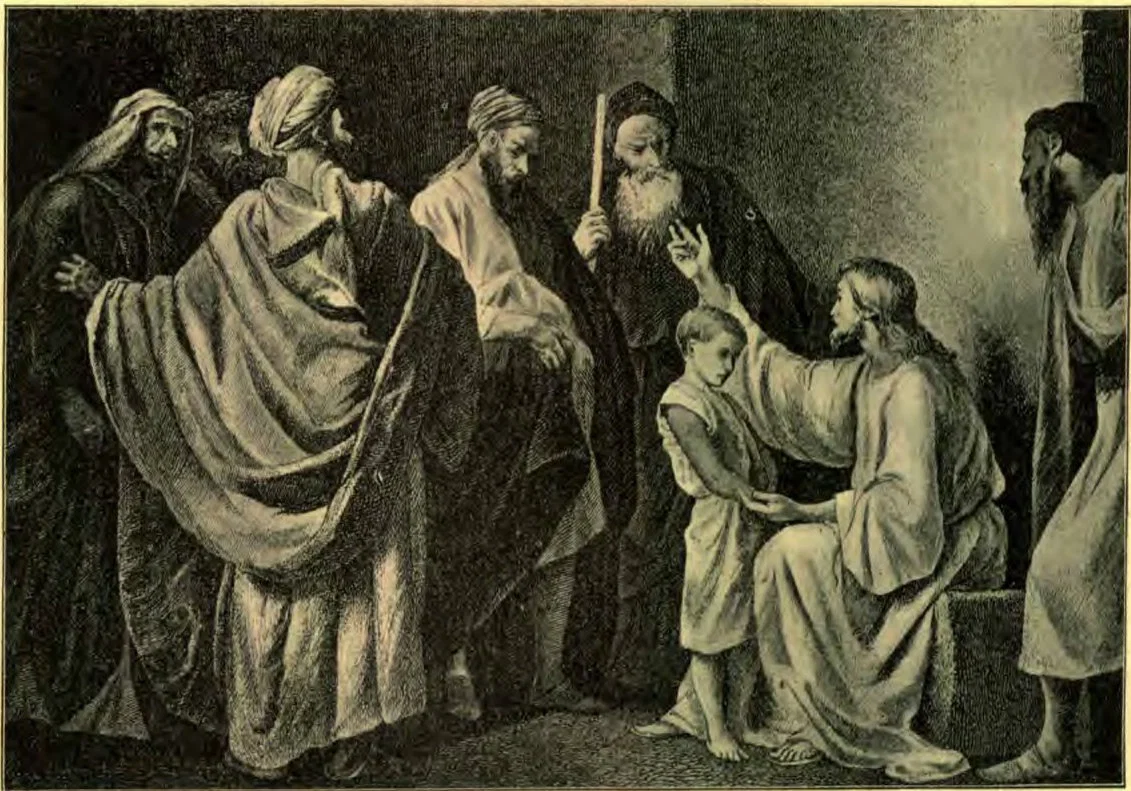
A LITTLE LAD WITH DEEP-BLUE EYE
Think of the childhood of Jesus in his home in Nazareth. He “knew no sin,” but lived a life of perfect purity “unspotted from the world,” in a place where nearly all the people were very wicked. And there is no little child anywhere who can not follow his example, and be like a lily in purity and grace and sweetness.
EDITH E. ADAMS.
THE L. I. S. AT 518
By Margaret Montgomery
It was too bad! The neighbors had thought this and several other unpleasant things, and also said them, more or less privately, a great many times. In addition to the eyes of the neighbors, Father and Mother Howard had eyes of their own. So you need not think they did not know how the yard looked.
By turns, there were hats and coats scattered over that yard, also books, tin cans, dolls, shovels, pin-wheels, scraps of paper, bones, dishes, rags,—in fact, everything that ought not to have been there. There was very little of the grass that ought to have been there.
The yard was unfortunately placed in the middle of a square where the lawns were beautifully kept, where every blade of grass knew its place, and where nothing got out of order. But then there was not a single child on the block but at 518, where the Howards lived, and there there was a house full of them, and they had to be busy. They all knew that, while the neighbors had lawns, they had nothing but just a plain yard. Father Howard said it was a back yard, and only needed a goat to look like Tim Flaherty’s. But then Father Howard had been tried the day he made that speech, because, when he brought an old friend to dinner with him, he had found three pictures drawn on the flag sidewalk with colored crayons, while a row of stones and four tin cans were arrayed on the front porch.
Mother Howard found that she was in the habit of going to the front door after any caller left the house, to look anxiously at the porch and yard. She found, too, that she was seldom happy after one of these observations. Really, something had to be done.
One day John, Joe, Stella, Clara, and even little Tom, received dainty notes, inviting them to meet Mother Howard “on the back porch at four o’clock, and, if the way be clear, to form an L. I. S.”
The five were at the appointed place when Mrs. Howard came out. Joe shut up his pocket-knife with a guilty air, and kept his back carefully placed over a freshly whittled spot on one of the posts. Clara had a pencil. In the most matter-of-fact way she went on stating, upon the side of the house, that “4 × 3 = 12, 4 × 4 = 16.” Since the tables had been troubling Clara’s brain, few people got further than the front door without seeing evidences of her struggle, on the fence, the sidewalk, or the porch, in queer-looking figures in pencil or chalk.
Mrs. Howard had just started to say, “By an L. I. S. I mean,”— when she was interrupted by a great cackling, as one of John’s chickens noisily dashed around the house.
“Yes, you’re part of it!” cried Mrs. Howard. “Children, I’m ashamed of having such a yard. Let’s have an L. I. S., and make it a lawn.”
Clara had just written that “4 × 8 = ;”—but she never finished the statement, as she stopped to hear the plan for the L. I. S.
It was to be a real society, with meetings once a week. The weekly dues were the queerest things. They were not to be paid in money, but in work. You see the L. I. S. meant Lawn Improvement Society, and the weekly dues were that each member was required to report some improvement made upon the lawn during the week.
“Like working out your road tax, as they do out at Uncle Joe’s,” Joe had declared.
“Exactly, and if Uncle Joe doesn’t work, he has to pay,” replied Mrs. Howard. “It is the302same with our Joe in our L. I. S. If he doesn’t report a single good deed done for the lawn or porch during the week, he’ll be fined five cents. The fines will go toward something to beautify the yard, which the society will vote upon when enough lazy members make it worth while.”
It was voted that a fine of one cent was to be laid on each member carrying stones, books, or any such thing to the front of the house, or making chalk pictures on the sidewalk.
When Father Howard came out, he said he thought it should be one of the laws of the society not to throw stones at the windows, or tear off the weather-boarding. But Mother Howard said that was too bad, and she would not let such a law be written, even in fun. They all knew it was an accident when John had broken a window the day before, and that such a thing would never happen again.
John was elected president, Stella secretary, and Mrs. Howard treasurer. After the treasurer’s treat to cookies, the L. I. S. adjourned.
Father Howard had been elected an honorary member, and told that this form of membership released him from weekly dues, but gave him the right to pay double the ordinary fine if he left tin cans or any of his belongings, such as hats or shoes, lying around the porch or lawn. The honorary membership also entitled him to help in disposing of the cookies.
Father Howard made the society a funny little speech, in which he thanked them for the honor done to him, and offered to give to the society a rubbish barrel marked L. I. S.
When the weekly meeting came, and the weekly report was called for, what a collection of deeds the dues made!
“John Howard,” read Secretary Stella.
“Couldn’t have a lawn with chickens running loose,” said John, a little shamefacedly, “so I’ve been all the week making a pen for my chickens. I don’t suppose they’ll do one mite of good penned up,” he added, slowly.
“I’ll pay five cents a dozen extra for penned-up eggs,” came from Mrs. Howard.
“Joseph Howard” was the next name on the secretary’s roll.
“Mowed the grass. I wish the honorary member would have the mower sharpened,” Joe added, as his father stepped out on the porch.
“Done! anything to encourage such a society,” the honorary member quickly replied.
“Clara Howard.”
“I scrubbed the side of the house where I wrote my tables before I joined the L. I. S.,” reported Clara. “Then I put a tin can that Nora left on the kitchen porch in the rubbish barrel.”
“Thomas Howard.”
“Shutted the gate two times, and pulled up three plantain,” piped little Tom.
“I’ve pulled about a ton of weeds out of the drive,” reported Stella, “and there are enough left to keep us at work all summer.”
For fines the first week there were eleven cents. Joe was the heaviest fine-payer, having paid a penny each for two books, one coat, one baseball bat, and one dead frog, left on the porch and grass Monday afternoon. Clara had paid for one tin can of sand and one spoon gathered off the front pavement. Stella’s hair-ribbon and John’s hammer had each cost their owner one cent.
It was wonderful how that L. I. S. transformed the Howard yard. When the society was a month old, the children voted to pass a by-law that there should be no running on the grass, except in the playground in the back yard. They also voted to move the hammock from the side yard back, and plant grass-seed on the old site of the hammock.
The triumph of the L. I. S. was not long deferred. They were gathered for one of their fall meetings when Stella came rushing in.
“What do you suppose I heard?” she cried.
“Some one going past said, ‘Pretty lawn, that,’ and pointed to ours! We’ve a lawn at last!”
This all happened three years ago. Now there is not another lawn in the square as handsome as 518. The neighbors, who used to say other things, now say, “You could not expect any of our lawns to look as well as the Howard’s, for they have five children; so, of course, they keep everything in order, even every leaf picked up,—of course, of course!”
But it wasn’t “of course” at all.—Margaret Montgomery, in S. S. Times.
CLEANSING THE LEPER
By W. S. Sadler
INTRODUCTORY
Preceding Events.—Following are the principal events in the Saviour’s life since the preceding miracle, the healing of Peter’s wife’s mother:—
1. The sunset scene at Capernaum at the close of the Sabbath day on which the demoniac in the synagogue and Peter’s mother-in-law were healed. Mark 1: 32–34.
2. The beginning of his first preaching tour in Galilee. Verses 35–39. It was during this tour, at some unknown place, that the leper was cleansed.
The Bible Story of the Miracle.—“And it came to pass, while he was in one of the cities, behold, a man full of leprosy; and when he saw Jesus, he came to him, beseeching him; and kneeling down to him, he fell on his face and worshiped him, saying unto him, Lord, if thou wilt, thou canst make me clean. And being moved with compassion, he stretched forth his hand, and touched him, and saith unto him, I will; be thou clean. And straightway the leprosy departed from him, and he was made clean. And Jesus strictly charged him, and straightway sent him out, and saith unto him, See thou say nothing to any man, but go thy way and show thyself to the priest; and offer for thy cleansing the things which Moses commanded, for a testimony unto them. But he went out, and began to publish it much, and to spread abroad the matter, and so much the more went abroad the report concerning him, that Jesus could no more openly enter into a city, but was without in desert places; and great multitudes came together to him from every quarter, to hear, and to be healed of their infirmities. But he withdrew himself in the deserts, and prayed.” (This quotation is the interwoven story from Matt. 8: 2–4; Mark 1: 40–45; and Luke 5: 12–16.
Place.—Unknown, but in Galilee, perhaps not far from Capernaum.
Circumstances.—Christ was making a tour of Galilee. Mark 1: 38. At some unknown point on this preaching tour, a leper came to Jesus, and kneeling down, said: “If thou wilt, thou canst make me clean.” This miracle was performed at the request of the one it benefited. The leper’s faith in Christ’s power is shown in the request, “If thou wilt, thou canst make me clean.” Jesus’ ready response to this request was enough to convince him of his willingness. Christ performed the miracle by putting forth his hand, touching the leper, and saying, “I will; be thou clean.” The miracle was performed in Christ’s presence, in response to his personal touch and his spoken word; and “immediately the leprosy departed from him, and he was cleansed.”
Great Lesson.—Christ’s willingness to forgive. His power and willingness to cleanse from moral leprosy. We need not ask, “If thou wilt;” there is but one question, and the answer to that lies with man: “Canst thou believe?”
STUDY OF THE MIRACLE
There Came a Leper.—In the Bible, leprosy stands as the type of sin. Leprosy of soul and body are so nearly alike that the process of their cure demands the same great power. Both are incurable. This man was full of leprosy, yet the Saviour could make him whole. This great miracle was wrought to show Christ’s willingness to cleanse us from all physical and spiritual pollution. Jesus said: “I will; be thou clean.” In answer to the question of every sincere soul that desires cleansing, the answer comes back from the Master’s loving lips, “I will; be thou clean.” Leprosy is a fitting symbol of sin, in view of its insidious beginning, its incurable nature, and its final results; and God, and he alone, has power to remove it.
The exclusion of lepers from association with their fellow beings was not only a sanitary regulation, but a requirement of deep spiritual significance. Leprosy stood for sin, and sin separates the sinner from God. Apparently, those not having the law of Moses did not treat leprosy as contagious. Naaman the leper was a general in the army of Syria. 2 Kings 5: 1. Gehazi, with his incurable leprosy (2 Kings 5: 27) talked with Israel’s king. 2 Kings 8: 5. When David said, “Purge me with hyssop, and I shall be clean,” he looked into his inner self, and contemplated himself as a spiritual leper, full of sin and the spirit of disobedience.
This poor leper came himself to the Saviour. He had no interested friends to urge him on. He came all alone, and without any encouraging precedent, for up to this time Christ had apparently healed no lepers. It is nowhere written, “Come unto me, all ye lepers, and be cleansed.” He had no particular promise to encourage him in thinking that Jesus would cure him of the loathsome disease from which he was a sufferer. In this he exhibited more courage than any of the ten lepers who had the mutual encouragement of one another in coming to Jesus.
If Thou Wilt, Thou Canst Make Me Clean.—The leper showed great faith, saying, “If thou wilt, thou canst make me clean.” While this is the first record of the Saviour’s healing leprosy, there might have been others among the multitudes that received healing at his hands. Note how anxious this poor leper was to be freed from this disease of physical loathsomeness. In this he is very unlike many a moral leper, many a social leper, who, day after day, seems more fondly to embrace the idols of sin, and more deeply to plunge into the dark waters of iniquity. The more they sin, the more they love to sin, and the less they desire to be cleansed from the leprosy that plagues their souls.
This leper did not come to Christ with the view of having his life prolonged as it was. He came for the purpose of being made whole. Disappointment awaits the sinner who comes to Christ with the thought of being made easy and comfortable in his life of sin. There is but one thing that Jesus can do in saving the sinner, and that is the work which his name implies: “Thou shalt call his name Jesus; for he shall save his people from their sins.” W. S. SADLER.
(Concluded next week.)
Prayer as a Conspicuous Theme of Scripture
By Charles Spurgeon
WHATEVER God has made prominent in his word he intends to be conspicuous in our lives. If he has said much about prayer, it is because he knows we have much need of it. So deep are our necessities that until we are in heaven, we must not cease to pray.—Charles Spurgeon.
1. What words of Christ at the close of the parable of the sower awakened the ears of the people?
2. Who immediately asked him a question?
3. What was it?
4. What answer did Christ make?
5. In this answer to whom did “you” refer? To whom did “them” refer? Compare Matt. 13:11 and Mark 4:11; note 1.
6. What kind of teaching was Christ using to show his disciples the mysteries of the kingdom?
7. Why could not the others understand this mystery in the parables?
8. What prophecy was fulfilled in them?
9. To which class do you belong, to the disciples or the others? Note 2.
10. What verse in Matthew 13 shows that in every parable God tells us a secret?
11. In what place in the Old Testament is there a prophecy that Christ would teach in parables?
12. In what part of his ministry did Christ begin his parable-teaching? in the early part or later on? See Outline of Christ’s Life.
13. What was his first parable? Find the three chapters that record this parable.
NOTES
1. “Them that are without.” These words refer to those who had no heart to understand what Christ was teaching. They did not come to Jesus, as did the disciples, and ask questions in order to find the truth, but if ever they did ask, it was to criticise and pick flaws with what Christ was saying. To this class belonged many Pharisees, Sadducees, and scribes.
2. Do not be discouraged if you belong to the wrong class. By nature we all have eyes that do not see, and ears that do not hear; but let us not forget that God can make the seeing eye and also the hearing ear. At this time Christ said to his disciples, “Blessed are your eyes, for they see;” but afterward, when unbelief had re-entered their hearts, he said, “Have ye your heart yet hardened? Having eyes, see ye not?” Let us ask God every moment to open our eyes, and quicken our ears; and let us not close them, as many in Christ’s day did lest “they . . . should be converted.”
OUTLINE OF CHRIST’S LIFE
Beginning of Ministry:—
Baptism of Christ.
Temptation.
With John at Bethabara.
First disciples—John, Andrew, Simon, Philip, Nathanael.
Miracle at Cana—Beginning of work in a Galilean village.
To Capernaum—He and his mother and his brethren and disciples.
Passover and cleansing temple—Announcing his mission as Messiah.
Nicodemus—Visit by night to Christ on Mount of Olives.
Christ tarries near John baptizing.
To Galilee again via Samaria.
At Cana—Passed by Nazareth because of their unbelief.
Healing of nobleman’s son.
Miracle at Bethesda—Christ rejected by Sanhedrin.
Early Ministry in Galilee (after John was cast into prison):—
Message—“The kingdom of heaven is at hand.”
Rejected at Nazareth—Thrust out of the city.
Goes to Capernaum to live.
Teaching in Peter’s ship—Draft of fishes.
Choosing disciples.
A Sabbath day in Capernaum—The unclean spirit.
In Peter’s home—All the city at the door.
In other towns—Healing of leper.
At Capernaum in Peter’s house—Healing of sick of palsy.
Call of Matthew.
Through the cornfields—Controversy of Pharisees.
Another Sabbath in the synagogue—Man with withered hand.
Pharisees counsel with Herodians to kill Jesus.
Jesus withdraws to sea with disciples.
Multitudes follow from every part.
Asks for a small ship—Heals them all.
Heals one possessed, blind, and dumb.
Goeth into a mountain—All night in prayer.
Ordains twelve disciples.
Sermon on the mount.
Entered into Capernaum—Centurion’s servant healed.
Widow of Nain.
Went throughout every city preaching tidings of the kingdom of God—Twelve were with him, and Mary, Joanna, and Susanna.
Mother and brethren seek him.
Parable of sower.
THE RIGHT KIND OF LIGHT
DURING my travels last year, I chanced to be on the outskirts of a large city at the time the street-lighter was making his rounds. It was rapidly growing dusk, and to me, a stranger, it was a relief to see the torch coming down the street. “I am glad to see your torch out tonight,” I said, as the street-lighter approached.
“Is that so?” he replied. “You must be a stranger in the city. I find so many people who prefer to live in darkness here, that I sometimes feel my work is not always appreciated.”
It was my turn to express surprise.
“I referred not so much to the street lights as to the gospel in human hearts,” he answered. “We could get along without the street lights, if we knew that every heart in this city was lighted with the gospel torch.”
“Yes, the street-lighter continued, “it matters not how humble the cottage, or how bare the room, if the heart is right with God. There is one part of this city where I always delight to go. Strange to say, it is what was only five years ago called a slum district. You don’t find broad avenues and shady walks there now, but you do find comfortable and happy homes.”
“Tell me about it,” said I, as I turned to walk along with him. “It must be an interesting story.”
“There’s not much to tell,” he replied. “Five years ago one of the confirmed drunkards in the community, John Rodney, was converted at the mission on K Street, and he determined to do some personal work for God. Curious to relate, he was converted through a text on the very subject we are talking about. Well, John said his little candle wasn’t going to stand under a bushel, and he went to work. He lighted so many other little candles, and they in turn lighted so many more, that virtually the whole community has turned to Christ. It’s a wonderful transformation. John fell asleep last year, but not before his little gospel torch had lighted a thousand others like his own.”—Ram’s Horn.
A Book for the Children and a Book that Children Love
By Adelaide Bee Cooper
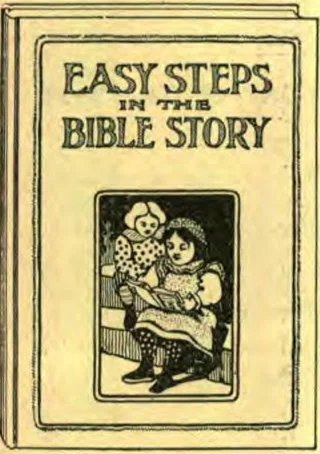
Easy Steps in the Bible Story
By ADELAIDE BEE COOPER.
The minds of children turn as naturally to the stories of the Bible as a lily to the sun. They never tire of hearing of the wonders of Creation Week, of the incidents of the Flood, and the building of the Tower of Babel, and of the lives of Abraham, Isaac, and Jacob. And Joseph—what mother does not hear again and again from childish lips the request, “Tell me about Joseph”?
“Easy Steps in the Bible Story” gives all these and other narratives reaching from Creation down to the time when the Law was spoken on Mount Sinai. The stories are told in simple words that the children can understand, and the pictures help make the meaning still more plain.
Do your children have this book? If not, make them happy by giving them a copy. If they do, encourage them to present it to some little friend. In these days when the market is flooded with children’s Bible stories that are filled with teaching that strikes at the very foundations of Christian belief, the placing of this book in the hands of the little ones may be the means of forming in some childish mind an idea of the events of Creation Week that neither time nor later teaching can wholly efface.
“The best of all Bible books for children,”
—ALONZO T. JONES.
AGENTS WANTED EVERYWHERE.
Price: Bound in cloth, 50 cents; in paper, 25 cents.
Order of your State Tract Society; Review and Herald Pub. Co., Battle Creek, Mich.; or Pacific Press Pub. Co., Oakland, Cal.