IT is not easy to believe that any of our American people ever looked to the frog as a remedial measure for scarlet fever, measles, and canker rash, much less that they did so in the latter half of the nineteenth century; but according to Home and School this is true, and here is how the little green doctor served his patients:—
“Dr. Frog was taken into a sickroom and made to breathe in a very natural way, close to the face of the patient. He absorbed, so they tell us, the poison and soon began to swell up. When he had taken in so much that it seemed as if he were about to burst, he was taken out of doors and given a cold bath. Thereupon he assumed his natural size, ready to go out on another case.”
“An old paper, dated 1874, a paper noted for its truthfulness, states that a man near Hoosac Tunnel had one of these little green doctors in a spring behind his house, and that this particular frog had such exceptional curative powers that he was in demand for miles around whenever a child came down with a rash that was suspected to be scarlet fever.
“Many a child was reprimanded for killing a frog, because it never could be told when one would be wanted, and the more frogs there were alive the less likelihood there would be of delay.”
Every age has had its absurd and superstitious ideas. The twentieth century, we believe, is emerging into the sunlight of scientific and medical certainty, but it has not freed itself entirely from past absurdities and superstitions. To one familiar with present-day findings of science and medicine, the idea that alcoholic liquor is a benefit to the human organism seems as foolishly pitiable as the idea that the bullfrog could cure scarlet fever, and much more so, for while the frog did the patient no good it did him no harm. Dr. W. G. Halteren summarizes the present medical and scientific status of alcohol as follows:—
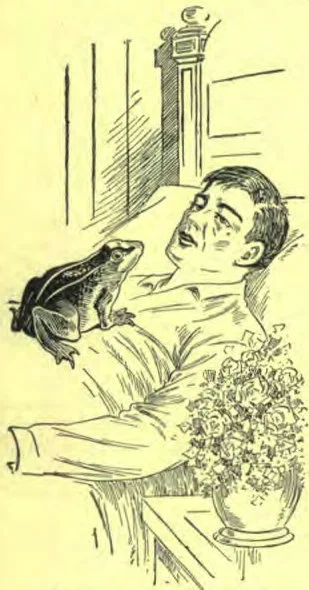
Dr. Frog and his patient
“Instead of being a valuable nutrient and tonic, as formerly considered, the facts presented show conclusively that alcohol is a protoplasmic poison, an active depressant, and the legitimate mother of anesthetics.
“Alcohol never stimulated anything or anybody. It always puts to sleep one or more of our faculties. It may put to sleep our sense of decency and our power of restraint, so that we become abnormally lively and vivacious. It may put to sleep our power of muscular control, so that we reel in walking and mumble our words when we try to talk. Finally, it may produce an actual stupor, when the individual, as we say, is ‘dead drunk.’ All these familiar changes are merely stages in one and the same process of stupefying ourselves—of lessening our power to do and to be. As regards the deleterious effect of alcohol, the discussion has practically been closed. The transitory effect alone should be sufficient evidence to condemn it; but that is not all, alcohol increases the blood pressure, robs the tissues of needed oxygen, hardens the arteries, and invites degeneration, decay, and disease. Physiologically, it is no advantage or assistance to the body under any circumstances whatever; nor is it capable of increasing strength or endurance or vitality in any sense, medically or otherwise. Even in so-called moderate doses, alcohol invariably lowers the coefficient of efficiency, retards the mental processes, dulls the keenness of vision and hearing, diminishes the sensitiveness of touch and smell; in a word, it interferes with all physical and mental action, and is thus distinctly a poisonous and habit-producing drug, always dangerous and often deadly.”
In our hospitals its use has decreased seventy-five per cent in the last five years, and it has been entirely omitted from the United States Pharmacopoeia. While the old belief in its efficacy as a medicine dies hard, it is almost dead. A few uninformed mothers may yet act upon the old conception freely dispensed by the brewer, that beer is good for mothers just before and after childbirth. Science has long since completely exploded this idea, showing that one of the worst things a woman can do is to drink alcoholic liquor, though the real effect of the alcohol may not be apparent except in the abnormal liking for intoxicants revealed on the part of the child after manhood is reached. But this may be enough to wreck the life of the child.
The New York Health Department says to mothers, “You can’t drink liquor and have strong babies. Sickening liquor or healthy babies — which? Take your choice.”
According to Drs. Chittenden and Mendel one tablespoonful of whisky reduces the digestive activity more than seventy-five per cent. Dr. Bunge, of Germany, asserts, “When alcohol is taken into the system in any appreciable amount, the digestive process is arrested and fermentation ensues.”
Call in “the little green doctor” if you wish. He cannot harm you, and his croakings may arouse you; but never, under any advice, call in any member of the alcoholic family to minister to your needs. They can do nothing but harm to the delicate human organism. “You don’t need alcohol for health; you don’t need it for strength; you don’t need it for food; you don’t need it for drink. It never does you any good; it always does you harm. Let it alone.”
The Fatal Prescription—A True Incident
By Mrs. E. V. Wilson
YOU ask me why I so seriously oppose the use of alcohol in sickness. As one of my reasons I will give you the experience of a friend.
You remember meeting at our home, just before you moved West, a Mr. Lester and his wife. You thought their prospects for happiness bright, as you remarked to me that you had seldom met a couple more attractive and apparently so well suited to each other. Mr. Lester and my husband had been intimate friends for years, and when at the age of thirty-five he married and brought home a fair girl of twenty with whom he fell in love while on a business trip, we were delighted, for, as Fred said, Lester was “too good a man to live a bachelor.”
Mrs. Lester we found to be a charming woman, bright and intelligent. They went into society a good deal the first year of their married life; but during the second a babe was born to them, and of course that made a change. They seemed, however, happier than ever. But alas! the child, when about a year old, sickened and died. Mrs. Lester, who had idolized the little one, became low-spirited, and at last ill, and for some time her life was despaired of. Just at this time my own domestic affairs confined me closely. My mother was in delicate health, and our little Nellie had a long illness, so that for almost a year I scarcely left the house, and saw very little of others.
As soon as Mrs. Lester recovered, she called to see me; at first she came frequently, but since I was so absorbed in my own troubles, her visits became farther and farther apart, until sometimes months lay between them. I asked my husband one day what had become of the Lesters, as I had not seen Mrs. Lester for a long time. He said he knew little about them.
“Some unaccountable change,” he went on, “has taken place in Lester; he is totally unlike himself, scarcely ever smiles, seems to take no interest in anything or anybody.”
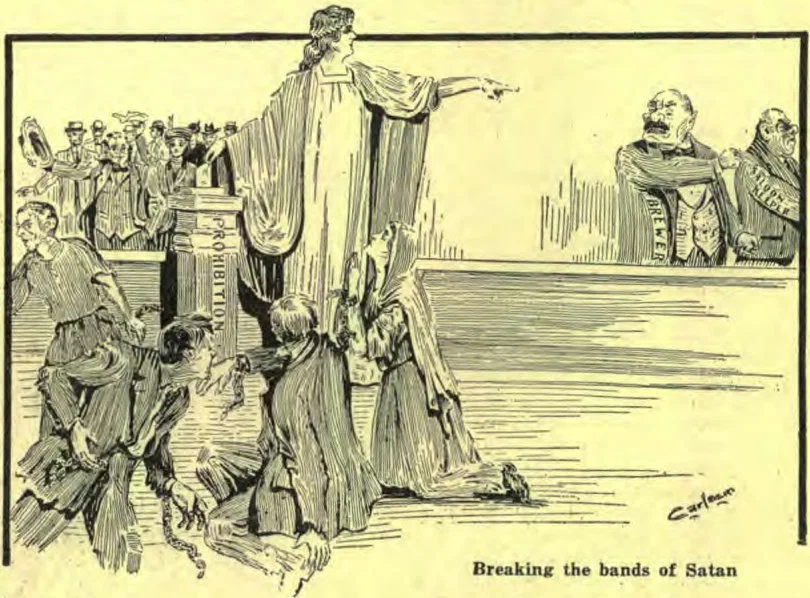
Breaking the bands of Satan
“Perhaps,” said I, “he has business troubles.”
“I think not,” said Fred, “his business appears to be prosperous.”
The subject was dropped; but I thought a good deal about it, and at last determined to visit my old friends to see if they were in trouble. I was kindly received by both Mr. and Mrs. Lester, and could detect no difference in their manner to each other or to me, and yet there was a feeling of restraint which troubled me, and an air of mystery about the house which perplexed me. I soon learned that others felt as I did, and of course there was “talk.”
Servants told strange tales of Mrs. Lester’s “hysterics” and “queer spells,” which often confined her to her room for days. During these periods no one but her husband was permitted to see her.
Mr. Lester and his wife finally left home, ostensibly to travel for the benefit of Mrs. Lester’s health.
Two years passed, when one day my husband said:—
“The Lesters are home again, Nellie. I met Lester this morning, and of all sad faces I think his is the saddest. I was afraid to ask after his wife, for I felt sure she was dead.”
“And is she?” I asked.
“No; he told me she was well and would be glad to see you.14Shall we call this evening?” he asked. “I feel anxious about Lester.”
Company came and prevented our contemplated visit. But in a few days I called at the house and inquired for Mrs. Lester. The old woman who came to the door had lived in Mr. Lester’s mother’s family until it was broken up by the death of old Mrs. Lester, and since then had lived with the son. I knew her well, and was surprised at the embarrassment she showed when I asked for Mrs. Lester. She did not invite me to enter; but after a moment’s hesitation said she hoped I would excuse Mrs. Lester, as Mr. Lester was quite sick. I accordingly returned home without seeing her.
About dark that evening I received a message summoning me to her side. Mr. Lester’s illness was violent, and proved fatal in a few days. Whatever the trouble in the family, it was not lack of mutual affection, for his dying eyes sought hers, his hand clasped hers until it was cold in death. As for her, she neither ate nor slept during the time his suffering lasted, but was constantly with him, allowing no one to assist him in anything she was able to do for him. And when all was over, her agony was terrible to see. It was with difficulty I persuaded her at length to leave her dead, in order that the body might be prepared for burial.
About midnight I prevailed on her to lie down, and, exhausted in body and mind, I threw myself on the bed by her side and fell into an uneasy slumber, from which some slight noise aroused me.
Looking around, I saw, by the dim light, Mrs. Lester standing in front of the dresser with what appeared to be a bottle in her hand. I spoke to her, asking if anything was the matter. She seemed confused, and put her hand to her head, then replied that her head was aching badly. I offered to get up, but she begged me to lie still, and in a short time returned to bed and apparently fell asleep. After this I must have slept soundly, for when I awoke it was daylight.
Dressing myself quickly and quietly, to avoid disturbing my companion, I was about to leave the room, when my eyes fell on her face. The eyes, half open, were bloodshot, while the whole countenance was flushed almost to a purple hue.
“Dear me!” I exclaimed, “she is very sick.”
Hardly ringing the bell, I tried to arouse her. As I did so, the fumes of alcohol surprised me. I did not know what to think, but I proceeded to bathe her head in cold water and comb the tangled locks away from her face. While I was thus engaged, old Rachel entered the room.
“Just let her alone, Mrs. C——,” she said; “she is drunk, and that’s all there is to it. O you wretched creature!” she continued, addressing the unconscious woman, “couldn’t you wait until he was under the ground to make your shame known? Now,” she cried, turning to me, while tears streamed down her wrinkled face, “you know the life he led; do you wonder he was changed? O ma’am! if ever there was a saint on earth, that poor man that lies a corpse downstairs was one.”
Let your vote be for the protection of my boy and not for his destruction.
I was so surprised and horrified I could scarcely speak. “O Rachel!” I said at last, “I never dreamed of this; how long has it been going on?”
“Why, almost ever since her baby died. She was so feeble, you know,” said Rachel, “that the doctor said she must have wine every day. Of course, nobody thought of harm until it was too late. Poor thing! she did try to break herself of it, but it seemed she couldn’t. I thought Mr. Lester would go crazy. He would try to scold her sometimes, but more times he would coax her. I have seen her get down on her knees before him and promise, with tears running down her cheeks, never to touch the stuff again; and I believe she meant it, for she loved him dearly.”
“It seems strange, Rachel,” said I, “that, loving him as she did, she would persist in doing what she knew, or at least what she might have expected, would drive him from her. There are few men, I think, who would prove faithful to a drunken wife.”
“That is the truth,” answered the old woman. “Women are expected to live with drunken men, but not men with drinking women, and she knew it; she used to tell him that, and beg him not to leave her. Oh! if love could save the drunkards, Mrs. C——, there would be few unsaved; but I tell you the craving for whisky—it is not always love of it—is stronger than love or hate or any other passion. I know that woman,” pointing to Mrs. Lester, “loved her husband better than her own life; she would gladly have died for him.”
“Sometimes there would be weeks during which she would not touch liquor. Once she went three months without it, and they were very happy! That was while they were traveling. They thought she had entirely lost her desire for it, and he brought her back, thinking to have a happy home again. But they were invited to dinner at the Rev. Mr. Brown’s. They never thought of danger there. But a friend had sent the minister some expensive old port, and his guests were invited to taste it.
“Immediately after dinner Mr. Lester brought Mrs. Lester home, on the plea of his own head aching. Poor man! if he had said heart aching he would have told the truth. I saw at once by her flushed cheeks and loud talk that somehow she had got liquor. But I helped him coax her to lie down, and together we watched by her until we thought her asleep. Then, as he had some business to see to, he left me in charge and went to the store.
“O Mrs. C——! she was not asleep; as soon as he left the house she got up, and in spite of me left her room. I ran to fasten the doors, but she was too strong for me. It was dark and raining hard; she got away from me and ran out into the street bareheaded. I followed her, begging, praying her to go home. But it was no use. In the darkness I lost her, she was so quick. Then I went to the store for Mr. Lester and told him. I think death struck him then, for he turned gray in the face; not white, Mrs. C——, but gray, ashen gray, and he staggered like a drunken man. As he hurried past me, I tried to follow him. But I am old and weak, and it was so cold and dark I returned to the house to get things ready for them when they came back.
“It was nearly midnight when they came. I don’t know where he found her; but he was half carrying her. They were both wet through with rain, and her beautiful dress was covered with mud. He only said, ‘Help me, Rachel,’ and we got her clothes off and put her in bed. Then I got him dry clothes, and wanted him to lie down, but he did not. The next morning he was sitting just where I left him when I went to bed, and he had that same strange gray color on his face.”
Dear Favur, I fank thee for making our State dry. Muvver says we can now have lots of good fings to eat.
Mrs. Lester was still asleep and breathing loudly, or it seemed loud in the still room, as Rachel paused in her sad story.
“When did you say this was, Rachel?” I asked.
“Just the day before Mr. Lester took down,” she replied. “He had not been well for several days; in fact, he had not wanted to go to the dinner party. He only went to please Mrs. Lester. The next morning when she roused up, he told her he was sick, and if she would stay with him he would lie down.”
“O Rachel! How did she act? How could she look him in the face?” I asked.
“She felt bad, I know,” said Rachel; “but she did not refer to the occurrences of the night before. She was pale and weak, but she tried to keep up, and stayed in the room with her husband all day, lying by his side most of the time. She became frightened at last, as he got no better and she noticed that strange look on his face.”
“‘What does it mean, Rachel?’ she whispered to me. ‘Go for the doctor. O Rachel! have I killed him?’”
“I did not tell her what I thought, but I brought the doctor as quickly as I could. You know the rest—how he never rallied, and how she nursed him. I will tell you one thing more, in justice to her. Mr. Lester told me that his wife inherited her love of liquor from her father, who died a drunkard. If so, we should pity her, should we not?”
Mrs. Lester attended her husband’s funeral in a calm, decorous manner. After it was over, she disappeared, no one knew whither, nor could the utmost efforts of lawyers or friends discover her whereabouts.
With the exception of a handsome legacy to Rachel, Mr. Lester had left all his property—which was large—to his wife, in charge of a lawyer friend, with particular instructions in regard to his wife, which the lawyer kept secret, while he spared neither time nor money in his endeavors to find his charge.
Years passed with no tidings from the wanderer, when, one bitter cold winter morning, I received a note from an intimate friend, stating that she would call for me in an hour, in company with Dr. Bland, in order that we might go with him to see a sick friend.
Wondering somewhat, as I knew of none of our friends’ being ill, I soon made ready, and when the carriage arrived, stepped in at once. We were driven to a distant part of the city, tenanted by the lowest class of people. I suppose I looked my surprise, for Dr. Bland remarked:—
“You will know all soon enough, Mrs. C——. I cannot bear to tell you.”
At last the carriage drew up at the door of a miserable house, and we alighted. The doctor preceded us up a rickety flight of stairs and into a room near the top of the house. Oh, the wretched, wretched place! The bare, dirty floor; the uncurtained, grimy windows; the broken, smoky grate with just a handful of coals; the mass of rags, on which, in lieu of a bed, lay all that was left of our once beautiful, happy Annie Lester.
She extended her hand to me. I took it, while unbidden tears filled my eyes.
“Do not cry now,” she said, in a faint voice; “rather be glad that a miserable life is about to end. I never would have returned15but for that. It is only a question of hours, Doctor; isn’t it?”
The doctor bent his head. And she continued brokenly:—
“I would have spared you, dear friends, this, to you, painful scene, but I have a favor to ask. I want to be buried near my—my husband.” She paused, and a thin stream of blood trickled from her lips. I wiped it off and she went on, still more faintly: “Near him, friends; not at his side, ah! no, not there, but at his feet. I killed him. Oh! I who loved him so, I killed him as surely as if I had driven a knife into his heart. O Dr. Bland!—that fatal prescription of yours! If it had not been for that! O my God!”
She half raised up, but fell back exhausted, while the pallor of death settled on her wasted features.
“Doctor,” she gasped, pushing away the spoon he placed to her lips, “don’t try to prolong this misery.” She raised her dim eyes to his face. “I forgive you,” she said, “as I hope to be forgiven. You—you,” she went on, a word at a time, while each laboring breath grew shorter, “did not mean, but oh! that daily glass of wine; it found its way to the hidden taint in my blood. O my father! what a heritage you left your child; but it might never have been awakened if it had not been for that. I tried so hard—I have suffered so—a thousand deaths—my husband’s feet, remember, re—”
Death sealed her lips. As the doctor bent to close the glazing eyes and fold the cold hands, he trembled as with an ague.
Next day, while snow fell fast from the dull gray sky, we laid poor Annie Lester’s body, not at her husband’s feet, but by his side, where, while life lasted, he had so nobly kept her, and where we knew he would have wished her to rest at last.
As Dr. Bland left me at my home, after the last sad rites were over, he retained my hand in his a moment. His face was pale, and his firm lips quivered a little as he said:—
“Mrs. C—, I think I fully realize the woe of him who putteth the cup to his brother’s lips, and I am resolved that no human being shall ever again lay his ruin at my door.”
“Amen!” I answered. “Would that every member of your useful profession would make the same resolution and abide by it, for I am sure the sum of human sin and suffering would thereby be greatly lessened.”
The doctor bowed gravely, and stepping into his carriage, was driven homeward, while I entered my own happy home, and in the society of my dear ones strove to recover my usual cheerfulness. Still my heart is sad whenever I think of those two wrecked lives, and of that “fatal prescription,” and of numerous other similar prescriptions whose histories likewise have been written in human suffering and degradation, but have not yet been put in print.—Mrs. E. V. Wilson, in Arthur’s Home Magazine.
Standard Publishing Company, copyright
Shall I Vote?
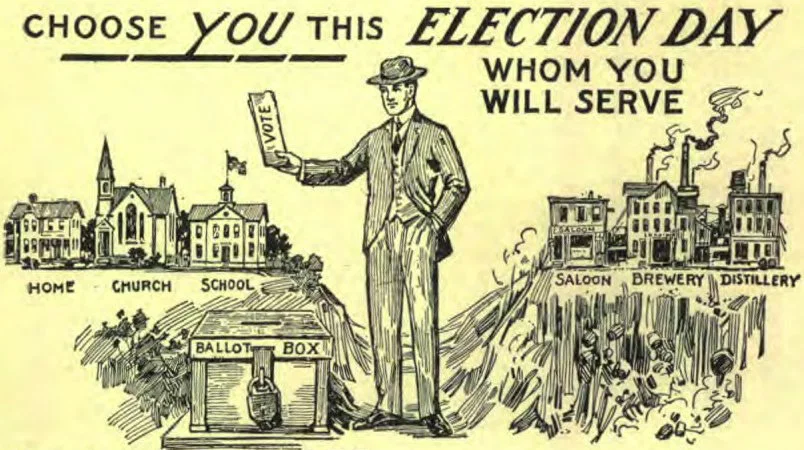
Of course you should vote. Dr. Ira Landrith says that “scarcely a prohibition vote has been lost in a decade except by the indolence of the upright.” In Ohio in 1914, 160,000 men stayed at home and failed to vote on the liquor question. If you do not want to be reckoned as an accomplice in all the evil wrought through the accursed liquor traffic, then bestir yourself and vote for annihilation whenever opportunity offers.
For a generation a certain Massachusetts town had been a no-license town, and doubtless all the good people thought it would forever remain so; but thinking and voting are both necessary to keep the slimy body of the liquor traffic out of any place. However, the town forgot this, and awoke one morning to find that the liquor people, who had been awake all the time, had crowded the town hall and voted in the saloon. But fortunately the selectmen were prohibitionists, and saved the day by deciding to place the liquor license at $1,000,000, if necessary, to keep the traffic out.
The great Yukon Territory missed becoming dry for want of three votes. We are told that if the ministers who left the city of Dawson that day had remained and voted, prohibition would have won.
Bicknell, Ind., and Whitewater, Wis., according to reports, were each made dry by one vote. What sorrow and loss would have come to many in these places but for the one vote! Mr. Daniel Poling regards nonvoters as civic grafters. He says:—
“There are men who would not steal a cent, who would not misappropriate a single dollar of a trust fund, who do steal liberty, who do take the priceless institutions of freedom without paying for them, who are civic grafters.”
“It was one of these who said during the campaign for State-wide prohibition in Vermont, ‘Prohibition will carry the State all right; and if I wasn’t so busy, I should like to vote myself.’”
In the election which followed, he and his kind defeated prohibition, for, with one hundred thousand eligible voters in the State, only fifty thousand went to the polls, and a majority of the delinquents were registered in territory already dry through local option.
“Shame! Vermont of the Green Mountains! Vermont, out of which Ethan Allen came to walk with the immortals! The descendants of men who tied rags about their frostbitten, bleeding feet, and marched through blizzards to die for liberty, sat by their firesides on a day when the honor of their commonwealth and the future of her unborn were at stake, and with the supreme weapon of citizenship in their hands and the gauge of civic battle thrown down, struck not a blow. The battle went to the enemy by default; it was not won, because it was not contested. Hats off to the heroic men and women who struggled until the last minutes of the voting day against unfair odds laid on them by the indifference of those who should have been their fighting comrades; but thrice shame upon those others who sold their neighbors’ birthright and their own for the pottage of civic laziness.”
As a people we are given the definite counsel that we fail to do our whole duty unless we exert our influence, by precept and example,—by voice and pen and vote,—in favor of prohibition and total abstinence. We ourselves must grapple with this giant foe, our motto, “No compromise, and no cessation of our efforts till the victory is gained.”
The Saddle Maker
At a North Dakota rancher's rear door a middle-aged man, a tramp, begged for something to eat.
“Why don't you fellows go to work instead of begging and beating your way?” asked the rancher, banker, and all-round successful business man.
“There is nothing doing in my line in this country,” answered the man. When asked what his line was, he said, “I am a saddle maker, sir, and I can make as fine a saddle as man ever rode. I came to this State to get away from drink. When I learned that I could escape drink by coming here, I did not stop to inquire about work, but came at once. I paid my fare as far as I could, and since then I have walked and starved and shivered, until I can go no farther.”
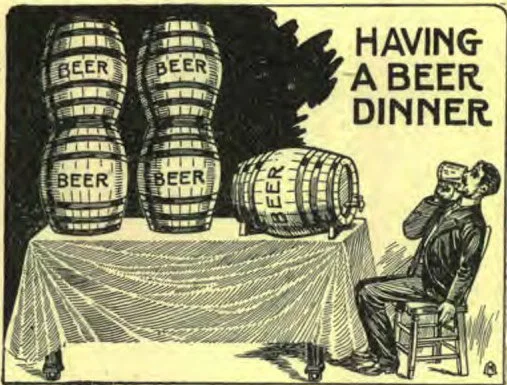
Scientific analysis shows that one loaf of bread contains more nutrition than five barrels of beer.
“Come in and get warm, and have some breakfast,” said the rancher with an uncomfortable lump in his throat. “There are a lot of cowboys on my own and neighboring ranches who purchase many saddles. I have a vacant room you may use. I will furnish you with material, and if you can do what you say you can, your success is assured.”
The handsome saddle presented to the rancher at the end of the week proved that the wanderer was a saddle maker of the first class. He was therefore given every opportunity by the philanthropist to ply his trade. His success is shown by the fact that in time the Jackson Saddlery Company, Limited, was organized under the laws of North Dakota, with a paid-up capital stock of $50,000. Since September, 1914, the company has had contracts with the British government for all the saddles it can make.
“I had always made money,” said Mr. Dillon, the saddle maker, “but drink got it away from me, and I was left poor. Thank God for a State where a man can't get liquor!” And so say we.
Results of Prohibition in Oregon
By Glaudia Albrecht
THROUGHOUT the beautiful State of Oregon, from Ashland, the most extreme southern town, to Portland in the north, the majority of the buildings that were erstwhile grogshops are now being utilized by clean, legitimate businesses, beneficial to the consumer as well as to the manufacturer. Others, however, with their glaring advertisements of the nefarious business that was within still unobliterated, stand closed and forsaken, a mute and welcome evidence that the hideous evil with its direful consequences has been extirpated.
Since the State went dry on Jan. 1, 1916, the total arrests in the city of Portland have decreased 41 per cent; arrests for drunkenness, 77 per cent; disorderly conduct, 36 per cent; vagrancy, 56 per cent. Admissions to the Oregon penitentiary decreased 42 per cent. There were 44 less admissions to the Multnomah County Poor Farm. In Portland, fire alarms were cut in two. Pisgah Home Rescue Mission has closed because not an inmate was left nor an application pending. Thirty-five policemen of Portland were dropped and more could be, though the city has been increased 25 per cent in area. The five-cent eating houses have quit business because the hobos are patronizing the twenty-five-cent restaurants, and they have moved from the five- and ten-cent houses, demanding steam-heated rooms.
Oregon bank deposits increased $12,000,000; Portland bank deposits increased $4,200,000, of which $2,200,000 was in the savings banks, representing dry prosperity for the poor.
Grocers, butchers, bakers, and clothing merchants, reported to the Progressive Business Men's Club an increase in business.
Dairies have increased business because the poor are buying milk. Robert G. Duncan, manager of the Retail Grocers' Association, declares that he has been made a prohibitionist by prohibition. He affirms that the grocerymen of Portland are almost unanimous in their indorsement of it.
“The grocers are helped wonderfully in the matter of collections. Men who used to dodge their grocery bills are now prompt in paying, and their families are not going hungry.
“Many wives used to come to the office begging for leniency in the matter of bringing action to collect legitimate bills. For example, a fireman’s wife came in one day last year and begged for time. She said that her husband had a way of getting drunk on pay day, and when drunk, he turned to crap shooting. As a result she got little of the money for household expenses. He had contracted a bill of $110 with one grocer, and six other food firms were losers by his acts. Since the State went dry, that man has not only been prompt in his payments, but he has almost paid up his former indebtedness.”
Mr. Duncan personally opposed prohibition until he saw the good it did. He says he can now ride in his automobile without fear of being rammed by a drunken autoist; he can go home on a street car without smelling a polluted breath or listening to some liquor-laden argument.
The saloon is the sum of all villainies. Happy the State that frees itself from the blighting curse. Let us work assiduously and systematically, with a heart uplifted in prayer to Almighty God, that this deadly evil, this ubiquitous snare, may be eradicated from our entire nation. GLAUDIA ALBRECHT.