“Why, oh, why does he not come? I wonder if it is that cursed liquor again. Poor Burton! he has tried so hard to stop drinking, but it seems of no use. Why will men sell a poison that can debauch so noble and good a man, and starve his little ones?”
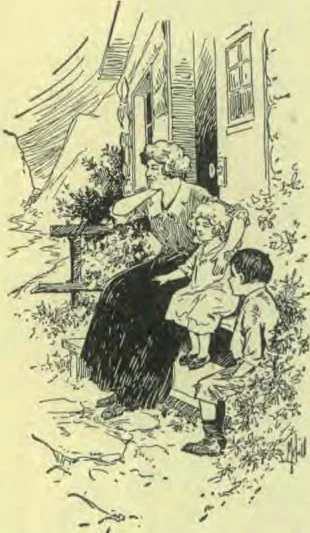
The speaker was a woman of thirty years, whose pale, emaciated countenance and wavy hair bore traces of rare beauty not long departed. As she sat in the doorway of the lonely cabin, her eyes wandered out over the familiar scene. Near the house stood a growth of scrubby cottonwood trees, which extended far up and down the cañon. On either side rose the river banks sheer five hundred feet to the level of the brown prairie. Bleak cut banks they were, destitute of vegetation except where a pale and sickly sagebrush clung to their precipitous sides. Between these banks meandered the treacherous Milk River, named from the milky hue of its turbulent waters. This was the scene upon which Alice Stanford had looked for eight years, and never during that time had she been out of the valley. There were no neighbors nearer than forty miles away on the bank of the Missouri River.
“Papa bing little May dolly when he tum! Papa said so.”
Then a moment later: “When papa tum, mamma?”
The mother smiled sadly as she looked into the animated face of the trusting child, and said simply, “I hope your father will come today.”
The little one, taking this for assurance, brushed back the nut-brown curls and seated herself at the mother’s feet, while her deep blue eyes wandered far up the frowning bank to see if papa had already started down its steep sides, with the coveted doll.
The waiting that is known only to a drunkard's family.
The day wore on as had many days before during the three weeks of the father’s absence; the shadows lengthened, but the mother stirred not. She saw not the things around her: the little house, the scrubby trees, the deep cañon, were all forgotten. She is a girl again in the beautiful Eastern home, among youthful and happy friends; books in hand, she trips up the broad steps of the old brick school-house at the end of the street; once more she sees the loving faces of father and mother as the family gather around the hearth; again she hears the lark and the thrush in the pasture lot, and hears the happy robin calling his mate to come where the cherries are ripest; once more she hears the voice of manly Burton pleading to be forgiven for his error in tipping the flowing bowl; and how plainly she hears her mother’s warning voice; how clearly she remembers her father’s words of counsel:—
“Don’t marry a man to reform him;
Don’t be by his promises led;
If he can’t be a man when he’s wooing,
He can’t be a man when he’s wed.”
Yet she believed Burton. True, he had promised the same before, but it was his companions who were to blame. If they were married and away out on a ranch in the Golden West, where every one is happy, he would not drink. Burton believed this, and Alice believed it, despite her father’s counsel and her mother’s tears. She trusted and sought the West.
“Mamma, may I have a cooky?”
The mother awoke from her reverie as the sound of the boy’s voice broke upon her ears. A look of pain crossed the pale features as, gazing tenderly into the face of her boy, she replied:—
“My son, there are no cookies.”
“Some bread, then?”
“There is no bread.”
“What may we eat, mamma? We have eaten potatoes and salt so long they don’t taste good any more. Can’t I make some bread, mamma? I know you are too sick to do it, but can’t you sit by the table and tell me how?”
This was almost more than mother-love could bear—to see her children suffering from hunger, while over the bar at Chinook, a hundred miles away, the father was freely tossing the money that would have made them comfortable and happy; but she quietly replied in a voice that was not altogether steady, “There is no flour, my child.”
The boy, who possessed a thoughtfulness beyond his six years, stood squarely up before his mother and said, “When I get big and sell cattle, I’m going to spend all the money for flour and sugar and shoes for you, mamma, and some pretty ribbons for sister.”
“Papa bing me dolly, mamma, when papa tum.” And the little face was wreathed in smiles of anticipation. “Dollies have hair, don’t they, mamma? an’ eyes, an’ teef?”
The autumn shadows lengthened into twilight; the woman rose feebly and entered the little house. What a house! Walls bare; but one chair, and that made of rough boards; a table of the same material, on which stood the stump of a candle in the neck of a bottle serving as candlestick; no stove, only a fireplace of rough stones plastered over with clay. At the opposite end of the room stood two bunks made of cottonwood poles, upon which were ticks filled with hay and covered with coarse blankets. Yet in these rude surroundings was seen the hand of refinement; everything was immaculately clean; floor spotless, windows shining, the rough board table adorned with a bouquet of late fall grasses, and the bareness of the walls relieved by tastefully arranged wreaths of green and golden forest leaves tied with knots of silk grass. With what undying tenacity does a gentle heart cling to the beautiful?
The little ones were soon divested of their scanty clothing, and after repeating their childish prayer and bestowing the good-night kiss, they were snugly tucked into bed, and soon were fast asleep. The mother sat for hours lost in thought, and her poor heart ached as she tried to look away into the future—into the future of the two dear ones now sleeping so innocently. How she longed to guide their feet, but knew this could not be. Grief over a fallen husband, starvation, and exposure had broken her once robust health, and she knew that the end was near.
“O that I might live until he comes! Why, oh why, does he not come?” broke from the pale lips; and creeping softly to the bedside, she gazed long and earnestly upon the baby faces.
“Papa bing me dolly,” came from the lips of little May.
“O poor motherless children of a drunken father! How I wanted to stay and—and—”
The chill November morning broke over the world, and at last found its way through the dense fog and down into the great cañon. The little ones, aroused by its light, began to talk in whispers that they might not wake mamma. Soon they slipped out of bed, and helping each other to dress, stole quietly from the room and were soon building imaginary houses in the sand; but hunger overtaking them, they wondered why mamma slept so late. Peering cautiously through the door, they saw her lying upon the bed with eyes open. They called; she did not answer. Little Lynn touched her hand. It was cold. Diminutive May climbed upon the bed and kissed her, but she did not smile. A nameless terror filled their hearts, and they fled from the room. All day they hovered about the door, but mamma did not move. Evening came on; they dared not enter now, but stole away to the huge haystack by the corral, where they cuddled down together, cold, hungry, terror-stricken, and cried themselves to sleep, poor innocent victims of the demon alcohol.
Another day passed, and still they waited. They were nearly starved now, but in spite of the pangs of hunger, little May talked of the wonderful doll which papa would bring.
“We ain’t nezzer seen a wealy dolly, has we, Lynn? Mamma says wealy dollies have wealy hair and wealy eyes and wealy teef, too. An’ you tan hold her half ’e time Lynn, and we’ll make a playhouse for her. S’pose papa’ll tum dis night, Lynn?”
As the little ones were talking, a huge mountain wagon with shrieking brakes was making its way down the winding trail that leads from the prairie into the cañon below. In the wagon, guiding the tandem six with the air of one accustomed to the practice, sat a man of perhaps thirty years, tall, sinewy, and strong, of blond complexion and regular features, a manly face to look upon; but just now the eyes were bloodshot, the face bloated, and a look of shame overspread the countenance. From the top of the bank and for nearly halfway down he could see the little cabin nestling among the trees—the cabin which he had built, he and Alice; the cabin where the Lord had given them the sturdy Lynn and little May, whose disposition ever reflected the sunshine of the month whose name she bore; the cabin where for three years no sorrow came to them and happiness reigned supreme.
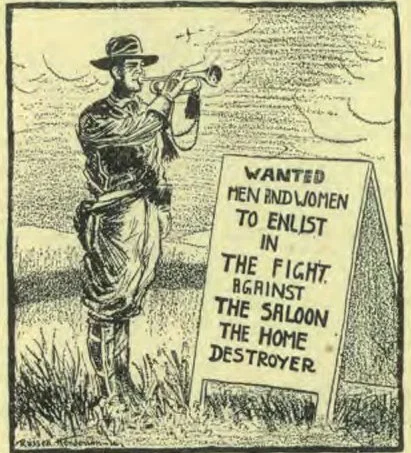
Civilization’s preparedness call
Then came the first shipment of cattle. How proudly he drove them to market; how hopefully Alice bade him good-by, and how eagerly she watched for his return with warm clothing for the babies and a few pieces of much-needed furniture for the home! Ah, could he ever forget the bright, happy face that greeted him as he arrived, or the look of disappointment at the empty wagon?
In town he had met an old friend, and together they took a social glass. From that time Burton could but indistinctly remember what occurred until he arrived home with empty wagon, and saw his wife’s disappointed face. Four consecutive years the act had been repeated. How he had struggled to overcome the appetite!7How he had tried to be a man again! But in spite of all his efforts it had occurred again; and as he reached the familiar gate, he bowed his head in shame, and the scalding tears ran down his sunburned face.
“Why, oh, why,” groaned he, “did I take the first glass? Do I love rum better than my patient wife? Do I love it better than those sweet children? God knows I don’t. I hate the cursed stuff! Then why must I drink it and ruin the ones I love?”
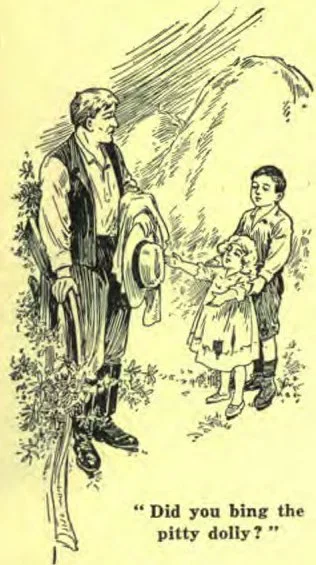
He neared the house, but Alice came not forth to greet him. He called; no answer came. From behind the haystack, two pale little figures staggered toward him. It was Lynn with tear-stained face, and looking much older than his years, who came slowly forward leading little May, who, in spite of her weakness, shook her nut-brown curls and in a hopeful voice queried: “Did you bing de pitty dolly? Is it got wealy hair, an’ eyes, an’ teef?”
“Where is your mother?” the father asked quickly, anxious to divert the child’s mind from the doll which he had promised and forgotten.
“Mamma is asleep,” said Lynn. “She slept all day yesterday and today. We kissed and kissed her, but she didn’t wake up. She was just awful cold, and we covered her all up warm. I guess she thought you’d be home sooner, for she looked and looked for you. And once when she didn’t know I was near, I heard her say, ‘Lord, keep him from the drink this time. You know he wants to be good.’ What did she mean, papa?”
Did you bring the pretty dolly?
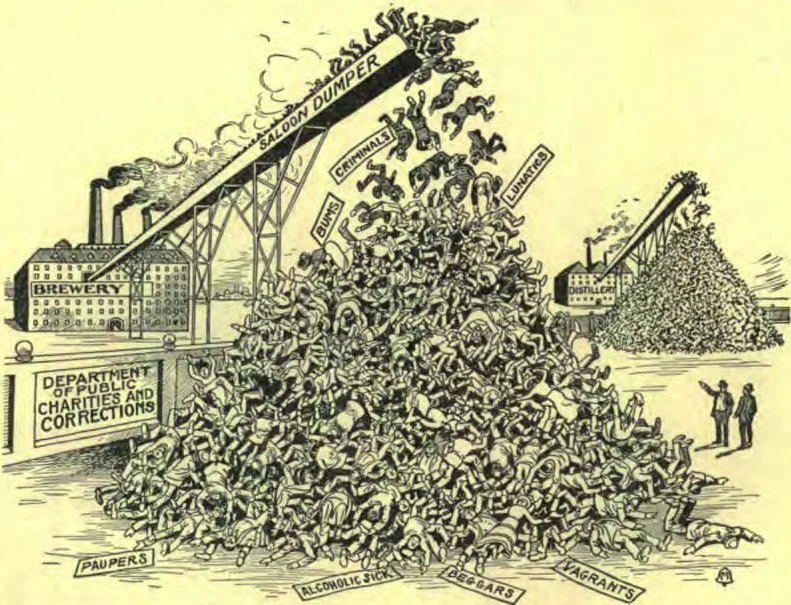
The liquor manufacturers take the profits and dump their refuse on the taxpayers.
With a sinking heart the man pushed open the door and met the lifeless stare of those beautiful eyes which through all his downward course had never given him a reproachful look.
Through the long night he worked to prepare the last resting place of her who had hoped through all; and in the gray dawn he placed the sleeping children in the great wagon, and drove up the long, winding trail which led to the brown prairie above, and out into the sunlight of a better life.
Such tragedies the liquor traffic is enacting every hour in every corner of the land where licensed saloons exist. Will your vote help to perpetuate such a traffic? God forbid! GLENN S. BUGBEE.
The Trader’s Fire
Near the heart of Africa a missionary and his wife pitched their tent in the great fields of dry grass, so high that it hid the tent almost entirely from view. Not far from his mission home lived a slave trader, a white man, who, when he heard of the coming of the missionary, knew his “business would be ruined” if the missionary had his way. The wily trader, in an effort to prevent this catastrophe, hit upon a plan that he felt sure would result in exterminating the missionary instead of the missionary’s annihilating his lucrative business. So after the missionary had pitched his tent, and started one day to a neighboring station, the trader suavely told him he would like to accompany him if there was no objection. The missionary gladly accepted his company. The trader, however, before leaving home gave directions to a native boy to set fire to the grass at a certain place. He knew that, once afire, it must sweep everything before it, even the missionary’s wife, baby, and tent. Then, having lost all, the leader must of necessity return to civilization, and abandon the mission.
But this diabolical plan failed because there is a God in heaven. When the missionary’s wife saw the fire coming like a race horse toward her tent, and knew that there was absolutely nothing she could do to save herself, her child, or her home, she looked for protection from the devastating flames to Him who said to his children, “Fear thou not; for I am with thee; . . . I the Lord thy God will hold thy right hand.”
He heard and granted her petition; for the fire parted, went around the tent on either side, met again on the farther side, and then pursued its relentless course. As the missionary neared home, saw the flames, and saw from the hill his tent unharmed, he knew the angel of the Lord had protected his family.
You are horrified that a man could be so black of heart as to commit such a crime against human beings in order that his wicked business might suffer no interruption. But is he worse than those who deliberately flood every heathen land with rum, which does more to hinder the work of the gospel than the blotting out of many missionary families? Is his act worse than that of yours when you vote to license the liquor traffic, which wrecks a million homes every year?
It is greed of the basest kind that perpetuates the liquor traffic in face of all the crimes it is constantly committing. It could not live for a moment if people did as their better nature tells them they should do. All who love their fellow men better than they do the dollar, cry, Down with greed, and up with nobler principles of living!
The Dog and the Bottle
By A Contributor
ONE afternoon my mother had a severe headache, and was smelling a bottle of ammonia. A handsome Newfoundland dog named Guess watched her, and in his most beseeching way asked to have a smell of what she seemed to be enjoying.
Finally mother placed the bottle on the floor, and gave him an invitation to come “smell the bottle.” In his eagerness to do so, he tipped it over, the contents poured out, and poor Guess was nearly overcome by the strong fumes. He never forgot the episode, although he was young when he had the experience.
Sometimes when we had company we would tell the story, and one of the family would ask Guess if he wanted to smell the bottle. He would get away from us as far as he could, and if we persisted in following him up with the inquiry, he would get into a corner and turn upon us with a look of reproachful love, yet with an air of determination that said that nothing or nobody should persuade him to smell the bottle.
Any one outside the family, friend or stranger, asking him about the bottle, would send him to the corner, and when once there, a gleam in his eyes would cause the person to halt, daring not to advance. Even we whom he loved so dearly thought it prudent not to persist too long.
Would that every young man who takes his first drink of rum’s fiery liquid and reaps the consequences of it, were as wise as Guess, forever after shunning the glass that else must prove his complete undoing.
A CONTRIBUTOR.
California Forewarned
“After eight months’ experience, Spokane warns California that prohibition means a loss of population in your jails, your poorhouses, your hobo camps, and your dives; it means less business for policemen, divorce lawyers, and bad-bill collectors; it means more money in the savings banks, more food for the babies, and more smiles in the homes.”—Spokane Chronicle.
Employers Weigh Drinking Habits of Job Applicants
FROM a report of the United States Department of Labor, 98 per cent of transportation, 88 per cent of trade, 79 per cent of manufacturers, 72 per cent of agriculturists, and 56 per cent of miners and quarrymen, consider the drinking habit of applicants for positions.
Bookmark furnished the public schools by the Department of Health, City of New York. Printed on the bookmark is the instruction: "Whisky is poison; save your body; save your brain; whisky brings you death and pain."
Painted by a Physician
By Carolyn E. Geisel
Dr. Carolyn E. Geisel
In the golden-grain belt live a father and a mother. The father fought through the Civil War, and carries a bullet around in his body as a reminder. Years ago if any one said anything to this man about his service in the war, he would say: “That is nothing. I never did anything for my country. But mother and I are doing something now, and he would point to his boy. That boy was his pride and joy. “Doing something now for our country: we’re raising a man; and when America wants a man, she will know where to get him — right here in the golden-grain belt.” So this boy grew on up through childhood, through the grade schools and the high school, and one day the father said to the mother: “Come on, Sarah, we will put on the finishing touches. He knows all the high school can teach him, and we want him to be ready for anything,—maybe the White House might want him; so let’s send him to the university.” And to the university he went. Can’t you see that father and mother working for that boy’s education? No side trips, no vacations, no new gowns or bonnets for mother; every dollar they could save or get their hands on was put aside for that boy’s education, because they were finishing a man for America. That is the basis of the home, and my America needs just that kind of men,—men that have faith in Old Glory, not faith in the saloon. America does not need defectives; it needs better men.
Look you, the boy is ready to go to school. Look at him! Not a defect in that family tree, not a drunkard, not a criminal, everybody all right! Four statesmen worth while, two governors, a number of lawyers and preachers, and two literary men of national reputation — a fine ancestry back of that boy!
And the boy goes away to a wet university town. Every ounce of blood in that boy’s body is as clean and pure as heredity could make; all his surroundings and environment have been right; he has a Christian father and a Christian mother; the best stuff on earth is in that boy. And he goes to a wet university town. It is full of saloons. There are five saloons in that town which are run for the “benefit” of the college men; they are called “college saloons,” “college men’s clubs.” Can you not see them making everything attractive for this boy, and others just like him? Can you not hear them saying if the boy does not come as regularly as they wish, “We missed you for several days. We can’t keep up this place unless you support it”? And so the boy goes, and bad reports go home the first year. His father comes up to talk with him, and the boy does better for a few days. But the second year is worse, and the third year is worse yet, and the fourth — well he just gets through by the skin of his teeth. This part of the story was told me by Wilbur Wright. He said the boy came home from college, came into the living-room, and the father rose to greet him; but he sank back in his chair, horrified. What was the matter? The boy was drunk, so drunk he staggered — staggered into his father’s presence with his diploma in his hand. Can you think what that meant to that father? After all his work and planning and his high hopes of training up a man for Old Glory, then to get just a good-for-nothing drunkard after four years! It took just four years for the university to ruin him,—that splendid American lad,—to turn him into a defective. My friends, that is why we plead for a nation-wide prohibition. What though you may live in dry territory, you send your boy out into wet territory to be educated, and at the end of four years you get back a debauchee.
That old man rose from his chair, shut his hands together, and said: “Go! go! I tell you! My country has no use for drunkards!” Do not call him an unnatural father. He loved his boy; but he also loved his country and his flag. He could not stand the disgrace, so he took even his name away from the boy. He bought him a ticket in another name and sent him to Paris, and that is where I saw him, staggering up and down the streets, not able to earn his bread. I was interested in the boy, and tried to keep track of him, but my fellow students would say to me, “We’ll get your American brother some day,” for France gives the dead bodies of paupers to La Grande Clinique. And I shall never forget the morning when I walked into that clinic, and there lay the haggard, dead body of that American university graduate. And oh, how I pleaded for that body! I told them I knew his father and mother; I wanted to bury him so that I might tell them where we had laid him; I wanted to say a prayer over him and wrap the flag around him. But they pushed me away and said, “No.” Besides, there was something there they wanted to see—something in his brain cells. So they took his brain out and separated it into single cells, that they might see the effect of alcohol. If you do not rise up and put the saloon out of reach of the boys, this nation is going to fail.
CAROLYN E. GEISEL.
Real Evidence
SEVERAL men in a railway train were discussing God and religion. A salesman who had been quite loud in his talk, said:—
“But what tangible evidence that there is a God can you, any of you, give? With what do you,” and he turned to an old gentleman, “satisfy your own belief?”
“I don’t know that I satisfy it, in the sense which you mean,” said the one addressed. “I accept it. I have faith, an abiding faith. Anyway, as Arthur Balfour once said, ‘Any system of religion which is small enough for our intellectual capacity is not large enough for our spiritual needs.’”
“And is it thus, blindly and without reason, that all men accept God and religion?”
Hardly had he finished when a lean fellow who had attracted attention earlier in the evening spoke: “I have been listening with much interest to what has been said, and I should like to tell you an experience, if you will allow me. You speak of not being sure about God! You say all your life you have not felt any influence or evidence of the Almighty!
“I have always believed; but I had something happen to me two years ago that has made me much more certain — something I can never forget.
“When I was twenty years old I began drinking. I am now forty-three. Little by little I took more and more, until one day my old boss said to me, ‘John, I guess we don’t need you any more.’ My next job lasted only a few days.
“This time I was not in so much of a hurry to find something to do. We had a little money in the savings bank; and I felt, as all drinkers do, that I could quit whisky and get a good job when I got ready. I loafed around for a week or two, spending nearly all the time — even the nights — away from home. Our money soon went, and I did nothing at all to relieve my good wife from the worries of a big family; and she did not always know whether there would be anything for supper or not. I don’t see how a man can get so low!
“But what is the use of telling it all? You know how it is — the misery, the disgrace, the rottenness of it all.
“It was two years ago this winter on a cold day that I started across the street in Chicago for about ‘four fingers’ to help keep off the zero weather. As it was, I had just about as much as I could carry, but I wanted more. I had almost reached Tom’s place when there came over me, suddenly, like the rap of a trip hammer, something that made me stop. It was as if some one stood by my side and said, ‘One more drink, and you go down and out for the count.’
“I remember that I laughed in a drunken kind of way at this strange hunch, and started for the door. Again I was stopped, and as God Almighty hears me I have never touched a drop since that day.
“What was it that made me stop? What was it that made me think of my family, of whom I had not thought for many a day? What made me, who had no idea at all of quitting whisky, stop there on that busy street in Chicago, and never touch the booze again? And what made me feel at that minute, as never before, the presence of the Almighty, who points the way if we are not blind? You asked for evidence, and that is mine.”