Since early childhood I have always cherished a love of good reading, and have never found it difficult to gratify my desire. Being the oldest child in my father's family, the next child being a brother five years younger (my playmate sister having died), I naturally sought companionship somewhere, and I found the chiefest gratification of that desire in good reading.
When the time came that God saw fit to give me four little boys to train for him, I felt the responsibility keenly, and my mind instinctively turned to the reading of good books and papers together with the Bible. I taught them the Sabbath-school lessons and memory verses, and most of the Sabbath afternoons were spent in reading to them, telling them stories, and talking about the things we had read.
As they grew older and learned to read for themselves, I was surprised and disappointed that while they were desirous of hearing, and were good listeners, they manifested little desire to read for themselves. They told me they could not understand it as well. I thank the Lord that that time is now in the past. I do not have to insist or seek for incentives to lead them to read any longer. All except the youngest, who is ten years old, satisfy my early expectations in reading good books and papers, and he will in time. It took four or five years of effort to bring about this result.
I will speak of only the best incentives used. I did not cease reading, but did a little less, and selected, at first, short stories or selections that I knew would be interesting to them, and asked that they read them. I noted the ability of each, and selected the reading accordingly. I would sometimes speak of some interesting point I had read or was reading about some person or thing; at once their curiosity was aroused to know more, and I would tell or show them where they might find the desired information. Biographies, stories of animals, descriptions of different countries with their animals, people, habits of life; in fact, anything interesting, aside from bare facts or statements, will interest children.
When they were old enough to study history in school, they became especially interested in that line of reading. For several years they were each given a small garden plot, and were allowed to sell the produce and receive the proceeds. Seed catalogues were provided, whose pages they closely perused, gaining many valuable points in farming and gardening. The Little Friend and the Youth's Instructor are eagerly sought; also the REVIEW, Watchman, Life and Health, and other papers and books are read by them. I attribute their interest in the REVIEW to interesting accounts of foreign missionary work which I have given to each one to tell about in our foreign missionary meetings.
These results were obtained by patient, untiring, and determined effort. "No I am sure it pays.
I have written this not to boast, but that some one with a similar need may be encouraged and benefited. We must train these lambs of the flock in the way they should go.
Modale, Iowa.
Helpful Hints for Busy Mothers
By Grace V. Brown
Every mother who gives to her children's lives even a less degree of attention than the average mother loves to bestow, can not fail to be impressed with the fact that imitation is one of the strongest traits of childhood. Whatever attractive thing papa or mama, brother or sister, may do is closely watched, and, when the opportunity presents, surreptitiously imitated—oftimes to the dismay of mama, who has to repair the damage which is pretty sure to result from unaided but well-meant efforts.
For instance, my little daughter, three years old, watched me sweeping a floor with salt scattered over the carpet, and although she begged to “help mama,” I told her to run away and not bother me.
A short time after, having occasion to go into the parlor, I found my little girl, whose offers to help had been so unkindly repulsed, engaged in brushing the Brussels carpet with a hearth brush, after having scattered ashes from the hearth thickly about.
Several hours spent in repairing the damage thus wrought gave me ample time to reflect that, had I furnished my little, eager, would-be assistant with a small broom and let her do one corner for me, I should have kept her busy and contented, besides saving myself no small amount of time and worry. Not only this, but she would have been learning the rudiments of housekeeping by the exercise of her own faculties—the only true way in which a child may learn.
This incident brought home to me forcibly a lesson every mother should learn; and thereafter I sought to so plan my work that the little ones would be able to “help mama” to their hearts' content.
How often I have heard a tired mother say wearily, as one did a few nights ago, “Well, I can't see that I have accomplished anything to-day. I tried to sew, but the baby wouldn't let me; she bothered me so I spoiled all my cooking, and I couldn't even sweep, for her.”
Now, that same “baby” was three and a half years old, and if properly directed might have taken such an active interest not only in the sewing, but in the cooking, and the sweeping also, that the work would have been well done, and ample time left for resting both mother and child. The trouble lay in the lack of judgment on the part of the mother. When ready to begin the sewing, she had given the child a book with pictures that aroused no interest because so often seen before, and said, “Now you must be quiet for mama wants to sew.” She did not know that12keeping quiet was next to impossible for the child who wanted to “sew too.”
Being refused the one desired thing, she next asked for a story, and after repeated refusals began to fret and cry, with the result that the mother angrily exclaimed that she never could sew with a child bothering her, and gave up in despair to leave the work until evening, when, tired in mind and body, the task would seem doubly hard.
Had this child been given some bright-colored scraps of cloth, a pair of blunt scissors, and a threaded needle, with thread securely tied, and told she might make something for her dolly while mama made her dress, I am sure, from experience, that the afternoon would have been profitably spent by both mother and child. And who can know the thoughts of a child and measure the influence upon the growing mind, when the little one, weary at night, settles down to the sweet sleep of childhood feeling that she has done something for mama during the day now ended? Wise men tell us that in the whole domain of human endeavor there is nothing so restful, so satisfying, so conducive to perfect contentment, as profitable employment. It is but reasonable to assume that in the early years of life, this same law holds sway, though, of course, to the young child the idea of profit, as we understand it, can not come. It satisfies the child to be doing something which seems to tend to a result, a completed work. It is extremely doubtful if any intelligent child would be satisfied to work at what seemed to be useless; for example, carrying a number of building blocks from one side of the room to the other, then back and forth. After the first repetition it is more than likely that there would be a “strike.”
A wise mother will remember this principle, and so plan the occupations of her children that, whether in work or play, there will always be an object in view—an end toward which the several acts constantly tend. Such early training has a far-reaching influence for good upon the development of the child.
Many mothers find it difficult to entertain their little ones, and at the same time be faithful to the daily round of household duties. The secret is not to entertain the children—except occasionally by a story or other childish amusement—but to teach them to entertain themselves by the exercise of their own hands and brains.—Grace V. Brown, in American Motherhood.
Diet and the Teeth
An exchange says: “One of the commonest causes of bad teeth is that of taking very hot food. Hot food and very hot tea or coffee cause the enamel on the teeth to expand, and breathing cold air afterward causes it to contract. When the enamel cracks, as it soon does, the inner part of the tooth soon crumbles away. Acids formed by the decomposition of food within the mouth, or acid regurgitation due to fermentation of food in the stomach, are always waging war upon the teeth by breaking down their enamel. To guard against this evil, care should be taken in the selection and combination of food, and thoroughly to cleanse the mouth at least night and morning, even if it be not possible to do so after every meal. More dangerous than naturally formed acids is the more powerful acid of vinegar. Place an egg in a cup of diluted vinegar, and in a few hours the shell will be entirely dissolved. Vinegar exerts a similar influence on the teeth. Yet foolish girls, to make themselves pale, often drink vinegar; the teeth pay the penalty. If one desired to ruin his teeth, he could not choose a surer way of doing it, and it is a well-known fact that the dentist’s most profitable patients are those who indulge in the use of vinegar in their food.”
The Modern Plague of Flies
THE following from the Philadelphia Public Ledger gives some information which should be known and put into practise by every housekeeper, particularly those possessing domestic animals:—
“So long ago as 1873 Dr. Packard investigated the life history of the common house-fly, and in 1895 the Department of Agriculture instituted experiments for the purpose of controlling the evil. The results may be briefly summed up thus: The house-fly chooses, before all other places, for its eggs the refuse from a horse or cow stable. The blue-bottle deposits its eggs in decaying animal matter. The greenbottle fly selects the refuse from a cow stable; and a troublesome, small, jet-black fly breeds in the dust under carpets.
“The question is, How shall we protect ourselves? With regard to the last-named fly, it is simply a matter of domestic cleanliness. With the others, it does not seem to be such a difficult matter, if we will sacrifice a trifling expenditure of labor and money. If all decaying animal matter were destroyed as it ought to be, there would be no blue-bottles to drive philosophers and others mad. If the refuse from stables were treated with chlorid of lime, a very cheap and effective disinfectant, not a single house-fly could survive. The Department of Agriculture authorities found that a pound of chlorid of lime utterly destroyed all eggs in a quarter of a bushel of refuse. It ought to be possible to make a solution so cheaply that all refuse, in town and country, could be treated efficiently, and thus keep down the plague. There appears to be no difficulty in the matter when the refuse is placed in proper buildings; but, of course, if we are so uncivilized as to neglect necessary cleanliness, we must suffer. Why can not we be decent about our domestic animals? Why do we still, in this twentieth century, refuse to improve upon the methods of the kitchen-midden folk?
“Dr. Leidy proved long ago that flies were the means of carrying hospital gangrene. Flies caught in a room occupied by a consumptive patient were found to be infected with the bacillus of tuberculosis. That typhoid fever is disseminated by flies is a fact demonstrated by bitter experience in camps. If we really desire to exterminate these destroyers of health and peace, we must exert ourselves to persuade people to be cleanly about domestic animals, to reckon disinfecting among the necessary operations of the stable as well as of the contagious disease hospital. The only modern Moses with rod of might is perfect cleanliness.”
Take Warning
A two-dollar bill came into the hands of a relative of mine, writes a lady in Boston, which speaks volumes on the horrors of strong drink or the traffic in it. There was written in red ink on the back of it the following: “Wife, children, and over $40,000, all gone. I am responsible. All has gone down my throat. When I was twenty-one, I had a fortune. I am now thirty-five years old. I have killed my beautiful wife, who died with a broken heart, have murdered my children with neglect. When this bill is gone, I do not know how I can get my next meal. I shall die a drunken pauper. This is my last money and my history. If this bill comes into the hands of a man who drinks, let him take warning of my life's ruin.”—Christian Advocate.
Pneumonia and Modern Architecture
PNEUMONIA is a disease of modern architecture—of the custom, steadily growing during the past fifteen or twenty years, of covering every available square foot of land with the building, and using every available square inch within its walls for little cubby-holes and cubicles in which human beings are to work and live and sleep. Air famine is the most potent cause of pneumonia, as it is of consumption. The high priest of modern hygiene, Edmund Parkes, more than a generation ago formulated a table demonstrating that three thousand cubic feet of air per hour is necessary for healthy life indoors, and during the latter third of the generation our architects have been steadily getting farther and farther away from this standard, and the pneumonia mortality incident thereto has been as steadily increasing.—Selected.
How the Dog Was Saved
A LADY who was lunching on a railroad train with a little boy and dog, suddenly discovered that her little boy was offering a bit of pickle to the dog that was sharing his meal with him. In great alarm and in tones which revealed deep solicitude for the dog, the lady exclaimed, “Stop, Tommy. Don’t feed that pickle to the dog. It will make him sick. Eat it yourself.”—Selected.
The Work in Spanish Honduras
By A. N. ALLEN
A. N. ALLEN
The northern coast of Spanish Honduras forms the southern shore of the V-shaped bay known as Bahia de Honduras. British Honduras forms the other side of the bay, and Guatemala has about fifty miles of coast between the two.
This coast, unlike that of British Honduras, which is protected by numerous reefs and many small islands for many miles, is entirely exposed to the waves continually rolling in from the Caribbean Sea. If it were not for the Bay Islands lying off this coast, and affording a shelter for vessels in time of storm, it would be a very dangerous coast to travel, as the northern sweep across the gulf with great violence every winter. While the islands afford a place to which the vessels and smaller boats can flee for safety, they are too far from the mainland to afford any shelter to the coast. The nearest are seven miles off, and Utilla, the next nearest, is eighteen miles distant. Honduras has about three hundred and fifty miles of coast on the north, and perhaps twenty-five on the Pacific side, in the Golfo de Fonseca.
The mountains are usually quite near the coast, and in some instances there is not room for a road between them and the sea. Consequently the rivers are mostly short and small. Many small creeks also empty their waters into the sea.
They all form bars at their mouths, which are usually easily passed during the dry season, yet occasionally an animal goes down in the quicksand; the rider is obliged to get off in the water, and the horse and rider seek safety as best they can. Again it is necessary to unsaddle, and get into a dory, and let the animal swim across. In the rainy season these creeks and rivers are all flooded, and traveling is almost impossible, and dangerous at best.
Many small towns are scattered along the coast, usually situated on or near one of the many creeks. The inhabitants are a mixture of Spanish, negro, and Indian. They are of all colors and shades. The Carib and the Mosquito Indians are the only coast tribes that have maintained their tribal individuality.
These tribes usually build their towns separate from the other populace. Either one of these tribes would make a good field for missionary labor. The Carib Indian has nearly all the characteristics of the African, but the Mosquito Indian is short and stout, has straight black hair, and is copper-colored. Neither is ever found away from the coast. Fish compose a large part of their diet, and this may explain why they have so many skin diseases. Here, as in all lands, the port towns are more corrupt and more given to vice than are the towns in the interior.
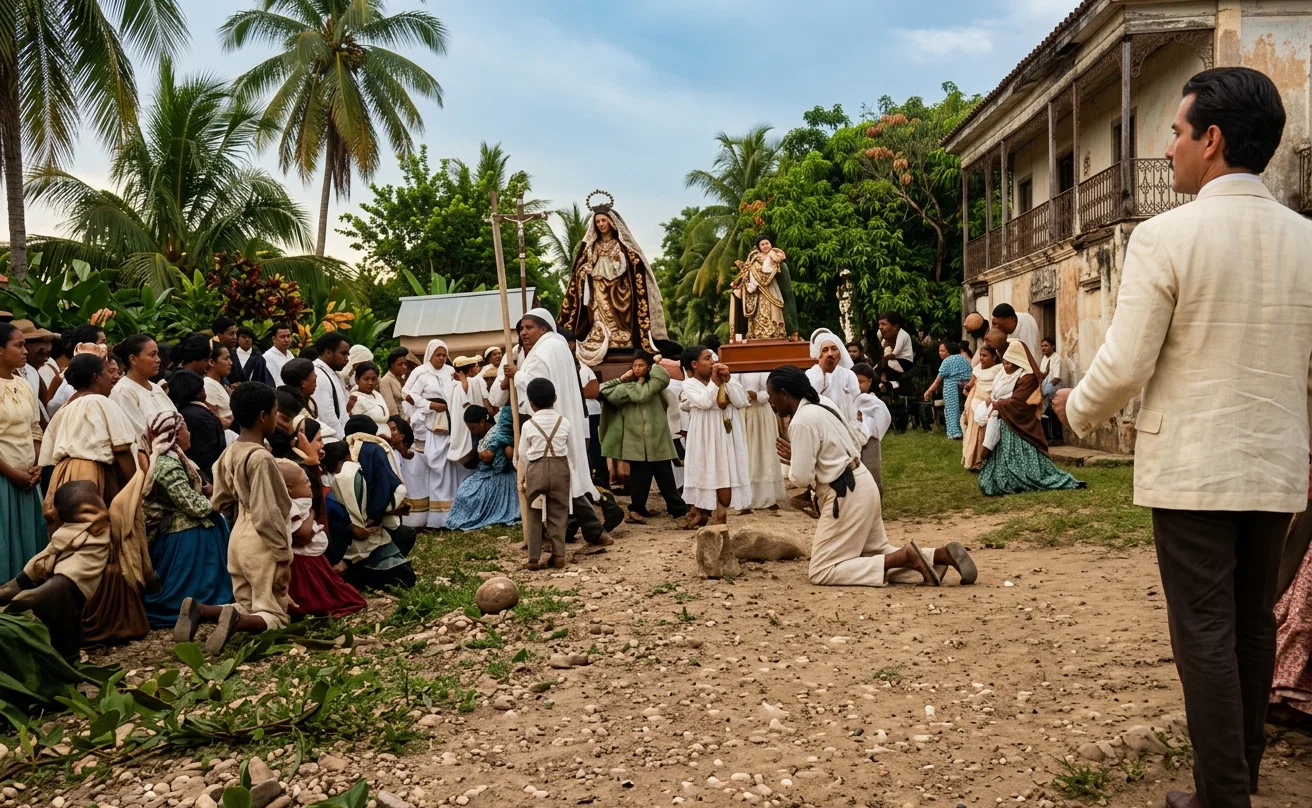
A RELIGIOUS PROCESSION IN HONDURAS
The religion of the people is Catholicism. All the larger and many of the smaller towns have their church. The church is usually much the largest building in the town, and each one is supplied with from one to six bells, which make a great deal of noise on important feast-days. The furniture in the church is usually very meager,—an altar, a few images and pictures of the saints, but never any seats. The men seldom go to church. The women kneel before the images to say their prayers. Many candles are burned before these images and pictures of the saints. Each house is also provided with the cross and one or more images and pictures, and on feast-days and in cases of sickness candles are burned at home also. The burning of candles before the images is supposed to have great power in driving away evil and curing the sick. When any one is about to die, a priest is called if there is one near enough, and for a sum of money, varying according to the possessions of the one about to die, he is granted a pass through purgatory. After death the body is taken to the graveyard, which is called in Spanish El Campo de los santos, or the camp of the saints, and is interred. Then begins a nine days’ prayer for the deceased. I was once called on to say these prayers for a man who had died, and so had a good chance to present the true state of the dead. But when I was through, I was told that what I had said was all good, but that if I could not say the prayers, some one would have to be found who knew how.
The Catholic religion, like all heathen religions, is virtually a worship of the dead. With them people are supposed to become saints only at death. When asked if I believe in saints, I reply, “Yes, in living saints.” This gives me an opportunity to read portions of Paul’s letters directed to the saints of God, and to tell my questioners that these saints were living people like ourselves. Then I sometimes present God’s message to us now, to get ready to go to the home Jesus has gone to prepare. It is almost impossible to imagine the ignorance of those who have never been allowed to read the Bible. Many have never seen one. I do not suppose there is one Bible to a thousand homes in this dark land. Most of the people have heard of the Bible, but suppose it to be a very bad book, with which it would be dangerous to meddle. Novels of the lowest type are eagerly devoured. There is not a religious paper published in this country. The local newspapers contain many extracts from the writings of Greek philosophers and other infidel authors, and as a result there are many skeptics and atheists.
When a colporteur passes through a village, a few, through curiosity, may venture to buy Bibles, yet, believing they are doing wrong, they may, perhaps, experience a similar sense of guilt to that which those better instructed have felt on buying the first novel. Most of the Bibles thus sold are usually gathered and burned by the padre (father). A very few, however, are concealed and read occasionally, and once in a while a family is found that has really begun to defy the priest and read the Bible openly.
Our work in this field can hardly be said to have touched Central America proper. The only ones for whom work has been done, are the Protestant people of Belize, the Bay Islands, and the English-speaking people of this coast. I am thankful for the privilege of spending my life in uplifting this people. Believing that our influence will be greater if the people see that we are here to stay, we have thought it best to build a small house, as rent is very high, and the houses are very poor. It is now nearly done, and we expect to move into it this week. God has blessed us in getting a healthful and desirable location in a suburb, and on the road leading to the interior.
The last time Elder Goodrich and I were in Utilla, the people kindly contributed money to buy a horse for the work here on the coast. The greater part was given by those not of our faith, as our brethren there are all very poor. The horse has already proved itself useful in my work here.
Brother Moncada, a lawyer of this place, and his wife are both awaiting baptism. I believe they are the first-fruits14of the message among the Spanish people of this country. Brother Moncada has a printing-press that he is very anxious should be used in spreading the message.
A missionary physician would find a good opening here in La Ceiba to do good as well as to make a good living. If some one of our physicians could locate here, I believe treatment rooms would be a profitable investment as well as the means of opening many hearts to inquire into our faith. There is nothing of the kind on this coast, and yet there is a call for such a work.
Several hundred dollars’ worth of books and papers have been sold on this coast during the last year. Two Sabbath-schools have been organized. A few have begun the observance of the Sabbath. All our people are taking our papers, and nearly all are paying tithe. May God water the seed sown, that many more may be willing to receive the seal of the living God.
The Norwegian Meeting
By GUY DAIL
GUY DAIL
June 27 to July 2 the Norwegian Conference was held at Stavanger, on the western coast, a city of about twenty-seven thousand inhabitants, a nice, intelligent class of people. It is a hilly city, but has a nice, large harbor. It contains a fine church, erected of very enduring stone in 1272, also a number of factories, many of which are engaged in the canning and preserving of various kinds of fish.
GENERAL VIEW OF STAVANGER
Although there was not that unanimity of feeling among the workers which we found elsewhere, yet the Lord's Spirit melted hearts, and blessed the people, and we had a good meeting together.
God has blessed the labors of our workers in Norway, and by his providence he has opened the way for them to secure places for pitching their tents, and has also moved upon the heart of one person to donate a second tent to the conference for tent-meetings. The tent was pitched in Drammen last year, near Christiania, and it was so neatly fitted up that it became quite an attraction to the people of the place, who visited it and the meetings by the hundred. Many were convinced of the truth, but thus far only about twenty have taken their stand; others are now awaiting baptism, as the tent effort was followed by winter meetings.
A new series of meetings will be held at Trondhjem, where God has wonderfully opened the way for us to secure a place to pitch the tent on the grounds of a very wealthy person, owning a fine large castle on the hill, at the foot of which we shall have our meetings. The way to secure this place seems to have opened in direct answer to the earnest, daily prayers of the church-members who received the truth in the tent effort last summer. There will be also a second tent pitched, not far from Larvik, in southern Norway.
On the west coast there have been continually accessions to our membership, as well as in Christiania itself. During the year sixty-two were baptized and added to our membership, which numbered eight hundred and eight at the close of 1904. The tithe was $4,409, against $3,999 last year; and the gifts $897, instead of $513 the previous year. The book sales increased from $4,801 in 1903 to $7,307 during 1904. The publishing house in Christiania added $515 to its capital. The health institution in Christiania has had a fair year. In general, the finances of the conference are much better than at any previous period for years. It has been decided to do more toward establishing a fund for the payment of the material in the manufacture of “Christ’s Object Lessons,” and to push the sale of that book as much as possible. They will also try to increase their First-day offerings during the coming year. For the last few years little has been done in Norway toward this system of giving, as there have been so many other matters demanding financial aid.
The Sabbath was the best day of the meeting. The Spirit of God visited the people, and their testimony showed that they had been touched by his power. Four were baptized.
The officers chosen for the coming year are: President, O. A. Johnson; other members of committee, O. P. Norderhus, N. P. Nelsen, O. J. Olsen, L. Halvorsen, J. M. Narem, H. Z. Johansen; Treasurer and Manager of the Book Mission, A. C. Christensen; Canvassing Agent, J. M. Narem; Secretary Sabbath-school and Missionary Department, Johan Nielsen.
Ministers: O. A. Johnson, H. M. Hansen, N. P. Nelsen, O. P. Norderhus, A. Sevaldsen; Bible workers, E. Iversen, O. Narem, Johanne Bjorckelund, Julit Lycke.
We trust God's blessing may continue with the brethren here, and wish for them a successful year. The political outlook is not the most assuring, and yet we know that the God of hosts will be with all who will trust him. Let this people be remembered by their brethren throughout the world, that the work may be advanced in all its branches, and the cause of God continue to prosper.
Hamburg, Germany.
The Bible in the Frozen North
At Norway House, on a certain occasion, says Mr. Egerton Young, missionary of the Canada Methodist church there, a number of Indians came into my room, noiselessly, after their fashion, so that the room was filled with them before I knew it. When I became aware of their presence, I asked whence they were. “From a journey of fourteen nights,” they replied; for they reckon distance by the number of nights they are delayed to sleep. “We have got the Kessenaychen [the Great Book], but we don’t understand it, although we can read it.” I thought they were joking, for the Indians can not read unless some one has taught them, and I knew from their account they must live far away from any missionary; but I asked them: “From what missionary did you learn?” “We never saw a missionary nor a teacher.” I took down from my shelf our Bible, printed in the beautiful, syllabic character for the Creek language, and opened to Genesis; they read it with ease and correctness. I turned the pages, and they read in many places. I was amazed, and asked them again where they lived. They described it to me; it was far away, north of Hudson’s Bay, hundreds of miles from any missionary. Their hunting-grounds, it seems, adjoin those of some Christian Indians,—they cover great distances in hunting,—and, continued my visitors, “We visited your Indians, and found that they had the Kessenaychen. We got them to read it, and then to teach it to us; and we were so pleased with it that we all learned to read it during the winter.” Every soul in a village of three hundred population had thus actually learned to read the Bible without ever having seen any white teacher; and having providentially come into possession of some copies that happened to be in the hands of the Hudson Bay Company’s agent, these heathen Indians had journeyed through the snows fourteen nights’ distance, that to them might be given instruction in the Book they had thus learned to love.—Selected.
The Time Is Short
By Hezekiah Butterworth
UP, up, my soul! the long, spent day redeeming;
Sow thou the seed of better deed and thought;
Light other lamps while yet thy light is beaming;
The time, the time, is short.
—Hezekiah Butterworth.
Kolo, Basutoland
By J. A. CHANEY
As I intimated in a former letter, we presented tithing at our meetings every Sabbath in June. Last Sabbath I invited the people to bring in their tithe. This is what I have received so far: one three-year-old ox, one Angora goat, three fowls, some kafir corn, potatoes, pumpkins, and two bags of fuel. They have not yet finished harvesting their grain, so that is still to come. As soon as it is all in, I will sell it, and send you the money.
I have held Bible readings in Mafeteng each Wednesday for the past three weeks. The class consists of the A. M. E. minister, his son, and three young men of their school. But the minister is now away on a short trip to the Cape, so I shall not go again until next week.
Last Wednesday, just as I was starting out of the gate to go to Mafeteng, a woman came to me and said that she had come to talk with me about her sins; that she had been thinking and thinking of them, and that they had become too heavy to carry longer. I left her with Mrs. Chaney and Murray, who directed her to One who can take away sin and give peace. She came from the kraal where we have been holding meetings every Sunday afternoon for the past two months. This shows that God's Spirit is working. I hope that hundreds may be made to feel the weight of their sins through the preaching of God's truth.
The last time we were at the kraal, I had Murray go around quietly among the people after the meeting, to see if there were any who could be dealt with personally. He conversed with several men. They said, in substance: “What you say is true, the Lord is coming again soon. But our hearts seem quite hard. However, you must not get tired of coming to us, as you are sowing the seed now, and no doubt some will grow.”
To-morrow morning Mrs. Chaney, Murray, and I will go to Maseru (D. V.) to sell books, and give the message in every way we can, and see if we can find some young men who want to come to school. We shall probably go on beyond Maseru, and may be gone from Kolo about ten days, if the weather does not become too rough.