The following recent words of Bishop Wordsworth constitute a timely admonition on the subject of the misuse of means God has intrusted to men:—
As regards money, not one of us is sufficiently careful of it as a trust from God. Most waste it, sometimes by hoarding it, more often by misspending it, and many are proud of their extravagance. Men and women run lightly into debt, and tempt others into it. In some villages there is scarcely a family which is not in debt; and to be in debt encourages dishonesty, and lessens generally the sense of honor. Even educated men take or give bribes, and call them “commissions;” others take what is not theirs, and call it a “perquisite.” Again, the sin of betting and gambling and generally of speculation is one which particularly affects the young of our generation; and those who give way to it are drawn on into other sins, often without seeming to be able to help themselves. Like the other evil passions of impurity and intemperance, the reckless pursuit of money ends very frequently in suicide. . . . Unfortunately, public opinion too often treats such suicide almost as a brave act, or as a natural way of escape from a difficult position.
Rockefeller Predicts Financial Panic
JOHN D. ROCKEFELLER, of Standard Oil fame, is quoted as predicting a financial panic in this country in about two years, due to overproduction. As Mr. Rockefeller has in his possession, or under his control, about $1,000,000,000, he is probably in a position to speak with authority upon financial questions. It is in the power of a few men in this country to bring on a financial panic at almost any time if they should choose to do so.
The Work Among the Colored People
By Ellen G. White
DEAR BRETHREN AND SISTERS. I greatly desire to impress your minds with the importance of doing what you can to help forward the work for the colored people in the Southern States. In this field there are thousands and thousands of negroes, many of whom are ignorant and in need of the gospel. Upon the white people of the United States the Lord has laid the burden of uplifting this race. But, as yet, Seventh-day Adventists have done comparatively little to help them.
There are many, many places in the South in which no earnest Christian effort has been made for the colored people. These unentered fields, in their unsightly barrenness, stand before heaven as a witness against the unfaithfulness of those who have had great light. When I think of the way in which this line of work has been treated, there comes over me an intensity of feeling that words can not express. Like the priest and the Levite, men have looked indifferently on a most pitiful picture, and have passed by on the other side. For years this has been the record. Our people have put forth only a hundredth part of the earnest effort that they should have put forth to warn the indifferent, to educate the ignorant, and to minister to the needy souls in this field.
A few faithful laborers have made beginnings here and there. And among our brethren and sisters in the more favored fields of America, there are warm hearts beating in sympathy with the hearts of those who, with integrity and faithfulness, have bravely borne a burden of labor for the colored people, laying a foundation that will be as enduring as eternity. The Lord has been working with and for the tried laborers in the South. Many are preparing to put their shoulders to the wheel, to help advance the work. The cloud of darkness and despondency is rolling back, and the sunshine of God's favor is shining upon the workers. The Lord is gracious. He will not leave the work in the South in its present condition. The people living in this great field will yet have the privilege of hearing the last message of mercy, warning them to prepare for the great day of God which is right upon us. Now, just now, is our time to proclaim the third angel's message to the millions living in the Southern States, who know not that the Saviour's coming is near at hand.
The Training of Workers
For the accomplishment of the Lord's work among the colored people in the South, we can not look wholly to white laborers. We need, O, so much! colored workers to labor for their own people, in places where it would not be safe for white people to labor. Without delay, most decided efforts should be made to educate and train colored men and women to labor as missionaries. We must provide means for the education and training of Christian colored students in the Southern States, who, being accustomed to the climate, can work there without endangering their lives. Promising young men and young women should be educated as teachers. They should have the very best advantages. Those who make the fear of the Lord the beginning of wisdom, and give heed to the counsel of men of experience, can be a blessing, by carrying to their own people the light of present truth. Every worker who labors in humility and in harmony with his brethren, will be a channel of light to many who are now in the darkness of ignorance and superstition.
It was for the education of Christian workers, that, in the providence of God, the General Conference purchased a beautiful farm of three hundred acres near Huntsville, Ala., and established an industrial training-school for colored students. During the past two or three years I have often received instruction in regard to this school, showing what manner of school it should be, and what those who go there as students are to become. All that is done by those connected with the Huntsville school, whether they be teachers or students, is to be done with the realization that this is the Lord's institution, in which the students are to be taught how to cultivate the land, and how to labor for the uplifting of their own people. They are to work with such earnestness and perseverance that the farm will bear testimony to the world, to angels, and to men, regarding the fidelity with which this gift of land has been cared for. This is the Lord's farm, and it is to bear fruit to his glory. Heavenly angels will be able to read, in the thrift and painstaking effort revealed in the care of the farm, the story of the improvement made by the students themselves in character-building. On this farm the students are to learn how to earn their living by honest work. Such a knowledge will be of inestimable value to them when they go forth to teach others of their race.
The students of the Huntsville school are to be given a training in many lines of service. All are to be taught the importance of practical Christianity. And they are to learn how to present the truth for this time to their own people. Not only are they to learn to do public work, but they should learn also the special value of house-to-house work in soul-saving. In carrying forward work among the colored people, it is not learned men, not eloquent men, who are now the most needed, but humble men who in the school of Christ have learned to be meek and lowly, and who will go forth into the highways and hedges to give the invitation, “Come; for all things are now ready.” Those who beg at midnight for loaves for hungry souls, will be successful. It is a law of heaven that as we receive, we are to impart.
In all the Lord's arrangements, there is nothing more beautiful than his plan of giving to men and women a diversity of gifts. The church of God is made up of many vessels, both large and small. The Lord works through the men and women who are willing to be used. He will bless them in doing the work that has brought blessing to many in the past,—the work of seeking to save souls ready to perish. There are many who have received but a limited religious and intellectual training, but God has a work for this class to do, if they will labor in humility, trusting in him.
The Lord says, I will take illiterate men, obscure men, and move upon them by my Spirit to carry out my purposes in the work of saving souls. The last message of mercy will be given by a people who love and fear me. “Not by might, nor by power, but by my Spirit.” We should give willing, devoted men every possible encouragement to go forward and in their humble way reveal their loyalty to principle and their integrity to God. Let them visit the people at their homes, and talk and pray with the unwarned regarding the soon-coming Saviour. Let them take a personal interest in those whom they meet. Christ took a personal interest in men and women while he lived on this8earth. He was a true missionary everywhere he went. His followers are to go about doing good, even as he did. By personal efforts to meet the people where they are, coarse and rough though some of these people may be, humble house-to-house missionaries and colporteurs may win the hearts of many to Christ. In their unpretentious way they can reach a class that ministers generally can not touch.
The Establishment of Schools
No line of work will be of more telling advantage to the colored people in the Southern field than the establishment of small schools. Hundreds of mission schools must be established; for there is no method of giving the truth to these people so effectual and economical as these small schools. This line of work has been specially presented before me. But the work is almost at a standstill for the lack of money to provide facilities for the training of teachers, and for the building of schoolhouses, and for paying the wages of the teachers.
There are many who can not even read the divine Word; many are slaves of superstition; and yet through divine power these poor, ignorant beings, degraded by sin, may be saved, elevated, sanctified, ennobled. And in the Lord's estimation every soul saved is worth more than the wealth of the whole world. Those who are ignorant must be educated; and this means much. Instead of making superabundant provision for educating a few, we should devise ways and means of helping the many who are neglected and oppressed.
So far as possible, these mission schools for colored people should be established outside the cities. But in the cities there are many children who could not attend the schools that will be established out of the cities; and schools should be opened for them.
The colored people need simple books. They have been left in ignorance when they should have been taught; left unconverted when every effort possible should have been put forth to rescue and save them.
This work will require talent, and, above everything else, the grace of God. The colored youth will be found to be far more difficult to manage than the white youth, because they have not been taught from their childhood to make the best use of their time. Many of them have had no opportunity to learn how to take care of themselves. Those who for years have been working to help the colored people, know their needs; and they are the best fitted to begin schools for them. Colored teachers must work for the colored people, under the supervision of well-qualified men who have the spirit of mercy and love. How important it is, then, that we place our training-school at Huntsville on vantage-ground, so that many may be educated to labor as teachers of their own race!
Medical Missionary Work
In no place is there greater need of genuine gospel medical missionary work than among the colored people in the South. Had such a work been done for them immediately after the proclamation of freedom, their condition to-day would have been very different. Medical missionary work must be carried forward for the colored people. Sanitariums and treatment rooms should be established in many places. These will open doors for the entrance of Bible truth.
This work will require devoted men and means, and much wise planning. Years ago we should have been training colored men and women to care for the sick. Plans should now be made to do a quick work. Let promising colored young men,—young men of good Christian character,—be given a thorough training for this line of service. Let them be imbued with the thought that in all their work they are to proclaim the third angel's message. Strong, intelligent, consecrated colored nurses will find a wide field of usefulness opening before them.
Christ, the great Medical Missionary, is our example. Of him it is written, that he “went about all Galilee, teaching in their synagogues, and preaching the gospel of the kingdom, and healing all manner of sickness and all manner of disease among the people.” He healed the sick, and preached the gospel. In his service, healing and teaching were linked closely together. To-day they are not to be separated. The nurses who are trained in our institutions, are to be fitted to go out as medical missionary evangelists, uniting the ministry of the Word with that of physical healing.
The Lord has instructed us that with our training-schools there should be connected small sanitariums, that the students may have opportunity to gain a knowledge of medical missionary work. This line of work is to be brought into our schools as part of the regular instruction. Huntsville has been especially pointed out as a school in connection with which there should be facilities for thoroughly training consecrated colored youth who desire to become competent nurses and hygienic cooks. We have delayed long enough the carrying out of this instruction.
Redeeming the Time
My brethren and sisters, let us look at the destitution of this field. Let us consider the ignorance, the poverty, the misery, the distress of many of the people. They know but little in regard to Bible truth. They are unacquainted with the Lord Jesus Christ. And yet this field lies at our door! How selfish and inattentive we have been to our neighbors! We have passed them by, doing little to relieve their suffering. The condition of this field is a condemnation of our professed Christianity.
Let us now arise, and redeem the time. Everything in the universe calls upon those who know the truth to consecrate themselves unreservedly to the proclamation of the truth as it has been made known to them in the third angel's message. That which we see of the needs of the millions of colored people in the South, calls us to our duty. We are not to become dispirited and disheartened over the outlook. The Lord lives and reigns. And he expects us to do our part, by training for service and by sustaining in the field those who are best fitted to labor for the colored people. To our every effort he will add his blessing. His faithful servants in charge of the various lines of work, will be given wisdom to discern talent, and to train an army of workers to labor with courageous perseverance for their own race. There is work to be done in many hard places, and out of these places laborers are to come. The field is opening in the Southern States, and many wise, Christian colored men and women will be called to the work. The Lord now gives us the opportunity of searching out these men and women, and of teaching them how to engage in the work of saving souls. When they go forth into the field, God will co-operate with them, and give them the victory.
ELLEN G. WHITE.
Linger Not
By Bonar
THE time is short!
If thou wouldst work for God, it must be now;
If thou wouldst win the garland for thy brow,
Redeem the time.
Shake off earth’s sloth!
Go forth with staff in hand while yet ’tis day;
Set out with girded loins upon the way;
Up! linger not!
Fold not thy hands!
What has the pilgrim of the cross and crown
To do with luxury or couch of down?
On, pilgrim, on!
With His reward
He comes; he tarries not; his day is near;
When men least look for him he will be here;
Prepare for him!
Let not the flood
Sweep thy firm feet from the eternal Rock;
Face calmly, solemnly, the billows’ shock;
Fear not the storm.
Withstand the foe;
Die daily, that forever thou mayest live:
Be faithful unto death; the Lord will give
The crown of life.
— Bonar.
Babylon (Continued)
By M. E. Kern
M. E. KERN
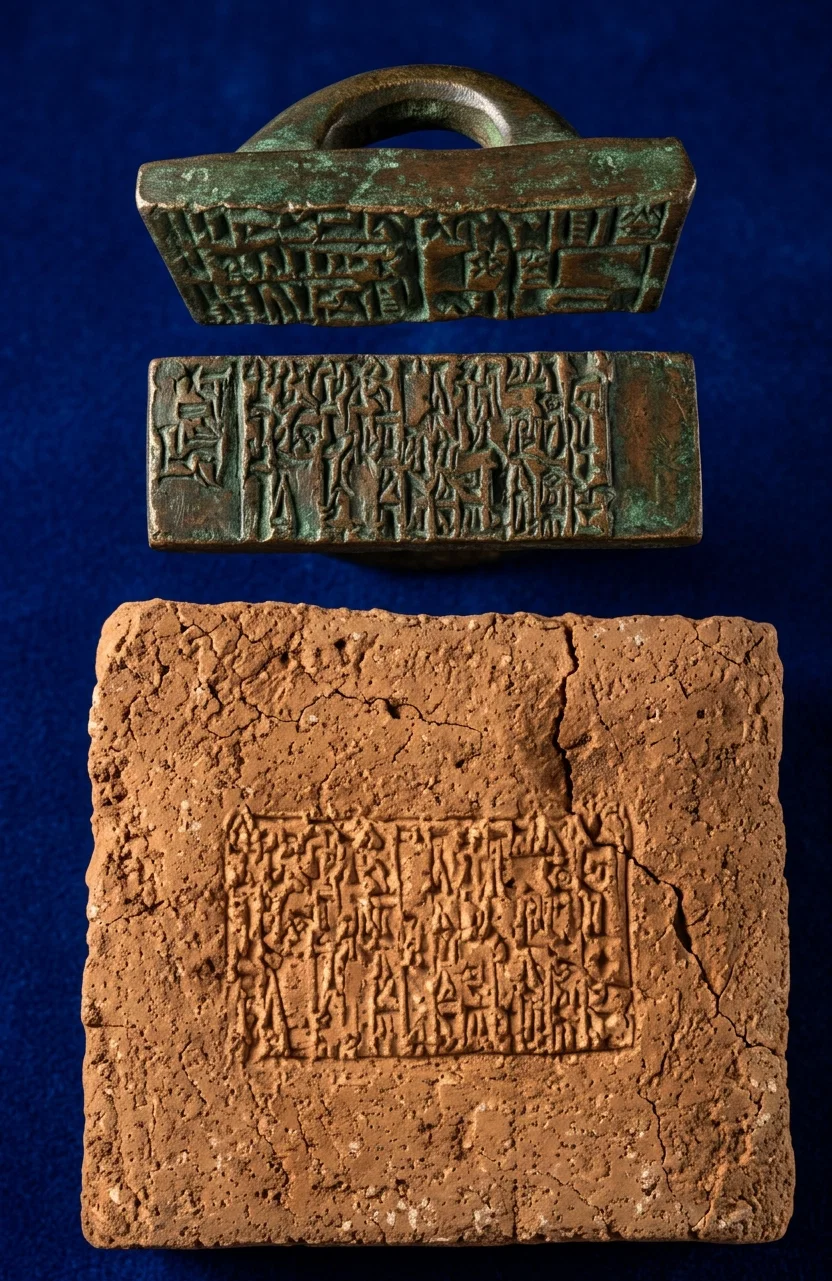
How do we know what kings built these ancient ruins? Inscriptions are usually found such as are often seen on buildings nowadays, telling who built them; but there is another thing that enables us to determine who built the ancient Babylonian structures. The kings usually put their name and title on every brick. The illustration shows a brick of Sargon I of Babylonia (not the Assyrian Sargon), and also the stamp with which the impressions were made. This practise enables us to tell also who repaired the buildings. Thus Nebuchadnezzar was a great builder, and boasts also of having repaired many buildings. This we know to be true; for his bricks are found everywhere. He repaired what is supposed to be the “tower of Babel,” rearing it up, he says,9that its top might reach to heaven, almost the same expression used by the original Babel builders.
The Nippur Library
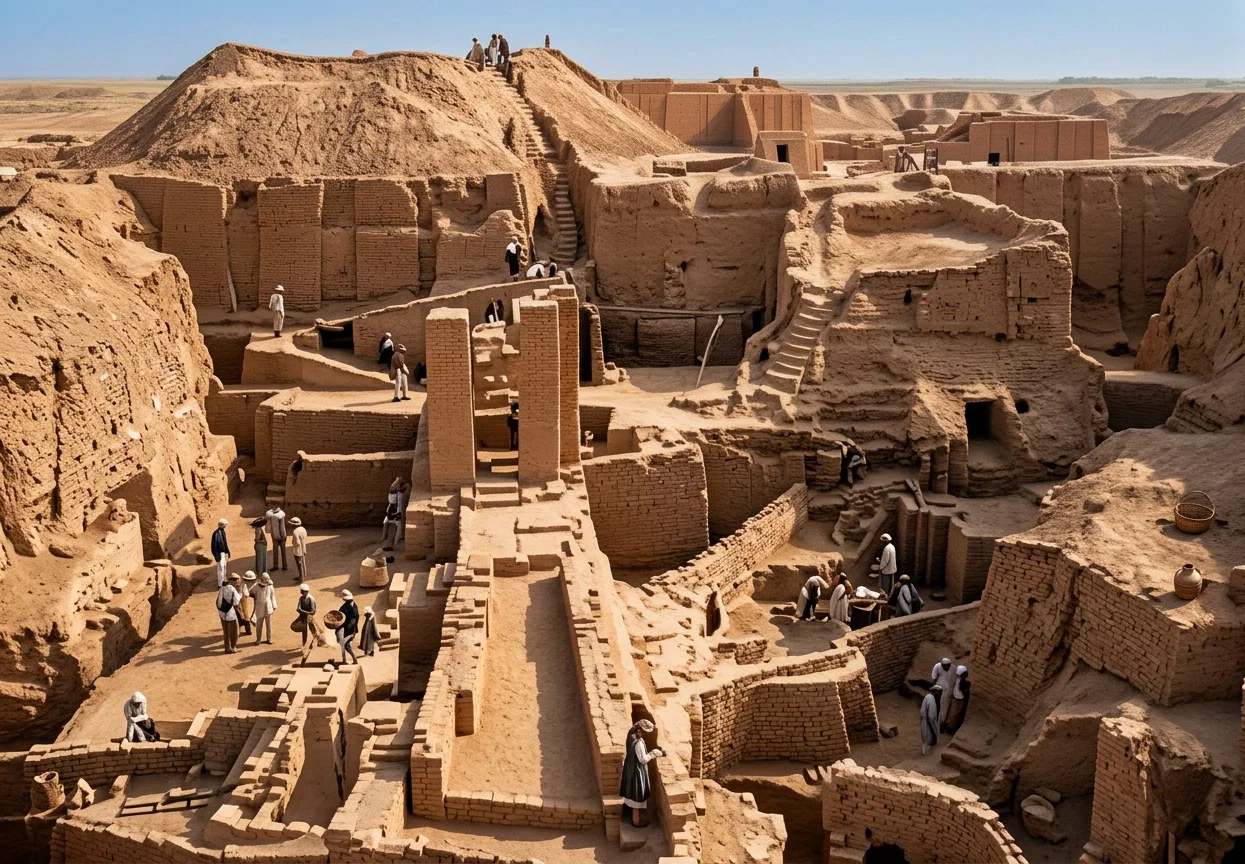
I spoke of the discovery of Assurbanipal’s library at Nineveh over thirty years ago, and the effect it produced on the world. But the library of the temple school at Nippur lately excavated, far surpasses the Assyrian library. On a recent campaign the University of Pennsylvania expedition found a series of rooms twenty-five feet below the surface, containing great piles of clay books, and over sixteen thousand have already been removed, while only one twentieth part of the library has been excavated. Professor Hilprecht estimates that, when fully excavated, this library will yield one hundred and fifty thousand cuneiform tablets. And remember that this library belongs to a period prior to Abraham. The library collapsed under the destructive acts of the Elamites who invaded Babylon, it is thought, about the time that Abraham left Ur of the Chaldees.
Not many of these tablets have been read, but enough have been deciphered to show that they will materially change our ideas of those early times. Knowledge of astronomy, mathematics, jurisprudence, and other sciences little dreamed of heretofore has been brought to light. We shall await with interest the revelations of this wonderful library. We could hardly expect that these tablets will reveal the name of Abraham, who doubtless was little known in Babylon as a nation, and who probably left his wicked surroundings there quietly. We will look with interest, however, to see whether Nimrod’s name will be found; for, though the name of this mighty man lives still in the traditions of the country, it has never been found on the monuments.
The Tower Temple
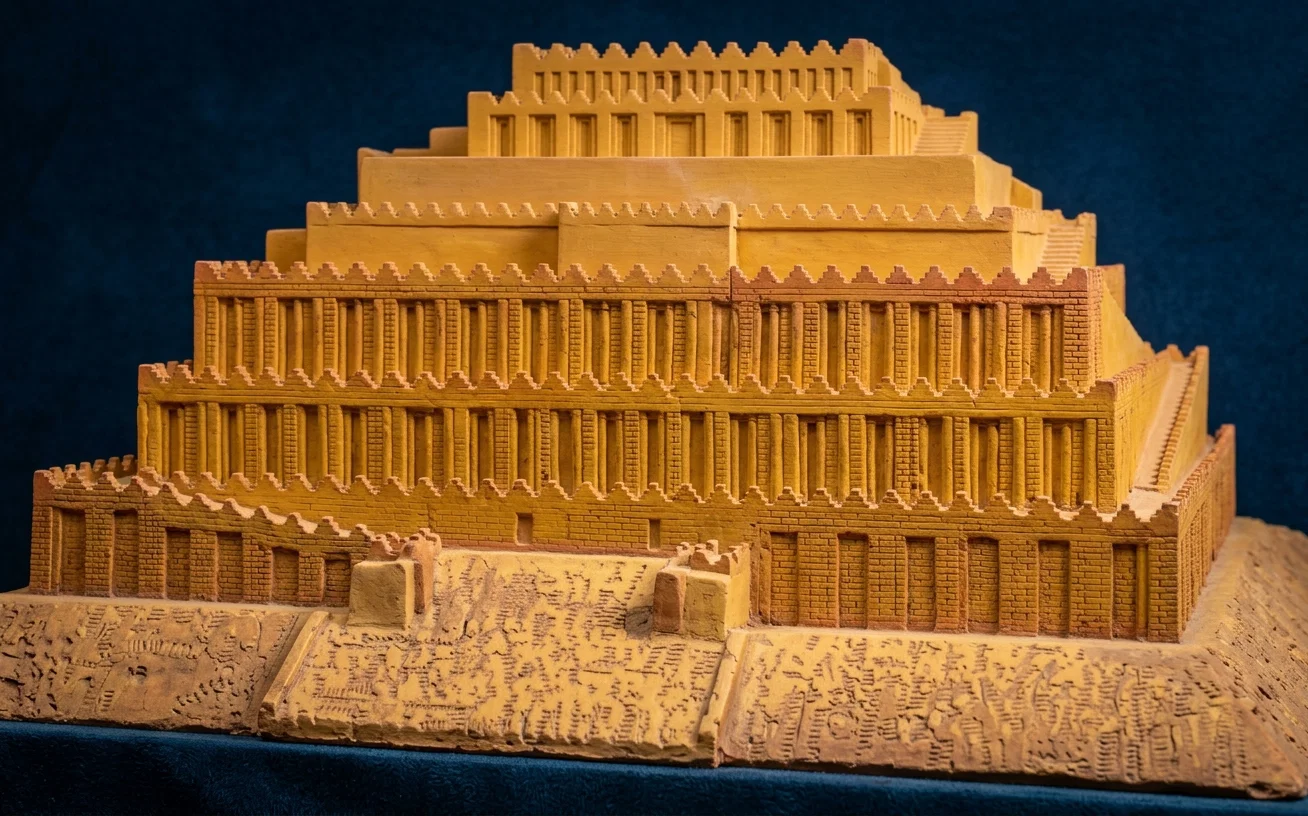
The tower temple, or ziggurat, of the Babylonian cities is an interesting structure. Every city of note contained one dedicated to the local deity. The temple at Nippur which was dedicated to Bel, or Baal, was built in three stages, or platforms, diminishing in size as they rose, and one resting on the other. The one at Babylon, rebuilt by Nebuchadnezzar, which is supposed to be the tower of Babel, was built in seven stages and each stage colored differently. The whole structure was built on a platform of sun-dried bricks raised a few feet above the plain.
“The first stage was black, sacred to Saturn; the second, red, brown, or orange, sacred to Jupiter; the third, red, belonging to Mars; the fourth, gold plates, to the Sun; the fifth, yellowish white, to Venus; the sixth, dark blue to Mercury (Nebo); the seventh, silver plated, to the Moon.”
The accompanying illustration is that of a model prepared by Sir Henry Rawlinson. The shrine of the god was on the very top. The account of the German excavations in the ruins of this old tower temple is a very fascinating story.
The River Chebar
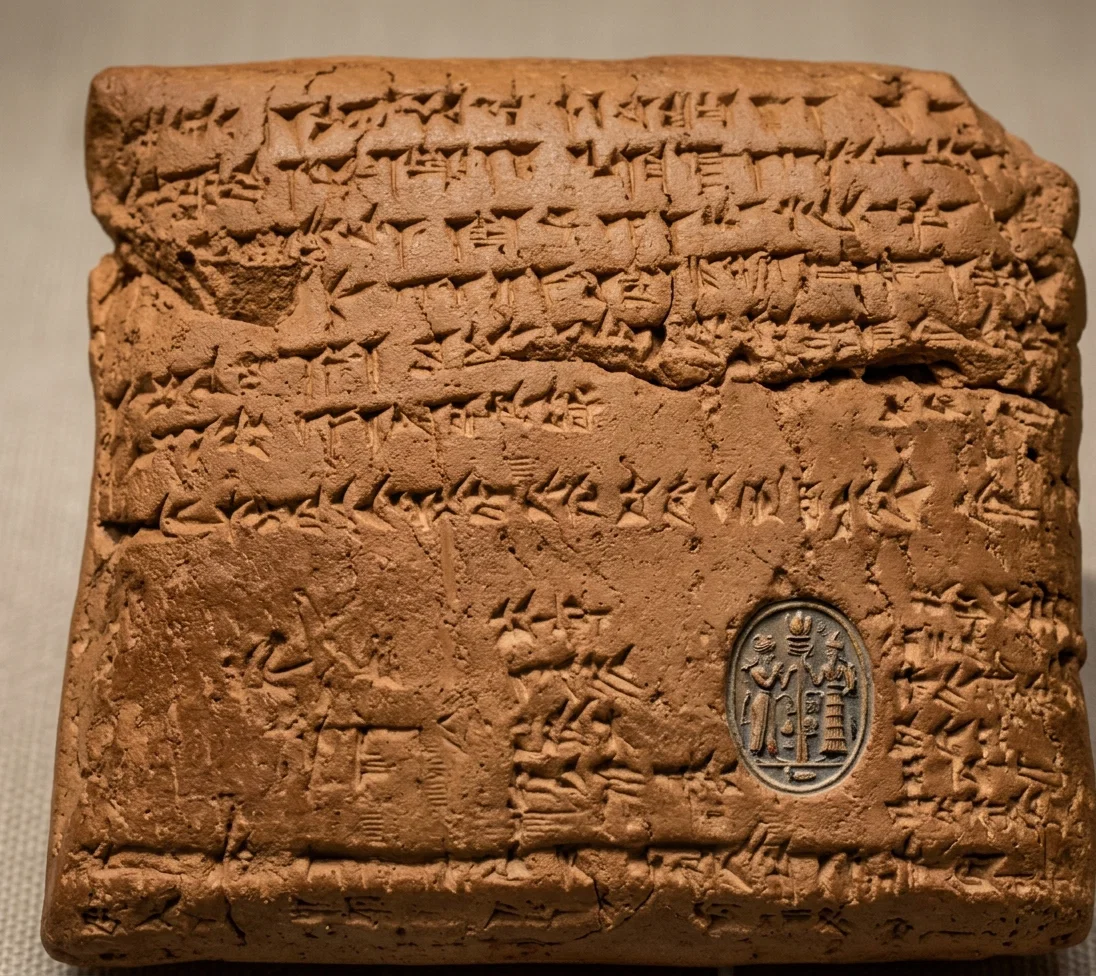
I will speak of another of the many things of interest at Nippur bearing on Bible history. In the course of their excavations they discovered the office and archives of a great firm of bankers and brokers, known as “Murashu Sons,” who flourished in the times of Artaxerxes I and Darius II, 464-405 B. C. (including, as you see, the time of the return of the Jews). In this room were found seven hundred and thirty business and legal documents, such as mortgages, leases, promissory notes, records of debts, surety bonds, guarantees, receipts of sales, payment of taxes, and in fact, almost every kind of business document. The illustration shows one of these business documents with the seal impression upon it. On these documents are found many Jewish names, among which are Nathanael and Jonathan.
EXCAVATIONS AT NIPPUR (IN BABYLONIA)
This, together with the fact that several Hebrew inscriptions were found here, causes the belief that there was a Jewish colony of exiles here. Professor Hilprecht thinks, too, that he has found the river Chebar mentioned in Ezekiel. On the banks of this river Ezekiel saw visions of the abominations done in Jerusalem, women weeping for Tammuz, and other heathen rites, with which he was doubtless familiar at Nippur; for it was the center of Babylonian worship. The word found on two of these business tablets is “Nar Kabari,” and means “the Euphrates of Nippur.” It was the great canal that ran through Nippur and central Babylonia, turning the desert into a fruitful plain. The bed of the canal has been explored, and interesting things have been found in it.
Ur of the Chaldees
I can not leave Babylon without calling your attention to the old home of Abraham, “Ur of the Chaldees,” known at present as Mugheir. The most that has been done here was by Taylor in 1854. The ruins consist of a series of low mounds, oval in form, a little over one-half mile in diameter. The principal building, the one shown in the picture, is about seventy feet high, and is the tower temple once dedicated to the moon. Two stories remain. In excavating, Mr. Taylor found in one of the corners, in a niche formed by omitting one of the bricks of a layer, a clay cylinder, and on investigation he discovered one of these commemorative cylinders in each of the other corners. A fine barrel cylinder was also found, and from this and inscribed books Rawlinson determines this to be “Ur of the Chaldees.” This temple was built by one of the early kings, and was repaired by Nabonidus, the last king of Babylon. The commemorative cylinders are his, and each one closes with a prayer for the life of the king’s eldest son, Belshar-usur, or the Biblical10“Belshazzar,” who was associated with his father on the throne, and of whose death we have an account in the book of Daniel. Other inscriptions have been found which speak of Belshazzar in the most familiar way. Critics have ceased to laugh at the idea that Belshazzar was a real personage.
It has been some time since the identity of this mound was determined, yet it lies unexcavated. An expedition was organized a short time ago in this country for the purpose of excavating this site, but the Ottoman government refused Dr. Banks, the director, the necessary firman, or permission, to excavate, and the expedition has been abandoned. What the uncovering of this mound will reveal is of great interest to all Bible students.
College View, Neb.
MODEL OF BABYLONIAN TEMPLE TOWER
BUSINESS DOCUMENT OF MURASHU SONS AT NIPPUR
Its Relation to the Atonement
By J. O. CORLISS
The Final Adjustment of Human Awards—No. 6
Its Relation to the Atonement
J. O. CORLISS
THERE is the closest connection between the judgment awards of the last day, and the atonement work of Christ for sinners. So necessary indeed is one to the work of the other, that without the atonement there could be no final awards, because the atonement work finds its accomplishment in the decisions of the judgment alone.
That these statements may appear comprehensive and satisfactory, it is perhaps well to inquire at this time about the meaning of the word “atonement.” It is not, as some have taught, the mere act of Christ’s dying upon the cross. His death could not free any one from sin who does not accept the offering of life made in his behalf. Therefore, whoever receives the benefit of Christ’s atonement, must yield to the demands of heaven, and depart from the ways of sin. This being true, it follows that an individual atonement is the result of the one receiving it co-operating with Christ in its promotion.
These considerations bring us to study the necessity for such an arrangement. In the beginning man was created in God’s image. Being thus made in every way like God, man was in harmony with his Maker, and so was reconciled to him and his requirements. But when man transgressed the law of Jehovah, he became a sinner, hence at enmity with God. 1 John 3:4; Rom. 8:7. Hence, to be saved, and to dwell with God, man must again become reconciled to heaven’s laws, and so once more become one with God. 2 Cor. 5:18. This at-one-ment Christ seeks to promote through his own death. Rom. 5:10. The gift of his own life-blood is the purchase price of man’s deliverance from sins (Acts 20:28),—that which reconciles, and brings him nigh to God (Eph. 2:13), by washing, and cleansing him from all sin in the blood of Calvary. Rev. 1:5; 1 John 1:7.
Such a work could not have been done without the death of Christ. This may seem a hard problem to many when considering the needs of those who lived before the blood of Christ was actually spilled on Calvary. But we are infallibly assured that “without the shedding of blood is no remission.” Heb. 9:22. It is therefore safe to affirm that no sinner, ancient or modern, can possibly be freed from the blight of sin, except through the application by faith of the required blood. This was so well understood from the earliest time that when Abel offered the firstling of his flock, God recognized his offering to be “a more excellent sacrifice” than the first-fruits of the ground offered by Cain, his brother. Heb. 11:4. Abel saw by faith in the blood of his offering, the blood of Christ yet to be shed on Calvary for the remission of sins.
To the faith of Abel, the blood of his offered lamb was the seal of his at-one-ment with God. Not that it actually took away his sins, for this, we are assured, it could not do (Heb. 10:4); but it was Abel’s token of faith in Christ, who was a “Lamb slain from the foundation of the world.” Rev. 13:8. This significance was attached to every blood-offering of the days before the actual suffering of Calvary’s divine Victim.
In the ninth chapter of Hebrews we have a statement of how the priests of the earthly sanctuary performed their official duties. Their “service of God,” we are told, included the offering of blood for themselves, and “for the errors of the people.” The sanctuary where these ministrations were performed, consisted of two apartments. The first contained three special pieces of furniture,—the golden candlestick with seven branches, the table for the show-bread, and the altar of incense. In the second apartment was the “ark of the covenant,” a chest, overlaid with gold, holding the two tables of stone on which were engraved the ten commandments, the standard of righteousness.
In this first apartment, and before its entrance, the common priests ministered daily in behalf of those who came to confess their sins by the offering of blood. Their work was to receive the sinner, and acknowledge his offering by appropriate ceremonies. But the offerings made for sin at the entrance of the sanctuary, by no means closed the work in behalf of the sinner, although the ceremonies for its cleansing were confined to the work of the common priests, and to the first apartment of the sanctuary, for the entire year.
At the end of each ceremonial year, however, the work done in behalf of the sinner by the priests was taken up by the high priest. On the tenth day of the seventh month, he took upon him all the sins brought to the sanctuary during the year, and with appropriate ceremony carried them into the second apartment, before the ark of ten commandments. From above this, on the mercy-seat, the symbol of God’s presence was met, and the final work of atonement was so far completed as to permit the high priest to carry out the sins to the door of the sanctuary, and there confess them upon the head of the scapegoat prepared for the occasion, after which this creature bore them out of the assembly into an uninhabited wilderness. Compare Heb. 9:1-7; Lev. 4:27-35; 16:29, 30, 15-22.
This was the typical cleansing of that sanctuary from the sins confessed within its precincts. That tabernacle having been appointed God’s earthly dwelling among his people, when sin was brought into it, though only by confession, the place must necessarily be cleansed, and so brought into at-one-ment with the purity of him whose dwelling it was; hence the day of atonement.
The sins removed from the sanctuary on that eventful day, were those transferred there from sinners. When cleansed from the sanctuary and removed from the camp, those who had committed them were also freed from their effect, and so were brought into at-one-ment with him who can not tolerate sin. But only those who really confessed their sins before the sanctuary, received the benefit of that year-end cleansing. Others who did not have their sins removed through confession still retained them, and inasmuch as the goat was removed from the camp because of having received on him the confessed sins of the people, it follows that those who still bore their own sins, must also be separated from those who had been freed from sin.
This was really a work of judgment, as the services of that typical atonement day clearly show. True, this was but a shadowy service which did not really take away sin, but it was one of faith, in which was pointed out through the figure employed the real work of atonement to be accomplished by Christ, the real High Priest of God. The comparison of the typical with the real atonement service must, however, be reserved for another paper.
Mountain View, Cal.
Rejecting Christ
By John Bunyan
It is not the abundance of sins committed, but the not coming heartily to God, by Christ, for mercy, that shuts men out-of-doors. And, though their not coming heartily may be said to be but a sin, yet it is such a sin as causeth that all other sins abide upon them unforgiven.
God complains of this: “They have not cried unto me with their heart; . . . they returned, but not to the Most High.” They turned feignedly. Jer. 3:10; Hosea 7:14, 16.
Thus doing his soul hates; but the penitent, humble, broken-hearted sinner—be his transgressions red as scarlet, red like crimson, in number as the sand—though his transgressions cry to heaven against him for vengeance, and seem there to cry louder than do his prayers, or tears, or groans for mercy, yet he is safe. To this man God will look. Isa. 1:18; 66:2.—John Bunyan.
Day by Day
By Julia Harris May
I HEARD a voice at evening softly say,
Bear not thy yesterday into to-morrow,
Nor load this week with last week's load of sorrow.
Lift all thy burdens as they come, nor try
To weigh the present with the by and by.
One step and then another, take thy way—
Live day by day.
Live day by day.
Though autumn leaves are withering round thy way,
Walk in the sunshine. It is all for thee.
Push straight ahead; as long as thou canst see,
Dread not the winter whither thou mayst go,
But, when it comes, be thankful for the snow.
Onward and upward. Look and smile and pray—
Live day by day.
Live day by day.
The path before thee doth not lead astray.
Do the next duty. It must surely be
The Christ is in the one that's close to thee;
Onward, still onward, with a sunny smile
Till step by step shall end in mile by mile.
“ I’ll do my best,” unto my conscience say,
Live day by day.
Live day by day.
Why art thou bending toward the backward way?
One summit and another thou shalt mount;
Why stop at every round the space to count?
The past mistakes if thou must still remember,
Watch not the ashes of the dying ember.
Kindle thy hope. Put all thy fears away.
Live day by day.