THE progress of the evil genius of Church-and-State union in the United States is marked by frequent steps forward. These steps, however, are of such an artful character that in most cases even the promoters are not aware of their undermining influence upon the primitive principles of the government. Yet some of these acts are so bold that it seems almost impossible that they do not proceed from deliberate purpose. While they are capsulated in a zeal for the moral welfare of the people, the casing is so very thin as to be transparent at a glance to the practical Protestant eye. The latest move in this direction is thus stated by the Keystone Gleaner:
“The friends of Senator M. S. Quay [of Pennsylvania] are bringing into his canvass for re-election his record as a maker of Sunday laws. This record consists of having made an amendment to the bill appropriating $5,000,000 to the World’s Fair, in 1892, the amendment making the condition of receiving the appropriation that the fair should be closed on Sunday. It was during the debate over the passage of this bill that the House of Representatives decided by a vote of 131 to 36 that Sunday is the ‘Christian sabbath,’ and by a vote of 149 to 11 that the ‘seventh day is not the Sabbath.’”
The subject of the last vote grew out of the fact that the senator supported his Sunday amendment by having the clerk read the fourth commandment. Being reminded that the commandment specified the seventh day as the Sabbath, the vote was taken, as above stated. One of the ostensible purposes of the National Reformers is to have the government administered in all departments by Christians, and to give all the Christian laws, usages, and institutions the sanction of the national Constitution, and, therefore, of the national and State laws; also to make the law of God the basis of all national law. The practical working of such a political scheme, however, is seen in the quotation we have given from the Gleaner, coupled with the fact that, while the senator is being boomed for re-election on his Sunday-law record, both he and his son are under indictment for the misuse of public funds. Whether they can be proved innocent or guilty does not matter for the purpose of this reference. We are not endeavoring to establish either position; that is the business of the courts. But the fact is already demonstrated that a religious profession, especially a zeal for the establishment of religious institutions by the government, is being set up as a qualification for high political position—and that, too, in the face of criminal indictment not yet disposed of.
The arrogance of this Church-and-State influence, when it has once gained a foothold in any government, has a history of centuries, reaching its height in the Dark Ages, and, according to prophecy, is to come to the full again before the coming of the Lord. Its upward tendency and consequent arrogance are now manifest in this republic by a growing disregard of the rights of conscience, and even of the plain language of the Constitution, which emphatically declares that “no religious test shall ever be required as a qualification to any office or public trust under the United States.” See Article VI., section 2.
The promulgation of such a qualification in any candidate for office is equivalent to its requirement, at least by those who support him on that ground. And the action of Senator Quay’s political supporters (that is, those who support him because of his Sunday-law record) demonstrates that they do so either in ignorance or in disregard of both the Scriptures and the Constitution. It is hardly possible that it can be in ignorance. W. N. G.
A Walk about Jerusalem
By H. P. H.
JOTTINGS FROM PALESTINE. NO. 13.
A Walk about Jerusalem.
From the German Temple Colony we walked a short distance to the west, where, amid a wilderness of rocks, is located the Moravian Leper Hospital. Mr. Shubert, in charge, kindly showed us through all the building. The director and nurses live in the same building as the lepers, but have to themselves a distinct part, which the lepers are not allowed to visit. There are about thirty lepers, some very near death, and others able to work some in the garden. There are two forms of the disease,—one in which portions of the body drop away, especially the extremities, and one in which all sensibility is gradually lost.
Some of the lepers will not stay at the home, but run away, preferring to beg their living, as thus they get more pocket money. Along the road from the Joppa Gate to the railway station may be seen quite a number of lepers sitting, and begging of the passers-by. Where the disease is at an advanced stage, lepers are a pitiable sight.
It is now near sunset; so I return to the city, and, passing the Joppa Gate, go around the city to the north, past the Damascus Gate, and around the northeast corner down the Kidron Valley to Stephen’s Gate, called also the Sheep Gate. All along the north, outside the walls, are many modern buildings. The surface is here quite undulating; but there is no deep valley, as on all other sides of the city. It is claimed that this is the only side from which the city was accessible to a besieging army. The present wall entirely encircles the ancient city, and is of Mohammedan origin; it is supposed to occupy in many parts the same place as the ancient wall, tho it must be that the city was anciently much larger than at present. It would not be possible for the population of the city at the time of its destruction by the Romans to be contained within the present walls; for in those days they knew nothing of “sky-scraper” buildings.
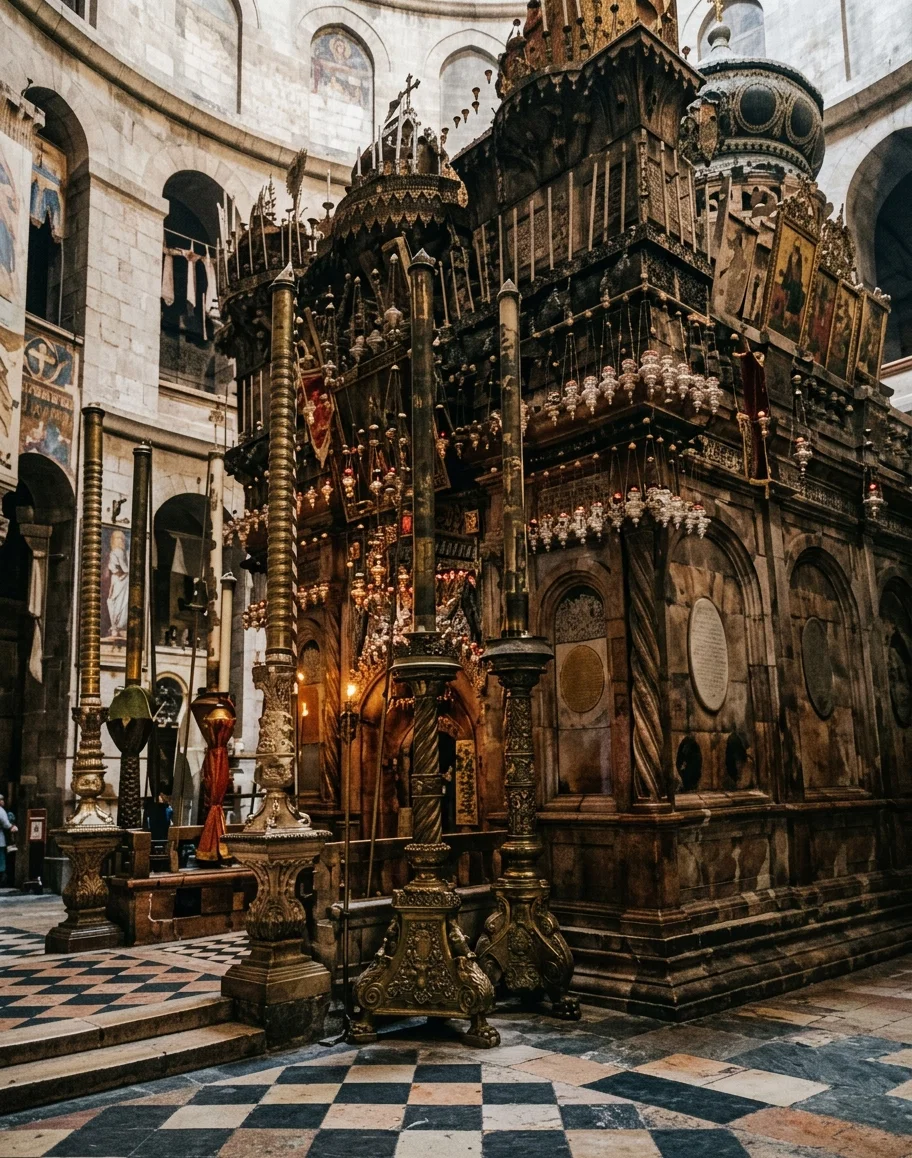
THE CHURCH OF THE HOLY SEPULCHER (AN INTERIOR VIEW).
We walk along outside the eastern wall above the Kidron Valley to Stephen’s Gate, near the center of the city north and south. As we stand at the gate viewing the Valley of the Kidron, or Valley of Jehoshaphat, and the Mount of Olives, we see here and there in the valley and on the sides of the mount small groups of black goats. In the evening hour the shepherds are leading them to the city. They enter by this gate, anciently called the Sheep Gate, doubtless because the many sheep required in the temple service entered the city here. The goats are driven into the city every evening for their milk.
Entering the Sheep Gate—which is doubtless at the same place as the ancient gate, for the eastern wall occupies the same place to-day as anciently—we pass along a well-paved street to the west; on the left is the large square formerly occupied by Solomon’s Temple; on the right, but a short distance from the gate, is the pool of Bethesda, where Jesus healed the man that had been sick thirty-eight years. We turn in to view this pool; it is approached through ruins of an ancient church, and is considerably beneath the present surface of the ground. If it is the veritable pool of Bethesda, it is so covered with ruins and changed by later buildings that one can form very little idea of its appearance in the time of Christ.
Continuing down our street, we observe by the inscriptions that it is called Via Dolorosa (Way of Sorrow), because it is claimed that Christ passed along it bearing His cross to Calvary. Along the route, tablets in the buildings mark the “stations” to the number of fourteen, indicating what took place at each; such as where Christ first took up the cross, where He fainted, and the cross was laid on Simon, where His mother met Him, etc., till the fourteenth, which marks the sepulcher. At one station, an indenture in the stone wall of a building is claimed to have been caused by the hand of Christ, as He sank beneath the cross and thrust His hand against the wall for support. This is a specimen of the superstitions and fictions with which Jerusalem is filled. The Latins, Greeks, and Armenians, all desirous of obtaining possession of as many so-called “holy places” as possible, have not only presumed to locate all the events mentioned in the Scriptures, but have invented many not mentioned; and, like the wood of the cross, some of these places have been multiplied. It is doubtful if there is another city on earth where there is as much superstition to the square rod as in Jerusalem. And, as if the matter so overdone by Christians were not enough, Jews and Mohammedans have added their quotas of still more shallow superstitions.
As an illustration may be mentioned the Church of the Holy Sepulcher, which is claimed to cover both the tomb of Christ and the place where the cross stood. And, as if one inconsistency714justified another, both places are located within the city, not far from the center, when the Scriptures plainly say that He suffered without the gate. Heb 13: 11-13. So in our walks about town we will lose no time in visiting such places, but will enjoy the genuine.
The general location of the city and of the surrounding valleys and hills is the same now as in the days of David and Solomon and Christ; these we can view with great satisfaction, as we recall the many scenes here enacted. But the location of streets is quite out of the question. As in nearly all cities of two thousand years ago, the present level is considerably above the ancient; in the Roman Forum, it is about fifteen feet; in Jerusalem, it is from four to ninety feet. Some of the ancient pavements have been excavated, and a few places are identified. One which has considerable show of authenticity is the pavement of Pilate’s judgment-hall. In connection with this pavement are portions of two arches, one of which is called the arch of “Ecce Homo,” because it is claimed that above it Pilate presented Christ to the mob, when he said, “Behold the Man!”
Concerning the place of the temple there is no question; the surface of the ground here is nearly the same as it was anciently. The temple square occupies nearly a fourth of the present city’s space within the wall, and is located in the southeast corner. It is now in possession of the Mohammedans, who are exceedingly fanatical about it, regarding it as a holy place next in rank to the Kaaba at Mecca. Until recently they would not permit Christians to enter this inclosure; and to-day they can visit it only by obtaining permission from the proper officials. One day I was walking around the temple square with an American who had lived in Jerusalem many years, and as we walked up one of the passages leading to the inclosure, to see a Mohammedan school which was hard by the wall inclosing the square, I thought to take a step farther to peep in; but my friend called me back, stating that if I stepped through the gate within the inclosure, I would very likely be stoned.
Altho the Jews might obtain permission to visit the temple area freely, they would not do so for fear of treading on the place where the holy of holies of the temple was located. The chief building of this inclosure is the Mosque of Omar, situated near the center.
Passing through the city near the walls of the temple square to the southwest corner, we come to what is called the Jews’ wailing place, where a portion of the ancient wall, consisting of huge blocks of stone, is laid bare. Here the Jews assemble to bewail the departed glory, and to pray for its return. It is a sad sight to see them leaning against the wall, kissing the stones, weeping, and praying, especially when one considers the great light which was committed to them in the Sacred Oracles, and the utter darkness in which they now are in consequence of rejecting that light. But we are all human, and under the same conditions we could not expect better results for ourselves. “Because of unbelief they were broken off, and thou standest by faith. Be not high-minded, but fear; for if God spared not the natural branches, take heed lest He also spare not thee.” Rom. 11: 20, 21. H. P. H.
THROUGH PEACE TO LIGHT.
By Adelaide A. Procter
I do not ask, O Lord, that life may be
A pleasant road!
I do not ask that Thou wouldst take from me
Aught of its load.
I do not ask that flowers should always spring
Beneath my feet;
I know too well the poison and the sting
Of things too sweet.
For one thing only, Lord, dear Lord, I plead,
Lead me aright—
Tho strength should falter and tho heart should bleed—
Through peace to light.
I do not ask, O Lord, that Thou shouldst shed
Full radiance here;
Give but a ray of peace that I may tread
Without a fear!
I do not ask my cross to understand,
My way to see;
Better in darkness just to feel Thy hand,
And follow Thee.
Joy is like restless day, but peace divine
Like quiet night;
Lead me, O Lord—till perfect day shall shine—
Through peace to light!
—Adelaide A. Procter.
MISSION NOTES.
By Evelyn M. Riley
The Folly of Caste.
It is considered a sin for a Hindu to go to Europe. Whenever native Hindus return to India after spending a few years in England or America or any other foreign land, they are expected to take “Prayaschitta.” By this term is implied the ceremony of a “dip in the Ganges,” which is a sign of purification and also a pledge that they will not in the future take any food save from consecrated hands.
Most of these young men get broader ideas when in Europe, and when they go to their homes, refuse to do this.
Recently two gentlemen who had been in England, returned home and refused to take “Prayaschitta.” They were at once boycotted. The educated men of the city felt very sorry about this, and so one plucky Brahman and his wife gave a dinner inviting these two men, with others of the same caste. To their surprise, they all came to the dinner, and these two men were re-instated in their place in public esteem.
The African Plague.
The rinderpest has caused the death of nearly all the cattle in Central and Southern Africa the past year. Had it occurred last year, when food was so scarce, it is frightful to think what the results must have been, for there would have been no means to transport food to needy places. This is a disease of cattle that comes every few years. During the years that Livingstone spent in Africa this same disease broke out, carrying off nearly all the cattle. EVELYN M. RILEY.
OUR WORK AND WORKERS.
AT Elgin, Ohio, eight persons were recently baptized by Brother E. J. Van Horn.
THE Ohio Conference has decided to purchase a farm for the use of Mt. Vernon Academy.
HEREAFTER the Atlantic News, organ of the Atlantic Conference, will be published at 765 A Halsey Street, Brooklyn, N. Y.
ON the 9th ult. Brother W. S. Shreve baptized three candidates at Victory, Wis. These were the fruit of labor by Brother N. P. Nielsen.
BROTHER A. E. PLACE, having accepted the presidency of Atlantic Conference, has moved to Brooklyn, N. Y. His address is 814 Macon Street.
WORDS of encouragement come to us concerning the success of the church schools at Spokane, Wash., Baker City, Oregon, and Boise, Idaho.
THE Keystone Gleaner says: “Thirty-three almshouses, in thirty counties of Pennsylvania, are receiving a number of copies of the SIGNS each week.”
SIX persons were recently baptized at Liverpool, Texas, by Brother H. B. French. These, with one other who had been baptized, were added to the church.
AS a result of labor at Brenham, Texas, by Brother A. Kunze and wife, twenty-four persons have covenanted to “keep the commandments of God and the faith of Jesus.”
AT Duquoin, Ill., Brother C. H. Bliss occupied the Methodist pulpit on three occasions last month, by invitation of the pastor, who was taking a short vacation to recruit his health.
IN the last number of the Texas Reporter we find this testimonial: “The SIGNS seems, if possible, to grow better each week. We know that no just estimate can be made of the amount of good it will do when placed in the hands of seekers after truth.”
IN making a call for more beds for the Kansas City Mission, Brother L. W. Felter says: “We are having meeting four nights in the week, and are very much encouraged. Hands are up every night for prayer, and we hope to see many conversions during the winter. The more beds we have, the more men we shall come in contact with.”
ON the evening of the 30th ult. the new mission at 45 Fulton Street, Brooklyn, N. Y., was formally opened, and dedicatory services held. The Foreign Mission Board, the Brooklyn Church, and Dr. J. H. Kellogg work conjointly in this enterprise.
TWO VERY important enterprises are just being inaugurated by the International Tract Society. First, a paper is being started for the blind; and, second, the society is making arrangements to enter Porto Rico, Cuba, and the Philippine Islands with our literature. Means are needed to carry forward the work.
FROM the Reaper we cull this item: “Brother C. L. Ford has been doing a good work in our Seattle [Wash.] Mission for the past few weeks, in the way of fitting it up, so that it will be a comfortable home for more than one hundred men, and we trust will be much appreciated by the homeless class during the winter which is just before us.”
REFERRING to the new mission at Peoria, Ill., the Recorder says: “The missionary spirit has already taken root in Peoria. One physician has written to Elder Lane indorsing the idea, which he saw mentioned in one of the daily papers. Several have offered to work in fitting up the building. Some will donate lumber for necessary repairing. Some of the wealthy citizens have stated they would purchase meal tickets for the poor, and donate clothing.”
AT the recent organization of the Montana Conference the following resolution was adopted:—
“WHEREAS, Our conference desires to circulate as widely as possible the quarto-centennial number of THE SIGNS OF THE TIMES, which will make its appearance the first of the year; therefore,
“Resolved, That the conference committee take steps at once to organize in every church, special SIGNS bands, with leaders, that the work may be carried on in a systematic manner throughout the conference.”
THE Nebraska Reporter says: “One interesting feature of the York camp-meeting was the Gospel wagon which made evening trips to the city with singers and speakers. The wagon is owned by Brother J. H. Johnson, of Lincoln, having been built under his direction during the past summer. He expects to make a trip soon out into the ‘highways and hedges,’ distributing reading matter and talking with the people. Brother Johnson has been interested in this line of work for some time, and it seems that the Lord has especially led in this undertaking.”
CONCERNING the work in Fort Worth, Texas, Brother A. G. Bodwell writes as follows to the Reporter: “The Lord is wonderfully blessing us in our missionary work. The Holy Spirit comes into our meetings with mighty power. There have been some very remarkable conversions. One man was converted who had been drunk for over a year, and another that had been a drunkard from childhood. A large, portly man, who was traveling for a wholesale house, said to me as I shook hands with him; ‘I have gotten a revelation here to-night that I never had before. I see that a man is saved from his sins, and not in his sins.’ He said he had been a church-member for twenty-five years, and had supposed all the time that he was saved in his sins. He said we had something for him, and promised to come again.”
LIGHT AT LAST.
By Rossetti
I will not faint, but trust in God,
Who this my lot hath given;
He leads me by the thorny road,
Which is the road to heaven.
Tho sad my day that lasts so long,
At evening I shall have a song;
Tho dim my day until the night,
At evening-time there shall be light.
—Rossetti.
OUR THANKSGIVING NUMBER.
By Editor
Our Thanksgiving Number, of date November 17, will be published with a beautifully illustrated, tinted cover, with a fine engraving by Mr. Mente, of New York City. The paper will contain the following special articles, besides a good variety of other matter: History of Thanksgiving Days, For What to Give Thanks, When to Give Thanks, God’s Care for His People, The Awakening at Newton (an original Thanksgiving story for this number), An Original Poem. It should receive a large special circulation.
Pianos and Organs for Signs Readers
Brother L. L. Sage, of Ventura, California, has opened a music house at that place, and has agreed to furnish pianos or organs to all readers of THE SIGNS OF THE TIMES, from Seattle, Washington, to San Diego, California, at a much lower price than outside dealers will furnish them, handling all grades of pianos and organs, and selling for cash or on easy terms.
Those desiring an instrument should correspond with him at once.
BAPTISM: Its Significance, Its Nature, and the Necessity for It.
By Ellet Joseph Waggoner
By E. J. Waggoner. Bible Students’ Library, No. 79. Pacific Press Pub. Co., Oakland, Cal. 16 pp.; 2 cents.
10 “Hear, O My son, and receive My sayings; And the years of thy life shall be many.
11 I have taught thee in the way of wisdom; I have led thee in paths of uprightness.
12 When thou goest, thy steps shall not be straitened; And if thou runnest, thou shalt not stumble.
13 Take fast hold of instruction; let her not go; Keep her; for she is thy life.
14 Enter not into the path of the wicked, And walk not in the way of evil men.
15 Avoid it, pass not by it; Turn from it, and pass on.
16 For they sleep not, except they have done mischief; And their sleep is taken away, unless they cause some to fall.
17 For they eat the bread of wickedness, And drink the wine of violence.
18 But the path of the righteous is as the shining light, That shineth more and more unto the perfect day.
19 The way of the wicked is as darkness: They know not at what they stumble.”
Golden Text.— “My son, if sinners entice thee, consent thou not.” Prov. 1:10.
Suggestive Questions
(1) What injunction have we in the beginning of the lesson? V. 10. Note 1. (2) In what way has our Father taught us? In what paths has He led us? V. 11. Note 2. (3) What will be the result of following these paths? V. 12. (4) Of what are we to take fast hold? Why? V. 13. (5) Against what path are we earnestly warned? And against what way? V. 14. (6) How can we keep out of this way? V. 15. Note 3. (7) What is said of those who go in that way? V. 16. Note 4. (8) What of their eating and drinking? V. 17. (9) What is said of the path of the just? V. 18. Note 5. (10) How is the way of the wicked contrasted with the path of the just? V. 19. Note 6.
Notes
1. Obedience.—Verse 10 is in principle another version of the fifth commandment. The acme of honor to one’s parents is obedience. The father of us all is God, and the psalmist says, “Give unto the Lord the glory [margin, ‘honor’] due unto His name.” Ps. 29:2. Again we find the Scripture says, “To obey is better than sacrifice” (1 Sam. 15:22); “Behold, I set before you this day a blessing and a curse; a blessing, if ye obey the commandments of the Lord your God; . . . and a curse, if ye will not obey” (Deut. 11:26, 28). In harmony with this Jesus says, “If thou wilt enter into life, keep the commandments.” Matt. 19:17. A specific sign of honor to God is to keep His Sabbath (Isa. 58:13, 14), and the commandment says, “The seventh day is the Sabbath of the Lord thy God” (Ex. 20:10). Another injunction is, “Honor the Lord with thy substance” (Prov. 3:9), and the specific commandment is, “Bring ye all the tithes into the storehouse” (Mal. 3:10); and again, “Bring an offering and come into His courts.”
2. “The way of wisdom.”—The psalmist says, “The fear of the Lord is the beginning of wisdom; a good understanding have all they that do His commandments; His praise endureth forever.” Ps. 111:10.
3. “Avoid it.”—The prayer, “Lead us not into temptation, but deliver us from evil,” implies diligence and wisdom on the part of the petitioner to avoid temptation. One who deliberately runs into temptation can hardly expect to be delivered from it.
4. “They sleep not.”—Their night meditations are upon the gratification of their own carnal desires; their actions are mischievous; therefore they are as those of whom the Saviour said they “loved darkness rather than light, because their deeds were evil.” John 3:19.
5. The “path of the just” is the path of faith. “The just shall live by his faith.” Hab. 2:4; Rom. 1:17; Gal. 3:11. “Faith cometh by hearing, and hearing by the Word of God.” Rom. 10:17. Then it is the Word of God that shines on the path of the just; consequently the more of the Word we have in our minds, the more light there is on our pathway. David says, “Thy Word is a lamp unto my feet, and a light unto my path.” Ps. 119:105. Paul says that in the Gospel of Christ is “the righteousness of God revealed from faith to faith.” Rom. 1:16, 17. Then the path of faith, or “path of the just,” is a progressive path, and the farther we walk in it, the more light we have from God’s Word to enable us to continue in it—“unto the perfect day.”
6. A great contrast.—While the “path of the just is as the shining light,” “the way of the wicked is as darkness.” And the darkness of sin begets the darkness of ignorance—“they know not at what they stumble.” Christ came as the Light of the world, all of which lay in darkness. “He came unto His own, and His own received Him not.” John 1:11. Rejecting the Light, they were left in ignorance of His Messiahship, and they stumbled over Him, not knowing at what they stumbled. He was “to the Jews a stumbling-stone, and to the Greeks foolishness.” Peter says that when they crucified Christ, they “did it ignorantly;” but it was a wilful ignorance, as they had chosen the way of darkness, “teaching for doctrines the commandments of men.” Mark 7:7. Reader, which path have you chosen?