IN 1898 the late John Clark Ridpath, the historian, thus expressed himself regarding what he called the "Universal Monarchy," or the "Invisible Empire:"
"Not a nation in the world is exempt from the dominion of the Universal Monarchy. The political autonomy of every one has been surrendered, openly or covertly, to the will of a ruler whom none have seen, but before whom every state and principality, every republic, and kingdom, and empire, bends a supple knee. . . .
"More than twenty thousand millions of war debt resting upon the nations of the world! . . . Twenty thousand million of debt, and every dollar of it owned by the Invisible Empire! The interest at four per cent amounts to eight hundred millions of dollars a year. And it is intended that this principal and this interest account shall run forever. While civilization continues — as long as mankind shall be organized into nations — so long will this intolerable incubus rest day and night on the labor of the world. Under the horrid nightmare every working man in every country under the sun becomes and remains a slave. It is needless to say that such a debt will absorb the entire property of the world. It will drink the ocean dry. It will suck up, at the rate of eight hundred millions a year, the whole wealth of mankind, and then demand another planet to satisfy the vacuum in its infernal maw."
Matters have not improved since Mr. Ridpath penned the above. The power of wealth has increased by great leaps and bounds, and the destinies of nations are still held by the Universal Monarchy. It is no longer the Invisible Empire, it is coming out more and more in the open. When men like the late E. H. Harriman, the living John D. Rockefeller, John Pierpont Morgan, H. C. Frick, and others hold within their grip the very necessities and commodities of life in the greatest republic and the greatest country in the world, what folly it is to talk of freedom! Of course in a way men are free; in another way they may be free altho bound within the innermost cell of the mightiest prison on earth — free in Jesus Christ. But that country can not be called free which is held by a few plutocrats who are drawing their wealth from the masses.
In the last month a new money trust was formed, headed by John Pierpont Morgan. It includes among its strong men George F. Baker of the board of directors of the First National Bank, New York City; James Stillman, chairman of the board of directors of the National City Bank; William Rockefeller, vice-president of the Standard Oil Company; Henry C. Frick, capitalist; and William K. Vanderbilt, the representative of his family interests. The wealthy Guggenheim family, vastly rich in power in the mining and smelting world, are allied to both Standard Oil and Morgan interests. And it is also reported that James J. Hill, of the great Northwestern Railroad group, has close relations with the houses of Morgan and Baker, for Mr. Hill is a director of Mr. Baker's bank.
Then, too, the great Harriman estate is in friendly alliance with the trust. The Morgan house has control, through stock companies, of the following trust companies: Bankers, Equitable, Mercantile and Guarantee, and the Liberty National Bank. The three largest banks and the three largest insurance companies in the country are included in the trust as allies. They alone, we are told, furnish combined monetary assets amounting to more than one billion, five hundred million.
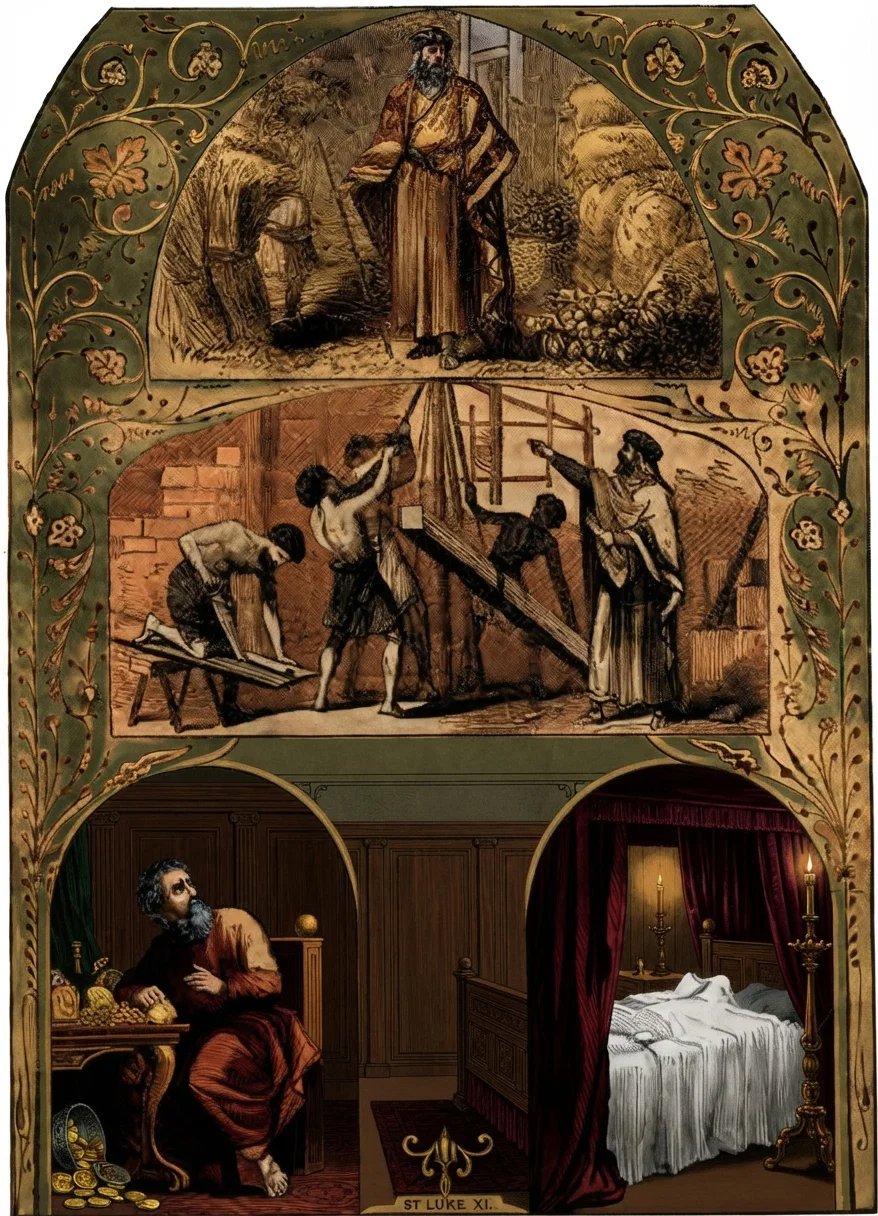
ST LUKE XII.
The New York "World" says that the system of interlocking boards of directors furnishes a remarkable exhibit of community interest, dominating not only financial institutions, but industrial corporations and great railway companies; and then we are given the boards of directors of the Steel Trust, the National City Bank, Farmers' Loan and Trust Company, the great railway concerns, and the American Telephone and Telegraph Company, etc.
The above paper also says: "The chain of financial control is being forged. Each main link has its own connections and dependencies, extending indirectly into every aggregation of capital in the country. Many of them operate independently in their own particular spheres; but like the musicians in an orchestra, when it comes to the ensemble they look to the one leader, the central figure of America's finance — J. P. Morgan."
The amount of this combined capital is astounding. It is impossible, unless one thinks in big figures, as do these great capitalists, to consider it at all. Its vast power if used together is incalculable. No government on earth could stand against it. Of course it is admitted that the vast sum of money is not in actual possession of the money trust, but the tremendous power of the few who control that trust lies in the fact that they are able to sway, to influence, to direct the use of it at opportune or critical times so that the very hints they may give and the lines of policy which they follow would so indicate to other controllers of wealth the course to be followed, that they would have an ever-increasing army of financiers in their wake.
The "World" thus summarizes what such a trust as that could do:
"It could call $200,000,000 of loans overnight, and ruin any adversary.
"It could reduce credits to such a degree as to cause extreme money stringency and great commercial distress.
"It could tie up the cash holdings of New York banks by demanding certificates of checks for enormous amounts.
"It could deplete bank reserves in New York by causing shipments of cash to any part of the country.
"It could make the money rate of interest almost what it chose, from two per cent to one hundred per cent on call loans.
"It could cripple the financial operations of the Government by refusing to purchase any bond issue.
"It could dictate the financial operations of great railway systems and expanding industrial corporations.
"It could and does dictate the terms and executions of every company promotion that is important enough to be financed in Wall Street."
This money trust is unincorporated, unofficered; yet it is tremendously concrete in its operation, and directed by one man — Morgan, with a half dozen capable aids.
It is not before the public as a capitalist company; and yet it commands unlimited capital. It is the most powerful organization in America, and hence in the world.
Right upon the heels of that comes the news that J. P. Morgan accomplished another of his tremendous coups on January 4 by merging three trust companies into one of the greatest banking institutions in the country, a $200,000,000 asset concern, to be known as the Guarantee Trust Company. The companies consolidated are the Morton Trust Company, the Fifth Avenue Trust Company, and the Guarantee Trust Company.
The Springfield "Republican" thinks that the trust may not be so dangerous, altho it might; but the great danger exists in one man's having so much power. It says, December 23, 1909:
"The greater danger, the fundamental one, to be disturbed about, is the existence of the towering individual fortune which gives to the one almost the power of an Oriental despot over the welfare of millions of his fellow citizens. No man is good enough or great enough to be entrusted with power of any such magnitude; and no republic or democracy is strong enough to endure him forever, if he were good enough or great enough to be so entrusted. The way to deal with such a money power as is described by the World, is to effect such reforms in taxation and for the abolition of monopolizing privilege as will make the acquisition of fortunes so great as these, practically impossible."
But can the remedy ever be applied? Lord Weiby, of England, was former secretary of the British treasury. He was asked for a message for the new year by the New York "World." He sees signs of steady progress in America, but he says this:11
"If you ask me if Mr. Pierpont Morgan's new money trust will help you by prudent exercise of the power, I shall ask you in reply, Is Mr. Morgan going to be acknowledged as the virtual and perpetual head of the American state? Of all countries I should have thought that a republic would have been the last to rely upon the extraordinary wealth of one man to preserve its banking system and maintain its credit. I should be sorry to think that the great state of the West is now going to allow it."
Thus an eminent stranger looks upon the dangers to America from colossal wealth; but when the colossal wealth of each of a dozen different men is combined, what evil can they not do if by doing it they can augment their own fortunes?
One of the first moves of the money trust to show its power, we are told, is an ultimatum to President Taft on the one hundred million dollars of Panama Canal bonds, and perhaps the forcing of Secretary McVeagh out of the cabinet.
Another striking fact which seems to have connection with the money power is the recent ultimatum to Japan. In other words, Japan is told that she must not meddle with the Chinese sovereignty in Manchuria, that she may not hold dominion over the railway properties in that Chinese province; and the statement by Secretary Knox intimates that the moneyed powers of the United States, Great Britain, France, and Germany are at the bottom of the decision and are assuming guardianship of the territorial rights of China.
One of the reasons why the monetary powers feel able to place this check on Japan, is the fact that the little island empire is almost bankrupt. At least her own papers indicate that this is the case. The "KoKumin," of Tokyo, says:
"Since the termination of the late war, Japan has paid and will still have to pay upward of one hundred million yen [fifty million dollars] each year in principal and interest. The present financial interest in Japan really represents that of Great Britain a generation ago; but since then the latter has made good all her debts, but the heavy debts of Japan are more than the nation can endure."
The "Hochi," of Tokyo, says:
"At no period in her history has the financial condition of Japan been so depressed as it is at present. Since the conclusion of peace with Russia five years ago, the finances of the empire have been going from bad to worse, and not a single new industrial enterprise has been started. Most of the population are groaning under the increased price of the commodities of life, and are clamoring for a reduction in taxation. The men of capital keep their money idle, and shrink from investing it in commercial enterprises. Should Japan remain in such a state a few years longer, the fate of the empire is sealed."
The "Nippon," of Tokyo, another prominent journal, after saying that some people thought industry would revive in Japan by the close of 1909, continued:
"Contrary to expectations, however, things have turned out just the contrary, and at this moment there is no prospect of business being restored to its former status. . . . Thus the condition of Japan really resembles that of a sick person whose recovery is almost beyond hope."
And this was just what John Clark Ridpath pointed out years ago. It was the determination of the Invisible Empire to involve every nation in the world in debt, controlling these nations by their debts and the amount of interest upon them. There were debts to the amount of twenty billion dollars in 1898.
"The World Almanac" for 1909 gives as the debts of the nations outside of the United States, more than $36,548,000,000; of the General Government of the United States, more than $2,500,000,000; and the public debt of the states, cities, and minor civil divisions in this country in 1902 at $1,864,000,000. Think of it! Think of the vast amount of interest upon this debt, that is eating right into the very heart of civilization! And while these debts are increasing, prices of commodities and necessaries of life are increasing. Wages, too, have increased to some extent, but not to the extent that the cost of living is increasing.
Of course there will be legislation. Men will legislate, and endeavor to check the power of such enormous interests; but they will find it utterly impossible to do it. Yet there will be an end, and God's Word has foretold that end. It has not only foretold the end, but it has given the very conditions which we see in the world to-day as an evidence of the times in which we are living. In the 5th chapter of the epistle by James is a solemn warning to rich men: "Go to now, ye rich men, weep and howl for your miseries that shall come upon you." And then the apostle gives the reason for this,— their riches are corrupted, and their garments are moth-eaten, their gold and silver are cankered, and the mighty hoard itself shall be a witness against them, and shall eat their flesh as it were fire. "Ye have heaped treasure together FOR THE LAST DAYS." He tells us, too, that this vast wealth is piled up regardless of the sufferings of the poor. Just the other day the steel kings met for a supper. It was a secret affair. One hundred dollars a plate was the price. That one hundred dollars a plate would have given four hundred men a good supper.
Not long ago, a bishop, as quoted in the New York "Christian Advocate," told us that the ministers in his diocese averaged only about $240. The cost of three individual plates would have been a welcome additional income to many of the pastors in this diocese. So the apostle James tells us, "Ye have lived in pleasure on the earth, and been wanton; ye have nourished your hearts, as in a day of slaughter." This condition he tells us is in "the last days." He does not advise revolution, or rebellion, or anarchy — nothing of this kind — that is foreign to Christianity. He does present the awful picture of misery and crime and wickedness; but his admonition is, "Be patient therefore, brethren, unto the coming of the Lord."
God notes all the sufferings of the poor. He tells us in this same epistle that He has chosen the poor, rich in faith, and heirs of the kingdom which He has promised,— the kingdom in which righteousness shall rule, justice shall reign, love shall abide. But He faithfully warns the rich in this world, not simply through the apostle James, but through the prophets Amos and Habakkuk, that if these things continue, the time will come when the poor and the oppressed will rise up with such rage and madness in their hearts that the very palaces themselves will be broken open, the wealthy who reside in them will be slain, and their riches scattered.
It is not our purpose to point out political remedies. Worldly-wise men can not agree regarding the remedies; and if perchance they do agree regarding the treatment of the case, there is failure in its application, so that the conditions grow worse instead of better. The prosperity is at the top and not at the bottom strata of society. It is far greater riches coming to the wealthy; it is more pinching poverty coming to the poor. All this sets class against class; and yet all these are the heralds of the coming of that kingdom in which there shall be no injustice, in which God shall be honored by every one, and every soul will find his highest pleasure in ministering to every other soul. To that we point our readers; and the one who trusts in the Lord Jesus Christ, the Heir of the kingdom and the Saviour in time of trouble, is richer than the wealthiest of earth's money kings. And while he may not sway so much power for a little time, his sphere of influence reaches out beyond this world, and takes in all the glories of eternity.
It Is Disgraceful.
By Editor
The Oregonian points out a disgraceful thing which is creeping into the social life of Portland, which "if not stamped out, may grow into a custom," and that is "the imported idea" that the best way to usher in the new year is "to get drunk in public;" a vice which the Oregonian intimates was probably caught from San Francisco, "the one American city that boasts of imitating the fashionable vices of the gay French capital." The Oregonian may console itself that the disgrace is not local. The pestilential thing is spreading all over the nation. We agree with our contemporary that "it is almost inconceivable that normal men and women whose conduct 364 days in the year bars reproach, should at this time compromise themselves by getting into a position where their intemperate acts may be seen and criticized by entire strangers; where for a few brief hours in the public mix-up it is not easy to distinguish decent people from women of the underworld and their men associates." It is pure lustful paganism.
Not a Sad Thing.
Congressman Douglass, in a speech before the House of Representatives January 4, which contains many important facts regarding increased cost of living, tells how "strange and sad" it seemed to him to learn that workers in Germany had meat upon the table only as a Sunday luxury. If Congressman Douglass only knew, there are a growing number of intelligent, active, diligent workers in the United States that do not have meat upon their table at any time during the week or month from choice. They are just as well, just as strong, just as able to work, and do just as good work and clear thinking, as those who live upon meat. What Mr. Douglass said in his speech, however, is important; and that is, that the cost of living for the working man is continually increasing. Secretary Wilson is emphasizing the same great fact, and Congress has appointed a committee to investigate the matter.
We are glad to note that for the first time in the history of temperance reform there is a real marked decrease in the consumption of alcoholic liquors. In other words, according to the statistics of the internal revenue office, the production of distilled liquors in 1908 was less than that of 1907 by 41,000,000 gallons; and it is stated that in the manufacture of beer, there was a falling off of 5,500,000 barrels. This is good; but will it last? Or does this really measure true temperance reform? Has there been a larger increase in drinking what is called "near beer," the French drink absinth, and other various forms of drug-drunkenness? These are matters which ought to be considered in connection with the temperance question. For all the advancement there is, we thank God.
Oil and Milk.
The New York World declares that the Standard Oil Company is very deeply interested in the great milk trust. While there is no clear evidence that the two companies are joined together legally, yet the great stockholders of one are shareholders in the other. A story in one of the recent magazines goes on to tell of how one man controlled the bread supply of the United States, gathered all the money, by the pennies and dimes and quarters, until the whole country was in his grasp. The milk trust would be a step toward that. If one great company controlled the light and the milk, before long they would grasp some other necessity; and how long would it be before the whole nation would be in the power of such a company?
The Grand Opportunity
By M. E. Emmerson
Among all the grand opportunities that have come to mankind, the one coming to us in this generation is the greatest.
To Noah was given the work of building the ark of safety for his house and for all who would hear his message. He warned the world of its impending doom; and tho none but his family entered the ark, yet he did the work well. He used the opportunity thus afforded him, and gained for himself an incorruptible crown, which will be given him when Jesus comes. Surely his opportunity was great, and he indeed made a success of life. The "well done" will be said because he was faithful in performing the duties God gave him.
Abraham had the honor of being called the father of the faithful. He did a work the result of which was to be seen for all coming ages. God called him His friend. Truly Abraham had great opportunity. By using it he became heir of God.
Daniel had the opportunity of standing before the world's mightiest sovereign, and declaring to him things concerning the God who reigns in the heaven of heavens. God used him as an instrumentality through which He made Himself known to the world. To Daniel it was said, "Thou shalt rest, and stand in thy lot at the end of the days." Thus the Lord assured him that when his name came up in judgment, Jesus Christ would plead his cause, and that with the righteous he would shine as the sun through endless day.
To John the Baptist was committed a great work, that of preparing the way for Christ's first advent. He was the forerunner of Christ the Lord. He preached repentance and conversion, urging the people to turn from their sins to God. Many were moved by his mighty preaching. He was free to say, "I am not the Christ." In answer to the question, "Who art thou?" he replied, "I am the voice of one crying in the wilderness, Make straight the way of the Lord." This also was a great work, and faithfully performed, for John the Baptist was faithful unto death.
The Greatest Opportunity
All these men spoken of, and many others, together with the people living in their times, have had great opportunities; but to those living in the present age, it has pleased God to give the greatest, the grandest, the most precious message of truth ever committed to man or angel. The message is this: "Yet a little while, and He that shall come will come, and will not tarry." Then the reign of sin will end.
On every hand we can see fulfilment of prophecy. Destruction by land and sea tells that the day is nearing. How can we doubt the prophecy? The children of Israel, after reaching the promised land, found that among all the good promises of God, not one had failed. The same can be said of the signs of the times now. Not one predicted has failed. Everything prophesied has occurred just as the prophecy foretold it would. Crime and vice are increasing. Some of the most enterprising and beautiful cities have been destroyed by earthquakes, storms, and tidal waves. Signs in the religious, political, and social worlds, all speak to us in no uncertain tones that the end of all things earthly is at hand.
The end indeed is near. The Gospel of the kingdom is being preached to all the world. Right and Wrong are locked together in the last great conflict for supremacy. Truth and Justice and Purity are often outcasts when they should be constant, abiding inmates. Be faithful a little longer. Even now the gray dawn of the eternal morn can be seen. The eye of faith catches faintly the first gleanings of the glories of the eternal world. Heaven is at hand.
M. E. EMMERSON.
Kolo, Basutoland.
Our Work and Workers
By Editor
HAPPY NEW YEAR wishes come from the Boulder, Colorado, Sanitarium, with three beautiful views of the main building and its surroundings. We do not know as anything that we could say would exaggerate the beauty of the surroundings of Boulder for pure mountain air, clear, sweet, cold water. There is probably no resort in the country that is any better located. We wish it the abundant patronage which it deserves in the year to come.
WE have received a very neat card from Hinsdale Sanitarium, Hinsdale, Ill., conducted by Dr. David Paulson. The buildings are very neat; and tho the time was winter when the photograph was taken, there was no snow on the ground, tho the trees were bare. The place looks cheery and inviting, and must be a beautiful spot in summer.
ELDER BABCOCK, of the Gold Coast Mission, West Africa, reports the organization of a church of thirty-four at Kickam, in the interior, and in an entirely heathen community, and the only church in the village. A number of years ago the Roman Catholics went among this tribe, but their missionaries were driven out. The Catholics named the tribe the Apollonians, after Apollyon. See Revelation 9:11. But the natives are anxious to hear the message of the Gospel. At Axim there is a church organized of seventeen, and a company of twenty-five at another point, while at Kickam fifteen more are asking for baptism. He closes his letter by saying: "Who will come over and help us? We are in great need of men and means."
MR. W. H. WILD, of Hinsdale, Ill., has a new and instructive Bible picture entitled "Beautiful Zion," illustrating the golden city of Revelation 21. It is lithographed in the colors of the rainbow and varnished. Size, 16 by 20 inches. In addition to the city, it has on the margin several excellent and highly practical illustrations, poetry, and Scriptural references, revealing God's love and His promises, His invitations, and His warnings. It is full of present truth. Mr. Wild promises to send it to any address for only 25 cents; will refund the money if the receiver is not satisfied. Agents are wanted. The book and picture outfit is 75 cents.
BROTHER J. V. WILLSON, in the South African Missionary, gives an interesting account of the children's raising money for missionary purposes by starting with sixpence. One little girl's 12 cents had grown to 60 cents; another's to 50 cents; another's to $1.35; another's to 80 cents; and so on. The net proceeds from the children's work at Kimberley amounted to about $10.50. That would be good work for children everywhere.
BROTHER SNYDER, writing from Cuba, states that he was surprised to find a company of sixteen at Guanajay, near Havana, almost wholly the result of the circulation of the Senales by one sister. Altho she has a family of seven to care for, she has a burden for precious souls.
PROF. GEORGE McCREADY PRICE writes from Loma Linda that they have been having a wonderful spiritual refreshing there. God has come in in great blessing, and they have found that this blessing has not had its effect upon religious meetings alone, but has been mightily helpful in the regular routine work and in all the business of the institutions there. And this is just what ought to be among God's children everywhere.
ELDER C. W. OLDS died at Glendale, California, Nov. 11, 1909, at the age of 77. He had been a devoted minister for many years, mostly in Wisconsin.
NEWS from Turkey states that the country is in an uncertain condition. Now that the government receives soldiers from Christians, many of the young men who are conscientious against serving are leaving the country.
THE night is far spent, the day is at hand;
Ye saints of Jehovah, O, stand! Firmly stand!
O, gird on thine armor,—the buckler and shield,
And breastplate of love,—and the mighty sword
wield.
The night is far spent, the day is at hand;
Pray, work, watch, and wait, till ye reach the bright
strand.
O, do with your might what your hands find to do;
And to Him that hath bought us, e'er dare to be
true.
O, gird on your armor, for swift speed the hours —
Lest the prize that awaits us should never be ours.
The hour that's the darkest now spreads o'er our
land.
Have your lamps burning bright — 'tis the Master's
command.
Hasten on to the fields, where the harvest is white;
For the glad jubilee is now almost in sight —
Lest, the summer all ended, the harvest all past,
"I am lost!" you exclaim, in the judgment, at last.
A. C. LOGAN.
Notice
By C. W. Flaiz
THE second biennial session of the North Pacific Union Conference will be held in the East Portland church, Portland, Oregon, February 10 to 20, 1910. The first meeting will convene at 10:00 A.M., Thursday, February 10; and it is earnestly desired that all delegates be present from the first.
C. W. FLAIZ, President.
Notice
By C. W. Flaiz
THE first biennial meeting of the North Pacific Union Conference Association will be held in the East Portland church, Portland, Oregon, at 2:30 P.M., Wednesday, February 16, 1910. Officers will be elected and such other business transacted as may legally come before the association.
C. W. FLAIZ, President.
Annual Meeting of the California Conference, S. D. A.
THE thirty-ninth annual session of the California Conference will convene at Lodi, Cal., February 1, 1910, and continue until February 6. The first meeting of the session will be held at 9:00 A.M., February 1. Each church in the conference is entitled to one delegate for the church, and one additional delegate for every twenty members. A full delegation is earnestly desired.
S. N. HASKELL, President. CLAUDE CONARD, Secretary.
California Conference Association, S. D. A.
Notice of Annual Meeting
THE fourteenth annual meeting of the California Conference Association of the Seventh-day Adventists will be held in connection with the thirty-ninth annual session of the California Conference of Seventh-day Adventists, at Lodi, Cal., February 1-6, 1910, for the purpose of electing a Board of seven directors and transacting such other business as may come before the meeting. The first meeting will be held at 9:00 A.M., February 2.
H. W. COTTRELL, President.
CLAUDE G. CONARD, Secretary.
The Human Way
"The Human Way." By Louise Collier Willcox. Cloth-bound. Price, $1.25 net. Harper & Brothers, New York and London.
This is a series of well-written essays on the human phases of life. There are ten of them: The Service of Books, Out-of-Doors, The Children, Friendship, Human Relations, the Area of the Personality, The Hidden Life, Solitude, Memorat Memoria, Detachment. These delightful productions flow smoothly and invitingly on, their chief aim to help us to see the helpfulness of all things which come to us in life. We read that "no brave man accepts failure as an ultimate solution;" "pain is the slow process of the enlarging of the consciousness;" "it is the men who have seen deepest into the misery of human things who have consoled and fortified us." The book abounds in such thoughts. We are warned that books should be a stimulus to action, not an opiate; the beauty of life is that "its meanings lie deep—deep." The wind voices, the bird songs, the flowers, the trees, the purling brooks, the mountains, all pay tribute to the easy pen of the author. The fruitlessness of revenge, the beauty of "the velvet soul," the true meaning of "career," are mere glints of a thousand flashes of light. It is not a religious nor a Christian book; nor will one always agree with its suggested theology; but its beautiful sentiments are noble and uplifting.
Hints for Carpenters
By Editor
"Hints for Carpenters." Compiled and edited by Albert Fair. Illustrated by 100 engravings. Price, 50 cents. Industrial Book Company, New York.
The worth of this book is not to be measured by its size, altho it has about 150 pages, with a copious index. Its object is to bring together in a convenient form for easy reference some of the best practical hints of practical men. It isn't a one-man book, nor a one-idea book; but a book made by various experienced men, so that it will be useful not only to the young beginner, but to the old and skilful carpenter as well.
What makes it of more worth, it has been published before in the periodical The Practical Carpenter, and the very best has been selected, arranged, and edited in the form in which it now appears. For instance, we have some fine suggestions and directions on the care of tools, rust removers, marking tools, protecting the steel square, filing saws, the hand-saw and its uses, directions how to make a saw filing vise, sharpening of plane irons, convenient chapiters, something about nails and screws, glue, fitting doors, hanging doors, etc., etc., etc. We are sure that young carpenters would find it exceedingly educational and old carpenters convenient and helpful.
Is There an Agent in Your Town for the Signs of the Times Monthly?
By Editor
If not, we want one. Won't you be that one? Several can keep busy in the larger cities and towns. Hundreds of Christian people who believe the things taught in this magazine, are spending part or all of their time in this work, and they are doing well. But we want others, for "the harvest truly is great, but the laborers are few." Agents are making as much as $5 a day. You may not do so well; but to make, say, $2 a day, you have to sell but 33 copies. Why not try?
Reduced facsimile of February cover
We get lots of letters like these:
"The dear Lord has been very good to me. Last month I was able to get in only 17 days' work, but in that time He enabled me to dispose of all my papers (1,000), so I have no old ones on hand."
"I have been selling papers to-day. I started out this morning with faith in God that I would sell some papers, and I did. This has been the happiest day that I ever had in all my life. My heart was uplifted to God in prayer."
The February Number Is Now Ready
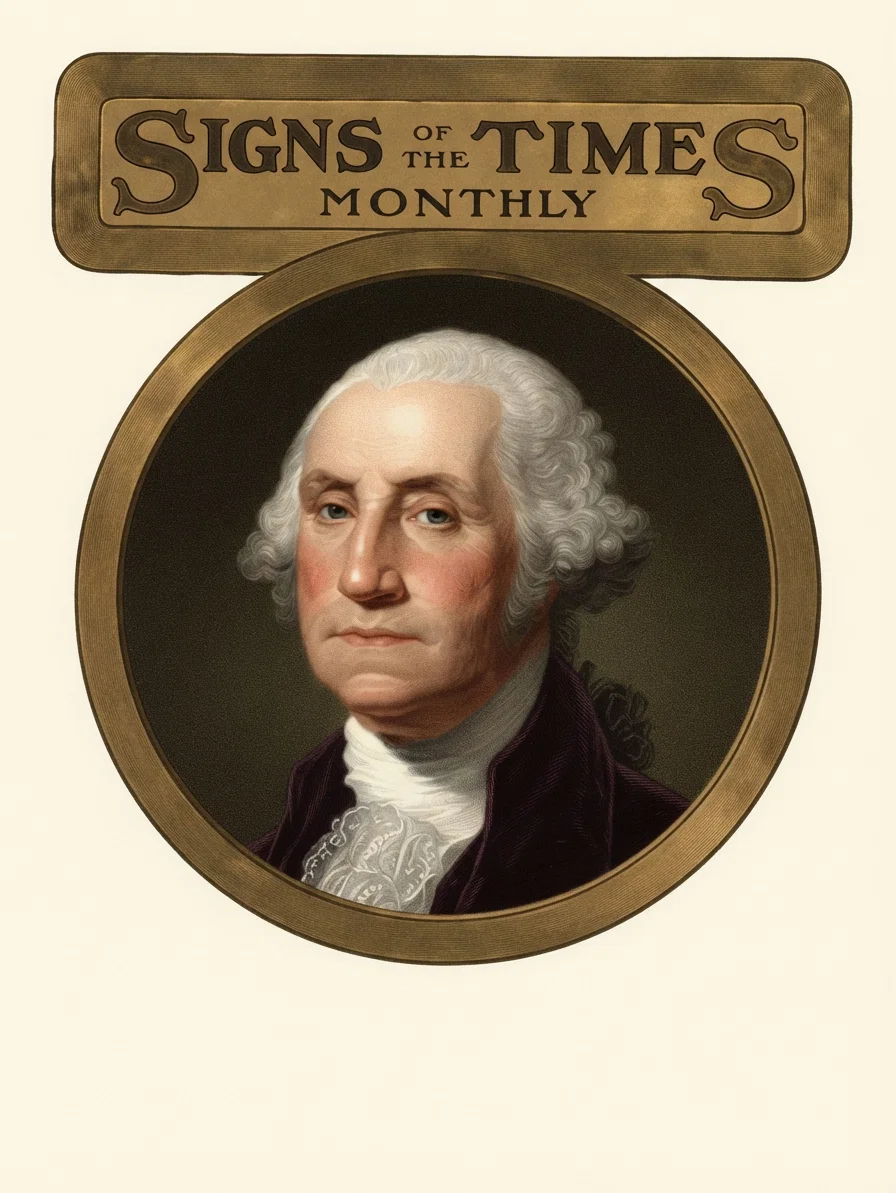
WASHINGTON-LINCOLN MEMORIAL NUMBER
Some of Its Features:
Splendid historical sketches of Washington and Lincoln, generously illustrated.
Current Topics; Note and Comment; The Disappointment (a Story of the Days of 1844); What of the Night? (Significance of Recent Calamities); Why Keep Sunday?
Fifty copies cost $2.00; you sell them for $5.00
More than 50 copies at same rate—4 cents a copy
Address Your Tract Society, or Signs of the Times, Mountain View, California
BOOK NOTICES
"Ant Communities and How They Are Governed. A Study in Natural Civics." By Henry Christopher McCook. Illustrated from nature. Neatly bound with ornamental side stamp. Price, $2.00 net. Harper & Brothers, New York and London.
This instructive work of sixteen chapters is packed full of interesting information upon the ubiquitous ant family. Some of the astonishing things these often troublesome insects do, seem almost too wonderful to be believed; but a knowledge of them as set forth by Mr. McCook inclines one to read with fuller appreciation the words of the wise man, "Go to the ant, thou sluggard; consider her ways, and be wise." The old proverb touches the scientific side in the "her," as well as the moral side, which our author sometimes notes; for we learn that in ant communities it is the female that is strong and aggressive, the indefatigable worker, the true "war lord" of the tribe. How these communities are governed, the means of communication, the wars waged between different colonies, the courage and determination shown, and many other things treated, make the volume one of interest. There are more than a hundred illuminating drawings from nature.
Extra Fine Jessie Strawberry Plants
By J. C. Evans
$3 per 1000 for small lots; rates made on large lots; very large, early, prolific, and sweet berries, and self-pollenizing.
J. C. Evans - - - Ripon, Cal.
Good Home for Sale
Modern six-room house on 50 by 150 corner lot. Located two blocks from Seventh-day Adventist Church, Mountain View, Cal. This is a new house, well built, up to date in every way, well located. Price and terms reasonable. Address, S. L. W., care SIGNS OF THE TIMES, Mountain View, Cal.
Another Choice Property for Home or Investment
Modern six-room double house. Each apartment contains three rooms, bath, etc. Ideal for renting to small family. Located on 50 by 150 foot lot adjoining property described above. Reasonable price and terms. Address S. L. W., care SIGNS OF THE TIMES, Mountain View, Cal.
Stories of Hell’s Commerce
By Editor
"Stories of Hell's Commerce; or the Liquor Traffic in Its True Light." Compiled and edited by Elton R. Shaw. Price, cloth, $1.50; half morocco, $2.00. Shaw Publishing Company, No. 2 Pearl Street, Grand Rapids, Mich.
The volume consists of interesting stories, true incidents, striking illustrations, poetry, song, etc., which portray the evils of the curse of intoxicating drinks. Samuel Dickie, the noted temperance orator, and president of Albion College, furnishes the introduction. Many of the compilations are from the greatest of temperance workers, such as John G. Woolley, John P. St. John, John B. Gough, L. A. Banks, D. L. Moody, Wendell Phillips, and others. There are ten full-page half-tones, eleven line engravings, and eight illustrated poems. We wish every one could read the forcible arguments, the pathetic stories, the striking illustrations, of this book. We do not believe a liquor dealer could calmly, thoughtfully read it and continue his business. Every temperance worker should have it. It is sold by subscription. May it have a large circulation.
Soul-Winning Texts, or Bible Helps for Personal Work
By Editor
"Soul-Winning Texts, or Bible Helps for Personal Work." By Dr. Wm. S. Sadler. The Central Bible Supply Company, Chicago.
This is a valuable little help for those who are engaged in working for souls. In fact, it was a little work which we had in our own publishing house before the fire; but on account of our being unable to undertake it immediately after the fire, it was taken elsewhere for publication. It gives first of all some excellent hints to personal workers, how to deal with different temperaments. It classifies texts, for instance: for anxious seekers, for triflers, for skeptics, for those who are backslidden, and so on and so on — something like eight different classifications, with numerous subdivisions. It is printed in convenient form, making it easy to slip into the vest-pocket, and is bound in cloth and leather. Price of cloth, 25 cents; leather, 50 cents.