1. What Sabbath law has God given us?
See Sabbath law on this page.
NOTE.—Mark the position of the Sabbath law in the middle of the Decalogue, that recognized compendium of all morality. If it were placed at the beginning or end of the law, man might say that it formed no part of that wonderful document; that it was added by men, was ceremonial in its nature; that it did not stand on the same basis as the other nine precepts, etc. But Divine Wisdom, anticipating all these attempts to belittle the Sabbath, placed it in the very heart of that law; therefore before the impious hands of sacrilege can reach it, three moral walls guarding our duty to God on the one side, and six moral laws guarding our duty to humanity on the other side, must be broken down. So strong is the citadel of the Sabbath commandment of Jehovah. It, like all the others, is eternally moral.
Questions on the Law
2. What shows that the Sabbath is not at this time a new institution?
"REMEMBER the Sabbath day."
3. What are we to remember?
"The SABBATH DAY."
4. For what purpose are we to remember it?
"To KEEP IT HOLY."
NOTE.—It is therefore evident that the day, the DAY of the REST (for "Sabbath" means "rest"), is not made holy by man's keeping. Man's keeping does not make it holy; man is to keep holy that which God has made holy.
5. What day of the septenary cycle, or week, is the Sabbath?
"The SEVENTH day."
6. Whose Sabbath is the seventh day?
"The seventh day is the Sabbath of the Lord [Jehovah] thy God."
7. What made it the Sabbath, or rest, of Jehovah?
"In six days the Lord made heaven and earth, . . . and rested the SEVENTH DAY."
8. When did God thus rest?
"Thus the heavens and the earth were finished. . . . And on the SEVENTH DAY God ended ["finished," A.R.V.] His work which He had made; and He RESTED on the SEVENTH DAY from all His work which He had made." Gen. 2:1, 2.
NOTE.—It is said that God finished His work on the seventh day, because the making of the Sabbath was the rounding-out of that week's work for man. God's rest on that day was a part of His week's making. His rest upon that day of the cycle made that day of the cycle His rest day to all eternity; for the fact of the rest could not be set aside. The rest was a step which Divine Wisdom felt necessary in the institution of a holy rest day.
9. What did He do after resting?
"WHEREFORE the Lord BLESSED the Sabbath DAY, and HALLOWED it."
"And God BLESSED the SEVENTH DAY, and SANCTIFIED it: BECAUSE that in it He had rested from all His work which God created and made." Gen. 2:3.
NOTE.—God "hath blessed; and I can not reverse it," said a prophet of old. Num. 23:20. He blesses, that the thing blessed may be a blessing. Gen. 12:2. So will God's Sabbath prove to him who receives it. "Sanctify" means to set apart to a holy or sacred use, to separate from the common. The sons of Aaron were flesh and blood like their brethren; but God sanctified them, set them apart, separated them from the other tribes unto the priesthood. Ex. 28:41. Mount Sinai was composed of rock and earth like other mountains; but God separated it unto Himself, and made it holy. Ex. 19:23, 12, 13. This sanctifying the Lord did by command; so also He sanctified the Sabbath. Note also that it is THE DAY, ever the DAY, not one day in seven, not a seventh part of time, but the seventh DAY.
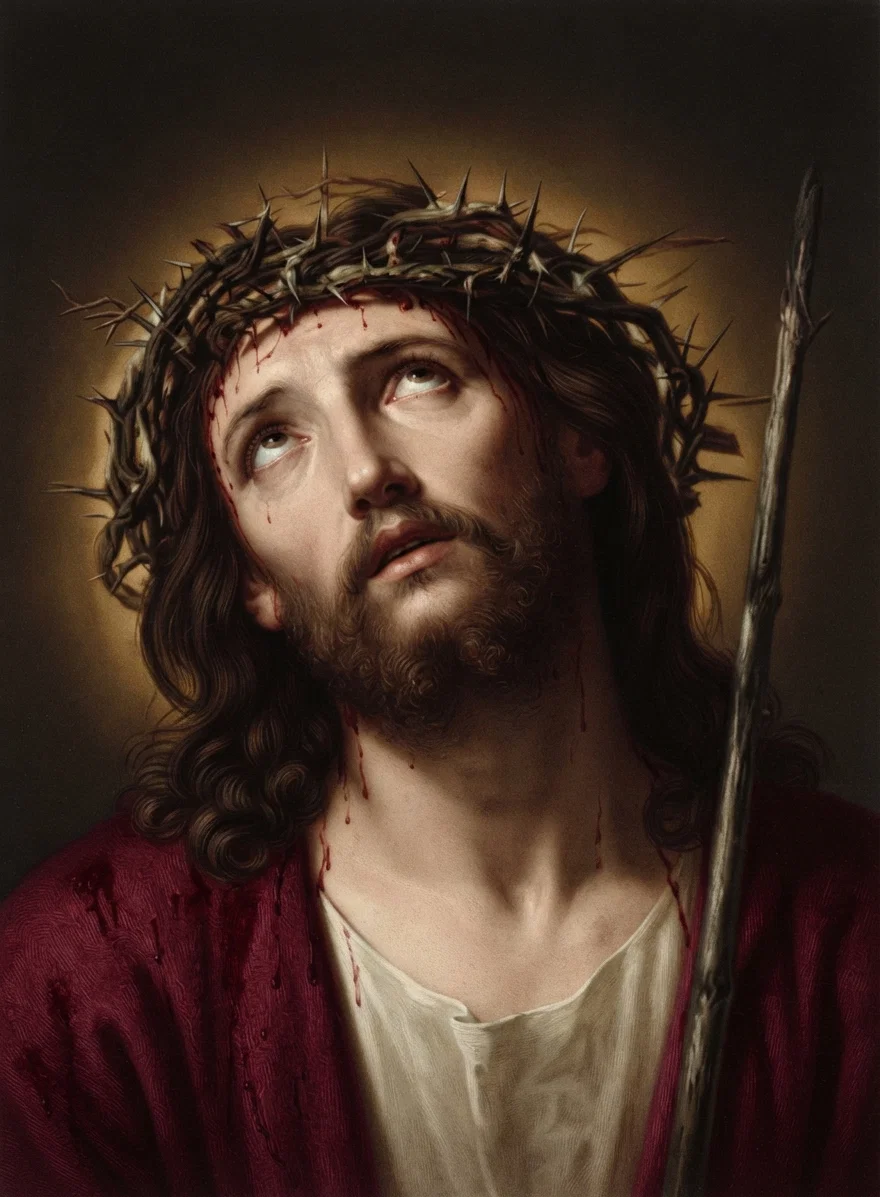
Christ Crowned with Thorns
The sufferings of Christ were all endured to save man from the penalty of a law so holy that it could not be set aside, and to win him to loving obedience to its every precept.
10. For whom was the Sabbath made and set apart?
"The Sabbath was made for man." Mark 2:27.
Note that it was made 2,500 years before there was a Jew, and given to generic man, the head of the race, and hence was for all the race, even as the earth was for all the race.
Memorial and Sign
11. Of what, then, is the Sabbath a memorial?
"He hath made His wonderful works to be remembered." Ps. 111:4.
12. How long shall His memorial remain?
"Thy name, O LORD, endureth forever; and Thy MEMORIAL, O LORD, THROUGHOUT ALL GENERATIONS." Ps. 135:13.
NOTE.—If men had ever been mindful of God's Sabbath, earth would never have known an idolater. The Maker of heaven and earth would have been kept in constant remembrance.
13. Of what, then, did the Sabbath become a sign?
"And hallow My Sabbaths; and they shall be a sign between Me and you, that ye may KNOW that I am the LORD [Jehovah] your God." Eze. 20:20.
14. Of what else is it a sign?
"Moreover also I gave them My Sabbaths, to be a sign between Me and them, that they might know that I am the LORD THAT SANCTIFY THEM." Eze. 20:12.
NOTE.—The only power which can make holy and save the sinner is creative power; therefore the Sabbath becomes a sign of redemption as well as a memorial of creation. God created mankind; He redeems His Israel, His people, out of Egyptian bondage. Therefore to the redeemed the Sabbath comes as a twofold token of creation and of redemption. Compare Ex. 20:11 with Deut. 5:15. The power of redemption is creative power. Eph. 2:10; 2 Cor. 5:17. Even so God made known to His people the fulness of the Sabbath on Mount Sinai. Neh. 9:13, 14.
Jesus and the Sabbath
15. How did Jesus regard the law of which the Sabbath is a part?
"Think NOT that I am come to DESTROY the law, or the prophets: I am NOT come to DESTROY, but to fulfil. For verily I say unto you, Till heaven and earth pass, one JOT or one TITTLE shall in NO WISE pass from the law, till all be fulfilled. Whosoever therefore shall break one of these least commandments, and shall teach men so, he shall be called the least in the kingdom of heaven: but whosoever shall do and teach them, the same shall be called great in the kingdom of heaven." Matt. 5:17-19.
"It is easier for heaven and earth to pass, than ONE TITTLE of the LAW to FAIL." Luke 16:17.
NOTE.—A "jot" is the smallest letter of the Hebrew alphabet. A "tittle" is a distinguishing point of a letter. To fulfil a moral law is to do it. Gal. 6:2. Christ kept the law and died that we might be redeemed to keep it.
16. What works did He say were allowable on the Sabbath?
"It is LAWFUL [according to the Sabbath law] to do well on the Sabbath days." See Matt. 12:1-12.
17. How did He spend the Sabbath day?
"As His CUSTOM was, He went into the synagogue on the Sabbath day." Luke 4:16.
18. How did His teaching and example affect the women who accompanied Him, even after His death?
"They returned and prepared spices and ointments; and RESTED the SABBATH DAY according to the commandment." Luke 23:56.
19. Who is set before the Christian as an example?
"He that saith he abideth in Him ought himself also so to walk, even as He walked." 1 John 2:6.
20. How did Christ walk?
"Who did no sin." 1 Peter 2:22.
"I have kept My Father's commandments, and abide in His love." John 15:10.
21. How will the Christian's love be manifest?
"For this is the love of God, that we keep His commandments: and His commandments are not grievous." 1 John 5:3.
The Sabbath Law
"Remember the SABBATH DAY, to keep it holy. Six days shalt thou labor, and do all thy work: but the SEVENTH DAY is the SABBATH of the Lord thy GOD; in it thou shalt not do any work, thou, nor thy son, nor thy daughter, thy man servant, nor thy maid servant, nor thy cattle, nor thy stranger that is within thy gates: for in SIX DAYS THE LORD made heaven and earth, the sea, and all that in them is, and RESTED the SEVENTH DAY: WHEREFORE the LORD BLESSED the SABBATH DAY, and HALLOWED IT." Ex. 20: 8-11.
Is There Not Need of a Message?
By Abdiel
By Abdiel
Was Protestantism a mistake? Were John Huss, John Wyclif, Martin Luther, and their fellow Reformers, all in error? Was the mighty movement which swept the earth in the fifteenth and sixteenth centuries, of the evil one? Are we to apologize for the break made in the Catholic Church at that time, as many are apologizing to-day?
These are serious and vital questions. If Protestantism was a mistake, it is still a mistake. If it was a mistake, then the Roman Catholic claim to be the only church of Christ is true, and all Protestants are heretics, and the sooner Protestants renounce their Protestantism and get back to Rome the better.
But if that great Reformation was of God, then Protestantism started out on right principles, and upon those principles ought to be perpetuated. If Protestantism has wandered away from those principles, to them it ought to return. If Romanism is still the same, as she indubitably is and as she declares herself to be, then the principles of the Reformation should be living, molding elements in the world to-day. The principles of the Reformation are thus set forth in the historian of the Reformation, D'Aubigné:
"The Reformation was accomplished in the name of a spiritual principle. It had proclaimed for its teacher the Word of God; for salvation, faith; for king, Jesus Christ; for arms, the Holy Ghost; and had by these very means rejected all worldly elements. Rome had been established by the law of carnal commandment; the Reformation by the power of an endless life."
"If there is any doctrine that distinguishes Christianity from every other religion, it is spirituality. A heavenly life brought down to man — such is its work. . . ."
"The Gospel of the Reformers had nothing to do with the world or with politics."
The Basis of Faith
And this is the testimony of Chillingworth, who became a Catholic by persuasion when young, but who subsequently, after long, thoro, and prayerful study, renounced Catholicism:
"The Bible, I say, THE BIBLE ONLY, is the religion of Protestants! . . . I for my part, after a long and (as I verily believe and hope) impartial search of the true way to eternal happiness, do profess plainly that I can not find any rest for the sole of my foot, but upon THIS ROCK ONLY. . . . In a word, there is no sufficient certainty but of Scripture only, for any considering man to build upon."
And this from John Dowling ("History of Romanism"):
"The great question at issue between popery and Protestantism, is this: Is the Bible only to be received as the rule of faith, or the Bible and tradition together? Is no doctrine to be received as matter of faith, unless it is found in the Bible, or may a doctrine be received upon mere authority of tradition, when it is confessedly not to be found in the sacred Scriptures? The whole Christian world, both nominal and real, are divided by this question into two great divisions: the CONSISTENT AND TRUE-HEARTED PROTESTANT, standing upon this rock — 'THE BIBLE, AND THE BIBLE ONLY' — can admit no doctrine upon the authority of tradition; the papist and the Puseyite place tradition side by side with the Bible, and listen to its dictates with a reverence equal to or even greater than that which they pay to the sacred Scriptures themselves; and he who receives a SINGLE DOCTRINE upon the mere AUTHORITY OF TRADITION, let him be called by what name he will, by so doing, STEPS DOWN from the PROTESTANT ROCK, passes over the line which separates Protestantism from popery, and can give no valid reason why he should not receive all the earlier doctrines and ceremonies of Romanism, upon the same authority."
The Roman Catholic platform is the Bible AND tradition, or the Bible interpreted by tradition, making tradition higher than the Bible. The true Protestant basis is the Bible and the Bible alone.
Therefore from the true Protestant standpoint the Roman Catholic Church is as much in need of a spiritual, fundamental reformation as she was when Martin Luther nailed his theses to the Wittenberg chapel door.
Departing from the Faith
But the great so-called Protestant churches are not prepared to preach that Reformation message which will lead men back to God and His Word. The Reformation message is needed in the Protestant churches. For within the Protestant churches themselves the very foundation is undermined. The Word of God is no longer the basis of modern Protestantism. Listen to the testimony of a conservative and a radical; the conservative, Rev. David James Burrell, a Presbyterian and well-known author:
"The course of liberal thought is in evidence. It seems but yesterday when the boldest of free-thinking clergymen in evangelical pulpits could scarcely summon courage to deny the entire truth of any portion whatsoever of the Scriptures; to-day there are many who flout in toto the three miracles on which Christianity rests; to wit, the incarnation, the atonement, and the resurrection of Christ."
"There is nothing strange in the denial; the strange thing is that the deniers are the ministers of Christ, under oath to preach and maintain the very doctrines which they deny. This is not 'liberalism;' it is infidelity. It is not merely infidelity; it is mendacity. It is not merely mendacity; it is a flagrant violation of common honesty, and would be instantly branded as such in any of the common walks of life."
And much more than this he said. (See SIGNS of August 25 of last year, or the Homiletic Review of July, 1907.)
This from the radical side, from the New York Independent (June 24, 1909), which once stood strong and clear for orthodox Christianity:
"When we found that the world was more than six thousand years old, that there was no universal Flood four thousand years ago, that Adam was not made directly from the dust, and Eve from his rib, and that the Tower of Babel was not the occasion of the diversification of languages, we had gone too far to stop. The process of criticism had to go on from Genesis to Revelation, with no fear of the curse at the end of the last chapter. It could not stop with Moses or Isaiah; it had to include Matthew and John and Paul. Every one of them had to be sifted; they had already CEASED to be TAKEN AS UNQUESTIONED, FINAL AUTHORITIES, for plenary inspiration had followed verbal inspiration just as soon as the first chapter of Genesis had ceased to be taken as true history. THE MIRACLES OF JESUS had to be tested as well as those of Elijah. The date and purpose of the Gospel of John had to be investigated historically as well as that of the prophecy of Isaiah; and the conclusion of historical criticism had to be accepted with no regard to the old theologies. We have just reached this condition, and there is repeated evidence that it marks an EPOCH, A REVOLUTION, in theologic thought. This is what we learn from Chicago and New York, from two such militant denominations as the Baptist and the Presbyterian. . . ."
"But THIS DOUBT, even this questioning or denial, CHANGES THE OLD, EVANGELISTIC THEOLOGY. It questions or DENIES THE TRINITY, the RESURRECTION, the SACRIFICE OF THE CROSS, even ALL MIRACLES, and it determines all authority of inspiration or even revelation, and SENDS US BACK TO HUMAN REASON, with such divine guidance as may be allowed; the authority of the Bible and the authority of the church both to be validated ONLY BY HUMAN REASON. Just how this differs from the old Unitarianism, and what need there is for Unitarianism to maintain itself, are questions that must arise for consideration."
Therefore the message of need, in teaching, in life, in power, to bring men back to the Word of God, to the Gospel of Jesus Christ, to loyalty to His holy law; from tradition to His Word; from evolution to creation; from ethics and hypotheses of men to the power of the Spirit of God. Such a message is needed to-day. It is due to-day. God has provided it in the Scriptures of truth; and to-day it is being fulfilled in your ears. It is found in epitome in the threefold message of the everlasting Gospel in Revelation 14. What attention have you given it? Study it with us.
In His Workshop
BENEATH Thy hammer, Lord, I lie,
With contrite spirit, prone;
O, mold me till to self I die,
And live to Thee alone!
With frequent disappointments sore,
And many a bitter pain,
Thou laborest at my being's core,
Till I be formed again.
Smite, Lord; Thy hammer's needful wound
My baffled hopes confess;
Thine anvil is the sense profound
Of mine own nothingness.
Smite, till from all its idols free,
And filled with love divine,
My heart shall know no good but Thee,
And have no will but Thine.
— Author Unknown.
Heaven’s Distant Lamps
WHAT seem to us but dim funeral tapers may be Heaven's distant lamps.— Longfellow.
I am Jehovah thy God, which have brought thee out of the land of Egypt, out of the house of bondage. Thou shalt have no other gods before Me.
II
Thou shalt not make unto thee any graven image, or any likeness of anything that is in heaven above, or that is in the earth beneath, or that is in the water under the earth: thou shalt not bow down thyself to them, nor serve them; for I Jehovah thy God am a jealous God, visiting the iniquity of the fathers upon the children unto the third and fourth generation of them that hate Me; and showing mercy unto thousands of them that love Me, and keep My commandments.
III
Thou shalt not take the name of Jehovah thy God in vain; for Jehovah will not hold him guiltless that taketh His name in vain.
IV
Remember the Sabbath day, to keep it holy. Six days shalt thou labor, and do all thy work; but the seventh day is the Sabbath of Jehovah thy God: in it thou shalt not do any work, thou, nor thy son, nor thy daughter, thy man servant, nor thy maid servant, nor thy cattle, nor thy stranger that is within thy gates; for in six days Jehovah made heaven and earth, the sea, and all that in them is, and rested the seventh day: wherefore Jehovah blessed the Sabbath day, and hallowed it.
V
Honor thy father and thy mother: that thy days may be long upon the land which Jehovah thy God giveth thee.
VI
Thou shalt not kill.
VII
Thou shalt not commit adultery.
VIII
Thou shalt not steal.
IX
Thou shalt not bear false witness against thy neighbor.
X
Thou shalt not covet thy neighbor's house, thou shalt not covet thy neighbor's wife, nor his man servant, nor his maid servant, nor his ox, nor his ass, nor anything that is thy neighbor's.
THE LAW OF JEHOVAH
And the Witness of Prophet, Apostle, and Jesus Christ
"The Law of the Lord is perfect." Ps. 19:7
"Jehovah came from Sinai; . . . from His right hand went a fiery law for them. Yea, He loved the people." Deut. 33:2, 3
"Hear, O Israel; the Lord our God is one Lord; and thou shalt love the Lord thy God with all thine heart, and with all thy soul, and with all thy might. And these words, which I command thee this day, shall be in thine heart." Deut. 6:4-6
"Thou shalt love thy neighbor as thyself." Lev. 19:18
"Master, which is the great commandment in the law? Jesus said unto him, Thou shalt love the Lord thy God with all thy heart, and with all thy soul, and with all thy mind. This is the first and great commandment. And the second is like unto it, Thou shalt love thy neighbor as thyself. On these two commandments hang all the law and the prophets." Matt. 22:36-40
"The works of His hands are verity and judgment; all His commandments are sure. They stand fast forever and ever, and are done in truth and uprightness." Ps. 111:7, 8
"Lift up your eyes to the heavens, and look upon the earth beneath: for the heavens shall vanish away like smoke, and the earth shall wax old like a garment, and they that dwell therein shall die in like manner; but My salvation shall be forever, and My righteousness shall not be abolished. Hearken unto Me, ye that know righteousness, the people in whose heart is My law: fear ye not the reproach of men, neither be ye afraid of their revilings. For the moth shall eat them up like a garment, and the worm shall eat them like wool; but My righteousness shall be forever, and My salvation from generation to generation." Isa. 51:6-8
"My tongue shall speak of Thy word; for all Thy commandments are righteousness." Ps. 119:172
"Thy righteousness is an everlasting righteousness, and Thy law is the truth." Ps. 119:142
"Concerning Thy testimonies, I have known of old that Thou hast founded them forever." Ps. 119:152
"My covenant will I not break, nor alter the thing that is gone out of My lips." Ps. 89:34
"For the commandment is a lamp; and the law is light; and reproofs of instruction are the way of life." Prov. 6:23
"Let us hear the conclusion of the whole matter: Fear God, and keep His commandments; for this is the whole duty of man. For God shall bring every work into judgment, with every secret thing, whether it be good, or whether it be evil." Eccl. 12:13, 14
Of Christ: "I delight to do Thy will, O My God; yea, Thy law is within My heart." Ps. 40:7, 8
"Believest thou not that I am in the Father, and the Father in Me? the words that I speak unto you I speak not of Myself; but the Father that dwelleth in Me, He doeth the works." John 14:10
"Think not that I am come to destroy the law, or the prophets: I am not come to destroy, but to fulfil. For verily I say unto you, Till heaven and earth pass, one jot or one tittle shall in nowise pass from the law, till all be fulfilled." Matt. 5:17, 18
"And it is easier for heaven and earth to pass, than one tittle of the law to fail." Luke 16:17
"If ye keep My commandments, ye shall abide in My love; even as I have kept My Father's commandments, and abide in His love." John 15:10
"Ye are My friends, if ye do whatsoever I command you." John 15:14
"What shall we say then? Is the law sin? God forbid. Nay, I had not known sin, but by the law; for I had not known lust, except the law had said, Thou shalt not covet." Rom. 7:7
"Whosoever committeth sin transgresseth also the law; for sin is the transgression of the law. And ye know that He was manifested to take away our sins; and in Him is no sin." 1 John 3:4, 5
"Do we then make void the law through faith? God forbid; yea, we establish the law." Rom. 3:31
"Thou shalt call His name JESUS; for He shall save His people from their sins." Matt. 1:21
"Who gave Himself for us, that He might redeem us from all iniquity, and purify unto Himself a peculiar people, zealous of good works." Titus 2:14
"If ye fulfil the royal law according to the scripture, Thou shalt love thy neighbor as thyself, ye do well; but if ye have respect to persons, ye commit sin, and are convinced of the law as transgressors. For whosoever shall keep the whole law, and yet offend in one point, he is guilty of all. For He that said, Do not commit adultery, said also, Do not kill. Now if thou commit no adultery, yet if thou kill, thou art become a transgressor of the law. So speak ye, and so do, as they that shall be judged by the law of liberty." James 2:8-12
"Here is the patience of the saints: here are they that keep the commandments of God, and the faith of Jesus." Rev. 14:12.
"Blessed are they that do His commandments, that they may have right to the Tree of Life, and may enter in through the gates into the city." Rev. 22:14.
"He that saith he abideth in Him ought himself also so to walk, even as He walked." 1 John 2:6.
"It is time for Thee, Lord, to work; for they have made void Thy law. Therefore I love Thy commandments above gold; yea, above fine gold." Ps. 119:126, 127.
OUR reading for this week covers Exodus, chapters 5 to 26 inclusive. Learn to remember the subject of the chapter by some one or two central topics. That will help us in carrying the reading in our mind. We may be compelled to read rapidly sometimes. Endeavor to concentrate the mind on the reading; shut out as far as possible all thoughts of other things; even tho others may be around, shut yourself in, so to speak, with an invisible wall, so that you and the Master may be alone; then listen to Him speak; fix the great thought or thoughts of the chapter in your mind; think of them through the day.
As suggestive of this week's reading, note the topics: chapter 6, the Lord's message to Moses, and the genealogy of Moses; chapter 7, the first plague, the waters turned to blood; chapter 8, the plagues of frogs, lice, and flies; chapter 9, the plagues of murrain, boils, and hail; chapter 10, the plagues of locusts and of darkness; chapters 11 to 13, the last plague, the Passover, and the going out of Egypt; chapter 14, crossing the Red Sea; chapter 15, triumphant song of Moses; chapter 16, the fall of the manna; chapter 17, the striving with Jehovah and war with Amalek; chapter 18, the visit and counsel of Jethro; chapter 19, before Mount Sinai; chapter 20, the giving of the law; chapters 21 to 23, practical instruction for various phases of life growing out of the law; chapter 24, Moses in the mount receiving the law; chapter 25, instructions for the building of the sanctuary, including the ark, the table of showbread, and the candlestick; chapter 26, directions for the making of the tabernacle itself.
It will be seen that in all of these plagues, God designed to teach Pharaoh and the Egyptians, and Israel as well, that the gods which they worshiped were vanity. Every form of life was by them deified. The turning of the Nile into blood was a blow against Hapi the Nile god. One of their female deities had a frog's head—Heka, the wife of the god of the cataracts, or of the inundation which came every year. The very animal they deified became a plague. The frog was the symbol of regeneration with them. The third plague of the lice from dust, fell upon the earth, worshiped in the Egyptian pantheism as Seb, the father of gods, while the dust of the black, fertile soil of the Nile was especially sacred, called Kemi, from which Egypt took its ancient name.
From the air came the fourth plague. The air was deified as Shu, son of Ra, the sun-god, or as Isis, queen of heaven. The fifth plague struck at ox-worship, the murrain on cattle. The sixth plague was from ashes scattered toward heaven, from which sprang the boils—a challenge to Neit, the mother-queen of highest heaven. Some tell us that these ashes came from the holy furnace where sacrifices were offered. The seventh plague took in much of their visible manifestations of deity,—the hail, thunder, and lightning,—smiting man, beast, herb, and tree. The eighth, the locusts, ate the very trees which the Egyptians prized so much, and which were considered sacred. The locusts themselves may have been so considered also.
The ninth plague, darkness, obscured their greatest of all idols, Ra, the sun-god. Every god was remembered in the last plague, the smiting of the first-born; and in this the Lord declares, "I will execute judgment against all the gods of Egypt." Every town and home had its sacred animal,—frog, beetle, ram, cow, cat, etc.,—we are told, each representing a god.
The word "Pharaoh" means simply "king;" is not a proper name, more than would be czar, cesar, emperor, pasha. The Pharaoh of Joseph is supposed to be one of the Hyksos, or shepherd kings which ruled Egypt for a time. The Pharaoh of the oppression was Rameses II, the great builder, who reigned 67 years. One of his immediate successors was the Pharaoh of the Exodus, given by Fausset's Biblical Encyclopedia as Thothmes II.
The word "borrow" in chapter 11 is better translated "ask," or "demand." It comes from a Hebrew word which means ask or demand. The children of Israel, as they went out of Egypt, were to demand something for the service which they had rendered. See the Revised Version.
Note in chapter 13 the carrying of the bones of Joseph with them as they departed from Egypt. All the while that these bones had been preserved in Egypt, it was a prophecy to Israel that God would deliver them.
The song of Moses, chapter 15, is a pæan of triumph over earthly foes. It will be repeated sometime, and there will be added to it the song of the Lamb, triumph over all temporal and spiritual foes. See Revelation 15.
Note the great threefold weekly miracle in which God pointed out that one day and one day only of the week could be the Sabbath; and this for forty years, as recorded in chapter 16. Note also in the connection that when God came to Israel with His holy law, it was designed to bring them blessing—a revelation of His marvelous love; but they would not receive it as such. How comes the law to us?
What Is the Law of God?
IT is inconceivable that a moral governor should leave his subjects without a law. It is inconceivable that men should be called to account for infractions of moral conduct, and not have revealed to them the standard by which conduct is determined.
The great infinite God does not demand of men obedience to an unrevealed law. His nature and the nature of His responsible creatures demand clear, readable, understandable revelation.
Before man sinned, this was not necessary; for the law was written in man's heart and nature, and an unperverted, undefiled conscience was a sufficient monitor. But after man sinned, his conscience became perverted, his heart carnal, and a revelation outside of him became necessary.
How early this written revelation was given, we know not. Noah may have possessed it. We know that in Abraham's day great codes of laws were written; and from the fact that Abraham is said to have kept God's charge, and commandments, and statutes, and laws, we would infer that these were classified.
Not a single one of the Ten Commandments was a new precept when it was spoken from Sinai's top and inscribed by its Author on tables of stone. All existed before, and were observed by the enlightened faithful. The divinely given Decalogue summarized the great moral precepts for sinful man, and placed them in such form, and inaugurated their giving with such display of power and glory, that they could never be questioned by a believer in God's Word.
That law was committed to Israel for the world. Rom. 9:4. God made His people priests of the nations (Ex. 19:5, 6); and the priest's lips should keep knowledge, and the people should seek the law at his mouth (Mal. 2:7).
That law of Ten Commandments, while a part of the law of Moses, interwoven in all its precepts, was a distinct code by itself, and is called "the law." Ex. 24:12. When God finished speaking it, "He added no more." Deut. 5:22. He differentiated between that and all other laws, not only by speaking it in audible voice, but He engraved it Himself in tables of enduring rock. Ex. 31:18; 32:15, 16. Then were the tables placed for safest preservation in the holy golden ark. Thus by every means which would appeal to men God honored His law.
Our Lord honored that law by its observation and by His teaching, as the prophet seven centuries before declared, "He will magnify the law, and make it honorable." Isa. 42:21. One thousand years before Christ, He had said through the psalmist David, "Lo, I come: in the volume of the book it is written of Me, I delight to do Thy will, O My God; yea, Thy law is within My heart." Ps. 40:7, 8. And when the Word was made flesh, He averred in harmony with the prediction which went before, "For I am come down from heaven not to do Mine own will, but the will of Him that sent Me." John 6:38. Of that law, our Lord declared that one jot or one tittle would never pass from it, and that it was easier for heaven and earth to pass than one tittle to fail. Matt. 5:17-19; Luke 16:17.
The above, and many other considerations and scriptures, abundantly testify that between Jesus and the law there was perfect harmony. He gave it, He loved it, He lived it, He taught it, He died to save men from its condemnation, He lives to bring them to its obedience.
It is this law which points out sin (Rom. 7:7; 1 John 3:4), and which faith establishes in the heart (Rom. 3:31). Only the carnal mind is at enmity with its righteous requirements. Rom. 8:7. The regenerated heart loves it and keeps it. 1 John 5:3.