The Youth’s Instructor, Vol. 49, No. 13.

KINGLETS

The Youth’s Instructor

Mar 28, 1901

Review and Herald Publishing Company · Battle Creek, Mich. · Mar 28, 1901

KINGLETS
It was the last day of March save one; the weather almost too cold for comfort outdoors, though the sun shone with all the glory of a day in spring. I had been out on a tour of observation, and had discovered a number of birds, among them several robins, a nuthatch, and a flock of juncos.
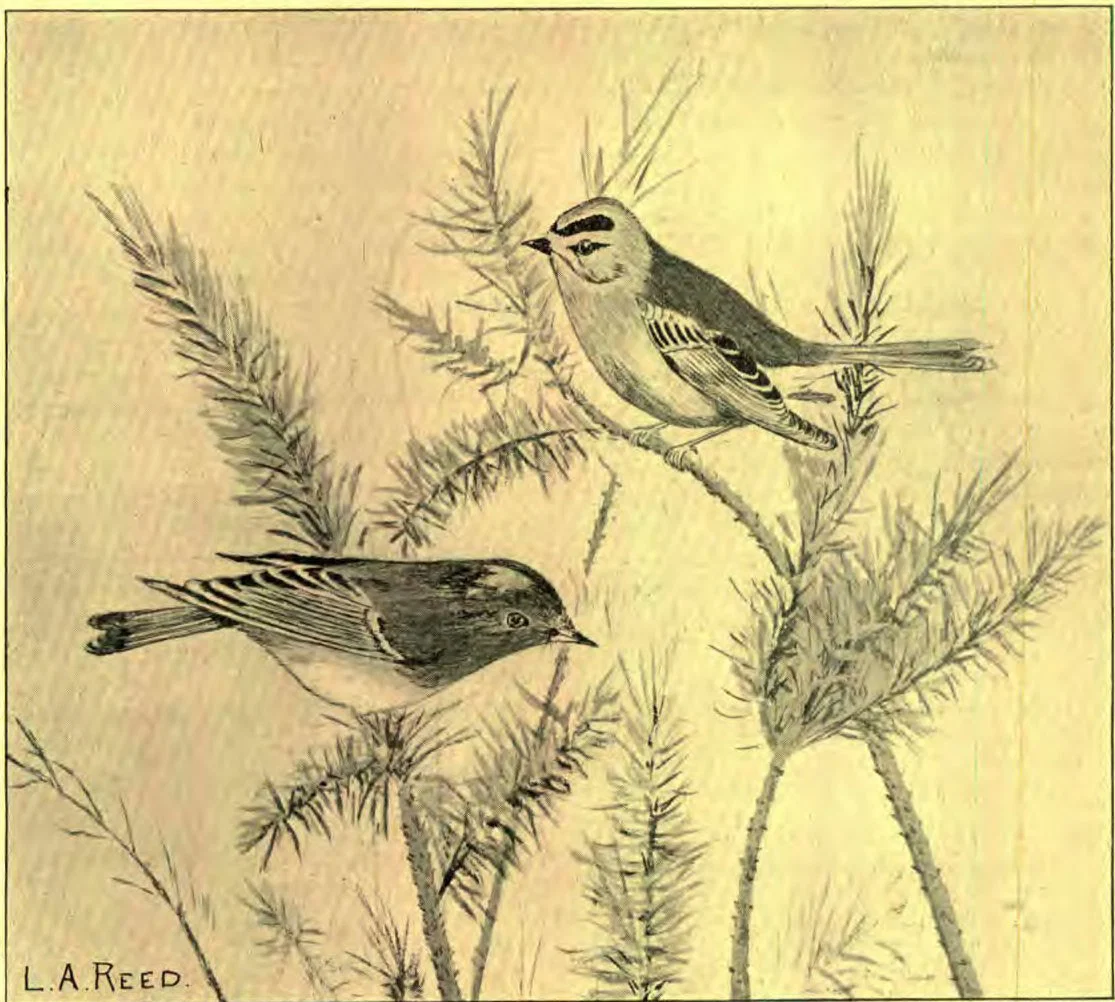
I was edging about to make my way home, when I discovered some trees by the roadside literally alive with tiny birds, which kept the air vibrating with their thin, warbling notes. They kept up a constant flit, flit; but I made out their colors to be about as follows: under parts whitish; upper parts olive-green; orange-colored spot on crown of head, with two black stripes. From descriptions I had previously read, I recognized the birds as Golden-crowned Kinglets.
A month or six weeks later I was visiting in Battle Creek. With some friends I had been out to a near-by lake for a picnic dinner, and later in the day was looking for birds. In the course of the afternoon I noticed several small, grayish, olive-green birds, which, from descriptions, I took to be Blue-gray Gnatcatchers. As I was puzzling over the identity of these little creatures, one of them turned his head so as to expose his crown to my view. Suddenly there was a flash of ruby-red as he raised his little crest, and I knew my bird for the Ruby-crowned Kinglet.
The Ruby-crowned Kinglet is a gifted and accomplished singer.
“The May morning,” says Professor Chapman, “when first I heard this Kinglet’s song is among the most memorable of my early ornithological experiences. The bird was in the tree-tops in the most impassable bit of woods near my home. The longer and more eagerly I followed the unseen singer, the greater the mystery became. It seemed impossible that a bird which I supposed was at least as large as a Bluebird could escape observation in the partly leaved trees. The song was mellow and flutelike, and loud enough to be heard several hundred yards,—an intricate warble past imitation or description, and rendered so admirably that I never hear it now without feeling an impulse to applaud. The bird is so small, the song so rich and full, that one is reminded of a chorister with the voice of an adult soprano.”
The Golden-crowned Kinglet, in summer, is not found in the United States except in the very northern portions. During this season he makes his home in the most northerly parts of the United States and still farther north, in Canada. He may be seen, however, any time in winter by residents of the Middle States, though he is more common at the time of migration, in October and April.
L. A. REED.

TWO LITTLE KINGS

THE largest bird in the United States is the California vulture, or condor, which measures, from tip to tip of its wings, nine feet and a half. At the other end of the scale are the hummingbirds, one kind of which, at least, has wings that are less than an inch and a half in length. Next to these insect-like midgets come the birds which have been well named in Latin “Regulus,” and in English “Kinglets,” that is to say, “little kings.” The fitness of the title comes first from their tiny size,—the chickadee is almost a giant in comparison,—and next from the fact that they wear patches of bright color (crowns) on their heads.
RUBY-CROWNED KINGLET GOLDEN-CROWNED KINGLET
Two species of kinglets are found at one season or another in nearly all parts of the country. They are known respectively as the golden-crown, or goldcrest, and the ruby-crown. The golden-crown has on the top of its head an orange or yellow patch (sometimes one, sometimes the other), bordered with black; the ruby-crown wears a very bright-red patch, though you may look at many specimens without finding it. Only part of the birds have it,—none but the adult males, perhaps,—and even those that have it do not always display it. The orange or yellow of the goldcrest, on the other hand, is worn by all the birds, and is never concealed. If you are a beginner in bird study, uncertain of your species, look for the black stripes on the crown. If they are not there, and the bird is really a kinglet, it must be a ruby-crown. You may know it also—from the goldcrest, I mean—by what looks like a light-colored ring round the eye. In fact, one of the ruby-crown’s most noticeable peculiarities is a certain bareheaded, large-eyed appearance.
The ruby-crown is famous as a singer—a genuine music-box, we may call him. In spring, especially, he is often bubbling over with melody, a rapid, wren-like tune, with sundry quirks and turns that are all his own; on the whole, decidedly original, with plenty of what musical people call accent, and a strongly marked rhythm, or swing. Over and over he goes with it, as if he could never have enough, beginning with quick, separate, almost guttural notes, and winding up with a “twittity, twittity, twittity,” which, once heard, is not likely to be soon forgotten.
A very pleasing vocalist he surely is, and when his extreme smallness is taken into account, he is fairly to be esteemed a musical prodigy. Every one who has written about the song, from Audubon down, has found it hard to say enough about it. Audubon goes so far as to say that it is as powerful as a canary’s, and much more varied and pleasing. That I must think an exaggeration,—natural enough, no doubt, under the circumstances, but still a stretching of the truth. However, I give but my own opinion. Let my readers hear the bird, and judge for themselves; they will enjoy him, whether or no. Every such new acquaintance that one makes is a new source of lifelong happiness.
The enormous California vulture is said to be almost dumb, having “no vocal apparatus,” and “emitting only a weak, hissing sound.” What a contrast between him and the ruby-crown,—a mere speck of a bird, but with a musical nature and the voice of an artist! Precious stuff, they say, comes in small packages. Even the youngest of us may have noticed that it is always the smaller birds that sing.
But if all the singers are small birds, it is not true that all small birds are singers. The golden-crowned kinglet, for example, is hardly to be classed under that head. What my readers will mostly hear from the goldcrest is no tune, but a hurried “zee, zee, zee,” repeated at intervals as he flits about the branches of a tree, or, less often, through the mazes of a piece of shrubbery. His activity is wonderful, and his motions are really as good as music. All you need is eyes to see him, but you will have to “look sharp.” Now he is there for an instant, snatching a morsel, or letting out a “zee, zee, zee.” Now he is yonder, resting upon the air, hovering against a tuft of pine needles, his wings all in a mist, they beat so swiftly. So through the tree he goes, and from one tree to another, till presently he is gone for good.
Once in a great while you may find him feeding among the dry leaves on the ground. Then you can really watch him, and had better make the most of your opportunity; or you may catch him exploring bushes or low savins, which is a chance almost as favorable. The great thing is to become familiar with his voice. With that help, you will find him ten times as often as without it. He is mostly a bird of the woods, and prefers evergreens, though he does not confine himself to them.
If you do not know him already, it will be a bright and memorable day, though it be the dead of winter, when you first see him, and are able to call him by his regal name, Regulus satrapa. It is a great pity that so common and lovely a creature, one of the beauties of the world, should be unseen by so many good people. It is true, as we say so often about other things, that they do not know what they miss; but they miss a great deal, notwithstanding.—Bradford Torrey, in S. S. Times.

WHAT GIRLS TALK ABOUT

“A word fitly spoken,” said Solomon the Wise, “is like apples of gold in baskets of silver.” Again, he declares, “Whoso keepeth his mouth and his tongue keepeth his soul from troubles.”
Do our girls ever think about the “word fitly spoken”? What do we talk about? Let me tell: About our clothes, other people’s clothes, what Lou said to Mary, what Mary said to Grace, what Will said, what Charlie said, how she looked, how he acted. On their way to school, in the cars, even in church, before service and after, at home, at the beach, wherever girls are, they start an endless chain of, “I said, he said, I said, she said, I said, I said, I said.” Isn’t this true? And, all the time, do we not feel in our hearts that this chitter-chatter is unworthy of us? that it wastes our time, weakens us, wearies us? Still—oh, the absurdity!—we keep at it with a zeal that would do credit to a useful enterprise, because, we say, “the other girls do it,” and we want to please them, and not seem odd. How often, in order to please them still more, we find ourselves enlarging on the bare outlines of the story, becoming sensational in our extravagance, all the time refusing to hear the voice of conscience, which tries to warn us that we are telling lies! Is it worth while to dull the edge of our conscience simply to entertain people?
Are you a Christian girl, and does your conversation consist of foolish gossip, the detailing of former illnesses, trivial anecdotes, the repetition of idle conversations, speculations upon the circumstances or the motives of other people? Then know that you are letting the powers of your soul go up in vapor. If all the hours that we girls have spent in vapid talk, were summed up to us, we should be appalled. We should realize that in the wasted time we might have read hundreds of noble volumes; that we might have set in order countless things which rise up to reprove us for our negligence; that we might have comforted the sick, covered the naked, held out sustaining hands to the falling. As Thomas à Kempis has it: “If thou wilt withdraw thyself from speaking vainly, and from gadding idly, as also from harkening after novelties and rumors, thou shalt find leisure enough and suitable for meditation on good things.” For, mark you, one of the deadliest results of our love of talk is the inability to be happy alone, or to find satisfaction in inward communion with God and nature.
I do not say these things because I want girls to pose, or mouth, or set themselves up for oracles of wisdom, declining to speak of anything except matters of national importance; but because I earnestly desire them to hesitate before they fall into the pit which has held so many good women. Our lives will be happier, and our spirits will have sweeter peace, if we go about our business resolutely refusing to stoop to thrash the old straw of what we used to do or say, or what other people have done or said. Untrammelled by such pettiness, our own thought and feeling will grow more worthy; and, unconsciously, we shall stimulate others to put forth their highest rather than their lowest.—Mina Stanwood, in the Well Spring.

THE SIGNS OF THE ZODIAC

THE word “zodiac” comes from a Greek word meaning “a little animal.” As far as is known, the idea of dividing the heavens into twelve equal parts, originated with the people of Mesopotamia, on observing that there are twelve full moons in successive parts of the year. This they made the starting-point for all their divisions of time. The year separated, naturally, into twelve parts; so they separated the day into twelve double parts, or “double hours.” And their great cosmical, or solar, period of forty-three thousand two hundred years was divided into twelve sars, each sar, month, and hour being represented on their solar chart of the zodiac in the space cast by the shadow of the sun as it passed over it. As far as can be ascertained, this system was original with the Chaldeans, and therefore it is from this people that we have received the zodiac, its divisions, and its names. The reason for the choice of some of the symbols used is apparent enough, but in many cases it is merely conjectural.
The bull occupies the first position, as the principal object of veneration and worship. The next sign controlled the period covered by the Babylonian first month, Nisan,—a month of sacrifice to Anu and Bel; hence it was represented by a ram, the typical offering.
The third month commemorated the building of the first city, and was generally typified by a pile of brick; afterward, the brothers Romulus and Remus, of Roman legend, were added to it, expressed by figures of two male children. The fourth, the crab, signified the retrograde movement of the sun, begun at that period. The fifth, the lion, the representative of fire, signified the culmination of the sun’s heat. The sixth commemorated the descent of Ishtar to Hades in search of her lost husband, Tammuz.
The meaning of the seventh sign is not so clear. The earlier Greek writers knew only eleven symbolic divisions of the zodiac, and hence carried the feet of the scorpion over two spaces, as they had only eleven symbols for the twelve spaces.
The balance, recognized in the eighth division in the Julian calendar, through the efforts of Sosigenes of Alexandria represented the equality of the day and night. The libra, or scales, has been traced back to Chaldea; and the rivalry between it and the scorpion was finally settled by placing the balance in the claws of the scorpion, so allowing the latter to have sway over both the seventh and eighth divisions. The scorpion denotes the decline of the sun’s power, and the consequent darkness after the autumnal equinox.
Sagittarius, symbolized later as a centaur, represented the god Mars. Capricornus, signifying the winter solstice, is represented by the nurse of the young solar god (son of Nimrod) of Oriental legends.
The tenth month, having the sign of the fish-tailed goat, bears a close resemblance to the sign Cipacti on the Mexican zodiac. The eleventh month was known anciently as the month of “want and rain,” and therefore is typified by the god Romman, crowned with a tiara, and pouring water from a vase. The deluge is closely associated in ancient legends with this symbol.
The symbol of the fishes typifies the resurrection from death, and the resumption of agriculture after the deluge. An Assyrian monument shows a corpse guarded by a pair of fishes. The double sign of the fishes represents the supplementary year of three hundred and sixty days, added in the Babylonian calendar by adding a thirteenth month once every six years.
W. S. CHAPMAN.

The Bluebird: A Poem of April

Winged lute that we call a bluebird, You blend in a silver strain The sound of the laughing waters, The sound of the spring’s sweet rain.
The voice of the wind, the sunshine, The fragrance of blossoming things,— Ah, you are a poem of April That God endowed with wings!
—Selected.

Hearing Is Not Listening

“HEARING is not listening. Good listening needs more than the ears; it needs the heart and the brain and the will. Attention and intention and comprehension are essential to listening. We listen to good purpose when we listen with interest and understanding.”

Christ's Rest Is Harmony, Not Torpor

THE world proposes rest by removal of the burden. The Redeemer gives rest by giving us the spirit and power to bear the burden. The rest of Christ is not that of torpor, but of harmony. It is not refusing the struggle, but conquering in it; not resting from duty, but finding rest in duty.—F. W. Robertson.

BECOMING A TRAP

God gives to some a pretty and attractive face, that they may be able to exhibit to the world a sample of his divine glory and beauty; for whatever is truly beautiful comes from him. But often that which should have been for their welfare becomes simply a snare to attract others to self, to stimulate vanity and encourage flattery; and thus the gift that was intrusted of God “to profit withal,” becomes a snare to the soul. Ps. 69:22. Some whom God could not trust with a beautiful face he has given the still greater gift of a beautiful character. To others has been intrusted the gift of song,—a power that is especially intended by the Giver to be used to draw men to Christ; but how often the possessor of such a gift degenerates to such an extent that he desires only the applause of men, and the thought of using his voice to inspire souls to a higher life is entirely lost sight of! In fact, some can not be led to use this gift for its original purpose unless there is a specified financial arrangement; in other words, they do not propose to “shut the doors for naught,” neither to kindle a fire on God’s altar for naught. Mal. 1:10. These wonderful gifts from God, and opportunities to glorify him, are valued simply at what they will bring in money; and thus they become a snare, a trap, to the soul.
DAVID PAULSON, M. D.

A WISH

What shall I wish for thee, friend, dear friend? What gift shall the all-wise Father send, With which not a trace of ill can blend, And ne'er a thing that harms? Shall I ask for thee heaps of silver and gold? Ah! under those piles so bright and so cold May lurk a demon who waits to enfold Thee in his cruel arms.
A place in the kingdom of fair renown? The heights of fame and a laurel crown? Alas! if its weight should drag thee down— Those heights by storms be riven!
Shall I wish thee a life all fair and bright, With little of sorrow and less of blight? The pleasures of earth oft hide from sight Diviner joys of heaven.
I know not, dear, what is best for thee; Mine eyes are holden; I can not see One step of the dim futurity That waits thy coming feet.
This only, then, will I dare to pray— That hourly, momently, day by day, Thou mayst be found in the narrow way That leads to bliss complete.
All needful blessings that path attend; The Guide is one who foresees the end, And knows that the way will surely wend Through gleaming gates of pearl.
VIOLA E. SMITH.

THE SMITH'S TREE

It was a member of the maple family, one of the fast-growing kind, and it grew in the Smiths' little back yard. It grew and it grew, until it cast shadows on six or eight back yards belonging to neighbors of the Smiths.
These neighbors had only praise for the tree during the summer months, when it protected the backs of their houses from the sun's glare; but when the leaves began to fall and litter the tiny grass plots, spotting the brick pavements with gold, these same neighbors voted the tree a nuisance.
“If I swep’ our pavement once yesterday, I swep’ it six times!” said Miss Polly Hornblower, in an aggrieved tone, as she gave her broom a dash against the board fence to clean it.
“I’ve just been cleanin’ out our hydrant dreen,” said Mrs. Rathburn, putting her hand to her back. “Leaves is awful for chokin’ up dreens!”
“I don’t see what the Smiths ever planted that tree for, anyhow,” put in Mrs. Melone, opening her gate on the opposite side of the alley. She also had a broom in her hand. “It keeps a body sweepin’ and pickin’ up, and pickin’ up and sweepin’, and the worst is you don’t know what to do with the leaves when they’re swept!”
Another woman joined the group, and another; and two new voices added further complaints against the tree.
Sewing in the back upper room of the house next door to the Smiths, Kitty McKray heard all that was said, through the screen in the open window. Kitty did not like an untidy back yard any better than her neighbors; but as she considered the situation to-day, it presented to her a humorous side, and she could not help laughing.
Looking out at the tree towering over the back wings of the houses, Kitty fancied that it might be laughing, too, as it swayed and shook in the October breeze, every now and then letting fall a leaf on the bare heads of the women in the alley.
“What’s the fun, Kitty?” asked Arthur McKray, looking into the room.
“Oh, only a council of women in the alley talking about the leaf nuisance,” said Kitty, still smiling. “It’s the usual autumn indignation meeting. I’ve heard it all before, though it never struck me until now that there was any fun in it.”
“Folks are a bit unreasonable,” said Arthur, falling into his sister’s mood. “What do the women expect the tree to do with its leaves?”
“Consume them in some mysterious way, I suppose.”
“What do the folks do with the leaves?”
“Some of them burn them in the heater. Others collect them in boxes for the ash man to carry away. It does make a good deal of extra work—that tree of the Smiths.”
Arthur McKray stepped to the window, and looked out at the little plot of grass with a garden strip round two sides of it, and a brick walk leading to the alley gate. The whole was plentifully sprinkled with leaves. “Your flowers didn’t seem to do well, this summer,” he commented.
“No; the soil is too poor. I ought to have bought more flower soil in the spring, or some fertilizer, or something. But, you know, those things cost.”
“Flower soil! Why, Kitty, ‘flower soil,’ as it is called, is—or ought to be—made largely out of rotted leaves. I used to help gather leaves for that purpose when I worked at the florist’s. Why not use the leaves you gather up in the yard for fertilizing the bit of garden?”
The young girl’s face lighted. “The very thing! I can make a hole in the corner of the yard, and put the leaves in as I sweep them up. Then I’ll cover them over with soil, and let them decompose at their own sweet will. I’ll do it, and convert our nuisance into a blessing for next year.”
With Arthur’s help, Kitty carried out her design, and the next summer her flowers did much better. But in the work of utilizing the fallen leaves, it occurred to them that, instead of fretting over other difficulties and trials, of greater significance, the wiser course would be to turn them to account for their own advantage. They saw that blessings and grievances are not unmixed—that the one often contains the elements of the other, and that even trouble may serve to nourish blossoms in the soul.—Selected.

THE GENTLE JAPANESE

“The Frenchman of the East,” the Japanese is called, because of his perfect manners and unfailing courtesy. London Truth gives this description of the training of the Tokio policemen—a training not in vogue on this side the Pacific:—
The Japanese policemen are taught to knock gently at the doors of houses before they enter. Under no circumstances are they to talk roughly.
“Rough talk intimidates the innocent, while the hardened criminal does not mind it.”
In executing search warrants they must not disturb sleeping children or invalids.
They must deal kindly with dogs belonging to strangers; hospitality is due to animals as well as to men.
No amusement must ever be shown at the mistakes of foreigners. Every effort must be made to impress strangers with Japanese politeness, and all people with the kindness as well as the justice of Japanese law.—Selected.

WASHINGTON

A HAND, a voice, a name, a mighty power, Arose in old Virginia long ago. That hand struck tyranny a fatal blow, And turned the light on freedom’s bursting flower; That voice was heard in fate’s decisive hour, And turned the nations in a ceaseless flow; That name fills history with prismic glow, And makes the ghost of foul oppression cower; That power—whence came it?—On his bended knees He drew his inspiration from on high. He conquered, and the thrill went through all lands! So freedom’s flag floats proudly on the breeze; The name of Washington will never die While faith like his makes strong heroic hands.
B. F. M. Sours.

A Single Sunbeam Drives Away Shadows

“A SINGLE sunbeam is enough to drive away many shadows.”

NEW JAPAN

II
You remember that in the seventeenth century the Japanese thought they had wiped out Christianity from their land,—such a beautiful land, with its mountains, lovely flowers, and grand trees, its superb landscapes and wonderful seascapes. Wasn’t it a pity they did not look from “nature up to nature’s God,” and worship the Creator as their Heavenly Father? But they worshiped rather the things that he had made instead of him. When you look at a beautiful picture or statue or building, do you not think of the grand mind that thought it out, and the skillful hand that copied the thought, and made it possible for others to enjoy it? So the mountains and seas, the sunshine and flowers and birds, should show us God’s power and love.
Well, it was not convenient for the rest of the world to have Japan a “hermit nation;” so Commodore Perry sailed over there from the United States, and said to these people: “You must open up your country. You must let foreigners enter it, and let Japanese go abroad, and see what is being done in the big, round world. You must wake up!”
The men who talked the matter over with him were much pleased with his courtesy, kindness, and firmness. It always pays to be polite. They said: “If this man is a barbarian, we, too, would better be barbarians.”
The result of all this was that parts of the Island Empire were thrown open to foreigners, and they could go to almost any other part by using a passport.
In 1859 Christian work began again. It went very slowly at first. The people had not forgotten those bloody days when the very name of Jesus would make one grow pale. At every cross-road there were great signs up, saying that any one who became a Christian must pay the penalty with his head. Many military men, called samurai, who wore two swords, a long one to cut down their enemies, and a short one with which to commit suicide if desirable, stalked about the streets, looking very grim and terrible, and frowning at all the “foreign barbarians.” The missionaries had to stay closely at home. It was hard to get teachers, too: every one was afraid to do anything for the foreigners, for fear he might be thought to favor their hated religion. Up to 1872 only ten Japanese had dared become Christians. But there was plenty of work for the missionaries to do meanwhile. They had to make grammars and dictionaries of the language, and translate the Bible.
But the work moved so slowly that finally the missionaries were almost discouraged. Then they held a great prayer-meeting. Many Japanese met with them, and prayed, with tears rolling down their faces, that God would open the hearts of their people. Soon a church was established; and in the ten years following, over ninety other churches were organized, and nearly five thousand Japanese became Christians. Since then the work has grown steadily till now there are over forty thousand Christians in Japan.
LAURA DE LANY GARST.

THE FIFTH KINGDOM

In our last Bible study we learned, from the great image of Daniel 2, that the time will come when the kingdom of our Lord Jesus Christ will supersede the kingdoms of this earth. The Saviour said, “Blessed are the meek: for they shall inherit the earth;” and in Isa. 45:18 we learn that the Lord “formed the earth and made it; he hath established it, he created it not in vain, he formed it to be inhabited.” In the present condition of sickness, death, and the oppression of God’s people, we can not say that the time has come when the meek inherit very much of this earth’s estate. No; we are all pilgrims and strangers, dwelling as in a strange land. And when we remember how small a portion of this earth’s surface is really inhabitable at the present time, we know that the fulfillment of these promises must be in the future.
Peter tells us that before the earth is given back to the children of men, it will be thoroughly purified by the fires of the last days, which will cause it to melt with fervent heat, and that the works that are therein shall be burned up. 2 Peter 3:10. But he also says, in verse 13, “Nevertheless we, according to his promise, look for new heavens and a new earth, wherein dwelleth righteousness.”
The fulfillment of this promise, as all can readily understand, must be yet in the future. This earth is still under the control of human governments, but the time will come when the servants of the Most High will take the kingdom, and possess it forever and ever. Then shall the desert blossom as the rose; then shall the eyes of the blind be opened, and the ears of the deaf unstopped; then shall the lame man leap as an hart, and the tongue of the dumb sing; for in the wilderness shall waters break out, and streams in the desert. Read all of Isaiah 35.
In Isa. 35:21–25 we read of the righteous that “they shall build houses, and inhabit them; and they shall plant vineyards, and eat the fruit of them. They shall not build and another inhabit; they shall not plant and another eat.” The redeemed will have employment—not wearisome labor, but refreshing, invigorating exercise. We know that when God first placed Adam and Eve in the garden of Eden, their work was to dress and keep the garden; in other words, they were to train and care for the plants, vines, and flowers. It was not until after they sinned, that they were compelled to earn their bread by tiresome exertion: so in the earth made new, our work will be pleasant employment.
We are also told in these same verses of the animals that will be there,—not the fierce, destructive beasts that sin has made; but mild, gentle, frolicsome pets, such as God made the animals in the beginning. “The wolf and the lamb shall feed together, and the lion shall eat straw like the bullock: and dust shall be the serpent’s meat”—not the loathsome reptile we now have, but the serpent as it was in the beginning, the most beautiful of all the animals that God had created. Again, in Isaiah 11:6–9, we are told that “the wolf also shall dwell with the lamb, and the leopard shall lie down with the kid; and the calf and the young lion and the fatling together; and a little child shall lead them. And the cow and the bear shall feed; their young ones shall lie down together; and the lion shall eat straw like the ox. And the sucking child shall play on the hole of the asp; and the weaned child shall put his hand on the adder’s [margin] den. They shall not hurt nor destroy in all my holy mountain: for the earth shall be full of the knowledge of the Lord, as the waters cover the sea.”
Who does not want to be there? Every one of us may be there. God excludes none. It is our sins that separate between us and God. He wants to save us. He wants to give us a home in the earth made new. He wants us to possess one of those lovely mansions that our Saviour has gone to prepare for his children in the heavenly Jerusalem,—the city that will come down to earth, and become the capital of the new dominion. Rev. 21:2–4. Then “from one new moon to another, and from one Sabbath to another shall all flesh come to worship before me, saith the Lord.” Isa. 66:23.
OTHO C. GODSMARK.

WHAT MUST I DO NOT TO BACKSLIDE?

II

4. Spiritual Exercise.—“Work out your own salvation with fear and trembling.” In order to grow physically and prevent disease, it is necessary that our physical powers be in constant use. So it is spiritually: in order to “grow in grace, and in the knowledge of our Lord and Saviour Jesus Christ,” and to prevent the encroachments of spiritual disease, it is necessary that the soul—the spiritual faculties—shall be constantly exercised. This means that we must put forth daily effort to help others. The effort we make to assist our suffering fellow men constitutes our spiritual exercise; and when we neglect regular moral exercise, we grow weak spiritually, and often lose our spiritual appetite as well. The less we work for others, the less we shall enjoy reading the Bible, and the less we shall pray; for active work is not only productive of a good appetite, but also of deeper and better breathing, or prayer. And so the more we work for others spiritually, the more we shall enjoy reading the Bible, the more good we shall get out of its study, and the more we shall engage in earnest prayer.
5. Spiritual Sight.—It is when the soul is engaged in the daily study of the Bible, walking in the Spirit, and putting forth earnest effort to help others, that the spiritual sight is clearest, and the moral discernment best, thus enabling us to discern the devices of the enemy and to detect the snares of evil. “Lest Satan should get an advantage of us: for we are not ignorant of his devices.”
Failure to work, pray, and study God’s word, produces a condition of spiritual blindness, in which we are easily and quickly led into the enemy’s snare. The soul that would avoid the snare of backsliding must, by conscientious attention to its spiritual habits, maintain clear spiritual vision,—good moral eyesight. “But the natural man receiveth not the things of the Spirit of God: for they are foolishness unto him: neither can he know them, because they are spiritually discerned.” 1 Cor. 2:14, 15.
6. Spiritual Healing.—The soul that has begun to backslide, sometimes thinks that the Lord’s ears are dull, that he can not hear; but this is a mistake. “Behold the Lord’s hand is not shortened, that it can not save; neither his ear heavy, that it can not hear.” It is our spiritual hearing that has grown dull as the result of our inattention to the habits that govern the health and growth of the soul. The still, small voice, once so easily heard, the backslider is unable to recognize, and so he passes heedlessly on to destruction. If we would avoid this disaster, we must look to it that the ears of the soul are ever open, and that we do not allow spiritual deafness to settle down upon us. “Speak, Lord, for thy servant heareth,” should ever be the attitude of the Christian.
7. Spiritual Associates.—Having done all in our power to acquire the habits of soul that are conducive to spiritual health, let us make sure that we surround ourselves with those moral influences that will favor our spiritual growth. However conscientious you may be in your Bible study, prayer, etc., if you associate habitually with those who are not spiritually minded, it is only a question of time when Satan will number you among the backsliders. It is written that the children of God “spake often one to another.” We are exhorted to “come out from among them, and be separate.” Although we are in the world, we should not be of the world. Worldly associations will, sooner or later, neutralize all the good the soul can gain from every source.

SUGGESTIONS FOR SPIRITUAL HEALTH AND GROWTH

1. We should live a life of prayer. In addition to having regular and stated intervals for prayer, our souls should ever be in an attitude of prayer, constantly seeking the will of God in place of the will of self. Acts 10:2.
2. We should study the Bible daily, making sure that its principles and truths find their way to our hearts, and become a part of the character, not simply retained as a theory in the mind. Acts 17:11.
3. We should endeavor to live momentarily in the Spirit, having our souls watered by his refreshing influence, and cheered by his heavenly presence. Instead of grieving the Spirit, our attitude should be that of constantly receiving the Spirit. Eph. 4:30; John 20:22.
4. We should never allow a day to pass without making some definite effort to help others. This active work brings a moral strength not secured in any other way. Energetic personal effort is one of the best things to prevent backsliding. Eccl. 9:10.
5. We should ever keep our eyes fixed on Jesus. The eye of faith, kept on Christ, will not grow dim. The moral discernment of the one who constantly beholds Jesus, will be clear and sharp and penetrating. Heb. 12:2.
6. We should conscientiously cultivate obedience to the voice of conscience, yielding instant and unquestioning obedience to the first warning of the still, small voice within. Avoid spiritual deafness and hardness of heart, which result from yielding to temptations and compromising truth. 1 Sam. 15:22.
7. While we are to work for the worldly minded and unconverted, we are to associate with the spiritually minded, those of like precious faith. This is a point on which Satan makes special effort to entrap Christian young men and young women. John 17:15, 16.
W. S. SADLER.
1926 Wabash Ave., Chicago.

God's Keeping: Committing Our Thoughts to Him

THERE is no other keeping like God's. If we commit to him the keeping of our thoughts, he will guard them for us. It was a prayer of Fenelon's: “Take me, O Lord, for I can not give myself to thee. And when thou hast me, oh, keep me, for I can not keep my own life.” We must let God keep us, or we can not be kept.—M. C. Hazard, in the Well Spring.
Continue reading: THE WILLOW TREE