The Youth’s Instructor, Vol. 49, No. 13.

KINGLETS
Earlier text: KINGLETS

THE WILLOW TREE

The willow is the earliest of the smaller trees, except the hazel, to tell us that spring is coming. It begins to get ready in the autumn. Then the buds swell, and often burst, so that you can see the tufts of white silk peeping out, as if the flowers were in such a hurry they could not wait till spring. All the long winter they are growing.
Willows are of all sizes; some are tall trees, thirty or forty feet high, and some are very small. They are not confined to temperate climates. Those who have studied these graceful trees for many years are still puzzled by them. They plant them in gardens, all the kinds they can find, so that they may watch and compare them more closely.
One kind is always found by the water-side, bending over the still, slow stream. It is called the “white willow,” because its leaves are covered on both sides with soft, white silk. They are two or three inches long, narrow and pointed. This and another species called the “crack willow” are the only ones that are large trees. The leaves of the latter are like those of the white willow in shape; but on the upper side they are bright-green, with no silky covering. It is called the crack willow because its branches crack and break at the joints so easily. Give them just a little blow, and they snap at once. This is the common willow which grows most frequently in our gardens or by the roadside. The trees are generally very crooked. Their trunks split and bend; and sometimes, when near a stream, they stretch over it, as if they wished to make a bridge across. Some people think this spoils their beauty; but who would want all trees alike?
The rapid growth of the willow tree is referred to in the Bible. “They shall spring up . . . as willows by the water-courses,” is said of the children of God’s people.
There is another willow called the “osier.” It has long, slender arms, which are used for making baskets. If you try to break off one of these arms that look so very fragile, you may tug away in vain, it is so tough. You can bend these slender shoots as much as you like, and still they will not snap; and for this reason they are just the thing for weaving into light baskets.
The quick and vigorous growth of the willow renders it easy to provide material for basket-making, an industry which has been in vogue since the earliest times. It is very easy work, and is a valuable resource to the blind, and is practiced in all institutions for them. The little boat called a “coracle,” in which the ancient Briton paddled down some of his rivers, and which he could carry on his shoulders, was of basket-work. These boats had to be covered with skins to make them waterproof. Shields were also made of willow wands, and were much lighter and easier to carry than any other kind.
Another shrub, or little tree that is well known is called the “goat willow,” and it grows in hedges everywhere. It has purplish-brown branches, and from it you probably gather your first pussy willows. It flowers with the snow-drops, even while it is still winter, in cold February or March. The leaves of the goat willow are broad and thick and crumpled. Their edges are often rolled under, and they are lined with a thick coat of gray down. So you see that even all the trees of one family are not dressed alike.
The bark of the willow tree, and also the leaves, are used in tanning and for medicine.
If you see a hole in the trunk of a willow, through which you can put your finger, you may know it is the home of the goat-moth. When full grown, this moth is three inches long, and is very ugly to look at. His back is the color of raw beef, and the under part of his body is yellow. He has a disagreeable odor, like that of a goat, from which he is named. He has very strong jaws, and constantly gnaws away at the heart of the tree, eating the wood. When he is three years old,—a very great age for a caterpillar,—he weaves himself a chamber of wood, chips, and silk, and goes to rest. After a few months’ sleep he wakes up a large moth, but he is so shy that he flies about only at night.
Sometimes in the winter you may find under the willow bark hundreds of wee, shining insects, blue and green, called “willow bugs.”
It is said that a piece of willow may be cut off anywhere, and put in the ground, either end up, and it will take root, and grow into a tree. If a gardener ties his plants to roots cut off the willow, these often sprout and take root themselves, as if they could not be satisfied with helping others to grow.—Selected.

PUSSY-WILLOWS

A soft, gray sky, with a hint of blue, A wistful wind a-blowing, And hemlocks, whitened here and there With flakes of last night’s snowing; The yellow grasses bow and bend— Poor withered things! left over From summer’s happy revelings With honey-bees and clover.
It is the hopeless time of year, When all the world is weary Of waiting through the winter months, So long and cold and dreary; But nature, smiling to herself, A secret safe is keeping; She knows her children are not dead, But only softly sleeping.
She knows the thrilling flood of life Within the forest welling, And sees the branches blushing red With longing to be telling; She feels the mayflowers lift their heads From off their mossy pillows; And now the smallest tree has told, For here are pussy-willows!
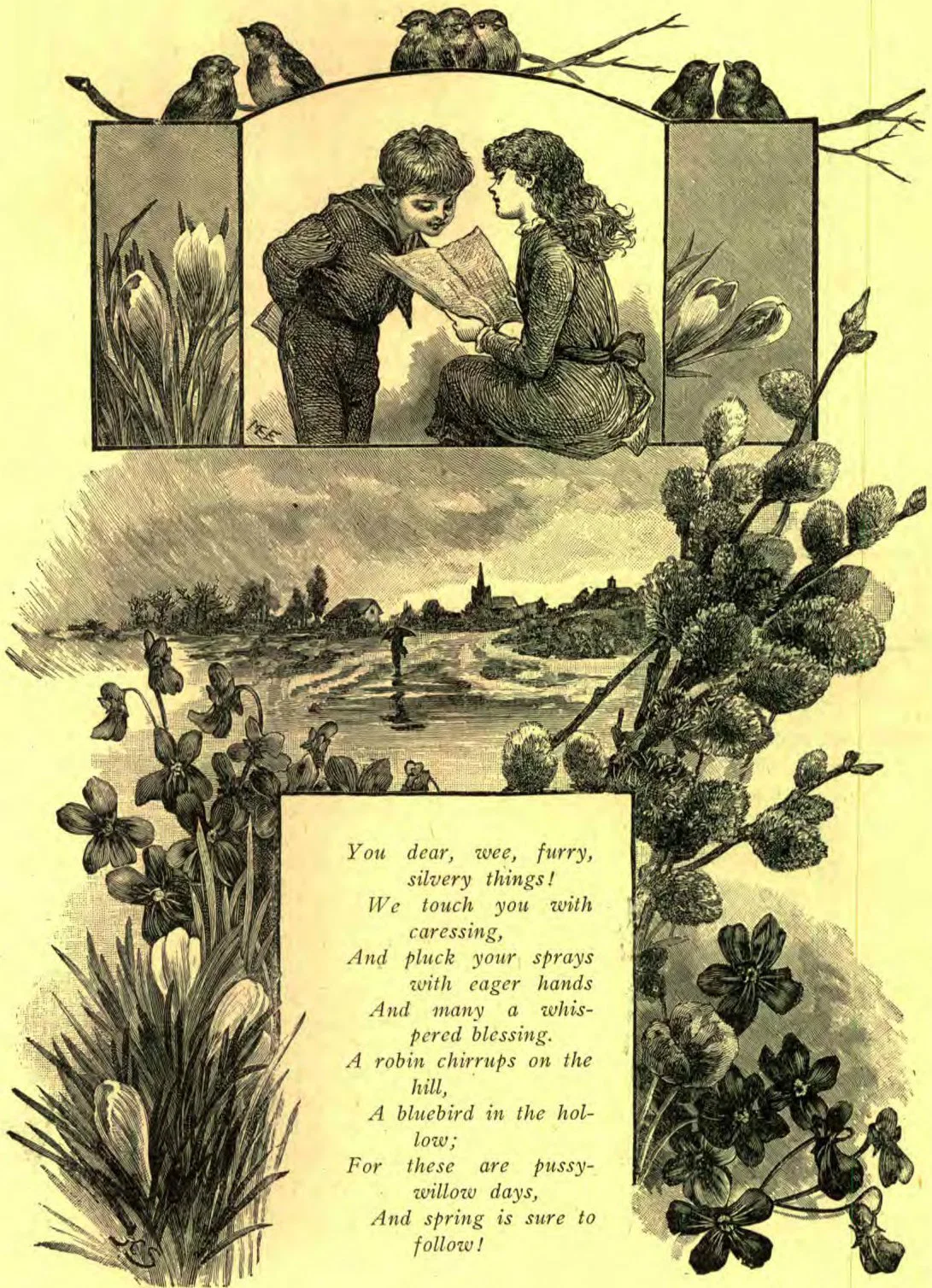
You dear, wee, furry, silvery things! We touch you with caressing, And pluck your sprays with eager hands And many a whispered blessing. A robin chirrups on the hill, A bluebird in the hollow; For these are pussy-willow days, And spring is sure to follow!
— E. K. Stevens.

Pussy Willow Days

You dear, wee, furry, silvery things! We touch you with caressing, And pluck your sprays with eager hands And many a whispered blessing. A robin chirrups on the hill, A bluebird in the hollow; For these are pussy-willow days, And spring is sure to follow!

PREPARATION OF CHRIST FOR THE PRIESTHOOD

(April 6, 1901)
MEMORY VERSE.—Heb. 2:17.

QUESTIONS

1. Before Jesus came into this world to live, by what name was he known in heaven? What great work had been performed, by him? Heb. 1:10.
2. How low a place did he take when he came to dwell with men? Heb. 2:9; 2 Cor. 5:21; note 1.
3. What is he now pleased to call people here on earth? Heb. 2:11, 12; note 2.
4. By taking sinful flesh and blood, what would Jesus be able to do to Satan? And what for the children of men? Vs. 14, 15.
5. In how many things did he become like the sinful people of the earth? Why? Vs. 17, 18; note 3.
6. To be a perfect priest for men, what was it necessary for Jesus to learn? Heb. 5:8–10.
7. How terrible were his sufferings in overcoming sin? Heb. 12:3, 4; note 4.
8. At what particular time did he thus suffer? Luke 22:44.
9. Why was he willing to endure such agony? Note 5.
10. In how many things did Jesus suffer temptation? In what way? Heb. 4:15; note 6.
11. When he had taken, in every possible way, the place of sinful men, how must he be treated? Isa. 53:5.
12. As Jesus saw what he could accomplish for the world, how did he feel concerning the trials and sufferings? Ps. 40:7, 8; Heb. 12:2; note 5.

NOTES

1. The place which Jesus had in heaven, and the wonderful glory and power which he there enjoyed, we shall never be able to understand until we go to live with him. He was the great Commander of all the angelic hosts, who bowed before him in worship and praise, and it was to him that all the inhabitants of other worlds brought their offerings of prayer and song. It was Jesus who had made the worlds, and who held all things in their places, both in heaven and in earth. But though he was so great, so glorious, and so much loved, he could not be satisfied while he saw his people here on earth lost. So there came a day when his place in heaven was empty, and he appeared on earth as a little babe. We can not understand how it could be so, but it is true that Jesus took upon himself sinful flesh (Rom. 8:3); that is, flesh full of sin. The Bible says that he was “made to be sin for us.” Just as children of to-day are born with their parents’ sinful tendencies, so it was with Jesus.
2. There are wonderful lessons for us in the story of the coming of Jesus to the world. And one of these is that he is willing, glad, yes, even anxious to call us “brethren.” He is “not ashamed” to call sinful persons his brethren, whether they be great or small, rich or poor, young or old, learned or ignorant, good or bad. He is the great Brother of all who need help. And he loves his brethren. If Jesus loves one more than another, it is he who is farthest from God, who has sunk lowest in sin. Do you sometimes feel that you are the most sinful person on earth? If that should be true, you need not be discouraged; for you are therefore the one whom Jesus loves. In a special sense you are his brother, and he will lift you up.
3. Jesus was made like us in “all things.” He took all our weaknesses, all our sorrows, all our temptations, so that he might know just how to help us in all our experiences. And because he has known every part of life, we have confidence in his ability. When he speaks to us, we may know that he is not talking a theory which he has not proved. Because he took all, he knows how to help all.
4. The work of Jesus on earth was to fit him for his work for us in the sanctuary in heaven. As our friend in heaven, he must know all that we have to pass through on earth. He saw that some could not get to heaven without terrible battles with Satan. He saw those who would have to pass through the time of trouble, and in order to be able to guide and keep them in that awful time, he suffered all that they will need to suffer. While Jesus was in Gethsemane and on the cross, it seemed to him that he was forsaken of his Father, and all was darkness and gloom; so those who live on the earth while the plagues are falling, will have the feeling that God has left them to perish. But Jesus has been over the path before them, and he will deliver them.
5. Jesus was willing to endure all the afflictions and temptations which came to him, because he saw that the experience was fitting him to help others. He was learning how to be a priest for us. He found joy in traveling the thorny path; for he saw that by so doing he would be able to travel it again in company with those who would live after him. He traveled the road once alone; now he travels it together with us.
6. The temptations that came to Jesus were just such temptations as come to all his people in all time and in all the world. So it makes no difference where we live, when we live, nor who we are, whether young or old; we may know that Jesus has conquered these same temptations that we have to meet, and is willing and able to help us gain the victory over them. Sometimes our earthly friends are not patient with our faults and failures: they have never passed through just our experience, and therefore they do not understand our need. But Jesus, our High Priest, having felt all our weaknesses while he lived on earth, sympathizes with us, and tenderly helps us in all our trials. He says to all, “Be of good cheer; I have overcome the world.”

BEREAN LIBRARY STUDY

Revelation 17: “Thoughts on the Revelation,” Pages 657-662
  • (March 31 to April 6) *
NOTICE the one who presents this view to the prophet, and the object of presenting it. John had just beheld the seven angels pour out the seven last plagues upon the wicked; and now one of these very angels comes and talks with him. The angel gives him a view of the character of the mystery of iniquity, upon whom the plagues had fallen so heavily. After beholding the true character of the harlot mother, John could better appreciate the mercy and justice of God in pouring out the plagues.
Mother of Harlots.—A family is here brought to view. The father, the devil, is not mentioned; but the family resemblance is so strong that a glance at the children reveals the father. In no family is any one child an exact representation of the mother. Each child has its own individuality, yet the resemblance is such that one recognizes the parent by the looks and actions of the child; so in Babylon’s daughters—no one is exactly like the mother, but every daughter holds some family trait or custom, by which the family tie is shown. In one we find infant baptism; in another, saint-worship; and in yet another, the immortality of the soul. But the regard for Sunday, the strongest family trait, is seen in all the members of the family.
Woman Drunken with Blood.—One loves and craves drink, in order that he may take sufficient to make him drunken. If the taste of liquor is distasteful to an individual, he will never become a drunkard. The woman loves the taste of the blood of the martyrs; she revels in it, and becomes drunken. No wonder the prophet marveled. It is truly a marvel that any church called Christian could ever take delight in shedding the blood of the followers of Christ.
The Woman the City.—The woman is that great city, which the prophet saw under the seventh plague divided into three parts, corresponding to the dragon, the beast, and the false prophet of Rev. 16:13. While paganism, Catholicism, and apostate Protestantism stand seemingly separate, they are all bound into one family. All have “one mind” in regard to the worship of Sunday, and all unite in enforcing Sunday laws.
The Ten Horns Have One Mind.—The ten horns correspond to the ten horns of the fourth beast of Daniel 7, also with the clay and iron and ten toes of the image of Daniel 2. They represent the different nations on the earth at the time of the end. They will all be united upon some point; for as the prophet saw them, he said, “These have one mind.” It is a new thing in the world’s history for different leading nations, while they are preparing for war, and fighting among themselves, to be so united upon one point that they can be said to be of “one mind.” In “Great Controversy,” Vol. IV, page 635, we find the following words: “When the protection of human laws shall be withdrawn from those who honor the law of God, there will be in different lands a simultaneous movement for their destruction. As the time appointed in the decree draws near, the people will conspire to root out the hated sect. It will be determined to strike in one night a decisive blow, which shall utterly silence the voice of dissent and reproof.” The nations all over the earth will have “one mind” on the subject of disposing of Sabbath-keepers. There will be a simultaneous movement in different lands.

LEAST FIRST

“Do you suppose,” said Johnny, as his little cousin laid away her largest, rosiest apple for a sick girl, “that God cares about such little things as we do? He is too busy caring for the big folks to notice us much.”
Winnie shook her head, and pointed to mother, who had just lifted baby from his crib. “Do you think,” she said, “mother is so busy with the big folks that she forgets the little ones? She thinks of baby first, ’cause he’s the littlest. Surely God knows how to love as well as mother.”—Selected.

King Conscience

King Conscience built a city strong, And walled it round about, And on its ramparts placed a throng Of soldiers, stanch and stout; And never may a foe invade To make this noble king afraid.
For kings have reigned, and kings have died, And nations come and go; But still King Conscience, true and tried, Is young and strong; and so His loyal city has not known Another king upon its throne.
Old Kings Deceit, and Brag, and Fear Are boastful kings and small; They build new castles every year, And every year they fall; But Conscience City shall endure, Because it has foundations sure.
—Frank Wolcott Hutt.

Letter Box Letters from Young Readers

In writing to the Letter Box, try to tell something that would interest you if some other boy or girl had written it. And in describing something that other people do not often see, be very careful to tell about it so plainly that they will be able to see it just as it appears to you:—
SOUTH MONTEREY, MICH. DEAR YOUTH’S INSTRUCTOR: The other morning papa and I were looking outdoors, and we saw a mourning-dove; but when my brother stepped to the door, it flew away. These doves stay around the barn, and feed on a stack of chaff near by. I am nine years old, and am in the third grade at school. BERTIE FRANK.
LEBECK, MO. DEAR YOUTH’S INSTRUCTOR: I am eleven years old, and have a sister who is eighteen. I have also two brothers who live in another county. One of them, with his family, is coming to live with us. He has a little boy four years old. I shall be so glad to see him, and will let him ride my horse Dike. Papa says he will try to let me take the INSTRUCTOR, for it is good reading, and I want to be a good girl. EUNICE FLOYD.
KENNEDY, N. Y. DEAR YOUTH’S INSTRUCTOR: The other day I was in a repair shop, and saw a man “gum” a saw. First he took the saw-teeth out of the frame, and then held them against an emery-wheel, which cut the steel. When the saw was held against the turning wheel, there was a row of bright sparks of fire. In this shop there were also a turning-lathe, a planing-machine, and a machine for making shingles. I was very much interested in them all. FLOYD E. BOWEN.
LE ROY, ILL. DEAR YOUTH’S INSTRUCTOR: I have taken the INSTRUCTOR four years, and enjoy it very much. There is no Seventh-day Adventist church nearer than Bloomington, a distance of eighteen miles, so I do not attend church service very often. We live in the country, and the schoolhouse is just across the road. I took the central examination a year ago, ranking first in a class of five; but I have not been to school since, for the very next day my mother ran a nail into her finger, resulting in blood-poisoning. So I had to take care of her, and help her. I am fifteen years old. CLIO V. BRANAMAN.
SAN FERNANDO, CHILE, Jan. 17, 1901. DEAR YOUTH’S INSTRUCTOR: I am very glad of having the opportunity to write you, and tell you that I have gathered many precious truths from your pages. I am sixteen years old, and in our Sabbath-school I belong to the youth’s division. I love the Lord because he first loved me, and I am determined, his grace assisting, to go forward. My mother and my youngest sister are also in the truth, and rejoice in it. We need your prayers that we may be kept every day. The work here is going forward, though there is much opposition. Hoping to meet all the readers of the INSTRUCTOR when the Master comes, I am, Your sister, DOROTHY GILTENS.

SELF-PRONOUNCING S.S. Teachers' Reference Bible
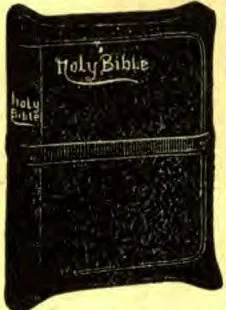
Contains the Celebrated Teachers' Helps,
Comprising nearly 400 pages. Also a complete series of fifteen new maps.

DESCRIPTION

Imperial Seal Binding, Tuck Edges, known as “Divinity Circuit,” Rounded Corners, Full Red Under Gilt Edges.
We offer this Bible, postpaid, for only six new yearly subscriptions at 75 cents; or twelve new six months' subscriptions at 40 cents.
We will also send it, postpaid, with the INSTRUCTOR one year for $2.25. For 20 cents extra we will stamp your name in gold upon the cover. Address—
THE YOUTH'S INSTRUCTOR, Battle Creek, Mich.

Best Stories FROM THE Best Book

since its publication, has met with a most gratifying reception. It grows in favor day by day. Everyone is delighted with the book upon first sight, but the more thoroughly they become acquainted with it, the more they realize its inestimable value. We know it is appreciated from the many kind words our friends have to say concerning it.

AN EXCELLENT HELP FOR CANVASSERS

Paw Paw, Mich.
The truths presented in “Best Stories” certainly make it a work that can not fail to bring much-needed light to many who have been reading the Bible for years. It is an excellent help for our canvassers.
GEO. MATTESON.

A READY SELLER

Elliott, Penn.
I like “Best Stories” very much. It is a ready seller, and an excellent book for young persons to sell.
F. E. PAINTER.
Pennsylvania State Agent.

AN INSPIRATION TO THE CHILDREN

SOUTH LANCASTER ACADEMY, SOUTH LANCASTER, MASS.
I find “Best Stories” very attractive to the children, as the illustrations are so beautiful, and the story so simply and impressively told. We are using it as a reader for beginners, with much enthusiasm and inspiration on their part.
SUSIE SISLEY.
This is just the book for children and young people to sell. It is a beautiful book, pleasing to the eye, and contains many fine illustrations. The fifty pages of “Easy Lessons” are a drawing feature of the work. It is a volume of which the children never tire.
Heavy paper, cloth back covers...........75c Heavy paper, board covers.................50c Thin paper, edition, limp paper covers....25c
For particulars, address your—
Tract Society; the Review and Herald Pub. Co., Battle Creek, Mich.; or the Pacific Press Pub. Co., Oakland, Cal.

Subscription Renewal Notice for April 1901

APRIL, 1901

IF the yellow address-label on first page of this paper, or on the wrapper, bears this month and year (John Brown), it indicates that the following blank should be filled out by you now, and mailed to the Review and Herald, Battle Creek, Mich., before the end of this month:—
Name, ................................................
Post-office, ................................................
Street, ................................................
County, ................................................
State, ................................................
Inclosed find $...... (money-order, express order, registered letter, or bank draft), for which please send...copies of the YOUTH'S INSTRUCTOR ....months to above address.
P. S.—If you object to clipping this out of your paper, or wish to forward other subscriptions, please write names and full addresses on a separate sheet, stating amount inclosed for that purpose.

Our Premium Testament

As an aid to daily Bible study, and to memorizing the Scriptures, there is nothing better than a pocket-edition. We have secured a beautiful Vest-pocket New Testament, size 4 x 2¾ in., that we offer, postpaid, with the INSTRUCTOR one year, for only $1.00. Well printed, in ruby type, as shown; Flexible Covers, Round Corners, Red under Gold Edges,—a splendid little book.

St. Matthew, 13.

42 The queen of the south shall rise up in the judgment with this generation, and shall condemn it: for she came from the uttermost parts of the earth to hear the wisdom of Solomon; and, behold, a greater than Solomon is here. 43 When the unclean spirit is gone out of a man, he walketh through dry places, seeking rest, and findeth none. 44 Then he saith, I will return into my house from whence I came out; and when he is come, he findeth it empty, swept, and garnished. 45 Then goeth he, and taketh
50 For whosoever shall do the will of my Father which is in heaven, the same is my brother, and sister, and mother.

CHAPTER 13.

3 The parable of the sower and the seed; 18 the exposition. 24 The parable of the tares, 31 of the mustard seed, 33 of the leaven, 44 of the hidden treasure, 45 of the pearl, 47 of the dragnet. 53 Christ is commended of his own countrymen.
1 The same day went Jesus out of the house, and sat by the sea side. 2 And great multitudes were gathered together unto him, so that he went into a ship, and sat; and the whole multitude stood on the shore.
This offer is made to both renewals and new subscribers. Address—
THE YOUTH’S INSTRUCTOR,
BATTLE CREEK, MICH

GRAND TRUNK RY. SYSTEM.

Taking Effect Dec. 16, 1900.
Trains leave Battle Creek.

WEST-BOUND

No. 9, Mail and Express, to Chicago. 12.15 P. M. No. 1, Chicago Express, to Chicago. 8.30 A. M. No. 3, Lehigh Valley Express, to Chicago. 3.50 P. M. No. 5, International Express. 2.17 A. M. No. 75, Mixed, to South Bend. 8.30 A. M. Nos. 9 and 75, daily, except Sunday. Nos. 1, 3, and 5, daily.

EAST-BOUND

No. 8, Mail and Express, East and Detroit. 3.45 P. M. No. 4, Lehigh Express, East and Canada. 8.22 P. M. No. 6, Atlantic Express, East and Detroit. 2.10 A. M. No. 2, Express, East and Detroit. 6.50 A. M. No. 74, Mixed (starts from Nichols yard). 7.15 A. M. Nos. 8 and 74, daily, except Sunday. Nos. 4, 6 and 2, daily.
W. C. CUNLIFFE, Agent, BATTLE CREEK.

A CHILD'S DEFINITION OF CHARITY

It was at a special children's meeting, where many visitors were present. The topic was “Gifts to God;” and as soon as the meeting was thrown open, a little fellow rose promptly to take part. His shrill, childish voice rang through the large room, every word distinctly audible:— “If you have anything you don't want,” he said, “don't throw it away, but give it to the poor.”
There was a little rustle of amusement among the visitors; the face of the young girl who was teaching the children grew red with embarrassment.
One gentleman in the audience turned to another: “Pretty good definition of some people's religion,” he remarked.
It was only a childish blunder, of course; the boy's thought was neither irreverent nor selfish, only the wise one that the Master himself taught, — that of taking up the fragments. But, is it a definition of some people's religion? is it, ever, of our own religion?
There are so few hours in a day, and so many things that we want to crowd into them! Is God the first and greatest need? or do we leave for him only tired, hurried moments between our eager plans? Ambitions, money, pleasures, friends, — how they brim our lives with gladness! Among them all is the Master having his place and share? or — how pitiful the question looks, written out in black and white! — are we giving to this dearest, tenderest Friend only the fragments that we don't want? — Selected.

THEY MAKE NO SIGN

A LIFE-SAVER at a bathing-beach was set to talking by a reporter last summer, and the experience he related was at variance with common opinions in several points. “It is generally supposed,” he said, “that persons struggling in the water call for assistance, but such is not the case. For some reason, which can hardly be explained, they never signal help. They simply throw up their hand,—not both, mind you,—and under they go. I have noticed this particularly at the Washington beach. In not a single instance has there been a call for help. I have pulled from the water persons who were struggling for life, yet who never uttered a single outcry. I have been with fairly good swimmers who became exhausted, and who, without a word of warning, threw back the head as if about to float, or swim on the back, and went under. As they sank, one arm came up.”
This is true to life, and it is true of a wider life than that of the seashore. The men who are going down on the ocean of life are making no noise about it. They may wear a smile on their faces — when they are not alone. Indistinguishable among the comfortable, well-dressed throng, they may be passed on the street with no knowledge of their danger. Indeed, in your very office, or even in your home, may be one who is going down, and is making no sign.
The physician does not come until he is called; but the Great Physician and his disciples must go before they are called, or they will be too late. Their eyes must be skilled to see symptoms hidden from the sufferer himself. They must be able to make out a diagnosis without a question or the feeling of a pulse.
It is possible to get on through the world very comfortably. It is easy to believe that there is very little sin that needs combating, and very little sorrow that needs comforting. The worst sin and the heaviest sorrow always hide themselves. If you do not see them, it is not because they do not exist; it is because you do not know how to look.
And how can you get seeing eyes? By way of the sympathizing heart. Not by way of pride, but of humility. Know yourself, your own proneness to sin, if you would know others. Obtain for yourself the unfailing Help, if you would know how to help others. Live deep lives, and you will be able to rescue those who are down in the depths of woe and wickedness.—Caleb Cobweb, in Christian Endeavor World.

PROPERLY NUMBERING OUR DAYS

“So TEACH us to number our days, that we may apply our hearts unto wisdom.” Ps. 90: 12. Whether we are day by day securing a wealth of wisdom depends largely upon whether we have learned the wonderful incentive that takes possession of the soul that has acquired the secret of numbering his days. When a man regards each day as if it were the last, he will always be applying his heart to wisdom. He will soon be far ahead of the ordinary procession of mankind, and will be regarded by the majority as possessing some special gift, when in reality he may possess less ability than many whom he is leaving so far behind. He simply has learned to number his days, and the stimulus resulting from this knowledge leads him to apply his heart unto wisdom.
David Paulson, M. D.

THE BATHING-GHATS IN CALCUTTA

At various points in Calcutta, along the bank of the Hughli River, wealthy Indians have erected great pillared memorial porches, with steps leading down to the river, for the benefit of bathers. Every morning the Hindus crowd these bathing-ghats for a dip in the sacred waters, the Hughli being but a mouth of the Ganges. Rich and poor, men and women, wash in the muddy waters. With their faces to the sun, many may be seen saying prayers.
As I was one day crossing the bridge which spans the river between Calcutta and Howrah, the railway terminus, I saw an unusual crowd about one ghat. A dozen small tables were placed in the stream to serve as platforms for the readers, who read all together from some Hindu service book. The crowd responded, all the time dipping branches of the sacred tulsi plant into the water, and flirting the drops over themselves and their neighbors. It was some festival. On this occasion the crowd was composed of educated and intelligent men. The darkest superstitions may thrive along with any amount of merely intellectual enlightenment. W. A. Spicer.

A NEW SUBSTITUTE FOR LEATHER

A FRENCHMAN by the name of Brigalant, has invented a new substance, which he calls “fibroleum,” and which, he declares, will replace leather to a considerable extent. It is made by chemical treatment of leather-waste, which hitherto has been used only for the extraction of the grease that it contains. Describing the process of making it, a recent issue of the Revue Scientifique states that “the clippings of leather, cut into very small bits, are stored in great vats, where they are macerated in an alkaline solution, which, by dissolving the substance that cements the fibers together, leaves them independent. . . . The resulting pulp, which is very soft to the touch, is treated in machines similar to those used in paper-making, and the result is a very light but strong sheet not more than one millimeter [one two hundred and fiftieth of an inch] in thickness. These may be made to adhere, forming sheets varying in thickness from one to ten centimeters [two-fifths inch to four inches]. After treatment in the hydraulic press, these sheets look like leather and have its strength.” M. Brigalant is at present making daily from one hundred and twenty-five to one hundred and fifty gross of soles for shoes, and expects soon to turn out one thousand gross a day. Although the substance absorbs water more readily than leather, it is so strong, flexible, and cheap that it will be used extensively.
AUGUSTIN J. BOURDEAU.
Continue reading: FOR EVERY DAY OF THE WEEK