[The following lesson in Obstacles we take from an editorial in the Sunday School Times of September 29, 1906.]
THERE are many ways of learning God's will for us, and we need never be in doubt as to His wish for our every action. He will make plain to us, in diverse ways, when He would have us enter upon a new work, or when He would have us turn aside from a present work, even tho no new work is yet apparent. But there is one way by which, we may pretty safely rest assured, God does not call men out of their work which they are doing. That way is by putting difficulties in their path. . . .
When God wants a child of His to move forward in a certain direction, He usually indicates this by placing an obstacle in that particular path. Obstacles are God's chosen stepping-stones to higher, better things. They are His challenges to faith and character—and a challenge is always an invitation. God knows that ability and character are not made, and do not increase, by traveling smooth roads; therefore He removes this danger to our souls by often blocking our paths. And God knows that the man who will not be stopped by an obstacle is the only man whom He can really use, in this world and in the next. Therefore when God has plans ahead for the doing of a work, by one of His children, of peculiar importance, He is most likely to pile the obstacles high in the face of the one to whom He hopes to entrust that work. Of course, if that one is turned aside by such obstacles, when he ought to have pushed straight ahead and overcome them, it is proved that he is not the one to be trusted with the important work that lies just ahead. Another must be found to undertake it, and must be proved worthy of its undertaking by the same hindering process that revealed the unworthiness of the first. Sooner or later, some sturdy soul will keep on in that obstacle-blocked path and reach the prize of privilege which was intended for the others. And some of those who failed because they were willing to be turned aside by difficulties will envy the successful worker, and will wish they had had his "chance" and his "good luck."
Bibles Again
¶ Last week we described a few choice Bibles for the children, one good large type Bible for night study, and several beautiful Pocket Bibles.
¶ This week we give descriptions of the thinnest Bibles with and without concordance yet made, together with the new bold-faced type Teachers' Bible.
¶ Bear in mind the fact that in purchasing from this list you are securing the very latest editions in every instance.
REFERENCE BIBLES WITH CONCORDANCE
Inasmuch as the Bible with all the Teacher's Helps is somewhat bulky, there is a growing demand for a book with concordance, subject index, and a few of the more necessary tables and maps. Here are four of the best of this style.
4 The LORD is righteous: he hath cut asunder the cords of the wicked.
LORD, ²an habitation for the mighty God of Jacob.
²Heb. habitations.
Specimen of type used in Nos. 03464x and 03470x.
03470x—Minion type; facsimile edition. Size, same as above. Bound in best grade of levant morocco leather, overlapping edges, calf lined, and is the finest concordance Bible we carry. This is a very popular Book, and we thoroughly recommend it to any one wishing a concordance Bible . . . . . . . . . . . . . . . . . . . . . . . . . . . . . . . . . . . . . . . . . . . . . . . . . . . . . . . . . . . . . . . . . . . . . . . . . . . . . . . . . . $6.50
VERY THIN REFERENCE BIBLES
All printed on India paper.
03264x—Minion type; size, 6⅞x4¾ inches, and only half an inch thick. Good leather cover and leather lined, overlapping edges, silk sewed. Beautifully printed, and contains 12 maps It is the thinnest and most compact handy reference Bible yet made . . . . . . . . . . . . . . . . . . . . . . . . . . . . . . . . . . . . . . . . . . . . . . . . . . . . . . . . . . . . . . . . . . . . . . . . . . . . . . . . . . $3.25
03248x—Same as above, only it is bound in genuine seal skin and calf lined. One of the most beautiful Bibles obtainable . . . . . . . . . . . . . . . . . . . . . . . . . . . . . . . . . . . . . . . . . . . . . . . . . . . . . . . . . . . . . . . . . . . . . . . . . . . . . . . . . . $4.50
BOLD-FACED TYPE TEACHERS' BIBLES
A large, clear, black-faced type in a handy size.
This is the latest edition of the Oxford press. The student, teacher, or preacher will find this admirably adapted for carrying about, being light in weight, small in size, and beautifully printed on the famous "India paper."
This edition also contains the new "Oxford Cyclopedic Helps," which embodies the result of the most recent researches. A new series of fifteen maps is included in each volume.
The blessedness PSALMS. of
6 They search out iniquities;
7 Which stillet
they accomplish a diligent
the seas, the
search: both the inward
waves, and the
Size of type used in Nos. 0803x, 0809x, and 0815½x.
These Bibles all contain references, although they are not shown in this sample.
285 Salmon St., Portland, Ore. 1109 East 12th St., Kansas City, Mo.
AN OPPORTUNITY.
The four numbers of the SIGNS OF THE TIMES issued in September (dated September 5, 12, 19, 26) are filled with the truth for to-day.
Here is a list of some of the articles these numbers contain:
OUR DIVINE HUMAN PRIEST—A series of articles on the Sanctuary Question.
Because of the influence of one of these articles alone, we have had a number of calls for later numbers.
OUR GREAT TREASURE HOUSE—By Mrs. E. G. White. A series running through several numbers.
PROGRESS OF ROME'S RESTORATION—An Editorial.
THE LAST REFUGEES—By Eld. H. A. St. John.
SEARCH THE SCRIPTURES—By F. D. Starr.
A PRESENT LESSON FROM THE PAST—The Feast of Belshazzar—An Editorial.
Historically, this article is intensely interesting. Note the force of the first paragraph, which reads:
'A most striking lesson of the past, preeminently applicable to-day, is the fall of Belshazzar, the last of the kings of rich, proud, luxurious, voluptuous Babylon. 'Whatsoever things were written aforetime,' an apostle of Jesus Christ declares, 'were written for our learning.' Be assured we can study this with profit.'
EIGHT REASONS WHY I OBSERVE THE SEVENTH DAY AS THE SABBATH—By Francis M. Wilcox.
DANIEL AND HIS PROPHECIES FROM THE CRITICAL STANDPOINT—By Geo. McCready Price.
MISSION DEPARTMENT.
"Words of Cheer from the Field."
"Russia's Religious Ideals."
"In Prison and Ye Came unto Me."
"Echo from Chinatown."
OUTLOOK DEPARTMENT.
"American Federation of Catholic Societies," as looked at by a Bible Protestant; specially reported for the SIGNS OF THE TIMES. A series of five articles.
"Stricken Valparaiso."
"Naval Display on Labor Day."
"Roman Catholicism and the Philippines."
"The Papacy Again in Open Politics."
HOME DEPARTMENT.
"The Source of Health," appearing in two issues, by W. S. Sadler, M. D.
"Training Children for God;" "Training to Habits of Promptness;" "Children's Work."
"Why I Am a Total Abstainer," by Gen. Fred D. Grant.
"Your Own Boss;" "Individuality in the Wife."
This is a partial list of the contents of these four September numbers.
Could you, dear reader, do greater work for your friends than furnish them with such mental and spiritual food as these numbers contain? Think of the possible results of the circulation of even a single copy. We have a few hundred of these issues on hand.
We want to see every copy in circulation, cheering hearts, and bringing blessings to homes.
Haven't you in mind places where you could use, say ten, twenty, fifty, or perhaps a hundred copies? They are attractive and excellent copies to mail to friends at a distance.
In lots of 10 to 99, to one name and address, 2 cents each; 100 or more copies, to one name and address, 1½ cents each.
16 pages of Truth for To-day for 1½ cents.
Will you not take advantage of this opportunity?
Address orders at once to SIGNS OF THE TIMES, Mountain View, Cal.
CHRIST THE WAY.
THERE are two things especially noted in the great highways of life, namely, gates and bridges. They take but little of the space of the highway, the former but the thickness of the wall oftentimes; the latter, measured by the chasm spanned. Both are splendid illustrations of great spiritual lessons.
WHEN there is a stream to cross, nothing is more important than a bridge of some sort, a floating bridge of plank, a pontoon bridge, an ice bridge, a strong timber bridge, a stone bridge, a modern steel structure. Some one of them all is welcome, and is appreciated in proportion to its safety.
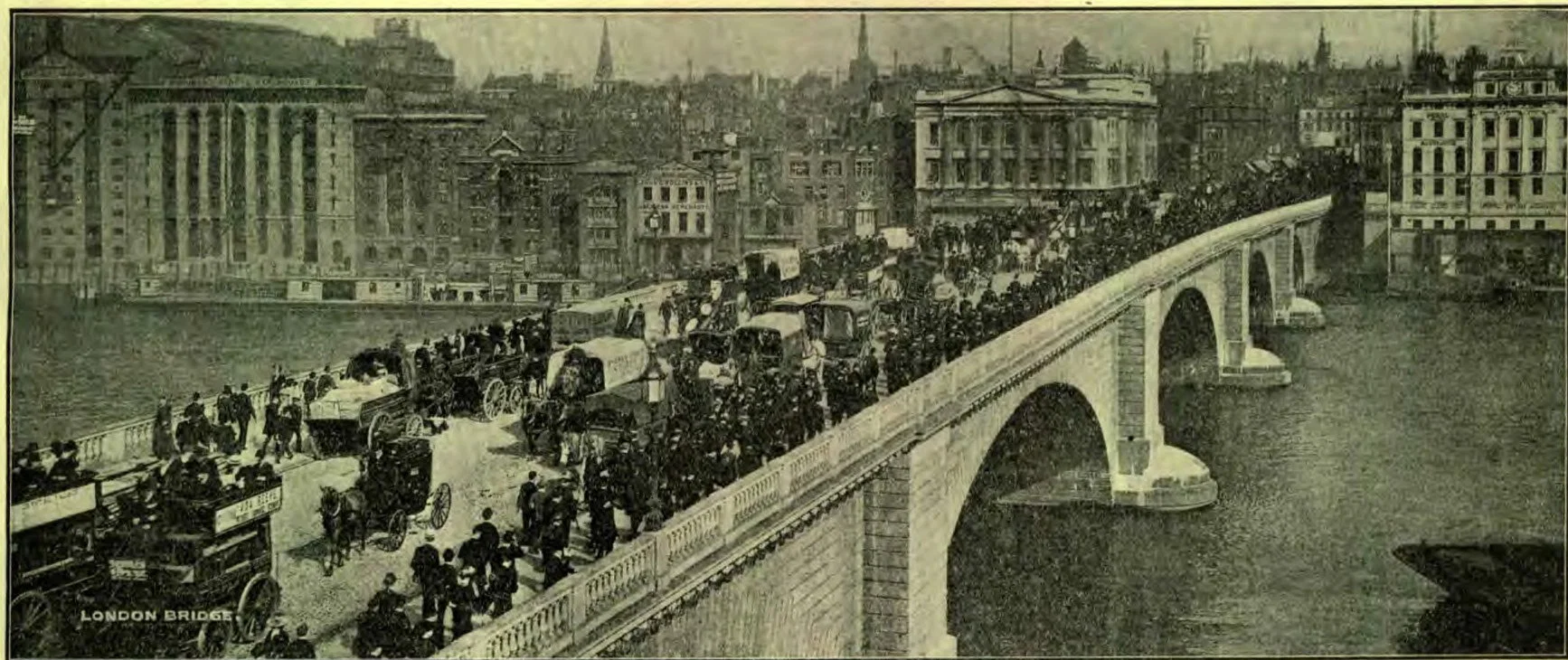
WONDERFUL things men have accomplished in bridge-building and chasm-spanning the centuries gone. Seemingly impossible feats have been achieved. One of the first famous bridges of history was that builded, according to Herodotus, by Queen Nitoeris over the Euphrates at Babylon, said to have been five furlongs in length. The first records of stone bridges come down to us from the war-loving Romans, unless it be that the Chinese antedate them in this art. Rome's oldest bridge was the Pons Sublicius, across the Tiber. Ruins of that still remain. And there were seven more. Another famous bridge was over the Rhone at Avignon, which took a hundred and twelve years to build—1076-1188. The same year work was begun upon England's famous pons, London Bridge. It was finished in 1209. Peter of Colechurch began the work, but dying before it was completed, was buried in the structure, according to the rule of the guild to which he belonged. It was noted for its strength and massiveness, two-thirds of the Thames being occupied with its great piers. The first bridge had a row of houses along the entire length of its structure. We are told of the man who was born, lived, and died on the bridge without ever leaving it. The modern structure is seen in our picture on this page. In later times America has excelled in both wood and steel bridges, till we come to Niagara Falls' structures and the bridges in and about New York City. But these are by no means the greatest. If commerce demanded it, we should probably next hear of a bridge building across the Grand Canyon of the Colorado.
But with all man's art and skill in building bridges, he has never been able to span the dark chasm which sin has made between this island world and the continent of heaven. He has tried and tried, but he can place no pier in the awful, bottomless gulf, he can find no safe abutment on the hither side, and he has no power in himself or by the aid of his fellows to throw a span to the other shore. "Only in dreams" does he bridge the gulf; but wakes to find Death's deep, dark river flowing on to the sea of eternity, bearing in its poisonous depths millions of souls, and on its boiling surface the shadows of earth's dearest hopes.
Yet the torrent is bridged. The dark river has been spanned. As safe and secure as heaven itself its mighty cables are anchored in the throne of God, and span the awful gulf to the very heart of earth. The Son of God, the eternal Word, became flesh,—God-with-us, Immanuel,—and formed a union never to be broken—eternally God, eternally man. As man He met temptations for us, suffered for us, conquered sin in its stronghold the flesh for us, died for us, and by the power of His righteousness rose from the dead for us. While here He said: "I am the Way." John 14:6. Back from His glory upon the throne of the Father He sends to His children this word: "Fear not; I am the first and the last, and the Living One; and I was dead, and behold, I am alive
forevermore, and I have the keys of death and of Hades." Rev. 1:17, 18. He is the ladder which the penitent and humbled Jacob saw in his dream, reaching from earth to heaven, filled with shining messengers of God, passing to and fro on errands of mercy and love to the needy of earth.
O SOUL, in sin and misery, separated by your sins from God, doomed by sin to eternal death, with no power or strength or skill or wealth to bridge the awful chasm, Christ has bridged it for you. All that He asks of you is to yield your will unreservedly to Him, and to accept Him as your personal Saviour in life, in death, from sin, from selfishness, to serve Him forevermore. He will save. He will cleanse you from sin. He spans the gulf for you by the righteousness of God in Him. He will make you by His own blessed discipline and creative power a fit inhabitant of heaven. Believe Him. Trust Him.
The Famous London Bridge across the Thames.
THE 'MAN OF SORROWS.'
SEVEN hundred years before the birth of Christ as a man, it was written by the prophet Isaiah, 'He is despised and rejected of men; a Man of sorrows, and acquainted with grief.' And this word concerning him was literally fulfilled in His earthly career as a messenger of truth. He endured sorrow and affliction and persecution to an extraordinary degree, yet it was all in behalf of those who had proved recreant to His love and long-suffering care. Yet notwithstanding this ingratitude, He never complained on His own account. His service was a labor of Infinite love, therefore the sorrow it entailed could not be even tinctured with selfish complaint. As far as He was personally affected He could bear, and did bear, willingly and patiently, all the ingratitude of loved ones and all the temptations and persecutions inspired by the adversary of souls. His grief was all because of the sad consequences to those who failed to appreciate His mission, and therefore would fail to benefit by His great sacrifice and loving service.
By a parable of a vineyard, given through the same prophet (Isaiah 5), the Lord tells what He had done for Israel. Of this 'vineyard' it is said, 'He fenced it, and gathered out the stones thereof, and planted it with the choicest vine, and built a tower in the midst of it, and also made a winepress therein.' To emphasize this preparation He asks: 'What could have been done more to My vineyard, that I have not done in it?' For this reason He naturally 'looked that it should bring forth grapes.' And so it did, but they were 'wild grapes,' just such as grew in the wood without any preparation of soil or cultivation or protection from destroyers and thieves.
That there might be no misunderstanding of the parable, it is said that 'the vineyard of the Lord of hosts is the house of Israel, and the men of Judah His pleasant plant.' What was meant by the 'grapes' and the 'wild grapes' is also made plain: 'He looked for judgment [righteous judgment, rectitude of character], but behold oppression.'
That the sorrow of Christ was entirely unselfish is shown in His expression of grief for Jerusalem: 'O Jerusalem, Jerusalem, thou that killest the prophets, and stonest them which are sent unto thee, how often would I have gathered thy children together, even as a hen gathereth her chickens under her wings, and ye would not! Behold, your house is left unto you desolate.' This sad result was the cause of His weeping. Again, on the way to the cross, as certain women wept in sympathy for Him, His solicitude was for the results to them instead of to Himself. Turning to them as they followed and wept, He said, 'Daughters of Jerusalem, weep not for Me, but weep for yourselves, and for your children.'
In the light of these evidences, are we to suppose that Jesus has lost His solicitude for those whom He loves, and for whom He has done so much? Can we imagine for a moment that He looks upon the wayward conduct of those who profess His name at this time, and not be grieved because of their disregard of His merciful love? Because He has changed the scene of His labor for sinners from their immediate presence to the heavenly sanctuary, there to make intercession for them, it does not follow that their rejections and backslidings do not still cause Him sorrow of heart in their behalf. 'For we have not an High Priest which can not be touched with the feeling of our infirmities.' Then Christ is no less 'a Man of sorrows, and acquainted with grief' on account of those whose conduct shows a lack of response to His overtures of mercy, because of His more exalted position. Crucifixion of the Messiah has lost none of its cruelty, none of its expression of disregard for His continued effort in our behalf. Yet we are told that those who 'have tasted the good word of God, and the powers of the world to come, if they shall fall away, . . . crucify to themselves the Son of God afresh, and put Him to an open shame.'
To witness the fulfilment of prophecy, that 'in the last days perilous times shall come,' because 'men shall be lovers of their own selves, covetous, boasters, proud, blasphemers, disobedient to parents, unthankful, unholy,' etc., and to realize that these have 'a form of godliness,' is a sure testimony that the loving Saviour is still 'a Man of sorrows, and acquainted with grief.' And when those who are 'lovers of pleasures more than lovers of God' are found in the ranks of those who look for the Messiah's second coming, is it not adding sorrow upon sorrow in the heart of Him who is already 'wounded for our transgressions,' and 'bruised for our iniquities'? On the other hand, 'the Lord taketh pleasure in them that fear Him, in those that hope in His mercy.'
THE IMPORTANCE OF CONVERSATION.
THE world is governed through the medium of conversation. Every department of life, every accomplishment of mankind, is subject to its moulding influence. Therefore it is a matter that should receive more serious consideration than is commonly accorded to it. As with every other great moral principle, it can be properly considered only from the standpoint of the Word of God. The highly important position of conversation in the welfare of humanity is briefly expressed by the Lord through David, in these words: "Whoso offereth praise glorifieth Me, and to him that ordereth his conversation aright will I show the salvation of God." Ps. 50:23. In this text, as in Ps. 37:14, "conversation" stands for the whole conduct of life. This is shown in the marginal rendering; and it also lays additional stress on the thought that the conversation is the life. Also in 1 Peter 1:18 "conversation" is rendered "manner of life" in the margin; and in 2 Peter 3:11, it is "life" in the Revised Version.
That a man's life is indicated by his verbal conversation is shown by a comparison of Matt. 12:36, 37 with Rev. 22:12. The first text reads: "But I say unto you, That every idle word that men shall speak, they shall give account thereof in the day of judgment. For by thy words thou shalt be justified, and by thy words thou shalt be condemned." The second scripture says: "Behold, I come quickly; and My reward is with Me, to give every man according as his work shall be." Thus the work is so far moulded by the words, the daily conversation, as to affect the acceptance or rejection in the final judgment of God.
The inseparable connection between the conversation and the life is also shown in Gal. 1:13 and 1 Peter 2:11, 12. So Paul's exhortation to Timothy is, to be "an example of the believers, in word, in conversation, in charity, in spirit, in faith, in purity." And James gives this general advice: "Who is a wise man and endued with knowledge among you? let him show out of a good conversation his works with meekness of wisdom." Paul's counsel to the Ephesian brethren is also to the point: "Let no corrupt communication proceed out of your mouth, but that which is good to the use of edifying, that it may minister grace unto the hearers."
In this same epistle is a pointed condemnation of a very common habit of conversation. The apostle says: "Fornication, and all uncleanness, or covetousness, let it not be once named among you, as becometh saints; neither filthiness, nor foolish talking, nor jesting, which are not convenient [or befitting]; but rather giving of thanks." In harmony with this, we have the counsel to the Philippian church, "Only let your conversation be as it becometh the Gospel of Christ."
But these exhortations for purity and soberness of speech necessitate a condition back of the words we use. Whence do our verbal utterances come? and what gives rise to expression in words? The Saviour answers: "Out of the abundance of the heart the mouth speaketh. A good man out of the good treasure of the heart bringeth forth good things; and an evil man out of the evil treasure bringeth forth evil things." Matt. 12:34, 35. So the words we utter, which compose our conversation, are simply the expression of the thoughts we harbor. "Those things which proceed out of the mouth come forth from the heart." Hence the wisdom of Solomon, when he says, "Keep thy heart with all diligence; for out of it are the issues of life." "As he [any man] thinketh in his heart, so is he."
Then it is essential that the thoughts have such pure substantial basis as will insure the inspiration of pure conversation; and the Lord does not leave us without a lesson on this point. The lesson is, "Whatsoever things are true, whatsoever things are honest, whatsoever things are just, whatsoever things are pure, whatsoever things are lovely, whatsoever things are of good report; if there by any virtue, and if there be any praise, think on these things." Phil. 4:8.
Now where is the most fruitful source of true and pure things upon which the mind can feed in order to produce pure thoughts and pure, truthful conversation? Let the psalmist5answer: "The words of the Lord are pure words; as silver tried in a furnace of earth, purified seven times." Ps. 12:6. "The commandment of the Lord is pure, enlightening the eyes." Ps. 19:8. "Thy word is very pure; therefore Thy servant loveth it." Ps. 119:140. "Thy Word is true from the beginning; and every one of Thy righteous judgments endure forever." Verse 160.
To this testimony we add that of the Lord Jesus: "Man shall not live by bread alone, but by every word that proceedeth out of the mouth of God." Matt. 4:4; also Deut. 8:3. And this is the word of truth by which we are to be sanctified." John 17:17.
Of the present social results of such feeding of the mind, the apostle Paul says: "Let the Word of Christ dwell in you richly in all wisdom; teaching and admonishing one another in psalms and hymns and spiritual songs, singing with grace in your hearts to the Lord." Col. 3:16.
The sure Word of prophecy shows, after the final indignation against all earthly nations, that the Lord will "turn to the people a pure language [margin, "lip"], that they may call upon the name of the Lord, to serve Him with one consent." Zeph. 3:9.
G.
1911.—The Care of the Bible.
By Editor
Who took care of the Bible from its first existence until the Reformation? Or, where did the Protestants get it from? O.
God in His providence cared for it. The Old Testament has been preserved through Jews as well as through Christians. Copies of the New Testament were multiplied by early Christians, and these copies were widely scattered. Some were hidden in churches and monasteries and secret places. Institutions and orders in the Catholic church preserved some of these copies, not knowing their worth and importance. We have an exact parallel in the Christian era to the Jewish age. Altho the Jews became apostate, they preserved the Scriptures, which they made void in their own lives by their tradition. Altho the church of the Christian era became fearfully apostate, in its archives were preserved copies of the Scriptures, not for use, but as sacred relics, the teachings of which the tradition of the church made void. Both the Old and New Testaments were preserved despite the apostasy in His church until the time of reformation. But if God's people in both Old and New Testament times had been faithful, how much better both would have been preserved, what a vastly greater number of copies the world would have had! Yet, praise God, notwithstanding the suppression of truth by apostasy, God preserved His Word which condemned the apostasy.
Question Corner
1910.—First Bishop of Rome.
Who was the first bishop, or pope of Rome? O.
We do not know. No one knows. The tradition that it was Peter is open to all sorts of discussion. The Bible gives Paul a much stronger, clearer connection with the church at Rome than it does any other apostle.
But what difference does it make who was the first bishop (or elder, for so it means) at Rome, not of Rome? A vastly more important query is, Who is the head of the church of God, the true church? And the Bible answers that very clearly: "And hath put all things under His [Christ's] feet, and gave Him to be Head over all things to the church, which is His body." Eph. 1:22, 23. "He is the Head of the body, the church." Col. 1:18. Not only this, but there are no intermediaries; for "the Head of every man is Christ." 1 Cor. 11:3. "For other foundation can no man lay than that is laid, which is Christ Jesus." 1 Cor. 3:11. See also 1 Peter 2:4-8. As to primacy, or headship, among the apostles, Paul tells us that "he was not a whit behind the very chiefest apostles" (1 Cor. 11:5), and when he mentioned the apostles, with this very matter of leadership in view, he places the three great apostles in this order, James, Peter, and John. Gal. 2:9. Furthermore, the first council that was ever held, the only apostolic council, was held in Jerusalem, and the divinely appointed president, chief spokesman, of that council was James. Read the record in Acts 15:6-29. It was Jesus who said, "One is your Master, even Christ, and all ye are brethren." Matt. 23:8.
1912.—Pentecost.
On what day did Pentecost fall? In Leviticus 23 it is stated that the Passover was on the fourteenth, or Friday; the next day, the fifteenth, was the first day of unleavened bread. I suppose the Sabbath to be mentioned in verses 11 and 15, which made the Sabbath that Christ lay in the grave, an high day; and the next day, verse 11, Sunday, the wave sheaf was offered, a type of the resurrection of Christ, the first-fruits of them that slept; and counting fifty days, verses 15, 16, would throw Pentecost on Sunday. M. T. C.
There is nothing in Leviticus 23 which intimates that the fourteenth day of the first month fell on Friday. The Passover was governed by the moon; whatever the date the paschal full moon came on, then the passover was killed. It of course fell on Friday some of the time, as it did on every other day of the week; but the Passover did not conform to the week; it was not a weekly feast, but a yearly feast. If any of the great days of the Passover fell on the Sabbath, as of course they did, as also on other days, they were Sabbaths of special importance and could be called high days.
It is a serious question whether the time of Pentecost can be fixed. Did the Passover fall on the day that Christ ate it with His disciples or the day following when He was crucified? Did Jesus meet the type when He ate it with His disciples, as regards time, or did He meet it as regards time when He died upon the cross. These are questions over which Bible students have been puzzled for centuries. Some have held that the Jews themselves were divided between the two times of eating the Passover. If the eating of the Passover by our Lord and His disciples was at the right time, Pentecost probably fell on the seventh day, as Kitto admits, and some other authorities. If our Lord was crucified on the day of the Passover, Pentecost probably fell on the first day of the week.
But mark this, that the fulfilment of any of these types did not in any way or manner emphasize the day of the week. Had that been the question the Lord would certainly have mentioned the day of the week. He would have told us that when the sixth day came, or the fifth day came, or when the first day came, then the Pentecost came; but nothing of the kind occurs in the sacred writings. If it had been the day of the week the Lord designed to honor or emphasize, He would not have passed over in silence one first day between the ascension and the outpouring of the Spirit on Pentecost. There is no question regarding the days of the week that hinges in any way upon any of those annual feasts.
1913.—Women Speaking in Church.
Do you know of any history that says it is a shame for women to speak in church? H. P. G.
We know of none except what the apostle says in 1 Cor. 14:34. But the apostle does not there contradict what he elsewhere says. The passage has been explained twice in this volume. We have not space for it again.
1914.—What Did God Create?
Did not God create all things that were created? And if He did, would that determine His perfection? R. E. B.
We read in Gen. 1:31, “And God saw everything that He had made, and, behold, it was very good.” That certainly is clear and positive. But the question would of course immediately arise, What does it mean in Isa. 41:7, “I form the light and create darkness; I make peace and create evil; I am Jehovah that doeth all these things”? “Evil” is not used here in the sense of sin or unrighteousness, but in the sense of judgment upon sin. God’s holy, living law is such that if men will do it they will live by it—“in the way of righteousness is life.” But He has also placed within that living law the penalty of transgression—“transgressors shall fall thereby.” The perverted law brings death. “The strength of sin is the law,” but it dooms to death the sinner. Only in this sense is it that God creates evil, by bringing upon sin its own judgment; and that also shows the perfection of God’s system. He must do this or sin would completely overwhelm His kingdom. The same thought is expressed in Amos 3:6, 7.
1915.—The Ordinances.
How do you hold about the ordinances, such as feet-washing, the holy kiss, lifting up holy hands, etc.?
G.
Feet-washing is clearly instituted in John 13. It is very clearly enjoined there. Then do as commanded. But what is there in the “holy kiss” which would make it an ordinance? Does not the emphasis rest on “holy” rather than on “kiss”? Kissing was a common way of greeting; but it was sometimes used to cover a treacherous, unfriendly heart. So Judas kissed Jesus. The apostle does not rebuke the custom, but enjoins that the kiss shall be “holy,” sincere, pure. The “lifting up of hands” is merely an attitude of prayer.
1916.—The Day-Line.
What reason have you for teaching that the day-line is in the Pacific Ocean? A student here claims that there is no certainty as to where it is. P. P. C.
The day-line has been fixed in God's providence in the Pacific Ocean. The day began, of course, in Eden as the world was before the Flood. At that time there seems to be good evidence from Genesis 1 that there was only one body of land, and one of water, for the waters were gathered together to one place. Noah carried the day with him through the Flood, and after the Deluge was over, he, of course, kept the day as he had carried it, clearly marked by divisions of seven, while in the ark. See Genesis 6, 7, 8. The ark rested in western Asia. From there the children of men spread out over the habitable portions of the earth, carrying the day with them wherever they went, eastward, northward, southward, westward, and that day has been preserved in that way to the present time. Beginning on the eastern edge of the Eastern Continent and going westward, we are in harmony with all peoples as regards the days of the week, that is, if they have any week at all, until we reach the Pacific Ocean. Here there may be a few mistakes in some of the islands of the sea in consequence of the way in which the week came to them by navigators, but as a general thing there is perfect harmony throughout the world, and all ship-masters, traders, and scholars in general are agreed in fixing the day-line in the Pacific Ocean; so that every ship in crossing either adds a day or drops a day from its reckoning, depending on the way it is going. Trying to fix a day-line anywhere else in the world throws the world into unutterable confusion. There are some things just as truly fixed in God's providence as tho the specific command were given to us, and any effort to establish the contrary will always result in confusion. See tract entitled "The Identical Seventh Day," No. 114, B. S. L., price by mail, two cents.