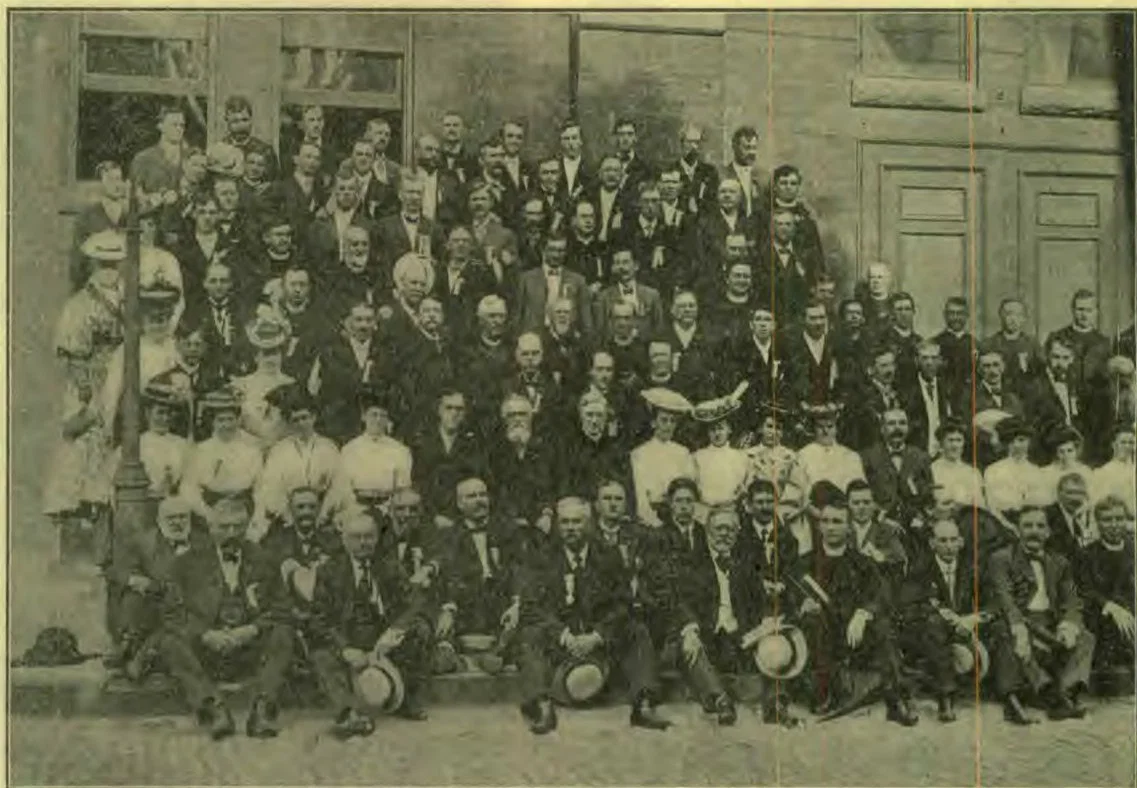
WE have given in past numbers from our own representative the report and the meaning of the American Federation of Catholic Societies which held its fifth annual convention in Buffalo the last days of July. We give in this some pertinent extracts from a report in the Catholic Mirror of August 11. We are first told that the convention „was undoubtedly one of the most successful movements ever made by United Catholicity in this country,” that the mass meeting that day included „more Catholics than ever assembled in Buffalo at any one time, and graced by the presence of some of the most learned churchmen in the country.” The secretary’s report showed „the gigantic strides already made by the Federation, and the brilliant future that is before it.” The secretary reported various things accomplished. We note these among those quoted by the Mirror:
„In Ohio the obnoxious Wynne free text-book bill was defeated and one of the non-Catholic members of the Ohio Legislature said to a Federation official that „if that unknown Federation had not made such a strong and convincing argument against said bill, it would have been passed by the Lower House.’ In Ohio the Lucas County Federation has gained permission to have holy mass celebrated in the workhouse and other public corrective and charitable institutions.”
“„In New Jersey, Indiana, and Missouri the Catholic Societies some time ago caused the defeat of the free text-book bills.”
“„In Pennsylvania strong protests were made against a series of paintings violating the truth of history and offensive to Catholics. The paintings are placed on the walls of the State Capitol building at Harrisburg.”
“„The Catholic Societies of Iowa, especially the Staats Verband of that state, were successful in having the Ritter bill adopted, giving free access to Catholic priests to all state institutions for the purpose of administering to the wants of Catholic inmates.””
Aims and Meaning.
The object of the Federation is thus stated by Bishop Canerin, from whose address we take the following:
„This Federation may be considered as an organized representative of every form of Catholic activity, and, within certain limits, the guardian of Catholic rights and interests, which are threatened and violated by materialism and secularism, and the false and pernicious practices which spring from them.
„The aims of the Federation are religious and patriotic; they are public interest of all American citizens who believe in the Divine Lawgiver and in the revelation of a divine religion through Christ our Saviour.”
It is well to remember that the only true representative of that Divine Lawgiver, as held by Rome, is the pope and hierarchy of the Roman Catholic Church. To quote again:
„To carry out the purpose of this association, every force of religious activity, pastors and people, bishops, priests, and laymen, speakers and writers, must be solidly united to speak with one voice and act with one will for God and our country. We must make the Federation an Apostolate of Catholic truth, to aid the Church in teaching her children to think as Catholics, to speak as Catholics, to live as Catholics.
„We are not a political party or a sect; we stand for the Christian life of the nation itself, and we are ready with our whole energy, to co-operate with all loyal citizens, with our government, and with all political and social energies which work for truth and virtue. The more consistent the Catholics, the more loyal the patriot. It is not patriotism, but cowardice, to minimize Catholic teachings in regard to our civic rights and duties, or to surrender any essential principle of Christian doctrine concerning the relations of the church to the state, the family, the school.
„This is federation. It means the union of Catholics of every race and language in the United States for the preservation of Christian principles, and the progress and elevation of men to higher spiritual life and more unselfish citizenship; it means that we stand together for the defense of right and the redress of great wrongs in the family, in the school, in the social, economic, civil, or political conditions of the country. It represents and fearlessly proclaims Catholic public opinion on the most important questions of the day. It needs a center and an organ that it may be the propagator of Catholic literature among all classes.
Prelates and Delegates at the Federation Meeting.
„We wish Christian principles to rule everywhere; in the state, in business, in labor unions, in all the civic, social, financial, and industrial relations of men.
„The disregard of the Lord’s Day is one of the signs of the materialistic spirit and godlessness of our times. It is a subject worthy of serious consideration. Thousands of Catholic men employed in iron and steel mills, in mines and factories, on railroads, street-cars, docks, and wharves, in different departments, on many large contracts, have no opportunity, I will not say to rest, but even to worship God for one hour by attending mass on Sunday. If they have a day, or half a day of rest during the week, it usually is on Saturday. Work and pleasure and material progress are made of supreme importance and the mad sacrifice to mammon proceeds on Sundays, as if laboring men had no Sabbath, no public worship to offer, no souls to save. Against this unnecessary labor, this athletic profanation of the Lord’s Day, this paganizing and brutalizing of the laboring man, and shutting out from his life all religious light and grace, this Federation should resolutely use its power, in civic, as well as in social and private life.
„Already the light is breaking, and the best minds of this country are realizing the truth of Catholic principles of civil, social, domestic, and private virtue. Heretofore there has been wanting a united effort and expression of Catholics for the rights of religion and the welfare of society. In many places we have needed educated and religious laymen, trained to compete and lead in public careers of American life. We are one in six or seven of the population; the proportion of our numbers in the higher offices ought to be one in six or seven.
„Never in the history of the country, was there a better opportunity for the Catholic laymen to prove the value and power of religion in citizenship and to show how religion alone can conserve the majesty of the law and the stability of the state.
„There are members of our Catholic societies in all the trades and labor unions of the United States. Let this Federation be a school to prepare these men to be apostles of honesty and respect for law, of truth and morality to those about them, so that we may count every member of this union an opponent to the anti-Christian, materialistic, and socialistic doctrines of all sects and societies which rise up against religion and just government.
Bishops and priests and the laity should be foremost in all movements for education, political and social purity, and the improvement of the condition of the poorer working classes; improvement in their dwellings and manners of living, in their moral environment, in their efforts to obtain fair wages, without recourse to violence, and where possible, without recourse to strikes; to prevent the cheapening of labor by the employment of children and women in occupations unfit for them; in encouraging among the people useful societies; in opposing all unnecessary work on Sundays.
„By our faith in Jesus Christ and its unchanging doctrines, we hold in our hands the future stability and peace of this country, and the principles of conscience, honesty, and personal responsibilities upon which it rests. Religious education, Catholic faith, and Catholic morality, are the only living forces which can save marriage, save the family, protect property, defend the poor and weak—save the state itself, from the perils15of materialism, secularism, and the cruelty and sensuality of Paganism.”
In all this we believe Roman Catholics to be sincere. But if the „state itself” is to be preserved only by „Catholic faith and Catholic morality,” if „the future stability of the country” rests upon the „unchanging doctrines” of that church, surely Catholics ought earnestly to work for it. But the effect of the „Catholic faith and Catholic morality,” and the „unchanging doctrines” of that church may be seen in those countries where she has held full sway, as for instance Spain and Italy. Surely they have been utterly wanting in stability in the past, and the future makes no promise of better conditions. May God save America from such „stability,” from such salvation.
THE DECLINE OF THE PROTESTANT MINISTRY.
THE religious press is commenting on the decline of the Protestant ministry; that is, the numerical falling off year by year in pro portion to churches and population. In the California Christian Advocate we find this comment:
“The Episcopalians say that the falling off is due to the openings for brilliant careers constantly oc curring in other directions. For ourselves, we believe it is entirely due to the decay of faith in the German universities. The teacher's rostrum may be occupied by a man of brilliant gift and profound learning, but if he have no faith, his class-room is robbed of both light and heat. When skepticism masquerades as advanced Christian thought, we are not surprised if the class-rooms are empty.”
There is another reason for the decrease of Protestant ministers, and that is the waning of Protestant principles in the Protestant churches. No doubt German universities are to an extent responsible for the results, which are far more extensive than they would have been if American Protestants had not so blindly depended upon such institutions as teachers of doctrine. In this respect the tendency has been largely to copy from German fashion about as Paris is copied in dress styles.
Protestants are supposed to learn doctrine from the Word of God, and as long as this rule was ad hered to there was no decline in the number of Protestant ministers. The Scriptures are “profitable for doctrine,” and from them the “man of God” may be “thor oughly furnished unto all good works.” But Protestants have become so ambitious to have worldly knowledge, “science falsely so called,” portrayed in their ministry, that they have sadly departed from the original Protestant bear ings.
The prophecy of Revelation 13 foretells a restoration of papal influence to its former universal pres tige, and this could be accomplished only through the waning of Protestant influence, which could re sult only from a departure from the Protestant standard. So we find the Outlook, in commenting on the decline of the Protestant ministry, noting the fact that “on the other hand, the number of students of Roman Catholic theology is not only not declining, but increasing proportionately with the population.”
Naturally, as Protestantism recedes from its orig inal positions, it recedes toward Catholicism. There fore, in the same prophecy of Revelation 13, we are shown a world power, at first lamb-like, but event ually speaking as a “dragon,” and commanding the people to imitate, or set up an image to, the power that had met so great a temporary reverse. Such a consummation must naturally follow in a Protestant country where Protestantism is “de clining” and Catholicism is “increasing,” and where it is getting to be the fad in high political circles, as also in some “Protestant” ministerial circles, to express the hope that we may yet have a Catholic President.
It is also noticeable, and significant, that the message which gives warning against the making of the “image” to the papal power, and the re ceiving of its “mark” (Rev. 14:8-12), which is now being proclaimed throughout the world, is so far receiving a more bitter opposition from waning Protestantism than from increasing Catholicism. Furthermore, declining Protestantism is doing more, directly, to accomplish the state enforcement of the papal “mark” upon the people than is the Catholic Church.
The Advocate, in acknowledging the downward trend of the Protestant ministry, says, “The real cause is not easily defined.” There could be only the one cause, namely, departure from the Protestant faith, logically followed by education along that line. G.
THE CUBAN EXPERIMENT.
For four years the experiment of Cuban independence has been on trial. Its first revolution has overturned the government with scarcely an effort on the part of the government to sustain itself. It has failed to stand its first practical test as against the innate spirit of unrest that imbues the people, and which was so long cultivated during the years of chafing under Spanish misrule. The following statement by a correspondent of the New York World gives some interesting facts that help to explain the situation:
“To understand the present revolt and the strong feeling against Palma and his administration, one must go back to 1902, when Palma was first elected president of Cuba. The occupation of the United States had been tedious, and to the Cuban mind Palma was the Washington government's choice for president of Cuba. Had all his acts been Solomonic in their wisdom, he could not have escaped Cuban resentment of what they felt was the imposed choice of an alien power. His services in the ten years' war of the '70s against Spanish dominion, his capture in 1876 and imprisonment in Morro Castle, and then the final confiscation of his properties and banishment from Cuba for life, were forgotten. A new generation had arisen which knew nothing of all this. For twenty-four years he had been an exile in an obscure village in the United States, and Cuba had lost touch with Palma and he with Cuba. Any other man under these conditions would have been as heavily handicapped. Palma is the most bitterly hated person in Cuba. The rebels against Spanish rule have no recognition in his administration, no hope of relief through elections. Palma, an ultra-conservative, is surrounded by the old pro-Spanish influence. His own private secretary was, up to the Spanish evacuation in 1898, judge-advocate in the army of Spain—the man who prosecuted the Cuban patriots in the field. Their lives and liberties were in the hands of this Spanish prosecutor, and to-day no old Cuban fighter can gain access to the president without permission of this man. Imagine the feeling of these hardy, bitter old campaigners as they seek permission from the man who has ordered their comrades out with a file of soldiers at dawn or turned the keys of the dungeons of Morro.”
What shall we say of the politics of this great republic when two men in the greatest of the states hold the power to decide which one of the two shall name the candidates of a popular party for the dignified positions of judges of the various grades of courts? Then one of the two has to yield to the one whom he had but recently denounced in his paper as everything that is corrupt, socially and politically. And the privilege of naming the candidates for high judgeships is yielded to this bold, bad man because his influence was deemed necessary to the political success of the one who had so denounced him. In another great state it is conceded that one man virtually controlled the nomination for governor in the conventions of two different parties. He had one nominated with a view to his election, and the other for the purpose of defeating a third candidate by dividing a certain party vote. And the masses sing the praises and fawn at the feet of men who are capable of doing such politics. Yet some Christians talk of the duty of going to the polls, that good men may be elected to office. But when at the polls, they can vote only for some candidate set up for them by political gamblers. A vote for a candidate not on a regularly certified and registered ticket would not be counted. So the franchise privilege of the people is merely stock in the hands of office brokers. And all this passes for republicanism in “the land of the free!”
Of all modern public utilities, the railroad is deemed the most valuable, yet it involves a cost in the United States that receives very little public attention. A statement has just been issued by the Interstate Commerce Commission that the railroad entails a yearly cost that can not be computed in dollars and cents. For the year ending June 30, 1905, the number of people killed was 9,703, while the injured numbered 86,003. Inasmuch as this was a considerable increase over the previous year, we may reasonably expect that when the account for the past year is in, it will show further increase. And this is only one item in the great daily sacrifice of human life on the altar of money-getting—“covetousness, which is idolatry.” Modern machinery, coupled with modern rush and recklessness, is a wanton destroyer of human life.
The Department of Botany of the University of California has been presented with the very valuable Brandegee Collection of botanical specimens together with the Brandegee Library of some three thousand volumes of botanical works, and the furniture and fixtures for the care of the Herbarium. This gift is a most important one to the department for the reason that the Herbarium contains over 100,000 specimens of plants gathered principally in Southern California, Arizona, and Mexico, a region which is but little covered in the original collection of the University. The University Herbarium is now one of the largest and most valuable west of Harvard.
The character of Russian justice is indicated in the following press despatch: “Two hundred Jews arrested at haphazard during the massacre at Siedlce are being tried by field court martial, their judges being the same officers that participated in the disorders, and are therefore likely to condemn the accused in order to justify the massacre of their brethren. A committee of British Jews have issued a strong appeal to civilized nations to prevent such a crime against civilization. But such an appeal will hardly avail, for the reason that the Jew, as a Jew, has no national friend.
That high license does not help the temperance cause, is shown by the following press despatch from Chicago: “There are 8,000 drunkards in Chicago, and they are causing the police, hospital authorities, reform associations, and even the saloon men, a lot of trouble. While temperance workers have no authoritative statistics on the number of drunkards in the city, they are confident there is no decrease in sight, and are viewing with alarm the widespread use of intoxicants that permits so many saloon-keepers to stay in business, despite the $1,000 liquor license ordinance.”
Christian Endeavor and Church Oversight
A reversal of purpose in the Young People's Society of Christian Endeavor is severely criticized by a writer in Christian Work. He says: "So much emphasis has been laid upon 'Endeavor' that the idea has become widely prevalent that the organization is designed to be a modern machine for the rapid turning out of certain products which the church finds useful and even necessary. . . . The Christian Endeavor Society is not a 'job office' or a machine shop. We have carried the workshop idea quite too far in our estimate of the movement. It is not 'the young people of the church at work,' but 'the church at work for her young people'—which is a very different thing. A great deal of the collapse which has marked 'Endeavor' in local circles is due to the surprising lack of superintendence and oversight on the part of the church itself." This statement by one of experience in the matter of which he writes illustrates two dangers of honest people in the conduct of church affairs. One is, the liability of young people in places of responsibility to assume too much; the other is, the tendency of the older class to shrink responsibility, and allow the young willing ones to go ahead without necessary oversight or balance-wheel co-operation. It is not always the fault of young people if they get a little beyond the bounds of good judgment or propriety. The tendency is too strong toward confounding legitimate and appropriate young people's work with that which should be the work of the whole church.