"He that is our God is the God of salvation; and unto God the Lord belong the issues from death." NO great human system is operated without agencies. To every organization there must be first a recognized head. On the throne of every kingdom is a king. An empire has its emperor; a republic, a president. The chief ruler has his counselors, his messengers are a host.
The facilities which the ruler of a nation has at his command for the operation of the government and for keeping in close touch with all parts of his dominion, are as complete and perfect as possible; and upon the efficiency of these resources depends the safety and strength of the government. He is in touch with all portions of his dominion by means of the telegraph, telephone, and post services. In case of rebellion, armed legions—army and navy—promptly obey his call to battle, till every rebel is overpowered and subdued. While the rebellion is in progress, all who will lay down arms, cease fighting, and take the oath of allegiance—thereby coming into harmony with the government—are forgiven, and accorded the full rights of citizenship.
Who Stands at the Head
of the government of the universe? Let Inspiration answer. "There is no power but of God." "For the kingdom is the Lord's, and He is the Governor among the nations." He "hath prepared His throne in the heavens; and His kingdom ruleth over all."
We can not for a moment entertain the thought that any ruler under heaven has a more complete system of government, or greater facilities at his disposal for the administration of his government, than He who is "the great King over all the earth," "the Governor among the nations." Shall we not rather conclude that the infinite Creator has facilities for keeping in touch with all parts of His dominion, and resources for the operation of His government, which far excel those of any ruler upon the earth, which is only, as it were, an atom in the vast universe? Earthly kings have been compelled to acknowledge
His Universal Kingship.
When Nebuchadnezzar had been deposed from his kingly throne for failure to recognize "the Most High" as "Governor among the nations," he freely bore witness to the universal dominion of the government of heaven, saying, "He doeth according to His will in the army of heaven, and among the inhabitants of the earth; and none can stay His hand, or say unto Him, What doest Thou?" "Now I, Nebuchadnezzar, praise and extol and honor the King of heaven."
"The Lord is our Law-giver, the Lord is our King, the Lord is our Judge." He has a Counselor, the Son of God, and also the Son of Man. He is called "Wonderful, Counselor," and "the counsel of peace is between Them both." From His treasure-house flow life and sustenance for every living creature. "The eyes of all wait upon Thee; and Thou givest them their meat in due season. Thou openest Thine hand and satisfiest the desire of every living thing."
To the Son is committed the execution of judgment. His armies can traverse land and sea, and can navigate air and all space. His angelic ambassadors are despatched to all habitable portions of His boundless domain; His human agents to earth's remotest bounds.
He has the most complete and effectual methods of communication by which each of His subjects, in every place, has instantaneous connection with the throne.
Rebellion—Its Remedy.
Rebellion has entered His dominion, and all of His agencies are employed in putting it down, once for all, and meanwhile He is offering the most liberal terms of full and free pardon to all who will lay down their arms, accept terms of peace, and take the oath of allegiance.
To fight against God is as futile as an effort to dip all the water from the ocean; "for he who wars with God must fight a losing fight." The resources of His government are amply sufficient to "put down all rule and authority" that are contrary to righteousness and truth. The all-important question for each member of the human family to settle is, "Where will I stand, when rebellion and all incorrigible rebels are conquered?"
No plan of salvation can satisfy or meet the demands of the human family unless its author has all power, both in heaven and in earth; for if there is any power superior to that which is vested in the Head of the plan of redemption, and a more universal manifestation of that power, then it must finally triumph. But let us forever settle the truth in our own minds, that the power of the Head of the plan of salvation is in reality
the Only Power in the Universe;
for all life and all strength is simply loaned to all creatures by the Author of this plan. Even the life wherewith Satan, demons, and wicked men curse God is simply the vitality loaned them by the Creator; "for there is no power but of God." It is a fact well worthy of our consideration also, that while our God is the Creator of the heavens and the earth, His rival can not create anything, nor supply life to a single being. He is only "Apollyon," the destroyer. He only fights, permitted, against the Government of heaven.
In order to illustrate the greatness of the power of the Head of the plan of salvation, He says, "To whom then will ye liken Me, or shall I be equal? . . . Lift up your eyes on high, and behold who hath7created these things, that bringeth out their host by number; He calleth them all by names by the greatness of His might, for that He is strong in power; not one faileth." He it is who can speak into empty space, and, as a result, spheres spring into existence; "for He spake, and it [the earth] was; He commanded, and it stood fast."
When the Lord desired to teach Job his dependence upon his Creator, He addressed to him this question, "Canst thou guide Arcturus with his sons?" We are informed by astronomers that Arcturus is more than a million times as large as the sun of our solar system, with a volume of light equal to five hundred and fifty-eight thousand times that which is poured forth by the glowing orb that rules our day. This mighty sun, Arcturus, with its "sons" or system of worlds, rushing on through space at the rate of four hundred miles per second, is spoken of as "runaway," because he goes sweeping majestically on, disdaining the combined attractions of all other heavenly bodies, and apparently without guidance or control. The God of our salvation spoke Arcturus into existence and controls him more readily and easily than we preserve our balance in walking.
All His Power Is Pledged in Our Behalf.
Surely, then, we have great occasion for rejoicing. Satan would take keen delight in having us think the Lord is against us; for if he can thus cause us to become discouraged, he will have every advantage of us. But "if God be for us, who can be against us?" "He that spared not His own Son, but delivered Him up for us all, how shall He not with Him also freely give us all things?" He is love, and His infinite love—His very nature—would not permit him to destroy a single member of our race, without first providing a plan of salvation for all who would desire to avail themselves of its priceless benefits.
The nations, to Him, are only as "the drop of a bucket," and are counted as the small dust of the balance, which can be blown away with a puff of human breath; yet He says of individuals among nations, "To this man will I look, even to him that is poor and of a contrite spirit, and trembleth at My Word."
Still better than simply looking, it is further written, "Thus saith the High and Lofty One that inhabiteth eternity, whose name is holy; I dwell in the high and holy place, with him also that is of a contrite and humble spirit, to revive the spirit of the humble, and to revive the heart of the contrite ones."
To the wicked He sends this message: "As I live, saith the Lord God, I have no pleasure in the death of the wicked; but that the wicked turn from his way and live; turn ye, turn ye from your evil ways, for why will ye die?" They also are assured that God is "long-suffering to usward, not willing that any should perish, but that all should come to repentance."
The prophet of the Lord is also given this word, "Comfort ye, comfort ye My people;" but in the same message we are reminded that all flesh is as perishable as the grass, and as the flower of the field. Wherein, then, is the comfort? It is man's very helplessness and need of God that prompted the plan of redemption. "Like as a father pitieth his children, so the Lord pitieth them that fear Him." No matter how great our weakness, the greater our helplessness, the stronger does our condition appeal to the heart of our heavenly Father, who is the Source of all strength. All His power is pledged for us in the plan of redemption, and herein is occasion for soul-inspiring song. The psalmist, grasping this thought, said, "I WILL SING OF THY POWER; yea, I will sing aloud of Thy mercy in the morning; for Thou hast been my defense and refuge in the day of my trouble. Unto Thee, O my Strength, will I sing."
He is addressing you, dear reader, if you will but believe, when He says, "Fear thou not; for I am with thee; be not dismayed; for I am thy God; I will strengthen thee; yea, I will help thee; yea, I will uphold thee with the right hand of My righteousness." "For I the Lord thy God will hold thy right hand, saying unto thee, Fear not; I will help thee."
"O that men would praise the Lord for His goodness, and for His wonderful works to the children of men." "Praise ye the Lord."
ACCOUNTABILITY TO GOD.
By Ellen G. White
TO EACH of us God has committed sacred trusts, for which He holds us accountable. He designs that man shall be so educated as to develop his mental and moral powers, that he may have a well-balanced mind and a symmetrical character. But education alone will not prepare him to answer the object of his creation. He needs the grace of God, and divine aid awaits his demand. Divine power united with human effort will enable him to do good and glorify his Creator.
Few appreciate the value of man, and the glory that would redound to God were he to cultivate and preserve purity, nobility, and integrity of character. The value that God sets upon man is shown in the price that has been paid for his redemption; His love is expressed in that He withheld not His beloved Son, but gave Him to die for a sinful race. Angels could not, by any sacrifice that they could make, accomplish the work of man's redemption. It was only through the suffering and death of Christ that he could be restored to the favor of God. For our sakes, He who knew no sin was made an offering for sin. He was afflicted, insulted, oppressed. Arraigned as a criminal, He suffered shame, insult, mockery, and pain.
Exalting the Law.
Christ bore all this to rescue man from the hopeless state into which he had been brought by his disobedience of the law of God; for sin is the transgression of the law, and death is its penalty. He did not suffer to do away with the law, or to lessen its force, but that its claims might be met, and the sinner be spared. Through His perfect obedience, the law was exalted and made honorable.
Christ will elevate man, and give him rich and glorious possessions, if he will respect the claims of God's law; but if he choose the service of Satan, and will ruin his hope of heaven by his stubborn sinfulness, he must lose these blessings. He will have a place with associates similar in character to himself,—with those defiled by sin, who consider it a virtue, an evidence of smartness, to doubt God's Word and be ranked among skeptics. To choose to be a sinner is to refuse to stand before the throne of God washed from the defilement of sin; it is to refuse the riches of eternal glory; it is to refuse to be a joint-heir with Christ to the immortal inheritance, and to be exalted to an equality with the heavenly angels;—it is to reject all these, and to choose instead the sure consequence of sin, the sinner's fixed doom.
Measure of Accountability.
Those who might become co-laborers with Christ, and do good service in advancing the interests of His kingdom, but who use their talents and influence to tear down instead of to build up, are like noted rebels; their prominence, the value of the talent they use in the service of Satan, increases their guilt and makes their punishment sure. These will feel the wrath of God. They will experience what Christ suffered in saving men from the penalty of the broken law. The value of man and the measure of his accountability can be known only by the cross of Calvary. He who presents Himself to the sinner as the One strong to deliver, will prove Himself mighty to execute wrath and judgment upon every unrepenting son of Adam. He who holds the worlds in position, who weighs the hills in scales, and the mountains in a balance, who taketh up the isles as a very little thing, will show Himself mighty to avenge His unrequited mercy and spurned love. Those who flatter themselves that God is too merciful to punish the sinner, have only to look to Calvary to make assurance doubly sure that vengeance will be visited upon every transgressor of His righteous law.
The penalty for breaking the law of God is proportionate to the price paid to redeem its transgressors. What unutterable bliss is prepared for those who will be saved through Christ, and what depths of wo for those who despise and reject His great salvation! Whatever of a worldly nature men esteem valuable sinks into insignificance when viewed in this light, and how great appears our obligation to use in the service of God all the talents that He has entrusted to our keeping.
Science Is Too Limited
to comprehend the atonement; the mysterious and wonderful plan of redemption is so far-reaching that philosophy can not explain it; it will ever remain a mystery that the most profound reason can not fathom. If it could be explained by finite wisdom, it would lose its sacredness and dignity. It is a mystery that One equal with the eternal Father should so abase Himself as to suffer the cruel death of the cross to ransom man; and it is a mystery that God so loved the world as to permit His Son to make this great sacrifice. The Holy Spirit exalts and glorifies the Saviour. It is His office to present Christ, the great salvation that we have through Him, and the sacred, elevated purity of His righteousness. Says Christ, "He shall take of Mine, and shall show it unto you." The Spirit of truth is the only effectual teacher of divine truth; those who are taught of Him have entered the school of Christ. How must God esteem the race, that He gave His Son to die for them, and appoints His Spirit to be man's teacher and continual guide. Satan understands this, and he lays his plans to mar and wound man, the workmanship of God, and to prevent him from enjoying the happiness that this great rebel lost through his disobedience and malice.
Since his fall from heaven, it has been Satan's only joy and constant employment to thwart the plan of God by preventing the salvation of perishing men. He has carried on this work with marked success, and will continue it until Christ shall bring his career to an end. He has tried to induce men to aid him in treading the honor of God into the dust, and many have become co-laborers with him, and have encouraged his rebellion. Those who do this, who glory in their skepticism, and lead others to despise the law of Jehovah,8Place Themselves
in the ranks of the enemies of Christ, and use their influence to destroy rather than to save souls. They second Satan in his efforts to undermine the law of God by assuring the sinner that he will be saved while transgressing that law. They serve Satan, and will share his terrible fate.
The short space of time allotted to men here is exceedingly valuable. Now, while probation lingers, God proposes to unite His strength with the weakness of finite man. We should so educate ourselves that we can serve Him intelligently. Those who have cherished skepticism may, by proper discipline of the mind, learn to cherish faith.
Those who truly love God will desire so to improve the talents that He has given them, that they may be a blessing to others. And by and by the gates of heaven will be thrown wide open to admit them, and from the lips of the King of glory the benediction will fall upon their ear like richest music, "Come, ye blessed of My Father, inherit the kingdom prepared for you from the foundation of the world." Thus the redeemed will be welcomed to the mansions that Jesus is preparing for them. There their companions will not be the vile of earth,—liars, idolaters, the impure, or the unbelieving; but they will associate with those who have overcome Satan and his devices, and through divine aid have formed perfect characters.
Every Sinful Tendency,
every imperfection that afflicts them here, has been removed by the blood of Christ; and the excellence and brightness of His glory, far exceeding the brightness of the sun in its meridian splendor, is imparted to them. And the moral beauty, the perfection of His character, shines through them, in worth far exceeding this outward splendor. They are without fault around the great white throne, sharing the dignity and privileges of the angels.
"Eye hath not seen, nor ear heard, neither have entered into the heart of man, the things which God hath prepared for them that love Him." In view of the glorious inheritance which may be his, "what shall a man give in exchange for his soul?" He may be poor; yet he possesses in himself a wealth and dignity that the world could never bestow. The soul redeemed and cleansed from sin, with all its noble powers dedicated to the service of God, is of surpassing worth; and there is joy in heaven, in the presence of God and holy angels, over one sinner that repents,—a joy that is expressed in songs of holy triumph. MRS. E. G. WHITE.
EVENTIDE.
"Peace I leave with you, My peace I give unto you; not as the world giveth, give I unto you. Let not your heart be troubled, neither let it be afraid." John 14:27.
I NEED so much, dear loving Saviour mine,
As day draws to its close;
Thy peace so sweet, all other things above,
To sweeten night's repose.
I seek the peace that e'er I find, upon
My Elder Brother's breast;
I have secure—when daily toil is done—
A calm of heav'nly rest.
I need, dear Lord, when all is hushed and still,
The sweetness of Thy love;
To woo me from the toilsome stress of life,
To muse on joys above.
I crave the blessing too, of Thy sweet peace,
While nearing death's deep sleep;
Then when eternal morn awakes, my hands
Glad harps of praise shall sweep.
IN our last study we considered some of the specific features of the little horn power and found them all to apply to the Papacy. It came up among the ten divisions of Rome; it was little at first; its look was more stout and arrogant than its fellows; before it fell three of the ten divisions of Rome; it was possessed of far-seeing shrewdness and foresight as compared with the other powers; it has spoken great, presumptuous words and assumed prerogatives and titles belonging to Deity alone; it differed from all its fellows in its very nature, a religious power in contradistinction to a civil government.
The other specifications noted last week were as follows:
8. It "made war with the saints;" it "shall wear out the saints of the Most High." Verses 21, 25.
9. It "shall think to change the times and the law." Verse 25.
10. It should continue dominant a definite period, "a time and times and half a time." Verse 25.
11. It would after this lose its dominion gradually to other powers. Verse 26.
12. Yet even at the very last, before Christ should come, and judgment be given to His people, it would make war with God's people and prevail against them. Verse 21.
The Fulfilment.
Last week we saw the fulfilment of seven of the twelve specific predictions of the "little horn" of Daniel 7 in the Papacy. Above are five more. If these fail, all that has gone before is of no worth. If there is but one specification that is not fulfilled or in prospect of fulfilment, which in the nature of the case belongs unto the future, we must look to some other power in history symbolized by the little horn, or deny the prophecy. Let us continue our examination.
VIII. "Made War with the Saints."
It "made war with the saints;" it "shall wear out the saints." Has this been true of the Papacy? Of course, it will be denied by the adherents of that system. Whom God calls saints men have often denominated "heretics," "enemies," "traitors." The Papacy considered, and doubtless, honestly, that the thousands upon thousands which were put to death by papal devotees and papal governments, into whose hand the "Church" delivered them with a plea for "mercy," were perverse, obstinate heretics, enemies to the church and to the state, because, forsooth, they dared to think for themselves and to follow the interpretation of truth as God gave them. The fruits of the Inquisition in Spain and Rome, in St. Bartholomew's massacre, the auto da fes, the rack, the dungeon, the torture chamber, the very teaching of the Papacy, all bear witness to the persecutions of the Papacy during the Dark Ages. Those put to death by that system were first condemned by that system, it is true; but this is contrary to the Gospel of Jesus Christ, who expressly declared that "I came not to judge the world, but to save the world. He that rejecteth Me, and receiveth not My sayings, hath One that judgeth him; the word that I spake, the same shall judge him in the last day." John 12:47, 48. No man, or set of men, assuming to be in Christ's place has authority to do what Christ did not authorize. He makes His Word the judge, and the last day the time of judgment. The power which assumes otherwise we must count a usurper. The judgment of the Waldenses, the Albigenses, the Huguenots, and scores of others may be counted "obstinate heretics" in the wisdom of the Papacy; believers of Christ's words will prefer to wait till the last great Tribunal shall pass irrevocable sentence. Suffice to say that the prophecy has been met in the Papacy.
IX. "Shall Think to Change the Times and the Law."
He shall "think himself able" to change the times and the law, the Douay Version reads. It refers to a law that this power can only think to change, but shall not be able to change—the times and the law of the Most High. To every earthly ruler is given the right, the authority, to change the times and laws of his predecessor, and this he is often able to do; but the little horn, with all its power over the other horns, wearing out the saints, speaking great words, can only9think to change the law and the times of God. Spurrell reads, "the appointed times and the law."
God's first appointed time is the day, from evening to evening, from sunset to sunset. Genesis 1; Mark 1:32, and other scriptures. The next appointed time is the week, or septenary cycle of seven days, each day looking forward to and closing with the Sabbath, the crowning day of the week.
Both of these appointed times are directly connected with God's law; and it is impossible to change the times without changing the law. For that commandment which above all others reveals the Godhead, reads:
"Remember the Sabbath day, to keep it holy. Six days shalt thou labor, and do all thy work; but the seventh day is a Sabbath unto Jehovah thy God: in it thou shalt not do any work, thou, nor thy son, nor thy daughter, thy man-servant, nor thy maid-servant, nor thy cattle, nor thy stranger that is within thy gates; for in six days Jehovah made heaven and earth, the sea, and all that in them is, and rested the seventh day; wherefore Jehovah blessed the Sabbath day, and hallowed it."
That law declares the seventh day to be the Sabbath, the day as God gave it, and the seventh day of the cycle. But apostasy has changed the day's beginning and closing from sunset to midnight, and that change has been accepted and endorsed by the Papacy. Apostasy has set apart the first day of the week in honor of the sun, and the Papacy has not only adopted and approved this child of Apostasy, but she presents it as the very mark of her power to command men under sin. The commandment enjoins "the seventh day," but the reply in "Butler's Catechism," a standard Catholic work, as to what the commandment teaches is—
"To Sanctify the Sunday."
Of course we know that the Sabbath commandment teaches no such thing.
Another work ("Catholic Christian Instructed") thus sets forth the claim of the Papacy:
"Ques. How prove you that the church hath power to command feasts and holy days?"
"Ans. By the very act of changing the Sabbath into Sunday, which Protestants allow of; and therefore they fondly contradict themselves by keeping Sunday strictly, and breaking most of the fasts commanded by the same church."
These witnesses might be extensively multiplied down to the present time. The Papacy has fulfilled the prophecy of thinking to change the times and the law of God. But the eternal precepts of God stand fast forever and ever.
X. Dominant for a Definite Time.
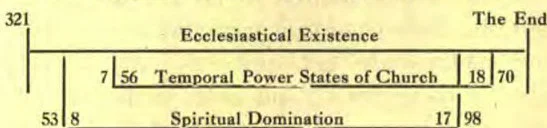
"And they shall be given into his hand [power symbolized by the little horn] until a time and times and half a time." A "time" is a year; "times," the dual number, two years; a "half a time," half a year; or three and one-half years, given in other prophecies as forty-two months, and 1,260 days. See Rev. 11:2, 3; 12:6, 14; 13:5. Three and one-half years equal forty-two months, and at thirty days to the month, the Bible reckoning, 1,260 days. As the short-lived beasts represent long-existing kingdoms, so the short periods of time represent long periods. The Bible rule is "a day for a year." Num. 14:34; Eze. 4:6. The "little horn" power should therefore continue its domination over saints, times, and law 1,260 years. Is this true of the Papacy? Let us see. There are three great phases to Roman Catholicism: (1) Its ecclesiastical organization, beginning about the time of Constantine and continuing to the end. This is entirely independent of the civil power. (2) The temporal power of the Papacy, beginning under the reign of Pepin of France in 756, and continuing till 1870, when the last vestige was taken away by Victor Emmanuel. This was temporal dominion over the States of the Church. Neither of these are referred to in the above prediction. (3) Spiritual domination over the minds and consciences of men by the consent of the civil power. In 533 Justinian, emperor of Rome, decreed that the bishop of Rome should be "the head over all the holy churches," and "true and only corrector of heretics." This was confirmed and acknowledged.
But this did not immediately go into effect. The Arian Ostrogoths stood in the way of the Roman bishop's assumptions. They were subdued and fell in 538. Here began the 1,260 years. They extend to 1798. That period of time is known in the world's history as the Dark Ages. During that period "the wearing out of the saints" took place, and God's law was trodden underfoot by those who professed to be His servants.
Jesus declared that the persecution, or tribulation of those days should be shortened. Matt. 24:21, 22, 29; Mark 13:20, 24. The same thing is referred to in Dan. 11:33, 34; Rev. 12:15, 16. The shortening of the persecution of those days was caused indirectly by the influence of the Reformation, the decree of toleration by Maria Theresa, Empress of Austria in 1776, and the opening of America the same year as the home of the oppressed of all nations. The French Revolution, a reaction from the Papacy, further weakened her power, and when Pius VI. was taken captive in 1798 no power was so poor as to bow to her mandates. This threefold aspect of the Papacy may be better comprehended by the following diagram:
Specifications 11 and 12 must be left to a future study.
DIVINE FULNESS.
DEAR brethren, when you are all full of divine grace, you are filled for all the circumstances of life. If you go filled with God, you are provided for every emergency. Come calamity or prosperity, whatever shape temptation may assume, if the love of Christ has filled you with the fulness of God, you are ready for it. See how prepared you will be to meet your brethren and benefit them. Suppose you should make one in a little gathering of believers, and they should ask you to speak a word; if you are full, your speech will be worth hearing, but if you are empty, your communications will be empty also.
Sometimes when we preach we are conscious of unfitness for the work, because our soul is poverty-stricken. There can not be much in our mouths if there is little in our hearts. Out of an empty sack you can not shake a bushel of wheat, even if you shake it very hard. I have heard a brother pray a wearisome while, and I believe he was long because he had nothing to say. A horse can run many miles if he has nothing to carry. Long prayers often mean wind and emptiness. The Lord be with you and in you to the full.—Spurgeon.
NOT SELF, BUT OTHERS.
God's world is very large,
Ours is so small;
Our love is for our own,
His love for all.
The Father's light and love
No change can dim;
Why have His children grown
So unlike Him?
Faces care-worn and hard,
Hearts of unrest,
Hands swift to snatch and hold
For self the best.
Insatiate greed of gold,
Luxury, ease—
What do the sons of God,
Craving for these?
O, for the love of God,
Keep love to man!
Study the Father's will,
Further His plan.
Self-love is never joy,
Never knows peace;
Aye, in the Godlike soul
Self-love must cease.
Children of love divine,
Learn larger ways;
Cherish the nobler life
Filled with God's praise.
Sorrow will lose its power,
Morning will break,
If the heart lose itself
For love's dear sake.
—Marianne Farningham.
Page Number
By Max Hill
1
"WHY LOOKEST THOU TO EARTH?"
By Lilian Huntley
LONG years ago I saw a picture bearing the above title, which showed a narrow path leading through a mountain. On each side rose huge cliffs towering far above a weary mortal slowly passing along the bending beneath a load far greater than his strength. The path he had passed over may have been bright and pleasant, but now it was lost from view, and the path before also was hidden in the depths of the great rocks. Only the bitter present was visible to him, and he bent beneath his load as tho it were "greater than he could bear." With eyes close fixed to the ground he wended his way in deep distress, while high above him was a glimpse of the beautiful sky, and hovering over him were numerous angels waiting to minister to him if he would but look up. Poor, short-sighted creature, with heaven all his own for a look, and God's messengers eager to help him, he was passing along with eyes riveted to the earth and his thoughts only on his hard path and heavy load.
How many of us, like that earth-bound traveler, let our cares and troubles weigh us down, forget to look up, and thereby lose the beauty and comfort God always has at hand for His children. What if our lot is hard? He may be just putting the finishing touches to us, His handiwork. If our lines have fallen in hard places, let us take comfort in thinking that God has great faith in us to give us such a heavy load.
"In just that very place of His
Where He hath put and keepeth you,
God hath no other thing to do."
No other can fill our place; we only can do this work of His, and He wants us to do our best. He may be just fitting us for higher service, for a fuller life where our influence for good may be greater. So, let us forget "those things which are behind, and reaching forth unto those things which are before, . . . press toward the mark for the prize of the high calling [rendered 'upward calling' in the New Version, marginal notes] of God in Christ Jesus."—Lilian Huntley.
WHAT WE MOST NEED.
MEN who can not be bought. Men who put character above wealth. Men who possess opinions and a will. Men who will not lose their individuality in a crowd. Men who will not think anything profitable that is dishonest. Men who will be honest in small things as well as great things. Men who will make no compromise with questionable things. Men whose ambitions are not confined to their own selfish desires. Men who are willing to sacrifice private interests for the public good. Men who are not afraid to take chances, who are not afraid of failure. Men who will not have one brand of honesty for business purposes, and another for private life.—Citizen's Bulletin.
THE HOME
By May Gower
RAIN AND SHINE.
ALL day the murky clouds had hid
The smiling sun from view,
And showered its wealth of crystal tears
The budding branches through.
And clad in mist, the distant groves
Loomed faintly indistinct,
Like shadows seen within the stream
Above the mossy brink.
I watched the gloomy, restless clouds
Shift slow from west to east,
Where bright no beauteous colors burned
The weary eyes to feast.
But when the twilight's mantle broad
Its dusky folds outspread;
Lay dim and gray the landscape o'er,
The cloudy west was red.
Commingled bright with burnished gold,
The scarlet mantle veiled
The red and hidden sun that still
His ancient pathway trailed.
The doubting soul in fettered chains
Read, written in the skies,
The parable of suns and rains
And cloudy rainbow dyes.
Tho hidden oft by clouds of sin,
The Infinite is nigh,
By clouds enwrapped above the world
Behind the gloomy sky.