The Youth’s Instructor, Vol. 48, No. 11.

PLANT LIFE IN WINTER
Earlier text: PLANT LIFE IN WINTER

THE FIRST LESSON IN ANATOMY

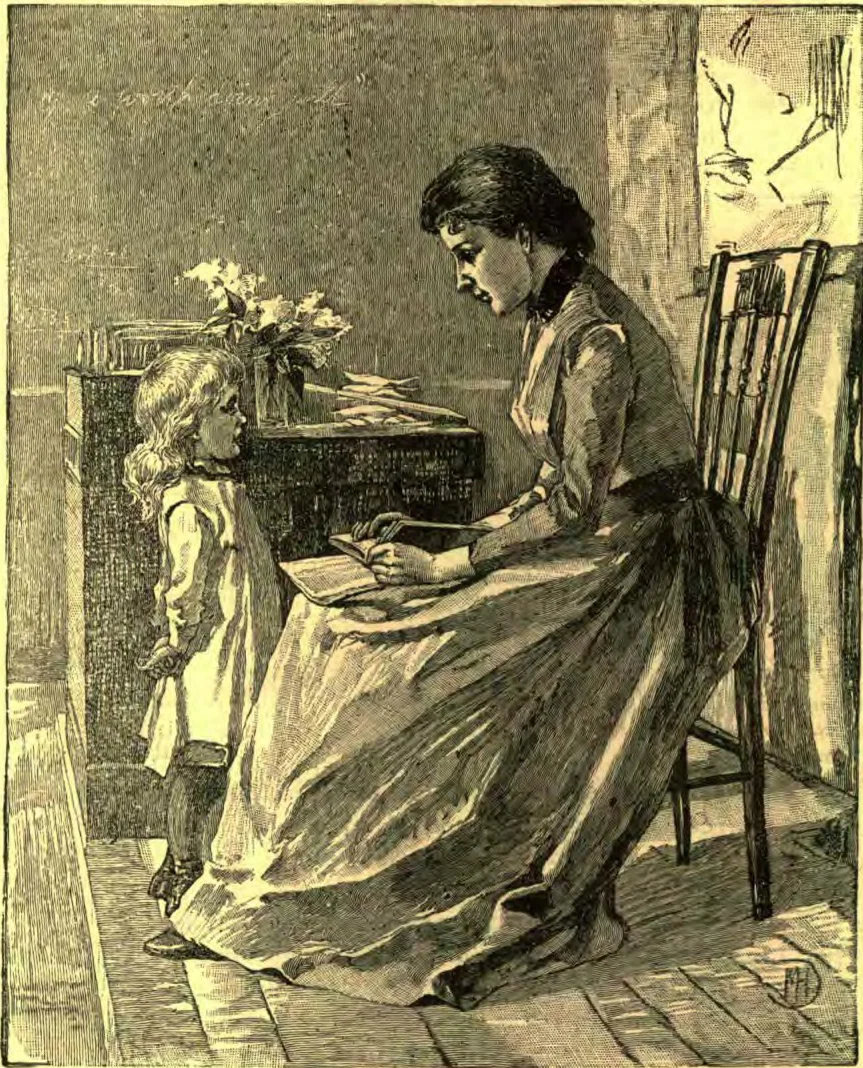
My body has so many bones it's hard to tell the names of all, They call the bones the skeleton; some bones are large, and some are small.
My forehead has the frontal bone, and two parietals the crown, While that called the occipital is found a little lower down.
Two bones, the temporal, contain the organs of our hearing; two, The nasal bones, project the nose. The upper jaw also has two.
These such a great long name are called—"superior maxillary"—oh! How could one think such little folks these dreadful names could ever know?
And then we have the lower jaw— "inferior maxillary." My! Such horribly long-drawn-out words, — enough to make us heave a sigh.
The malar, or cheek bones, repose within the face; while just below The curved occipital we find the vertebræ begin to grow.
These are the bones that form the spine; they number twenty-four alone. The shoulder of two bones is formed — the scapula and collar bone.
One large bone forms the upper arm, and this is called the humerus. Two form the lower arm; these are the ulna and the radius.
Each finger has three little bones, the carpus eight, the thumb but two.
The metacarpus five—in all, how many in your hand have you?
The sternum the breast-bone is called; the slender ribs are twenty-four;
Ossa innominata, two. Oh, how such names I do deplore!
But then their office is so great, that this, of course, somewhat atones:
The lower limbs to trunk are joined by these important "unnamed" bones.
The femur, or thigh bone, we find is very long and large and round. The tibia and fibula—two bones below the knee are found.
The knee-cap, or patella, forms a cover for the bending knee. They say the foot has twenty-six small bones; and that's what puzzles me.
Two hundred and eight bones in all, they say, within the body grow.
I don't see where they all are hid; but then I s'pose it must be so.
I can't name any more; you see they are so many, I so small.
Just wait a while till I get big, and see if I can't name them all.
MRS. A. N. LOPER.

WHO SENT HASSAN?

HASSAN was a young Turk who lived in Egypt. He loved money, and was anxious to earn a great deal of it by acting as interpreter between his own people and the English and Americans who came to see the wonderful sights in his wonderful land. He wished to learn more, so he could make more money, and begged a lady to give him “something English to read.” She gave him a little book that had been given to her by a dying friend. Its title was “Heavenly Light on Earthly Pathways.” It was a collection of Scripture verses; and besides these, there had been pasted in the book holy poems and hymns, and little gems of thought.
“THEY ARE MANY, I SO SMALL.”
Hassan took the book, and was very glad to get it. He read it; he found Jesus in it, accepted his name and faith, and went to work for him. Hassan’s father disowned him, but that mattered not. He started schools and missions in places where no missionaries had then come; and not only did he work himself, but he also drew his brother into the same work. He set wheels in motion that will influence the world for time and for eternity.
Who sent him?—Certainly not the lady who gave him the book; she was only acting for another,—the dying girl from whose hands she had received it. The poor girl had desired to be a missionary herself. She had prepared for missionary work, and was on the eve of leaving home to go to her Heavenly Father’s far-off, foreign vineyard, when her health suddenly failed, and she slowly faded away, leaving the little book as a last legacy to her friend. It thus became her missionary, and did the work that she was not permitted to do.
It is a Sabbath-school story, beautifully told: I give only the outline. Save the beautiful thoughts, the holy hymns; but while you are doing this, give yourselves to God. You know not what may be wrought out through you and the tender keepsakes that you put into other hands.
Work, little ones, and be sure that you work for Jesus. AUNTIE WINCE.

WHAT BERNICE LEARNED ABOUT THE TWELVE APOSTLES

V

“I can tell you something else I learned this week, grandma,” said Bernice. “I found out that Bartholomew had another name,—Nathanael,—or at least it is supposed that this is so; but does the Bible say so, grandpa?”
“I think not, my child,” said grandpa; “but I am sure you are right; for although I can not find that the Bible says, directly, that Bartholomew and Nathanael refer to the same person, it is evident that they do. But what did you learn about Bartholomew, Bernice?”
“The history says that after Christ’s ascension, he went to India, and after a while he left this place, and moved to Phrygia.”
“I have noticed that Philip and Bartholomew are always mentioned together; very likely they were dear friends. But can you tell us, Bernice, what kind of people lived in Phrygia when these apostles went there to labor?” asked Aunt Emma.
“They were heathen. They did not worship the true God at all, and the rulers did not like to have the people converted: they wanted to have the authority over them, so they declared that Bartholomew must be killed. It is dreadful to think that those good men could not tell the people about Christ without making the wicked rulers angry. At last they fastened Bartholomew in some way to a cross, but the history does not tell just how.”
“Perhaps they nailed him—that was the custom,” said grandpa.
“But I don’t think they did, grandpa, because by and by they took him down, and he lived and preached a long time afterward. I think they must have tied him on—you know that was the way the wicked people did with St. Andrew. The history of the Bible only says that they ‘fastened’ Bartholomew to a cross.”
“I dare say you are right, Bernice,” said Aunt Emma; “but you do not tell us why the people took the apostle from the cross.”
“Why, Auntie, their act was so very dreadful and wicked that they became ashamed and sorry before they had killed the good man, and so they hurried and took him down,—I was so glad when I read it.”
“Do you not think,” asked grandpa, “that the Lord troubled them by his Holy Spirit, and made their hearts tender, so that the life of his servant might be spared until he had fully accomplished the work that the Master had for him to do?”
“I think so,” said Aunt Emma; “the Lord has work for us each to do, and he will keep us until it is accomplished, if we trust in him. But what finally became of St. Bartholomew, Bernice?”
“Well, he thought it would not do any good to stay at this place any longer, so he went to Lycaonia. He was much more successful here than in Phrygia, and many persons were converted. But at last he went to a very wicked city called Albania, and there he was put to death by the cruel people, whom he had tried so hard to help. They were not contented until they had tortured him to death. It seems to me that they might have been satisfied,” continued Bernice, “by just putting him in prison; that would have been bad enough.”
Then Bernice crept up on grandma’s lap, and laid her head on the kind shoulder, while grandma said: “You have done very well, indeed, my child, and I am sure these studies will be profitable for us all, and particularly for you; because whatever you learn now, while you are young, you will be likely to remember. How necessary and commendable it is for you to store your mind with gems of truth from the word of God before the time comes when, in his providence, we may be brought before kings and rulers of this world, as were the apostles of old, to answer for the hope that is in us.”
MRS. L. D. AVERY-STUTTLE.

Paper Pulp Sails for Vessels

ACCORDING to the Well-Spring, a process has been discovered by which sails of vessels of all kinds can be made out of paper pulp, and it is claimed that they serve quite as well as canvas, and are very much cheaper. They swell and flap in the wind like the genuine, old-fashioned article, and are supposed to be untearable.

BEREAN LIBRARY STUDY

Dan. 11:14-19; “Thoughts on Daniel,” pages 230-239
The regular Outline of these studies is published in the Review and Herald and also in the Missionary Magazine. What is here given is only supplementary, and should be studied in connection with the Outline.

NOTES ON LESSON 16

(March 18-24)
1. Egypt—the “Gift of the Nile.”—Under the name “king of the south,” Egypt is introduced in the prophecy of Daniel 11. The River Nile flowing northward to the Mediterranean Sea, enriched the valley by the overflow of its swollen waters, thus annually depositing a layer of the most fertile soil. Notwithstanding her rainless climate, Egypt, nourished, watered, and cooled by the bounties of her solitary river, rivaled the Tigris-Euphrates basin as a center of early civilization.
2. The Scene of Many Bible Incidents.—To the Bible student Egypt is a country of special interest. Abraham at one time sojourned in Egypt because of the famine in other lands. Joseph was sold to merchantmen who took him to Egypt, where he finally became “governor over the land,” and made Egypt the granary of the world during the seven years’ famine. The family of Jacob was established in Lower Egypt and grew and multiplied. For a time the Hebrews were held in honor by the government, but later suffered oppression. They were set to work enlarging cities, digging the great canal between the Nile and the Arabian Gulf, toiling in the brickyards, and all the time beaten and oppressed by taskmasters, until they broke out in an insurrection. Finally the Lord brought them out of Egypt, and magnified his name in so doing. During the time of the kings of Israel and Judah, the Jews were alternately in alliance and at war with Egypt for many years. The infant Jesus was taken in haste to Egypt, to avoid the decree of Herod. Later Joseph, Mary, and the Child returned to Nazareth, according to the instruction of the Lord, and in fulfillment of Hosea 11:1.
3. The First Kind of Writing Paper.—The oldest material commonly used for writing purposes appears to have been the papyrus, or paper-reed, which flourished so luxuriantly that it formed jungles along the banks of the Nile. This paper-reed had a large, three-sided, tapering stem, two or three inches broad at the base. The reed was prepared for use by peeling off the smooth bark, and cutting the inner mass of white pith lengthwise into thin slices, which were laid side by side, edges lapping. A second layer was then placed crosswise upon the first, and the whole sprinkled with the muddy Nile water. A heavy press united the layers and strips into one mass. After drying, it was cut into sheets of the required size. In a prophecy concerning Egypt, Isaiah says: “The paper reeds by the brooks, by the mouth of the brooks, . . . shall wither, be driven away, and be no more.” Isa. 19:7.
4. The Alexandrian Library.—Mention is made in our lesson of the burning of that famous library. It was one of the seats of “the learning of the Egyptians,” famous throughout the East. At one time the library is said to have comprised, in all its collections, seven hundred thousand volumes. Connected with it was the Museum, a botanical and zoological garden, an astronomical observatory, and a chemical laboratory. Teachers were provided at the public expense, and the scholars of the world resorted there. Probably no other institution ever exerted so wide an influence.
5. The First of the Cæsars.—Julius Cæsar was born July 12, B. C. 100. At the age of forty he was still only a soldier in the field. He had been a reckless spendthrift while at the capital, and was pale, slender, prematurely bald, and had no reputation except for personal bravery. Suddenly he became a changed man. In the rivalry of the leaders at Rome, he saw his opportunity. He sought and obtained a command which enabled him to train an army by whose help he became master of Rome. Then it was that the “lightnings of his genius began to flash.” He fought at the head of his legions, swam rivers, climbed mountains, ate hard bread, shared the lot of his soldiers,—the hardiest of the hardy and the bravest of the brave, all the time heaping up “the glowing embers of his ambition.” It seemed that the forces of his mind could never be sufficiently occupied. When riding or resting, he was constantly planning, discussing, or writing, occasionally dictating to as many as seven secretaries at one time.
6. His Ambition Triumphed.—The tide of Cæsar’s popularity increased, and the Roman Senate heaped titles and honors upon him. One decree made him the father of his country; another, consul for life; another, dictator for life. He was given full charge of the treasury, and a figure of his head was stamped upon the coin. The name of the month in which he was born was changed from Quinctilius to Julius, and is still our July.
7. “He Shall Stumble and Fall, and Not Be Found.”—Nothing is more fickle than the favor of the world. The professed friends of Julius Cæsar united with his enemies, in a plot to take his life. On his way to the Capitol some one handed him a scroll containing the details of the plan, but he had no opportunity to read it. As soon as he had taken his seat in the Senate chamber, the conspirators crowded about him, but he did not surmise their intentions, as they were men who owed their lives and fortunes to his favor. Suddenly there was a gleam of swords and daggers. For a moment he defended himself, but catching sight of Brutus, one whom he had especially loved and trusted, he exclaimed, “Et tu, Brute!” (Thou, too, Brutus!), and wrapped his mantle about his face, as he fell pierced to the heart.

MARCH STUDY OF THE FIELD

Part III: “Historical and Political China”

(March 18-24)
1. Opium.—Opium is prepared from the juice of the opium poppy. It is said to have been introduced into China about 1280 A. D., probably by the Arabs. It appears to have been used as a medicine before the trade with India began. Most of the opium used in China is imported from India. The poppy is largely cultivated in China also, and the opium produced there competes successfully with that imported.
2. Opium-Smoking.—Opium-smoking is prevalent throughout China. The habit is soon formed, and it so weakens the moral nature and the will power that it is very difficult to break. After the habit is formed, if not indulged in at the usual period, there is a state of exhaustion. The smoker lies on a couch, with the smoking paraphernalia near him. With a needle-like implement he places over the bowl of the pipe a small piece of opium, holds it in the flame of the small lamp, and inhales the vapor. In a few seconds the smoke is exhaled. This is repeated again and again, until the Chinaman goes to sleep under the influence of the drug. The use of opium seems to be increasing.
3. Shanghai.—This is one of the chief ports. The “Foreign Quarter” was built by Europeans, and is governed by foreigners. The roads of the city are good, and the streets quiet and orderly, presenting a contrast to those in the Chinese quarter. Along the river bank is a broad and well-kept boulevard, called the Bund. On the water side of the Bund are trees and a grass plat. On the other side are mercantile buildings second to none of their kind in the world. At one end of the boulevard are well-kept gardens, with hothouses and conservatories. Here the band plays on summer evenings.
4. The Island of Hong-Kong.—This island is situated off the southeast coast of China. Hong-Kong means “The Place of Sweet Streams,” being so called from the number of streams that flow through the island. This is one of the small cluster of islands that were called Ladrones, or Thieves, by the Portuguese, from the habits of the old inhabitants. The island is rocky and mountainous. The circumference is about twenty-five miles. Rice, sweet potatoes, and yams are cultivated along the coast, in small patches of land. One of the chief products is building stone, which the Chinese quarry. From May to October the heat is oppressive, and there is much rain and dampness. During part of the winter the weather is cool, dry, and bracing, and sometimes cold.
5. The Capital of Hong-Kong.—Victoria, the capital, is situated at the northwest extremity of the island, and is laid out in fine streets and terraces. In the European section the houses are large, and often beautiful, surrounded with gardens and trees. Some of the industries are sugar-refining, rum-distilling, and ice-making. The harbor is fine.
6. China and Foreign Trade.—The first attempt that the English made to open commerce with China was about 1635. The result was not very encouraging. Another attempt was made in 1664. But the Chinese placed restrictions upon trade along the coast, putting an additional tax upon imported and exported goods, and appointing an officer who alone had the right to trade with the merchants. Thus trading was carried on at a disadvantage. Twice England sent over embassies. The first was received civilly by the emperor, but was unsuccessful in gaining that for which it was sent—the removal of the tax on foreign goods, and the opening up of certain ports to foreign trade. The next embassy was not treated so well. America and Europe subsequently sent embassies, but the Chinese were stubborn, and would not yield. The opium war resulted in opening up some ports to trade with other countries. The war with England and France opened further trade.
7. Chinese Emigrants.—The following is a description of the way in which eight hundred Chinamen entered a ship that left one of China’s southern ports: When the cargo was all on the ship, the passengers were allowed to go aboard. They came on frantically, with a rush, all shouting, and in great excitement. The first thing many of them did after getting on the vessel was to throw down a mat and stand upon it, thus claiming for their use during the voyage the place that the mat occupied. They did not seem to mind at all the fact that others going to their places trampled upon the mat with their dirty feet, and almost destroyed it. In a short time they had spread over the parts of the ship allotted to them.
8. Life on Board an Emigrant Ship.—After the passengers had been inspected by the officials, to make certain that they were all proper persons to sail, and that there was no sickness among them, the voyage was begun. The men seemed contented, and behaved very well, considering the great number of them. Although they were so closely packed that they must have been a great inconvenience to one another, disagreements did not occur often. There were sixteen cooks. One cook would seat himself on the rail of the ship, near the immense pot of rice, and as each Chinaman came up with his basket, he would place in it the proper allowance of rice.

THE AGONY OF THE CROSS

  • (March 24, 1900)
Memory Verses.—Rom. 5 : 6–8.
Time: A. D. 31. Place: Calvary. Persons: Thieves, centurion, acquaintances of Jesus, women of Galilee, multitude, Jesus.

QUESTIONS

1. As they hung upon the cross, what taunting words did one of the thieves utter? Luke 23 : 39. What did the other immediately say in reply? Vs. 40, 41. Then, looking to Jesus, what wonderful request did he make? V. 42. What comforting answer came from Jesus’ lips? V. 43; note .
2. What persons who were especially dear to Jesus stood near the cross? John 19 : 25, 26. With what words did Jesus make provision for the care of his mother? Vs. 26 (last part), 27.
3. At noon (the sixth hour) what change took place in nature? How long did it continue? Mark 15 : 33; note . While darkness enveloped the cross, what cry escaped the Saviour’s lips? V. 34. What did some understand him to say? V. 35. In his agony, what did Jesus now say? John 19 : 28.
4. Touched with pity, what did one of the bystanders do? Matt. 27 : 48. What did others, in derision, say? V. 49. With what words of victory did Jesus yield up his life? John 19 : 30; Luke 23 : 46; note .
5. When Jesus died, what significant event took place in the temple? Mark 15 : 38; note . At the same time, what other startling things occurred? Matt. 27 : 51–53; note .
6. Who took note of these things? What confession were they led to make? V. 54; note . What did others do? Luke 23 : 48. What friends of Jesus remained until the close of the crucifixion scenes? V. 49.

NOTES

GRAND TRUNK RAILWAY SYSTEM.

Time-Card in Effect November 19, 1899.

C. & G. T. DIVISION.

WEST-BOUND FROM BATTLE CREEK.

No. 9, Mail and Express, to Chicago 12.15 P. M.
No. 1, Chicago Express, to Chicago 9.00 A. M.
No. 3, Lehigh Valley Express, to Chicago 3.40 P. M.
No. 5, Pacific Express, to Chicago, with sleeper 1.10 A. M.
No. 75, Mixed, to South Bend 8.20 A. M.
Nos. 9 and 75, daily, except Sunday.
Nos. 1, 3, and 5, daily.

EAST-BOUND FROM BATTLE CREEK.

No. 8, Mail and Express, to Pt. Huron, East, and Detroit 3.45 P. M.
No. 4, Lehigh Express, to Port Huron, and East 8.27 P. M.
No. 6, Atlantic Express, to Port Huron, East, and Detroit 9.25 A. M.
No. 2, Leh. Exp., to Saginaw, Bay City, Pt. Huron, and East 6.50 A. M.
No. 74, Mixed, to Durand (starts at Nichols) 7.15 A. M.
Nos. 8 and 74, daily, except Sunday.
Nos. 4, 6, and 2, daily.
A. S. PARKER, Ticket Agent, Battle Creek.

To Reach BATTLE CREEK

FROM
CHICAGO, BUFFALO, DETROIT, OR TOLEDO,
Purchase Tickets Reading over the MICHIGAN CENTRAL “The Niagara Falls Route.”
A First-class Line for First-class Travel between Chicago and New York and Boston. Elegantly equipped through trains pass Battle Creek in each direction daily.
R. N. R. WHEELER, Ticket Agent, Battle Creek. O. W. RUGGLES, Gen’l P. and T. Agt., Chicago, Ill.

TAKE THE Canadian Pacific Railway

for . . . CHATHAM, OTTAWA, MONTREAL, LONDON, GALT, QUEBEC, WOODSTOCK, TORONTO, BOSTON, PORTLAND, and all points in New England, the Maritime Provinces, Great Britain, and the Continent.
Illustrated literature, time-tables, and full particulars, upon application to—
J. FRANCIS LEE, GEN. AGENT,
Passenger Dept. 228 SOUTH CLARK ST., CHICAGO
Branch Offices: 76 Ottawa St., Grand Rapids, Mich. Room D, Chamber of Commerce, Cincinnati, Ohio. 315 Chestnut St., St. Louis, Mo.

Cincinnati Northern Railroad Co.

TIME TABLE NO. 3.

IN EFFECT SEPT. 24, 1899.
Trains Pass Battle Creek, as follows:

WEST-BOUND.

Train Time
No. 21, Mail and Express 6.58 P. M.
No. 23, Accommodation 2.07 P. M.
No. 27, Local Freight 8.25 A. M.

EAST-BOUND.

Train Time
No. 22, Mail and Express 8.25 A. M.
No. 24, Accommodation 1.45 P. M.
No. 28, Local Freight 5.30 A. M.
Direct connections are made at Toledo with all roads diverging. Close connections for Detroit and Cincinnati.
J. L. READE, Ticket Agt., Battle Creek.
B. R. SMITH, City Pass. Agt., 6 West Main St.

“IT WAS MY FAULT”

How the heart unconsciously warms to the frank, open-hearted boy or girl, man or woman, who is willing to “own up” to a mistake! who does not endeavor to hide behind, “I didn’t think,” “I’m not supposed to look after that,” “I forgot,” “Somebody else didn’t—or did,” and the hundred and one excuses of the shiftless person, who tries to deceive his employers or teachers, parents or playmates, into believing that it “wasn’t really his fault.” Sometimes he succeeds—for a little while; but in the long run the world usually estimates him at his true worth: the gold-plated nickel piece is finally held at its true value.
One of the most foolish and futile things a person can do is to try to make out that he is infallible: the very effort shows large self-esteem and lack of thought, and so defeats itself. Every one makes mistakes—but the wise person is careful not to make the same mistake twice; and when he is “overtaken in a fault,” he does not double, and twist, and turn, and finally grudgingly admit that “maybe it was his fault, but—” No, indeed! He says, sincerely and at once: “It was my fault. No one else is to blame. I am sorry it happened, and I will try to see that it does not occur again.” And when all is done that can be done to remedy the error, he does not waste time in worrying and fretting over that mistake, and so open the way for others, but goes diligently ahead with the day’s duties, determined that they shall be done to the very best of his ability.
But, when all is said, it is only common honesty to admit one’s failures, and try to correct them. It is the mark of a really fine character to be willing to bear the blame of other people’s negligence and carelessness and stupidity, in order to save friction—and to bear it so sweetly and cheerfully as to cover, thereby, “a multitude of sins.”
A few days ago I saw a young girl in a trying place. She is a clerk; and an angry customer had come into the store to demand an “explanation” about a package she had ordered and paid for two days before, and which had not been sent. The proprietor, who had taken the order, and who had evidently “forgotten,” laid about him for excuses, and finally shifted the blame to his young clerk. There was only one small detail in which she could possibly have been held at fault, but it did not seem to occur to her to excuse herself. Courteously and sweetly she accepted the blame, mollified the irate customer and her somewhat unjust employer, and at the same time unconsciously showed forth the virtue of the “soft answer.” In a moment every one was good-natured, and the customer went away declaring “that it really didn’t matter much, after all.” But think how differently it would have been had Elsie allowed the natural thought that she was not to blame, and that it wasn’t fair to be so accused, to gain the ascendency in her heart, and find sharp expression! The customer would have left the store with the resolve never to enter it again, the proprietor would have been angry, and Elsie herself would have been unhappy; for it is a poor sort of satisfaction that comes as the result of setting one’s self right at the expense of others.
What impressed me most in this particular case was the way the blame was taken—so quickly, naturally, and with such unconsciousness of doing anything unusual. It showed a heart not filled with vanity and self-love, ready to be wounded at every turn, but the character of the peacemaker, whose joy comes in making others contented, even when it costs something.
When you make mistakes, do not be ashamed to acknowledge them—rather be ashamed not to. Even our blunders, rightly met and frankly acknowledged, may become stepping-stones on which to rise to that perfection in our work that will make us indeed “workmen approved.” And if by chance we are placed where we receive the blame for another’s errors, let us think twice before we expose his weakness to save ourselves. Perhaps by bearing the blame for him, we may help him as we never could by leaving him to bear the full weight of his offense alone.

FOR EVERY DAY OF THE WEEK

SUNDAY:

“To be nameless in worthy deeds exceeds an infamous history.”

MONDAY:

“The lamps I light along life's way May throw their rays on meager space; The flowers I scatter, day by day, May brighten but a little place; Yet if I light to higher goal One who the upward path would gain, Or cheer some sorrowing, starving soul, I can not count my labor vain.”

TUESDAY:

The weightiest words in our language are two of the briefest ones—yes and no. One stands for the surrender of the will, the other for denial; one for gratification, the other for character.—Theodore T. Munger.

WEDNESDAY:

“We can not all be heroes, And thrill a hemisphere With some great, daring venture, Some deed that mocks at fear; Yet we can fill a lifetime With kindly acts and true: There's always noble service For noble souls to do.”

THURSDAY:

Christianity wants nothing so much in the world as sunny people. The old are hungrier for love than for bread, and the oil of joy is very cheap; and if you can help the poor on with a garment of praise, it will be better for them than blankets.—Henry Drummond.

FRIDAY:

“Lean hard on the heart of the Master, But give of his strength to all; For the human touch has a virtue such That, feeling, we may not fall.”

SABBATH:

“Behold the fowls of the air: for they sow not, neither do they reap, nor gather into barns; yet your Heavenly Father feedeth them. Are ye not much better than they?” Matt. 6:26.

“A GOOD THING TO LET ALONE”

We hear a good deal in these days from certain would-be reformers about “amending the Constitution,” and so fixing it up that their ideas and convictions may be carried out. It is therefore refreshing to hear a voice raised in defense of the Constitution as it is,—that of one of the editorial contributors of the Saturday Evening Post. Under the heading given above, he says:—
“There are various schemes before Congress to amend the Constitution. Many good people would, if possible, ingraft forever their fads and ideas upon this venerable and imperishable instrument of free government. In order to make any amendment, there must be a two-thirds vote of Congress, and the vote must be ratified by three fourths of the State legislatures. An alternative allows the calling of conventions to do the work, but that is no longer feasible. It is well that our forefathers protected the Constitution so thoroughly; but it is like the other work they did in establishing this Republic. The Constitution was the product of four months of secret and heroic work by the best men of the new nation, presided over by Washington. Many a time results were despaired of, and even Franklin came near giving up hope; but, in the end, the matchless document was adopted. Then it had another trial before the States, and it was with the greatest difficulty that it was finally ratified.”
“Two years afterward there were added ten amendments, largely the work of James Madison, and intended to guard the rights of the Constitution and prohibit dangerous exercises of authority. Seven years later, in 1798, the eleventh amendment, referring to suits against the government, was agreed upon. In 1804 came the twelfth amendment, referring to the work of the Presidential Electors. For over sixty years from that date the Constitution remained untouched. Then came the thirteenth amendment, in 1865, confirming the Proclamation of Emancipation. In 1868 followed the fourteenth amendment, making the negroes citizens of the United States; and in 1870 the fifteenth amendment gave these freedmen the right to vote.”
“This, in brief, is the history of the grandest plan of government the world has ever known. . . . After we have investigated all the suggestions, and weighed all the propositions, there seems to be nothing to change the fact that, as the Constitution is to-day unequaled and supreme, it would not be wise to endanger it by ‘improvements.’ Let us hold it sacred!”
Continue reading: Guarding Our Greatest Strength Against Excess