The Youth’s Instructor, Vol. 48, No. 11.

PLANT LIFE IN WINTER

The Youth’s Instructor

Mar 15, 1900

Review and Herald Publishing Company · Battle Creek, Mich. · Mar 15, 1900

PLANT LIFE IN WINTER
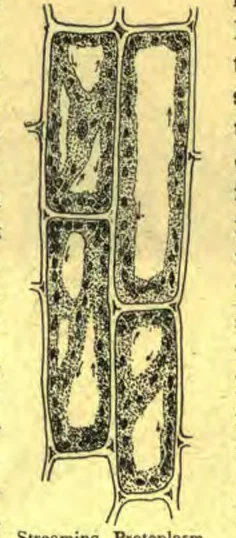
In the last article we spoke of the cells of plants and their protoplasmic contents. We have learned that all plant activity and growth are due to the multiplication and action of protoplasm. There is, further, a remarkable action of the protoplasm in the interior of the cell itself. Just as the blood in your body is forever flowing through the heart, the arteries, and the veins, back into the heart again, thus making round after round, so in these cells there is, under a favorable temperature, a constant streaming of the protoplasm.
Often protoplasm is studded with minute, dark granules called microsomata. These granules are seen “driven backward and forward with the stream, like particles of mud in turbid water,” and their motion reveals the motion of the protoplasm in which they lie. There is often more than one current in the same cell. “Granular currents flow hither and thither, now uniting, now again dividing. They often run in opposite directions, even when only a trifling distance apart.” In the drawing (see following page) the direction of these currents is indicated by arrows.
I have mentioned this streaming of protoplasm in plants, in order that we may study what happens when a plant freezes, and see how hard it tries to keep from freezing. Professor Kerner, of Germany, has given us some observations made with the Nitella Syncarpa, a plant growing in the clear water of lakes and pools in Central Europe. When this plant is exposed to a temperature where water freezes, its vital activity is not disturbed. The streaming of the protoplasm in the cells is still very active; and even if, by further cooling of the surrounding water two degrees centigrade, needles of ice are formed, the streaming of the protoplasm may still be recognized. The cells are somewhat crowded and compressed by the ice-needles, but even at three degrees below zero centigrade, the protoplasm is never killed.
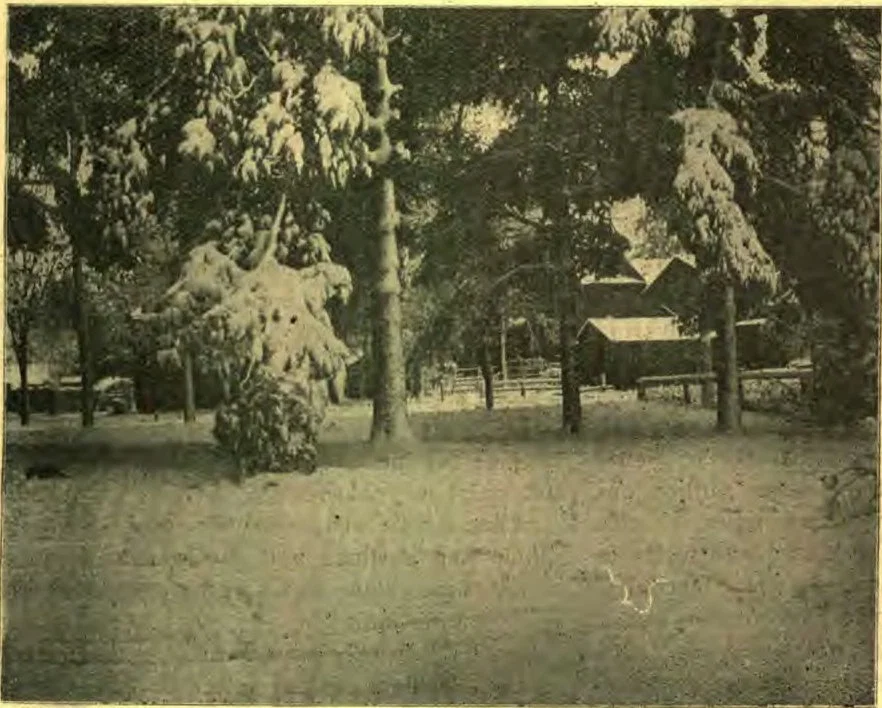
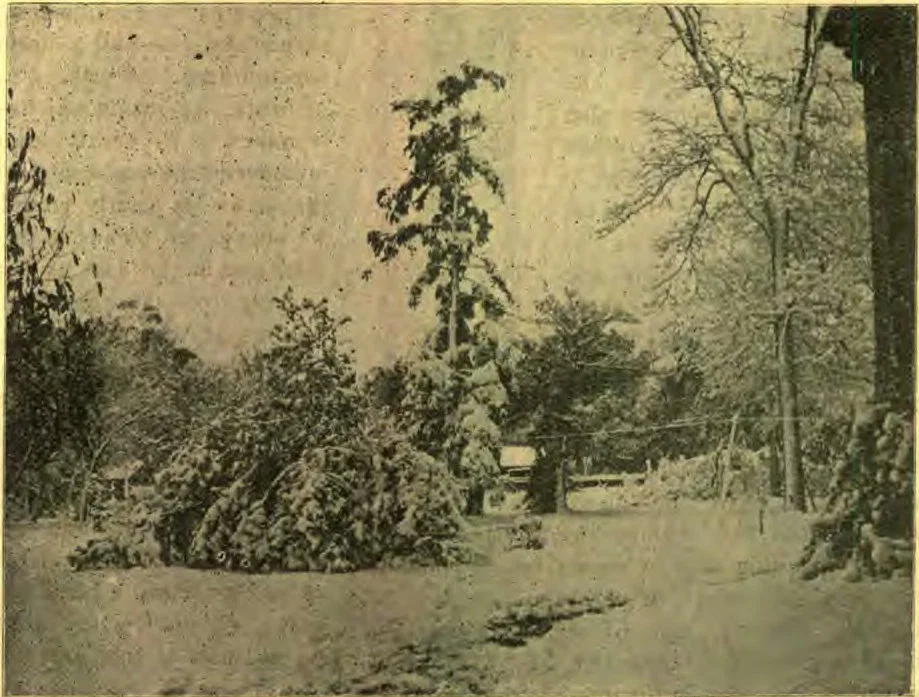
“LOW THE TREES BEND THEIR HOAR HEADS.”
“THEIR WINTER ROBES OF PUREST WHITE.”
The water in ponds or lakes, if it remains fluid, never gets colder than this, and near the bottom it may even be warmer; so we see that this little plant is safe from freezing if it does not get too near the surface, where the water turns to ice. But if this plant is exposed to a temperature of −4°, its cells first begin to shrivel up, give up a portion of their water, shrink away from the cell-wall, and make a folded contracted sac in the center of the cell; while the water around it— between it and the cell-wall—stiffens into ice. The protoplasm is dead. When exposed to a warmer temperature, the ice melts, and the protoplasm expands, and lies close to the cell-wall; but it is incapable of again producing the streaming movement; it has ceased to live.
What I wish you especially to notice is the fact that the protoplasm never freezes without first squeezing out some of the water in itself. This water flows out into a space between itself and the cell-wall, so that we have, looking from the outside of the cell, a sphere, or ball, of fairly hard material called the “cell-wall;” inside of this lies a second shell, so to speak, of water; and in the center of this is the little sac of protoplasm.
If the temperature does not become so cold that the water from the protoplasm is frozen solid, the protoplasm will come to life, if slowly brought back to a warmer temperature. Why is this water squeezed out of the protoplasm when the cell gets cold?—Because the water is what turns to ice; and should the water, while still in the protoplasm, be turned to ice, the protoplasm would at once be killed. In order to adapt itself to a cooler temperature, and still not die, the protoplasm squeezes out this water; then the water may have many crystals of ice all through it, and still do no special harm to the protoplasm. But if the weather grows colder, the water freezes solid, and the protoplasm dies of cold.
You know that salt placed on ice in winter will often cause it to melt when clear water is quickly frozen solid. In the same way, brine, or salt water, will not freeze until the temperature has passed far below the freezing-point; if at last it does freeze, the water separates from the salt before it becomes solid. So with the protoplasm. Like salt water, it will not freeze when ordinary water is turned to solid ice; but when the weather gets colder and colder, the water separates from the protoplasm; and when this water freezes, the plant dies.
You know that some plants can stand much more cold than others. For instance, water freezes at the freezing-point; with a little salt added, it freezes at a somewhat lower temperature. The more salt in the water, the lower its freezing-point. The water of the Greenland Ocean freezes at a temperature three and one-half degrees below that necessary to congeal clear water. “When concentrated till its specific gravity reaches 1.1045, sea-water requires for its congelation a temperature eighteen degrees lower than the ordinary freezing-point.”—Tyndall. In a similar manner all protoplasm does not freeze with the same amount of cold. House plants will not live where apple and cherry trees are uninjured. Peaches will freeze where evergreen trees flourish luxuriantly.
The stone pine and the shore pine can not bear the frost of winter, while the arolla pine and the Bhotan pine flourish in regions where the trunks and acicular leaves of all the trees are cooled down for weeks to four degrees below zero Fahrenheit, or thirty-six degrees below the freezing-point of water.
Streaming Protoplasm
On the summit of a fairly high sand-hill, over which the icy north and northeast wind swept almost uninterruptedly, a plant of scurvy-grass was observed by travelers on the northern coast of Siberia. “This plant had begun to bloom in the summer of 1878, and had also partly developed fruit.” When the winter began, however, it still possessed ripe fruits, flowers, and flower-buds, as well as succulent green foliage leaves. It was to be expected that during the long winter, under the influence of continuous cold, the delicate succulent tissue would be completely destroyed. In the summer of 1879 the plant, whose tissue had without doubt been cooled down for a long time to twenty-two degrees below zero Fahrenheit, or eighty-six degrees below the freezing point of water, began once more to grow, and continued the growth from where it had been interrupted at the beginning of winter. The leaves resumed their functions as in the previous summer, the flower-buds opened, and new inflorescence sprang from the axils of the leaves, proving that the protoplasm of this plant had not been killed, even by a temperature of fifty-one degrees below zero, or one hundred and thirteen degrees below the freezing-point of water!
Myrtle and orange trees freeze dead in a temperature from four to seven degrees below the freezing-point; cypresses and fig trees at from twelve to sixteen degrees; vines at thirty-eight degrees; oaks and beeches at forty-five degrees; apple and pear trees at fifty-nine degrees; and plum and cherry trees at fifty-six degrees.
L. A. REED.

THAT EVENING STAR

Probably none of the INSTRUCTOR family have failed to notice the bright star that hangs in the western sky during the early part of the evening. This glowing gem has been our evening star since the middle of September, and will continue to claim our admiration for some months. It will be well to watch this planet, and fix its position in mind; for by the last of June it will set too early for satisfactory study, and after July 8 it will set before the sun, to appear as a morning star the remainder of the year.
This planet—Venus—makes an annual journey around the sun, the same as does our own Earth, except that, as it does not have so far to travel, it accomplishes its circuit in about seven and one-half months; or, to be exact, two hundred and twenty-four days. Its path, or orbit, lies inside our own; that is, the path it makes in its yearly journey around the sun is between the sun and the path that our planet makes in its yearly round. For this reason we always see Venus in the west as an evening star, and in the east as a morning star, never varying from these positions. Because its path lies inside that of Earth, we never see the full illuminated face of the planet only as it swings to the farther side of the sun, which places it at the farthest possible distance from Earth.
To the unaided eye, Venus appears as a bright golden star; but when viewed through a telescope of even moderate power, we see it as an immense globe, or world, swinging in space, upheld by the mighty power of God. As we look at this world when it is on the opposite side of the sun, the view is similar to that of the full round moon; but as the planet approaches more nearly to our own position in the heavens, it presents the different crescent phases similar to our moon in passing from the full to the third and last quarter.
Venus has her north and south poles, as has Earth; and these being inclined to the plane of her ecliptic, that world enjoys the seasons of spring, summer, autumn, and winter, the same as do we, only these changes take place more rapidly than on Earth, the whole year being less than eight months long. The days and nights on Venus are similar to our own, except that there is no moon. Why Venus was given no moon we can not tell; some of our sister planets have as many as six and even eight moons, while it is now claimed that Saturn has nine of these shining orbs to rule her night.
Although Venus has a much shorter year than Earth, her days and nights are about twenty-three hours long. The atmosphere being less dense than that of Earth, fewer electric rays coming from the sun are converted into heat and light; therefore we need have no fear about the inhabitants suffering more from heat and light than do we, though they are much nearer the sun. The mean distance of Venus from the sun is about thirty-seven million one hundred and ninety thousand miles, a trifle over two thirds the distance of Earth from our common source of heat, light, and electricity. As far as size is concerned, that world is nearly as large as is the one on which we live. The diameter of Venus, or the distance in miles through the planet, is seven thousand four hundred and eighty, while the diameter of Earth is seven thousand nine hundred and twenty-six miles.
If the readers of the INSTRUCTOR have never made a study of the starry heavens and the wonderful works of our Heavenly Father, would it not be well to begin now? We shall soon go home to our Father’s house, and follow the Lamb “whithersoever he goeth;” and as our Saviour will visit the different worlds that make up his loyal kingdom, how blessed the assurance that we may accompany him!
Let us follow these worlds in their courses around our sun, during the coming year, and become familiar with their movements. “When I consider thy heavens, the work of thy fingers, the moon and the stars, which thou hast ordained; what is man, that thou art mindful of him? and the son of man, that thou visitest him?” Ps. 8:3, 4. Venus will be brightest about July 8; then it will rapidly fade away, setting earlier each evening until it is lost to sight altogether. Then it will soon appear as a morning star, rising earlier and earlier each morning, becoming brightest about August 14, after which time it will fade away until it finally returns to us again as an evening star.
The coming year will be especially favorable for studying this branch of the handiwork of God, as this summer and fall we shall be favored with several beautiful evening stars, whose names and habits we will study later on. We invite you all to join us in these interviews with our sister worlds.
O. C. GODSMARK, M. D.

ONE KIND OF BRAVERY

Boys, shall I frighten you away from this article if I tell you it is to be a sermon,—a little bit of preaching to all manly boys? I am very fond of boys, because I believe in them, and am sure that nearly every one of them is to be trusted. Within the last twelve years, I have had occasion to send strange boys (boys called in from the street) on many errands; and in all that time only one has played me false, filling a can with water instead of getting the oil I sent him for, and keeping my money.
The sort of bravery I wish to write about is the kind that is gentle to animals. You like them, do you not? Perhaps not all have equally your affection; that is why I ask you to keep wide-awake while I preach. One of the noblest virtues is bravery; and the very highest sort of bravery is that which enables a person to fight against the foes within his own nature,—the enemies that would lead him to do a cowardly thing, plan a cowardly act, or think a cowardly thought.
Be brave, boys. Resist all temptations to cruelty, for cruelty is cowardice: no brave man is ever anything but tender. Do not mistake the bully for the hero. What use to boast of bravery, while treading on a worm or throwing a stone after a dog?
Be consistent; let the noble quality we are considering permeate your whole character, not only one phase of it.
When a little girl, I was very fond of young chicks and goslings, and often caught them up to pet them. One day a woman reproved me for “taking hold of the poor soft, tender things.” I quickly put down the little fuzzies, much ashamed of an action I had always thought harmless; but what was my surprise to notice my critic smilingly watching a poor fly, into whose body she had stuck a pin, crawling along, dragging the instrument of torture after it! It may seem great fun sometimes to tease a helpless animal or insect, but remember that the “fun” is all on one side,—the side of the coward.
When the impulse to torment a helpless creature prompts you to plague cats, capture birds, worry dogs, mice, rats,—in fact, anything in your power,—will you not try to imagine how you would feel, if some one as much more powerful than yourself as you are more powerful than the creature you are tormenting, was treating you as you propose to treat it? Sometime your character, your very inner nature, will surely have to pay a heavy debt for every pang you make one of the brute creation suffer. Are you less to be trusted with the lives and happiness of innocent, unoffending creatures than you would be with money left in your care by a stranger?
Boys, dare to be brave.
MIRIAM ZIEBER.

GOD IN NATURE

So soberly and softly The seasons tread their round; So surely seeds of autumn In springtime clothe the ground. Amid their measured music What watchful ear can hear God’s voice amid the garden? Yet, hush! for he is here!
No mere machine is nature, Wound up and left to play: No wind-harp swept at random By airs that idly stray: A spirit sways the music, A hand is on the chords; Oh, bow thy head and listen,— That hand, it is the Lord’s!
— Selected.

Asking God and Laboring for Our Needs

“As we must ask of God whatever we need, so must we labor for all that we ask.”

THE CEIBA, OR COTTON TREE

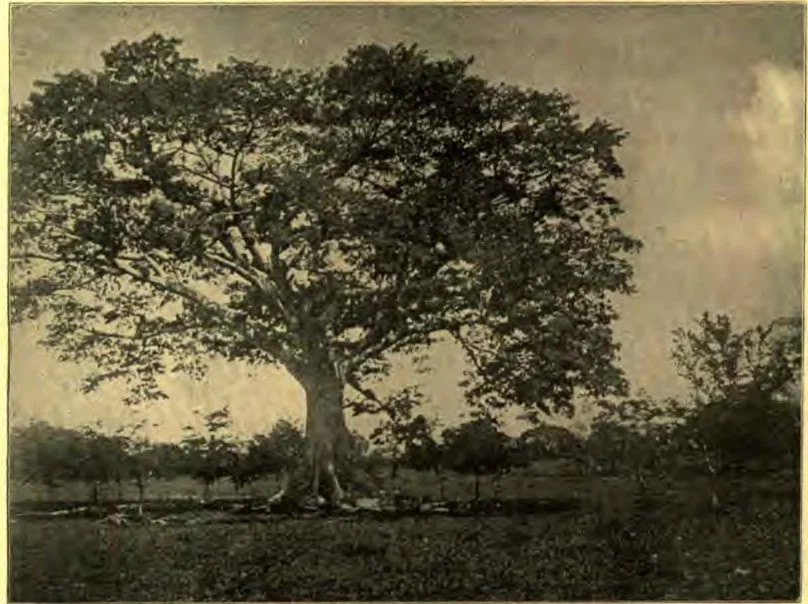
ONE of the most noticeable trees of the West Indies is the ceiba, or, as it is commonly called, the cotton tree. It is usually quite symmetrical, and presents a stately appearance. One peculiarity that distinguishes this tree from its companions is that it usually has no branches low down; often the first branches are as high as fifty feet from the ground. Some of these are as large and long as an ordinary tree. Another peculiarity is a barrel-like bulging a short distance from the ground, making the circumference of the trunk larger there than at the base. This is more noticeable, however, in those trees that have no spur roots running out from the trunk partly above ground. These spur roots are an almost universal characteristic of the tree. Another thing that distinguishes the cotton tree from most other tropical trees is that it is deciduous. Most trees in the tropics shed their leaves gradually, at the same time putting out new ones, so that they are always green. But the cotton tree sheds all its leaves, and then almost immediately puts on its new green coat. As a rule this change takes place in March or April.
The ceiba bears a boll, somewhat similar to that of the cotton plant, which bursts in May and June, and scatters far and wide its long, silky down, full of small, light, flat, brown seeds not unlike those of the milkweed. As far as I can learn, scarcely any use is made of this cotton.
The leaves of the ceiba are small, narrow, and pointed, perhaps four inches long to one wide, and arranged in star-like clusters. The bark is smooth, and has a purplish-gray tint, which is very attractive. The wood is white, and comparatively soft, somewhat like that of the cottonwood of the United States. It is mainly used for canoes. This is done by felling a tree, and hollowing out the trunk. Some of these canoes are over forty feet long, and are supplied with small masts and sails.
Not long ago we took the measurements of a large cotton tree near Santa Cruz, Jamaica. We had no means of accurately determining its height; but its girth, nine feet from the ground, was forty-four feet. The first limb was fifteen feet in circumference, and we counted sixteen limbs between two and five feet in diameter. The longest of these was one hundred and twelve feet in length. The longest spur root, and there were several, showed above ground for thirty-eight feet from the tree trunk. You can know that the shade of such a tree covers a considerable extent. A tree nearly as large stood not far away.
As the shade was so dense, we could not get a good picture of this stately old monarch, but found one in an open space, which we took for you, and which gives you a good idea of the form and general appearance of these trees.
AN OLD COTTON TREE.
AN OLD COTTON TREE.
As one passes along the roads, he can see these trees in every direction; often their limbs are covered with common orchids, and the trunks draped with rootlets growing down from parasites lodged among the branches. Sometimes these roots wrap themselves around the tree, and grow so large and strong as to choke it to death. Then the tree rots away, leaving the parasite to fill out the top, cover up the trunk with its roots, and finally be the tree itself. Thus it literally crushes away the life, and usurps the place of a once sturdy tree,—a good illustration of how a bad habit, if not promptly checked, will eventually ruin and transform into worthlessness what might have been a strong, symmetrical, useful character.
ANNA AGEE HALL.

FITTING UP A DARK ROOM

The title “dark room” is a misnomer. One of the best dark rooms I ever had the pleasure of working in was so light that I could read a newspaper in it.
If a beam of sunlight is passed through a prism, it will be separated, and the spectrum will show a gorgeous array of colors. Each of these colors has a different photographic value; that is, light of some colors decomposes the salts of silver more rapidly than does that of others. The red rays, though they have the greatest effect upon the eye, make no impression upon the sensitive plate; yellow rays also have little photographic value. If we can get a pure red light, it will make no difference how much of it we have in the dark room. But it is practically impossible to get a pure red light.
When we look through a colored glass, everything seems to have the same color as the glass. The reason for this is that the glass permits light of its own color to pass freely through, while it stops most of the rays of other colors. If glass could be made to stop all the undesirable light, it would be safe to build a dark room entirely of red glass. But some of the violet rays will filter through the best of ruby glass; so the problem is to find how much light can be admitted before the violet rays will have a perceptible effect on the sensitive plate, in the time usually occupied in developing.
Many of my readers will no doubt be able to utilize some dark closet for their dark room. Others may be compelled to build one in a corner of the cellar or garret, or in some outbuilding. The room need not be very large. Three by four feet will do, though twice that size would be better. All white light must be shut out of the room. If convenient to admit the light through a window, it may be made ten or twelve inches square, and covered with ruby glass or ruby fabric. But daylight is not the most satisfactory light for a beginner to develop by, as it is so much stronger at some hours of the day, and during some conditions of the atmosphere, than at others. An artificial light is preferable because it is much more uniform.
Perhaps some of the INSTRUCTOR family will be unable to provide themselves with a dark room. Such need not despair. After nightfall the kitchen, the bath-room, or even a bedroom may be turned into a dark room by simply closing the shutters and drawing down the blinds.
You can buy a fairly efficient dark-room lantern for about two dollars; but you can make a really good one for almost nothing, if you already have a small hand-lamp. If possible, procure at a drug store a box with a sliding cover, large enough, when standing on end, to accommodate your lamp, and leave three or four inches to spare at the top. In the middle of the end from which the cover slides (we will call it the top), bore or cut a hole about an inch in diameter. Now take a strip of tin three inches wide by four inches long, and fasten one end on the inside of the box with three or four tacks, so that it will cover the hole. Bend the tin away from the wood about half an inch, and then bend back the other end, and tack it also. This strip of tin will shut in the light and protect the top of the box from burning, at the same time providing a place of egress for the heated air. On one side of the box, near the bottom, make another hole to admit the air. This also must be protected by a strip of tin to shut in the light. It will not be difficult to do this, as light moves only in a straight line, while air does not object to going around a corner. Now cut a window in the side (formerly the bottom) of the box. Never fear about getting the window too large. If the box is strongly made, the entire side may be removed. This window may be covered with ruby fabric, or with two thicknesses of orange or yellow paper. The ruby fabric is preferable, as it gives a better light, and is not so liable to injury.
A dark-room lantern made in this way, and supplied with a good lamp, is equal in every respect to the best that can be bought. If you are unable to get a box with a sliding cover, you can either make one or use something else.
The plan here suggested is not the only one for making a lantern; but if you choose to follow an idea of your own, you should remember to do three things: (1) Provide a way readily to remove and replace the lamp; (2) have plenty of ventilation; and (3) be sure that no white light can escape from the lantern.
If you have a dark room, it should be provided with a table on which to work, and several shelves, where miscellaneous articles may be stored. Above all things, it should be kept clean. If any chemical solutions are spilled on the floor or table, they should be wiped up with a damp cloth before they dry. If this is neglected, you may have trouble with the chemical dust that remains after the water evaporates. Once this dust gets into the air, it seems determined to settle where it is not wanted.
If you have no dark room, and are compelled to do your developing in a room used at other times for other purposes, you should obtain a good-sized dry-goods box, and supply it with shelves and a hinged door. If there is danger of children’s getting into it, a lock and key should be added; for some photographic chemicals are poisonous. This box should be large enough to hold all your photographic apparatus. The top may be used as a developing table; but if there are any cracks in it, it should be covered with oilcloth, to prevent any chemicals that may be spilled from reaching the inside of the box.
Even though they may live in a small house, there are few boys who will be unable to find a place in some room for such a box. Then they can do their developing at night, when they will be in nobody’s way.
J. EDGAR ROSS.

QUERIES AND QUESTIONS

If the reader will use a dictionary in the effort to answer, more may be seen in the following queries than appears on the surface:—
Is a pale person achromatic?
Can you know a thing and yet not recognize it?
Why are hogs and horses classed as pachyderms?
Why is a proud woman called an icicle?
Can you jam your finger without being jammed?
What is the difference between dabbing and daubing? Is one who does either a skilled mechanic?
What is the difference between a fact and a factor?
What is the difference between a jabberer, a gabbler, and a prattler?
What is the difference between gaining and increasing?
What is the difference between idealism and truth? W. S. CHAPMAN.

Coal Beds of the United States

THERE are between three and four hundred acres of coal-beds in the United States alone.

FORM OF OBJECTS

BEFORE proceeding to shade a drawing, always see if the outline is correct; for it is useless to begin shading before the outline is completed or true, or to think any amount of shading will make a correct drawing from a poor outline.
It is natural for the untrained eye to notice details separately, and not the whole form, of which the details are a part. It is easy to see the eyes, nose, mouth,—any particular feature of the human head,—but difficult to see these parts together as a unit, as a single form; and yet this power should be acquired, as one possessing it can draw with ease and accuracy.
An aid in seeing objects as a unit is to view them through half-closed eyes, making the object look blurred, so that the details are eliminated, and the mass is plainly seen.
We often allow our knowledge to deceive our eyes. For example, when drawing a tree, our knowledge tells us that the foliage is composed of individual leaves, and using that knowledge in drawing, we try to represent the individual leaves, and of course fail. Unless we are very near the tree, we can not see the leaves separately, but only the mass of leaves taken together. The whole is of more importance than a part; therefore it should be the aim to represent the tree as a whole,—to draw the general shape, and then add some of the details.
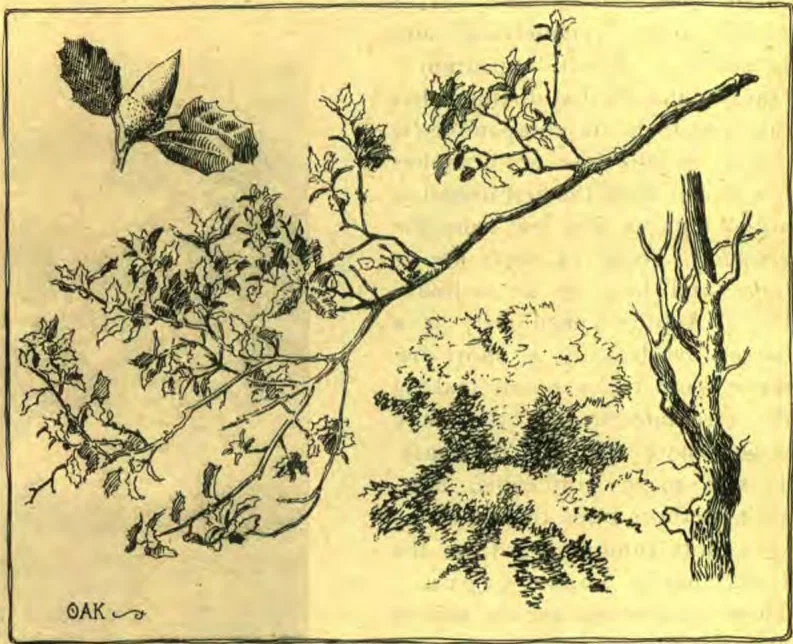
It is a good plan, in drawing trees, to take first a single branch of the oak, ash, or whatever tree you wish to represent, and, sitting near enough to see the details, draw it just as accurately as you can, again and again, until you are familiar with its leaves, bark, and method of growth. Then, moving to a position some distance away, take as your subject a larger portion of the tree; study the masses of foliage, the color, the light and shade; and when these have all received careful attention, move still farther away, and consider the tree as a whole. In the illustration you will see how I have made a study of different parts of an oak. Accompanying the last lesson was a drawing of the entire tree.
Remember that in drawing any large form there is danger of sitting too near it. Distance obliterates details, and broadens the masses; therefore it is best to be well removed from your subject, so that you may think of its form as a whole rather than of its details. After such study as this, it would be well to take an entirely different tree, and pursue the same course, afterward comparing your sketches, and making such corrections as an increasing knowledge shall suggest.
When walking along, notice the shape of the side of a building or any inclosed space; notice the shape of a leaf, plant, flower, shrub, or tree. Notice the form of a distant mountain, hill, or plain; of a wood, a field of grain, a meadow, or a clump of trees. Learn to group the form inclosed by lines. Cultivate the habit of observation; and in a short time the power of seeing any number of objects as a unit will be acquired. Drawing will then receive a new light, and be far more interesting and simple than would be otherwise possible. As soon as we recognize figures that we are acquainted with, their complicated form ceases to a large extent to appear complicated. All forms, however complicated, are composed of other simple forms, or figures, which, if recognized, will make the drawing of them easy. You can not study too carefully the simple forms of any object you wish to draw.
In your drawing use whatever medium best suits your work; and if unsuccessful for a long time with one, try another. Many find a rather soft pencil satisfactory; others can express themselves best in charcoal; while still others prefer pen and ink. Remember that whatever you work with is, after all, only the medium through which you express yourself; and that it is far more important to have something to express, founded on close observation and careful study, than to make beautiful lines, or shades that are without an intelligent meaning.
PEDRO LEMOS.

The Dream of the Four Rats

A POOR workingman told his wife, on awakening one morning, of a curious dream that he had had during the night. He dreamed that he saw coming toward him, in order, four rats. The first one was very fat, and was followed by two lean rats, the rear rat being blind. The dreamer was greatly perplexed, and appealed to his wife concerning the matter; but she, poor woman, could not help him. The son, who heard his father tell the story, volunteered to be the interpreter. “The fat rat,” he said, “is the man who keeps the saloon you go to so often; the two lean rats are mother and I; and the blind rat, father, is yourself.”—Exchange.

THE KEY

I SMILE, and then the sun comes out; He hides away whenever I pout; He seems a very funny sun, To do whatever he sees done. And when it rains, he disappears; Like me, he can't see through the tears. — Selected.

Pits for the Proud, Honors for the Humble

“THERE are pits for the proud, but honors for the humble.”

SOME QUEER CRADLES

WHAT queer cradles some little folks have! The Indian baby is strapped to a board and hung up in a tree, or carried on its mother’s back. He has no toys; and if the sun shines in his face or the storm beats on his head, it does not matter.
In Lapland the cradle looks something like a big slipper. The baby is laid in it, covered up with a sheet. There are holes in each side of the cradle, and through these a stout cord is laced across to keep the baby from tumbling out. When the Lapland baby’s mother attends church, she leaves him outside to keep warm in a hole made in the snow. Sometimes several cradles are left in a cluster, and then the children set up such a chatter that they disturb the meeting.
When the Laps are traveling from place to place, these cradles are slung on the mothers’ shoulders.—Selected.
Continue reading: THE FIRST LESSON IN ANATOMY