In his sermon on the mount, Jesus presented the manner of spirit and works that will be manifested by those who love God and who keep his commandments. His followers were to sustain to the world the relation brought to view in his words, “Let your light so shine before men, that they may see your good works, and glorify your Father which is in heaven.” But the Pharisees thought that this new Teacher was dwelling altogether too lightly on the law and its requirements. They had expounded the requirements of the law in altogether a different way from that of the world’s Redeemer, and had made the law a body of rigorous exactions; for they were “teaching for doctrines the commandments of men.” Our Lord came to strip from the truth the external observances which had been supplied to take the place of true religion. He preached his sermon on the mount in order to clearly define the true principles of the law of God, which had been misapplied and misinterpreted, and which had been strained to mean that which God had never designed. The Lord Jesus cleared away the rubbish of “they say,” swept out the old traditions of former teachers, and brought to light the teachings of the prophets and of holy men of old who spake as they were moved by the Holy Ghost. Christ himself had communicated the truth to these representative men, and in his lessons which he gave to the people he was clearing away the rubbish of man’s opinions by the truth which he himself had imparted to the writers of the Scriptures.
Jesus preached the truth of the Old Testament Scriptures with freshness and power, and elevated the word of God above the traditions and maxims of men. All that he said fell upon the ears of his hearers as a new revelation. He did not repeat the common-place traditional maxims after the manner of the rabbis, nor did he speak with hesitation and uncertainty as they did. He spoke with calm assurance and with marked independence. The religion that prevailed at the time of Christ’s public ministry was lifeless. Tho it was taught by men of education and talent, yet their instruction in a large degree consisted in senseless repetitions; but the words of Christ, spoken so earnestly and in such power, stirred the hearts of the people, and created an intense interest. They listened in vain for the senseless repetitions of the unchangeable exactions, and they were astonished at his doctrine, for he taught as one having authority and not as the scribes.
But when the Pharisees saw what a vast difference there was between the teaching of Christ and their own teaching, when they began to realize that the majesty, beauty, and purity of the truth which he taught was exerting a gentle but powerful influence, and was taking hold of the minds of men and working a reformation in their characters, they saw that their own instruction was made of no effect, and they reasoned that unless something was done to put a stop to the ministry of Christ, all the world would believe on him. They saw that his bearing of divine love and tenderness was drawing the hearts of all the unprejudiced to him. The frowning countenances of the priests and rulers, their sneers and vindictiveness, set off in favorable contrast Christ’s patience and forbearance; for he was calm under the most unjust criticism and hostility. It was evident that their enmity arose from the fact that Christ did not exalt them as teachers of piety and godliness. The teachings of Christ continually rebuked their ungodly practices. He presented truths of the most vital importance, and they did not harmonize with the teachings of the scribes and Pharisees; for these instructors had taught that which misrepresented the character of God. They had misinterpreted his commandments, and because Christ did not teach the commandments as the rabbis did, they decided that he was destroying the law. Upon their astonished ears fell the words: “Think not that I am come to destroy the law, or the prophets; I am not come to destroy, but to fulfill. For verily I say unto you, Till heaven and earth pass, one jot or one tittle shall in nowise pass from the law, till all be fulfilled. Whosoever therefore shall break one of these least commandments, and shall teach men so, he shall be called the least in the kingdom of heaven; but whosoever shall do and teach them, the same shall be called great in the kingdom of heaven.” Then, stretching his hands toward his disciples, he said, “For I say unto you, That except your righteousness shall exceed the righteousness of the scribes and Pharisees, ye shall in no case enter into the kingdom of heaven.”
At another time he said to the people, “Did not Moses give you the law, and yet none of you keepeth the law?” Our heavenly Father requires that his people shall walk in the light that he gives them. His requirements are always reasonable and just, and he can not accept less than he claims, which is perfect obedience to his commandments. In the sermon on the mount the Lord revealed that it was failure to walk in the light that was separating the Jewish people from God, and as a sure result darkness was coming upon them in the same proportion as the light had been permitted to shine upon their pathway.6
Had the chosen people of God improved their God-given responsibility, and rendered obedience to the plainly revealed will of God as it had been made known to them through patriarch and prophet, they would have been prepared to have exhibited to the world character and works of an elevated order, in harmony with the light which had accumulated upon their pathway.
The traditions of men, to which they gave so much heed, were as chaff to the wheat. Christ cleared away the rubbish of men’s opinions, the multiplied exactions with which men had surrounded the commandments of God, so that the true character of the law was revealed. Jesus had given the law, and he was the one who could expound its true principles. It was essential that this should be done in order that the character of God might be vindicated before the inhabitants of a fallen world, and before the inhabitants of worlds unfallen. Jesus showed the contrast that there was between error and truth, between the words of finite men and the word of God. The word of God was plain, but men’s words had made it mysterious and unintelligible. But the instruction which Christ gave was unmistakable. His disciples were to obey the precepts of the law, and to represent the character of God to the world. He said, “Be ye therefore perfect, even as your Father which is in heaven is perfect.”
Question Corner
“Enquire, and make search, and ask diligently.”
No. 284. Pledges and Tithing.
If I pledge money for any purpose, or give it to the cause, should I pay tithe on it? L. M. B.
We do not pay tithes on money, but tithes of it. When the tithe is set apart for a particular purpose, as it is among us, for the support of the Gospel ministry, we should not think it ought to be used to meet special pledges, or free-will offerings. We do not give the tithe to the Lord; it is the Lord’s already. The Lord’s tithe, as we read in the Bible, should be first. After that, offerings of various kinds.
No. 285. Saving of Children and Faith.
How is it possible for an infant child to be saved, in the light of Heb. 11:6, “Without faith it is impossible to please Him,” and Rom. 2:11, “For there is no respect of persons with God?” Is it possible for a babe to have faith? J. H.
“As in Adam all die, even so in Christ shall all be made alive.” 1 Cor. 15:22. Only those will die the second death who have committed sins of their own. Just a word more, brother: The injunctions, commands, duties, etc., of the word of God are addressed to those of responsible age and mind. We need not worry over those who can not believe. God will care for all such in his own everlastingly good and wise way. A good work on baptism is “Thoughts on Baptism,” by J. H. Waggoner, Pacific Press, Oakland, Cal. Its price is, we believe, paper cover 20 cents, flexible cloth 30 cents.
See SIGNS OF THE TIMES No. 7, present volume, February 18, question No. 262. These texts were more fully explained there than we have space to explain at the present.
No. 287. Wine of Her Fornication.
DOES not the wine of Babylon’s fornication mean the delusive doctrines taught by her, such as the conscious state of the dead, reward at death, immortality of the soul, sprinkling and pouring for baptism? All who believe the doctrines taught by her, have become religiously drunk. J. H. Cox.
Doubtless these help to make up the cup which Babylon holds out to the nations, but it includes more. It is the wine of her fornication. Fornication is unlawful union, or union between church and state. By this baleful doctrine the nations of the world have been blinded, besotted, stupefied, and every doctrine not from God but the world has been a help in the seduction and drunkenness.
See answer to question No. 278, in SIGNS OF THE TIMES of March 5, 1896, page 4.
FAME
By Charles W. Hubner
“What boots it whether in Westminster Abbey, or under the shadow of a village spire, my ashes lie; whether a few years earlier, or a few years later, earth is my resting-place. The world will soon forget me.”—Thackeray.
WHAT is fame?—An air-born bubble in a stream; ’Tis the evanescent phantom of a dream; ’Tis the down of thistles drifting on the wind; ’Tis the flash that for a moment makes us blind!
Shake the dew-pearls on yon lily from their place, And for aye is gone the fashion of their grace; From its slender stem dissever yonder flower, And thy prize will pale and wither in an hour.
Little time, forsooth, hath Beauty here to live, And the life of fame, believe me, is as brief! As the dews exhale, and roses turn to dust, So will earthly glory perish, and be lost.
He that fame and honors seeketh will pursue Thistle-down, and bubbles drifting out of view, Yearn for phantoms ever fading from the eye, Grasp at shooting-stars that glitter, flash and—die.
On the poor man’s grave the roses bloom as fair As upon the tomb that shrines the millionaire; Stars shine bright, and songsters warble full as sweet O’er a dead king—and the beggar at his feet.
—Charles W. Hubner.
THOUGHTS FROM THE SEPTUAGINT.
By F. D. Starr
BY F. D. STARR.
The Glory of Moses’ Face.—In 2 Corinthians 3 the subject is introduced of Moses’ putting a vail over his face when he spoke to the children of Israel. This was on account of the shining of his face. The record of this is found in Exodus 34. It is there stated (verse 29) that “Moses wist not that the skin of his face shone.” In the Septuagint the expression is more like that used by Paul in Corinthians. It reads thus: “Moses knew not that the appearance of his face was glorified when God spoke to him.” It is very evident from the identity of expressions in both the Old and New Testament accounts that it was the ministration that was represented by the glory there revealed. Moses’ face was glorified. It is distinctly stated that that glory was done away. Some have had the mistaken idea that it was the law itself that was done away, but a careful examination of these texts will show that nothing is said about the law being glorified, or that Moses hung a vail over the law; he hung the vail over his face, and that which was done away was the glory of his face, over which the vail was hung.
The Brazen Censers.—In the account given in Exodus 39 of the various vessels of the sanctuary, the garments of the priests, etc., in addition to the information given in the Authorized Version, we have this account in the Septuagint, verse 22: “He made the brazen altar of the brazen censers which belonged to the men engaged in sedition with the gathering of Core.” An account somewhat similar to this is given in Num. 16: 37–40, but in the Greek it seems to be introduced here by way of anticipation. Most likely the rebellion of Korah and his company took place after most of the vessels of the sanctuary were made.
Sinning Unwillingly.—In Leviticus 4 directions are given as to what various individuals should do in case certain sins had been committed. We read in verse 2, “If a soul shall sin through ignorance against any of the commandments of the Lord concerning things which ought not to be done,” etc. Like expressions in reference to sinning through ignorance are found in verses 13, 22, and 27. Just what would be called a sin of ignorance might be a matter of study. In Heb. 10:26 we read, “For if we sin willfully after that we have received the knowledge of the truth, there remaineth no more sacrifice for sins.” No provision was made under the law for willful sins. It is evident also that under the Gospel there is no provision for willful sins. There is a sin unto death, and there is a sin not unto death. 1 John 5:16, 17. Our Saviour has told us that all manner of sins shall be forgiven, except the sin against the Holy Spirit. Such sin must be willful sin, as mentioned in Heb. 10:26. A sin of ignorance then must belong to that class of sins which are said to be not unto death—sins for which there is forgiveness. But can men who have been instructed in the ways of the Lord, and who have fallen from the path of virtue, be said to have sinned ignorantly? Can we say that David sinned ignorantly in the transgression by which he gave occasion to the enemies of the Lord to blaspheme? He surely had a knowledge of the will of the Lord, and was not in ignorance. If we will allow the rendering of the Septuagint in this case, we will have a better insight into this question, which otherwise might perhaps present some difficulty. If it were only sins of ignorance, strictly so called, that are to be forgiven, the chances of most of the professors of religion would be very slim. The word employed in the Greek version is rendered “unwilling.” “If a soul of the people should sin unwillingly,” “if a soul shall sin unwillingly,” “if a soul of the people of the land shall sin unwillingly, in doing a thing contrary to any of the commandments of the Lord,” etc. The expression “unwillingly” is of like meaning with the one in Rom. 8:20, “not willingly.” There is such a thing as sinning unwillingly. This is on account of the deceitfulness of sin; for sin is indeed a very deceitful thing, and while the person is not really ignorant of the claims of God’s law, yet for the time being he is blinded—deceived—and he seems to be controlled by a power outside of himself, and this power is an evil power. He is made the unwilling servant of Satan. He longs to be free. He knows the thing that is good, and desires to do it, but somehow he has not the power. “The Spirit indeed is willing, but the flesh is weak;” and thus, being a slave in the bondage of an oppressive master, he does those things that ought not to be done, and things that, left to himself, without the influence of another power, he would not do. This man is sinning, not so much ignorantly as unwillingly, going against the law that in his own mind he acknowledges to be holy, and just, and good, and doing service to a power from which he wishes to be free. For those who are thus unwillingly led into sin, “overtaken in a fault,” the Lord has provided a most gracious sacrifice, as typified in the ceremonies of the old dispensation, and fully carried out in the realities of the new. It is glorious indeed to search for and find the Gospel of Christ in the ordinances of the law. How thankful we should be for the hope held before the unwilling servant of sin, that his sin may be forgiven, and he receive power by which to be relieved from the oppression
of the devil, and be no longer his unwilling servant!
Called Unclean.—It is stated in Lev. 13:45 that the leper should put a covering upon his upper lip, and should cry, “Unclean, unclean.” The rendering of that verse as found in the Septuagint is this: “And the leper in whom the plague is, let his garments be ungirt, and his head uncovered; and let him have a covering upon his mouth, and he shall be called unclean.” This would place the burden of calling the individual unclean upon another, and not upon himself. Inasmuch as verse 46 states that he should dwell alone and his habitation be without the camp, it would hardly seem necessary that he should continually cry unclean. This fact would seem to favor the rendering of the Septuagint, that he was simply to be pronounced, or called, unclean by others. The singular manner in which he was to be attired would signify to others the uncleanness that rested upon him.
Living Water.—In Lev. 14:5 a ceremony is described which included the killing of a bird in earthen vessels over running water. The term in the Greek is living water. The reader will call to mind that quite frequently in the Old Testament, as well as in the New, we find the expressions “running water,” or “living water.” The terms are equivalent. Water that came from a fountain or a continually running stream, instead of from a pool or cistern or some standing body of water, was called living water. This living water was not only to be used in the typical service, but the expression was also employed by our Lord in speaking of the work of salvation, which he should accomplish for the race; the free grace and life bestowed upon them were called living water, “a well of water springing up into everlasting life.”
TRUE RELIGION.
By J. T. Murray, D.D.
True religion is a determined purpose to live for God, come what may. It will cling to God in poverty, and say, “If Jesus, who is rich, for my sake became poor, and refused the temptations of the devil, who offered him the kingdoms of the world and the glory of them, if he would fall down and worship him, I can bear poverty for the sake of virtue.” It will cleave to him in bodily pain, and suffering, and mental anguish, saying, “Our light affliction, which is but for a moment, worketh for us a far more exceeding and eternal weight of glory.” Yea, he will stand alone in the world, stripped of fortune, health, and friends, and say, “Tho He slay me, yet will I trust in Him.” Tho the flames of the burning fiery furnace flash in his face, he will not be terrified into bowing down to worship at the shrine of any idol of this vain world.—J. T. Murray, D.D.
Waiting for the Lord: Practical Faith in the Interim
By John McNeill
WE are away up in a far corner of the nineteenth century, and eighteen hundred years count for something, even in the Lord's calendar. How are we putting in the time? Don't flatten your face against the pane, waiting, nor sit down with the time-table between your knees, reckoning when he is coming. Avoid heresy on the one hand and lunacy on the other. Hold it practically—go out and fish.—John McNeill.
The Spirit Should Never Grow Old
“If wrinkles must be written upon our brows, let them not be written upon the heart. The spirit should never grow old.”
A Lesson from the Life of Job.
By H. F. Phelps
BY H. F. PHELPS.
In the reply which Job made to the Lord (Job 42:5, 6), he said: “I have heard of thee by the hearing of the ear; but now mine eye seeth thee. Wherefore I abhor myself, and repent in dust and ashes.” Evidently there is a vast difference between hearing of God,—hearing about God,—and seeing God for one’s self. And there is also a vast difference in the results upon one’s own life. In seeing God as Job saw him is life. But in the hearing of God with the hearing of the ear, unless it leads to something more, there is only death.
There are very many who have heard of God, and heard about God; yet they do not know God, and that because they have never seen him for themselves. There is salvation in seeing God and knowing him for one’s self. There is salvation in it because it leads to a proper estimate of self, that of utter abhorrence of self, and repentance. But salvation is not found in hearsay,—hearing about God.
God’s Testimony about Job.—The Lord’s testimony concerning Job was “that there is none like him in the earth, a perfect and an upright man, one that feareth God, and escheweth evil.” Job 2:3. And yet this uprightness of character was not enough. There was something more for the patriarch. Let us learn the lesson. It is evident that Job was trusting in his own uprightness of life, in his own righteousness, which could only bring ruin to him, or to any one who trusts in that kind of righteousness. That this was the case is evident from the answer that he gave to his friends. “Till I die,” said Job, “I will not remove mine integrity from me. My righteousness I hold fast, and will not let it go; my heart shall not reproach me so long as I live.” Job 27:5, 6. Such was his testimony of confidence in himself. But every one who enters the kingdom of Christ must let go of self. Having heard something about God and his requirements, and being convinced of the justice of these requirements, Job was led to resolve to lead an upright life. And to this end he had made a covenant with his eyes (Job 31:1) that he would not do evil. Evidently Job had raised himself up to quite a degree of success. But he needed more. Like many a person to-day, he needed to know God for himself.
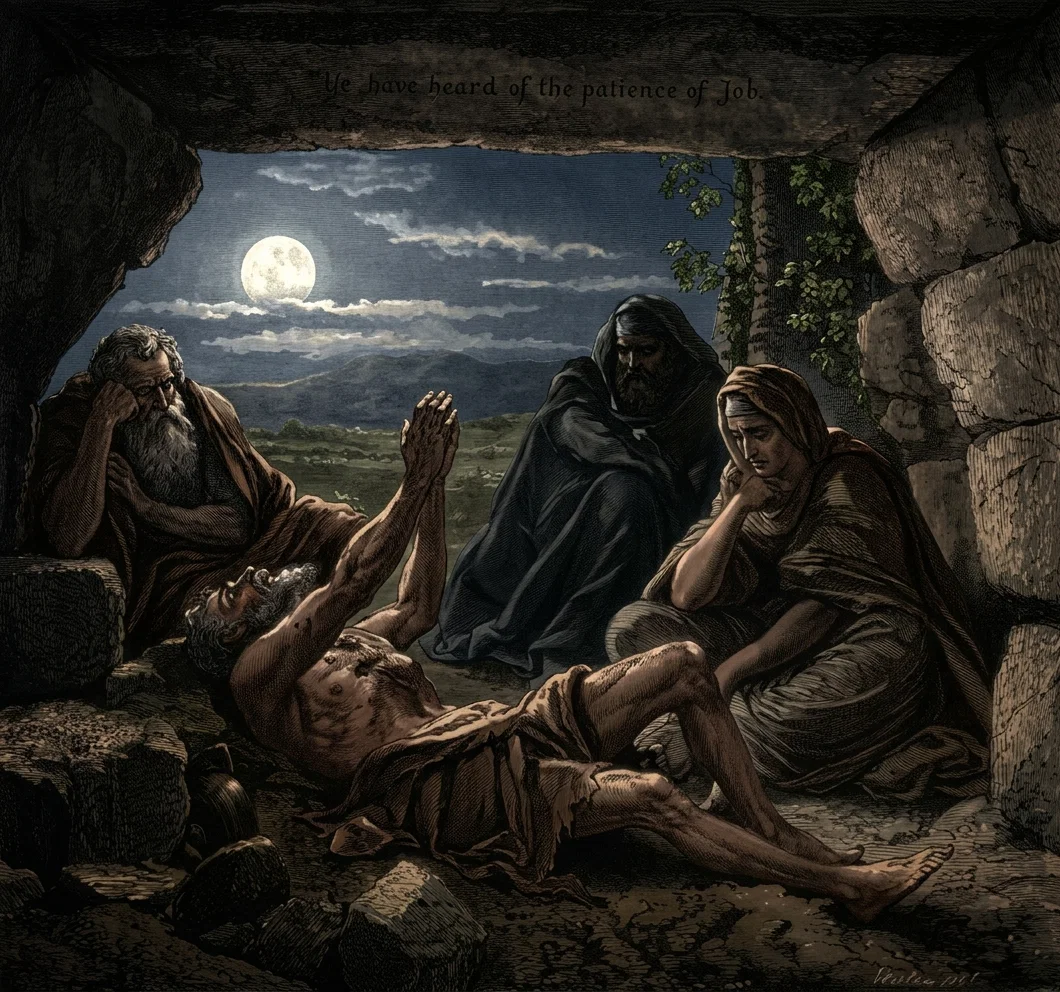
A Severe Lesson Well Learned.—It was because of Job’s self-righteousness that the hedge that God had built about him (Job 1:10, Ps. 34:7) was withdrawn, and sudden calamities and afflictions followed, which is always the case when God withdraws his protecting care. So terrible were these afflictions that Job sat down among the ashes,—a symbol of the deepest sorrow, and grief, and mourning.
The Three Friends.—When Job’s three friends heard thereof (Job 2:11–13), they came to see him, “to mourn with him, and to comfort him.” And such was their utter consternation that they lifted up their voices and wept, and rent their garments, and sprinkled dust upon their heads toward heaven, and sat seven days and seven nights without speaking a word to him, “for they saw that his grief was very great.” But when at last they did speak, such was their comfort, conveyed in words that were as an arrow to the wounded soul, that Job declared them to be miserable comforters. And, indeed, it is not calculated to assuage grief to be assured by a friend that one’s sufferings are because of sins, and that any certain sufferings are because of God’s displeasure. This is just what the three friends did, trying to convince Job that he was unrighteous.
Job’s Defense.—The defense that Job made for himself, as against the charges of his friends, was a most complete justification of self, and a vindication of his own self-righteousness. No doubt, in all his dealing with others, he had been upright, for God had said that he was upright. And so certain was Job that even God would find no fault in him, that he exclaimed: “O that I knew where I might find him! that I might come even to his seat! I would order my cause before him, and fill my mouth with arguments. I would know the words which he would answer me, and understand what he would say unto me. Will he plead against me with his great power? No; but he would put strength in me.” Job 23:3–6.
Inasmuch as Job could not find God, that he might see him face to face and plead his cause before him, he proceeds to plead it before his friends, and declares: “Neither have I gone back from the commandment of his lips; I have esteemed the words of his mouth more than my necessary food.” Job 23:12. And in chapter 24 he contrasts the lives of those who “remove the landmarks,” and “violently take away flocks, and feed thereof,” who “drive away the ass of the fatherless,” who “take the widow’s ox for a pledge,” and “turn the needy out of the way,” with his own life. With himself it had not been so, “Because,” said he, “I delivered the poor that cried, and the fatherless, and him that had none to help him. . . . And I caused the widow’s heart to sing for joy. . . . I was eyes to the blind, and feet was I to the lame. I was a father to the poor.” Job 29:12–16. What more could Job have done? Indeed, what more can any man do? Does not James call such works “pure religion and undefiled”? James 1:27.
One Thing More Is Necessary.—There was yet one thing more needed in Job’s life to make it a perfect life. He needed to see God’s righteousness, and to take it. Is that one thing needed by the reader and the writer? It is for all. All of Job’s afflictions were that he might see the one thing lacking, and take it for himself. That necessary thing was a personal acquaintance with God. Hearing about God was not enough for Job. Neither is it enough for us to-day. Hearing about God, and seeing the reasonableness of his requirements, sometimes leads men to do these works of goodness. Especially is this so when, like Job, we have enough and to spare, and when the doing of these things leads to the honors that men can give, which Job also once enjoyed. Chapter 29. And when this is the case, how human like to look at these good works as evidence of our righteousness, and so, robing one’s self in it, to be satisfied with that which is only filthy rags! Isa. 64:6. No greater mistake could ever be made by any as to their acceptance with God, and as evidence of a righteous character. There is no salvation in it, but, rather, death. This would be going about to establish our own righteousness, not having submitted ourselves to the righteousness of God. Rom. 10:3. This is just what Job did, and this is what made necessary his afflictions. At last the lesson was seen by Job, and it is written for our learning. Then may we also learn the precious lesson.
As the reality of his own condition began to dawn on the mind of the patriarch, he heard the Lord speaking to him in all his experiences. He saw God for himself, with his own eyes. His faith had once led him to declare that he knew that he should see his Redeemer at the latter day. Job 19:23–27. But this is not enough. In order to see the Redeemer at the latter day, and see him in peace, it is necessary that we see him now, and know him. We must see God nigh at hand. It is even Christ within, the hope of glory. Col. 1:27. Job saw God for himself at that time, and when he saw God, his confidence in himself was all gone. This was what he needed. It is just what is needed in the experience of many at this day. It is just what is necessary in order to meet Christ when he comes. When Job saw God, then it was that he said, “I have heard of thee by the hearing of the ear; but now mine eye seeth thee.”
The Blessed Result.—The result was just what might have been expected,—utter abhorrence of self, followed by repentance. “Wherefore,” said Job, “I abhor myself, and repent in dust and ashes.” Job 42:6. It was like coming forth to the light of day all besmeared, and bespattered, and covered with the smut and dust and drippings of a coal mine. The contrast of the light and the darkness, and the contrast of one’s appearance as seen by one’s self in the darkness and the broad light of day, is immensely great. This, however, is but a faint comparison. When a person walks in the light of his own righteousness, which is but intense darkness itself and no light at all, he enjoys a sense of satisfaction in himself that will end only in bitter disappointment at the last day. But8coming to see God, coming to the light of God’s presence, the contrast is immensely greater. The first impulse may be discouragement, but the better thought is that of self-abnegation and repentance. And, thank the Lord, who meets us more than half way with forgiveness, and receives us all as his own. Then it is that God can safely increase our blessings, as with Job; and with these blessings our usefulness may be increased.
The Moral.—From all this we may learn that, however much temporal blessings may be enjoyed, they may not be entirely for our good, and that something more is needed in order that we may see ourselves as the needy beings that we really are, and that we may let go of self as we should, for there is no salvation in self. When Job saw himself as he truly was, a poor mortal and a vile sinner, one to be utterly abhorred, with no virtue in himself, wretched, miserable, blind, and naked, when he saw God in all his fullness and blessedness, what more did he need of self? Then God removed his distresses and greatly increased his blessings. This could now be done with safety to Job himself. He now had no love for self, hence all love for God.
It was not a matter of discouragement when Job began to open his eyes to see God, even tho it revealed himself the worthless creature that he was. But it was altogether the opposite,—a matter for encouragement and rejoicing, even an evidence that God had not left him in his own self-righteousness, but that he was even nigh at hand, and loved him still. The danger was when Job could not see his true condition, and trusted in his own righteousness for salvation. It is just so with us. The seeing of our sins, our failures, our weaknesses, our errors, our backslidings, even all the blackness of darkness of our own hearts, is not a cause of discouragement, but of encouragement; for God is near, and has not departed from us forever. Seeing this as we should, we turn to Him who is our righteousness, our strength, our holiness, our goodness, our faithfulness, and we are led to accept him for all that he is and may ever be to us. We give up all, and take all. It is then that we may say, “Mine eye seeth thee,” and exclaim that, In him is my holiness, my righteousness, my faithfulness, my all and in all. Self is given up for Christ. “I am crucified with Christ; nevertheless I live; yet not I, but Christ liveth in me; and the life which I now live in the flesh I live by the faith of the Son of God.” May we live this life.
COMPULSION VERSUS FREE CHOICE.
By A. G. Daniells
BY A. G. DANIELLS.
It is in every sense deplorable and unjust for civil government to legislate on religious questions. Many reasons can be adduced in proof of this. We will here present one. It is this:—
Civil law means force; religion means free choice; and these ideas are absolutely incompatible.
We will demonstrate this. Government is defined to be “the administration of laws.” To administer law is to carry it into effect; to execute or enforce it. To enforce is to compel.
Civil government exists for the protection of the individual rights of its citizens. The value of the legislative branch of a government lies in the just laws it enacts for the protection of its citizens’ rights. The dignity of the executive department lies in the impartial execution of those laws. A government that has not the power to either make or enforce just laws is a farce.
Thus the idea of force is inseparable from civil government.
But not so in matters of religion. Religion is man’s personal relation of faith and obedience to God. “Whatsoever is not of faith,” says Paul, “is sin.” Faith, then, must be the mainspring of all action in matters of religion.
But faith is voluntary. “Faith cometh by hearing, and hearing by the word of God.” Faith can not be produced by law, nor by any amount of compulsion. It is a matter of free will absolutely.
The basis of civil government is law, and law means force. The basis of religion is faith, and faith is voluntary. For this reason, then, we submit that civil government and religion never can be united, except at the peril of one or the other, or both.
THE BIBLE.
By E. Hilliard
BY E. HILLIARD.
No BOOK has ever been published that has exerted such a strong influence for good, against such a mighty tide of opposition. Thousands of orations have been made against it, and volumes have been written, denouncing it in the strongest terms. It has been defamed, ridiculed, mocked, blasphemed, and children have been taught in thousands of families that the Book is poisonous literature, unfit to be studied or perused. But for all this it lives, and is operating as heavenly leaven in changing the hearts of many from sin to holiness.
As we study its sacred pages, we wonder how any can ridicule or denounce it. It is a beacon light that safely guides the helpless mariner through the rocks and shoals of a treacherous sea into the harbor of heavenly rest. Its celestial rays gleam beyond the dark prison-house of the dead, and it speaks words of comfort to the mourner. Listen to its heart-cheering promise: “The dead in Christ shall rise first; then we which are alive and remain shall be caught up together with them in the clouds, to meet the Lord in the air; and so shall we ever be with the Lord.” 1 Thess. 4:16, 17.
It bids the ruined, sin-wrecked soul look away from the darkness of despair and bitterness of death, to the compassionate Saviour, with arms extended wide to receive, and give an unending life.
The blessed Book has called together more people, erected more costly buildings, than any other book extant. It contains greater promises, offers greater compensation (if its principles are followed), than any production of man can offer and fulfil. How many aching hearts it has relieved! how many homeless ones it has cheered with the promise: “I go to prepare a place for you. And if I go and prepare a place for you, I will come again, and receive you unto Myself; that where I am, there ye may be also.” John 14:3. Blessed promise! blessed Bible! beautiful place for the homeless wanderer!
Nature’s great Architect will spare no pains in the preparation of the place for those he is to receive unto himself. The touch of heavenly beauty will be upon everything that constitutes that eternal home; and yet men curse the Maker and ridicule the promise. The promises of freedom from sin, the peaceful rest of a sin-pardoned soul in this world, and the free gift of mansions in glory, are written in the blood-drop sweat of Gethsemane and Calvary’s cross. May God pity and bring to repentance the poor, deluded, spiritually blind individual that sets at naught the promises of the Bible, and thereby ignores the pains of Gethsemane and the blood of the cross.