Your ShelfYour Projects

Review and Herald, Vol. 91, No. 1.

THE WORK
Earlier text: To the Fields in 1913

“The Ancient World of 1853”

This is the title of an article in the Standard of Dec. 6, 1913, by Dean Shailer Mathews. He contrasts the conditions which existed in the world in the year in which this Baptist publication was started with conditions which exist today. This comparison shows some of the many changes which have been made during the last sixty years. With slight omissions we quote the statement entire:—
California was the only State west of the Missouri in 1853. Indians and buffaloes possessed the plains; the continent was crossed by trails, gold had just been found in California; and forests still covered vast stretches of Michigan, Illinois, Wisconsin, and Minnesota.
Short railroad lines were beginning to be combined into systems in 1853. Americans were beginning to put postage stamps on letters, and were organizing their first clearing houses.
Slavery was guarded by the Constitution in 1853. Men still thought they could keep a balance between free States and slave States, and Kansas had not begun to “bleed.”
There were no ironclads in 1853. Nations could still afford frequent wars, cannon and muskets were loaded through the muzzle, granite forts were impregnable, and Christian nations were fighting each other for a chance to take up the white man’s burden.
Pestilences were regarded as unavoidable dispensations of providence in 1853. Bacteria were unknown or unconquered, and doctors prescribed “blue pills.”
Japan and China had not been “opened” in 1853. India had not mutinied, foreign missions were feeble, uniform Sunday school lessons were not invented, Chautauqua was to wait twenty years to be founded, the first Y. M. C. A. in America had been established two years, and university settlements had not been dreamed of.
Science was only beginning to be recognized in colleges, there were few professors of history, fewer gymnasiums, no intercollegiate athletics, and a college of five hundred students was enormous.
Wages were low in 1853. Labor was just learning to organize; there were no trusts, few millionaires, and no anxiety over interstate commerce except in slaves.
Men wore shawls in 1853, children wore pantalets, and women wore hoop skirts.
Houses were warmed by air-tight stoves in 1853. Anthracite coal was a curiosity, wood was burned on locomotives, and the first oil well had not been bored in Pennsylvania.
Baseball was “three-old cat” in 1853. Athletics were all but unknown; 2:40 was an undreamed-of speed for trotting horses, and the chief dissipations of New England were lyceums and singing schools.
They had been telegraphing not quite ten years in 1853, and had used reapers, sewing machines, and rotary presses for even a shorter time, while farmers still cut grass with scythes, raked hay by hand, and hauled it in with oxen.
They had no telephones in 1853; no electric lights, no electric cars, no bicycles, no automobiles, no talking machines, no kodaks, no Pullman cars, no limited trains, and few bathrooms.
Maine had just passed the first State prohibition law in 1853. Women before the law were still classed with infants and idiots, had little opportunity for higher education, and had no right to vote.

“Undermining Confidence”

MUCH has been said and written of late regarding the dangerous tendency which exists among some so-called Christian teachers of undermining confidence in the Scriptures of Truth. The so-called higher critics of the Bible deny many things that have been regarded as cardinal truths. The Christian Observer of Dec. 10, 1913, under the above heading, reviews the work of these critics in an excellent article, which we reproduce entire. The editor says:—
Much of the modern assault upon the statements of the Bible proceeds from parties within the church. Many of the assailants justify their work of destructive criticism by the claim that they are not touching the really essential elements that make it the Word of God, but are merely exposing and eliminating the imperfect human elements. The Davidic authorship, according to their view, has no vital connection with the spiritual value of a given psalm. The inaccuracy of Old Testament prophets in matters of geography or history does not impair, to these critics, their contribution to the religious ideas of the race. Their doctrine of God, their spiritual ideals, their lofty and pure ethics, stand regardless of the overthrow of their dates and incidental affirmations.
The soundness of this position must be tested from various points of view. And we can at present call attention to only one of the many applications of this principle. Two points in the recorded career of Jesus have been selected by modern criticism for special attack, the virgin birth and the bodily resurrection of our Lord. Many who have denied the former have held tenaciously to the latter. But among those who have repudiated the testimony of the Gospel records to one or to both, there has been a stout protest against any charge that would group them with unbelievers in Jesus. Some affirm that they can repudiate the testimony as to the virgin birth and still hold to the evangelical doctrine of his deity and his office as Saviour. On critical grounds, they tell us, they cut out those parts of the infancy narratives that relate a virgin birth, and yet accept as veracious and reliable the rest of the Gospels, or at least the substantial proportion of what remains.
That an individual may do this, has actually done this, we shall not deny. For nothing is clearer in history than the versatile ability of the human intellect in the way of bad logic and flagrant inconsistency. But that a widespread and permanent faith of this kind is possible, we are bold to deny. No continuous succession of men, no large school of thought that projects its life into the future, will maintain this attitude. In the long run, the human intellect, even in deeply religious circles, will make its inevitable logical choice between the two positions. It will hate the one and love the other, or else will hold to the former and despise the latter. It will not be able to serve both the criticism that cuts out Matthew and Luke as competent and credible witnesses to the manner of the birth of Jesus, and the faith that accepts the rest of their remarkable record along with that of Mark and others.
For it will inevitably be the case that confidence in the credibility of the witnesses as such will be undermined. If the writers of the first and third Gospels were so gullible, so ignorant, so given to romance, so easily deceived, or so ready to invent and deceive others, as to palm off on their readers this account of the birth of Jesus, their reliability, their competence as historians, is at once discredited. How can we pin our faith to them at other points? If on so delicate and important a matter, involving the most sacred matters of human life, they perpetrate a blunder or a crime so gross and historically unpardonable, the inexorable verdict of intelligent men will sooner or later strip them of their claims and say, “Thou mayest no longer be historian.”
For—and let all our readers mark the statement—the evidence for the virgin birth of Jesus is the same as the evidence for his miracles, his resurrection, his teaching, his sinless life. It is the same as the evidence that he lived and died at all. The witnesses may be fewer. But the evidence is the same in character, and is just as worthy of credence. The men who will not believe Matthew and Luke will not continue long to trust Mark or John or Paul. Certainly the disciples and followers of such men will not. When confidence in the witness is undermined, the story which he tells will be summarily brushed aside by the merciless logic of the human mind. The Bible must really be trusted altogether or not at all. The average man of reverence and common sense will, as a matter of fact, trust it fully or virtually repudiate it entirely as an authority over conscience and life.

Huerta Orders Destruction in Northern Mexico

The Mexican revolutionists have been successful in their steady advance toward the capital city. Seeming to realize the impossibility of capturing the country from the rebels, Victoriano Huerta has ordered the remnants of his army to begin a campaign of destruction, making northern Mexico practically a wilderness, and untenable for Pancho Villa and his followers. Villages and towns are to be laid waste, and farms completely destroyed.

Barotseland Mission

MRS. W. H. ANDERSON
It has been some time since we reported from this field. This has not been because we were discouraged, nor because the work was not progressing. It seems to us many times that the work moves very slowly; but when we take a wider view of the field, it is not that way.
Travelers have to go very slowly over new and rough roads. Christ is the guide, and we know that the work progresses just as fast as he knows is best. We have been greatly blessed in many ways. God has done for us far above all that we asked or thought. We have experiences, many times, indicating truly that "man's extremity is God's opportunity."
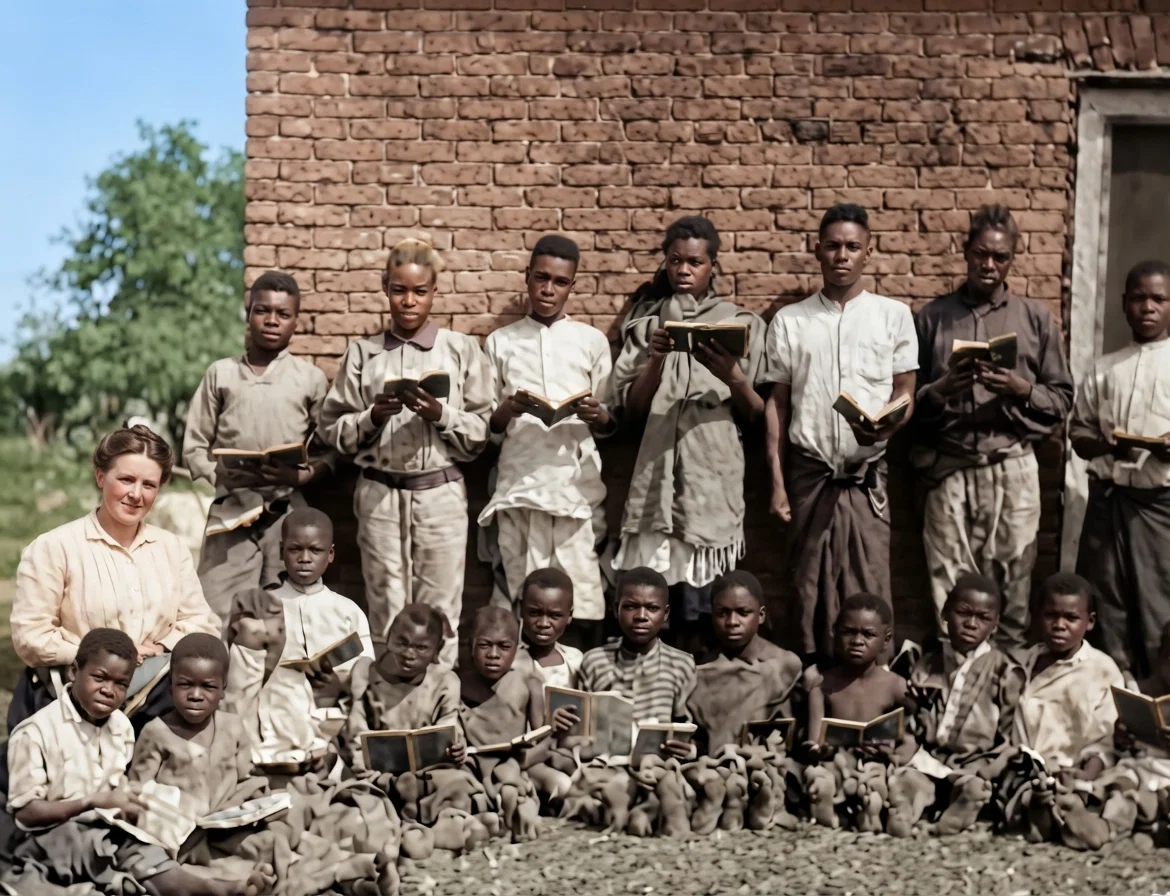
NEW ARRIVALS AT THE BAROTSELAND MISSION SCHOOL
Mr. Anderson and I have just been out for two weeks visiting the out schools. We found things in a prosperous condition at most of the schools. We fitted out each place with tools and repaired the old ones, ready for the teachers to start plowing as soon as the rains begin. At one place we found that the lions had killed two of the mission cattle. But we have been greatly blessed in losing so few. These are the first that have been killed for four years. Others all around us lose cattle every year.
I spent a very pleasant afternoon with my near neighbor, who lives thirty miles from the mission. We see each other once, or possibly twice, a year. We spend the time very pleasantly together when we have the privilege.
Some of the missions in this country have been self-supporting the past year. This has meant very strenuous labor and much sacrifice; but we are glad that we can sacrifice that the means may go to some more needy field. There are many starving souls around us who have no one to break the bread of life to them. They know nothing of the sacrifice that Christ has made for them. Very few of us really know what a real sacrifice is. Yet it is such a privilege to give for Christ! It would be very convenient for us to draw on the Mission Board, but we are willing and glad to do without, that help may be furnished other places, and the consummation of the message thus be hastened. We are glad that we are not in need of money for operating expenses again next year.
Dear brethren, do you know that soon the Saviour is going to make this announcement, too? The work will soon be finished, and he will then have no need of our means. If we want a share in the work, now is the time to invest. One dollar now is worth more than one hundred will be a little later. What a golden opportunity to increase our deposit in the bank of heaven! No panic will affect the value of these shares. No moth will corrupt them. We need no safe, for thieves cannot break through and steal.
Pemba, Central Africa.

Yencheng, Honan

JOHN J. WESTRUP
I HAD never enjoyed a general meeting as much as I did the one here that closed October 20. Most of those who attended the meeting made a great sacrifice to do so, and all received a real blessing, especially the workers. I saw plainly that the seed sown in the past had begun to bear precious fruit. Praise the Lord. Between 150 and 160 attended the services regularly, among whom were about forty women. I did not expect that even ten women would be able, or would have the courage, to get here in these dangerous times. Some of the women came about 100 miles through territory filled with robbers.
Five men came 166 miles, from a place where the robbers have been fierce all the year round. They surely give evidence of an earnest desire and a great hunger for the truth. Thirty-one earnest persons were baptized.
The work has opened up north of the Yellow River in a wonderful way, which is surely the Lord's doing. A great many are interested, and many are keeping the Sabbath.
The foreign houses have been finished, and I have also built eleven Chinese houses with tile roofs; and the two large schoolhouses, each seating almost 200, have been built of brick, at a cost of less than $750 gold. Next Sunday we shall open our schools. About eighty have been passed by the committee as proper candidates for the school, but as we have not sleeping quarters for more than about sixty, some have to wait until February. Nearly all of these are very intelligent and earnest Christians, and many will develop into workers.
The terrible poverty in this province is something that hurts my soul. I have already paid out $100 Mexican of my own money to help poor persons. One brother came to the meeting on Friday, having walked sixty miles. On the Sabbath he fasted, and on Sunday he came to say good-by. When I asked why he was going to return so quickly, he said he had to, as he had no money to live on. I then gave him enough to supply his necessities until the meeting closed. Think of a brother in his poverty coming so far to share a day's blessing of the Lord, and that day fasting. Such earnestness is bound to get through to the kingdom. This same poor brother gave $1 Mexican to help build the schools.
We are now passing through an experience similar to that of last fall. We have had a long dry spell, and the people are unable to sow their wheat, and the price of food is going up at a rapid rate. Even if we should get rain now, the wheat crop will be much poorer than if it had been sown on time—about a month and a half ago.
Everything seems to be out of order in these last days. In the north of China they have had very destructive floods, but here and to the south of us there is a terrible drought. I do not know what will happen here if we do not get rain soon. The robbers, too, are still working terrible havoc. They have been very close to us many times this summer, and sometimes we have been surrounded by them. But God has surely been good to us, and mercifully preserved us in these troublous times. James 5 has certainly been partly fulfilled. The rich have reaped what they have sown. Great numbers have lost their lives as well as everything they had in the world.

Cleansed for Service

TAKE them from my heart, Lord Jesus, Every sin, and every stain; Wash me in thy perfect cleansing, Till no evil shall remain;
Till thine eye, so pure, so holy, Looking from thy throne above, Till thy Spirit's deepest searching, Can discover only love,—
Love for thee in all thy beauty, Love for man in all his needs; Love for every work and duty, Love to follow where God leads;
Love to bear my brother's burden, Love to share my brother's pain, Love to raise the weak and fallen, Love to labor without gain;
Love to suffer, if such need be, Even as thou didst for me, To endure the chain or prison, That my brother may be free;
Love to weep with him that weepeth, To lament when he is sad; Love to heal the broken-hearted, To rejoice when he is glad.
So, dear Lord, I plead for cleansing, For thy Spirit's loving power, That with thee, O gracious Master, Day by day, and hour by hour,
I may journey close beside thee, Through this world of darksome night, Then with thee and thy redeemed ones, Dwell in realms of love and light.
There, beside life's flowing river, In the city of our King, Of thy matchless loving-kindness, Through eternal ages sing. Roseburg, Oregon.

Items From the Philippines

ELBRIDGE ADAMS
AFTER about twenty-seven days' voyage Elder L. V. Finster, with his company of thirteen, arrived in Manila. For the most part they had a good trip, and all seemed to be in good health. It took considerable time to get all their things through the customs, but when that was done we loaded the baggage into a truck and went out to the home prepared for them. We sat down to the good dinner that was waiting for us, and enjoyed eating together, feeling that we were one family united to help carry this sweet message of salvation to these islands.
Of course the people wanted to see them as soon as possible. So we had planned a reception for the evening, in which all seemed to take great interest. The Filipinos told them that they regarded them not as Americans, but as brethren in Christ. And of course the new workers called these dark people brethren. In our company four dialects are spoken; and in the program a few items of interest were mentioned by these members concerning their people, and an appeal was made for some of the workers to go to labor among them. A song was sung in each of the four dialects, which were Tagalog, Visayen, Ilocano, and Cagayan.
I am sure that our hearts are all glad for this help, and we pray God's richest blessing upon every one, that the most may be accomplished for the Master. When these workers shall have been placed in their respective fields of labor, there will still be so much territory unprovided for that it will seem as if a bare beginning has been made. And, brethren, don't forget that we shall be ready for more workers very soon. We are thankful for what has been done for us. It makes us hope for the finishing of our work in the near future; and that means the return of our dear Lord and Master.
On Sabbath, October 25, a native brother by the name of Francisco Santos told me how he learned to read. It was near the first part of this year. He bought a Bible soon after he accepted the truth. And as he took it home he thought, "I cannot read." That troubled his mind very much. So one day he took his Bible and went into as quiet a place as he could find, and knelt down and prayed to the Lord to teach him to read. He got up, and although he did not know one letter from another before, he began to read with understanding. He has increased in speed by practice. But surely the Lord heard his prayer and answered it.
Before this, this same brother had sickness in his family. His child was seriously ill, and had become too weak to lift its head. He said: "I had no money to buy medicine. So I went into the kitchen and prayed in the name of the Father, Son, and Holy Ghost to heal my child. I went back to the child and laid my hand on its breast, and it got up and began running around."
This poor brother has not much of this world's goods, and he did not even know how to read; but he believed God, and God did for him what he could not do for himself. That is just what he wants to do for us all. But the trouble with many of us is, we are inclined to feel, "I am rich, and increased with goods, and have need of nothing." I believe that God would do more for us if our faith were more simple.
In his weekly letters Brother Ashbaugh always expresses hopefulness and courage. The Lord is blessing him in the work, and I have no doubt but that much of the good seed that he has sown will spring up and produce a harvest. He says: "When I am tempted to feel lonesome I sing, 'The long, dark night is almost o'er, the morning soon will come.' When the burdens seem to weigh heavy, I sing, 'Not now, my child, a little more rough tossing, a little longer on the billows' foam.' Now is the time for earnest work and faithful burden bearing. What little we do will seem very small when we hear the words, 'Well done.'"
This brother has had some very interesting experiences. They are rather exceptional, or would be in the United States. In one of his late letters, he says: "Today a young man came running after me on the street and said, 'Excuse me, I want to get one of those books.' I had not seen him before, but his friends had told him about the book."
This is the way Brother Ashbaugh explains Eccl. 11:4: "He that observeth the wind [baguio] shall not sow [take orders]; and he that regardeth the clouds [rain], shall not reap [deliver]." The baguios are our heavy windstorms.
Truly this is a blessed work. If every Seventh-day Adventist young man only knew what honor, promotion, and wealth are bound up with this missionary work, the world's best would have no attraction for him. The greatest glory of men pales before the eye of faith which sees that which is awaiting the faithful. And the more perfect our vision the more we can appreciate the choice of Moses. "By faith Moses, when he was come to years, refused to be called the son of Pharaoh's daughter; choosing rather to suffer affliction with the people of God, than to enjoy the pleasures of sin for a season; esteeming the reproach of Christ greater riches than the treasures in Egypt: for he had respect unto the recompense of the reward." God help us not to make the mistake that so many are making—choosing that which is only transitory and fleeting, when they could have "an inheritance incorruptible, and undefiled, and that fadeth not away."

Mission Notes

REV. WM. HAYNE LEAVELL, D. D., has been appointed envoy extraordinary and minister plenipotentiary from the United States to Guatemala. The Guatemala daily papers announce that he is a Presbyterian pastor of great reputation and learning, and also famous in matters of science and philosophy; that he comes from one of the best families in the United States, and is from the first rank of the typical citizens of the northern republic. The appointment of a Protestant clergyman to this Roman Catholic country is a new experience in diplomacy. The influence of a strong Christian gentleman may be a mighty factor in the progress of Guatemala, and may help to develop a still more friendly spirit between the people of Guatemala and the people of the United States, and may also help forward the cause of Christ.
A strange prayer meeting was reported in June, when the Buddhists, Taoists, and Mohammedans in Tientsin held an indignation meeting to protest against the slight placed upon their religions by the president when he asked the Christians to pray for the welfare of China. After a good deal of aimless discussion and mild vituperation, one of the leading men proposed that they show their patriotism by sinking their differences for the nonce, and holding a monster prayer meeting of their own. But they could not decide to whom the prayers should be addressed. A prominent Christian who had attended the meeting from curiosity, suggested that they unite in sending their petitions to Shang-ti, the term used in the Chinese classics for the "Supreme Ruler," and adopted by the Protestant millions as the Christian term for God. This suggestion being favorably received, the meeting soon changed in character, when fervent prayer was offered by the few Christians present; but when the members of the other religions ventured upon extempore prayer, their efforts are said to have been sadly lacking in coherency and unction.

Fresh Air in Winter

G. H. Heald, M. D.

(Editor Life and Health)
THERE is great ado nowadays about employing children in factories and the industries, the contention being that this works ill to the child physically and mentally, and perhaps morally. Children brought up in the mines, the sweatshops, the factories, the canneries, are stunted and anemic, and have no preparation for their future life upon which they can depend to better their condition. This is undoubtedly a wrong to the child, and the efforts made to do away with this condition are praiseworthy.
But how about the children who are permitted, or, rather, compelled, to attend school? Are school life and school discipline the best calculated for the physical, mental, and spiritual welfare of the child? While we are attempting to abolish the injustice done children in the industries, is there not something we can do for them in the schools?
The Philadelphia medical school inspector who performed an experiment in order to determine the effect of fresh air upon children, has rendered a lasting service to the growing generation. He chose in one school two rooms similarly situated, containing healthy pupils of the same age and grade, and as near alike as possible in every particular. One of the rooms he subjected to the ordinary school ventilation and heating. In the other he threw the windows wide open throughout the school year, and allowed no heat turned on unless the temperature fell below forty-five degrees. The children were of course well provided with extra wraps.
From week to week during the entire school year the physician kept track of the weights, general health, progress in study, etc., of the pupils in the two rooms. At the close of the year careful comparison showed that the open-air pupils had gained twice as much in weight as the others, and had been entirely free from colds, had been much more regular in attendance than the others, and had been quicker to learn, freer from daydreaming, and better behaved; in fact, they showed superiority in every way; and yet at the beginning of the year one could not have made a choice between the rooms.
This open-air system, which has done so much for anemic pupils and those in the incipient stage of tuberculosis, has been shown by this experiment to be the ideal method for normal, healthy pupils.
How long must it be before schools all over the country — public schools and church schools — adopt what has proved to be of such marked benefit to the pupils?
Will the teachers profit by the hint given by this experiment and do justice to their pupils, or will they follow the precedent and the crowd, and let the children suffer in stuffy rooms for a few years longer?
Parents, why not bring this matter to the attention of the teachers of your children, and thus help on in the good cause and render your own children a great service?
There is another suggestion for parents: Is your ventilation in winter what it ought to be? We know it is in summer; but do you in winter attempt to economize in your fuel bill by shutting out the fresh air? If you do, you are taking just so much out of the lives of your children.

For Favor in Judgment

ARTHUR W. SPAULDING
Hear thou my prayer, O God of all the earth! For thou art true, though I be honor- less. Vain were my trust in station or in birth: In mercy answer, and in righteousness.
Not into judgment with me enter, Lord: Some chosen cleft let thy bright pres- ence hide, Thy gentle hand before thy face my ward; For in thy sight shall none be justified.
Smitten to earth, my life is like a tree That once its branches to the sunshine spread, Now fallen, upright feebly strives to be, Yet feels the creeping canker of the dead.
My soul is whelmed, my heart is deso- late, Mine eyes ashamed, my head in an- guish bowed. In fear upon thy works I meditate Amid the senseless chatter of the crowd.
What is the world? — A bauble I have clutched. What is thy love? — The breath that keepeth life. If, like a child, I have forgot, and touched, Thou, like a Father, know'st with me no strife.
Cause me to hear thy loving-kindness now; For in thy mercy and thy grace I trust: Thou my forgiver, my restorer thou; Thou art the gracious, as thou art the just.
Teach me to do thy will, O thou my God! Deliver me from them that would op- press; And from the vale of sorrow I have trod Lead me into the land of righteousness.
Sanitarium, Cal.

Preparation for What Comes Next

WHAT God may hereafter require of you, you must not give yourself the least trouble about. Everything he gives you to do, you must do as well as ever you can, and that is the best possible preparation for what he may want you to do next. If people would but do what they have to do, they would always find themselves ready for what comes next.—George Macdonald.

Beauty and Use in All

THERE are beauty and use in strength; there is a beauty and a use in feebleness, also. All are not made alike. God, who cuts no two leaves upon a tree after the same invariable model, shapes also his soul-work after his own will, variously.—A. D. T. Whitney.

The Noon-Hour Prayer

"Evening, and morning, and at noon, will I pray, and cry aloud: and he shall hear my voice." "And the Lord turned the captivity of Job, when he prayed for his friends."
Dr. Jowett once said concerning prayer:—
"Sometimes the Lord's answer has really come, but we have not prayed for eyes to see it. It has not come quite in the dress we expected, and therefore we did not know it. A friend was appointed to meet me at a railway station. He looked for a man in clerical attire, and we wandered about, little knowing that we were brushing shoulders with each other all the time. He thought I had not arrived, but I was there in another dress. And, therefore, it is well to look at our ordinary circumstances when they do not come to us in familiar and expected guise."

Requests for Prayer

1. An anxious mother in Washington asks prayer for the healing of her daughter.
2. An afflicted sister in Nebraska desires us to pray that her failing eyesight may be restored.
3. "Please pray that my son, an only child, may overcome the tobacco habit," writes a Wisconsin mother.
4. A brother in the State of Maine, who, under peculiar circumstances, is in deep trouble, requests prayer for physical strength and sustaining grace to endure his trial.
5. An afflicted brother in New York desires prayer for healing.
6. Two sisters in Oregon earnestly ask our prayers for physical and mental strength to withstand severe trials.

The Message Returning in Power to the East

At the close of the institute conducted by Elders Daniells, Evans, and Thompson, possibly one of the most important series of meetings held in the East since 1844, the members of the Atlantic Union Conference Committee met for the purpose of planning their future work. The first meeting, instead of being opened in the accustomed manner, was opened with a study on the needs of the hour. A deep impression was made on those present. All felt the need on the part of every minister and of every church member, of seeing clearly from this time forward the important work which is called for to hasten the finishing of the work of God in the earth.
There were no special resolves, but differences seemed to melt away through the confessions that were made, and through the unconditional surrender of each one to God for service. This meeting came the nearest to being a Pentecost of any we have ever attended. We were fully united before the close of the meeting, and felt we were able to present a solid front to the enemy. Effectual prayers were offered.
It is stated that "for ten days the disciples prayed before the Pentecostal blessing came. It required all that time to bring them to an understanding of what it meant to offer effectual prayer, drawing nearer and nearer to God, confessing their sins, humbling their hearts before God, and by faith beholding Jesus and becoming changed into his image. When the blessing did come, it filled all the place where they were assembled, and, endowed with power, they went forth to do effectual work for the Master."
We felt solemnly impressed that for the baptism of the Holy Spirit every one should now be breathing out earnest prayers to God. This promised blessing, if claimed by faith, we are told "would bring all other blessings in its train, and it is to be given liberally to the people of God." The Holy Spirit must from this time forth be depended upon to give efficiency to all our spiritual labors.
It is the reception of the Holy Spirit that will restore our "first love." The first works of the church, which gave expression to this love, were seen, we are told, "when believers sought out friends, relatives, and acquaintances, and with hearts overflowing with love, told the story of what Jesus was to them and what they were to Jesus."
The promise of the Holy Spirit belongs to, and may be claimed by, every believer. When this inestimable blessing is received, we shall have the fulfilment of the representation which passed before Sister White, of "a great reformatory movement among God's people. Many were praising God. The sick were healed and other miracles were wrought. A spirit of intercession was seen, even as was manifested before the great day of Pentecost. Hundreds and thousands were seen visiting families and opening before them the Word of God. Hearts were convicted by the power of the Holy Spirit, and a spirit of genuine conversion was manifest. On every side doors were thrown open to the proclamation of the truth. The world seemed to be lightened with the heavenly influence. Great blessings were received by the true and humble people of God. I heard voices of thanksgiving and praise, and there seemed to be a reformation such as was witnessed in 1844."
The members of the union conference felt clear that a special effort should be made in the city of Boston by first imparting to the members of our churches the blessings we had received, and encouraging them to pass them along. We were surprised to find that God had gone before us, and that already some had been earnestly praying for the baptism of the Holy Spirit. They came to the first meeting ready to praise God for the power they had received to bring every thought into subjection to the obedience of Christ.
There was no special excitement in any of the meetings held. So far they have been too solemn for anything of a superficial nature. The desire seems to be to be honest with God, and there is a deep yearning to be Christlike.
At the sanitarium precious victories have been gained by members of the faculty, by doctors, and by nurses. God is drawing very near. Meetings have been held in all our churches in Boston, and on Sabbath afternoon a union meeting was held in Tremont Temple. This meeting was well attended, and will not soon be forgotten.
On Sunday night another union meeting was held at Cambridge, in a commodious church building which has been rented for the purpose of carrying forward a revival effort later on for those not of our faith. We hope that this awakening among our people will be followed by a united, well-organized, systematic, and continuous effort to carry hope, courage, and good cheer to all within the reach of their influence, and to cooperate with heavenly agencies in preparing a people for Christ's soon coming.
We feel convinced that this movement is of God. The time for the manifestation of this gift has certainly arrived. It will be needed by the church for the finishing of the work. "The work of God in this earth," we are informed, "can never be finished until the men and women comprising our church membership rally to the work and unite their efforts with those of ministers and church officers." Let each church pray, plan, and work to this end.
R. D. Quinn, K. C. Russell, D. H. Kress, G. B. Starr.
Continue reading: Newspaper Activity in the Atlantic Union Conference