Your ShelfYour Projects

Signs of the Times, Vol. 27, No. 34.

SUN-WORSHIP

Signs of the Times

Aug 21, 1901

Pacific Press Publishing Company · Oakland, California · Aug 21, 1901

SUN-WORSHIP
THE most glorious object in all the universe to the visible eyes of earth-born children is the sun. From the effulgent luminary earth receives its light and warmth. Passing from our sight, the earth grows chill and dark. Swinging low in yearly journey, and the tropical summer changes to the frigidity of winter. The seed is warmed into life at the presence of the sun. The little shoot or blade springs from the bosom of mother earth at his morning call. The bud opens to a flower at his repeated kisses, and in his daily visits the green fruit turns to luscious ripeness.
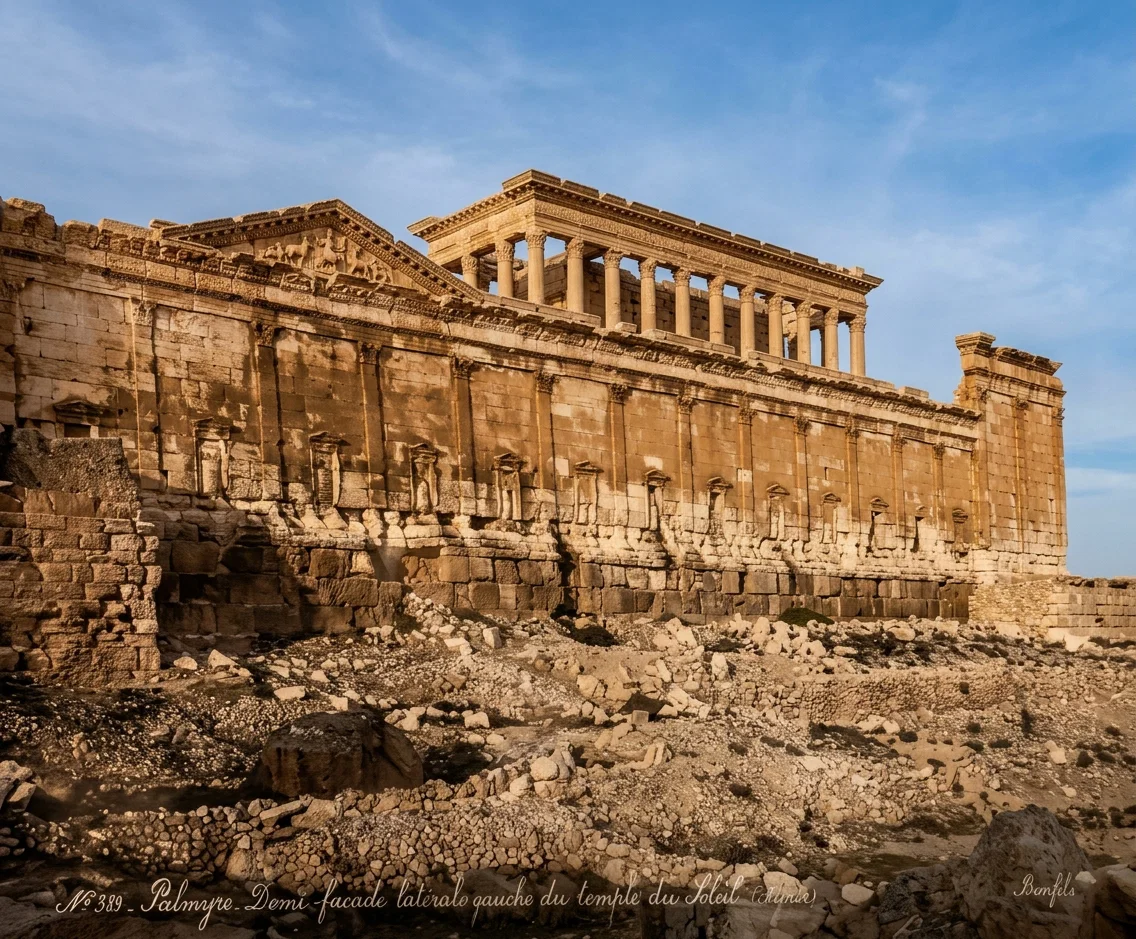
Part of the Ruins of the Magnificent Temple of the Sun in Old Palmyra, or Tadmor, in Syria. Literal Temples All Crumbling; the Old Worship Does Not Exist in Form; but Is It Not Here in Fact?
IT is not to be wondered at that Lucifer, the light-bringer, as his God-bestowed name indicated, chose the sun by which to deceive men, and draw them away from the worship of the invisible God, the Creator, to the worship of the creature. It is not to be wondered at that when men became blinded to God, they turned to the greatest and most glorious object visible, that one the potencies of which were ever manifest, and clothed it with all the attributes of Deity. True, the moon and stars, the earth and trees and rivers, and even down to the vilest insect, were worshiped; but the sun was regent, and all these other things of minor majesty connected more or less with sun-worship.
THE worship of the great Creator is spiritual. While His power and wisdom and love were manifest in everything, in all His works, before marred by sin, He Himself was invisible. Men must come to know Him in character before they could look upon His unvailed glory.
YET He “made His wonderful works to be remembered.” As by His mighty power He in six days brought the chaotic earth into that condition that fitted it to be the home of man, and rested the seventh day, refreshed and delighted for His children’s sake, so He gave them the Sabbath of holy rest and refreshing, a special worship day, laden with double blessing, as a constant reminder of His love and power to save and keep. The one day—the seventh—was not itself alone the reminder of God, but every day, numbered with respect to that Sabbath day, became a memorial of God’s work. It was not “Sunday,” “Monday,” that God named the days, but “First Day” to the Sabbath, “Second Day” to the Sabbath, and so on to the Sabbath. And the command, “Remember the Sabbath day, to keep it ‘holy,’” included in its scope every day of the week.
WHAT a blessed thing it would have been for this world if the Sabbath, instituted by Christ under God, the Creator, had always been observed in the spirit! There would have been no multitude of gods, no bestial idolatry, no warring of creeds, no hecatombs of heretics. God alone would have been glorified in worship, and His manifold brightness would have been reflected in manifold glory from all His children.
WHEN Lucifer rebelled, he said, “I will be like the Most High.” Isa. 14:12–14. He must deceive God’s children so as to make them forget the Creator; He must get them to substitute for the mightier, clearer vision of faith that of sensuous sight, to exalt self to the place of God, to forget the Creator in the worship of the creature. He blinded man through self. He entered his heart through the perverted senses. Desire of God and goodness was changed to selfish lust; worship of God, to glory of man. And then man clothed the great created things which he felt were above him with his own conceptions of Deity.
OUT of this grew the worship of the sun, the chiefest of all visible objects. With this worship naturally came in all kinds of nature worship. As the warmth of the sun caused the earth to bring forth, so sexuality came to be inseparably connected with sun-worship; and the worship of the sun became the most grossly licentious of all systems of idolatry. An example is given in Numbers 25.
AS GOD had a day to commemorate His created work, so the great false god was given a day, the first day of the septenary cycle, that in the very beginning of the week man might forget his Maker. Yet, missing the object of the Sabbath, Satan chose the only day in the week that could not, in the nature of the case, be a Sabbath. The Sabbath was a holy day, freighted with blessing. The day of the sun was made a holiday, filled with lustful curses. One writer well calls it “the wild solar holiday of all pagan times.” Its name, Sunday, or something equivalent to that, was known in nearly all the great pagan nations of antiquity. Connected with the day, as with the worship of the sun, has been the large indulgence of the flesh, a thing impossible for the devotion of an earnest Christianity (wrongly directed) to even approximately overcome.
IN honor of the great sun-god some of the most glorious temples of earth have been erected, of which we have an illustration on our first page. These temples have mostly crumbled into ruins before the truth of God’s Word, the Gospel of Jesus Christ; but of late men are seeking to erect a temple of law,—national and international,—to uphold the day dedicated to the great luminary from time immemorial, and in which earnest devotees are seeking, contrary to the Gospel of Christ, to compel all men to worship. The question is now as ever of old, even now as never of old in intensity and importance, Will we worship the creature or the Creator? Will we bow to the mandates and ordinances of Lucifer, the revolting one, or will we obey God and keep His commandments forevermore? Sun-worship is not dead; it is a question of earth’s ages. How many will decide with Elijah, as between Baal the sun-god and Jehovah the Creator?

THE NEED OF MISSIONARY EFFORT

The last message of mercy is to be given to the world by the proclamation of Gospel truth. Truth, Bible truth,—this is what the people need. On our knees we are to claim the promises of God’s Word, asking that we may receive pure, unadulterated truth, and that we may realize the necessity of giving this truth to others. Then men and women will be converted. The hand of God will be recognized in the raising up of new churches. The Lord will baptize with the apostolic spirit many who will go forth to do missionary work in places where the people know not the truth.
True missionary work will furnish the churches with a sure foundation, a foundation having this seal, “The Lord knoweth them that are His.” Then God will be glorified in His people. Christian missions will be built upon Jesus Christ. Under the supervision of God the work will go forward, and innumerable evidences will be given of the genuineness of the work. The workers will not seek to glorify self, but will praise God as the designer and organizer of every holy, ennobling work. They not only profess to be believers; they are believers. They are sanctified by the truth; for truth acted as well as preached has a purifying influence upon the character.
In the home and in the church the true missionary is a living exposition of truth. He eats the flesh and drinks the blood of the Son of God, and his life is moulded according to the divine similitude. He digests and assimilates the Word, saying, “I live, yet not I, but ‘Christ liveth in me.’” True missionary work leads those engaged in it to bow before God in humiliation and unfeigned gratitude for the past and present manifestations of His power. They hide self in Christ, praising and glorifying Him as the One altogether lovely.
Christian missionary work is of great value to the home churches. By it the members are inspired with holy, sanctified zeal to deny self, to lift the cross of Christ, to labor with self-sacrificing effort to send the truth to regions beyond. Christian missionary work has a reflex influence upon the churches, an influence uplifting and sanctifying. It has a salutary influence upon unbelievers; for as the workers labor under divine superintendence, worldlings are led to see the greatness of the resources God has provided for those who serve Him. God’s truth, demonstrated by the working of grace in the heart, multiplies the agencies of Christian usefulness and makes a decided impression upon the world.
God desires His people to be living examples of the purifying influence of the truth. He desires them to reveal in their lives its power to elevate and ennoble. Thus they are to illustrate the excellence of the truth, raising the standard of Christian courtesy, tenderness, and love. With an intensity of effort they are to seek to save those who are perishing. Let the heart yearn even to breaking over those who know not the truth. Let not believers center their thoughts upon themselves. Let them go to work for others, forgetting self in the loving desire to help those around them. Let them think and plan and work for those who know not God. It is not only the learned, the talented, who are to work for others. All who claim to believe in Jesus should do this. This is Christian usefulness. And in this work let us show a holy dependence upon God. Dependence upon God, sanctification of purpose, earnestness in service,—these distinguish between those who serve God and those who serve Him not. We who believe are to illustrate in our lives the excellence of the Christ-life. Church-members are to arise and shine amid the moral darkness of the world. If we are connected with the Light of the world, we shall reflect light to others. If we partake of the Saviour’s rich grace, we shall be a blessing to those around us.
God calls upon us to show a hallowed patriotism, to reveal the attributes of the Saviour in the home and in the church, to deny self that we may have to give to the work in the fields afar off. Let all seek to manifest the benevolence of Christ. He gave His life to save a fallen world, and shall Christians, those who claim to be His representatives on the earth, be unwilling to deny self? Shall they remain weak and inefficient because they are too selfish to make sacrifices for Him who gave His life as a sacrifice for them?
God help us to arise and take a most decided stand in the center of a large circle of benevolent work. Thus we may glorify and magnify the name of Him who is truth. We are laid under the most solemn obligations to furnish, in Christian missions, a grand illustration of the principles of the kingdom of God. The church is to work actively as an organized body to spread abroad the influence of the cross of Christ. Those who work unselfishly to give the truth to those nigh and afar off are registered in the courts above, “Laborers ‘together with God; . . . God’s husbandry, . . . God’s ‘building.’” Controlled by the great Designer, they show what human beings can be when they wear the yoke of Christ, learning His meekness and lowliness.
It is because so many of Christ’s professed followers seek to be first that He can not trust them. Were they humble, willing to be taught by Him, they would be a power in showing to the world the influence of the truth upon human character. Those who work in Christ’s lines, never seeking to exalt self, will reveal constant activity and steady progress in missionary enterprises. They will not be satisfied unless church is added to church.
God expects those in His service to contend earnestly for the faith once delivered to the saints. Our aggressive missionary work is to be more abundant than it has been in the past. More territory is to be annexed; the standard of truth is to be planted in new places; churches are to be established; all is to be done that can be done to fulfil the commission, “Go ye therefore, and teach all nations, baptizing them in the name of the Father, and of the Son, and of the Holy Ghost; teaching them to observe all things whatsoever I have commanded you; and, lo, I am with you alway, even unto the end of the world.”
The life of a church depends on the interest which its members manifest in those outside the fold. Let the church of God remember that Christ gave Himself as a sacrifice to save a world from destruction. For our sake He became poor, that we through His poverty might come into possession of eternal riches. Shall those whom God has blessed with a knowledge of the truth become narrow in their plans? Let them arouse to a sense of their vast obligations, cutting away every thread of selfishness, that the Lord may pour upon them His Holy Spirit. Let them seek the Lord while He may be found, and call upon Him while He is near. They have no reason for being faithless and complaining. Let them cease all fault-finding and murmuring, and encourage a spirit of gratitude for past mercies and blessings. Let them praise the Lord in unfeigned gratitude for the light of His Word, which shines upon their pathway, to be received into heart and mind, and reflected upon those in darkness. Thus they will be prepared to work to the praise and glory of Christ, and to inscribe upon their banners, “Here are they that keep the commandments of God and the faith of Jesus.” MRS. E. G. WHITE.

HAVE LARGER FAITH.

It is impossible for our faith to make too large demands upon God's love and power. We can not exhaust His gifts. The word is, “All things are yours; whether . . . the world, or life, or death, or things present, or things to come; all are yours.” 1 Cor. 3:21, 22. “He that overcometh shall inherit all things;” and the victory has already been won for us. In Christ are all things, and He is “the desire of all nations;” therefore we can not desire a thing that is not ours already. Nay, our desires can not begin to compass the things that God has given us; for “eye hath not seen, nor ear heard, neither have entered into the heart of man, the things which God hath prepared for them that love Him. But God hath revealed them unto us by His Spirit.” O, then, “Receive ye the Holy Ghost,” and “Be not faithless, but believing,” for “all things are possible to him that believeth.” E. J. WAGGONER.

GOD’S SYSTEM OF JUDGING MEN.

SINCE every moment of men’s lives will be scrutinized at the final judgment bar, it follows that adequate records are kept, and that due time must be given to the examination of the employment of all these moments, before decision can be justly made, upon which eternal destinies hang. Eccl. 12:14; 3:17. That such a stupendous work may be done in proper time, some well-defined system of operation must be employed by which to accomplish the desired object. In order to arrive quickly at an understanding of this system, let us briefly look at an arrangement that not only provides for man’s success in his earthly existence, but also becomes a factor in the work of the judgment itself.
The angels of heaven have been constituted ministers of man’s earthly necessities. Heb. 1:14. Not only do these accompany men, to deliver them from the evil designs of God’s enemies (Ps. 34:7; Acts 12:5–11), but they are always present to record every word and act of those whom they are sent to assist. Matt. 18:10; Eccl. 5:6. When therefore the time of the judgment arrives, the angels become an important part of that tribunal. While the eternal Father sits upon the throne of His final decision in the cases of men, thousands upon thousands stand about to answer to His demands. Dan. 7:9, 10. These ministers in Heaven’s service, are the angels. Rev. 5:11. In the presence of this august assembly, the Lord Jesus comes directly before the throne of the Ancient of Days (Dan. 7:13, 14), and the judgment work begins.
Ponderous volumes are then opened, containing records of individual deeds and impulses,—harsh words and those of tender sympathy; slights to the poor and acts of kindly charity; neglect of prayer, and seasons of deep devotion. Every misdeed, in fact, as well as every righteous deed, together with every thought of reform and its attending forgiveness from God, each pang of sorrow or thrill of joy, the faintest discouragement or fondest hope, is laid bare in the sight of every heavenly being.
Another book,—one of far different character,—is also present, the “book of life.” In this is recorded the names of those who had longed for the likeness of Christ, and had been co-workers with God and the angels to that end. Luke 10:20; Phil. 4:3. As this book is opened, and the first name on its pages is announced, the angel who was the ministering spirit to that person in his earthly pilgrimage comes forward with the open record of his life. If these show that he was a final “overcomer,” the Lord Jesus then and there confesses his name before the Father, and before His angels, pleading His own blood in behalf of the individual’s misdeeds. These are then blotted out, and the person’s name is retained in the book of life. Isa. 43:25; 44:22. But if the records show a person’s name entered who afterward gave up his connection with Heaven to walk in the ways of the world, to the end of his life, his name is blotted out from the book, and his sins are retained against him, and will condemn him to the second death. Ex. 32:32, 33; Matt. 10:32; Luke 12:8, 9; Rev. 3:5.
This “blotting out” time is a specific period in the world’s history, rather than a point of time in any one person’s career. Thus we are distinctly told that our sins “may be blotted out, when the ‘times of refreshing shall come from the presence of the Lord; and ‘He shall send Jesus Christ, . . . whom the heaven must receive ‘until the times of restitution of all things.” Acts 3:19–21. Sins are forgiven when confessed, but as shown by the Saviour’s illustration in Matt. 18:23–25, these may be rolled back upon the individual, providing he does not prove faithful to the end. Matt. 24:13. In case of his failure, all the sins of his life must fall back on him as the one responsible for them. They could not, therefore, be “blotted ‘out” until his earthly career has ended, and the decision of the judgment has determined his standing in the sight of Heaven.
But when sins are once blotted out, then they can be no more remembered forever. Heb. 8:12. Those who committed them must then be forever free from them, and dwell eternally with the most high God, to enjoy the bliss of His presence. This state is well worth securing, even at the expense of all that the world affords.
J. O. CORLISS.

WHAT IS MAN?

WHAT is man that Thou art mindful of him?” Is he of great value? All his “righteousnesses are as filthy rags.” Isa. 64:6. If man’s best is as filthy rags, why did the all-wise God pay such an enormous price for his redemption?
God values man not for what he is, but for what he was, and may become. Let us briefly consider what he was. “God hath made ‘man upright.” Eccl. 7:29. “God created man in His own image.” Gen. 1:27. “Thou madest him to have dominion over the works of ‘Thy hands; Thou hast put all things under his feet.” Ps. 8:6.
Originally man, bearing the image of the perfect God, was king of this world. God still recognizes His image in man, even defaced tho it is by sin, and estimates his worth according to its value. The greatest mathematician on earth finds himself unequal to the task of computing the value of this image; but the heavenly Mathematician, who numbers the hairs of our heads, the birds of the air, and the stars of heaven, who weighs the mountains in scales and the hills in a balance, and comprehends the dust of the earth, knows the value of His image in a human soul.
In purchasing man, God did not consider him a servant, a slave, such as he is to sin, but regarded him as a king, such as he may become, a “royal generation.” Thus Jesus Christ, in purchasing men, purchased kings, and consequently paid a royal price; He could not regard kings as worthless, or of small value, because He Himself was a king, the “King of kings.” Were not kings, bearing the image of the Great King, worth such a purchase? Christ so estimated; and when man is redeemed, Christ will not regret the price paid; for “He shall see of the travail of His soul, and shall be ‘satisfied.’” Isa. 53:11.
W. C. MATHEWSON.
Luce, Mich.

LISTENING TO GOD.

A FRIEND of mine told me that he called one day upon a brother clergyman, who had been ill in bed for six months. He said to this man, “I suppose that God Almighty had a good many things to say ‘to you, but you were too busy to listen, and so He had to put you on ‘your back, that you might be able to give Him time.”
When he was going out the thought struck him, “I, too, am a ‘busy man, and God Almighty may have to put me on my back, that ‘He may tell me all He wishes.”
So he resolved that each night he would sit quietly in his study, not reading, not writing, but opening his heart, that God’s Spirit might impress upon him what He designed to teach, and criticise the life of the previous day.—F. B. Meyer.

THE ADOPTION OF “CHRISTIANITY” AS THE NATIONAL RELIGION.
From a government of the people according to constitutional principles, the republic of Rome degenerated to a monarchical absolutism, according to the wilful and vicious caprice of the one man who had the ill fate to be the monarch.
After that the next distinct governmental departure was the formation of a union with the apostate church and the adoption of that “Christianity” as the national religion.
We have seen that the Supreme Court of the United States in decision of May 19, 1890, confirmed by decision of May 27, 1901, established the doctrine of monarchical absolutism as a recognized governmental principle of the republic of the United States; and that that monarchical absolutism has already begun to be merged in one man who is to govern, not according to constitution or law, but according to will only.
And that decision of the Supreme Court of the United States, May 19, 1890, was followed Feb. 29, 1892, by a decision of the same Supreme Court establishing “Christianity, general Christianity,” as the national religion, and accordingly declaring that “this is a Christian nation.”
And as the principle of monarchical absolutism of the Supreme Court decision of May 19, 1890, has been followed in national action to the very brink of imperial absolutism; so the principle of established “Christianity” of the Supreme Court decision of Feb. 29, 1892, has also been followed in national action to the point of tantamount declaration of independence of the government of God, and to the very brink of an imperial “Christian” absolutism, passing itself off for God,—its will as the will of God, its voice as the voice of God, its power as the power of God.
And as the principle of monarchical absolutism, espoused by the Supreme Court May 19, 1890, and followed in national action unto 1901, was confirmed by decision of the same Supreme Court May 27, 1901; so the principle of imperial “Christian” absolutism espoused by the Supreme Court Feb. 29, 1892, and followed in national action even to the very fulness of the government’s actually passing itself off for God—its will as the will of God, its voice as the voice of God, its power as the power of God—will, if ever brought to the test, assuredly be confirmed by the same Supreme Court.
Yet, in order for the government to go to this full length in the practise of imperial “Christian” absolutism, it is not really necessary that the matter should be tested and confirmed by further decision of the Supreme Court; for all this was fully sanctioned by the court in its argument and citations in its decision of Feb. 29, 1892, which declared that “this is a Christian nation.” For by that decision “the Christian religion,” “Christianity, general Christianity,” is legally recognized and declared to be the established religion of the United States, and that consequently “this is a Christian nation.” Also by that decision, “in language more or less emphatic,” there is justified, and all as the “meaning” of the Constitution of the United States, (1) the maintenance of the discipline of the churches by the civil power; (2) the requirement of the religious oath; (3) the requirement of the religious test oath as a qualification for office; (4) public taxation for the support of religion and religious teachers; (5) the requirement of a belief in the Trinity and the inspiration of “the ‘Holy Scriptures of the Old and New Testaments;” (6) the guilt of blasphemy upon every one who speaks or acts in contempt of the established religion; and (7) laws for the observance of Sunday as the Sabbath, with the general cessation of all “secular business.”
Thus that decision of Feb. 29, 1892, completely justifies beforehand the veriest imperial “Christian” absolutism that could ever be exercised or devised. Consequently it is not at all necessary that there should be a confirming decision to make effective such national action; yet, if the matter shall be brought to test, there can be no doubt whatever that a confirming decision will be rendered of the principles of imperial “Christian” absolutism of the decision of Feb. 29, 1892, as has been rendered confirmatory of the principles of monarchical absolutism of the decision of May 19, 1890. And this identical thing is even foreshadowed in the decision of May 27, 1901. For therein are written the following words:—
There is a clear distinction between such prohibitions [of the Constitution] as go to the very root of the power of Congress to act at all, irrespective of time or place; and such as are operative only “throughout the United States” or among the several States.
Thus, when the Constitution declares that “no bill of attainder or ex post facto law” shall be passed; and that “no title of nobility shall be granted by the United States;” it goes to the competency of Congress to pass a bill of that description. Perhaps the same remark may apply to the first amendment, that “Congress shall make no law respecting an establishment of religion, or prohibiting the free exercise thereof,” etc.
“Perhaps”! Note the wide possibilities opened by that “Perhaps.” Only “perhaps” Congress is incompetent to make laws respecting an establishment of religion, or prohibiting the free exercise thereof. This statement is in itself almost an open confirmation of, and is in exact harmony with, the decision of Feb. 29, 1892, making “Christianity, general Christianity,” the national religion and therefore this “a Christian nation.”
Thus by the decisions of the Supreme Court of the United States May 19, 1890, and Feb. 29, 1892, the government of the United States was committed, and delivered over to the principles of monarchical absolutism both civil and religious. And nothing that has since occurred in national action in the manifestation of monarchical absolutism, either civil or religious, has been in principle new; and nothing that shall or can ever occur in the manifestation of monarchical absolutism, either civil or religious, will or can be in principle new. It all has been, and it all will be, but the plain manifestation in action, the simple logical expression, of the principles espoused as the fundamental principles of the nation by the Supreme Court of the nation in the decisions of May 19, 1890, and Feb. 29, 1892.
And even the decision of Feb. 29, 1892, making the United States “a Christian nation,” was hardly new; for the decision of May 19, 1890, establishing the principles of monarchical absolutism, was made to receive its inspiration from “the spirit of Christianity.” So that the decision of Feb. 29, 1892, was itself more of a confirmation of “the spirit of Christianity” in monarchical absolutism of the decision of May 19, 1890, than it was in itself a new and original decision announcing the principle. This result was so manifest in the decision of May 19, 1890, that in writing upon the subject in June, 1891, the writer of this present article said: “But no religious despotism can ‘ever be established over a free people. It were literally impossible ‘to establish a religious despotism over the royal freemen who made ‘the Declaration of Independence and the American Constitution. ‘This gradual but steady perversion and subversion of the genuine ‘principles of the government as established by our forefathers, this ‘steady inculcating of the principles of paternalism, is but sowing the ‘seeds of a despotism—whether of the many, of the few, or of the one, ‘it matters not—which at the opportune moment will be joined by the ‘political preachers, and out of the alliance thus formed there will come ‘the religious despotism in the perfect likeness of the one before it”—in Rome. And in less than a year the Supreme Court itself put forth its decision—Feb. 29, 1892—establishing “Christianity, general ‘Christianity,” as the national religion, and declaring this “a Christian ‘nation,” and thus opened the door which the political preachers immediately entered, and demanded and secured governmental action in behalf of church institutions and observances.
It is notable also that in all these decisions—May 19, 1890, Feb. 29, 1892, and May 27, 1901—Rome, both civil and religious; Rome, both Pagan and Papal, is the original of the principles espoused,—in the first two by definite citation, and in the last by inevitable, historical fact. And now that the principle of imperial “Christian” absolutism, after the example of Rome, has been thus established as the principle of the government of the United States, the only thing that remains to complete the active course of Rome is for the government of the United States to make practical provision for Papal—Roman—falsehoods and delusions.
The effect of the establishment of that imperial “Christian” absolutism in the Roman empire was so to fill the empire with hypocritical, Pharisaic iniquity, as speedily to sink it in awful and utter ruin. And since in the United States this course of Rome has been followed, and Rome’s history, in principle and in practise, has been repeated unto the very last item, civil and religious, will this nation, can this nation, now escape the repetition of that last item, and through it the result in ruin that came to Rome because of that item?
Therefore, sixteen years ago, in 1885, it was published that “when ‘our government shall repudiate every principle of its Constitution as a ‘Protestant and republican government, and shall make provision for ‘the propagation of papal falsehoods and delusions, we may know that ‘the time of the marvelous working of Satan is at hand, and that the ‘end is near.’” And this “national apostasy will mean national ruin.” It can not mean anything else. That is the one only thing that it meant to the republic of Rome, degenerated to monarchical absolutism and imperial “Christian” despotism; that is the one only thing that it can mean to the republic of the United States, traveling precisely the same course unto the brink of the last step that precedes ruin.
And all this is shown in the Scriptures. In the Scriptures, Rome from beginning to end—Rome Pagan and Papal—is “the Beast.” Dan. 7:7, 11; Rev. 13:1–8; 19:19, 20. And in the last days, in the time of the end, there arises “another beast,” that develops “an image of the Beast,”—that is, an image of Rome. The only thing out of which can come an image of Rome is a republic degenerating into empire, monarchical absolutism and imperial “Christian” despotism; then sinking in utter ruin. That is only what Rome was; and over that same course, unto the verge of the very last step that precedes ruin, this republic of the United States has already traveled in the perfect likeness of the course of the republic of Rome. Rome was the Beast; this is, and will continue to be, the very Image of the Beast. Rev. 13:11–18.
Accordingly, just now there is due to the world the message of God, proclaimed with a mighty voice, “If any man worship ‘the Beast and his Image, and receive his mark in his forehead or in ‘his hand, the same shall drink of the wine of the wrath of God, which ‘is poured out without mixture into the cup of His indignation. . . . ‘Here is the patience of the saints; here are they that keep the commandments of God and the faith of Jesus. . . . And I looked, ‘and behold a white cloud, and upon the cloud one sat like unto the ‘Son of man, having on His head a golden crown, and in His hand a ‘sharp sickle. And another angel came out of the temple, crying with ‘a loud voice to Him that sat on the cloud, Thrust in Thy sickle, ‘and reap; for the time is come for Thee to reap; for the harvest of the ‘earth is ripe. And He that sat on the cloud thrust in His sickle on ‘the earth, and the earth was reaped.’ Rev. 14:9–16.
“And the Beast was taken, and with him the false prophet [the ‘Image of the Beast] that wrought miracles before him; . . . ‘these both were cast alive into a lake of fire, burning with brimstone,” and so together are consumed “with the spirit of His mouth,” and destroyed with “the brightness of His coming.”
The course of the republic of Rome has been repeated by the republic of the United States unto the brink of the last downward plunge that preceded Rome’s ruin. That last step of the course of the republic of Rome will be repeated by the republic of the United States. And then utter ruin will be the inevitable consequence to the republic of the United States, as it was to the republic of Rome.
“Get ready, get ready, get ready!”
ALONZO T. JONES.
Ancient History Which Is Also Modern

NOT THE BIBLE, BUT EGYPT.

(Dr. Eduard Glaser in the “Beilage” of the Allgemeine Zeitung, Munich. No. 213)
ONE of the perplexing problems of Egyptian chronology has been the date of the opening of the era generally known as the “Middle Kingdom,” which included the famous eighteenth dynasty, and covered the period which runs parallel with the beginnings of the Israelitish people, especially the times of the patriarchs. As Egyptian research had all along maintained that this period antedated the events described in the chapter in Genesis referring to these times, a conflict has been supposed to exist between Egyptian and Biblical chronology.
The new papyrus find shows that the trouble all along has been an incorrect computation on the part of the Egyptologists with reference to this historic period. Professor Meyer has maintained that it began in 2130 B. C., Brugsch in 2466, Petrie in 2778, and Unger in 3315, so that the difference between the highest and the lowest was about twelve hundred years; yet not one could be brought into agreement with the Biblical records.
The new papyrus shows that the beginning of this period is to be placed between 1996 and 1993 B. C., and its close between 1783 and 1780, or fully one hundred and fifty years later than even the low computation of Meyer puts it; and a space of less than fifty years now exists between the current Biblical chronology and that of the Egyptologists, where formerly there was a difference of centuries, and a reconciliation seemed impossible. The near approach of the two chronological systems has been caused entirely by the discovery of errors in Egyptian calculations, and not in the Biblical.

Salvation Through a Personal Saviour

WE are not saved by nations or by churches or by families, but as individuals, through a personal interest in a personal Saviour.—John James.
Continue reading: (Concluded next week.)