Your ShelfYour Projects

Signs of the Times, Vol. 27, No. 34.

SUN-WORSHIP
Earlier text: AND THE BAPTISTS, TOO?

SOME WORDS FOR ALL CONCERNING RICHES.

“The Lord maketh poor, and maketh rich; He bringeth low, and lifteth up.” 1 Sam. 2:7.
“Surely every man walketh in a vain show; surely they are disquieted in vain; he heapeth up riches, and knoweth not who shall gather them.” Ps. 39:6.
“Trust not in oppression, and become not vain in robbery; if riches increase, set not your heart upon them.” Ps. 62:10.
“Defend the poor and fatherless; do justice to the afflicted and needy. Deliver the poor and needy; rid them out of the hand of the wicked.” Ps. 82:3, 4.
“When the Lord shall build up Zion, He shall appear in His glory. He will regard the prayer of the destitute, and not despise their prayer.” Ps. 102:16, 17.
“There is that maketh himself rich, yet hath nothing; there is that maketh himself poor, yet hath great riches.” Prov. 13:7.
“He that oppresseth the poor to increase his riches, and he that giveth to the rich, shall surely come to want.” Prov. 22:16.
“For riches are not forever; and doth the crown endure to every generation?” Prov. 27:24.
“Open thy mouth, judge righteously, and plead the cause of the poor and needy.” Prov. 31:9.
“He that loveth silver shall not be satisfied with silver; nor he that loveth abundance with increase. This is also vanity.” Eccl. 5:10.
“There is a sore evil which I have seen under the sun, namely, riches kept for the owners thereof to their hurt.” Eccl. 5:13.
“As the partridge sitteth on eggs, and hatcheth them not; so he that getteth riches, and not by right, shall leave them in the midst of his days, and at his end shall be a fool.” Jer. 17:11.
“He also that received seed among the thorns is he that heareth the Word; and the care of this world, and the deceitfulness of riches, choke the Word, and he becometh unfruitful.” Matt. 13:22.
“And I say unto you, Make to yourselves friends of the mammon of unrighteousness, that when ye fail they may receive you into everlasting habitations. He that is faithful in that which is least is faithful also in much; and he that is unjust in the least is unjust also in much. If therefore ye have not been faithful in the unrighteous mammon, who will commit to your trust the true riches?” Luke 16:9–11.
“Unto me, who am less than the least of all saints, is this grace given, that I should preach among the Gentiles the unsearchable riches of Christ.” Eph. 3:8.

PRACTICAL ART AT THE PAN-AMERICAN EXPOSITION.

AMONG the interesting things exhibited in the Graphic Arts Building at the Pan-American, is one by Funk & Wagnalls Company displaying the process necessary to produce a lithograph in sixteen colors. The picture that has been selected for this purpose is the colored plate, The Ark of the Law, in the Jewish Cyclopedia. In order properly to show this instructive exhibit, there has been placed a revolving stand on which are eight double frames, each of these frames holding four pictures. In No. 1 is shown the first stone which was engraved for this colored plate. This is the stone which lithographers call “The Base.” No. 2 shows the part of the subject which is to be printed in yellow; turning to No. 3 we find the result of this second stone printed over the first stone. No. 4 again shows the part of the subject which is printed in the next color, namely, medium red; and on No. 5 we have the result of this medium red printing over the preceding colors, and so on, step by step, until we have gone through the sixteen different printings, and finally see the finished picture. Thus the increasing effects of the various printings are clearly illustrated as one proceeds in the examination toward the later stones.
This exhibition illustrating the art of lithography was specially prepared for the instruction of the laymen, and the demonstration is so very simple and attractive that the ordinary person, after turning the eight double frames, should have a fairly clear idea of the manner in which lithography is produced.

The School of Bad Habits

THERE is a school that many a child enters at infancy, and from which he is not graduated until death, and that is the school of bad habits. He acquires them early, and adheres to them until late. The diploma that he gets in this school is ill health and chronic invalidism.

ON THE WAY TO INDIA.

From Queenstown to Aden.
THOSE who have ever had an experience of tossing upon the trackless ocean for nearly a week, out of sight of land, can imagine something of our delight as the green hills of Ireland appeared in view at 6:30 Wednesday morning, June 5. Sailing along the southern coast, we entered the harbor of Queenstown about noon. Our steamer did not touch the wharf at that place, but waited in the mouth of the harbor till quite a number of passengers were transferred to a small steamer to be taken to land. Then we glided across the waters of the Irish Sea so smoothly that most of the time our great steamer seemed almost motionless.
Arriving at Liverpool, Tuesday morning, June 6, we had a very pleasant ride over the verdant and charming fields of England to the great city of London. This metropolis of the British empire occupied an area of 117 square miles in 1896, and had a population of 4,421,492; and the population of Greater London at that time was 6,177,913. Our London friends who came to meet us at the train, not only gave us a hearty welcome, but rendered us every possible assistance, and only by their active and timely aid were we able to get away on the train that we wished to take the same day, so as to give us a quiet Sabbath of rest at Marseilles, and time to take the steamer June 9.
Crossing from England to France, the water was rough. Our ride across France was an interesting one, tho the scenery was not equal in beauty to that of England. The French system of farming appears to be different from any other that we have ever seen. Their crops are raised in narrow strips, that seem to average from one to three rods in width, caused by the division of the land at the time of the French Revolution. We spent a part of the day Friday in the beautiful city of Paris, and arrived in Marseilles early the next morning. Here we supplied ourselves with deck chairs and fresh fruit, before our good French steamer, Earnest Simon, started on her long Eastern voyage.
Monday, June 10, at 4 P.M., we passed between Corsica and Sardinia. Tuesday morning we found our steamer was running toward the center of a burning mountain, that rose high before us, and we were informed that it was the volcano of Stromboli. But instead of running into it, we turned to the left, and passed near by on the north side, having a fair view of the heated masses rolling down the sides of the mountain, and raising a white splash as they plunged into the sea. Just as we were directly opposite on the north side, the ancient orator favored us with a speech, accompanying the one loud word by a volume of smoke, mingled with broken rocks, that flew high in the air, and could be distinctly seen as they descended upon the mountainside. About twenty minutes later another volume of smoke shot upward; but we had passed too far to hear the report.
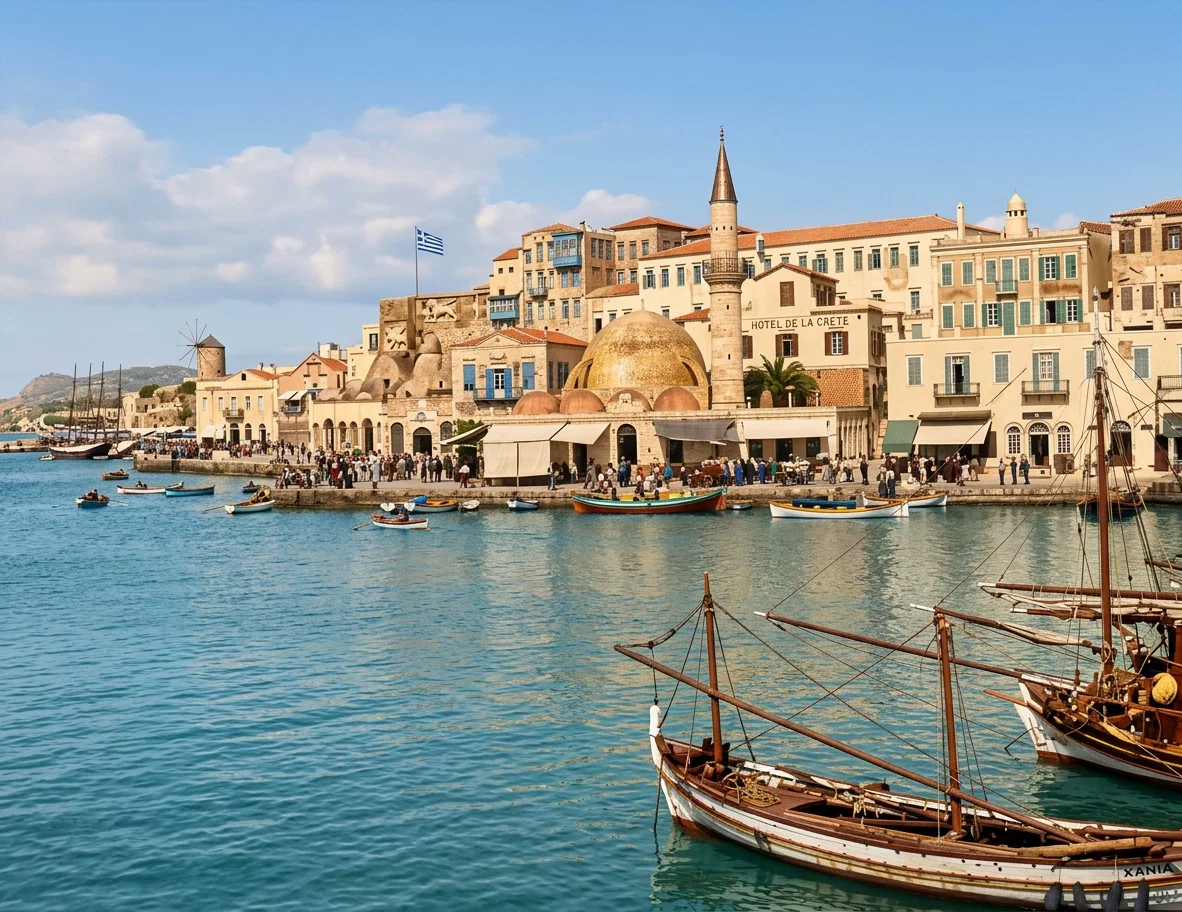
Canea, a City in Crete.
Leaving Stromboli behind, the southern coast of Italy, the “toe of the boot,” soon appeared in view; and then the northern coast of Sicily was seen. Passing through the Strait of Messina, we had a view of Messina on the right, and at our left, of the village of Reggio, the ancient Rhegium in Italy, where Paul spent one day. After passing these, we had a view of Mount Etna, on the Island of Sicily. As we again passed out of sight of land, we thought of the storm that broke over this part of the Mediterranean and wrecked Paul’s vessel. But He who called us from the West to go on a mission to the East; He who once said to the troubled Sea of Galilee, “Peace, be still,” knowing that we have not the power of endurance that Paul had, has spoken peace to the “Great Sea,” and in obedience to His voice it bears us safely upon its quiet bosom, so gently that our vessel seems almost motionless. A part of the time the glassy surface of the sea has such an oily smoothness that it might almost be said to be waveless; and when we are in our cabins, the boat seems as if it were standing still.
Wednesday, June 13, we study more about the third voyage of Paul, as we sail between Crete and Clauda. We are having precious seasons of Bible study and worship, in which we realize, as never before, the presence of the One who has promised ever to be with us. None of our company seem to have any doubt about being in the right path. Altho we all love our native land, and appreciate the full meaning of the word “home,” yet we do not regret that every day bears us farther and farther away from all those scenes so dear to us. Altho we value our friends so highly, and greatly miss their society, yet we go willingly to dwell among strangers in a strange land. Such are our present feelings, tho we know not what severe trials are before us, and we are aware that the great tests have not yet come. But this we know: we have the sure promise in Phil. 4:19, “But my God shall supply all your need according to His riches in glory by Christ Jesus.” (A bank-note on which there is no discount.) And if we need to be tested by fiery trials, they will surely have a place in our experience.
Thursday, June 13. Our course is farther south than was that of Paul during the days of contrary winds. Friday, June 14, we entered Port Said at 5 A.M. There we found a mixed multitude of people of different nationalities, most of them very earnest and persevering in their efforts to sell their wares to strangers. Some of them retained their patience and cheerfulness to the last, even tho unsuccessful; others manifested impatience at the first refusal to trade with them. They were indeed interesting object-lessons for our study.
At 12:30 P.M. we began to move down the Suez Canal. “From remote ages the Isthmus of Suez has been traversed by a canal, following nearly the line of the present one. Nothing certain, however, seems to be known as to who was its first constructor; but the credit is generally given to Pharaoh Necho, who reigned about 600 B.C. In the course of time it became clogged with sand; but it was cleared out by Trajan in the second century A.D., and was again cleared in 767. The Suez Canal is 99 miles in length from sea to sea, with a width of 327 feet for 77 miles, and of 196 feet for the remaining 22 miles, and its depth is 26 feet.”
We had proceeded but thirty-five miles on this canal, when a swift sirocco, sweeping from the Arabian Desert, came whistling through the rigging of our vessel, with its cloud of sand darkening the sky above, filling all the air around, and sanding our decks and cabins before the port-holes were closed against it. As our great steamer was unable to proceed with safety, it was tied to a strong post upon the bank, and stood quietly in the channel for about seven hours, a safe refuge from the storm that was sweeping over us. During the night our ship moved on, passing through three salt-water lakes, and arriving at the end of the canal at Suez about noon, Saturday, June 15. We remained here till 9 P.M., and then moved on down the Gulf of Suez. At first the waters were sleeping in oily smoothness; but very gradually they were stirred into motion by the gentle breezes, until we moved out into the Red Sea, where the rolling, dancing waves, with their sparkling, foaming whitecaps, added a more lively grandeur and sublimity to the scene, calling forth from our hearts lofty adoration of the loving Father,—
“Who holds them all within the hollow of His hand, Where every drop is subject to His wise command.”
Tuesday, June 18. We expect to reach Aden tomorrow morning, and must attend to the mailing of our letters this P.M. We feel assured that many prayers ascend for us. We behold the answers daily. Our steamer has seemed almost as steady as a house ever since we left Marseilles. Just now we passed the Twelve Apostles,—twelve large rocks standing up in a row in the Red Sea. June 19, a day of beauty, dawns upon the Gulf of Aden. Record of the quietness of the Red Sea, as well as of the Mediterranean, unbroken.
G. K. OWEN.

CHRIST WANTS THE BEST.

CHRIST wants the best. He in the far-off ages Once claimed the firstling of the flock, the finest of the wheat, And still He asks His own, with gentlest pleading, To lay their highest hopes and brightest talents at His feet; He'll not forget the feeblest service humblest love; He only asks that, of our store, we give to Him The best we have.
Christ gives the best. He takes the hearts we offer, And fills them with His glorious beauty, joy, and peace, And in His service, as we're growing stronger, The calls to grand achievements still increase. The richest gifts for us on earth, or in the heavens above, Are hid in Christ. In Jesus we receive The best we have.
And is our best too much? O friends, let us remember How once our Lord poured out His soul for us, And in the prime of His mysterious manhood Gave up His precious life upon the cross; The Lord of lords, by whom the worlds were made, Through bitter grief and tears gave us The best He had.
—Selected.

FROM KIMBERLEY, SOUTH AFRICA.

PERHAPS but few of the SIGNS readers know about the “Benevolent Home” at Kimberley, South Africa. This institution has been in operation some five years. It was started as a place of shelter for destitute men, with a lodging-room and dining-room, and a wood-yard to keep the men employed. The wood-yard was run until the city was besieged by the Boers, when the wood supply was cut off, and so that part of the institution was discontinued.
We were besieged 124 days, and daily the shells passed over our heads, dropped all around us, and three struck our house,—two 100-pound shells, and one nine-pounder, wrecking rooms, but not injuring any people.
When the siege was raised, then came pressure from our creditors to pay them. We were owing about $3,000. The South African Conference assumed these obligations, and that relieved the Home. Then a most remarkable chain of circumstances occurred.
Our bath-rooms had never been as good as the work demanded,—soft brick walls, mud plaster, low ceilings, and poor wood floors, etc.; but we never had the means to build better ones. But now the Lord took hold of it. First of all, He sent a terrible storm of rain for twenty-four hours, then a daily downpour for two weeks. By that time the soft walls began to fall. Something had to be done. We had not a dollar to begin with; but we moved out in faith. We took down the old walls, dug down to the solid rock for a new foundation, bought hard brick, and put up solid walls, covered with a new iron roof. When we dug the foundation, we found diamond debris, which produced diamonds to help us build. The Lord had them ready there, only waiting the action of our faith to get them.
When the people saw us putting up substantial walls, they began to ask us to put in good bath-rooms, and said they would help pay for them. So we went to them with a subscription paper, and they have contributed about $2,000 so far, and more is promised.
We are now putting in good, substantial bath-rooms, and preparing to establish a sanitarium here.
Our faith has been much strengthened by our experience here. The Lord has answered our prayers so many times, and helped us through so many difficulties, that it gives us new courage. When it came time to get our bath-tubs, there were none for sale in town, and the military had so tight a grip on the railway that for five months the merchants could not get any goods whatever up from the coast. But we sent to Cape Town, and in a very few days our tubs were landed in our yard,—the only bath-tubs brought to Kimberley in five months. We wanted tiles for our floors. Not a dealer in town could get a single tile. We ordered ours, and here they are,—the only tiles brought to the city in five months. We wanted steel ceiling for our bath-rooms, and got that immediately,—no other has been brought in.
One week we had not the money to pay our help. We needed $200, and it came Thursday. Next day I needed money. I went out on the street praying with all my heart to God for help. I went to one man—he gave me $26; another gave me $250. Next day we received $124 more in donations. So it has been all along. The Lord has given the means as fast as needed.
Another time we got in a strait place, and went to see a man of wealth, and he gave us $500 cash. Thus God has dealt with us every week, all the time. The Lord is so good. The greater our needs, the greater His gifts.
We hope soon to have the treatment rooms in good shape for extensive work. We are holding Bible-readings, visiting the sick, distributing reading matter, and sowing the seed by conversation with those who come to our bath-rooms.
Kimberley is a center of wealth and trade, and a good point to establish our work. There is no other place where the people can get these treatments within 600 miles of here. We hope soon to have a full line of baths, electric baths, and electric-light baths, needle sprays, etc., etc.
Our family had the African fever, but soon recovered.
We are of good courage in the Lord, and desire to stay right in the field as long as the Lord wants us there.
J. V. WILLSON.
MRS. J. V. WILLSON.
32 Old Main Street, June 22, 1901.

OUR WORK AND WORKERS.

A new church building has been erected at Seward, Neb.
Eighteen persons were baptized at Muncie, Ind., on the 20th ult., by Brother P. G. Stanley.
Two members were added to the church at Wallace, N.Y., at the last quarterly-meeting service.
At the last quarterly meeting of the church at Darbyville, Iowa, two members were added to the church.
A church of ten members was recently organized at Auburn, Ind., by Brethren F. M. Roberts and J. E. Collins.
A mission among the Indians on the reservation near Salamanca, N.Y., has been started by Brother F. H. Hicks.
An institute for college and church-school teachers is now in progress at College View, Wash., to continue till September 3.
Eleven converts, in meetings held at Lamar, Mo., by Brethren D. E. Scoles and J. B. Stuyvesant, are reported in the Record.
Six converts are reported at Clifton, Kansas, where Brethren I. A. Crane and E. H. Curtis have been holding meetings.
Five converts were baptized at Frankton, Ind., on the 18th ult., and four at Huntington on the 20th, by Brother W. A. Ebert.
At the local camp-meeting recently held in the Black Hills, near Custer, S. D., four candidates were baptized in Sylvan Lake.
July 27 a church of twelve members was organized at Astoria, Oregon, by Brother H. W. Decker, president of the conference.
From the Review we learn that during the past eighteen months 112 members were added to the church at Battle Creek, Mich. Thirteen were baptized July 27.
A new colporter wagon has been fitted out for work among the Scandinavian settlements in Nebraska. Brother J. F. Anderson has charge, and is working in the vicinity of Holdrege.
At the last quarterly-meeting of the church at Steamburg, N.Y., seven candidates were baptized. Five of them united with the church at Randolph, and two joined the Steamburg church.
The managers of the sanitarium at Spokane, Wash., are now erecting a new hospital building. Although this is a new institution, the question of accommodating patients is already a perplexity.
The officers of Ontario Conference for the ensuing year are, J. W. Collie, president; Helen McKinnon, secretary and treasurer. The executive committee are, J. W. Collie, E. J. Dryer, T. H. Robinson, J. H. Watson, Robert McCormick.
The missionary spirit was manifested at the recent New England camp-meeting, held at Springfield, Mass., when it was voted to sustain a minister in the Maritime Provinces for an unlimited time; to donate $250 to the work in New York City, and to support a Bible worker in that city.
A remarkable meeting at Keene, Texas, is reported in the Review by Brother C. McReynolds, president of Southwestern Union Conference. He had gone to Keene to hold some meetings in connection with the close of the school. He says that the first Sabbath of the meeting was a time that will remain in the memories of hundreds of God’s children. A general move began among the children, and little ones from seven to ten years of age went throughout the audience inviting their playmates and others much older to come to the altar of prayer. This work began without any suggestion on the part of any one, and it resulted in over sixty coming forward to seek the Lord. A week later twenty-two candidates were baptized.
The Dakota brethren have decided to hold a church-school institute, beginning about October 1, the place to be selected in time for due notice. All other preparation can be made in the meantime, as the place will be the most convenient available. It is expected that several new church-schools will be established this fall, as the people are said to be awakening to the importance of this branch of the work.
The Reaper of July 31 tells that “Brother A. J. Breed, accompanied by his wife, arrived in College Place, Monday, the 29th. He comes to take charge of the work in the Upper Columbia Conference, to which position he was elected at the last camp-meeting. He has been detained on account of the illness of his wife, but we are glad to announce that she is improving rapidly, and stood the trip remarkably well. All will be glad to welcome them into the work here.”
The July number of the Religious Liberty Library is entitled “Self-Government, or the Reign of Conscience,” by C. P. Bollman. It contains 48 pages, illustrated, and the price being only two cents, there is no reason why it should not have a wide circulation. The principles enunciated need emphasis in these days, when the tendency to ignore them is so manifest in both public and private life. Address International Religious Liberty Association, 324 Dearborn Street, Chicago, Ill.
The Missionary Review of the World for June gives some statistics of Protestant mission work in South America. It sums up 778 missionaries, among whom are sixty-three Seventh-day Adventists, just the same as the American Presbyterians, and more than some other prominent denominations. Yet we can truly say that “the laborers are ‘few’ compared with the importance and urgency of the Gospel of the coming kingdom, and its attendant admonition, ‘Prepare ye the way of the Lord, make ‘His paths straight.’”
Of our recent special issue, the Bulletin, of Des Moines, Iowa, says that the Wealth and War number of the SIGNS is all that was anticipated,—replete with choice thoughts, attractively presented, on the timely topics considered. But shall we be content with enjoying these good things alone? Are we not under obligation to bring to our fellow-men a knowledge of these saving truths for our time? This number of the SIGNS is another means given us to be used in the proclamation of the advent message to the world in this generation.
Concerning the new Emmanuel Missionary College now being established at Berrien Springs, Mich., as the successor of Battle Creek College, Prof. P. T. Magan reports that the people of Berrien Springs have been exceedingly kind, and have taken great interest and pride in the location of the school in their midst. The prayers of all the people of God are asked, that God may bless in the founding of this new institution. The move was made from Battle Creek for two reasons: (1) To secure a quiet rural location, better adapted to study and industrial training; (2) the college buildings in Battle Creek were needed for sanitarium and medical school purposes.
A letter in the Workers’ Bulletin, from Brother P. A. Hansen, notes the annual meeting held in Odense, Fyen Island, Denmark. He says that one hundred and fifty-nine were in attendance, and the city well represented. Some had accepted the truth previous to this, and the meeting was held here in order to establish the work. Twenty-two were baptized. This was the first baptism ever held in Fyen. We went up the river in a steamer with 300 on board; and the main road, which ran along the river, was thronged with people. That dread disease, tuberculosis, is at work here. Many even of our own people are going down with it, and it is stated by sure authority that one-fifth of the inhabitants are caught by it. Only the power of God, through obedience to His laws, can protect us. The Board of Health are doing all they can to prevent it from spreading, and are building hospitals in every county.

PERIODICALS WANTED.

LATE, clean copies of the SIGNS, Review, Sentinel, and Youth’s Instructor, for missionary work. Address, post-paid, E. Walton, Huntsville, Ala.

ADDRESSES WANTED.

Any one knowing the address of Charles E. Sturdevant will do a favor by sending the same to W. J. Hicks, Donkville, Ill.
N. I. Field, 1420 Eleventh Street, Cedar Rapids, Iowa, desires from any one knowing it, the address of Samuel Starmer.

LESSON 8.—AUGUST 25.—ABRAHAM AND ISAAC.

Lesson Scripture, Gen. 22:1-13, R.V.

1 “And it came to pass after these things, that God did prove Abraham, and said unto him, Abraham: and he said, Here am I. 2 And He said, Take now thy son, thine only son, whom thou lovest, even Isaac, and get thee into the land of Moriah; and offer him there for a burnt-offering upon one of the mountains which I will tell thee of. 3 And Abraham rose early in the morning, and saddled his ass, and took two of his young men with him, and Isaac his son; and he clave the wood for the burnt-offering, and rose up, and went unto the place of which God had told him. 4 On the third day Abraham lifted up his eyes, and saw the place afar off. 5 And Abraham said unto his young men, Abide ye here with the ass, and I and the lad will go yonder; and we will worship, and come again to you. 6 And Abraham took the wood of the burnt-offering, and laid it upon Isaac his son; and he took in his hand the fire and the knife; and they went both of them together. 7 And Isaac spake unto Abraham his father, and said, My father: and he said, Here am I, my son. And he said, Behold, the fire and the wood; but where is the lamb for a burnt-offering? 8 And Abraham said, God will provide Himself the lamb for a burnt-offering, my son; so they went both of them together. 9 And they came to the place which God had told him of; and Abraham built the altar there, and laid the wood in order, and bound Isaac his son, and laid him on the altar, upon the wood. 10 And Abraham stretched forth his hand, and took the knife to slay his son. 11 And the angel of the Lord called unto him out of heaven, and said, Abraham, Abraham: and he said, Here am I. 12 And he said, Lay not thine hand upon the lad, neither do thou any thing unto him; for now I know that thou fearest God, seeing thou hast not withheld thy son, thine only son, from Me. 13 And Abraham lifted up his eyes, and looked, and behold, behind him a ram caught in the thicket by his horns: and Abraham went and took the ram, and offered him up for a burnt-offering in the stead of his son.”
Golden Text.—“By faith Abraham, when he was tried, offered up Isaac.” Heb. 11:17.

SUGGESTIVE QUESTIONS.

(1) What experience did Abraham have after his covenant with Abimelech? Verse 1. Note 1. (2) What command did the Lord give him? Verse 2. Note 2. (3) What preparation did Abraham make for the journey? Verse 3. Note 3. (4) How long was he in making the journey? Verse 4. Note 4. (5) When the Lord had shown Abraham the place, what did he say to his servants? Verse 5. Note 5. (6) How were the implements for the sacrifice taken the rest of the way? Verse 6. (7) What, in Isaac’s mind, was lacking for the sacrifice? Verse 7. Note 6. (8) What was Abraham’s reply to his son’s question? Verse 8. (9) When they arrived at the designated spot, what further preparation was made? Verse 9. Note 7. (10) What then did Abraham do? Verse 10. (11) Who then called to him out of heaven? What did the angel say? What was Abraham’s reply? Verse 11. (12) What command did the angel give? What reason did he give? Verse 12. (13) What then did Abraham do? What did he do with the ram? Verse 13. Note 8.

NOTES.

1. “After these things,” refers to the covenant between Abraham and Abimelech made at Beer-sheba (the well of the oath), mentioned in the previous chapter.
2. “Thine only Son.”—By this expression there was an emphatic denial of any other offspring of Abraham as the one through whom the promised seed should come. This made the command to make a burnt-offering of Isaac all the more mysterious. When Abraham and Sarah were at least thirty-five years younger, they had deemed a child of their own out of the question; and now, when he was 120 and she 110 years old, what could the prospects be, if Isaac were put to death? But he went forward in faith of the promise made nearly fifty years before, counting that God could raise Isaac from the dead. See Heb. 11:17-19.
3. Prompt Obedience.—Abraham went about the service early the next morning after receiving the command. The record leaves the impression that he did not even tell Sarah, and there was good reason why he should not. It was her suggestion that had caused him to distrust God’s ability before, and to bring trouble into the family through a polygamous marriage. It is doubtful whether Sarah would have borne the present much harder test of faith.
4. Three days and nights was a long, severe strain on an old man—traveling, meditating, praying, and keeping his secret within his own breast, with such an ordeal confronting him. Only a man inured to a life of faith could have endured.
5. Abraham left his servants behind because he wanted no witnesses to the sacrifice, and no probable hindrances. Servants might have deemed it proper to interfere to prevent such a tragedy, thinking their aged master was becoming demented. However, the promise that Abraham and the lad would return, is evidence of Abraham’s faith in the restoration of his offering.
6. “Where Is the Lamb?”—Up to the time of the offering, Isaac was unaware of the trial that was before him. Abraham had no doubt postponed the revelation to Isaac, in hope that some alternative would be presented. This question of the intended victim must have been like a knife-thrust to the father’s heart.
7. The sacrifice of Isaac was also a voluntary offering on his part. He was a strong young man of about twenty years, and could hardly have been forcibly bound and laid upon the altar by his aged father. Then he was a type of Christ; hence his sacrifice must have been voluntary, and his will must have been submissive to the will of his father. Ps. 40:7, 8. Isaac had been reared in the way of obedience, and in the way of faith in God’s promise to his father Abraham. Gen. 18:19.
8. “In the Stead of His Son.”—Notwithstanding the substitute-offering in the stead of Isaac, the Lord gives Abraham full credit for offering his son. Verse 12; Heb. 11:17; James 2:21. Abraham was “fervent in spirit, serving the Lord;” the sacrifice was whole-hearted, and literal as far as the Lord permitted. Let us remember, however, that when Jesus Christ, the antitype of Isaac, came to the altar for sacrifice, there was no substitute. There was no hand to stay the execution. He was Himself the Substitute for us.
Continue reading: LESSON IX.—AUGUST 31.—WORK OF THE JUDGMENT