SOME time ago an effort was made by the Indiana Legislature to suppress the terrible evil of cigarette smoking by children in that State. A law was enacted known as the “anti-cigarette law.” The effort has, it seems, resulted in a complete failure. The Indianapolis correspondent of the Washington Post says: “The law is practically a dead letter, and the old law, which prohibited the sale of cigarettes to children, . . . has fallen into disrespect with it.”
The anti-cigarette law made it an offense either to sell or give away cigarettes or “makings” (cigarette paper). The law was evaded and broken down by the tobacco trust. The trust obtained names and addresses of Indiana residents from directories and other sources, and began sending cigarette paper into the State free of cost, using the United States mails for the purpose. It was not liable under the law because it was a foreign corporation. The correspondent says:—
The post-office authorities at Washington have been appealed to, but have replied that they are powerless to act; that the American Tobacco Company can not be deprived of the use of the mails, for it is doing a legitimate business; and, in any event, a fraud order would not work a cure, for that only prevents a person from receiving mail, and not from sending it out. Under these circumstances the State is powerless to enforce the statute.
Some idea of the amount of paper that is being thus freely distributed can be gained from the fact that every envelope contains seven packages or books of cigarette paper, and each book contains twenty-five sheets, a total of one hundred and seventy-five. Five bushels of these envelopes were destroyed by the local post-office officials in one day, owing to faulty addresses.
Among those who are writing to the tobacco trust for cigarette paper, and receiving the same free of cost, says the Post correspondent, are “thousands of children.”
Persons guilty of such a crime against God and humanity will one day realize the truthfulness of the Saviour’s words: “Whoso shall offend [cause to offend] one of these little ones . . . it were better for him that a millstone were hanged about his neck, and that he were drowned in the depths of the sea. Woe unto the world because of offenses! for it must needs be that offenses come; but woe to that man by whom the offense cometh!”
One more instance is thus recorded of the failure of legislation as a means of staying the tide of iniquity that is lowering the moral level of the nation.
O the spring-time in its newness sweeping,
like an angel’s wing,
Over hilltop, mount, and valley, like a
high and holy thing!
O the summer’s boundless beauty bursting
on our raptured sight—
Morning, noontide, evening, symbols of
a day that knows no night!
Autumn, with her liveried legions, thrills
our heart’s divinest strings;
Splendor felt, for aye unspoken, lifts the
door for King of kings.
Winter, wrapped in ermine mantle, sparkling frost, and twinkling star,
Crowns the year with gleams of glory
from the pearly gates ajar.
But the eye that can not measure sunbeam’s length or eagle’s flight,
Can not pierce the arching azure,
boundary of our earth-born sight;
Can not pass celestial curtains that the
keenest eye debar,
Can not see the home preparing, where
the “many mansions” are.
And the ear that throbs ecstatic with the
peal of plumed life,
Can not hear the song immortal out beyond Time’s din and strife.
Though it master skill of masters in the
royal realm of song,
Still unheard the rhyme and rhythm of
that home we’ve loved so long.
But sometimes when souls are weary,
heavy-laden, faint, and sore,
Like a far-off chime comes stealing all
the angry billows o’er,
Sounds that soothe and sweeten sorrow,
set to words, “Be brave and true,
For heaven’s age of bliss is waiting just
beyond the ether blue.”
Faith that can not fear or falter, sees
the future in the now;
No more waiting for the laurel—placed
to-day upon your brow.
“All are yours,” the blessed message,
as o’er thorny heights you plod;
Then look up, and never murmur, ’tis
the path the Sinless trod.
Preparations for Building the Temple
By Ellen G. White
Lessons From the Life of Solomon—No. 2
Preparations for Building the Temple
MRS. E. G. WHITE
At the time when David committed to Solomon the affairs of the kingdom and the great work of building the temple he “assembled all the princes of Israel, the princes of the tribes, and the captains of the companies that ministered to the king by course, and the captains over the thousands, and captains over the hundreds, and the stewards over all the substance and possession of the king, and of his sons, with the officers, and with the mighty men, and with all the valiant men, unto Jerusalem.”
In the presence of the representative men bearing the responsibility of government throughout the kingdom of Israel, David delivered this dying charge. Sustained by the power that accompanies divine inspiration, he told them of his own desire to build the temple, and of the Lord’s command that the work should be committed to Solomon his son. The divine assurance was, “Solomon thy son, he shall build my house and my courts: for I have chosen him to be my son, and I will be his father.”
King David, in the years of his prosperity, had provided an abundance of the most costly material,—gold, silver, onyx stones, and stones of divers colors; marble, and the most precious woods,—to be used in the construction of the temple. These valuable treasures were committed by him to Solomon.
“Be Strong, and Do It”
David gave Solomon minute directions for building the temple, with patterns of every part, and of all its instruments of service, as had been revealed to him by divine inspiration. These directions, so precisely given, were not left to be recalled by treacherous memory, but were carefully and minutely written out, and preserved for the guidance of the builders.
Solomon was still young, and he shrank from the weighty responsibilities that would devolve upon him in the erection of the temple and in the government of God’s people. But David said to him, “Be strong and of good courage, and do it: fear not, nor be dismayed [by the greatness of the plans]: for the Lord God, even my God, will be with thee; he will not fail thee, nor forsake thee.” “The Lord hath chosen thee to build a house for the sanctuary: be strong, and do it.”
Free-Will Offerings
Again David appealed to the congregation: “Solomon my son, whom alone God hath chosen, is yet young and tender, and the work is great: for the palace is not for man, but for the Lord God.” “I have prepared with all my might for the house of my God,” he declared, and then he enumerated the materials he had gathered. More than this, he said, “I have set my affection to the house of my God, I have of mine own proper good, of gold and silver, which I have given to the house of my God, over and above all that I have prepared for the holy house, even three thousand talents of gold, of the gold of Ophir, and seven thousand talents of refined silver, to overlay the walls of the houses withal.” “Who then,” he asked of the assembled multitude that had brought their liberal gifts,—“who then is willing to consecrate his service this day unto the Lord?”
There was a ready response from the assembly. “The chief of the fathers and princes of the tribes of Israel, and the captains of thousands and of hundreds, with the rulers of the king’s work, offered willingly, and gave for the service of the house of God of gold five thousand talents and ten thousand drams, and of silver ten thousand talents, and of brass eighteen thousand talents, and one hundred thousand talents of iron. And they with whom precious stones were found gave them to the treasure of the house of the Lord. . . . Then the people rejoiced, for that they offered willingly, because with perfect heart they offered willingly to the Lord: and David the king also rejoiced with great joy.”
A Prayer of Thanksgiving
“Wherefore David blessed the Lord before all the congregation: and David said, Blessed be thou, Lord God of Israel our father, forever and ever. Thine, O Lord, is the greatness, and the power, and the glory, and the victory, and the majesty: for all that is in the heaven and in the earth is thine; thine is the kingdom, O Lord, and thou art exalted as head above all. Both riches and honor come of thee, and thou reignest over all; and in thine hand is power and might; and in thine hand it is to make great, and to give strength unto all.
“Now therefore, our God, we thank thee, and praise thy glorious name. But who am I, and what is my people, that we should be able to offer so willingly after this sort? for all things come of thee, and of thine own have we given thee. For we are strangers before thee, and sojourners, as were all our fathers: our days on the earth are as a shadow, and there is none abiding. O Lord our God, all this store that we have prepared to build thee an house for thine holy name cometh of thine hand, and is all thine own. I know also, my God, that thou triest the heart, and hast pleasure in uprightness.”
“As for me, in the uprightness of mine heart I have willingly offered all these things: and now have I seen with joy thy people, which are present here, to offer willingly unto thee. O Lord God of Abraham, Isaac, and of Israel, our fathers, keep this forever in the imagination of the thoughts of the heart of thy people, and prepare their heart unto thee: and give unto Solomon my son a perfect heart, to keep thy commandments, thy testimonies, and thy statutes, and to do all these things, and to build the palace, for the which I have made provision.
“And David said to all the congregation, Now bless the Lord your God. And all the congregation blessed the Lord God of their fathers, and bowed down their heads, and worshiped the Lord.”
“Of Thine Own Have We Given Thee”
With deepest interest the king had gathered the rich material for building and beautifying the temple. He had composed the glorious anthems that in after-years should echo through its courts. Now his heart was made glad in God, as the chief of the fathers and the princes of Israel so nobly responded to his appeal, and offered themselves to8the important work before them. And as they gave their service, they were disposed to do more. They swelled the offerings, giving of their own possessions unto the treasury.
David had felt deeply his own unworthiness in gathering the material for the house of God; and the expression of loyalty in the ready response of the nobles of his kingdom, as with willing hearts they dedicated their treasures to Jehovah, and devoted themselves to his service, filled him with joy. But it was God alone who had imparted this disposition to his people. He, not man, must be glorified. It was he who had provided the people with the riches of earth, and his Spirit had made them willing to bring their precious things for the temple. It was all of the Lord; if his love had not moved upon the hearts of the people, the king’s efforts would have been vain, and the temple would never have been erected.
All that man receives of God’s bounty still belongs to God. Whatever God has bestowed in the valuable and beautiful things of earth, is placed in the hands of men to develop and to test character,—to sound the depths of their love for him and their appreciation of his favors. Whether it be the treasures of wealth or of intellect, they are to be laid, a willing offering, at the feet of Jesus; the giver saying, meanwhile, with David, “All things come of thee, and of thine own have we given thee.”
It is an honor bestowed upon man that God should entrust to his keeping the riches of earth, and it is done that he may co-operate with God by using these precious gifts in advancing the Lord’s work in the earth. None of us can do without the blessing of God, but God could do his work without the aid of man, if he should so choose. But this is not his plan; he has given to every man his work, and he trusts men as his stewards with treasures of wealth and of intellect. Whatever you render to God is, through his mercy and generosity, placed to your account as a faithful steward. But ever bear in mind, “Of thine own have we given thee.”
This is not a work of merit on man’s part. However wonderful the powers and abilities of man, he possesses nothing which God did not give him, and which he can not withdraw if these precious tokens of his favor are not appreciated and rightly applied. Angels of God, with perceptions unclouded by sin, recognize the endowments of Heaven as bestowed in order that they may be returned in such a way as to add to the glory of the great Giver. For one to use these God-given capabilities for self-gratification or to promote his own glory, dishonors the Creator. Brethren and sisters in Christ, God calls for the consecration to his service of every faculty he has given you. He wants you to say with David, “All things come of thee, and of thine own have we given thee.”
Egypt
By M. E. KERN
M. E. KERN
The story of the unearthing of these ancient civilizations is full of romance. Not only the sphinx, but the mighty pyramids and lofty obelisks of Egypt were a mystery. The obelisks, temples, and tombs were covered with strange characters. If they represented a language it was unknown.
The Rosetta Stone
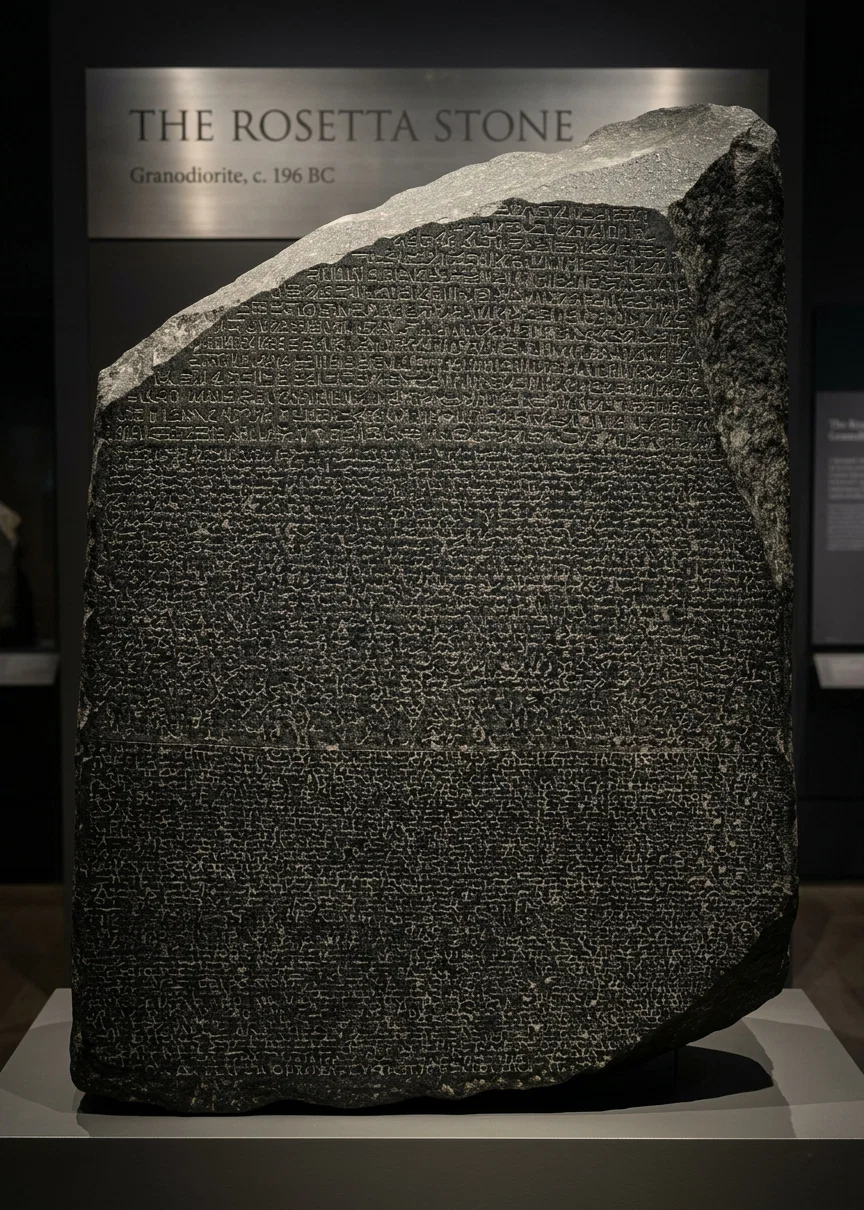
In the year 1799,—the next year after the beginning of the time of the end, when many should run to and fro, and knowledge be increased,—one of Napoleon’s generals in Egypt discovered at Rosetta, near Alexandria, a stone covered on one side with no less than three kinds of writing. This Rosetta stone proved to be the key to unlock the old Egyptian language. The writing at the top is the same as is everywhere seen on the temples and tombs, the middle is what is known as the Demotic text, and the bottom inscription is in Greek. The Greek, of course, could be read; from it the character of the inscription was learned, and there was strong evidence that the other inscriptions told the same story. With this as a clue, scholars set to work to decipher the long-forgotten hieroglyphics. The task was accomplished by Champollion, a French scholar, in 1818. Scholars now read the Egyptian language as readily as Greek or Latin, and wonderful indeed has been the revelation from the land of the Pharaohs.
Explorations
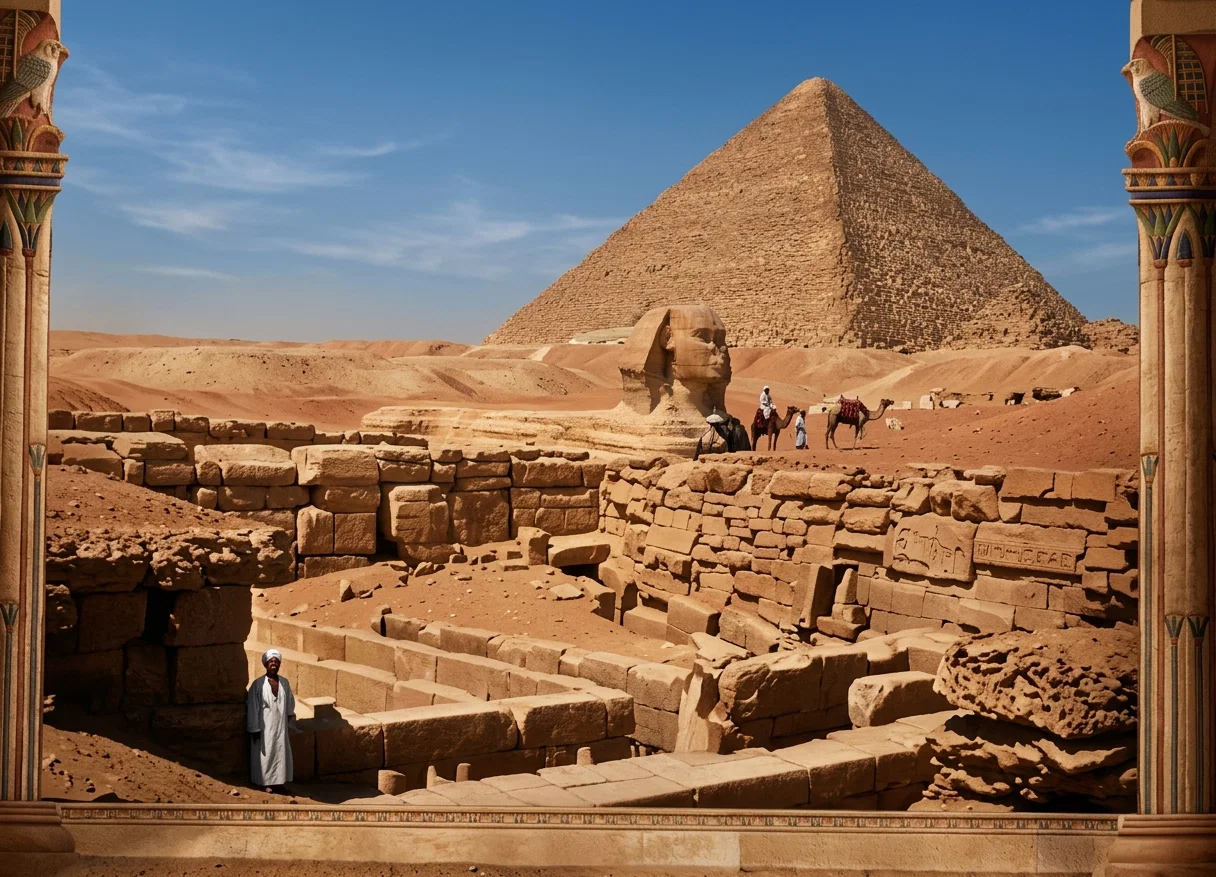
For the last fifty years Egypt has been the scene of busy activities of the excavators. Scholars from different nations have explored the long, narrow valley of the Nile, and studied its ruins. The pyramids have been entered. At the feet of the sphinx the sands of the desert have been cleared away, and a great temple unearthed. Not only have the buildings been found in Egypt, but the builders themselves. While in other countries, reliefs and statues of the kings have been found, in Egypt we have been permitted to look upon the very features of the Pharaohs. Perfectly preserved mummies by the hundred have been removed from the sacred tombs on the west side of the Nile.
THE ROSETTA STONE
Rameses II
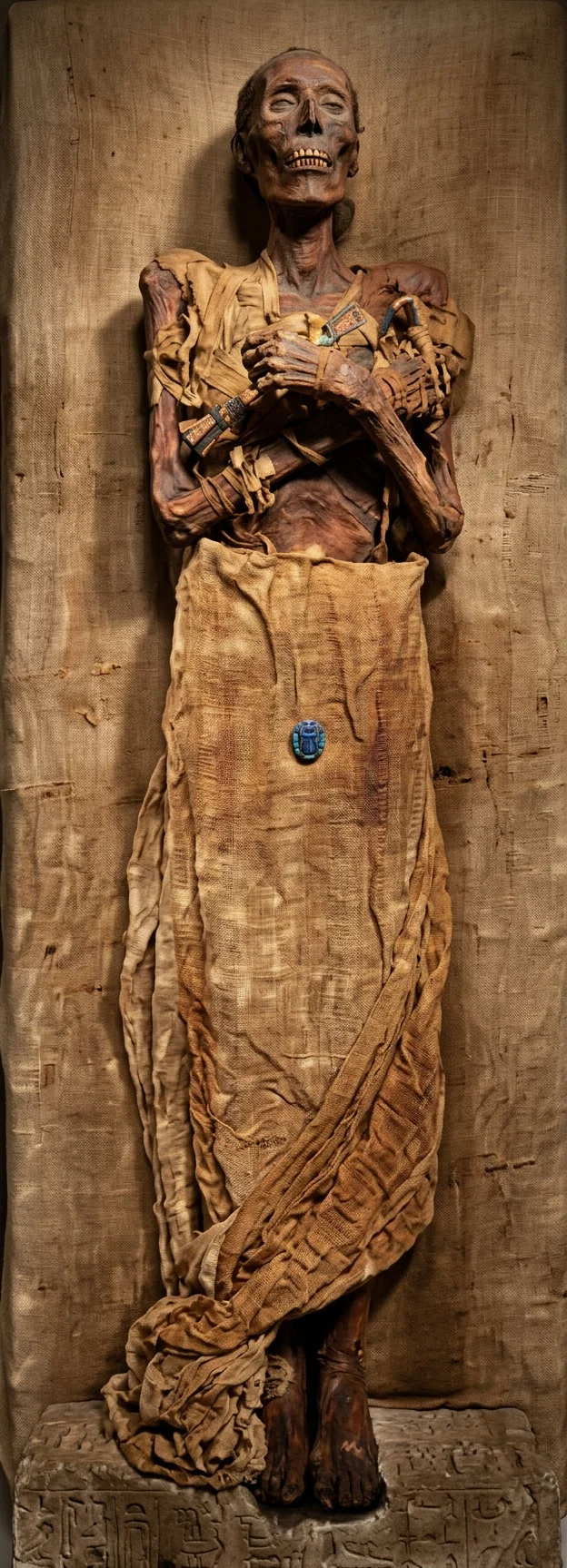
In the year 1881 there was found near Thebes in a rock cave, artificially constructed, a large number of royal mummies of the eighteenth to the twenty-first dynasties. Among them was Rameses, the Pharaoh of the Oppression, the king whose daughter adopted Moses. It seems wonderful indeed to be able to look upon the very face of him who talked with Moses. Being able to read the Egyptian, we are in many respects as familiar with his doings as with the conquest of Alexander the Great.
The eighteenth dynasty was the most glorious period of Egyptian history. The authority of Egypt extended to the Euphrates. Canaan was an Egyptian province. The kings married Asiatic wives, and the dynasty ended by an effort of Amenophis IV, the so-called “heretic” king, to supplant the Egyptian religion by an Asiatic form of faith. There was a national uprising, the Semites were driven out, and a new dynasty, or line of kings, set up, the nineteenth. Israel, who still lived on the outskirts of Egypt next to Asia, was a Semitic race, and as such was the object of greater hatred now perhaps than before. In this nineteenth dynasty we doubtless have the “king who knew not Joseph.” Two short reigns were followed by that of Rameses II, the picture9of whose mummy is here reproduced. The young king was fired with ambition for conquest. He drove his enemies before him, but in Asia he met an enemy not easily subdued, the powerful Hittites, whose very existence used to be questioned by the critics of the Bible. In a battle with them he was brought into a very close place. The poet Pentaur composed a poem commemorating his deliverance from the Hittites. The poem was inscribed on several of the temples. Rameses concluded a treaty with the Hittites, the first treaty known to history. In it is a remarkable clause known as the “extradition clause,” which provides for the return of any absconding robbers or slaves. It would almost seem that Rameses was far-sighted enough to see that Israel would some day escape. Perhaps he had learned of their hope in the promise that they should be delivered.
PYRAMID, SPHINX, AND RUINS OF TEMPLE NEAR THE SPHINX
Rameses, too, was a great builder. His name is found everywhere from one end of Egypt to the other. He built the great hall of columns at Karnak, near Thebes, and the rock-hewn temple of Abu Simbel in Nubia, a magnificent temple hewn out of the solid cliff, guarded by four colossal figures of himself.
How do we know that Rameses was the Pharaoh of the Oppression? A few years ago there was organized the Egyptian Exploration Fund to excavate in Egypt for the purpose of throwing light on the Bible, especially the exodus of Israel. Their first find was the ruins of Pithom, one of the store cities that the Bible says Israel built for Pharaoh. Ex. 1:11. And according to the inscriptions Rameses II built this city. Even the treasure chambers were found, built very strongly of sun-dried bricks. Dr. Naville tells us that some of these bricks are with and some without straw. This, then, is the man who made Israel to serve with such rigor, from whose presence Moses fled into Midian. Sayce says of the mummy:—
“It is an old face, the face of one who has attained almost his one hundredth birthday, but who still feels himself to be a ruler of men. The high forehead with its lock of pale yellow hair, the hawk-like nose and compressed lips, tell us of the kingly will that once breathed through them.”
College View, Neb.
MUMMY OF RAMESES II, THE PHARAOH OF THE OPPRESSION
Adversity Tests Principle
“ADVERSITY is the trial of principle.”
The Nature of Such an Event
By J. O. CORLISS
The Final Adjustment of Human Awards—No. 2
The Nature of Such an Event
J. O. CORLISS
God is no respecter of persons, and therefore will deal impartially with every one in the last day. Favoritism will be avoided from the fact that “every one of us shall give account of himself” at the bar of the universe. Rom. 14:12. But notwithstanding this apparent favor shown all men, we are assured that the test of that day will be of the most searching nature. Speaking of that event, the Saviour said: “But I say unto you, That every idle word that men shall speak, they shall give account thereof in the day of judgment.” Matt. 12:36.
But even this is not to be the limit of that great ordeal. The very motives of the heart will be open to investigation; for “God shall bring every work into judgment, with every secret thing, whether it be good, or whether it be evil.” Eccl. 12:14. With such a vast occupation before it as the research of every human motive, the judgment work can not be done hurriedly. There must be “time there for every purpose and for every work.” Eccl. 3:17. Agencies must be in operation then by which the minutiae of every person’s life-work will appear in just that order set forth in the sacred volume.
This being true, the idea instantly vanishes which is held by so many, that the judgment work will be a promiscuous one, in which good and bad will stand together in one vast assembly awaiting an arbitrary sentence. The truth is that but one class is under examination at the same time. To this the apostle agrees, as set forth in these words: “For the time is come that judgment must begin at the house of God: and if it first begin at us, what shall the end be of them that obey not the gospel of God?” 1 Peter 4:17. It is therefore clear that those who have made a profession of godliness will be the first called to meet the trying ordeal. These must receive sentence from Jehovah himself, who is “the Judge of all.” Heb. 12:23.
But another phase of the judgment work is to decide the cases of wicked men and evil angels. This is performed by saints, who have themselves passed the solemn test, and so have been changed into the perfect image of Christ. To the church at Corinth the great apostle wrote: “Do ye not know that the saints shall judge the world? . . . Know ye not that we shall judge angels?” 1 Cor. 6:2, 3.
It is quite evident, however, that this work is not entrusted to men in the mortal state, who are subject to the frailties of human flesh. These would be too apt to be swayed by human prejudices. This proposition is entirely settled by the admonition of the apostle when he said: “Judge nothing before the time, until the Lord come, who both will bring to light the hidden things of darkness, and will make manifest the counsels of the heart.” 1 Cor. 4:5. Until the Lord comes, and the saints are made immortal, they can not judge righteously, because they can not read the hidden counsels of the heart. But when Christ comes, this difficulty will have been removed, and the saints will be capable of being Christ’s representatives, not only in this world, but in the judgment as well.
This conclusion reaches back to develop a thought previously introduced. Since all who profess to be God’s children may not stand the test of sainthood, it follows that none will be permitted to sit in judgment on others who have not themselves first been pronounced saints through the first test. That the judgment of the saints is thus separated from that of the wicked is revealed in what the prophet describes. He says: “I saw thrones, and they sat upon them, and judgment was given unto them: and I saw the souls of them that were beheaded for the witness of Jesus, and for the word of God, . . . and they lived and reigned with Christ a thousand years.” Rev. 20:4.
It hardly need be repeated that among these were men who had lived on this earth, and suffered martyrdom for Christ; but when seen by the revelator on thrones of judgment, they all had been made to live again. Then he goes on to say: “But the rest of the dead lived not again until the thousand years were finished. This is the first resurrection.” The further statement is added: “Blessed and holy is he that hath part in the first resurrection: on such the second death hath no power.”
The second death, which visits those who come up in the second resurrection, is employed alone upon such as “the fearful, and unbelieving, and the abominable, and murderers, and whoremongers, and sorcerers, and idolaters, and all liars.” Rev. 21:8. This shows that the10first resurrection, which takes place a thousand years prior to the second, brings up those who are declared exempt from the penalty of the wicked. Their judgment sentence will, therefore, have been rendered at least one thousand years before that of the wicked.
The question then arises as to the exact time when these saints passed the judgment test. Was it before or after their resurrection? This query must be settled by an examination of the nature of the “resurrection of the just.” Writing upon this point, the apostle says: “Behold, I show you a mystery; We shall not all sleep, but we shall all be changed, in a moment, in the twinkling of an eye, at the last trump: for the trumpet shall sound, and the dead shall be raised incorruptible.” 1 Cor. 15:51, 52. From this it is plain that there would be no time to carry on the judgment between the sound of the last trump, and the change to immortality, which follows in “the twinkling of an eye.” Then also the fact that these are incorruptible when brought up from their graves, is the strongest evidence that their cases were decided before the trumpet sounded which called them forth.
It is clearly stated in another place that when Christ comes, “the dead in Christ shall rise first.” 1 Thess. 4:16. This reveals a discrimination between the righteous and the wicked which recognizes that the judgment has already decided who belong to each class. The apostle treats the subject in these words: “As in Adam all die, even so in Christ shall all be made alive. But every man in his own order: Christ the first-fruits; afterward they that are Christ’s at his coming.” 1 Cor. 15:22, 23. Thus the Scriptures make it plain that an investigation takes place before any resurrection, which determines who are worthy to come up in the first resurrection, and who are to be left behind to come up in the second resurrection. But more of this in the next paper.
Mountain View, Cal.
God as Our Heritage
By F. B. Meyer
THE man who is sure of God can afford to hold very lightly the things of this world. God himself is his inalienable heritage; and, in having God, he has all.—F. B. Meyer.
The Earth Made New
By Mrs. M. K. Emerson
MRS. M. K. EMERSON
’Tis joy to my heart, the thought I shall
dwell
On the beautiful earth made new;
Fondly I picture fair Eden restored,
And live in the hope of that view.
In vision I see the homes of the blest
In the beautiful earth made new,
And drink at the founts of holy delight,
And streams of sweet purity, too.
No traces of sin, no parting, no death,
In the beautiful earth made new;
Joys everlasting, beauties unfading,
Every flow’r that in Eden once grew.
Our powers, then touched by heavenly
fire,
United in harmonic chord,
With ocean’s vast deep and heaven’s
blue vault,
Will echo the praise of the Lord.
Jesus, our Saviour, the glory and light
Of the beautiful earth made new,
Assist us, by faith, because of our love,
Thy holy commandments to do.
The Sabbath and the Earth
By Cyrus Simmons
CYRUS SIMMONS
“O EARTH, earth, earth, hear the word of the Lord.” Jer. 22: 29. To the earth the word of the Lord has given a sabbatical rest. “But in the seventh year shall be a sabbath of rest unto the land, a sabbath for the Lord: thou shalt neither sow thy field, nor prune thy vineyard.” Lev. 25: 4.
Neither the strength of the walls of Jerusalem, nor the grandeur of Solomon’s temple, was able to resist the army of Nebuchadnezzar, nor persuade it from fulfilling prophecy. This exalted city could have enjoyed the distinction of remaining forever, if its citizens would have hallowed “the Sabbath day, to do no work therein.” Jer. 17: 24, 25.
To hearts that were hard, and to ears that were deaf, the warning words of the prophet appealed, but God’s promises were disregarded, the Sabbath was desecrated, Jerusalem became a desolation, and the foundations of the temple were plowed. Jer. 26: 18. What a sad commentary on the spirit of greed and gain, of venality and vice, that possessed this people! Her faithless sons and fair daughters were taken in captivity to Babylon, where for seventy years they contemplated the terrible results of their disobedience to the law of God,—“until the land had enjoyed her sabbaths: for as long as she lay desolate she kept sabbath.” 2 Chron. 36: 21.
In these “last days” the seventh-day Sabbath of the Lord is not only profaned, but many Christians are keeping Sunday, the first day of the week, and many Christian organizations are petitioning legislative bodies to pass laws enforcing its observance in opposition to the commandments of Jehovah. If, for the profanation of the Sabbath, the Lord permitted his chosen people to be taken as captives by their enemies; if he would allow Jerusalem, his beloved city, to become a desolation, and his sacred temple a ruin; if pestilence and famine, disease and distress, were part of the visitations of God’s judgments then, how can the professedly godly people of these “perilous times” expect to receive the approval of heaven when they are committing the selfsame transgression, and seeking its enforcement?
“Now all these things happened unto them for ensamples: and they are written for our admonition, upon whom the ends of the world are come.” 1 Cor. 10: 11.
The earth as well as man is visited with the condemnation of his sins. “The earth also is defiled under the inhabitants thereof; because they have transgressed the laws, changed the ordinance, broken the everlasting covenant.” Isa. 24: 5.
Avarice, one of the blindest of passions, still claims the mastery. All thought and ambition are becoming wholly absorbed in “the cares of this life,” in commercialism and aggrandizement. Life is a strenuous slavery. In the hurry and hurrah for an earthly crown the contestants are fast growing jaded, neurasthenic, dyspeptic. Tonics whip on the enervated, and doping drinks lull to deception the exhausted. Demands for doctors and drugs are everywhere. Sanitariums and health foods are becoming a necessity, which serve as indices pointing to the physical weakness and degeneracy of the race.
The people are overworked. The land is overworked. The earth is sick. “The earth mourneth and fadeth away, the world languisheth and fadeth away.” Isa. 24: 4. “The earth shall wax old like a garment.” Isa. 51: 6. The soil, too, must be stimulated with a tonic. Fertilizers are attempting to patch up the worn-out places in the garment—earth. In spite of the theoretical progress in farming, and the advancement agricultural students have made, speculations and misgivings attend the growth of crops, while frequent failures and famines evidence their distressing uncertainty.
Numerous insects, destructive to the field, the garden, the tree, and the vine, make their annual devastations, maneuvering their visible and invisible armies under new names, and with more precipitate encounters. “That which the palmerworm hath left hath the locust eaten; and that which the locust hath left hath the cankerworm eaten; and that which the cankerworm hath left hath the caterpillar eaten.” Joel 1: 4. “He hath laid my vine waste, and barked my fig tree.” Joel 1: 7. “The field is wasted, the land mourneth.” Joel 1: 10. “The vine is dried up, and the fig tree languisheth; the pomegranate tree, the palm-tree also, and the apple-tree, even all the trees of the field, are withered.” Joel 1: 12.
“Alas for the day! for the day of the Lord is at hand, and as a destruction from the Almighty shall it come.” Joel 1: 15. The signs of the times are foreshadowing the finality of things. The most reliable chronologists have associated the history of this earth with its people for nearly six thousand years. When Jesus shall come the second time in the clouds of heaven, accompanied by all the holy angels, he will resurrect and gather from the four quarters of the earth his saints, and take them with him to heaven, where they will be with him for one thousand years. Matt. 24: 30, 31; 1 Thess. 4: 16, 17; Rev. 20: 4.
Simultaneous with this millennial duration, the earth, upheaved and rent by mighty earthquakes, torn and shattered by violent winds, disfigured and misshaped to a void and a chaotic state (Jer. 4: 23-28), will lie in desolation for one thousand years (Rev. 20: 3-6), being the seventh part of the time allotted to the land for her sabbaths, “until the land had enjoyed her sabbaths: for as long as she lay desolate she kept sabbath.” It is God that says, “My word . . . shall not return unto me void.” Isa. 55: 11.
Knoxville, Tenn.
Works of Grace
By W. A. COLCORD
W. A. COLCORD
1. JUSTIFICATION gives pardon, imputed righteousness, acceptance, and peace with God. Rom. 3:19-26; Eph. 1:3-7; Rom. 5:1.