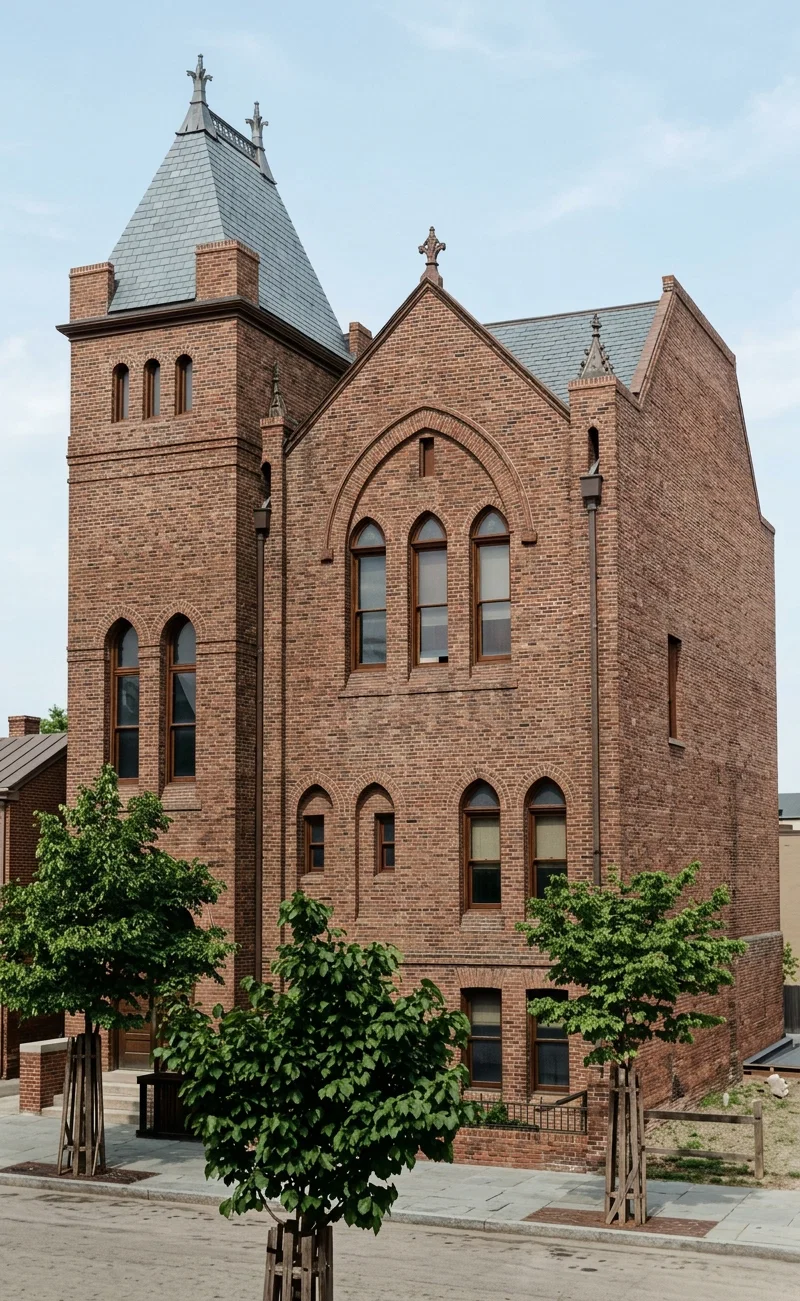
People's Seventh-day Adventist Church of Washington, D. C.
By Lewis C. Sheafe
A FEW words concerning what the Lord has wrought through the labors of Elder Sheafe in Washington, D. C., will doubtless interest the many readers of the REVIEW.
S. D. A. CHURCH, COR. 10TH AND V STS., N. W.
Three years ago last May we located our tent at Sixteenth and R Streets, N. W., and there began a movement that has continued to the present, with a spirit and power that only the Lord can give.
During the season of 1902 over sixty accepted the message. This greatly increased the membership of the first church of this city. There was an infusion of new life from the Lord. The fall and winter following, we continued our meetings in halls, holding special services Sunday nights, with large audiences and constantly deepening interest.
Others were gathered in, and those who had taken their stand were strengthened and established.
The tent season of 1903 found us with a new tent, sixty by one hundred and ten feet, which cost five hundred dollars, the purchase price having been raised on the field. We then had accommodations for our increasing congregations.
A new church, the People's Seventh-day Adventist, was organized Dec. 5, 1903, with forty-five members. Services were held in the True Reformers Hall, Twelfth and U Streets, N. W. The fruits declare that the Spirit of the Lord attended this organization. The church has maintained a good spiritual condition, and souls have been added from week to week, until now the membership is one hundred and thirty.
A church building became a necessity. We prayed, watched, and worked. In February, 1904, we deposited one thousand dollars in the bank toward a building fund, and we continued adding to this amount from time to time, until in April, 1905, we found that we had to our credit fifteen hundred dollars for this fund.
After most earnestly seeking the Lord, and experiencing much trial, perplexity, and difficulty in looking for a location for our church house, in a providential and unexpected way opportunity came for us to purchase the church property of the New Jerusalem Society, corner of Tenth and V Streets, N. W. It is a very desirable location in a thickly populated section of the city, near the car lines. The building is a three-story brick, occupying part of a beautiful corner lot fifty by ninety-five feet, and so located that another building can be added at any time if needed. The auditorium will comfortably seat two hundred and fifty persons; on the floor below there are two large rooms with folding doors between them. On this floor there is also a toilet- and bath-room. On the lower floor there is a large room that we use for a printing-office, and a large kitchen, which we expect to use for a cooking school, also bath- and toilet-rooms.
The building was erected in 1896 at a cost of about ten thousand dollars; the lot cost seven thousand dollars. Everything about the property is in good condition. Learning that it could be bought, we made an offer of nine thousand dollars, which was rejected. The owners stated that if we would offer ten thousand dollars, and would pay two hundred dollars down, they would consider the offer. We promptly met these conditions. We paid them fifteen hundred dollars cash, gave them five notes of five hundred dollars each, bearing interest at five per cent, then put a trust on the property of six thousand dollars at six per cent, with interest payable monthly. In July we took up one of these notes, making, in all that we have paid on the property up to date, two thousand dollars. This money was raised right here on the field, with the exception of a very few dollars that were given from outside the city.
There was no furniture in the church, so we had to furnish all the rooms. Our seating is of chairs, of which we have about three hundred and fifty; we also purchased tables and an organ. All of these we have paid for.
The Lord's hand was surely in the movement to secure the property. It is admirably adapted for the general work of a training-school for young men and women. Why would it not be a good idea to send some help to those who are trying to help themselves, and thereby hasten the good work? With some substantial financial help at this time, a noble work may be done in this city that will be far-reaching in its effects. We ask all who are interested, to pray and give, that this well-begun work may move forward to the glory of our Heavenly Father. The people have a mind to work, and the interest grows as they work.
Two brethren have entered the work from this church during the past season, B. F. Washington and W. H. Green. We hear that they are doing well in their respective fields. We hope to send out others. Who will help?
Our tent-meetings this season have16stirred the people as never before. Eager souls come night after night and listen attentively to the glorious message. Our tent was injured by a storm early in July, and we were without a tent for a week, but we arranged the chairs on the lot, and went on with our meetings, to which the people came as before. We have baptized eight, and there are twelve now waiting for baptism. We need a baptistery, and a baptismal outfit for the pastor.
The work speaks for itself. We hope that definite steps may be taken to give this branch of the work some financial help.
LEWIS C. SHEAFE.
Sedalia (Mo.) Camp-Meeting
By K. C. Russell
THIS meeting, which was held August 3-13, had been in progress several days when I arrived, and a most excellent spirit was pervading the camp. The conference business was practically finished when I reached the camp, so the greater part of the meeting could be devoted to the spiritual interests. There was a good representation of our people, and a good outside attendance every evening. The greatest harmony characterized the transaction of the conference business. Elder R. C. Porter was unanimously re-elected president for another term.
Sedalia has a population of about twenty-five thousand. The camp was located in a most beautiful grove at the edge of the city. There was a large building on the ground, in which there was a hall with a seating capacity of several hundred, and also a dining hall, kitchen, and other rooms. The daily papers of the city gave us about two columns in every issue in the publication of the sermons and addresses, which were reported by Elders D. E. Scales and E. A. Merrell. The importance of utilizing the public press on such occasions where it is possible to do so can not be overestimated; for even though the outside attendance may be small, yet we are enabled to preach the truth in this way to thousands of people each day regardless of the weather.
Profs. C. C. Lewis and M. E. Kern, and B. E. Huffman, educational secretary of the Central Union Conference, were present, and did most excellent work for a large number of young people who were in attendance at this meeting, also in arousing a lively interest in educational work.
The work of the Religious Liberty Department was given a liberal share of the conference, and also the missionary work at home and in other lands. Liberal offerings were made for all these branches of the work.
During the first part of the meeting Elder E. T. Russell, president of the Central Union Conference, was in attendance, and assisted in the business part of the meeting. Elder G. A. Irwin and his wife reached the camp-ground Friday morning, the 11th inst., from California. Their presence brought a new inspiration into the meeting; the last Sabbath and Sunday Elder Irwin gave his interesting experiences in the islands of the Pacific.
We were pleased to meet at this gathering Elder E. A. Merrell and his wife, whom we knew as laborers in the Pennsylvania Conference. There were two special revival services held, in which nearly all in attendance dedicated themselves to the Lord. We believe that this camp-meeting will mark a new era in the conference, and that greater prosperity and success will attend the work and workers in their ministrations as a result of this meeting.
K. C. RUSSELL.
The Collection for the Colored Work in the South
By GEO. I. BUTLER
October 7, 1905
The General Conference last May changed the time of taking the collection for the colored work in the South, from the first Sabbath in November to the first Sabbath in October. This date is rapidly approaching. About six weeks will remain from the time this article will come before the readers of the REVIEW AND HERALD till the collection will be taken.
The attention of all Seventh-day Adventists in the United States and Canada—yes, and others in different countries—who feel interested in this unfortunate race, should be called to this collection at once.
The General Conference of the whole Seventh-day Adventist denomination throughout the world, assembled in conference session at Washington, D. C., last May, recommended that this collection should be taken up upon this date. This, therefore, is not some minor affair originated by a few individuals, or even by a State or union conference alone. It has been considered by the representatives of the whole cause as a matter of wide interest, really pertaining to the well-being of a whole race of people.
To be sure, the money will be expended in the South, and more largely in the Southern Union Conference than in any other, because the great majority of the colored race in the United States are located in that conference of nine large Southern States, the very heart of the old Southern Confederacy, over six millions of the eight or nine millions of the colored people of the United States being within the bounds of the Southern Union Conference.
So it is easily discerned that the prosperity of the colored work in the United States will largely depend upon whether it is prosperous in the Southern Union Conference, as by far the largest proportion of the colored people are in that conference.
In the nature of things, it is impossible for the comparatively small number of white people of this Southern Union Conference, in their poverty and great lack of means, to do what ought to be done for six millions of negroes within the conference boundaries. They can hardly make a beginning. Indeed, the white people in this field are utterly unable to do for the white work anywhere near what really needs to be done.
The conclusion, then, is unavoidable that if our brethren in the great Northern field do not take hold of the colored work in earnest, it can not be made a success. Multitudes of souls will be lost, and the work will drag along as it has been doing, or even more slowly.
Paul the apostle says, “I am debtor both to the Greeks, and to the barbarians; both to the wise, and to the unwise.” Rom. 1:14.
In what sense was he a debtor (that is, one in debt to them)? God had given him great ability and much heavenly wisdom, and had revealed himself to him in a wonderful manner. Why did he do this? Just for Paul’s own comfort and pleasure?—O, no; but rather that through him he might impart great light to others. Wherever there were poor, lost, suffering souls going down to ruin, with whom Paul came in contact, it was his privilege to enlighten, bless, and save them. Yea, it was his positive and stern duty.
Suppose we see a house already on fire, and know that there are souls in jeopardy, fast asleep. Should we not be guilty before God and man unless we did our utmost to awaken and rescue them? We could never look our fellow men in the face had we neglected to alarm them by the most earnest possible efforts.
There will soon be a fire which will involve millions of souls, and their loss will be eternal. We have the privilege of “saving some.” Shall we not be in earnest, seeking to break the spell of spiritual stupor enthralling those around us?
The condition of the colored race, in view of all their past misfortunes and desperate needs, should appeal to every human soul. Through the Testimonies of his Spirit, God has called upon us as a people, over and over, to discharge our duty to this afflicted race. We have come far short of doing it.
To the writer’s personal knowledge we have hardly begun to do that which demands to be done. In the Southern Union Conference there are approximately two thirds as many colored as white people. The efforts and expense put forth for the salvation of the colored race within the bounds of this conference are not one third, hardly one sixth, as great as for the salvation of the white people. And yet, in view of our poverty and the peculiar difficulties of this field, but a fraction is being done for the white race of what is in crying need of being done.
These, my brethren and my sisters throughout our great Northern field, are the literal facts of our Southern condition. We speak of what we do know. Having labored for some eighteen years of my life in what was once slave territory, the writer knows of what he affirms.
The needs of this field are what we may well call appalling. Some of our brethren, even in leading positions, inquire, Why should not the South carry the main burdens of its own work, and not call upon the North for money? And it has even been said that our Southern people have been taught helplessness, and to look to the North to bear their heavier burdens.
We feel certain that these suggestions are not in the line of the actual facts. Although our Southern Seventh-day Adventists are, on the average, much poorer than our Northern believers, yet in the published statistics of the Southern Union Conference in the General Conference published reports, the pro-rata average of each member’s tithes was above several of the other American union conferences, and not so very far below the very highest. So was the amount of canvassing, and several other items.
Do these facts look as if these poor17distressed fields were being taught helplessness? We know no Northern State conference whose laborers have worked on for months without any salary whatever, as some have in this field, and the salaries of those who are paid wages average far below those in the North. Over and over have some of our ministers economized in every way in order to keep in the field and work for the Master.
The facts are, our visitors from the North know very little about the actual conditions here in the South. They take a flying trip; stop off perhaps at Graysville or Nashville, and possibly at a point or two besides, and because they meet several Northern brethren who have moved to the South and are living in comparative comfort, they think they are prepared to speak with authority. But let them travel around to many of our little churches, and they would be far wiser, and better prepared to understand the true conditions.
We believe it to be a fact that nearly three fourths of all our membership are sisters. Many of their husbands are not in the truth, and some have husbands opposed to it. Many of them have a hard time to cope with the struggle of life. But many of these are most earnest and devoted Christians. Many are too poor to be able to attend camp-meetings. Far less than a majority of the families are prepared to entertain and accommodate visitors in a way that in the North would be creditable.
Of course, there are exceptions. And we know of no country where there is a more hospitable spirit. They try to pay an honest tithe. Their hearts are in the work. They love God, and love his truth, and sacrifice what to them is far more than many Northern well-to-do believers ever think of doing. But when they are expected to pay money for schools, sanitariums, and various other costly enterprises, it is simply impossible for them to do it.
In the South by far the greater proportion of the wealthy people are in the cities. There are, of course, many well-to-do people in the South. Most of the Northern people who have moved here are in very moderate circumstances. The richer portion of our Northern people have many things that are too nice to leave, so they remain in the North.
Of course, there are Southern people in the South who have become well off, and, like a large number in the North, they know how to keep their money also.
This Southern field contains nearly one third of all the arable land in the United States. We have a little more than two thousand believers in this great conference of nine large States. They are scattered all over this immense space in very small churches, far apart, and most of them very poor. They can have but little labor. They are struggling against hard conditions. Very few of them have church houses. There are many noble, precious souls among them, many of whom have all they can do to get a living.
Let us make a few comparisons: Any one of such States as Indiana, Missouri, Colorado, Minnesota, Kansas, Ohio, or Nebraska has a larger membership, and far more means at its command, than this whole Southern Union Conference, while either Wisconsin or Iowa has nearly twice as many members, and far
more than twice as much wealth. But when the State of Michigan or California is considered, either of them has several times as many members as this whole Southern Union Conference, and vastly more wealth.
These comparisons are made to enable our brethren throughout this vast Northern field to see how weak in membership and means this great Southern country is. While this Southern Union Conference has a little over two thousand Sabbath-keepers, the Northern conferences have fifty-three thousand; yet the whole South has nearly one third of the whole population of the country, and the number of Sabbath-keepers has thus far been very small, compared with the North. And the difference in wealth is vastly greater than the difference in membership. These are facts that should be carefully considered. The servant of the Lord has said this field “is the most difficult in the world.”
While this vast difference exists in the amount accomplished in the South and in the North, can any sane Sabbath-keeper contend that these two thousand believers, struggling against fearful odds and against overwhelming difficulties here in the South, ought to be expected to be able to carry on the work as it should be carried on?
Even the Australian Union Conference is far stronger in membership and means than the whole Southern Union Conference. Think of the great sum of money raised for one city compared with the amount for these nine great States. The South and North speak the same language, and are of our own flesh and blood. After living here for many years, we can see no good reason why the number of Sabbath-keepers in the South may not approximate the same proportions as in the North.
But to return to the colored problem. We have already considered in this article the great needs of the whole Southern field. But let us realize at once that the colored work is by far the neediest in proportion to that of any part of the field. It is in a deplorable condition. It is even in a pitiable condition for the want of funds.
For example, take the Huntsville colored training-school, the only school of its kind among our people. It has a valuable tract of land of over three hundred acres, which was purchased years ago. It was an old Southern plantation, some four miles from the flourishing city of Huntsville. The old mansion has, of course, been used, but it has been in great need of repair. New foundations must be placed under a portion of it, or it will go into decay, and various improvements are absolutely necessary.
Over a year ago Mrs. E. G. White, and her son, W. C. White, were there, and members of the executive committee of the union conference. This was her first visit to the place. She spoke many words of encouragement in regard to what this place might become, if the light given should be carefully followed. She said one hundred students should have been there to have the benefits of the school the last year, and that arrangements should be made for from two hundred to two hundred and fifty as soon as possible. She felt very sad to see the lack of facilities for carrying on the school in a proper manner. She said a small sanitarium must be built, so that
the health of the students might be cared for, and they be taught the health principles in which our people have been instructed during the past years. She said that buildings must be erected, and facilities must be supplied, so that the institution should be a credit to the denomination. An orphanage for fatherless and motherless children whose parents have died in the faith must be erected, etc. An orphanage was planned; the cellar was dug, but for lack of funds the work stopped.
The management began last fall hopefully. About seventy pupils came to the school, and it was impossible to accommodate any more. For lack of funds little has been done for months. The conditions are truly distressing. Had not the union conference treasury advanced money to pay the teachers, the school would have had to close long ago. Several thousand dollars has thus been taken from the union conference treasury, which it greatly needed for the support of workers in the union conference. So the conference fund has had to run in debt. This money must be paid back. Few can know the straits to which we have been put for means to keep things running. But how could we close the school which the cause needs so badly, and of which the young colored people are in such great need?
The Southern Missionary Society has accomplished much good for this unfortunate race. Useful schools have been established for the young, and wherever they have been established, churches have sprung up. The result in Mississippi has been that fully one half the State conference membership has been of this race. A large percentage of the tithe has also come from this source.
But quite a large amount is required for the payment of teachers, as most of the pupils are very poor. Unless means are supplied, the work will be sure to suffer.
These schools have proved to be one of the most encouraging means of bringing the truth for this time to that people. A vast field needs to be entered upon in this manner. All lovers of humanity should be interested in this branch of the work. This problem ought to interest our people everywhere. For two or more years past the Lord has been appealing to our people mightily, to help in this work by their means. Shall we respond, and heartily carry on this branch of the work?
The Southern Union Conference, with the officers of State conferences, has studied carefully the question of supplying every State conference in the Southern Union with colored laborers. It has been a matter of great difficulty. Our Northern brethren and sisters can not fully realize the conditions which make this difficulty so great.
If that portion of this article which relates to the condition of this whole Southern field, its poverty, and the vast work to be done, and the meager means at our command with which to do this work, is carefully studied by our Northern brethren and sisters, they may be able to discern how perplexing it is to find the means necessary to send out colored laborers in all our State conferences. It is very perplexing to us to know how to maintain our white laborers, and instances are plentiful18where they have been poorly supported.
Where, then, will the means come from to furnish the colored workers? And if our training-school for the colored is not properly equipped and made efficient, how are the colored workers to be supplied?
These are questions, dear friends of the cause of God in the South, with which the writer and many devoted brethren in the work here have been wrestling for several years past. We want your help and sympathy, and above all, means with which the work may be strengthened.
This article is already too long. The far-reaching problems involved can hardly be properly presented in an article of moderate length. In the opinion of the writer the prosperity of our colored work in all parts of the world is more or less affected by the questions centering in this Southern Union Conference.
The great problem of African slavery has been considered in the past by some of the greatest minds of modern times. Various opinions have been entertained. In the writer’s opinion, God’s all-wise providence permitted this awful experience through which large numbers of that unfortunate race passed in being sold into slavery, transferred by the wicked cupidity of man to this continent to come in contact with a race more highly civilized than themselves, to be taught the English language, made acquainted with the religion of Christ, learn lessons of industry and many useful things, that they might be a blessing in various ways to the great Dark Continent, and to many others taken from it. Much of the interest in that continent and in its missionary enterprises has arisen from a sympathy begotten by the sad experiences connected with slavery. The attention of philanthropists in all lands has been called to this subject. England was aroused by the horrors of the slave trade, and great efforts have been made to put it down in Africa itself.
And now the colored people have become free. Noble Christian people have been laboring unselfishly to elevate this unfortunate race. We honor these blessed souls, and wish to engage in the same noble work. The central field of interest is the territory embraced in our Southern Union Conference, in the great States of Louisiana, Mississippi, Alabama, Georgia, Florida, South Carolina, North Carolina, Tennessee, and Kentucky.
If we can, through the help of our people in the North, firmly establish our blessed work of educating, elevating, thoroughly instructing in the practical truths of the Bible and useful pursuits large numbers of the poor, the unfortunate, the very needy of this race, our work will be a blessing to humanity, and be the means of saving many souls for Christ in the blessed kingdom of his love.
Brethren and sisters, the collection the first Sabbath in October is to help in this noble work. We ought to have at least ten thousand dollars from the results of that collection. The amount raised last year was a great help, though much less than that. Can not we greatly increase it this year? We hope that many articles in favor of this collection
will be written by leading writers to stir up an interest in this important work.
GEO. I. BUTLER,
President Southern Union Conf.
Washington
By O. E. Davis
SEATTLE.—At the time of my last report I was laboring among the Indians of Port Simpson, British Columbia. Soon after this Elder T. H. Watson was sent to take charge of the work among the Indians, and I was assigned the work in Vancouver.
At this place I found the church in great need of help, and their house of worship, which was erected three years ago, was still unfinished. The brethren and sisters responded heartily to the call to reconsecration, and to arise and finish the Lord’s house. The means flowed in freely, and willing hands gladly took up the work, and soon the building had received the needed alterations and improvements. We built a neat vestibule and belfry, and purchased a sufficient quantity of paint to paint the entire building outside; this part of the work was unfinished when I was called to another field.
I began Sunday evening services in Vancouver in the church where it was said by some that “the people had been preached to death;” but right in the same block with the church we found people who had never heard the message, and some came to the meetings who had never been inside the church before. At first the attendance was very small, but it steadily increased until we had a fair number at every service, notwithstanding it was during the rainy season. I took up the house-to-house work, and soon had on my list the names of about thirty families who were receiving literature and weekly Bible studies. Many became deeply interested in the truth, and one lady, who had held a position in the Methodist mission and had a wide influence in the city, began to observe the Sabbath; later she was baptized by Elder Johnson, and united with the church. But here, as at Port Simpson, I was not permitted to bind off the work, or to see the results of my effort, for in the midst of the work came the call to unite with the Western Washington Conference, and Elder Johnson was sent to take the work in Vancouver.
I arrived in Wilkeson, Wash., February 26, and united in labor with Brother D. Dodge, who had already awakened an interest among the people. We began meetings in the little church, which had practically been abandoned for more than a year, and of which only eight members could be found in the community. Brother Dodge was soon recalled to take charge of the mission boat on the Sound, and I continued the work alone. It is evident that the kind providence of God was still hovering over the scattered flock, and as the members of the fold were once more called to the house of the Lord, their spirits revived and their hope was strengthened. As a result of the effort here, April 2 Elder E. L. Stewart was called to conduct baptismal services, at which time nine persons were buried with their Saviour in the watery grave. At this time it was evident that others were halting in the valley of decision, and being advised by Elder Stewart to remain longer, I continued to labor, and June 10 Elder Stewart was recalled to baptize five others. Later, July 8, Elder Ward was called to rebaptize one sister. A young man of Tacoma who was visiting relatives at this place during these meetings became interested in the truth. Although he had been labored with before by others, and had strongly resisted all efforts put forth for his salvation, at this time he surrendered to the Lord, yielding himself to the voice of the Saviour, and was later baptized by Elder Martin, of Tacoma, and united with the church at that place.
Thus at Wilkeson, the services of the house of the Lord have been re-established, and from Sabbath to Sabbath voices of prayer and praise arise once more to our Heavenly Father for his matchless love and tender mercies to the children of men. From here I went to Lake Tapps, where I found two families who had accepted the truth several years ago, but had never been taken into the church. Calling these brethren and another family that had recently moved into the neighborhood, we organized a Sabbath-school and a class meeting. I held a short series of meetings here, and at its close six persons were baptized by Elder Stewart, including two who took their stand for the truth for the first time, and one who had wandered from the fold and had returned.
We now have at Lake Tapps a company of ten adult members and a few children. There is evidence that a few others may unite with this company soon. Six of this company and one sister from Buckley united with the Wilkeson church, making a total membership of thirty. My heart flows out in praise to our Heavenly Father for his condescension to use human instrumentalities in proclaiming the gospel of salvation. I am now holding services at Columbia City, a suburb of Seattle, in company with W. J. Boynton, with fair prospects of some fruits of our labors. Unto God be all the praise, honor, and glory.
O. E. DAVIS.
Forest Home Industrial Academy
By L. I. STILES.
THE Lord greatly blessed this little school the past year, and the outlook for its second year is very bright. Already there are nearly twice as many applying to enter the school and the home as we had last year. It seems that the Lord has brought the school into favor not only with our own people, but with many not of our faith. We believe this is due to the fact that our brethren throughout the conference have been praying earnestly for the success of the school, and that the Lord would bless those connected with it.
Thus far the school Home has consisted of one building, which would accommodate about twenty-four students, but now it seems necessary to erect another building, not only on account of the increased attendance, but because the Lord through his servant has said that the boys and girls should have separate buildings.
Work has begun on the new building, and will be pushed forward to completion if the Lord sends us the means. If not, it will have to stop, for we do not intend to place the burden of debt upon the school. We have faith to believe19that the brethren in this conference will not allow the work to stop. There certainly can be no more important work than establishing schools where our young people can be prepared for the work of carrying forward this third angel's message.
We ask that the brethren all offer up prayer in our behalf that the work here may prosper, that God's name be glorified, and his cause advanced.
L. I. STILES.
Mount Vernon, Wash.
Religious Liberty Notes
By W. A. COLCORD
It is not the every-day violations of the law, but the Sunday violations which seem most to concern some of the ministers of to-day who have much to say about “law enforcement.”
Advocates of Sunday laws are making a great plea now for the necessity of such laws in the interests of the laboring men. But the Sunday laws which they desire enacted for the laboring man are compulsory rest laws. It is not intended that individual liberty to work or not to work shall be respected. They will be destructive of liberty, and bring about enforced idleness.
“To crown Christ king is our purpose,” says Mr. W. F. Crafts, “and the way to do it is to make the law of God the law of the land.” The same gentleman further says: “It has been a long fight to get a Sunday law for the capital of our country.” When a national Sunday law has been secured we presume the National Reformers will then declare that Christ has been crowned king.
The eighth annual convention of the Federation of Churches and Christian Workers of Wisconsin, is to be held at Sparta, October 16 and 17, and is to be followed by a two-days’ session of the Wisconsin Sunday Rest Day Association. The Federation embraces ten state denominational bodies and six “moral reform” associations, among which is the Sunday Rest Day Association.
“It is a matter of dispute among theologians whether there is any such thing as a Christian sabbath, and whether, if there is one, it falls on Saturday or Sunday,” says the Chicago Chronicle. This fact ought to cause those zealous religionists to pause who are constantly demanding laws to enforce the observance of Sunday as the “Christian sabbath.”
Gov. Joseph W. Folk, of Missouri, has entered upon quite an aggressive Sunday closing campaign throughout his State, especially in St. Louis, on the ground that every law on the statute-books should be enforced. “No official,” he declares, “has a right to ignore any law. It is not for him to say whether the law is good or bad, but it is for him to enforce it as he finds it on the books.” Mr. W. T. Jerome, prosecuting attorney of New York City, opposes Mr. Folk’s position, and declares that “Sunday closing laws are sediments of Puritanism.”
A brother writing from Nebraska says: “This Sunday question is coming to the front faster than our people imagine, and the storm will soon break with fury upon an unprepared people. Little do we realize the spirit that is pent up in the movement. It will require every effort at our command to beat back the waves of falsehood and anger that are gathering in the sea of discord and discontent. The very atmosphere of the popular churches is tainted with the breath of unholy zeal, and animated with a blind fury of determination that is painful to experience. I detect it almost everywhere.”
An organization known as the Madison County Law Enforcement Alliance was recently formed at Alton, Ill., for the purpose of demanding the enforcement, by the proper officers, of the Sunday law against saloons. The organization is composed of representatives of the English Protestant churches of the country, three representatives from each church. Several ministers of these churches have refused to enter the league, however, on the ground that the best results can not be obtained by such methods.
In response to “complaints of ministers” the police authorities of Lincoln, Neb., began a strict enforcement of the Sunday closing ordinances of that city on July 30. Under the heading, “Lincoln Stores Must Be Closed on Sunday,” the Lincoln Star of July 29 says: “Merchants who keep their stores open tomorrow may be arrested. So declare the police. The complaints of ministers have caused the officers to watch for offenders.”
On July 25 the city marshal of McPherson, Kan., served notice on merchants who were found selling goods on the preceding Sunday, that Sunday sales must cease, and that if their stores were found open for business on the following Sunday, arrests would be made. He stated that he had been instructed to put a stop to all illegal selling on Sunday, and would carry his order out to the letter. A local newspaper says that “other towns in the State, and especially large towns, observe the Sunday closing laws very closely, and the day is soon coming when they will be enforced in every town in the State.” This is only a sample of the general crusade which is being carried on all over the country.
Twenty-four religious denominations, representing eighteen million communicants, have each appointed from five to fifty delegates to meet in New York City November 15, to take part in an interchurch conference on federation. The conference is to be held in Carnegie Hall for a week, the object being the federation of the Protestant forces in America for work largely along National Reform lines. Among the sixty speakers on the program are two justices of the Supreme Court of the United States, two judges of State courts, a United States Senator, a congressman, a governor, a mayor, and a number of college presidents, professors, and editors, besides many church bishops and ministers.
W. A. COLCORD.
Personal
By Harry W. Miller
Personal
It has been an encouragement to us in Honan to know that the work is so near the hearts of our brethren in the States; and I desire to express my sincere thanks to the many friends in America who have spoken and written words of sympathy in my affliction. We believe God will bind hearts closer to the heathen lands than ever before.
HARRY W. MILLER.
Honan, China.