Uncle Ambrose was a traveler; he had been to California and the Rocky Mountains, and to South America; he had climbed the Alps, and strolled under the deep blue sky of sunny Italy; he had paddled his canoe down the Jordan, in Palestine; and he had even visited Africa. He liked to study about the things God has made; and so he went to these far-off countries to find out more about them than he could learn from the books he had at home.
The children were always glad to have their uncle come to their house; for they never got tired of listening to his stories of other lands, or looking at the curious things he had brought back with him.
One day when they were all sitting in the dining-room after dinner, a little mouse ran across the floor. The girls scrambled up into their chairs, and Uncle Ambrose and the boys laughed at them.
Mousie didn’t know what to make of such strange actions, and suddenly stopped in the middle of the floor, and looked up at the girls to see what it all meant. Then he grabbed a bit of cheese they threw at him, and scampered to his hole in the floor.
“That makes me think,” said Uncle Am, as the children familiarly called him, “of an animal I saw once in Northern Africa.”
“One day when we were riding over a dry, sandy place, we came across a number of queer-looking holes in the ground. Getting off our horses, we stepped carefully up to these holes to learn, if we could, what made them; but before we could get near enough to see, out jumped a number of little creatures that looked not unlike the mouse you just saw. They were as large as a good sized rat.”
“Did you catch any?” they all asked in a breath.
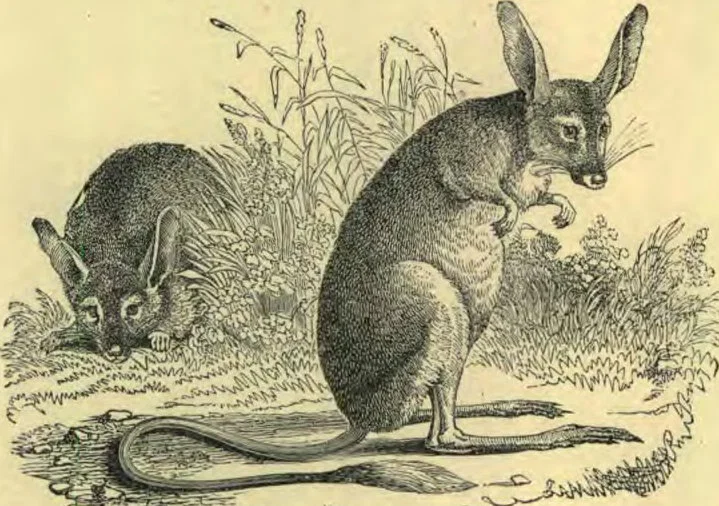
“It was a hard chase,” he replied; “we set the dogs after them, and they ran till nearly sunset before they caught any. One of our party made a picture of him for each of us.”
Uncle Am then took from his portfolio on the parlor table the picture, and showed it to them.
“This animal,” said he, “is called the gerboa. Its fur is of a light dun color with dashes of yellow, and on the underside is nearly white.
“They like company, and so a good many of them live together. They are hard to catch. The natives like them to eat, but they know that they cannot catch them by chasing them; so they stop up as many of their burrows as they can; and when the little fellows rush out of those left open, the people kill them. We cooked one that we caught, but did not think it tasted very well.
“The bottoms of the feet are well covered with stiff, bristling hair, which is a good thing to protect them from the hard, burning soil of the country where they live.
“The gerboa never comes out in the daytime to get anything to eat, but always waits until night, when he goes out to get roots and grain. Yet he sometimes goes outside the door daytimes to play with his neighbors or to lie in the warm sunshine. His teeth and claws are so strong that he can gnaw a hole through the thin layers of stone under the sand.
“His forefeet are short, and his hind ones long. His tail is also long, something like the kangaroo’s, and has at the end a tuft of hair, which is black at first, but at the very tip is white.
“When the gerboa wants to run, he raises himself up on his hind feet, and curving up his tail, gives such great leaps that a trained greyhound has hard work to catch him.
“We thought we would see if he could leap without his tail; so we cut one of the little fellow’s tails off. We found that when his tail was partly cut off, he could not jump nearly so far as before; and after we cut it all off, he was afraid to leap at all; and when he rose up on his hind feet, he could not sit up, but would always roll over on his back.
“So we see that many of these things about animals that look so queer to us are just as necessary to them as our hands and feet are to us.”
W. E. L.
PROGRESSIVE SERIES OF BIBLE LESSONS
By G. H. Bell
FOR SABBATH-SCHOOLS.
BY G. H. BELL.
No. 1.—BIBLE LESSONS FOR LITTLE ONES.—ADAM TO MOSES. This first volume presents the story of events from the time of Adam to that of Moses, in very simple language, suited to the youngest minds. Besides its fifty-two lessons, it contains valuable notes and hints to the teacher concerning the best methods of imparting instruction to very young children. 84 pages. 15 cts.
No. 2.—BIBLE LESSONS FOR LITTLE ONES.—EGYPT TO CANAAN. This volume is a continuation of No. 1, covering the history of the children of Israel in their journeyings from Egypt to Canaan. It is adapted to older children than the preceding, and the first five lessons consist of a general review of the first book, covering briefly the historical events presented there. 120 pages. 20 cts.
No. 3.—MOSES TO SOLOMON. In this volume new features are introduced, viz., the pronunciation of all difficult Bible names, and a series of maps, with notes of explanation, both geographical and historical, adding greatly to the interest and value of the book. 132 pages. 25 cts.
No. 4.—FROM THE BEGINNING OF SOLOMON’S REIGN TO THE REBUILDING OF THE TEMPLE AFTER THE CAPTIVITY. This volume is one of the most interesting of the series, giving an account of the glorious reign of Solomon, a brief notice of all the kings of Judah and Israel, the captivity of the Jews, their return to Jerusalem, and the rebuilding of the temple. The leading prophets and their work are presented and made prominent, and the historical events which they predicted are briefly set forth. 162 pages. 25 cts. No. 5.—FROM THE REBUILDING OF THE TEMPLE BY ZERUBBABEL TO THE SENDING OUT OF THE TWELVE DISCIPLES BY THEIR LORD. Continuing the historical narrative of the previous book, this volume embraces the work of Ezra, Nehemiah, and Malachi, the connection between the Old Testament and the New, the history of John the Baptist, the birth, childhood, baptism, and ministry of Christ to the sending out of the twelve disciples to preach the gospel. Geographical and historical descriptions are embodied in the lessons themselves, and are brought out by questions, like other parts of the lesson. 172 pages. 25 cts.
SABBATH-SCHOOL MAPS.
Twelve-sheet Map, illustrating the travels of St. Paul, 81x170 inches. $8.50
Eight-sheet Map of Palestine, 81x116 inches, 12.50
Eight-sheet Map, illustrating the Travels of St. Paul, 81x116 inches, 12.50
Peninsula of Mt. Sinai, 52x72 inches, 5.00
Old-Testament Map of Palestine, 41x58 inches, 3.00
Old-Testament Map of Palestine, 28x41 inches, 1.50
New-Testament Map of Palestine, 41x58 inches, 3.00
New-Testament Map of Palestine, 28x41 inches, 1.50
Map illustrating the Travels of St. Paul, 1.50
(The above are on cloth without rollers.)
Map illustrating the Travels of St. Paul, (boards) 13½x18½ inches, .50
Travels of St. Paul, (card) 5½x3½ inches, .04
Same on paper, .08
A Bird's-eye view of the Holy Land, in colors, varnished and mounted. 50x78 inches. With an index to all the principal places, rivers, and mountains of Palestine. 8.00
“Bird's-Eye View of the Holy Land can be sent only by express. Twenty-five per cent discount to Sabbath-schools. The others will be sent by mail on receipt of price.
HELPS TO BIBLE STUDY.
Sketches from the Life of Paul. By Mrs. E. G. White. This work comes fresh from the press, and is a continuation of the series known as “The Great Controversy.” It throws light upon the teachings of Paul and their application to our own time, and no one can read the book without entering somewhat into the spirit which actuated the great apostle. It is especially useful as a help in the preparation of the present Sabbath-school lessons, and should be in the hands of every Sabbath-school student. Bound in cloth, gold lettered. 334 pages. $.80
Life and Epistles of the Apostle Paul. By Conybeare and Howson. This work gives a vast amount of information of all kinds in regard to the apostolic times. 764 pp. $1.00
A Ride through Palestine. By Rev. John W. Dulles, D. D. This work, illustrated by 184 beautifully clear maps and engravings, is one of the very latest and best books of travel in the Holy Land, and meets a want in that direction which no book of its price has before met. The S. S. Times say of it: “It is a book pleasant in style, healthy in tone, admirable in spirit, and careful and trustworthy in information. We do not know of any one volume of like size and cost which will give so much help to an ordinary teacher or scholar in its immediate scope and line.” 528 pp. $2.00
From Exile to Overthrow. By Rev. John W. Mears, D. D. A history of the Jews from the Babylonian captivity to the destruction of the second temple. Illustrated with maps and pictures. 475 pp. $1.25
Smith’s New Testament History. This work, by the author of the well-known series of classical histories, consists of three parts. The First Part gives the connection between the Old and New Testament History; the Second Part contains the Gospel History; the Third Part embraces the Apostolic History and the establishment of the Christian Church. The information given is full and accurate. 780 pp. $1.75
Smith’s Dictionary of the Holy Bible. A Bible Dictionary is one of the things which every Christian family should possess; and Dr. Smith’s work is highly recommended by Bible students. $3.00
The Giant Cities of Bashan and Syria’s Holy Places. By Rev. J. L. Porter, A. M. This work brings out before the reader the departed glory of the ancient cities of Bible Lands, their present condition and aspect, and the tribes that inhabit them, in a very interesting and vivid portrayal. Its cheapness brings it within the reach of all, and its worth recommends it to teacher and scholar. 377 pp. $1.25
Hand-Book of Bible Geography. By Rev. Geo. H. Whitney, D. D. Illustrated by 100 engravings and 40 maps and plans. The places of Bible Lands, with accompanying descriptions, are arranged in alphabetical order, in the form of a dictionary. The book is of great value as a work of ready reference. 495 pp. $2.50
Biblical Atlas and Gazetteer. Pages 11x8½ inches in size. Contains 16 finely executed maps of Bible Lands, with 87 pages of descriptive matter, and a complete geographical Biblical Gazetteer. $2.00
The Temple and Its Services. By Rev. Dr. Edersheim. The author’s aim in this work is to take the reader back eighteen hundred years, and present Jerusalem, with the temple and its services, as they were in the time of Christ, and thus give some of the circumstances under which the Saviour taught. 365 pp. $1.25
Sketches of Jewish Social Life. This book is by the same author as the one above, and has a kindred aim. The two books read together give a vivid picture of the religious and social life of the Jews in the days of Christ. 342 pp. $1.25
Palestine for the Young gives more correct and interesting information in regard to the Holy Land than anything we have seen for so little money. It is entirely suitable for adults as well as young people. 368 pp. $1.00