Your ShelfYour Projects

The Youth’s Instructor, Vol. 31, No. 28.

A DAY IN JERUSALEM

The Youth’s Instructor

Jul 11, 1883

S. D. A. Publishing Association · Battle Creek, Mich. · Jul 11, 1883

A DAY IN JERUSALEM.
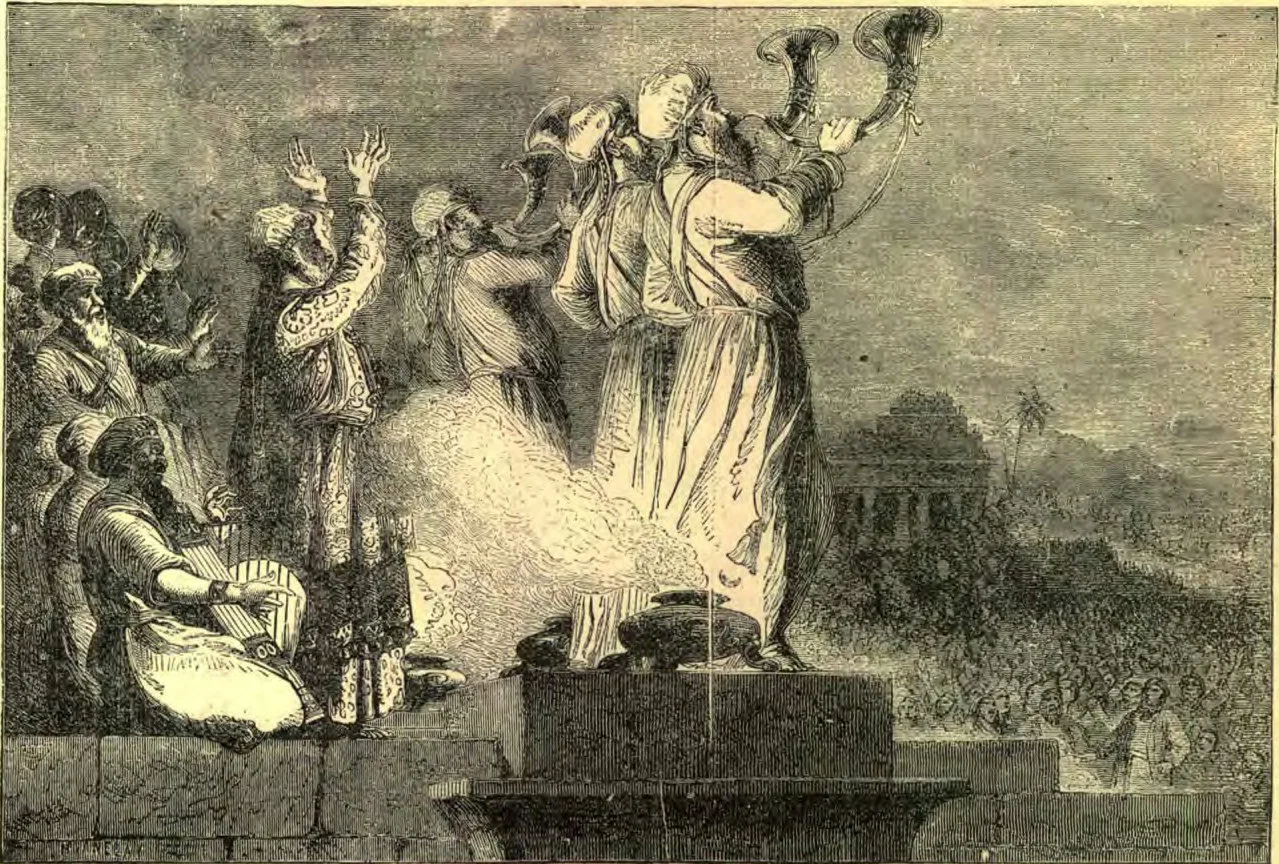
LET us imagine ourselves in the streets of Jerusalem something more than two thousand years ago. It is a bright morning about the middle of September; and though it is still very early, the gates are open, and the people are flocking into the city. In this country, where the sun shines so fiercely, it is not a strange thing to see the inhabitants astir at an early hour; but this morning there seems to be something more than usual on foot. Yet the market-places are not open, and there is a strange stillness in the streets where business is wont to be done. It seems almost like the Sabbath, and yet it is not the seventh day. Let us follow the crowd, and find out, if we can, the object of interest. Ah! they are going toward the temple; and all at once we hear the clear notes of the trumpet sounding out upon the morning air. As we make our way up the steps leading into the court, we see a large company of priests, one hundred and twenty in number, sounding with their silver trumpets; and gathered about them are the Levites with their instruments of music, and the singers dressed in their white robes. And as we come nearer, we hear the words of their chant, “Praise ye the Lord; for he is good; for his mercy endureth forever toward Israel.” As we approach the place where the priests, clad in the sacred robes of their office, are offering up burnt-offerings, we see by the extensive preparations that it is something besides the usual morning sacrifice which has called the people together.
All at once there is a surging in the crowd of gathered worshipers, and the suppressed murmur, “The king! the king!” meets our ears. And as King Solomon alights from the chariot, and accompanied by his retinue, makes his way into the temple, still louder than before sound the trumpets, and the singers take up the psalm prepared especially for that occasion: “Sing aloud unto God our strength; make a joyful noise unto the God of Jacob. Take a psalm, and bring hither the timbrel, the pleasant harp, and the psaltery. Blow up the trumpet in the new moon, in the time appointed, on our solemn feast day.” Yes; and well may the trumpets sound to-day; for this is the opening of the Feast of Trumpets, held each year on the first day of the seventh month of the Sacred Year, in accordance with the command of the Lord by Moses: “In the seventh month, in the first day of the month, shall ye have a Sabbath, a memorial of blowing of trumpets, a holy convocation.” Lev. 23:24.
The festival known as the Feast of Trumpets, coming as it did on a new moon, and on the first day of the month in which the great Day of Atonement and the Feast of Tabernacles took place, was an occasion of great interest. It has ever been observed by the Jews as connected with the Day of Atonement, and the ten days between the two were considered days of preparation for that solemn day. The two silver trumpets, made for the purpose of calling the people together (Num. 10: 1-10), and which were finally increased to one hundred and twenty by Solomon, were blown on this day more than at other times, because it marked the beginning of both the new Civil Year and the new month. Instead of the mere blowing of the trumpets of the temple at the time of the offering of the sacrifices, it was “a day of blowing of trumpets.”
This day of the Feast of Trumpets was also the time when the Sabbatical year, once in seven years, and the Year of Jubilee, once in fifty years, were announced. The day was kept as a Sabbath, no work being performed. The usual daily morning sacrifice was offered, then the monthly sacrifice of the new moon, and then the sacrifice peculiar to the day, which consisted of a bullock, a ram, and seven lambs for a burnt-offering, and a kid for a sin-offering. Num. 29:1-6.
Of old, the blowing of trumpets had been the signal for Israel’s host on their march through the wilderness, as it afterward summoned them to warfare, and proclaimed days of public rejoicings and feasts, as well as the “beginnings of their months.” The object of it is expressly stated to have been “for a memorial,” that they might be remembered before the Lord, it being especially added, “I am the Lord your God.” Num. 10:9, 10. It was, so to speak, the host of God assembled, waiting for their leader,—the people of God united to proclaim their King. At the blast of the priests’ trumpets, they ranged themselves under his banner and before his throne, thus bringing themselves into a position to “be remembered” before him and to “be saved.” And so every season of blowing the trumpets, whether on feast or fast days or in time of war, was an acknowledgment of Jehovah as King.
The old dispensation, with its solemn rites and seasons, its burnt sacrifices and its holy days, has long since passed away; but those things of which its ceremonies were but types and shadows, are as real now as then; and as of old the trumpet’s sound gathered the congregation of Israel before the Lord, so once again, and that soon, shall his people be summoned by the sound of a trumpet, and not only the living, but those who sleep,—the dead in Christ. And this innumerable company, having come off conquerors over sin and the grave, shall stand before the great white throne, and with the harps of God in their hands, sing: “‘Salvation to our God which sitteth upon the throne, and unto the Lamb.’ ‘Great and marvelous are thy works, Lord God Almighty; just and true are thy ways, thou King of saints’”.
EVA BELL GILES.

Every Day Is a Fresh Beginning

Yesterday now is a part of forever, Bound up in a sheaf, which God holds tight, With glad days and sad days and bad days, which never Shall visit us more with their bloom and their blight, Their fullness of sunshine or sorrowful night.
Let them go, since we cannot re-live them, Cannot undo, and cannot atone; God in his mercy receive and forgive them. Only the new days are our own; To-day is ours, and to-day alone.
Here are the skies all burnished brightly, Here is the spent earth all re-born, Here are the tired limbs springing lightly To face the sun, and to share with the morn In the chrism of dew and the cool of dawn.
Every day is a fresh beginning; Listen, my soul, to the glad refrain; And spite of old sorrow and older sinning, And troubles forecasted and possible pain, Take heart with the day, and begin again.

NEW EVERY MORNING.

EVERY day is a fresh beginning, Every morn is the world made new; You who are weary of sorrow and sinning, Here is a beautiful hope for you,— A hope for me and a hope for you.
All the past things are past and over, The tasks are done and the tears are shed; Yesterday’s errors let yesterday cover,— Yesterday’s wounds, which smarted and bled, And healed with the healing which night has shed.

FINDING GOD IN A FLOWER.

“Such nice work for a rainy day! Look at this rosebud of mine.”
“Ah! but look at my fern-leaf, with pansies against it.”
Three happy children chattered away over their box of water-colors with the eager delight which comes of anything produced by one’s self, with the rather dauby results of their morning’s work.
“I mean to run out and get some real flowers,” said Hugh, “and see if these are good likenesses.” Under the shelter of a rubber-coat, the lively run in the garden was highly enjoyed by the boy, and by his sisters, who watched him.
“They’re so bright and so fresh, with their faces all washed,” said little Jessie, who always lay on a lounge, and to whom every sweet and pretty thing came only through loving hands, for the poor little crippled feet could not carry her to them. “See, mamma, they make our painting look dull and smudgy. Look at the velvet on the pansies and on these dark verbenas.”
“But these pretty pictures are not dull and smudgy,” said May, looking at the embossed pictures they had been using for patterns.
Mamma came near, and put a magnifying-glass over them.
“Ah, they do!” exclaimed Jessie; “the color looks lumpy and ugly, and the paper looks coarse and rough.”
“Now look at the natural flowers.” Jessie gave a little cry of delight as she did so.
“O mamma! It’s beautiful! It’s beautiful! All the velvet in the verbenas is a great deal prettier, and those little things in the middle are lovely!”
The children amused themselves with magnifying the different flowers, and then other things within their reach.
“Ugh!” said May, looking with great displeasure at her white apron; “just see what coarse, ugly stuff—and look what horrid great threads in the embroidery! And do see the lace on your cuff, mamma—how can you wear such coarse stuff?”
Mamma smiled as she laid a bit of spider’s web beside the lace, which looked so delicate, till the sharp eye of the microscope spied out its defects.
“I think mamma is teaching us one of her lessons,” said Jessie, looking thoughtfully into her mother’s face.
“What is it, little daughter?”
“Something about the way God makes things, and the way man makes things—”
“Yes, dear. The finest and most beautiful things made by man are seen to be full of flaws and imperfections when they are closely examined, but everything from the hand of the great God is perfect, and the further we look into it the more perfect it appears.”
“I’m glad he is so careful about the little things,” said Jessie; “for it helps so to remember that he is going to care for us little ones, and not forget us.”
“Never, darling.” Mamma laid her hand on the soft hair which shaded Jessie’s pale forehead. “In weakness and suffering he only comes nearer to us, and watches more tenderly over us—”
“Look at this alder flower,” interrupted Hugh, in a burst of surprise. “Every one of these little white things is a regular flower all by itself!”
“And the heliotropes, too,” said mamma.
“I tried to paint a heliotrope,” said May, “and you ought to have seen what a muddle I did make of it.”
“And he makes the rocks, and the trees, and the mountains—yes, worlds, too, with the same hands that make these darling little flowers! I like your flower lesson, mamma.”
And now the rain was over, and the sun, breaking out of the clouds, showed a million jewels on flower and leaf. May and Hugh ran out to enjoy the fresh, moist air.
“This looks like nothing but heaven, I’m sure,” said Jessie, softly, talking half to herself, half to her mother, as she looked into the depths of a pink-tinted gladiolus. “O mamma, do look! It is like the gates of pearl and all the foundations of precious stones.”
Hugh rushed in and then rushed out, leaving a lily, gemmed with rain-drops, and laden with smells of the summer freshness. The child gazed reverently into its white heart, whispering, as her glass lengthened and broadened the wax-like stamens, “They look like the pillars of the Great White Throne!”—N. Y. Observer.

RUBY'S COBWEBS.

“Look up! Ruby, look up!” said Aunt Katie gently, as Ruby plied the broom in her cozy little sitting-room. “I like to see you digging out the corners and sweeping so nicely along the edges, but don't be like the man with the muck-rake, always turning your eyes downward. Look up, and you'll see some hideous cobwebs festooning the otherwise clean, pleasant room.”
Ruby's eyes went up to the ceiling at Aunt Katie's words, while her broom quickly followed.
“I never thought much about cobwebs, auntie,” she said, as she ran her broom around the room, taking down the ugly festooning. “I don't call them hideous, though.”
“I do,” said auntie, “for I am always certain, when I see cobwebs in a house, that somebody in that house is not neat; and of course it must be either the mistress or the maid who sweeps.”
Ruby blushed a little at auntie's plain words; but she was her truest, best-loved friend since her mamma died, so she only laughed and said,—
“Well, auntie, as I am both mistress and maid, I shall certainly have to plead guilty this time, but we'll see if I do it again.”
Auntie smiled as she continued,—
“There is another thing. Cobwebs make me think of some of our sins, besetting sins they are, too, sometimes, like pride and selfishness. They don't come to the front and get right before us all the time, like our naughty tempers, and so get swept out of the way. They hang up in the corners and dark places of our hearts, where we don't mind them, but where they make our whole lives unclean and unlovely. If we would but look up more toward the light that cometh down from above, we should see these cobwebs of our pride and selfishness, and, by God's grace, work away at them, till they should no more make our lives unclean and hateful.”
“Thank you, auntie,” said Ruby; “it is a very good text and a good little sermon, and I'll try to remember.”—Child's Paper.

HARRY'S LESSON.

Harry was spending his vacation with his Uncle John, who was a chemist, and spent many hours in his laboratory.
The boy felt quite privileged, because it was seldom that boys were allowed to go into this room where the gentleman tried his experiments.
But Harry was a special favorite with his uncle, for he was his dead sister's child; and, moreover, he was not meddlesome. A boy to whom he must say repeatedly, “Do not touch this,” or “Be careful of that,” he could never have permitted to watch him while he worked.
One day, a gentleman brought a specimen that he believed contained gold, for Uncle John to try.
It was a great delight to the boy to watch him as he took down his crucibles, and made them ready for the furnace.
“Why do they call these funny-shaped little cups crucibles?” he asked. And his uncle answered,—
“Some say that the name came from the Latin word crucis, for the alchemist in other days marked them with the sign of the cross; while others tell us that it came from the word crucio, to torment, because all things that are put into them are put to tormenting tests.
“Do you see that crucible over there with the gentleman’s ore in it?” he continued. “I shall put that into the furnace, and the fire will try it. And, just here, I want to say, my boy, that we all have our crucibles. All of us, sometime, must be tried by the fire of temptation; and even boys cannot escape this trial of character.”
Harry thought his uncle’s talk a long one, for he was more interested in the crucible that held the ore than in any crucible to which he might in the future be brought for trial.
At last, his uncle rose, and, going to the furnace, looked in. Then came another time of waiting, when the crucible was taken from the fire.
“Come here, Harry,” Uncle John said. And Harry saw in the cup nothing but a yellow substance. “Pure gold,” his uncle said. And the boy answered,—
“How happy the man will be!”
At last, the morning came which was to be the last of his vacation.
Uncle John, at the morning devotions, read those passages which speak of the trial of a man’s works, and of the burning of the wood, hay, and stubble, and then he prayed that, as Harry went forth to meet trial, he might come out of the fire pure gold.—Selected.

Happiness Seeks Duty's Path

WHILE I sought Happiness, she fled Before me constantly: Weary I turned to Duty's path, And Happiness sought me, Saying, “I walk this way to-day, I'll bear thee company.”

NEW-TESTAMENT HISTORY.

LESSON 143.—A CHURCH RAISED UP AT ANTIOCH.

WHEN the disciples were scattered abroad by the persecution that followed the martyrdom of Stephen, some of them traveled as far as Phenicia, and Cyprus, and Antioch. Wherever they went, they preached to the Jews dwelling in those countries, that Jesus of Nazareth was the Son of God and the Saviour of the world.
At Antioch, however, some of the disciples from Cyprus and Cyrene began to teach the Grecians also, preaching to them the gospel of salvation through Christ. “And the hand of the Lord was with them; and a great number believed, and turned unto the Lord.”
When the church at Jerusalem heard what was going on at Antioch, they sent Barnabas to look into the matter. On arriving at Antioch, he was made to rejoice at seeing what the Lord had done, and exhorted them all, that with earnest purpose of heart they should cleave to the Lord, and serve him faithfully. “For he was a good man, and full of the Holy Ghost and of faith: and much people were added unto the Lord.”
Knowing that Paul had been especially commissioned as an apostle to the Gentiles, Barnabas sought him in his retirement at Tarsus, and called him forth to an important field of labor. Paul and Barnabas returned together to Antioch, where they remained, preaching and laboring with great success, for an entire year. A large church was raised up, and here at Antioch the disciples were first called Christians.
About this time certain prophets came up from Jerusalem. Among them was one named Ag'-a-bus, who prophesied that there should be a great dearth throughout all the world. “Then the disciples, every man according to his ability, determined to send relief unto the brethren that dwelt in Judea; which also they did, and sent it to the elders by the hands of Barnabas and Saul.”
Not far from the time of the events just noticed, King Herod began to take an active part in persecuting the church. He killed James the brother of John, with the sword; and when he saw that this atrocious act pleased the Jews, he arrested Peter, and put him in prison. In order to guard against his escape, Herod put Peter in charge of sixteen soldiers, intending, after Easter, to bring him forth and put him to death before the people. While Peter was thus held captive, the church prayed incessantly for his deliverance; and on the very night before Herod was to bring him out, an angel of the Lord appeared to him. Now Peter was sleeping between two soldiers, and was bound with two chains, the keepers of the prison standing guard before the door. When the angel appeared, the prison was lighted up with his glory; he smote Peter on the side, and raised him up, saying, “Arise up quickly.” As these words were spoken, the chains fell from Peter’s hands, and the angel said, “Gird thyself, and bind on thy sandals.” When Peter had done this, the angel spoke again, saying, “Cast thy garment about thee, and follow me.” Peter obeyed, not knowing that he was really being delivered, but supposing that he was in a vision. When they had passed the first and second ward, they came to the iron gate that led into the city. To the great surprise of Peter, this gate opened of its own accord. After passing through the gate, the angel went on with Peter through one street, when he suddenly departed from him. As soon as he had recovered himself, Peter said, “Now I know of a surety that the Lord hath sent his angel, and hath delivered me out of the hand of Herod, and from all the expectation of the people of the Jews.”
After meditating a short time on this wonderful experience, Peter went on to the house of Mary, the mother of John whose surname was Mark. At this place a company were gathered together, praying. When Peter knocked at the door, a damsel named Rhoda went to ask who was there. As soon as Peter answered, she knew his voice, and was so delighted that she ran in, without thinking to open the gate. When they who were in the house heard her say that Peter stood without, they could not believe, but said to her, “Thou art mad.” Nevertheless, she constantly affirmed that it was even so. Then they concluded that it must be his angel. But Peter kept on knocking till they opened the door. When they saw Peter come in, they were astonished; but he motioned to them to keep silent, and then gave them a full account of his deliverance, saying, “Go, show these things unto James, and to the brethren.” Then he departed, and went into another place.
“Now, as soon as it was day, there was no small stir among the soldiers what was become of Peter. And when Herod had sought for him, and found him not, he examined the keepers, and commanded that they should be put to death. And he went down from Judea to Cesarea, and there abode.”

QUESTIONS.

  1. Into what countries did some of the disciples travel who were scattered abroad after the death of Stephen? Acts 11:19.
  2. What did they preach, wherever they journeyed?
  3. To whom did they preach this gospel?
  4. What bold step was finally taken by some of the disciples from Cyprus and Cyrene?
  5. With what success were these efforts attended?
  6. What action was taken by the church at Jerusalem, when they heard what was going on at Antioch?
  7. On arriving at Antioch, how was Barnabas impressed with the work there?
  8. What did he do?
  9. What was the character of Barnabas, as given by the sacred record?
  10. What was the success of his labors in Antioch?
  11. What help did he finally seek?
  12. What probably turned his mind toward Paul?
  13. Where was Paul at this time?
  14. What had caused him to seek refuge in the land of his birth?
  15. How long did Paul and Barnabas labor together in Antioch?
  16. How were their labors blessed?
  17. What fact is mentioned in connection with the church at this place? Acts 11:26.
  18. Who came up from Jerusalem to Antioch about this time?
  19. What did one of them prophesy?
  20. What did this cause the disciples at Antioch to do?
  21. Who bore their gift to the elders at Jerusalem?
  22. What action was taken by King Herod not far from this time?
  23. What special inducement led him to imprison Peter?
  24. How did he guard against his escape?
  25. What did he intend to do with him?
  26. What course was taken by the church, while Peter was thus held captive?
  27. When was Peter delivered?
  28. Tell how it was accomplished.
  29. While these things were going on, what did Peter think of the reality of his deliverance?
  30. What did Peter say after the angel had departed from him?
  31. Whither did he turn his steps after having meditated a short time on this wonderful experience?
  32. For what purpose had a company assembled at this house?
  33. Describe the surprise that attended the arrival of Peter.
  34. After giving them an account of his deliverance, what did he charge them to do?
  35. Describe the commotion at the prison, when it was found that Peter had escaped.
  36. What punishment was decreed upon the keepers of the prison?

NOTES.

Acts 11:19. Phenice (Rev. Ver., Phœnicia), a small but important commercial country, from 1 to 20 miles wide, and from 150 to 180 miles long, lying between the crest of Lebanon and the sea. Itself a fruitful country, its fleets carried not only its own products, but those of Assyria, Babylon, and Egypt, to the Greeks and other inhabitants of Europe and of Northern and Western Africa. It was peopled by the descendants of Ham, and its principal cities, which were ordinarily independent, uniting only under the most powerful in time of danger, were Sidon, Tyre, Berytus, Byblus, Tripolis, and Aradus.—L. Abbott. Cyprus. A large island in the Mediterranean, about sixty miles from the coast of Palestine. It is fertile, though not extensively cultivated, and produces cotton, wine, and fruits. It has also some mineral products. After belonging to Egypt, Persia, and Greece, it became a Roman possession A. D. 58, and was added to Cilicia.—Ibid. Antioch. The capital city of Syria, about 16 miles from the sea-coast, on the River-Orontes. It was 300 miles north of Jerusalem. It was founded B. C. 300 by Seleucus Nicator, and named after his father Antiochus. It was one of the three great cities in the civilized world. It was almost an Oriental Rome. Antioch was one to two miles wide, and between four and five miles long, from east to west. It was encompassed by walls 50 feet high and 15 feet thick, which were carried at a prodigious expense over ravines and the ridge of the mountain on the south. There were immense public buildings and wonderfully beautiful statues,—the noblest specimens of Grecian art. Having, too, a most delightful climate, it is not strange that it gathered from every quarter a population of over 500,000, among whom the languages spoken and the costumes worn were singularly diverse. Foremost in refinement and culture, false though they were, Antioch was also foremost in luxury and vice.—Ibid. Herod the king. Herod Agrippa I., the “Herod the king” of this chapter, was grandson of Herod the Great (the Herod of Matt. 2), son of Aristobulus, nephew of Herod Antipas (the murderer of the Baptist), brother of Herodias, and father of Herod Agrippa II. (the Agrippa of Acts 25), and of Bernice and Drusilla. Agrippa (as the Herod of this chapter is called by Josephus) was an intimate friend of the emperor Caligula, who gave him the provinces of Trachonitis and Abilene (Luke 3:1), with the title of king, and subsequently also Galilee and Peraea. The next emperor, Claudius, added to his kingdom Judea and Samaria.—Stock. To vex. Better “afflict” as in Rev. Ver. To vex is an English word now chiefly used of petty annoyances, but in the translation of the Bible having a much stronger sense. It is commonly applied to persecution or oppression.—Alexander.
Chap. 12:2. James the brother of John. James the elder, the son of Zebedee. He is to be distinguished from James the younger, the kinsman of our Lord (Gal. 1:19), who is the individual meant under this name in the remainder of the history (Hackett), and who was bishop of Jerusalem and writer of the epistle of James. After fourteen (A. D. 30-44) years of patient, noble work, the brother of John receives one portion of the high reward which Salome had asked for her two sons (Matt. 20:21). He was the first of the twelve to drink of the cup of which Christ drank, and to be baptized with the baptism with which he was baptized.—Schaff.
Ver. 4. Four quaternions of soldiers. A quaternion of soldiers was a squad or group of four, set in this case to succeed each other on guard over Peter, each party serving three hours on duty. The night was divided into four watches of three hours each. Of these four men, two slept with Peter chained between them and to them, while two others stood guard outside the prison gate.—Cowles. Intending after Easter (Rev. Ver., Passover). Easter celebrates the resurrection of our Lord, which took place during the Passover week; and the phrase has been improperly used here by our translators, in order to designate to the English reader the real time of the occurrence. The word so rendered is everywhere else in the New Testament translated Passover.—Abbott. To bring him forth to the people. That is, for trial and execution.—Rev. Com.
Ver. 8. Gird thyself. The Orientals, when they go to rest, do not undress fully as we do; or rather, do not change their dress; they simply loosen their girdle, and lay aside their outer garment.—Beda.
Ver. 13. Peter knocked at the door of the gate (or porch). Probably the small outside door that formed the entrance from the street into the court or area of the house.—Gloag. The entrance into this courtyard was closed by a heavy gate, in which was a small wicket for single persons.—Abbott.

THE SPIRIT OF THE WORK.

WITHOUT the true spirit of the work in which we are engaged, no great amount of permanent good is likely to be accomplished. Ardor and zeal may for a time give zest to our efforts, but it is only the deep movings of the soul that can secure the highest results. It is true that ardor and zeal are indispensable; yet, in order to be wholly useful, they must spring from the best motives, and from a deep conviction of the inherent value of the truth which we would inculcate. That truth must be taken into our own hearts and lives, we must know its worth from daily and hourly experience; others must see that the possession of it has been a blessing to us. We must show that we prize this truth above honor, above wealth, or any worldly enjoyment.
In addition to all this, we must have such generosity of heart, such gratitude for the truth, as will cause us to put forth the most earnest efforts to bring others into possession of it,—efforts greater than we would put forth for any selfish purpose.
Such a spirit gives fervor and effect to words that might otherwise have little force. It is the lack of such a spirit that causes many ministers and teachers to become formal and uninteresting. They begun well; but instead of improving by experience, have fallen into a monotonous round. Their circle grows no broader; they continually revolve around one point, without rising any higher. Like the horse on the windlass, they travel forever, but make no journey. The same view is ever before them. The enthusiasm which they first had, cools off, and their efforts become tiresome to themselves as well as to others.
With those who have a right spirit, however, the case is far different. Their work never grows monotonous. New beauties are ever opening before them. Their course is always onward. Their pathway grows continually brighter. Their words are welcome; for if their thoughts are not always new, they have a fervor which gives them freshness; they come from the heart, and are likely to reach the heart.
Sabbath-school teachers and officers who have this spirit never grow weary of their work. No matter how many times they go over a subject, it always seems new to them. All their labors for others are more than repaid by the satisfaction which they take in the work, and by the improvement which they make themselves. They are happy in their work, and therefore find no hardship in it. They feel it a privilege to try to do good, let the results be what they may. They feel that they owe a debt of gratitude which they never can pay, and are not afraid of bringing the world in debt to them.
But it is not officers and teachers alone who need this spirit. We all need it in the study and recitation of our lessons. In studying the Bible, we should endeavor to drink in the spirit of those who wrote it. Whenever we can do this, we shall find great delight and satisfaction in the study of our lessons. Gradually, a holy calm comes over us. God and heaven seem brought nearer to us. We walk and talk with Jesus and the apostles, and feel that we have been made better by their company. Thus our tastes, and habits of thought, are gradually molded to the Divine pattern.
The effort to memorize the lesson should never be so great as to turn the mind from the thought expressed in it. Critical points and trivial questions are not favorable to the frame of mind just described, and hence are unprofitable. Notes, bringing out incidental facts and circumstances, are useful just so far as they tend to make the scenes of the narrative more real, or give clear light upon the truths to be taught; further than this, they become a hindrance rather than a help. The doubts, theories, and conflicting opinions of commentators, often obscure passages whose practical meaning would otherwise be perfectly plain. They suggest difficulties, but do not remove them. They distort some of the most beautiful passages, until both their symmetry and their force are well-nigh lost. In study and in recitation let it be our chief aim—I might almost say our sole object—to be made better by the lesson. If this be our constant, prayerful effort, God will come in and help us. We shall discover riches in his Word that were unknown to us before. Angels will be with us; and we may cultivate a spirit that will not only affect our own lives, but the hearts and lives of others. Officers and teachers who learn to study well, will have taken a grand step toward learning to guide and teach well. Those whose hearts are most thoroughly imbued with the truths of God’s word, will be likely to impress them most deeply upon other minds. G. H. BELL.

WHEN SHALL THE LESSON BE STUDIED?

THE most common excuse offered for poor lessons in the Sabbath-school is the lack of time to study them. Friday evening is usually set apart for this duty. There are, however, some disadvantages in this way of doing. At the close of the week's toil, mind and body are weary, and call for rest, and it is difficult to fix the thoughts on the lesson. After reading it over two or three times, trying in vain to master it, we are apt to lay the paper aside, resolving to try it again Sabbath morning. But the morning proves all too short for the duties it brings, and too often the time comes to start for Sabbath-school before a moment has been given to the unlearned lesson. Perhaps some attempts are made to learn it on the way, but the results are generally very unsatisfactory; and when the recitation shows that we are not prepared, we resolve in ourselves that we will have our lesson another Sabbath! But, however sincere our resolutions may be, unless we set about planning how to fulfill them, and make some systematic effort in that direction, we shall very likely fail again.
Since we have found that Friday night is too late, our first care should be to commence in time. The majority of our Sabbath-schools are connected with small churches, where but one meeting besides the Sabbath-school is usually held on the Sabbath. This leaves quite a number of hours in the latter part of the day which cannot be more profitably employed than in the study of the lesson for the next Sabbath. After the older members of the family have prepared their lessons in the INSTRUCTOR, it will be a pleasant change for them to help the younger members learn their lessons in the lesson books. In this way all the lessons for the next Sabbath can be mastered, and still some time be left for reading, etc., before the close of the Sabbath. Those who are teachers will thus be prepared for the rehearsal of the lesson at teachers' meeting.
During the week, portions of Scripture bearing on the lesson may be read at family worship; and especially when prayers are conducted in the fore part of the evening, some time can be spent on the lesson itself, one of the family asking the questions while the others give the answers. Ten minutes a day spent in this manner will give results at the close of the week quite surprising to those who have never tried the plan. Thus the lesson will be kept in mind during the week, and will often be the subject of thought while the hands are busy with the daily duties. Thoughts will be suggested to the mind for which a hurried study would give neither time nor opportunity. By this plan only a brief review of the lesson will be required on Friday night, in order to be prepared for the next day's school.
A lesson of any kind learned under the whip and spur of an immediate recitation, never makes so strong or lasting an impression as one learned when the mind is more at leisure; and the feeling of relief and satisfaction with which one enters the school with a thorough preparation of the lesson will do not a little toward putting the mind in a proper frame to receive enjoyment and benefit from the Sabbath services.
C. H. GILES.

INJUDICIOUS CLASSIFICATION.

The success of any Sabbath-school depends very much upon the proper classification of the members. If those of different grades of advancement are placed in the same class, or if lessons are given out that are not adapted to the intellect and comprehension of the child, serious difficulty will be experienced in the work of the class. Some will be pushed forward faster than they can bear, others will be retarded in their progress, and still others will be gaining only a very superficial knowledge of what they are studying.
Our series of Sabbath-school lessons is graded to suit different ages and different minds. We have the “Progressive Series of Bible Lessons” Nos. 1 to 5, which is so graded that while the first book is adapted to the very youngest—the little ones—the others are entirely suitable for older children. And besides these, we have the New-Testament Series of lessons in the INSTRUCTOR, which is adapted to youth and older persons. Commencing with the Progressive Lesson Books, the language is at first very simple, and easily understood by the youngest; but as the lessons advance, the language is made to conform to the progress and expanding intellect of the child, so that while Lesson Books Nos. 1 and 2 are suitable for children from five to eight or ten years old, the lessons in the INSTRUCTOR would certainly be far beyond their understanding and years.
Any one will therefore readily see that it would be very injudicious to promote a child ten or twelve years old, who had previously been studying Bible Lessons No. 2, to the present INSTRUCTOR lessons on the acts of the apostles. This would result only in harm to the child. Yet we know of cases where this has been done. A child twelve years of age, who had been thus injudiciously promoted, was asked if she understood the lessons in the INSTRUCTOR, that she was studying. She replied that she could learn to repeat them, but that she could not tell what they meant. How much better it would have been if this child had been allowed to take up Lesson Book No. 3 and the succeeding ones, suited to her years.
Lesson Books Nos. 3, 4, and 5 are excellent books, and should be introduced into our schools, and studied by many who are now studying the lessons on the Acts. Superintendents should carefully look after the matter of classification; and if scholars are found studying lessons that are too difficult for them, the superintendent should feel free to make the proper change. This will certainly be a benefit to the scholar, as well as an advantage to the school.
A. B. OYEN.
Continue reading: WHAT IS THE MATTER?