The Youth’s Instructor, Vol. 47, No. 26.

AN ORIENTAL COLONY OF GREAT BRITAIN

The Youth’s Instructor

Jun 29, 1899

Review and Herald Publishing Company · Battle Creek, Mich. · Jun 29, 1899

AN ORIENTAL COLONY OF GREAT BRITAIN.
(Concluded.)
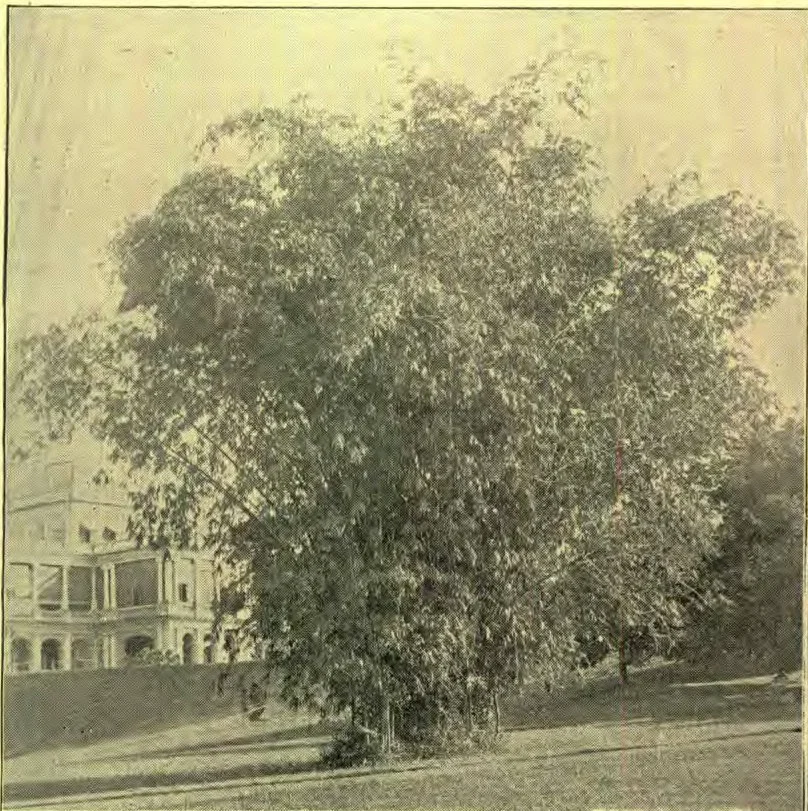
BAMBOO BUSH, SINGAPORE.
The population of Singapore amounts to about two hundred thousand, and includes a score or more of races. Indeed, representatives of many more nationalities are seen upon her streets. On the shelves of the British and Foreign Bible Society’s depot there are found portions of the Scriptures printed in more than eighty languages. The Chinese outnumber all the other races combined, and will probably reach one hundred thousand. The Malays, who are the natives of the soil, will number perhaps thirty thousand. Natives from different parts of India, chiefly from the east coast, will aggregate twenty or twenty-five thousand. There are several hundred Japanese, and a considerable number of Arabs, Armenians, Jews, Englishmen, and Germans, not to mention other nationalities.
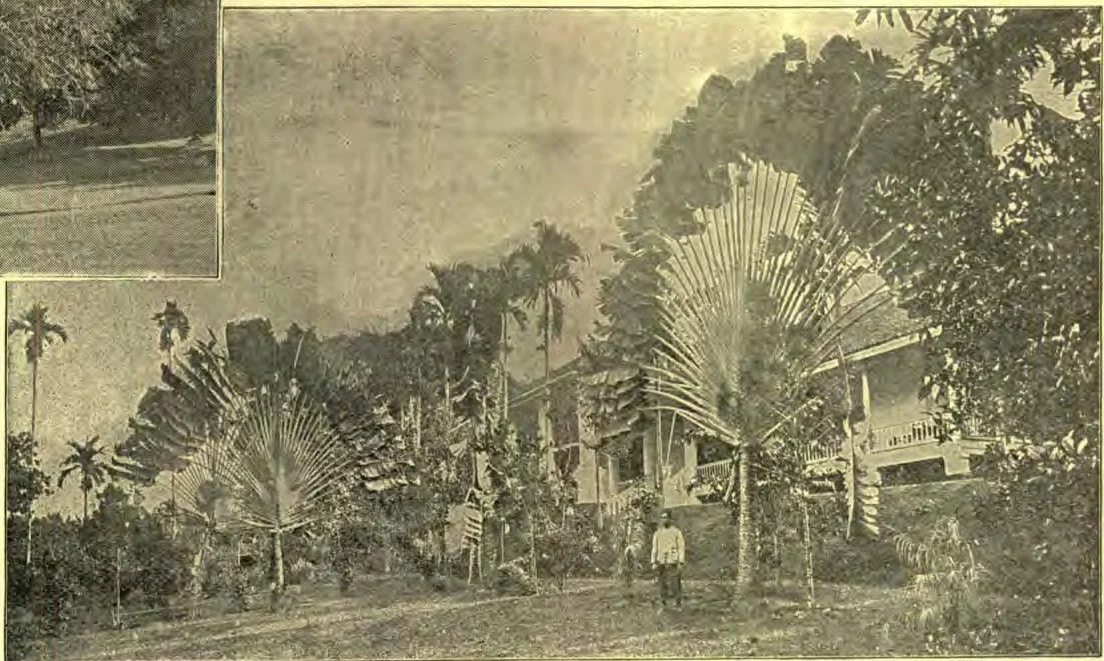
FAN PALMS, SINGAPORE.
As already stated, this colony is remarkable for its commerce. Singapore and Penang, situated on the Prince of Wales Island, are the chief centers of commercial industry. Singapore is like the hub of a great wheel, whose spokes stretch out in all directions up the coasts of the peninsula, to Siam, Borneo, Java, Sumatra, and even to India, China, and Australia. Indeed, flags of every nation on earth may be seen floating from the mastheads of the merchant marine that anchor in the spacious harbor. Singapore is one of the coaling-stations of Her British Majesty’s navy, and for this reason it is strongly fortified. The little islands that flank the harbor and the southern shore of the Island of Singapore bristle with cannon of the latest type, and a strong garrison is maintained, consisting of a thousand troops, besides several men-of-war. The governor is appointed by the crown, and the control of the colony is entirely in the hands of the home government, their condition being similar to that of the American colonies under George III. A partially representative government is maintained, but it is such only in name; for while the property-owners of the colony are able, through the unofficial members, who are elected by them, to express their wishes through a legislative council, the governor, together with the official members, can at any time outvote the unofficial portion, and so carry any measure that the Colonial Office wishes to pass, whether the people of the colony and their representatives in the council like it or not. The only thing that would restrain them from taking such a course as this at any time would be the fear of raising so much hostility as to affect materially the interests of the crown.
The government in general aims to be just and equitable, and as a rule the people of this colony are fairly dealt with; but once in my recollection, extreme measures were resorted to by the people of the colony to prevent an unjust tax laid upon them by the home government. In 1893, when the Sherman silver bill was passed by Congress, the Mexican dollar, which is the current coin of the colony, was rated in the exchange market at about ninety-five cents in American gold; but it soon began to decline, and in the course of two or three years had fallen to about fifty cents. The reason was that the military contributions levied by the home government, of a hundred thousand pounds sterling, increased from about six hundred thousand to one million dollars. The citizens, the legislative council, and various other bodies made vigorous protests and touching appeals, but without obtaining any relief. The hard-hearted ministers of state could not understand why they should make any concessions to a colony that was so prosperous; but when the newspapers began to remind the people of England of the scenes of 1776 and the Boston tea-party, and talked about taxation without representation; when every man who held an honorary position under the government resigned his commission, and rousing mass-meetings were held, attended by the entire community who had interests that were affected,—then, and not till then, did the Colonial Office relax its grip upon the purse-strings of the colony, and consent to compromise on the basis of seventeen per cent. of the gross revenue in silver, the home government to stand the fluctuations in exchange.
The importance of this possession to Great Britain will be better understood when I tell you that the governor receives an annual salary of eight thousand pounds sterling, together with perquisites and expenses, which bring it up to at least ten thousand pounds,—almost as much as our own President receives.
The incomparable civil-service system of India is in force here; and in shaping the colonial policy for our newly acquired island possessions, the United States would do well to study carefully this branch of the Indian government’s policy, and its highly gratifying success. Every civil servant is employed strictly on the basis of qualification, is promoted for faithfulness and excellence in service, and after having remained for twenty-one years on the pay-roll of the colony, is retired for life on a pension amounting to two-thirds of the salary received at the time of retirement. The result of this policy is that only the best men are engaged, and only the best men remain, in the colonial service. The advantages of such a system are obvious.
This colony is one of the most important links of the great chain of African and Asiatic possessions that connects England with the far East, and the most cursory observer will understand why Great Britain rejoices to see Uncle Sam acquire such extensive and valuable possessions as the Philippine Islands so near the Asiatic coast. Great events are looming on the horizon; and some of the most important, as well as the most interesting, scenes of all human history are undoubtedly within the near future,—so near that their shadows can almost be discerned athwart the landscape.
I have said nothing of the peculiarities of the races, languages, and customs of this part of the world, and can not do so in the space allotted me; but those who would like to study further this part of the Orient will find a series of articles in the Medical Missionary, beginning with the December number, 1898, on these subjects. R. W. Munson.

GOD'S PURPOSE CONCERNING THE YOUTH OF TO-DAY. II.

TO KEEP our souls in the love of God, requires strict self-discipline and watchfulness, mingled with earnest prayer. Every youth should seek to make all he possibly can of himself, that he may grow in grace, and in favor with God and man. His highest aspiration should be to give to others the treasures of science and knowledge that he has gained by following God’s will. Thus his works will harmonize with the works of Christ. Those who do this are constantly in communication with the angels of light, who minister to those who shall be heirs of salvation.
God expects the youth to think soberly and intelligently of how those of past generations toiled and sacrificed to leave to future generations a heritage of light. The patriarchs and prophets and the disciples of Christ received impressions from the Great Teacher, and this light and knowledge they bequeathed to those who live in this age. The youth now have the privilege of improving all the treasures that have been acquired by past generations. The Lord expects these hereditary trusts to be gathered up as golden treasures, and imparted to others.
Paul wrote to Timothy: “Young men likewise exhort to be sober-minded, in all things showing thyself a pattern of good works; in doctrine showing uncorruptedness, gravity, sincerity, sound speech, that can not be condemned; that he that is of the contrary part may be ashamed, having no evil thing to say of you.” “Let no man despise thy youth; but be thou an example of the believers, in word, in conversation, in charity, in spirit, in faith, in purity.”
God calls for large-hearted, large-minded young men, who hear the word of God and obey it; who are not trifling, but deeply in earnest. “Wherefore he saith, Awake, thou that sleepest, and arise from the dead, and Christ shall give thee light. See that ye walk circumspectly, not as fools, but as wise, redeeming the time, because the days are evil. Wherefore be ye not unwise, but understanding what the will of the Lord is.” “I have written unto you, young men, because ye are strong, and the word of God abideth in you, and ye have overcome the wicked one.”
God calls for young men who are cultivated, sanctified, refined, ennobled, through the truth, which has not merely been assented to, but brought into the inmost recesses of the soul, sanctifying the entire man. Such youth will learn daily in the school of Christ. Jesus died for the world, and souls are perishing for want of the knowledge that he came to bring. Knowing this, will young men who have all the facilities for gaining an education, both in science and religion, stand back, careless, unconcerned, and indifferent, content to spend their blood-bought time and privileges in self-gratification?
The great work for this time has already begun, and is awaiting men who, with hearts subdued by grace, will carry it forward and upward, their ability refined and purified to do God’s will, their lips touched with the holy fire which burns its way to the hearts of the people. Will youth merely look on at such a time as this, feeling no burden of responsibility? Shall the work be crippled in all its branches for want of men to teach the truth to others? Where are the laborers who will go forth, consecrating to God their time, their talents, and every jot of the ability they possess?
At this late hour shall the work of saving souls be retarded? Shall but little be done, when the curse of sin has grown to such proportions that already the Spirit of God, insulted, rejected, and abused, is being withdrawn from the earth? Just as fast as God’s Spirit is taken away, Satan’s cruel work will be done upon land and sea. Judgments by fire and flood will increase in fearfulness; for Satan claims his harvest of souls in the destruction.
Will young men now humble their hearts before God, and give themselves to his service? Will they not accept the holy trust, and become light-bearers to a world ready to be consumed by the wrath of an offended God? The use of intoxicating drink, which dethrones reason, and of tobacco, which clouds the brain and poisons the life-current, is increasing. Are our young men prepared to lift their voices in defense of temperance, and show its bearing upon Christianity? Will they engage in the holy war against appetite and lust? Our artificial civilization encourages evils which are destroying sound principles. The Lord is at the door. Where are the men who will go forth to the work, fully trusting in God, ready to do and to dare? God calls, “Son, go work to-day in my vineyard.” If the young men of to-day will give themselves to God, he will make them heaven’s chosen depositaries of truth, and will empower them to present before the people truth in contrast with error and superstition. May the Lord roll the burden on strong young men, who have his word abiding in them.
MRS. E. G. WHITE.

WIRELESS TELEGRAPHY.

SEVERAL years ago it was reported that Thomas A. Edison, “the Wizard of Menlo Park,” had devised a successful means of telegraphing from a wire to a moving train of cars, the message operating a receiving instrument by induction through a metallic roof on one of the cars. This was the nearest approach to “wireless” telegraphy until the year 1895. In that year, Marconi, a young Italian experimenter, set up on his father’s estates a series of tin boxes, which he called “capacities,” on poles of varying heights, and connected them by insulated wires with a crude form of receiver and transmitter, which he had invented. The extended surface in these tin boxes served the same purpose as Edison’s metallic car-roof.
Continuing his experiments, Marconi found that the higher his boxes were set, the longer the distance was through which signals could be transmitted between them. Intervening hills or other bodies did not obstruct the transmission. In 1896 he went to London, and extended his experiments on a larger scale. He sent up ten-foot balloons covered with tin-foil for “capacities,” and afterward used large calico kites, messages being sent in this way between points more than eight miles apart. Finally, in 1897, it was discovered that a single wire suspended from a supporting mast furnished all the surface necessary to constitute a successful “capacity.” Since that time the experiments have produced results of steadily increasing interest and value. Among the latest achievements is the perfect interchange of messages across the English Channel, over a distance of about thirty miles.
Mr. Marconi does not assume to say what are the kind of waves that are transmitted from one station to another, further than that they are generated in some way by the electric pulsations in the terminal wires. These waves travel outwardly in all directions unless directed, as they may be, for short distances, by a large parabolic reflector. The well-known “Morse code” is used in sending and receiving messages. The transmitting instrument includes an induction coil capable of producing a spark ten inches long. A single spark corresponds to a dot in the telegraphic code, while a dash is produced by a stream of sparks continuing as long as the operating key is depressed. Messages are sent at the rate of about fifteen words a minute.
The transmitting instrument is comparatively simple to understand. It is in the receiving instrument that the greatest ingenuity and originality are displayed. The waves which are transmitted from the terminal wires are very feeble, compared with the electric current from the induction coil, and must be caught by a delicate mechanism in the receiving instrument. In fact, the waves must be electrically re-enforced before they can register their message on the tape of the receiver. This is accomplished through what is called the “coherer.” It is a vacuum tube, like a thermometer, about two inches long, and containing two silver plugs attached to the circuit of a light battery which works the recording apparatus. This circuit is broken by a very minute distance between the silver plugs, and this slit-like space contains several hundred minute particles of nickel and silver. Marconi discovered that these particles of metallic dust would “cohere” under the feeble impulse of the ether waves, and thus complete the metallic circuit of the recording battery. But when they have once “cohered” into a solid chain, the battery current would hold them in that relation, and so record nothing but a continuous mark on the tape. So at the end of each dot, the Morse recorder automatically strikes the “coherer” with a little “tapper,” which shakes the dust-particles down, and so breaks the circuit until the next wave-impulse draws them together again. Each impulse thus records a dot, and the groups of dots form the letters in which the message is spelled out.
Many useful applications of this “wireless telegraphy” have already been foreseen. With terminal wires raised to a sufficient elevation, messages may be sent thousands of miles, without the use of submarine cables or overland conductors. Vessels at sea, in storm or fog, can signal their approach to harbor, or, in return, receive warning or directions from lighthouses and life-saving stations. Collisions between approaching vessels can be easily avoided through its use. These and many other applications of the principle are certain to be developed as soon as further experiments have prepared the way.
And so we see that many things which would have been considered miraculous a generation ago are rapidly becoming commonplace to us. History is being made very rapidly in these closing days of the nineteenth century, and the way is being prepared for many wonderful developments that seemed impossible only a few years ago. The Word of Prophecy is the only record that can give us a definite knowledge of what the future is to bring. F. W. HOWE.

THE QUIET HOUR.

When day has let her fires burn down To glowing embers in the west, And busy Care, with folded hands, Forgets her toil and drops to rest;
When shadowy pictures come and go, As twilight deepens o’er the plain, And dewy silence, breathing balm, Revives the drooping leaves again,
How sweet to worn and troubled hearts The falling shade, the soothing power Of ministries that nature holds To bless us in the quiet hour.
We do not heed them in the din Of toil and traffic on the street; They do not linger in the halls Where pride of wealth and fashion meet;
But, duties done, and thought released, And daylight closing like a flower, With home’s dear peace enwrapping all, How precious is the quiet hour!
— C. M. Goodrich.

Chapter III

From Sinai to Olivet

Chapter III.
The dragging afternoon hung heavily about her weary feet. How could Shirley leave her for an hour, even if father was provoking?
Hours passed; supper-time came. Shirley was still absent, and a desolation like that of death, to which even her moody face would have given gladness, settled over the farm.
The harvest-hands had seen Shirley running along the road, and knew that something had happened. Seth had been at the well near the kitchen for water, and had heard Mr. Goss’s last words to her; and knowing him and the spirited girl and her home life as he did, he was not surprised to see her fly, headlong, hatless, and with sleeves rolled to the elbow.
He understood. His love made him intelligent on the subject of Shirley Goss, and his heart leaped loyally after her.
“Goss’s arbitrary way with the girl is playing the mischief,” he said to himself; “might as well shut off the escape-valve, and keep the fire roaring under the boiler. She’s too high-strung to be handled like a mowing-machine or a potato seedling,—but you’ve got to give them a chance to act out nature, if you get any good out of them. I’ve seen what’s coming before to-day. I ain’t surprised to see her run, but I’m surprised at myself that I could ever have said what I have to her. But I felt cheated; I wanted her to look natural; to talk and smile and be herself,—and what would the musicale be with her not going to sing? How could I ever sing my part without hers trilling in my ears? It made me mad to see her so sober and still and mopey, and refusing to say she’d sing.”
Seth had brooded over those cutting words ever since, even more than Shirley did; and he hated himself for his momentary lack of sympathy for the young girl who was being driven to recklessness by the very people who loved her best, and among whom alone she would probably find safe shelter from a world that, having no heart, could have no pity.
Seth had been in a state of nervous tension all the afternoon. Several times he was on the point of leaving his team, and running after Shirley; and only that the eyes of the men were on him expectantly, he might have risked such a move, in spite of the instinctive fear that it would be dangerous as regarded any future relations. So he kept prudently at work, while in spirit he was more absent than present. The supper-call brought together a sober company.
Shirley seemed to have taken everything with her except the cloud that had been so offensive to them all. That she had certainly left behind, and it had settled over every face.
Mr. Goss at first made a good show of being the same as ever; but even his anger was not able entirely to sustain his pride. He was troubled and constrained in spite of himself. No one had realized how large a place the girl had filled in that home until now.
Mrs. Goss wore the traces of tears, and sat behind the coffee-pot silent, abstracted, eating nothing, and failing in service to the others. At last, when she passed an empty cup to Seth, Mr. Goss looked angrily at her, and said, with unusual roughness, reaching over and grasping the coffee-pot: “Here,—have I got to pour the coffee, too, if the hands have their rights? We’ll all have to turn in and cook our own victuals and wash our own dishes next.”
Seth had taken the empty cup, and now, as Mr. Goss attempted to fill it, turned it bottom side up in the saucer, and, lifting his head, looked squarely into Mr. Goss’s face, and said: “Thanks awfully, I’ll take mine so. Fact is, I’d choke before I’d drink from your filling.”
He set the cup down, pushed away from the table, arose, and went on: “And see here, sir, I saw Shirley when she went; I was at the well, and heard you. I don’t need anybody to tell me what it all means. I want you just to understand that I’m,—well, sir, I’m going to find her, since she hasn’t any father to care what happens to her. Have you anything to send to her, Mrs. Goss?”
Mrs. Goss opened her lips, but it was Mr. Goss who spoke: “Will you kindly leave us alone with our affairs, sir? When I have anything to send to anybody, I can choose my messenger, or go myself. I forbid your going to find my daughter, and you can get off my premises. I can put in my grain without you. There,” taking a roll of bills from his pocket and fumbling them, “is what I owe you.”
Seth kept his hands about the crown of the hat that he had taken from the floor near his chair, threw his head back, and laughed.
“This happens to be a free country, Mr. Goss,” he said, “and since Shirley didn’t take the road with her, and I own my own legs, your forbidding don’t amount to much. As for the cash, I’ll take mine from the man I work for, and this time it happens to be Sam Jordan there. It’s his seeder I’m riding this spring.”
“And,” said Sam, “you come back when you get ready, Seth; it’s you and I, as you say, this time.”
“All right, Sam,” replied Seth, as he strode out, leaving Mrs. Goss weeping bitterly; Mr. Goss in a rage, and the “hands” as expressive of sympathy as the process of eating and drinking would admit.
Not one among them but would have gladly gone with Seth or in his stead; but no one considered the matter more serious than a family row, which would doubtless soon end by the girl’s return, and would then be forgotten.
Seth was sure he knew where to find Shirley. “She’s gone to her Aunt Nell’s,” he said to himself. “Aunt Nell will understand, too,” and he walked rapidly in that direction. “Three miles at least,” he muttered, “this hot day, after all she’s had to do in the kitchen. She’ll be dead tired, but I admire her spunk,—no hat, sleeves up, apron flying,—my! but she is fine.”
Seth walked fast, and had made two thirds of the way over the dusty road when he stopped suddenly, and stood awkward and abashed; for there, on a log by the roadside, sat Shirley, fanning herself with her apron.
She was looking at him, and he saw nothing in the look to reward him for coming this far, or to invite him nearer.
Shirley was, in fact, still very angry,—more so because she felt foolish and undecided.
She had left hastily, and had sat down by the wayside to repent a little before she went on, if she went on, which was now, however, scarcely a question; but where and how?
No girl ever likes to be seen at a disadvantage by anybody, much less away from home. Of course Seth had seen Shirley hatless, in her calico dress, gingham apron, and coarse shoes before; but that was about the farm. He had, in fact, never seen her tastefully dressed anywhere, either according to her own notion or to his. He had seen her cross, but it was different then. Everything seemed different two miles from home on the public highway; and besides, she was very tired. She was homesick, heartsick, and did not want to be followed; least of all did she want Seth; yet there he was looking at her, bareheaded, untidy, undecided, as she was. She would not go back, she would not be sent for. She would go to Aunt Nell’s, borrow some clothes and money, and go on to the city.
This had been dimly suggested to her before; but when she began to feel foolish, she was on the point of going back to her mother, though never to her father. She could go, she thought, and live with her mother, work for her, and ignore her father. Seth’s appearance, however, put even that out of the question. She would not go home.
She did not wait for him to recover sufficiently to speak; she did not wait at all. She no sooner was sure that he saw her, than she was on her feet, saying, “You need not follow me, Seth Adams. Don’t you come one step farther. Go back to them that sent you. I am not a sick sheep or calf to be thrown over your shoulder and taken home.”
“But, Shirley, I———”
It was no use; she did not hear. She was running again, bounding like a deer away through the dust, surrounding herself with a thick cloud, and sending a smudge behind her.
“My!” ejaculated Seth, “but ain’t she mad? She’s got it in her,—but I like her all the better, considering. If she hadn’t held on, and took so much all along so patiently, it would be different. Goss is a mighty careless hand with fire. Fire is handy to have, but you want to keep it where it belongs; there isn’t any use sending it flying all over creation, any more than letting the fire out of the stove into the house and furniture. I’ll not forget the lesson that Benjamin Goss has given me a chance to learn. I’ll put it where it’ll keep for future reference.”
Seth sat down on the log in the very place that Shirley had occupied. “Just to think,” he muttered, “she supposed I came because I was sent to follow her, and carry her back, like a sick sheep or calf on my shoulder. My, but she’s mad, to think of such things! But I’m with her, just the same, and I’ll find a way; she’ll hear from me yet, when she needs somebody. A man like Benjamin Goss hasn’t any right to have a girl.”
He sat still on the log, working away on the problem of Shirley Goss long after it was too dark to see.
He could not help looking and listening as he passed Aunt Nell’s on his way home. But neither sight nor sound rewarded him. He kept the place in sight until it was very late, then he went with a heavy heart to the home that he shared with his mother.
The next day a boy who was passing on horseback left a note for Mrs. Goss. It read:—
DEAREST MOTHER: For your sake I am sorry, but I am not going home any more. I can not live so any longer. You will understand, and I really do not think you will wonder any, or blame me much.
I have borrowed some clothes and a little money to begin with. I am going to the city to find work. Father said he thought it would do me good to earn my own living. One thing I know: it will do me good to have the money I do earn, and spend it as I choose, so I am going to do both.
I will write when I get settled at anything. I shall miss you, dear. Don’t you worry. I shall do right always, and love you always. Good by. Your loving little—
SHIRLEY.
P. S.—Don’t be afraid, mother dear. I’ll do right always. I’ll try not to be so worldly, any more; and whatever work I do, I’ll keep the Sabbath—for your sake.
MRS. S. M. I. HENRY.
(To be continued.)

SOME THINGS ABOUT THE STEEL SQUARE.

There is probably no other tool in use among mechanics that has half the capacity for usefulness, or of which half so many applications can be made, as the steel square. A mere list of the operations that may be performed with it, and of the purposes for which it may be advantageously employed, would occupy more space than we can devote to this article. This familiar tool has been underrated, and is entitled to more attention than is usually given to it. In the hands of the mechanic, it is a calculating-machine of wonderful capacity.
Top.
Top.
In the study of the square, we will first give the names of the parts of the square itself, and then notice the marks and scales on it. The long part is called the blade, the short arm is called the tongue, and the connection between the blade and the tongue is called the heel. The blade is twenty-four inches long, the tongue from fourteen to eighteen inches. The blade in a perfect square is two inches wide, and the tongue is an inch and a half wide.
The first marks that we will notice will be the division into inches and fractions of inches. The heel of the square is the point from which it is most convenient to measure, both along the blade, and also on the tongue. In numbering inches, therefore, we begin at the heel, on the blade and the tongue respectively. The inch-marks on the inside edge begin numbering with the interior angle.
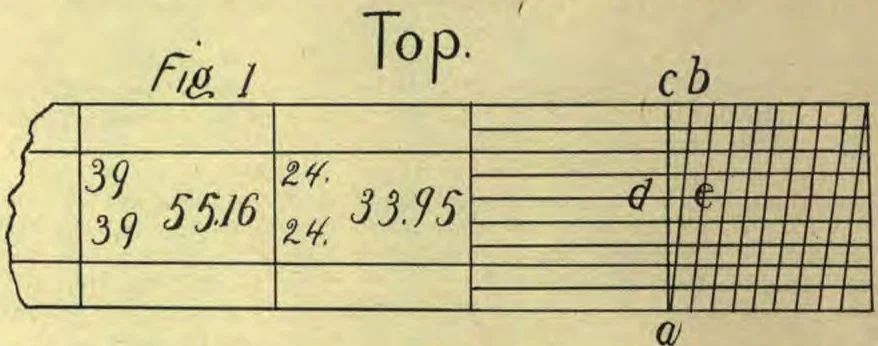
The blade of a good square has a row of figures, beginning with the outer end, between the other two rows of figures, which adapts this part of the tool for use in measuring the depth of mortises, etc. The different edges of the square are variously divided into fractions of inches. The outside edge on one side of the square is divided into sixteenths, while the inside edge is divided into eighths. The edge on the opposite side of the square is divided into twelfths, and is used as a scale for drafting,—an inch to the foot, each twelfth representing an inch. The fine lines ruled longitudinally on the tongue between the inch-marks 2 and 4 are parallel lines divided into tenths. The diagonal lines between 2 and 3 are also one tenth of an inch apart. By these lines the workman is enabled to find hundredths of an inch. As you will see in Fig. 1, from the line where the line starts at a to b, the distance is one tenth at b from c, and following up the line from a to b, the second line would be one hundredth, the third line two hundredths, and so on up to ten hundredths. Every time you move to the next line on the right, you gain ten hundredths more.
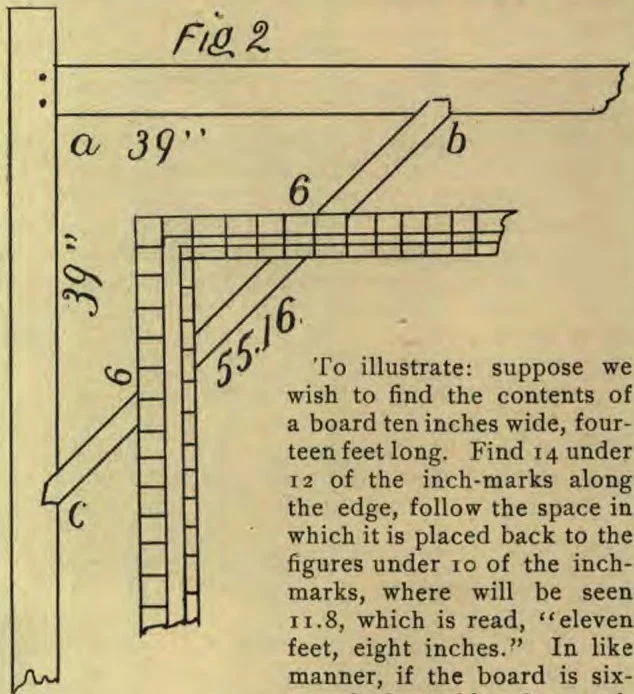
In Fig. 2 we have an illustration of practical work. If you were putting up a timber frame of any kind, and wished to frame in a brace, you would need to know exactly how long to cut the brace. The space from a to b and from a to c is called the run. The run from a to b is thirty-nine inches, and from a to c thirty-nine inches. To find the length that the brace should be cut, look on the tongue of the square, and notice the figures, as shown in Fig. 1: 39/39. 55.16. The thirty-nine inches is the length of the run, and the fifty-five inches and sixteen hundredths, the length of the brace from c to b, or four feet, seven inches, and sixteen hundredths of an inch. To find the measure as found on the square, run from the bottom line, Fig. 1, at a, up six lines to d. From d to e on this line is six hundredths of an inch. By adding another space at the right, you have the sixteen hundredths of an inch, which, added to your four feet seven inches, gives you the length of the brace. You will find the figures on the square for any run you may want. The length of the brace is found in the same way.
To get the bevel to cut the shoulder of the brace, lay the square across the brace, as seen in Fig. 2, an equal number of inches on the blade and the tongue. It is not customary in coarse framing to pay any attention to the hundredths; but in fine work, where needed, this gives an exact measure.
Fig 2
Fig 2
The parallel rows of figures along the blade of the square constitute what is called a board measure. The manner of using it is as follows: Under 12 of the inch-marks along the outer edge of the blade will be found the figures 8, 9, 10, 11, 12, 13, 14, 15, which represent the length of the plank or board to be measured. The contents in feet and inches will be found under the several inch-marks on the outer edge of the blade, corresponding to the width of the piece to be measured.
To illustrate: suppose we wish to find the contents of a board ten inches wide, fourteen feet long. Find 14 under 12 of the inch-marks along the edge, follow the space in which it is placed back to the figures under 10 of the inch-marks, where will be seen 11.8, which is read, “eleven feet, eight inches.” In like manner, if the board is sixteen inches wide, the result (under 16 of the inch-marks) is found to be 18.8, or eighteen feet, eight inches. Many other examples might be given.
Try to lead a life as square and true as the tool you work with.
W. K. LOUGHBOROUGH.
Continue reading: FINISHING THE SEWING-BAG