The Youth’s Instructor, Vol. 47, No. 26.

AN ORIENTAL COLONY OF GREAT BRITAIN
Earlier text: FINISHING THE SEWING-BAG

Grand Trunk Railway System

Time Card in Effect February 5, 1899.

C. & G. T. DIVISION.

WEST-BOUND FROM BATTLE CREEK.

LEAVE.
No. 11, Mail and Express, to Chicago — 12.00 M.
No. 1, Chicago Express, to Chicago — 9.00 A. M.
No. 3, Lehigh Valley Express, to Chicago — 3.40 P. M.
No. 5, Pacific Express, to Chicago, with sleeper — 12.55 A. M.
No. 75, Mixed, to South Bend — 7.30 A. M.
Nos. 11 and 75, daily, except Sunday. Nos. 1, 3, and 5, daily.

EAST-BOUND FROM BATTLE CREEK.

No. 10, Mail and Express, to Pt. Huron, East, and Detroit — 3.45 P. M.
No. 4, Lehigh Express, to Pt. Huron and East — 8.27 P. M.
No. 6, Atlantic Express, to Pt. Huron, East, and Detroit — 2.25 A. M.
No. 8, Lehigh Exp. to Saginaw, Bay City, Pt. Huron, and East — 6.50 A. M.
No. 74, Mixed, to Durand (Starts at Nichols) — 7.35 A. M.
Nos. 10 and 74, daily, except Sunday. Nos. 4, 6, and 8, daily.
E. H. HUGHES, A. G. P. & T. Agt. Chicago, Ill.
A. S. PARKER, Ticket Agent, Battle Creek.

TAKE THE Canadian Pacific Railway

for . . . CHATHAM, OTTAWA, MONTREAL, LONDON, GALT, QUEBEC, WOODSTOCK, TORONTO, BOSTON, PORTLAND, and
All points in New England, the Maritime Provinces, Great Britain, and the Continent.
Illustrated literature, time-tables, and full particulars, upon application to—
J. FRANCIS LEE, GEN. AGENT,
Passenger Dept. 228 SOUTH CLARK ST., CHICAGO.
Branch Offices: 76 Ottawa St., Grand Rapids, Mich.; Room D, Chamber of Commerce, Cincinnati, Ohio; 315 Chestnut St., St. Louis, Mo.

WHAT HAVE I DONE?

Day after day Heaven, listening, hears men cry: “What have I done that such a fate as this Should follow me? What have I done amiss That clouds of care should darken all my sky? That pain should pierce, and that shrewd poverty Should pinch me in that grievous grip of his, What time I tremble over the abyss, And long for death, yet, longing, dare not die?”
But when does Heaven, listening, hear men say: “What have I done that in the blue-domed skies The evening star should shine, the spring clouds move, The world be white with innocence that May Has set afield, and God in children’s eyes, To win our hearts to wonder at his love?”
—Julie M. Lippman.

Guarding Against Self in Our Work

A CONSTANT watch must be kept against the outcropping of self in our work. A selfish motive takes the bloom and beauty from the kindest deed.

Growth of Roman Catholic Priesthood in England

At the present time there are two thousand five hundred Roman Catholic priests in England. Fifty years ago there were only six hundred and twenty.

Love Goes Through the Gate

ONE may “work for” a home among the “many mansions” with a purely selfish motive, just as he would work for a beautiful home in this world—with this difference: he might obtain the one, but never the other. Only “love goes through the gate,”—love for God, that comes from the love of God shed abroad in the heart. This love will find its expression in working for others.

What Is Your Idol? Idolatry Beyond Image-Worship

“WHAT is your idol?” is the startling question printed under the picture of a heathen bowed in worship before a hideous stone image. It is a pertinent inquiry; and brings to mind the fact that idolatry is not confined to image-worship. Pride, covetousness, secret sin, love of the world,—all these may become idols if cherished in the heart; and it is just as true of such an idolater as of him who “maketh a graven image, and falleth down thereto, . . . and prayeth unto it,” that “he feedeth on ashes,”—a poor substitute indeed for the bread of life. “Little children, keep yourselves from idols.”

The Desire of Ages for Sabbath-School Study

EVERY one who is interested in the Sabbath-school lessons for this year should have “The Desire of Ages” to read in connection with his study. The most conscientious work has been done on this book in every detail, and no pains nor expense spared to make its mechanical features worthy of the Life it records. But take away the artistic cover, the hundreds of illustrations, and all that goes to make the book attractive to the eye, its intrinsic merit would still remain, and its words of admonition, comfort, and counsel be just as invaluable “to the great family for whom our Elder Brother lived and died.” Occasional paragraphs from “The Desire of Ages” appear in the notes on the lessons, but you miss a blessing if you do not have the whole chapter to read on the topic. Published by the Review and Herald Pub. Co., Battle Creek, Mich., and by the Pacific Press Pub. Co., Oakland, Cal.

Blessed Are the Poor in Spirit

TO BE “poor in spirit” is entirely contrary to the world’s standards of success: “poor spirited,”—the very term is regarded as a reproach! Nevertheless the leading beatitude says of such that “theirs is the kingdom of heaven.” They show their citizenship, too, never pushing themselves forward, trying to attract attention, looking for slights, picking a quarrel, nor flying into a passion over some fancied injury. Their association is a blessing and inspiration, and their friendship a great gift. The meek and lowly Saviour is their pattern, and his kingdom is also theirs.

Be Reconciled Before Offering Your Gift

“If thou bring thy gift to the altar, and there rememberest that thy brother hath aught against thee, leave there thy gift before the altar, and go thy way; first be reconciled to thy brother, and then come and offer thy gift.” Here is laid down a principle in giving that is too often lost sight of: the acceptable gift comes only from the heart where Love dwells. No room in that heart for unkind thoughts against one's neighbor, for anger, harshness, or evil-surmising. If it chance that these are found, they must be put away. After reconciliation, offer your gift; and the love that prompts it will make it acceptable.

AN UNFORTUNATE SPECULATION.

Greed for gain sometimes oversteps the boundaries of prudence, and defeats itself. This was the case with a Texan, whom we will call Perkins. Seized with the speculative fever, he thought he saw an opportunity to make a fortune in goats. The result of the venture is thus chronicled by the Detroit News:—
Just after the lifting of the blockade Mr. Perkins’s partner was in Havana. The house was considering chances to make money there. Perkins had been in Havana, and knew that the people ordinarily used goats’ milk. He telegraphed from Texas, “What could you do with a few goats?” The partner cabled back: “Might try a hundred.”
A hundred! This set Mr. Perkins wild. If a hundred could be used, a good many more could be. He bought five thousand goats in Texas at a dollar apiece, and loaded them on a steamer. His partner, dumbfounded to find such an army on his hands, went to see the butchers, and told them what a nice consignment he had.
The butchers were very poor, and so were the people of Havana, and all they could offer him for the goats was fifty cents apiece. In spite of the most persevering efforts, that was all he could get for them. He consulted Perkins by cable, and it was agreed to sell the goats, pocket the loss of twenty-five hundred dollars, and let it go at that. The partner went to get the goats, and then found that the Spanish custom-house authorities demanded two dollars apiece before the goats should be landed! He did everything he could to evade this charge, but quite in vain. That night he went aboard the steamer and tried to stampede the goats off the deck into Havana harbor. The goats had too much sense to be frightened into suicide. Every one of them remained aboard. He took the steamer to Jamaica, and not one of them was wanted there.
Here the captain of the vessel said that he could not stand it any longer, as the goats were eating up his rigging, and he was afraid they would eat up the whole ship. Then they steamed back to New Orleans, and here they were not permitted to land, as the quarantine authorities held that the goats had had an opportunity to become infected with the germs of yellow fever in Havana. It took a great deal of expensive cabling and a long delay to get them released at last, and obtain permission to land the goats, and give them away at New Orleans.
Thus ended what was, perhaps, the most unprofitable speculation of its size in history.

SOME EVERY-DAY EXPRESSIONS.

“Apple-pie order” is an expression often used to describe the neat arrangement of a library, a room, etc. Some years ago the origin of the phrase was under discussion, and it was decided that it should be “alpha-beta order;” that is, “alphabetical order.”
The origin of the motto, “Cleanliness is next to godliness,” supposed by many to be in the Bible, is unknown.
“To make a cat’s-paw” of another is to use him to do something disagreeable that we do not wish to do for ourselves. The expression is drawn from the fable of the monkey, who, having roasted some chestnuts, caught a cat, and used her paw to rake them from the fire.
“Humble-pie.” In feudal times, when the lord of the castle and his honored guests were served with venison pastry, the “umbles,” or entrails, of the deer were made into “umble-pie” for the servants and those who sat “below the salt.” This led to applying the phrase to those occupying an inferior position.
The expression “O. K.,” as used in this country, is supposed to have originated with old John Jacob Astor, whose shrewd good sense and sound judgment were highly valued by his friends. He was supposed to know the commercial soundness of other traders, and was often referred to by those who wished to make a safe investment. When he wished to indorse the standing of some person, he would write across the note of inquiry concerning him the letters “O. K.,” which he supposed to be the initials for “all correct,” and in this sense they are used to-day.
The raising and lowering of a ship’s flag in saluting is regulated by pegs. When special honor is to be paid, the flag is raised to its highest. “To take down a peg,” therefore, means to lower the dignity.
The word “news” is by some supposed to be formed of the first letters of the words, “north,” “east,” “west,” “south.”

A PRONUNCIATION DRILL.

Though the following words are in everyday literary use, and are said to involve no case of disputed pronunciation, not many persons can correctly pronounce the whole list at the first trial. Consult a standard dictionary in regard to all the words you are in doubt about, —and perhaps it would be well to look up those you are “almost sure” of. The result will surprise you. To be able to pronounce correctly the sixty-six words in this list is a good beginning to that correct speech that marks the person of culture:—
interesting mock vocables
inquiry goddess pestle
oyer vagary visor
terminer bade flaccid
indisputable reptile lithographer
heinous servile tribune
pageant rapine seine
juvenile pretense gaunt
extraordinary hiatus futile
pedestal precedence docile
directing precedent pathos
spectators simultaneously ordeal
tiara gross virago
carat raillery alias
nonchalance promulgate vaccine
leisure anarchism scabious
maniacal probity desuetude
laundress predilection obsession
squalor patronage irrevocable
detestation dilate inventory
hideous glaciers asylum
grimaces franchise homicidal

Longest Words in the English Language
The longest word in the English language is “protransubstantiationist,” a jointed word of twenty-eight letters. “Transubstantiationableness” is the next longest.
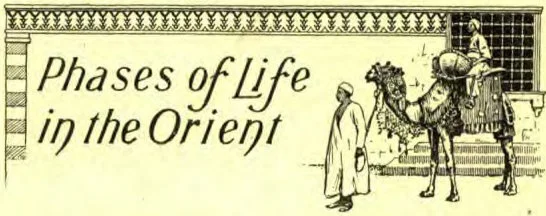
Phases of Life in the Orient

You have reached the end of this edition.

The Youth’s Instructor · Jun 29, 1899