Now that the bag is sewed at the side and end, turn down the top for a hem. First turn under the edge, then turn a hem about two and one-half inches wide. Begin at one side, basting the hem the same as you did the sides; then, pointing the needle from you, insert it at the edge of the fold, one third of an inch from the right-hand end, and bring it out close to the end. Carefully draw the needle through, leaving a little of the thread at the end, to be tucked under the hem, and sewed down with the first stitches. Take up one or two threads of the cloth, insert the needle in the fold of the hem two or three threads to the left, bring it out two or three threads to the left of the place where you insert it, and draw the thread through; take up one or two more threads of the cloth, and continue as before. Be careful to take up only one or two threads at a time.
When the hem is finished, make a place for the draw-string. To do this, insert the needle at the edge of the fold, about three fourths of an inch above the fold of the hem, thus making the place for the string three fourths of an inch wide. Draw the needle through, and baste a line along it, to make it even. Insert the needle as before; draw out and sew along this line of basting with a running-stitch, by passing the needle in and out of the material at regular intervals, taking up two or three threads of the cloth, and passing over the same number.
Make a slit in each side of the bag between the edge of the hem and the last row of running-stitching, for the tape to come through, and overcast the edges of each closely. Take two pieces of tape or ribbon a few inches longer than the width of the bag, thread the tape-needle, and insert in the slit on one side between the hem and cloth; carry it around, and bring it out at the same opening. Thread the other piece, insert it in the other in the same manner, carrying it around, and bringing it out at the same opening in which you inserted it; Press the bag smooth with a warm iron, trim it, tie the ends of the tape, and draw it up.
The bag is now ready for your tools, which should always be kept in it, so you will know just where to find them. Much precious time is lost in looking for things that have been carelessly laid down. Let us be careful in all these little things. NELLIE V. DICE.
UP-AND-DOING
By Frank Walcott Hutt
Of course you all have heard about
The Up-and-Doing Land, I know.
Geographies have left it out,
But ’t is not very far to go
To find its cities, old and new,
And all its happy people, too;
For Up-and-Doing Land is true,
And not a fairy-land at all;
And all have work enough to do
To keep them busy, great and small:
The Up-and-Doing people are
The busy people, near and far.
The children always find a way
To keep the idle strangers out;
And whether at their work or play,
They’re bright and wide-awake, no doubt.
Take warning, when you loiter down
The streets of Up-and-Doing Town.
— Frank Walcott Hutt.
Work for Some Good, Be It Ever So Slowly
By Mrs. Osgood
Work for some good, be it ever so slowly;
Cherish some flower, be it ever so lowly;
Labor!—all labor is noble and holy;
Let thy great deeds be thy prayer to thy God.
—Mrs. Osgood.
TIMOTHY
By Mrs. L. D. Avery-Stuttle
I WONDER how many of you have read the first and second letters of Paul to Timothy. Have you ever noticed how tender and loving these letters are? Paul must have thought a great deal of his “son,” as he called Timothy. Was he really Paul’s son?—The second verse of the first chapter of the first letter tells us that he was his “son in the faith.”
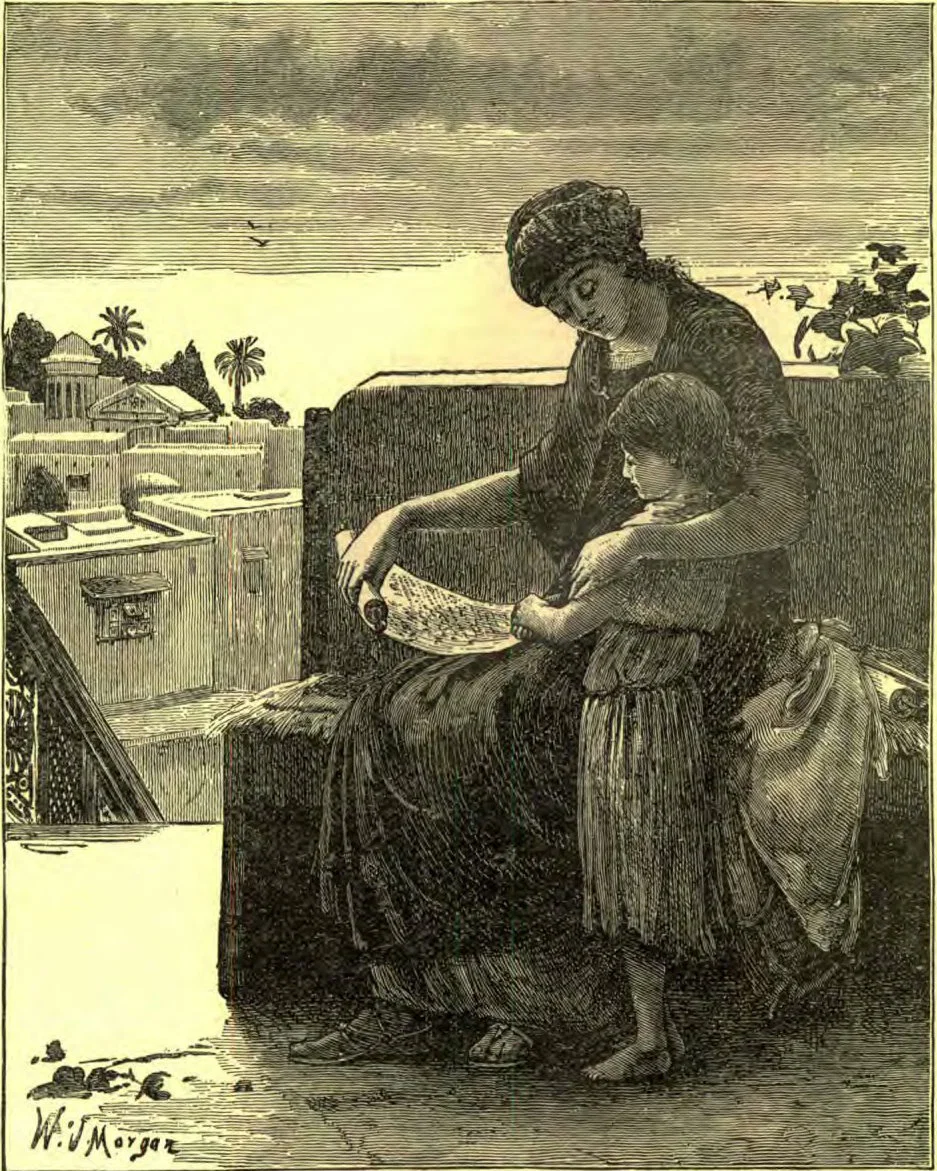
THE CHILD TIMOTHY AND HIS MOTHER.
Timothy was a worthy young man: he had been a good boy. He had enjoyed the training of a godly mother and a pious grandmother. But not every boy who has had all these advantages becomes a good man. There is one thing that we must all have in order to please God. Can you tell me what it is?
“Faith in Jesus Christ,” I hear some one answer. That is true; for “without faith it is impossible to please him.” But there is such a thing as pretending to have faith when we do not have it. If we profess to love Jesus, and do not show love for his children; if we are cross and uncourteous at home, if we are sly and revengeful, we have not true, saving faith, but a feigned faith. This is the opposite of the faith which young Timothy had, and which is so beautifully mentioned in the first chapter and fifth verse of the Second Epistle. He must have been a tender-hearted young man; for the fourth verse of the same chapter mentions his tears. I suppose he did not have a very easy life,—none of the early church had that,—but the Master himself endured far more than any of his followers have been called upon to suffer; for sin causes all the suffering and anguish that has ever cursed our earth, and the Master bore the sins, and therefore the grief, of the whole world.
Probably no small share of the sorrows of Timothy was caused by the cruel and ungrateful manner in which his dear friend and father in the faith was treated; for Paul was a stanch soldier of the cross, and because he did not hesitate to preach the truth, he gained many enemies. “All they which are in Asia,” he sorrowfully wrote to Timothy, “be turned away from me.” We can easily imagine that the tears of this loving young man flowed faster still as he read the affectionate letter from his absent friend.
This letter was not written alone to Timothy, but to all the followers of that Saviour whom Paul loved. Let us, like Timothy, in youth be students of the holy Word, that it may produce in us, as it did in him, “unfeigned faith,” gentleness, love, and an affectionate and sympathetic disposition. “Study to show thyself approved unto God.”
Take ye the Bible, and list to its counsel,
So shall it guide you in pathways of right,
Lead your young feet to the city eternal,
Be to your soul like a beacon of light.
Wonderful news of sins borne and forgiven,
Sent from the Father of infinite love;
Angels come bringing the message from heaven,—
Bringing sweet peace from the Master above.
Wonderful plan of a wondrous salvation,
Here in this heaven-sent Record we find;
Let us rejoice in the blest mediation
Of the Redeemer, who died for mankind.
If, like young Timothy, while in life’s morning,
Ere o’er the hills shineth life’s setting sun,
We but give heed to its counsels and warnings,
We may rejoice o’er the plaudit, “Well done.”
MRS. L. D. AVERY-STUTTLE.
WHAT DICKY HEARD.
A LITTLE boy and a little bug. The boy was Dicky. The bug was little Mistress Tumble-bug, and she was slowly and carefully crawling up a sloping mound of earth, carrying home a bite of something good for her babies’ breakfast. But every time she reached the top of the little mound of earth, Dicky would tip her over on her back, when she would roll helplessly down to the bottom again, while Dicky shouted with laughter. It was such fun—so Dicky thought.
The little bug was a courageous and persevering little creature, however. No sooner would she land all in a heap at the bottom than another brave effort to reach the top would be begun. She would wiggle slowly over to her feet, and begin to crawl up again, only to be tipped over on reaching the top, and to roll down the little hill again. Dicky laughed till the tears stood in his eyes—the little tumble-bug did look so funny, rolling heels over head down-hill! The little bug did not laugh, although I’m not sure but that tears were in her eyes.
She was crawling bravely up the hill for the eleventh time when Dicky heard a whistle close behind him, and turned about in terror to find big Ben Walden reaching for the silky curls that clustered under Dicky’s plaid tam-o’-shanter.
Ben was the horror of Dicky’s life just now; for he had a way of reaching for those silky curls, taking out his knife, sharpening it carefully on his boot, and pretending to cut the curls off, one by one, counting them carefully as he pretended to lay them down upon the ground behind Dicky.
It was all so real that the little boy would tremble all over, and cry as if his heart would break. But Ben would laugh, and snatching off Dicky’s cap, which was the joy of his heart, would propose to rub it in the dirt, or to cut the top out with his knife.
He finished his “fun”—as he called it—this morning by standing Dicky on his head in the dirt; then went off laughing, with Dicky screaming after him, through his sobs, “It’s mean, mean, mean, for a great big fellow to plague a little fellow so!”
Then Dicky rubbed the tears out of his eyes, brushed the dirt off his clothes, and finished just in time to find the little tumble-bug triumphantly reaching the top of the little mound of earth.
Dicky put his finger out quick to tip her over again,—but what do you suppose he thought he heard?—“It’s mean, mean, mean, for a great big fellow to plague a little fellow so!” Do you suppose it was the squeaky-voiced little tumble-bug that said it, or something inside of Dicky, that begins with a c-o-n?
Whichever it was, Dicky drew his hand back, stood still a minute, then walked away with a very thoughtful look on the little face under the plaid tam-o’-shanter.—Youth’s Companion.
A VERSE A DAY.
IN one of the Christian “Settlements” in New York City, a little brown envelope is given to every girl and every child on Sunday afternoon. In these envelopes are seven typewritten texts and promises,—one for every day in the week. In many of the homes where these little packages of promises thus go, a Bible would not be allowed to come. Indeed, one girl who had for some time enjoyed these texts, and by this means had come to love the Bible, at length ventured to take a copy of it to her poor home, only to have it thrown into the fire.
In connection with this mission it is related that during the Christmas holidays of 1898, one of the little cash-girls employed in a large store brushed against an expensive glass, which fell to the floor and was broken. “When that glass fell and broke,” she said, “and I knew that its cost was a dollar and a half, I was so frightened that everything around me grew dark for a moment; I was faint. I said, ‘I can never afford to pay for that, and how shall I dare tell my mother?’ Then my little text for the day came into my mind, ‘I will trust and not be afraid,’ and I remembered that God would take care of me, and that he was able to do everything I needed. I kept saying that over and over to myself, and by and by they sent for me to come to the desk, and they did not charge it. The clerk said, ‘This is a very busy time, and the store is crowded, and you are generally careful, so I will not charge it against you.’ Then I knew that God had taken care of me.” Thus God rewarded the faith of this little girl, who was reminded by her text to trust him; and surely Heaven’s smiles must have rested in loving approval on the busy clerk at the desk for his courteous thoughtfulness of the child. Perhaps he had a verse for that day, too.
Toil Is the Law of Life
If you want knowledge, you must toil for it; if food, you must toil for it; and if pleasure, you must toil for it: toil is the law.—Ruskin.
Immigration Increasing.
During the last six months of 1898, 125,283 immigrants landed in this country, nearly 26,000 more than came during the corresponding period of 1897. Italy furnishes a larger number of immigrants than any other country, the figures for the principal countries for a specified period being: Italy, 20,616; Russia, 12,323; Ireland, 10,362; Germany, 9,483; Switzerland, 6,995; England, 5,672; and Hungary, 3,585. Germany, Ireland, and Sweden furnish more women than men; but with the other countries the disparity is on the other side.
China’s Postal System.
It is said that China still has the old-fashioned custom of private letter-carrying. When a Chinaman wishes to send a letter, he goes to a letter-shop, and bargains for its transmission. He pays two thirds of the cost, leaving the receiver to pay the remainder on delivery. The letter is then stamped with the mark of the shop, and sent on. It is said that there are four hundred letter-shops in Shanghai. Letters sent in this way travel by runners or mounted men at a rate of from one hundred to two hundred miles a day.
A Graven Image.
In the church of Ara Celi at Rome is carefully kept a painted wooden doll, called the Bambino. It was carved from a block of olive-wood in the sixteenth century, and is supposed to represent the Child Jesus. This image is the object of great devotion, is richly dressed, and receives many gifts and legacies. A carriage and a jeweled crown are among its belongings. Miraculous powers are attributed to it, and it is often carried to the bedside of the suffering. Such image-worship is not one whit ahead of that of the most benighted heathen who bows in worship before some hideous idol that represents his idea of God.
The Cigarette Habit.
Many have written of the power of this habit, but only those who have been enslaved by this strong master can really understand the extent of the force with which he surrounds his victims. Recently a young man in Newark, N. J., who was a great lover of cigarettes, went to bed late after a night’s dissipation, with a lighted cigarette in his mouth. He fell asleep before it was consumed. About two o’clock he was awakened by unpleasant sensations, and found his bed on fire, and himself severely burned. The fire was soon extinguished, and a physician was summoned to care for the victim. If boys were forced into such slavery, enough could not be said against it; but as they take it upon themselves, it is allowed to continue with but little resistance.
Locusts as Food.
According to the Chicago Tribune, whole wagon-loads of locusts are brought to the market in Fez, in the northern part of Morocco, as they form a regular article of food for the Moors inhabiting this part of North Africa. The locusts are eaten in every style,—pickled, salted, simply dried, smoked,—any way except raw. The negroes on the northern coast of Africa prefer locusts to pigeons, and eat from two to three hundred at a sitting. They remove head, wings, and legs, boil them half an hour in water, then add salt, pepper, and vinegar. Locusts are prepared in a similar way at other points in Africa and Asia. These habits seem strange to us; but the habit common in this country, of taking shell-fish from the mud of the sea-bottom, and eating them without cleaning, might seem just as strange to these locust-eaters.
SERMON ON PURITY; MEETING WITH THE SYROPHENICIAN WOMAN
SABBATH-SCHOOL LESSON.—NO. 2.
(July 8, 1899.)
SERMON ON PURITY; MEETING WITH THE SYROPHENICIAN WOMAN.
TIME: A. D. 29. PLACES: Capernaum, region of Tyre and Sidon. PERSONS: Scribes and Pharisees, apostles, Jesus, Syrophenician woman.
QUESTIONS.
1. While Jesus was in Capernaum, who came to him? Matt. 15: 1. In what capacity did they come?—As spies. Upon what customs did these men place much importance? Mark 7: 3, 4. What question did they address to Jesus? Matt. 15: 2. With what question did Jesus meet theirs? V. 3. By what practice were they violating the law of God? Vs. 4-6; note 1.
2. In what words did Jesus describe their character and the nature of their service toward God? Vs. 7-9; note 2. In contrast with their tradition, what truth did Jesus then utter? Vs. 10, 11. What are the things which really corrupt? Mark 7: 21, 22. Are we to understand from Christ’s teaching that it matters not what our food is? Note 3.
3. Leaving Capernaum, to what place did Jesus go? Matt. 15: 21. Who came to him here? V. 22; Mark 7: 26; note 4. What was the woman’s request? Matt. 15: 22. How did Jesus outwardly receive her petition? What position concerning her did the disciples take? V. 23. As a rebuke to them, what did Jesus say? V. 24; note 5.
4. Notwithstanding the opposition of the disciples, what did the woman do? V. 25. With what word of seeming coldness did Jesus reply? V. 26. Why did he use the term “dogs”? Note 6. Catching the real meaning of Jesus, what touching answer did the woman give? V. 27. What benediction did Jesus then pronounce upon her? V. 28. What did she find, upon returning home? Mark 7: 30.
NOTES.
1. They [the Jewish teachers] taught the people that the devotion of their property to the temple was a duty more sacred than even the support of their parents; and that, however great the necessity, it was sacrilege to impart to father or mother any part of what had been thus consecrated. An undutiful child had only to pronounce the word “Corban” over his property, thus devoting it to God, and he could retain it for his own use during his lifetime, and after his death it was to be appropriated to the temple service. Thus he was at liberty, both in life and in death, to dishonor and defraud his parents.—“The Desire of Ages, pages 396, 397.”
2. The Jews pretended to keep the law of God, and were zealous in defending it; but in practice they violated every one of its holy principles. They had the form of godliness, but no power; and, lacking the power of the Holy Spirit, they sought to make up for this lack by multiplying the forms. Even the law of God, through tradition, became to them only a theory, no more than the many useless ceremonies with which they burdened it. Thus they worshiped in vain, teaching for doctrines the commandments of men.
3. It is a well-known fact that what man eats and drinks has much to do with his character. Certain kinds of food make feverish blood, which, in turn, makes a feverish brain, and consequently a deranged condition of the entire system. It were foolish indeed to believe that Jesus meant to break down these laws of our being, of which he himself is the author. He was breaking down, rather, the wicked ceremonialism, which was contrary to a righteous life. That we are to observe the laws of health, see 1 Cor. 6: 19, 20; 3: 16, 17; 10: 31; 2 Cor. 7: 1.
4. The woman was by language a Greek, by nationality a Canaanite, and by residence a Syrophenician. See “The Desire of Ages, page 399.” Syrophenicia was a sub-province of Syria, and included Phenicia proper, Damascus, and Palmyrene.
5. The expression, “I am not sent but unto the lost sheep of the house of Israel,” was, of course, strictly true; but Jesus included in its scope the entire world. The “house of Israel” includes all who will be gathered from among the Gentiles.
6. The Jews used the term “dogs” as applying to all heathen. The woman understood that she was so regarded; and accepting the fact as truth in her case, she claimed by faith the dog’s portion. “Dogs are not left unfed. They have a right to the crumbs that fall from the table.”
What can be said of Daniel’s genealogy, captivity, and character? What place does his prophecy occupy among the prophecies? Describe Babylon. To what purpose did Daniel adhere in the king’s court? How long a time did he suggest to test a vegetarian diet? What did he wish to drink? How did the steward like the result of the experiment? What did God do for Daniel and his companions? What did Daniel become? How long did he continue prominent?
NOTES.
1. The book of Daniel is the fourth and last of the major prophets. The Saviour called attention to it, saying, “Whoso readeth, let him understand.” It is of especial interest to the generation now living; for it was to be “sealed till the time of the end.” In that time, many shall run to and fro, knowledge shall be increased, and “the wise shall understand.” The lesson of abstinence taught by Daniel’s example is of especial value to those who would be fitted to stand before the King of kings. The agency by which the book was given to the world, was a Jew of the royal family of Judah. When but a youth, he was carried captive to Babylon, and, with three other Jewish youths, was chosen for the Babylonian court, and educated in all the wisdom of the Chaldeans. He was taken captive in the third year of Jehoiakim’s reign (B. C. 609-599), in the time of Nebuchadnezzar. He served in his court, and through the reigns of Belshazzar and Darius, and until the second year of Cyrus, his life covering the entire time of “The Captivity.” It is supposed that he died at Susa, or Shushan, in Persia, in his ninety-fourth year. For description of Babylon, see “Thoughts on Daniel,” pages 45-47.
2. In accordance with Oriental custom, youths chosen for court training were taken into the palace, and maintained at the king’s expense, eating from the royal kitchens, and in all respects treated as members of his vast household. They also received new Babylonian names.—Geikie.
3. “Daniel and his friends were far from home, surrounded by wicked persons, in a court where sin was fashionable, yet they lived pure lives. If Daniel could be upright in Babylon, a young man can maintain his character anywhere; and character is an element of success.”
4. He had been brought into favor with the “prince of the eunuchs,” and the friendly word of the king’s servant no doubt went a long way toward the success of his request. At that time the king and his courtiers were free from the narrow, cruel bigotry that seeks to compel men to act contrary to their best convictions.
5. “Purposed in his heart.” This purpose was the working of God within,—working in him both to will and to do. The strength of a pure purpose gives boldness (see Acts 4: 18-20). But though possessed of an unalterable purpose, Daniel does not announce it, but courteously requests that he be permitted to carry it out. “Daniel’s will was iron, but his manner was velvet.”
6. It was frequently the case that the meat used by the kings and princes of heathen nations, who were often the high priests of their religion, was first offered in sacrifice to idols, and the wine they used, poured out as a libation before them; and again, some of the meat of which they made use was pronounced unclean by the Jewish law; and on either of these grounds Daniel could not, consistently with his religion, partake of these articles; hence he requested, not from any morose or sullen temper, but from conscientious scruples, that he might not be obliged to defile himself; and he respectfully made known his request to the proper officer.—“Thoughts on Daniel, page 29, edition of 1897.”
7. In ten days Daniel and his companions were fairer and fatter than those who were nourished from the king’s table. They did not need to preach health reform; for their countenances revealed the benefit of their diet. In intellectual test, also, they were ten times better than the magicians. Salvation means harmony with law; and this harmony will tell its own benefits, physically, mentally, spiritually.
8. The object of Daniel’s captivity was to reveal the character of the true God and the benefit of his worship. Abraham, Joseph, Daniel, Job, are representatives of the ministry of all God’s people in the world. They are to be “the light of the world,” “the salt of the earth,” “a savor of life unto life.” The temperance shown in Daniel’s character is the very groundwork of true Christian success. He denied his appetite, lived in harmony with God’s directions, abstained entirely from stimulants, practised self-control, and reaped gloriously in intellectual and spiritual wealth. He was “greatly beloved” of God and honored of men.
9. One of the signs of the last days is unlawful indulgence of appetite. To us comes the lesson of Daniel’s example, as to no other age. The victims of gluttony and strong drink can hardly be numbered. Those who shall stand before the King of kings will be those who have not defiled themselves with the unlawful stimulants of this time. They will not be found “eating and drinking with the drunken.” The flesh of animals is becoming unsafe for food, as it is infected with tuberculosis and other dreadful diseases, and the fate of the drunkard surely is enough to warn men from the intoxicating cup. In spiritual eating and drinking, we should choose, as did Daniel, the seed, which is the word of God, and so avoid that which is sacrificed to devils, and the wine of Babylon.
NOTES AND COMMENTS
HE IS JUST THE SAME.
By Mrs. F. A. Reynolds
Do you know, dear INSTRUCTOR readers, that there are many professed Christians who really believe that God is not so powerful as he used to be? When they hear any one say he believes in faith-healing, they say, “Oh, God does not heal people nowadays!” And that is not the worst of it. When they hear of a case of healing in answer to prayer, they say, “Oh, well! I should have to see it before I would believe it!” or they declare that the person who was healed was “not really ill, just nervous,” etc.
Don’t such people know that it is just as wonderful to heal a sin-sick soul as to cure the body, which suffers because of sin? For my part, I believe that God honors genuine faith, and answers its prayer.
We may all be kept in health by living a life of faith, and we should trust God for our daily health, just as we trust him for our daily bread. If, however, one is taken sick through ignorance of the laws of health, or on account of carelessness, one might wish a regularly trained physician to diagnose the disease, and aid nature in restoring to health. Many times when doctors have pronounced a case hopeless, God has taken it in hand, and healed those given up to invalidism or death. I have heard of many such cases, given in testimony in meetings of the Christian Alliance, and believed them all; but one has come under my personal notice in this city [Providence, R. I.], and this strengthens my belief that the Great Physician still practises.
About four years ago one of our relatives lived next door to a Mr. B., who had his residence and a small store in the same house. My little boy used frequently to go to see his aunt, and thus became acquainted with Mr. B., who took a fancy to him, and finally asked him to work in his store during vacation. The child was a friendly disposed little fellow, and soon made the acquaintance of Mrs. B., who asked him about his home and family. Among other things she was informed that “mama wrote stories.” Then Mrs. B. said: “Won’t you ask your mother to come and see my daughter? She is interested in literary work, and she is an invalid. She would be so glad to see her.”
In a few days, therefore, I went over to see auntie, stepped into the next house, and introducing myself, repeated the message that Mrs. B. had sent.
She was very cordial, and took me at once to her daughter’s room. I found a bright little lady in bed, with a thin, pale face, and large, dark, intelligent eyes. We were congenial spirits, and before long she had given me an account of her illness and her hopeless condition. It seems that during an illness of her mother’s, several years before, she had lifted something, and had injured herself. She realized at the time that she had hurt herself, but told no one; and as she was able to go about, and did not suffer acutely at first, she went on with her work and her plans, not realizing her danger. Soon afterward she went to Paris to study art, where she worked several hours each day at her easel. Though suffering agonies, she remained there and at work for more than a year.
On her return, somewhat rested and desirous of repaying part of the expense of her art study, she obtained a position to teach Latin, and managed to teach during part of the year, when she broke down altogether, and had a severe illness. It was then that the physicians discovered the injury that she had received two years before, and they said that she could never get well without an operation; but if that was successful, she would recover her health. She submitted to the operation, and the doctors said it was successful, and promised that in a few weeks she might get up.
But when the time came, it was found that the operation had not been successful, and Miss B. could not walk a step without great suffering, followed by extreme weakness and nervousness. She waited for weeks, and then tried again, with the same result. So for over a year she had been confined to her room, and most of the time to her bed, suffering great pain, and nearly wild with a nervousness which, with all her determination, she could not control. She grew weaker. The doctors tried different medicines and different treatments, but could not help her, and did not dare say they could cure her. She was a devoted Christian, and was trying to resign herself to helpless invalidism until death should release her.
Thus I found her on my first visit, and thus I found her at each visit for several months. I went in often to talk with her, and found her so bright and sweet and cheerful that it was a great pleasure to go.
One day in February my husband’s mother went over to see her sister, and on her return she said to me, “Miss B. was out walking to-day.”
“Impossible!” I cried, “she can’t walk a step! She hasn’t left her room for over a year.”
“I can’t help that,” said mother; “she was out in the yard, walking off as briskly as you could.”
The next day found me at Mrs. B.’s door. She met me, and we sat down for a chat. Finally I said, “How is Miss B. to-day?”
She looked surprised, and replied, “Why, have n’t you heard?”
“Heard what?” I asked, breathlessly.
“Hattie is well,—as well as you, or I, or anybody!” she said, with a glad smile.
I begged her to tell me all about it; and she said that, having become discouraged with the results of the doctor’s efforts, and having heard of a man who had often helped sick people, she had asked the doctor if it would not be a good idea to send for him, and see if he could help her. The doctor told her to do so by all means; for he thought perhaps the man could help the invalid’s nervousness. So Mrs. B. sent for him. He came, a pleasant, kind-appearing gentleman, and after being introduced to the invalid, began to talk to her.
He told her that his belief was that Christ is the same to-day as when he walked the earth, and healed all who came to him; that we can claim his promises if we fully trust; that if our minds are in harmony with God’s mind and laws, we are well and happy; but if we get out of harmony, by any means, we are liable to be sick; that sickness is the result of sin; and that health may be regained by putting ourselves right with God, and then claiming the promises, believing that whatever we ask in faith, nothing doubting, we shall receive.
Miss B. was, as I have said, a devout Christian, so she easily agreed with his statements, and was able to claim healing. Mr. T. called on her several times, but it was after his first call that she trusted, arose from her bed, and walked about her room. She returned to her bed and rested, and the next morning went down-stairs to breakfast. Later she went out in the yard to walk, and in about two weeks she was dressed, and out making calls. In fact, she was out calling when I arrived; but she came in before her mother had finished telling the wonderful story. I had never seen her out of bed before, and the change was striking. When I had last seen her, she was pale and helpless. Now she stood before me, bright and smiling, and moving about as easily as any one. She repeated what her mother had told me, and added much of her experience that no one else could tell. She said that one night after she had completely given herself up to the Great Physician, she distinctly felt the healing touch, and ever since then she had felt perfectly strong where before she was so weak.
For three years since the day I was surprised by this good news, I have known Miss B.; and she has been perfectly well, and full of a calm sweetness that but few possess. She has done a great deal of work, too. She has written and published a book; filled the duties of a secretaryship; called regularly on many sick persons, in order to help them as she was helped, and corresponded with others; edited a department in a religious magazine; belonged to a literary club; and taken up her painting again,—all this in addition to the numberless little things that all women find to do.
How was Miss B. cured? The physicians did not cure her, and are astonished at her recovery. Mr. T. does not claim that he cured her; but he does claim that she was healed by the power of God, in answer to believing prayer, and that any one who has faith can help another receive the blessing of healing.
The record says that Christ healed all who came to him: “Great multitudes followed him, and he healed them all.” Will he heal the sick to-day? We may not have faith enough to trust entirely, but the failure is ours, not his.
MRS. F. A. REYNOLDS.
To Reach BATTLE CREEK
FROM
CHICAGO, BUFFALO, DETROIT, OR TOLEDO,
Purchase Tickets
Reading over the MICHIGAN CENTRAL
“The Niagara Falls Route.”
A First-class Line for First-class Travel between Chicago and New York and Boston. Elegantly equipped through trains pass Battle Creek in each direction daily.
R. N. R. WHEELER, Ticket Agent, Battle Creek.
O. W. RUGGLES, Gen'l P. and T. Agt., Chicago, Ill.