Your ShelfYour Projects

Review and Herald, Vol. 92, No. 24.

He Watches Over Israel
Earlier text: He Watches Over Israel

The More Important Question

MANY are asking the question, “How soon will our Lord return?” The disciples, in the days when our Saviour was on earth, were anxious to know the time of his return. They said: “Tell us, when shall these things be? and what shall be the sign of thy coming, and of the end of the world?” Matt. 24: 3.
The Saviour indicated to them that there was danger in dwelling upon the time. Their safety lay in knowing him and in being ready whatever the time might be. So he prefaced his answer with this admonition: “Take heed that no man deceive you.” But the time he could not reveal. Again he said: “Be ye also ready; for in an hour that ye think not the Son of man cometh.” Matt. 24: 44. Which, then, is the more important question, “When will he come?” or, “Am I ready now to meet him?”
We know that he will come soon. Are we just as certain that we are ready to meet him as we are that he will come soon? If we are not, then the chief business of our lives should be to get ready. It will do us no good to know that he will come soon, and for him to come soon, and we be unready for the event. Some say it makes no difference when he comes if only we are ready; but it does make a difference, else our Saviour would not have given us the signs by which we are to know when his coming is near. The signs were given for a purpose—to indicate the nearness of that great event; and God would never have given them if it were of no consequence that we should know when his coming is near at hand.
The Saviour cautioned his disciples and cautions us upon the point of being ready. These are his words:—
“Take ye heed, watch and pray: for ye know not when the time is. It is as when a man, sojourning in another country, having left his house, and given authority to his servants, to each one his work, commanded also the porter to watch. Watch therefore: for ye know not when the lord of the house cometh, whether at even, or at midnight, or at cockcrowing, or in the morning; lest coming suddenly he find you sleeping. And what I say unto you I say unto all, Watch.” Mark 13: 33-37.
The “lord of the house” did not demand of his servants that they should know when he would return, but he did demand that they be ready to receive him when he should return. He made no provision for their knowing the exact time; but he did make provision for their not being found unready, no matter when he should return. And the Saviour, in his earnest admonitions to us, is seeking to guard us against the awful calamity of being unready to meet him when he shall return for his own. He has gone to the far country. He has gone to receive for himself a kingdom and to return for the subjects of his kingdom. To those who are not ready, his coming is sudden. To those who are ready and waiting, his coming does not seem sudden. They have been praying for it, hoping for it, looking for it, expecting it, and have been crying, “How long, O Lord, how long?” To those to whom it comes suddenly it brings disaster and death. That is intimated in our Saviour’s words of warning, “Lest coming suddenly, he find you sleeping.”
Paul was writing of our Lord’s return when he penned these words:—
“But concerning the times and the seasons, brethren, ye have no need that aught be written unto you. For yourselves know perfectly that the day of the Lord so cometh as a thief in the night. When they are saying, Peace and safety, then sudden destruction cometh upon them, . . . and they shall in no wise escape.” 1 Thess. 5: 1-3.
It is to those who are dwelling in a “fool’s paradise” of peace and safety that the coming of our Lord is sudden and brings destruction with it. They have arranged a program which they hope is to go on forever, or at least for centuries; and their minds and their thoughts have been taken up with the working out of that program. Universal peace is essential to the complete fulfillment of their projects. So they work for world-wide peace, and are absorbed in plans for bringing it about. And when they think they have accomplished it, and the world is declaring itself at peace, the crash comes, the light of the glory of the Almighty bursts through the sky, the mighty voice of the Archangel rolls through the world, and the trumpet of God awakes the sleeping saints. What brings joy inexpressible to the faithful, vigilant watchers, brings consternation and destruction to those who were not expecting the event and were unready for it.
But there is no reason why we should be unready. God has made every provision necessary for our preparation. He has told us what is necessary, and he has opened a way whereby we can obtain it. “Let us cleanse ourselves from all defilement of flesh and spirit, perfecting holiness in the fear of God.” 2 Cor. 7: 1. Again: “We are a temple of the living God; even as God said, I will dwell in them, and walk in them; and I will be their God, and they shall be my people.” 2 Cor. 6: 16. He who is seeking daily and hourly to have the purpose of God the ruling function of his life will not be taken unawares and overwhelmed in the ruin of this world when the Redeemer returns to this earth. That attitude of mind, that consecrated determination of purpose, keeps the one who has it in constant touch with the opening providence of God. That is the key to the triumph of every overcomer, and it is exemplified in the life of Jesus. Of that exemplification the apostle speaks in these words:—
“Have this mind in you, which was also in Christ Jesus: who, existing in the form of God, counted not the being on an equality with God a thing to be grasped, but emptied himself, taking the form of a servant, being made in the likeness of men; and being found in fashion as a man, he humbled himself, becoming obedient even unto death, yea, the death of the cross. Wherefore also God highly exalted him, and gave unto him the name which is above every name.” Phil. 2: 5-9.
As he was slain for our transgressions, “to whom the stroke was due;” as he was punished, “the just for the unjust,” he demonstrated to the universe that he not only was not seeking his own exaltation, but that he was seeking to exalt those who had debased themselves and forfeited all right to exaltation. That is the spirit which wins the approbation of God, the spirit of sinking self to elevate others. Now we are admonished to “have this mind” in us “which was also in Christ Jesus.” That “mind,” or purpose, made him a victor over the world, the flesh, and the devil. It will do the same for us. But how shall we obtain it? The Lord has answered that question:—
“A new heart also will I give you, and a new spirit will I put within you; and I will take away the stony heart out of your flesh, and I will give you a heart of flesh.” Eze. 36: 26.
The new heart is given by God himself; but it is not given contrary to the desire of the individual. It comes in answer to earnest prayer. If the fountain of all our desires is right, we shall not be wrong. If we have in us the heart, the purpose, that was in Christ Jesus, it will lead us, as it led him, to walk in harmony with the will of the Father, and always be ready for whatever the Father may have for us. But we are mortal, fallible; we may purpose and may not always carry out that purpose. “If any man sin, we have an Advocate with the Father, Jesus Christ the righteous.” 1 John 2: 1. We are not complete in ourselves, but we are “complete in him.” Col. 2: 10. “In none other is there salvation: for neither is there any other name under heaven, that is given among men, wherein we must be saved.” Acts 4: 12.
To be a victorious Christian, it is necessary that we do more than merely give assent to the fact of salvation through Christ and try to figure out just when he will come. There will be something positive and progressive about the triumphant Christian. There is something to be done. The Spirit, speaking through Paul, gives us this view of Christian activity:—
“For though we walk in the flesh, we do not war according to the flesh (for the weapons of our warfare are not of the flesh, but mighty before God to the casting down of strongholds); casting down imaginations, and every high thing that is exalted against the knowledge of God, and bringing every thought into captivity to the obedience of Christ.” 2 Cor. 10: 3-5.
“Finally, brethren, whatsoever things are true, whatsoever things are honorable, whatsoever things are just, whatsoever things are pure, whatsoever things are lovely, whatsoever things are of good report; if there be any virtue, and if there be any praise, think on these things.” Phil. 4: 8, 9.
“One thing I do, forgetting the things which are behind, and stretching forward to the things which are before, I press on toward the goal unto the prize of the high calling of God in Christ Jesus. . . . For our citizenship is in heaven; whence also we wait for a Saviour, the Lord Jesus Christ: who shall fashion anew the body of our humiliation, that it may be conformed to the body of his glory, according to the working whereby he is able even to subject all things unto himself.” Phil. 3: 13-21.
“Because thou didst keep the word of my patience, I also will keep thee from the hour of trial, that hour which is to come upon the whole world, to try them that dwell upon the earth. I come quickly: hold fast that which thou hast, that no one take thy crown. He that overcometh, I will make him a pillar in the temple of my God, and he shall go out thence no more: and I will write upon him the name of my God, and the name of the city of my God, the New Jerusalem, which cometh down out of heaven from my God, and mine own new name.” Rev. 3: 10-12.
The great question which every Christian should ask himself is this: Am I ready to meet my Saviour now?
C. M. S.

The Sure Word of Prophecy

Synopsis of Present Truth— No. 5

The Sure Word of Prophecy

(Concluded)

The Desolation of Babylon

While Babylon was still the mightiest city of the world, with the period of greatest glory yet before it, the Lord revealed its ignoble end. By the prophet Isaiah, he declared:—
“And Babylon, the glory of kingdoms, the beauty of the Chaldees’ excellency, shall be as when God overthrew Sodom and Gomorrah. It shall never be inhabited, neither shall it be dwelt in from generation to generation: neither shall the Arabian pitch tent there; neither shall the shepherds make their fold there. But wild beasts of the desert shall lie there; and their houses shall be full of doleful creatures; and owls shall dwell there, and satyrs shall dance there. And the wild beasts of the islands shall cry in their desolate houses, and dragons in their pleasant palaces: and her time is near to come, and her days shall not be prolonged.” Isa. 13:19-22.
Never could a more doleful future have been pictured for a city full of splendor, the metropolis of the world. About one hundred and seventy-five years later the Medes and Persians were at the gates. Her time had come, and Babylon’s rule ended.
But still, under Medo-Persia, and later, under the Greeks, the city itself was populous and prosperous and beautiful. The skeptic of the time may have pointed to it as evidence that here, at least, the Hebrew prophet had missed the mark.
Apollonius, the sage of Tyana, who lived in the days of Nero and the apostles, has left an account of Babylon as he saw it, as late as the first century of our era. Still the Euphrates swept beneath its walls, dividing the city into halves, with great palaces on either side:—
The palaces are roofed with bronze, and a glitter goes off from them; but the chambers of the women and of the men, and the porticoes, are adorned partly with silver and partly with golden tapestries, and partly with solid gold in the form of pictures.
And of the king’s judgment hall he reported— that the roof had been carried up in the form of a dome, to resemble in a manner the heavens, and that it was roofed with sapphire, a stone that is very blue, and like heaven to the eye; and there were images of the gods, which they worship, fixed aloft, and looking like golden figures shining out of ether.—Philostratus’s “Life of Apollonius,” book 1, chap. 25.
Evidently Babylon was still “the land of graven images,” and the desolation foretold by the prophet had not yet befallen its palaces. But that prophetic word, written eight hundred years before, was still upon the scroll of the Book, the sure word of God, who sees the end from the beginning.
The view given us by Apollonius is perhaps the last glimpse we have of Babylon’s passing glory. Even then for centuries the walls had been a quarry from which stones were drawn for Babylon’s rival, Seleucia, on the Tigris. And Strabo, the Greek geographer (who wrote also in the first century), had described Babylon as “in great part deserted,” adding,—
No one would hesitate to apply to it what one of the comic writers said of Megalopolitae, in Arcadia, “The great city is a great desert.”—“Geography,” book 16, chap. 1.
Already pagan writers had begun to describe its condition in the very terms of the prophecy uttered so long before. And now what is its state? The doom foretold has fallen heavy upon the city, upon its palaces, and “upon the graven images of Babylon.” For a century and more, travelers’ accounts have frequently borne witness to the exact fulfillment of the prophecy in the remarkable desolations of that city, once mistress of the world.
“Babylon shall become heaps,” said the prophecy, “and owls shall dwell there.” This is what Mr. Layard, the English archeologist, found on his visit in 1845:—
Shapeless heaps of rubbish cover for many an acre the face of the land. . . . On all sides, fragments of glass, marble, pottery, and inscribed brick are mingled with that peculiar nitrous and blanched soil, which, bred from the remains of ancient habitations, checks or destroys vegetation, and renders the site of Babylon a naked and a hideous waste. Owls (which are of a large gray kind, and often found in flocks of nearly a hundred) start from the scanty thickets, and the foul jackal skulks through the furrows.—“Nineveh and Babylon,” page 484.
By the native Arabs the ruins are called Mudjelibe, “the Overturned.” See “Encyclopedia of Islam,” article “Babil.” The prophecy said, “Neither shall the Arabian pitch tent there.” The words might be construed to mean that the famous site would never become the place of a Bedouin village. But it is literally true, say travelers, that the Arabs avoid the place even for the temporary pitching of their tents. They consider the spot under a curse. As late as 1913, one of our missionaries, W. C. Ising, visited the site, where Professor Koldeway was excavating the ruins of Nebuchadnezzar’s palace. He wrote:—
Involuntarily one is reminded of the prophecy in the thirteenth of Isaiah, and many other places, which, in course of time, have been fulfilled to the letter. No one is living on the site of ancient Babylon, and whatever Arabs are employed by the excavators have built their mud huts in the bed of the ancient river, which at the present time is shifted half a mile farther west.—European Division Quarterly, Fourth Quarter, 1913.
Thus the centuries bear testimony to the fulfillment of the prophetic word. The Lord not only spoke the word in warning and entreaty for those to whom it first came, but it is written in the Scriptures of Truth as a testimony to all time that the Bible is the word of God, and that all his purposes revealed therein and all the promises of the blessed Book are certain and sure.
Fulfilled prophecy is the testimony of the centuries to the living God. The evidence of prophecy and its fulfillment is God’s challenge and appeal to men to acknowledge him as the true God and the Holy Scriptures as his word from heaven:—
“I have declared the former things from the beginning; and they went forth out of my mouth, and I showed them; I did them suddenly, and they came to pass. Because I knew that thou art obstinate, and thy neck is an iron sinew, and thy brow brass; I have even from the beginning declared it to thee; before it came to pass I showed it thee. . . . Thou hast heard, see all this; and will not ye declare it?” Isa. 48:3-6.
Surely no one can look at the evidence in history of the fulfillment of prophecy without seeing that of a truth the One who spoke these words knew the end from the beginning; and finding the living God in the sure word of prophecy, one must be prepared to listen to his voice in all the Scriptures, when it speaks of sin and the way of salvation through Jesus Christ.
Further, the prophetic word also has much to say of events yet future, of the course of history in modern times. It behooves us to give heed to what that word speaks concerning our own times and the events that are to take place upon the earth before the end. The apostle Peter (2 Peter 1:9) exhorts us to the study in these words:—
“We have also a more sure word of prophecy; whereunto ye do well that ye take heed, as unto a light that shineth in a dark place, until the day dawn, and the day-star arise in your hearts.”
W. A. S.

Seasons of Refreshing

THE round of yearly service in our church calendar brings us several seasons of refreshing. The week of prayer service last winter was one of great blessing. Another time of refreshing is promised in the camp meetings soon to be held in various parts of this country. No expense will be spared in making the coming meetings profitable occasions. Careful selection of locations will be made by our conference brethren, and all reasonable and necessary facilities for comfortable camp life will be provided at minimum expense. Able speakers, men of God, will attend the meetings, to labor for souls. The Lord himself will be present to bless, for he always keeps appointment with his children.
The church as a whole, we are convinced, will enjoy a great spiritual refreshing from the presence of the Lord. We hope this will be the experience of every member of the church. The blessing enjoyed will be in proportion to the effort put forth by every believer. Material blessings, favorable physical surroundings, good weather, or even good sermons will not be sufficient of themselves to bring the blessing of Heaven into the individual heart. There must be earnest personal seeking of God. There must be a putting away of sin and an opening of the heart to the divine influences of the Holy Spirit. Let every Seventh-day Adventist begin to plan now to attend the meeting in his conference, and let him begin to prepare his heart by seeking the Lord for a present blessing as an earnest of the greater blessing which he may receive as he unites with his brethren in seeking God at the camp meeting.
Some there are among our dear people who will be deprived of these seasons. Sickness or stress of circumstances in one way or another will keep some away. Let these remember that if through no neglect or indifference on their part they are kept from this communion with the saints, they may receive God's gracious blessing where they are. O, how good it is to realize that the giving of God's blessing is not confined to Samaria, nor to Jerusalem, nor to any locality on this earth! Every believer has direct access to the throne of grace, and he needs no intermediary, or priest or prelate, to present his case to the Father. He may come directly into the audience chamber of the great King, and there unburden his soul and open his heart fully to his great heavenly Friend. Let us not neglect to avail ourselves of this blessed privilege.
F. M. W.

The Northwest India Mission

The Northwest India Mission was set off at the biennial conference held in Calcutta, Dec. 18-28, 1914. It embraces the Punjab Province and its states, the Northwest Frontier Province, Kashmir, and Sind. Occupying the extreme northwest corner of the Indian Empire, it extends from the Himalayas southward along the eastern boundaries of Afghanistan and Baluchistan to the Arabian Sea. The population is given at 33,000,000, divided as follows: Punjab Province and its states, 24,000,000; Northwest Frontier Province, 2,000,000; Kashmir, 2,000,000; Sind, 4,000,000. Delhi, the capital of the empire, and Simla, the summer headquarters of the government, both lie within the boundaries of this mission. The scope of the territory, the number of people, and the variety of races all combine to give almost boundless opportunities for missionary endeavor. It is a most interesting field, and the conditions in the Punjab Province make that part of the territory very promising.
The circumstances connected with our entering the Punjab and creating this new division are most interesting and encouraging. These were told by Elder Wellman at the Calcutta conference. He said:—
In the fall of 1913, while traveling down to Lucknow from Simla, I met on the train an Indian preacher, Mr. S. Samuel, of the Plymouth Brethren Mission of the Gujranwala District of the Punjab. We became acquainted, and for the eight hours we traveled together, kept up a constant conversation on the points of our message. When we parted, Mr. Samuel asked for literature, and pressed me to visit his work and tell his people the views I had explained to him.
In December I made a brief visit to the Punjab, and spent a part of two days in these villages. I was impressed by what I found here, and felt that we might here make a beginning in this most promising province. Returning to Lucknow, I explained the situation to Professor Salisbury, and we decided to visit these people as soon as he could find the time to do so. In March, 1914, we carried out our plan, spending two full days in the villages, visiting several places. We were deeply impressed that we ought not to hesitate to enter this field, which seemed to have opened so providentially. Brother Frank Loasby was immediately called to work here, and he and his wife settled in Lahore in May, 1914. In October, Dr. V. L. Mann and his family joined Brother and Sister Loasby, and together these brethren have been working among the villages the best they could under the circumstances.
Leaving Simla, Professor Salisbury and I visited this section of the Punjab. At Lahore we met Dr. Mann and his family and Brother and Sister Loasby. They were all well and happy, and full of courage regarding their new mission. At the close of the Sabbath we four men, and Brother Gardner, a native, left Lahore for the country, to spend a few days among the villages. We reached Dhab­an Sing, forty-five miles from Lahore, about 9:30 P. M. Here we were met by Brother Samuel, our native preacher who first led Brother Wellman to this district. With Brother Samuel were fifteen or twenty men who had gathered from a number of surrounding villages to welcome us to their district. We were surely given a rousing reception. According to native custom, twenty or more homemade bombs were exploded at intervals of about one minute as a salute. We were then placed in a two-wheeled vehicle and taken some distance from the station; and then to do us full honor, the horse was taken from the cart and four men drew us back. This was a new kind of reception to me, and one I should have objected to under ordinary circumstances. But the brethren assured me that the better way would be to keep still and let our hosts have their way. I must say, however, that my heart was touched by the simple, whole-hearted earnestness of these people who wanted to tell us how glad they were to have us come to see them. I told the brethren who were with me that God will hold us responsible for the influence we exert over these people.
Our reception proceedings ended with a light repast of rice and fruit which they had prepared for us. When all was over and we were left to retire, it was midnight, and we were very weary.
We were up early the next morning for a strenuous day's work. When breakfast was over, we were requested to meet a company of about fifty gathered in an open lot near the station for a religious service. Native hymns were sung, a Scripture lesson was read, and prayer was offered.
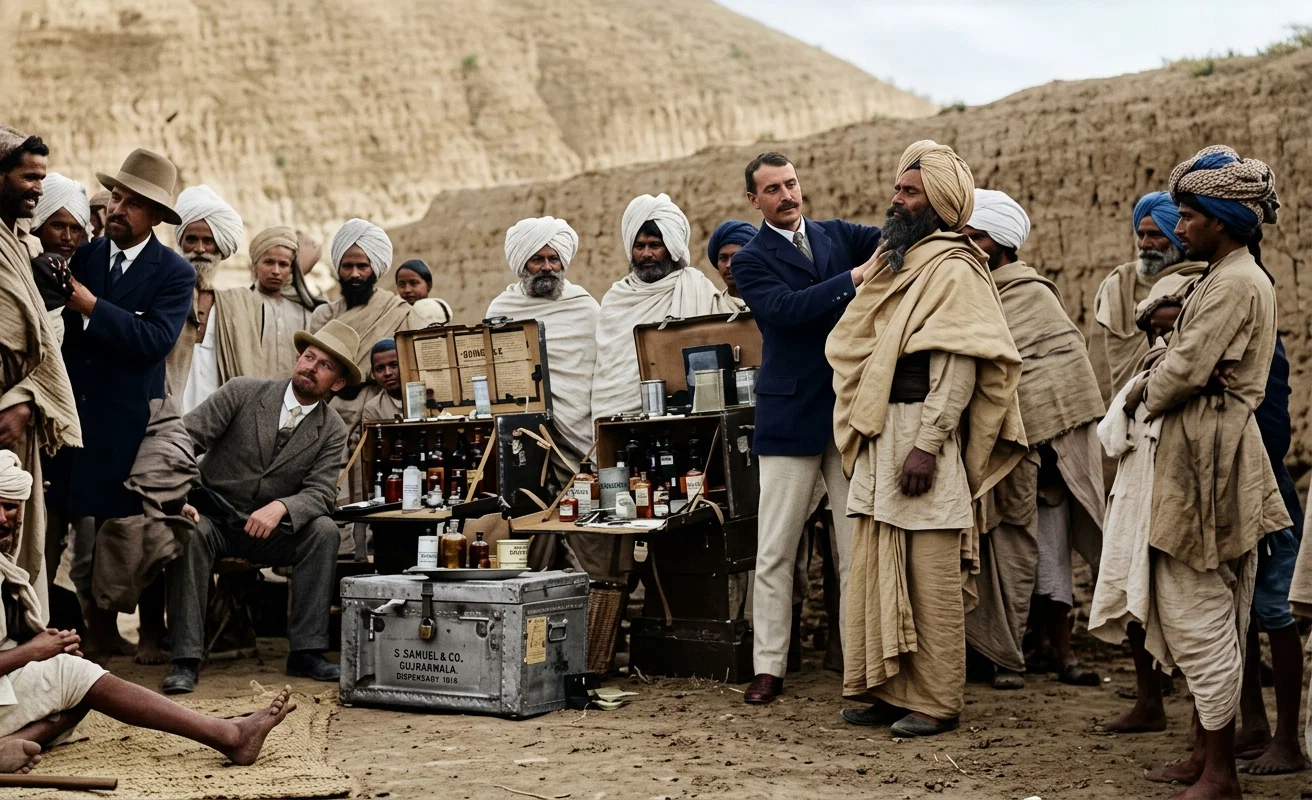
OPEN-AIR DISPENSARY — DR. MANN AT A VILLAGE IN PUNJAB PROVINCE
Then Brother Samuel read an address to us from those present. As I should like to have our brethren in America know the situation we met way up here in the northwest corner of India, under the Himalayas and by the side of Afghanistan, I here give this address as it was read to us in the best English Brother Samuel could command:—
An Address for the Elder Daniells, the President of the Seventh-Day Adventist Mission
DEAR SIR: We are very thankful to the Elder Daniells because he has taken a great trouble in coming to us from a very far country. We realize that he has suffered the inconveniences of the terrible route. We are convinced that he has shown a favorable consideration for the strayed souls of this province, therefore he has made a sincere sympathy in coming to us, for which we are exceedingly obliged and grateful.
Now we supplicate God the Father that he bestow the dew of grace upon him, and moreover, fill him with both the secular and spiritual blessings, and besides this he may confer on his whole . . . the heavenly gifts.
We beseech God the Son that he may reveal on him the needs of more workers for the Punjab Seventh-day Adventist Mission work, because the field is vast, but the workers are very few, consequently we are quite sure that God will send more laborers into his vineyard.
We implore the Holy Spirit that he will draw the attention of the elder toward those oppressed boys and girls who have been expelled from the boarding schools of the other missions because their parents have joined the Seventh-day Adventist mission. So we have a true hope that the Lord will manage the education of these poor people, and the hope maketh not ashamed.
Now the glory of the Father, and of the Son, and of the Holy Ghost be forever and ever, amen.
Your brother in Christ, [Signed] S. SAMUEL, Assistant Missionary (and others). Seventh-day Adventist Mission, Martin Pur, Punjab. Dec. 12, 1914.
It will be noticed that in this address these people take the name of “Seventh-day Adventist Mission,” and that Brother Samuel signs it as “Assistant Missionary.” Several villages are represented, but we do not know how many people are living in them.
Now we are quite aware that these people have nothing approaching a clear conception of our message and work. From their manner of living in the villages we visited, we could scarcely recognize them as Seventh-day Adventists. Quite possibly some of them may have selfish aims back of what we see. All this we have taken into account, and yet after making great allowance we believe with all our hearts that the providence of God has led us into this field among these people.
In responding to their address, Professor Salisbury and I explained to them the best we could the meaning of our message, the object of our missionary enterprises, and our methods of work. We also told them we believed the providence of the Lord had brought us to them in much the way that it took Paul to Macedonia, and that we sincerely hoped that a great blessing would come to all of us by our association together.
AT RIGHT: DR. AND MRS. MANN AND THREE CHILDREN; AT LEFT: MR. AND MRS. LOASBY
The meeting having ended, Professor Salisbury and I started off with Dr. Mann and Brother Loasby to visit some of the near-by villages. In order to transport the dispensary and stereopticon outfits, we were obliged to get some of our new brethren to draw them in the one-horse wagon we found it possible to secure.
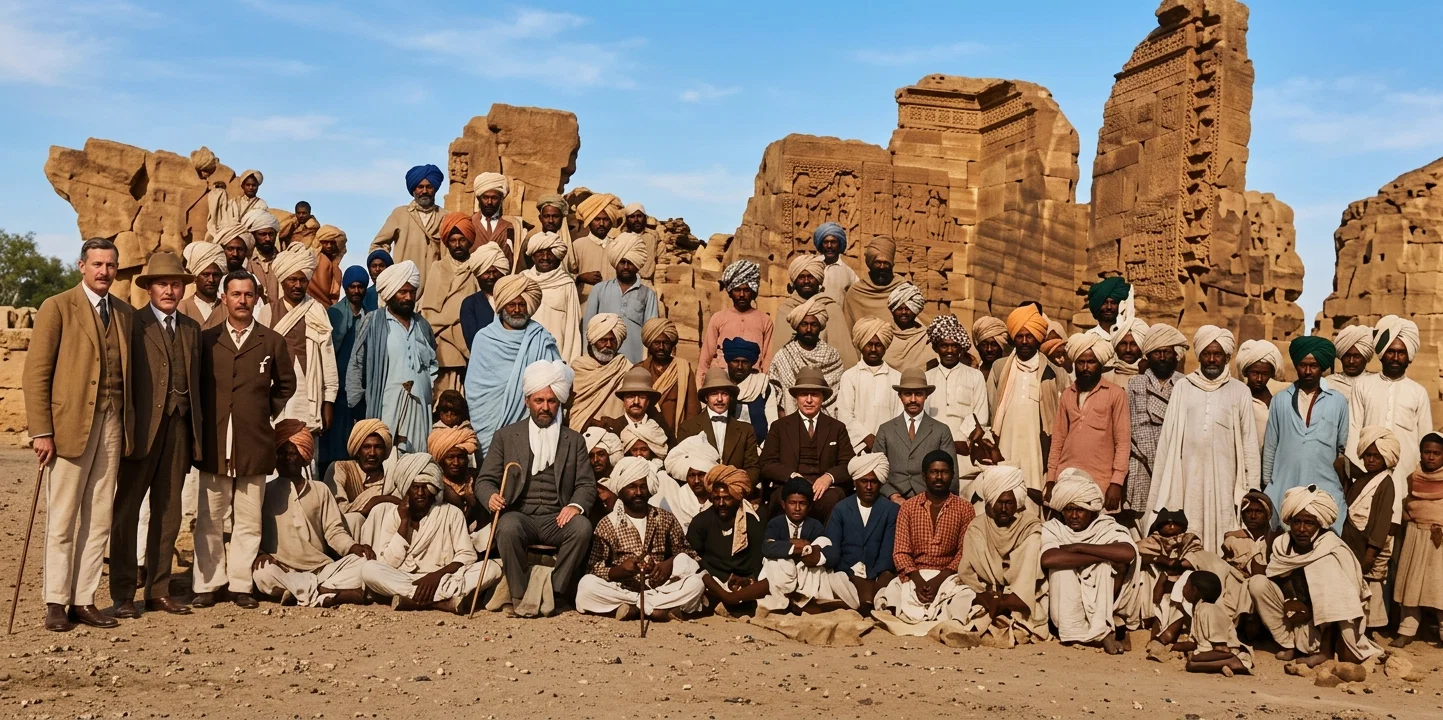
FOLLOWERS WHO HAVE TAKEN THE NAME OF SEVENTH-DAY ADVENTIST
MISSION, PUNJAB PROVINCE
FOLLOWERS WHO HAVE TAKEN THE NAME OF SEVENTH-DAY ADVENTIST MISSION, PUNJAB PROVINCE
After going a mile we came to a place where the vehicle could be taken no farther. Then the men carried the boxes another mile on their heads. The doctor set up his dispensary outfit on an open plot of ground. Quicker than one would think it possible, the whole village seemed to have been notified, and the people with ailments of all sorts began to flock around the dispensary. This was a revelation to me of the terrible condition and needs of these villagers, and the untold amount of good a medical missionary can do for them. The doctor seemed quite at home, and by his every act showed his love and tender sympathy for these unfortunate, suffering people.
Thus we tramped about until it was too dark to do more, and then found our way back to the railway station, where we were to sleep for the night.
Early the next morning we left for another large center thirty or forty miles south. The particular village we wanted to visit was Martin Pur, a Christian village in which there was not living one professed heathen. This is very rare in India. Brother Samuel, with a large circle of relatives, lives in this village. We found Sister Samuel more than an ordinary Indian woman. Her house was clean, and everything impressed us very favorably. We met Brother Samuel's father and mother, an uncle and aunt, and other relatives, all believing that they were members of the “Seventh-day Adventist Mission.” We were especially impressed with the superiority of his uncle and aunt. They had a good house, a nice little farm, and well-kept cattle. They received us with manifestations of Christian love. Tears were in the old man's eyes as we bade them good-by. We believe these people are not far from the kingdom, and that, like the woman at the well of Samaria, they need only to hear the message of life to take their stand for the Saviour.
What may ultimately be found by weeks of visiting among these people no one can tell. But we do feel that “a great door and effectual” has been opened to us in the Punjab, and that no time should be lost in beginning work. Dr. Mann and Brother Loasby are all wrapped up in this field and its work. But they are seriously crippled by the conditions in which they are placed. Their homes are from thirty to fifty miles from these villages. There is not a dwelling nearer in which they can place their families. They had no conveyance for traveling from village to village and transporting their tent, bedding, cooking outfit, and dispensary and stereopticon outfits. They had been trying to itinerate without a conveyance. After doing a little of this itinerating with them, I handed them several hundred rupees that one of our doctors had placed in my hands to use where I thought necessary for medical missionary work, and told them to buy two good bullocks and an itinerating wagon.
But they need more than two bullocks and a covered wagon. They need a bungalow in the center of these villages, so that they can be on the ground to look after the people. Just as soon as they begin active work, they will have to conduct Sabbath services, and, too, the doctor will have hundreds of patients to care for.
The brethren showed me the town on the railway line which they believe will make a good center from which to work. In every direction are to be seen villages in which thousands of people are living. It is proposed to erect a hospital in this center, from which the doctor and nurses can go out to the villages, and to which a certain class of the seriously ill can be brought. There is at present in the treasury at Lucknow the sum of $6,000 which has been appropriated for this hospital; but when the war broke out, the Mission Board requested that all building operations not fully under way be suspended for a time. We have asked the board to grant us permission to proceed with the erection of this hospital at once, and are hoping the request will be granted. There is not a hospital, nor a dispensary, nor a doctor nearer than Lahore, forty miles distant. We shall have a commanding position there. While Dr. Mann carries on the medical work, Brother Loasby will push forward with the evangelistic work. These brethren are united heart and soul in these two lines. They have a clear vision as to what is needed, and how to do the work. It did my heart good to see their faces turned from the city to that forest of villages. And Sister Mann and Sister Loasby are as eager to get into the country as are their husbands.
It would have been a pleasure to tarry longer with these dear fellow workers. We felt the peace and blessing of the Lord in their home, and in all our association with them. We cannot help feeling the keenest interest in their mission.
Now the Northwest India Mission needs a superintendent. As there was no one to take the superintendency at the time of the conference, it was laid on Professor Salisbury's already heavily loaded shoulders. We must have a man of experience and consecration to take this great mission. The Punjab Province is one of the greatest in all India. It is one great alluvial plain; and since the British government has completed a system of irrigation, this plain has been turned into one of the most productive spots on the earth. The Punjabis are a progressive people. A report made public by a large influential committee while I was in that part of the country, takes strong ground for the education of women, the removal of the purdah, the destruction of the caste system, etc. It is in the Punjab that the great mass movements toward Christianity are taking place. Now is the time for our movement to be set on foot in the Punjab. What a work could be done if the Mann-Loasby combination were multiplied a hundredfold! Here indeed is a field for medical missionaries. May the Saviour of men lay the burden of this work on the hearts of those who will count it a joy to go to these suffering, hopeless, groping millions with the light of life.
A. G. DANIELLS.
Continue reading: Note and Comment