Your ShelfYour Projects

Review and Herald, Vol. 92, No. 24.

He Watches Over Israel
Earlier text: Note and Comment

Work for the Colored in Virginia

By invitation of Elder W. C. Moffett, the president of the Virginia Conference, I spent two weeks with him, visiting the colored churches in that State.
The first company we visited was at Wytheville, in the southern part of the State. We spent the Sabbath there, speaking twice to them. There are about twelve believers composing the company. Elder J. B. Mallory had spent two weeks there encouraging the believers and following up an outside interest. It is hoped this company will soon be organized into a church.
We spent Sunday, April 4, in Roanoke and Lynchburg, visiting the members in Roanoke and speaking in Lynchburg at night to a well-filled house. There is only one colored Sabbath keeper in Lynchburg, and none in Roanoke. There is a large colored population in both cities, and we hope something will soon be done to reach them with the message of the soon-coming Saviour.
From Lynchburg we went to Danville, where we have a small church. We were glad to meet Elder W. H. Armstrong and wife at this place, who have done faithful work for both races, bringing several into the truth during their short stay. At one time there was a strong colored church in this place, but by apostasy and removals the membership has been greatly reduced. They have a good church building, which will be repaired and used in an effort to rebuild the membership. There are some faithful souls there, and with the earnest efforts being put forth, I am sure good results will follow. There are about ten thousand colored persons in Danville.
One day was spent with the church at News Ferry, conducting a night meeting and visiting. This church is located in a prosperous farming section. We found the believers of good courage in the message.
After one night in Chase City, where we have one Sabbath-keeping family, and where Elder Moffett spoke in the Baptist church on the Eastern Question to a very attentive congregation, we reached Richmond for Sabbath, April 10. We met with the two churches on the Sabbath, and spent the afternoon visiting the sick ones, reading and praying with and for them. May the grace of the Lord sustain his suffering children. We have the sick with us always. May the day of deliverance from sin, with all its consequences, hasten on.
Sunday we met with the churches in Newport News, Portsmouth, and Norfolk. We have small churches in the three places, but only one church building, which is at Newport News. In Portsmouth a hall is used, and in Norfolk a room in the home of one of the members. The Lord came near in all the services, and gave us a new vision of the greatness of the work committed to our hands, and inspired in us a new determination to be more active in the spread of the present truth. In these cities are many thousands who must have the privilege of hearing the message. Two church schools are being conducted. We visited them, and noted with interest the progress being made by the children in their studies. No doubt some of these children will be used to proclaim the warning in the closing scenes of this world's history. "A little child shall lead them." Elder Moffett informed me that he was planning to invite Elder Mallory to begin a tent effort in Newport News soon, to be followed by the camp meeting.
There are between eight and nine hundred thousand colored persons in Virginia. We have about one hundred and fifty Sabbath keepers, two ordained ministers, one retired minister who does what he can, one Bible worker, and two school-teachers laboring to bring the third angel's message before all these people. While the laborers are few, they are of good courage. The outlook for the work in this conference is encouraging. C. B. STEPHENSON.

Oklahoma

OKLAHOMA CITY.—The work in Oklahoma is steadily progressing, and its advancement brings courage to the hearts of the believers. Many have been the blessings that have strengthened the faith of the workers as they have toiled to bring to the people a saving knowledge of the gospel.
All who study the signs of the times in the light of the prophetic word, must see that we have reached the closing scenes of this world's history. In view of these times, we feel that a great responsibility rests upon us to enlighten all who will listen to the word of truth. If we do this work faithfully, we believe that many will escape “the wrath to come” who might be lost if we neglected to do the work committed to us.
We are glad that we are able to say that the missionary spirit is growing among our people. A number of missionary conventions have been held with encouraging results. The grace of giving is also developing more and more in our people as they learn of the great needs of the mission work.
During the year 1914 the receipts of the conference, in tithe and general mission funds and donations to the conference corporation obligations, were larger than for any previous year. The tithe was $34,700, which is an increase of $10,359 over the previous year. But $2,500 of this came in a little too late to appear in the report of 1914, as the treasurer had just closed his books when this amount was received, so it will go into this year's report. Even then this was the largest yearly tithe in the history of the conference, and $7,859 more than that of the year before.
The Sabbath school offerings show an increase over the previous year of $1,253.50. We are trying to double this increase this year.
The book and periodical sales fell a little short of the year before, there being no sale for the cotton. A large portion of the population depends for a living on cotton raising, and although the cotton crop was the largest in the history of the State, it did not find a market. We also fell short on the Twenty-cent-a-week Fund, reaching only seventeen and three-fourths cents a week per capita; but we are bending every effort to reach our goal in every apportionment this year.
The educational work has steadily grown until this year's work has exceeded that of any previous year. A uniformity of textbooks is adopted in nearly all the schools. The grades are equal to those of the public schools.
Our teachers are doing thorough work, the majority of them having received their education in Keene Academy and Union College. Students finishing the eighth grade are required to take the State examination questions in the common branches. The two intermediate schools are worthy of mention because of the good work they have done. There will be nearly twenty-five students who will finish the eighth, ninth, and tenth grades at the close of the spring term.
Almost every school has taken an interest in the Junior Society work. About twenty schools have been organized into the work of the society or the consecration service. What has been accomplished in this work has been almost entirely the effort of this year.
Our schools number twenty, with twenty-six teachers and some student help and an enrollment of over five hundred. The terms have been lengthened in a number of schools. Conditions were never more promising than at present. A spirit of cooperation has existed among patrons, teachers, and conference workers.
The outlook for the future prosperity of the educational work was never better. It has been “a year of precious blessings” for the educational work. The large army of young people among us gives promise of strength to the work in general. JOHN ISAAC.

Southern New Jersey

The Lord is adding his blessing to the work in the southern part of the State of New Jersey. During an excellent union meeting held in the Bridgeton church in January, six members were added to the church in that place, and others were interested, whom we hope soon to see added to the church.
On February 28 the writer baptized seven persons, all men. These with one sister, were added to the church at Cape May Court House. Of the seven brethren baptized, six were the husbands of sisters in the church, and the heads of families. Four of these have since entered the canvassing work. Three of the seven baptized were brothers. Their mother, who had long prayed and labored for the conversion of her boys, rejoiced to see her three sons buried with their Lord in baptism.
The conference president, Elder A. R. Sandborn, and the writer spent April 9 and 10 with the churches at Pleasantville and Atlantic City. The Lord’s Supper was celebrated with these believers, and all enjoyed the services very much.
Excellent work is being done by the believers in Ramah, Jericho, Shiloh, Fairton, and other parts of this field, where some are being interested in God’s saving message and brought into the truth. In Vineland several have become much interested in the truth, whom we hope soon to see added to the church there.
In other parts of southern New Jersey a number of persons are awaiting baptism and acceptance into the church. The Lord is working upon the hearts of sincere seekers everywhere, and soon these dear ones will be gathered into the garner of God.
In Cape May Court House the church building has been painted and repaired. In Bridgeton the church building has been painted, wired for electric lights, and otherwise repaired. We hope to occupy until He comes, and to be prepared for an abundant entrance into God’s everlasting kingdom.
GEORGE W. SPIES.

The Work Among the Foreigners in the United States
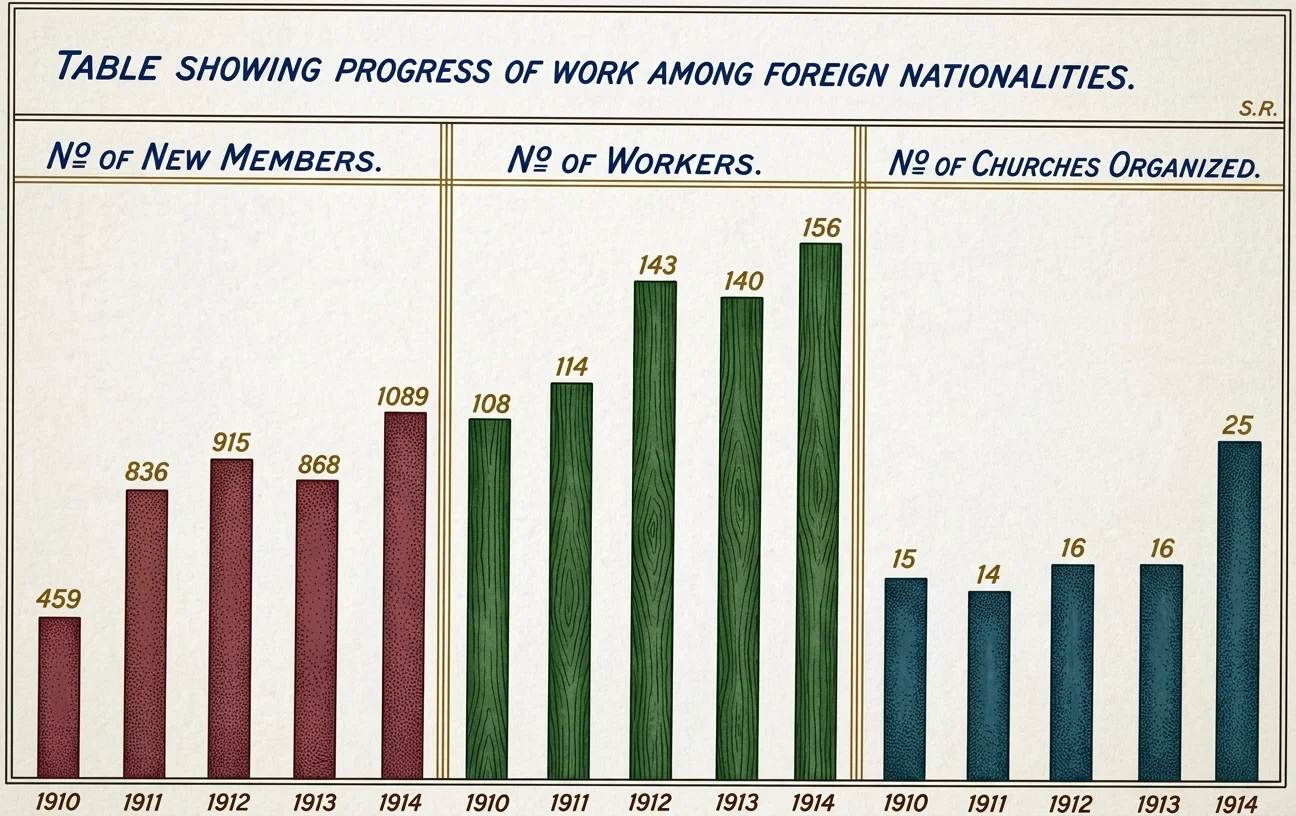
MANY of the faithful readers of the REVIEW watch with great interest the progress of the work in the homeland and abroad. Many have no doubt been following the progress of the work among the many different nationalities here in this country with marked interest. Reports, however, have not been many and long, and probably some of our brethren have been tempted to conclude that this foreign work in the home field is having but very little success and making but slow advancement.
It was a source of great encouragement to our deceased and beloved Brother O. A. Olsen to see the advancement the work made during 1914. His burden for the foreign work was a great one, and his thoughts were constantly occupied with plans and methods by which the most could be accomplished to win precious souls. Brother Olsen wished that much more could have been done; but on account of the lack of so many things, among which men and means are the more prominent, the work could not move so rapidly as we all desired. Nevertheless we are very thankful to God for the results attained.
During 1914 we carried on work in this country among eighteen different nationalities: Germans, Swedes, Danes, Norwegians, Italians, Frenchmen, Hungarians, Roumanians, Bohemians, Finns, Lithuanians, Servians, Jews, Russians, Hollanders, Japanese, Slavonians, and Spaniards.
NORTH AMERICAN FOREIGN DEPARTMENT 1910 - 1914.
Four years ago, during 1911, we labored among ten different nationalities. Thus eight nationalities were added during the four years. This we feel we can call an advancement. By looking over the accompanying table, which has been specially prepared for this article, it will readily be seen whether progress has been made or not. On the table we have listed only three items: number of new members, that is, Sabbath keepers won during each year; number of workers; and number of churches organized. It will be seen that while 459 new members were gained in 1910, returns for 1914, which have just been compiled, show that 1,089 accepted the message. During 1910 and 1911 respectively we carried on the work with 108 and 114 workers, while in 1914 the force of laborers had increased to 156, another substantial gain.
When we look upon the number of churches organized during the last four or five years, it will be seen that practically the same number were organized during the quadrennial period 1910-13; but when we reach 1914, a marked rise sets in, and twenty-five new churches were added in one single year.
While, of course, much the greater part of this foreign work is being done among the Germans and the Scandinavians, among whom the work has been in operation for several decades, yet we have been very interested in taking note of the marked progress that has been made among all these other nationalities enumerated above. Take, for instance, the Russians. During 1914, ninety-two Russians accepted the message under the faithful and earnest labor of four or five workers. At one place alone—Yale, Va.—more than fifty accepted the truth at one time. Altogether we now have a Russian constituency of more than 250.
Then we have the Servians, with only one ordained minister and one licentiate. Twenty-three new members were baptized among that nationality during 1914, and we now have three good Servian churches, two in Canada and one in St. Louis, Mo. Among the Roumanians eleven were added to the Roumanian companies in Ohio, all through the faithful and self-sacrificing labor of one licensed minister. Among the Italians seven new members were gained and added to the Italian church in Chicago. The Slavonians report eight new members. And so we could go on and mention some here and some there gathered out from among all these many different peoples.
During the beginning of this present year, work has been started among another foreign nation, the Icelanders. Brother David Guldbrandsen, after completing his course at the University of Christiania, Norway, spent some time in Iceland, perfecting himself in the Icelandic tongue, and also doing colporteur and other missionary work. He has now been called to North America, and has taken up work in Winnipeg, Manitoba, Canada, where there is a large settlement of Icelanders.
Thus, little by little, we reach one after another of these many foreign peoples, who are waiting to receive the third angel's message; but an immense task is still before us in giving the truth to the scores of nationalities who are yet unreached. Great privileges and opportunities present themselves in the coming to our very doors of these many foreigners, and we have certainly reached a time in the history of this denomination when every wide-awake member should not only do something to bring the message of salvation to this great host of our fellow men, but put both heart and soul into a gigantic effort for the saving of benighted souls in this country.
STEEN RASMUSSEN, North American Foreign Department.

Bermuda

Since my last report three adults have accepted present truth, and six have been baptized. Two of these were new converts, and the other four were children of believers. The condition of the finances is good, and the work is considerably more than self-sustaining, though the expenses have been quite heavy for the past two years. The tithe for 1914 was £219 2s. 10d.; Sabbath school offerings were £46 13s. 3d.; the Harvest Ingathering Offering was £5 8s. 10d.; and the Annual Offering was £1 9s. 9d., the total tithes and offerings for the year being £272 14s. 8d.
The church has recently organized a missionary society, which, with the young people's society, has ordered a sufficient quantity of literature to supply every family on the island, and we expect to see much good accomplished as the result. The brethren and sisters are all of good courage, and are determined to do their part in the closing work of the third angel's message.
EUGENE LELAND.

News and Miscellany

Notes and clippings from the daily and weekly press
— A nine-foot tunnel is about to be constructed in London for the conveyance of mail. It will contain two tracks with island platforms at the eight stations from Paddington to Whitechapel, inclusive. The trains will be run without operators from distant control stations at an average speed of twenty-five miles an hour. At the island platforms there will be electric elevators to transfer the mails to the sorting offices.
— A vapor-bath train has been constructed by the Russian government for its soldiers at the front. By this device 2,000 men can bathe in twenty-four hours. While they are engaged in this healthful exercise, their clothes are taken from them and disinfected in drying vats. When the czar inspected this bath train, he was interested to learn that 250 pounds of soap would be consumed whenever it was used for twenty-four hours continuously.
— What is said to have been the largest single real estate transaction in the history of Chicago was made known the other day. This was the purchase of the Fine Arts Building by the trustees of the estate of Charles A. Chapin for $3,000,000. There have been other real estate transactions in which more money was involved, but where more than one piece of property changed ownership. This is said to be the largest price for a single piece of property.
— Russia has given an earnest of its pledge of the promised freedom of Poland at the close of the war. A law has just been promulgated granting local municipal self-government to all towns in Poland. This gives Polish committees a measure of self-government equal to that enjoyed by any Russian incorporated town and district. Another feature of the law is the great care with which provision has been made to give a fair measure of representation to the Jewish population.
— The legislature of Texas is considering a plan to divide the State. If a majority of the people of the whole State so vote, the western half may be set off as the “State of Jefferson.” People generally may not know that Texas has peculiar privileges in the matter of subdivision. The act of Congress that admitted it to the Union gave it the right to divide itself into as many as five States, without any action on the part of Congress. It would make five States, each larger than New York.
— The great $6,000,000 corporation of the Dennison Manufacturing Company, with offices on Franklin Street, Boston, and factories at South Framingham, has been turned over to its 2,400 employees, who will have full control of the concern. Only the eight-per-cent preferred stock, with a more or less fixed income, is retained by the original owners, who will have no voice in the affairs of the company. Every employee of the company is to share in the profits. Each employee receiving more than $1,200 a year will be given common stock, with voting privileges.
— More than 60,000 cases of cold-storage eggs recently reached Europe from China, by way of the Panama Canal and New York City. Printing is not the only “art preservative” that the Chinese have mastered.

The Last Crisis

THE Scriptures bring to view the last crisis between commandment keepers and the beast and his image, in the twelfth, thirteenth, and fourteenth chapters of the book of Revelation. The last issue which will be raised in the final conflict is the enforcement of the mark of the beast by the image of the beast. The image of the beast in the United States must constitute an organization or federation of organizations which is a facsimile, or likeness, of what the beast was in the Roman Empire.
The Roman church united with the Roman state constitutes the beast of the book of Revelation. Analogy would force us to conclude that an image to the beast in the United States would have to constitute a legally established religion in this nation. The prevailing religion in the United States is Protestantism. If any religion is ever established in the United States, it will be apostate Protestantism or a union of Protestantism and Romanism.
The mark of the beast must be a religious institution which demands worship. It must be a religious institution originating with the beast, or it could not be denominated “the mark of the beast.” The image of the beast has accepted a papal institution as a part of its own worship. The mark of the beast is religiously held by both Protestants and Catholics. It is upon this issue, namely, the enforcement of the mark of the beast, that both Protestants and Catholics unite.
The image of the beast is to compel all people to worship the image of the beast and to receive the mark of the beast. In order to accomplish this it will be necessary for the state to do the compelling. The state will have to enforce the mark of the beast by law, otherwise people could not be compelled to accept it.
What religious institution has Protestantism accepted from Catholicism which it is asking the state to enforce by law? Of all the dogmas which Protestantism has accepted from Romanism there is only one religious tenet which is strictly papal that Protestants are requesting the state to enforce by law and thus compel all the people to observe it, and that is Sunday as a day of rest and worship. No other religious institution held in common by Protestants and Catholics is being enforced by law.
Thus compulsory Sunday observance must of necessity be “the mark of the beast” which the image of the beast will seek to enforce, first by means of the boycott in the commercial world, and lastly, after the boycott has failed to bring the desired results, by the death penalty.
This was the exact mode of procedure which the Papacy pursued in compelling people to observe Sunday at the time the Catholic Church was in supreme command. The image of the beast, or apostate Protestantism, the prophecy asserts, is to pursue a similar course in the United States.
In Volume V of the “Testimonies for the Church,” pages 449-451, we read:—
“The same spirit which actuated papists in ages past, will lead Protestants to pursue a similar course toward those who will maintain their loyalty to God. . . . To secure popularity and patronage, legislators will yield to the demand for a Sunday law. Those who fear God cannot accept an institution that violates a precept of the decalogue. On this battle field comes the last great conflict of the controversy between truth and error.”
In Volume VII, page 141, occurs this significant statement:—
“The substitution of the laws of men for the law of God, the exaltation, by mere human authority, of Sunday in the place of the Bible Sabbath, is the last act of the drama.”
This shows conclusively that the last great issue which will bring on the final crisis is the compulsory Sunday law controversy between God’s loyal followers and those who have forsaken his law.
In our last article, we furnished facts showing the National Reform Association to be the leading aggressive factor in this great Protestant movement in the United States to secure a union of church and state. This association has many allied organizations aiding in this backward and revolutionary movement in America.
The first organized ally of the National Reform Association was the W. C. T. U., which was induced by the National Reform Association to second its efforts to secure Sunday legislation, the recognition of Jesus Christ as the governor of the nation, and the establishment of all the laws and usages of the Christian religion as a part of the fundamental law of the land. The W. C. T. U., at the request of the National Reform Association in 1887, added the department of Sabbath observance to its organization, and Mrs. J. C. Bateham, of Ohio, was put in charge of this new religio-political department.
That the W. C. T. U. had fully accepted the platform principles of the National Reform Association is quite evident from the following W. C. T. U. authoritative utterances:—
“A true theocracy is yet to come, and the enthronement of Christ in law and lawmakers; hence I pray devoutly, as a Christian patriot, for the ballots in the hands of women, and rejoice that the National Woman’s Christian Temperance Union has so long championed this cause.”—W. C. T. U. Monthly Reading for September, 1886. “The Woman’s Christian Temperance Union, local, State, national, and world-wide, has one vital, organic thought, one all-absorbing purpose, one undying enthusiasm, and that is that Christ shall be this world’s king, yea, verily, this world’s king in its realm of cause and effect,—the king of its courts, its camps, its commerce; king of its colleges and cloisters; king of its customs and constitutions. . . . The kingdom of Christ must enter the realm of law through the gateway of politics.”—W. C. T. U. National Convention. 1887. See “Religious Liberty in America,” by C. M. Snow, pages 281, 282.
In 1887 the American Sabbath Union was organized, and at once allied itself with the political schemes of the National Reform Association by adopting the platform principles of that union in its own constitution, and working hand in hand with the National Reformers to secure compulsory Sunday observance in Congress and the State legislatures.
The following year the Third Party Prohibition party, at the instigation of the National Reform Association, adopted its platform principles in its own constitution by favoring a union of religion with the state, the Lord as supreme ruler of the nation, “to whose laws all human laws should conform.”
The secretary of the National Prohibition Convention held in 1888, made the following significant statement:—
“I want to see the day come when the church shall be the arbiter of all legislation, State, national, and municipal; when the great churches of the country can come together harmoniously, and issue their edict, and the legislative powers will respect it, and enact it into laws.”
There are more than a score of Protestant organizations which have been won over to the platform principles of the National Reform Association. We are told that “the National Reform Movement, exercising the power of religious legislation, will, when fully developed, manifest the same intolerance and oppression that have prevailed in past ages.”
C. S. LONGACRE.

Religious Liberty Department

C. S. LONGACRE     N. Am. Div. Secretary

The Medical Convention at Boulder, Colo.

THE BOULDER-COLORADO SANITARIUM, CONSISTING OF A LARGE MAIN BUILDING AND TWENTY-TWO SMALLER BUILDINGS
The last of a series of three medical conventions was held at Boulder, Colo., April 4-6. The sanitarium work of the Central and Northern Union Conferences was well represented, the superintendent and manager of each of the sanitariums being present, with the exception of Dr. H. W. Barbour of the Iowa Sanitarium, who was unable to attend on account of emergency work.
The following were listed among the delegates and visitors: Drs. H. W. Miller, H. A. Green, J. D. Shively, E. D. Haysmer, L. A. Sutter, Kate Lindsay, F. H. Weber, Anna B. Durrie, N. C. Nelson, C. H. Morian; Brethren I. H. Evans, W. T. Knox, N. Z. Town, R. A. Underwood, A. T. Robinson, E. G. Fulton, R. R. Cook, E. J. Baker, A. F. Kirk, Burton Castle, R. L. Carson, T. S. Dock, E. L. Austin, Chas. Beeby, H. L. Holmden, A. W. Lane, W. W. Ruble, C. L. Taylor, M. B. Smith, Ralph Emery, J. P. Hansen, E. M. Frost, and L. A. Hansen; Sisters Rosella Collie, Flora Huenergardt, Ada J. Madison. There were also a number of nurses and other workers from the Boulder Sanitarium in attendance at some of the meetings.
A committee on plans consisted of W. T. Knox, Dr. H. A. Green, Dr. J. D. Shively, A. T. Robinson, and L. A. Hansen. The members of the committee on training schools were Dr. H. W. Miller, Dr. L. A. Sutter, Dr. Kate Lindsay, Dr. E. D. Haysmer, and R. A. Underwood.
The program of the convention was much the same as of the previous two conventions, the same general agenda paper being followed in all. The discussions took the same general course as that followed in the other conventions, and the same excellent spirit prevailed throughout. Nothing occurred to mar the unity of the meeting or to detract from the object of the convention. The unanimous sentiment was that the occasion was one of entire blessing.
While it was recognized that some expense is involved in thus bringing these workers together in these conventions, it was also recognized that it has cost much more not to hold more frequent medical conventions. All felt assured that our medical missionary work will greatly profit by these three conventions, and that the future bids fair for the carrying out of the principles for which our health work stands.
Some additional recommendations were adopted at the Boulder convention, all of which will appear in due time, with a summary of the discussions.

The Boulder-Colorado Sanitarium

This is perhaps the most proper time and place to make special mention of the Boulder-Colorado Sanitarium and its work. The medical convention gave the visitors a good opportunity of becoming better acquainted with this splendid institution and its fine family of workers. We feel no hesitancy in speaking of this sanitarium and its progress in most favorable terms.
Those acquainted with the adverse conditions under which this sanitarium has operated for a long time will the better appreciate learning that last year's business showed an operating gain of over $5,500, after generous allowance for depreciations, and that, even after the large interest account had been paid, a net gain of over $2,000 was shown. The financial statement of the treasurer shows great care and detail in the accounting department, covering a comprehensive departmental cost system.
A feature especially noticeable is that while there is felt an urgent need for certain improvements and additional equipment, much care and economy is shown in expenditures in this direction, the workers being willing to get along as economically as possible until conditions will permit securing added facilities. At the same time, the appearance of the institution does not betray any lack of means nor does the grade of work done indicate anything wanting. Things look good, work is up to the standard, and results are excellent. A saving could probably be effected and the earnings increased with a little more equipment.
The last three years have seen a constant growth in patronage, the winter's business showing its part in the increase, which is especially desirable, this having been the dull season, and presenting the biggest problem of finance to the management. The summer's patronage will run to about 130 patients, while the winter's work falls below what is necessary to meet operating expenses.
It looks as if considerable increase in the winter's patronage might be secured if there were general cooperation on the part of all our people who could help to send patients to Boulder. The institution is well prepared to care for them, and any one can feel free to recommend people to the institution. There is considerable territory that could contribute patronage. With some public city work that may be entered into by the institution, and with field work by its constituency, the winter patronage should soon be almost equal to that of the summer season. This would mean a great deal to the sanitarium in its financial outlook and its work in general.
Another medical institution near by offers strong competition in some lines. Some physicians who while friendly to our institution are more closely affiliated with the other, are giving it support that might otherwise come to us. A more up-to-date equipment in some lines, new buildings, and some other advantages help to draw business to the other institution. Nevertheless, our own is enjoying a growing local patronage.
Four doctors are associated with the Boulder-Colorado Sanitarium. Through medical society meetings and by other means, they have pleasant relations with the medical fraternity and other people of Boulder. They are offered opportunities of doing public work of an educational nature. Likewise does the business management sustain relations with the commercial bodies and business men of the city that help in keeping this sanitarium favorably before the public.
Considerable is being done in caring for those unable to pay regular rates—possibly more than the institution can afford in its own present needy condition. A liberal spirit in this direction is shown, and this should be appreciated by our people; it offers another good reason why they should help in securing a paying patronage.
While there has been irregularity in the definite oversight of the spiritual work of the sanitarium, there prevails a reasonably good spirit in this matter. A large share of the burden of this part of the work now falls on Sister Ada J. Madison, who acts as Bible teacher for the students, gives readings to patients, looks after making provision for patients' public worship, and sees to providing suitable entertainment for patients. She is busy, and profitably so.
Health educational work is being carried forward by the medical staff. Dr. H. A. Green (superintendent), Dr. Kate Lindsay, Dr. Anna B. Durrie, and Dr. F. H. Weber all do their share, inside and out, in carrying forward this part of the work. The tourist class is now in less evidence. Persons are not encouraged to stay simply as boarders. This is beneficial in various ways.
The cooperation and lack of friction seen among those in responsibility is gratifying. The business interests are carried by a financial committee. R. R. Cook looks after certain house management. E. J. Baker is treasurer and head office man. The managing board and the faculty, together with all the workers, make up a good, strong working force. May the Lord continue to bless them all abundantly and give success to their labors.
L. A. HANSEN.

Medical Missionary Department

W. A. RUBLE, M. D. . . General Secretary
L. A. HANSEN . . Assistant Secretary
H. W. MILLER, M. D. . N. Am. Div. Secretary

Help for Our Dining Room Service

Our medical convention passed a recommendation requesting that the North American Division Conference secure Brother E. G. Fulton to visit our sanitariums and give instruction for the improvement of the service in the kitchen, dining room, and other departments. The request was favorably acted on, and Brother Fulton made arrangements to enter upon this work at once. His long experience in culinary lines gives him special fitness to help in this way, and his services are appreciated in the places where he has already been.
At this writing Brother Fulton had visited the sanitariums at Boulder, Hastings, and College View. At each place classes were held for as many workers as could possibly come together. Instructions, demonstrations, and drills were given. Great interest was shown by all, and a hearty reception was given Brother Fulton. The lessons were presented in a way to make them entertaining, pleasing, and profitable.
As this work is done in all our sanitariums, it will aid in bringing about a much desired uniformity of service, and place this part of the work upon a basis that will commend itself to our patrons. We bespeak for Brother Fulton a continued welcome, and feel assured that each institution and the sanitarium work as a whole will greatly benefit by this timely and needed instruction. L. A. HANSEN.

Western Washington Conference

THE fourteenth annual session of the Western Washington Conference of Seventh-day Adventists will be held in connection with the camp meeting, at Manitou Park, Tacoma, Wash., June 17-27, 1915, for the election of officers for the ensuing year, and the transaction of such other business as may come before the conference at that time. The first business meeting of the session will be held at 9:30 A. M., Friday, June 18. Each church is entitled to one delegate for the church without regard to membership, and one additional delegate for every fifteen members.
LEWIS JOHNSON, President; H. A. GREEN, Secretary.
Continue reading: Camp Meetings