"WE are made a spectacle unto the world [Greek, the cosmos, or universe], and to angels, and to men." Certainly here is a wide enough sphere of influence for anybody. This is not the word of any mere man, either. The pen of inspiration has written it, and declares to us that our influence moves out in lines that extend beyond the stars.
And this influence is not a stray word that goes out here and there, and now and then, for the word "spectacle" comes from the Greek term which means circus, or amphitheater. At Corinth, and other Greek cities, there was the great outdoor theater,—an amphitheater, or a theater in which the seats were built up one above another in centrical lines around the stage. Thousands of people could assemble in the seats, and look down upon the stage, where some play or show of interest was enacted.
So, then, if we are made an amphitheater to the world, to angels, and to men, it means that something of more than usual interest is going on. They peer down upon us from the seats of the mighty. They "desire to look into these things." They long to know the meaning of human life and human history, and the course and outcome of the great controversy between good and evil.
"We are made a spectacle to the universe, to angels, and to men." Who will remember it to-day, and walk in the realization of it, knowing that his words, his acts, yea, even his thoughts, shall be scrutinized in the great controversy? What we do shall throw light or cast a shadow, illuminating the problem or darkening counsel in the conflict.
Here is the influence of human life as recorded in the Book. These are the dimensions of its sphere. Who, then, can say that the days are insignificant, and that life is not worth while?
L. A. R.
CHRIST'S ACTORS
By J. O. C.
THE Lord of glory was an actor in the world's theater. Coming to earth in human form, He in the flesh revealed the Ruler of the universe. The world beheld the marvelous drama of God-life among them and were bewildered. Some said, "We never saw it on this wise before"; and others, "What manner of man is this?" But with all His demonstration of God-power, even the beloved Philip could not be satisfied without demanding an actual view of the One personated. John 14:8. The Jews were ready to stone the royal Actor, even though they had seen in His life what in reason they knew to be the works of their avowed Father. John 10:32. But so little was then actually known of God's attributes, only a few were able to recognize the perfection of that divine stage setting.
Only through the death of Christ was the onlooking world to comprehend how accurately God had been personated in the wonderful drama of Christ's earth career. Though He did nothing in secret throughout His ministry, His most open act was the triumph of His resurrection, when many graves released their captives, who were led by their Emancipator to mansions in the heavens. Matt. 27:52, 53; Eph. 4:8.
But though the Saviour removed from earth to heaven, it is certain that He did not design to have the stage curtain drop, and thus hide His life-work from the view of humanity. Among His91later earth words were these: "I, if I be lifted up from the earth, will draw all men unto Me." John 12:32. As He came in the flesh to be the world's light, so through the flesh that light must continue to shine, and draw men to Him. But this can be done only by human beings becoming actors for Him and in His stead before human audiences. The great apostle, when writing of himself, said that though he was chief of sinners, yet he had obtained mercy, that in him first Christ might show forth all long-suffering, for a pattern to those who might afterward believe. 1 Tim. 1:16.
Men were then, and are now, called to the same end — openly to show forth the virtues of Him who has lived the God-life for them in the flesh. 1 Peter 2:9. To do this successfully is to personate Christ in the presence of surrounding humanity. Such exhibition, however, will not be alone before men, but also in the sight of a heavenly host. For as the angelic legions viewed with evident anxiety the pageant act of Christ's earthly sojourn, so before these all, humanity is called to act the part over again of that princely life in its holy setting.
Whether one wills or not to have this so, we are assured that it is so at all events. Thus the apostle says, "We are made a spectacle unto the world, and to angels, and to men." 1 Cor. 4:9. For the word "spectacle" in this text, the marginal rendering gives "theater"; that is, a stage where the habits, customs, and characters of noted persons are reproduced in pantomime or dialogue. Spectators attend such exhibitions to view the story of human life in active deeds, anticipating a treat in the language and dress of the original characters presented. If the rendering is true to historical setting, it is well spoken of; if not well performed, the actor becomes an object of contempt.
With Christ's actors it is practically the same. If before the great world audience they personate Him to a fair degree, a drawing influence results; but if the acting is indifferent, and the dress and the pose are carelessly assumed, or adjusted to the world's standard, not only are the actors ridiculed, but the cause of Christ which they profess to represent is sadly jeopardized. To be an actor for Christ is a high and noble calling, and one deserving careful study of the character to be personated. J. O. C.
HUMAN CHRIST-EPISTLES
By John Owen Corliss
It is not known that Christ ever penned an ink epistle to any one. He did at one time write a message in the sand to a company of pharisaic hypocrites, so condemnatory of their lives that, one by one, they slunk in shame from His presence. John 8:11. The text of that writing, however, has never been divulged, and probably never will be this side of the great Judgment. That was sand-engraved composition, perishable in nature, and quickly obliterated. But the Saviour has chosen to leave behind Him living epistles, to be read and understood by all who care to investigate their contents.
An epistle, or letter, is the expression, through written words or by symbolical figures, of thought power. Human action was chosen by Christ to be the indicator of His mind while personally removed from earth, because that is an intervening substance entirely open to all observers. But as out of the abundance of the heart, or mind, of the human instrument issue its words and deeds of life power (Matt. 12:35), so the very seat of life must have become the tablet of Christ's mind strokes, before its pulsations can express the divine mind through outward action.
It was this daily experience, this mind writing of Christ, which gave the apostle Paul his Christian life walk. Gal. 2:20. Through this alone he was able to bear in his flesh the afflictions of Christ, which pressed him from every side so that he always carried about in his body the dying of the Lord Jesus, and so to manifest the life of Christ in mortal flesh. 2 Cor. 4:8-11. His life was therefore the open expression — the epistle — of Christ to all the world.
Bearing thus distinctly in himself the mind of Christ, the apostle could well afford to ask the church at Corinth if he needed letters of commendation to make his anticipated visit acceptable to them. He knew surely that they already recognized his oneness of mind with the Master, and he therefore declared that they themselves were his epistles, known to every one, since they were also declared to be the epistles of Christ, ministered by him to them. 2 Cor. 3:2, 3.
The apostle having brought to them the grace of God's peace — the gift of Christ — and they having followed him as he followed Christ, the hearts of teacher and learners were united in the great problem of letting their life actions express the mind of Christ to the world, not by letters of ink written on parchment, but by that which Divinity had written on the fleshly tables of their hearts. Such are truly living epistles of heavenly impulse, appealing to the inner selves of the world's toilers to yield their hearts and souls to Him who died for them.
J. O. C.
4260 — GENTILES KEEPING THE SABBATH
By James White
Where in the Bible does the Lord command a Gentile to keep the Sabbath? Where in the Bible does the Lord command a Gentile to keep the law of Moses?
J. W.
And, let it be asked further, where in the Bible does the Lord address any command or any promise to the Gentiles, as such? Where in the Bible have the Gentiles, as Gentiles, any promise of salvation? Where have they, as Gentiles, promise of anything? Christ Himself said that “salvation is of the Jews.” John 4:22. Christ Himself, according to the flesh, was a Jew; and the promise is, “If ye be Christ’s, then are ye Abraham’s seed, and heirs according to the promise.” There is no qualification of this statement. If you are Christ’s, you are Abraham’s seed; and Abraham was the father of the Jewish nation. Therefore when we accept Christ we become Israelites. The Jews, when they rejected Christ, became Gentiles; for “He is not a Jew, which is one outwardly; . . . but he is a Jew, which is one inwardly.” Rom. 2:28, 29. Paul affirms himself an apostle to the Gentiles, in these words: “I speak to you Gentiles, inasmuch as I am the apostle of the Gentiles.” Rom. 11:13. And on the question of the law, the covenants, and the promises, he says: “I say the truth in Christ, I lie not, my conscience also bearing me witness in the Holy Ghost, that I have great heaviness and continual sorrow in my heart. For I could wish that myself were accursed from Christ for my brethren, my kinsmen according to the flesh: who are Israelites; to whom pertaineth the adoption, and the glory, and the covenants, and the giving of the law, and the service of God, and the promises; whose are the fathers, and of whom as concerning the flesh Christ came, who is over all, God blessed forever.” Rom. 9:1-5.
A person is seeking to escape by a very slim excuse when he tries, by affirming that he is a Gentile, to evade plain moral duty clearly taught in the word of God.
The word “Gentile,” in both the Old Testament and the New, is translated from words that refer to the nations of earth. These words are not only translated “Gentile,” but they are also translated by the terms “nation” and “heathen,” showing that the Scriptures, in the use of these words, are referring to the heathen nations of the world; and God’s promises are not for the purpose of saving heathen nations in their heathenism, but they are for the purpose of saving them from their heathenism. Hence the hope of the Gentiles is in turning to the light of the Scriptures of truth.
The Bible does not need to say that the law of Moses is to be kept by the Gentiles, for the reason that the whole tenor of the Scripture is to show that the Gentiles, or the heathen—terms that were synonymous—were to be sought for and brought into the fold of salvation; but it nowhere says that the law was exclusively for the Jews.
Who will deny that all except the fourth precept of the Decalogue are binding on all the human race? It is because of their unwillingness to obey the fourth commandment that men attempt to prove that the law of God is not binding on Christians. But of this very precept, as if to guard it from such misapplication, Christ says, “The Sabbath was made for man” (Mark 2:27)—not for the Jews only, but for man as a race.
To the Jews was given light which was given to no other nation, simply because they were in a condition to receive it, while the other nations were not. But the truth was not given them to keep to themselves. They were to be priests to the nations around them, “a kingdom of priests.” Ex. 19:6. They were set among the nations to be “a light to the Gentiles; to open the blind eyes” (Isa. 42:6, 7); to declare the glory of the Lord among the Gentiles (Isa. 66:19).
Those who try to elude the obligations placed upon them in the Bible, under the claim that these are binding on the Jews only, will find, in the Judgment, that they have rejected the salvation which also is promised to the Jews only. They are like the “unlearned and unstable” spoken of in 2 Peter 3:16, who “wrest . . . the Scriptures, unto their own destruction.” “Take heed, brethren, lest there be in any of you an evil heart of unbelief, in departing from the living God.”
In Mark 9:43-48 the Master refers to this illustration found in Isa. 66:24. He speaks of people being cast “into hell, into the fire that never shall be quenched: where their worm dieth not, and the fire is not quenched.” “Hell” in this passage in Mark is translated from the Greek word Gehenna, and literally means the Valley of Hinnom, which was situated to the southwest of Jerusalem. During some of the idolatrous backslidings of Israel, the horrible worship of Moloch was conducted in this valley. Josiah overthrew these altars of worship on which human beings were sacrificed; and for the purpose of preventing the recurrence of the heathen rites, the valley was defiled by being reserved thereafter as a “place for the burning of the refuse of the city, along with dead animals and the bodies of criminals.”
It was perfectly natural, therefore, that this burning should become the symbol for the destruction of the wicked. The dead bodies that were cast into this valley were burned up; and if perchance any portions escaped the fire, the worms preyed upon them until they were completely destroyed. The fires were not quenched, or put out, but were permitted to burn as long as there was anything for the flames to feed upon. Also the worms remained as agents of destruction while there was anything for them to devour.
An unquenchable fire does not necessarily signify an everlasting fire. Passages like Jer. 7:17-20 tell of the warnings of unquenchable fire that God pronounced upon Jerusalem and the cities of Judah, because of their idolatries. These fires were to be sent as judgments from God, and therefore no man would be able to quench them; but when the material upon which the flames fed should be devoured, the fires would go out of themselves—they would not be quenched. And thus this passage in Isaiah is shown to harmonize with the other scriptures which so plainly teach the complete destruction of the wicked in the second death, which is the wages of sin.
SYSTEMATIC BIBLE STUDY
By Editor
“ACCORDING as His divine power hath given unto us all things that pertain unto life and godliness, through the knowledge of Him that hath called us to glory and virtue: whereby are given unto us exceeding great and precious promises: that by these ye might be partakers of the divine nature, having escaped the corruption that is in the world through lust.” 2 Peter 1:3, 4.
The “exceeding great and precious promises” of God are the means that He uses in causing us to partake of the divine nature, and by which we escape “the corruption that is in the world through lust.” Our partaking of the divine nature, then, and our escaping from the lusts of the flesh, depends upon our knowing and appropriating the great promises of the divine Book. It is therefore necessary that we be constant readers of the Bible, in order to find these great promises that are scattered all through its sacred pages.
Read a chapter in each of these books on each week-day, and on the Sabbath read two chapters in Exodus and two in Luke.
We trust that those who are following this schedule of Bible reading are also finding time to read those two excellent books “Patriarchs and Prophets” and “Desire of Ages,” the one of which is so helpful in the study of the first part of the Old Testament, and the other throwing so much light upon the New.
Remarkable Work in the Ancient City of Calvin
By Jean Vuilleumier
Theological Battles in Reformation Times—Geneva Becomes a Mighty Stronghold of Protestantism— The Message of Christ and His Coming Given There with Power—An Appeal That Should Touch Our Hearts
By JEAN VUILLEUMIER
At the request of the local church officers of the city of Geneva, Switzerland, M. Vuilleumier, an old resident of Geneva and now leader in the French evangelistic campaign in Montreal and Quebec, has prepared the English translation of a stirring appeal for help that comes to us in this article. Geneva was truly a light station in the dark days of papal supremacy. All papal France in the old time feared that city, with its testimony to Protestant truth, and again and again plans were laid to move against it and subdue it by force of arms, and again and again the providence of God intervened to frustrate these purposes. The Catholic reaction following the Reformation has won back much that at first seemed gained by the reform movement along the Latin border. Geneva is a strategic outpost, and we thank God for the stirring report that comes in this appeal. The city is one of the beautiful touring centers of Switzerland, and is thronged every summer with visitors from all parts of the world. W. A. S.
I may not be too late to tell the readers of the SIGNS of wonderful developments in connection with our work last winter in the city of Geneva, Switzerland. But before doing so, allow me, dear reader, to go back to the Reformation for a few moments, in order to measure more correctly the importance of this city as a religious center.
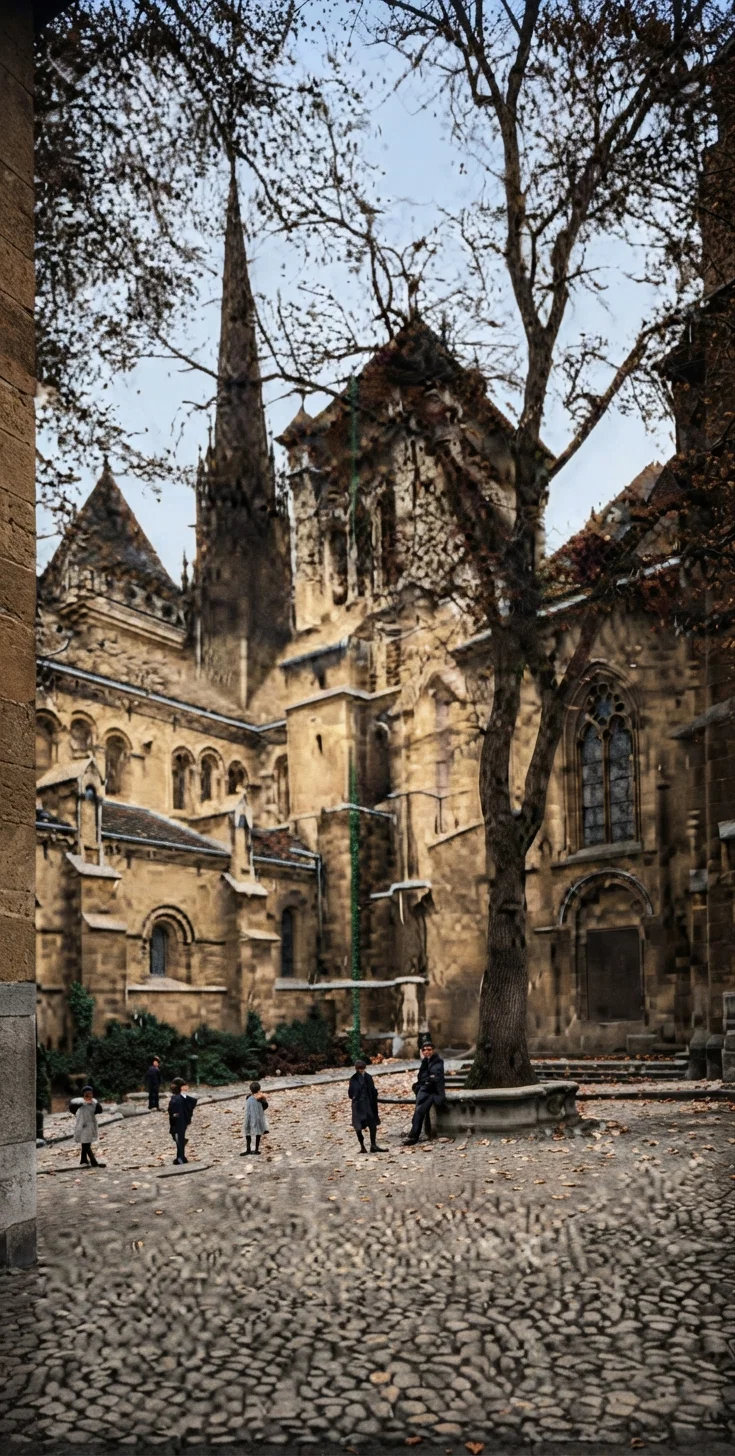
ST. PETER'S CATHEDRAL CALVIN'S OLD CHURCH IN GENEVA
THE SUPERSTITIOUS AND FRIVOLOUS CITY
At the time of the Reformation, Geneva, under its bishop and temporal prince, was a gay, superstitious, and frivolous city. The pure gospel first made an appearance among its people through the New Testament, published in French by Lefevre, a professor of the Paris university. The valiant Farel went there to preach against idolatrous worship, but was expelled. Froment, a school-teacher, made some progress in his quiet manner. Farel came back for the great battles, sustained memorable debates, and had the great joy of seeing the city decide by vote, August 27, 1535, that only the doctrine of the New Testament should henceforth be preached there. The bishop, the priests, the friars, the nuns, all left the city.
But a great work remained to be done for the worldly and dissipated Genevans, if their lives were to be brought into harmony with the gospel which they had nominally adopted.
STAYED THOUGH TERRIFIED BY THE RESPONSIBILITY
Farel, the indomitable pioneer, felt that the task was beyond his strength. Calvin, a young man of twenty-nine, but already well known through his book, “The Institution of the Christian Religion,” happened at that time to pass through Geneva on his way to Basel. Farel, learning of this, ran to his hotel, and terrified the young traveler into the conviction that it was his duty to stay.
But the dissolute elements in the city cared little more for holy living than for a false worship. The Reformers were asked to leave the city. Farel went for good, but Calvin was humbly recalled, and returned, never to leave his work until his death in 1564, having spent in Geneva nearly twenty-five years out of fifty-three. Under his theocratic form of government (none other was known in those days), under his faithful teaching and his pastoral watch-care, the moral condition of the citizens was completely changed. Geneva became a model city, whose good order, austerity, and culture excited the envy and admiration of the world.
WHERE THE BRIGHT, BLUE-TINTED WATERS OF LAKE GENEVA FLOW OUT TOWARD THE SEA
Theodore de Beza, Calvin’s worthy and distinguished successor, continued and developed the work. Geneva became a learned center, the bulwark of the Protestant cause, and a refuge for the victims of persecution in France. Repeatedly the hand of God was signally manifested in delivering the city from the plots of popes, Savoy, and France. But in time, religious indifference and worldliness again appeared. French incredulity crept in. Voltaire made his residence in the neighborhood, and his poisonous writings had their nefarious effect. At the end of the eighteenth century, Geneva was religiously dead and theologically rationalistic.
EARNEST LABORS RESULT IN A HARVEST OF DISTINGUISHED REFORMERS
About the year 1830, two devout Scotchmen, the Haldane brothers, explained the epistle to the Romans before a circle of theological students. A revival followed, which produced such men as Malan, Guers, Bost (evangelist), Merle d’Aubigne (historian), Gaussen (expounder of the prophecies), Vinet (religious liberty writer), and de Gasparin (advocate of a finished Reformation). This revival was felt and is still felt all through French Protestantism.
But a new decline came on. Instead of receiving the third angel’s message, which corresponds exactly with the principles laid down by the men of 1830, higher criticism and evolution were embraced. Geneva grew more and more worldly, until now the once austere city has become an up-to-date resort, a center of pleasure, Socialism, and infidelity. Many Roman Catholics have settled there, constituting about half of the population, and they hope to rule the city again, and to reintroduce the mass in the old St. Peter cathedral.
MESSAGE OF CHRIST AND HIS COMING IN GENEVA
Our colporteurs entered the city at an early stage. Elders Bourdeau, Alb, J. Curdy, L. P. Tieche, and others labored there in public and in private. One or two camp-meetings held there attracted a great deal of attention. Within a few years, several families from our strong Swiss churches went there to reside. One year ago,93Elder H. H. Dexter, president of the French Swiss Conference, opened a course of Bible lectures in the Casino de St. Pierre. The advertising was done on a large scale. The audiences began with two hundred fifty, and grew from day to day to four hundred, six hundred, finally reaching one thousand. Larger and still larger halls had to be secured. Up to this time, collections have brought in about six hundred dollars, and, best of all, the church has gained about fifty members.
A JOYFUL BUT PERPLEXING RESPONSIBILITY
This, to the Geneva church, has been an unexpected, joyful, and at the same time a solemn experience. The other Swiss churches assisted with their prayers. The city seemed to be stirred by the simple, straightforward preaching, and the startling character of the subjects announced. Cottage prayer-meetings and studies were held to satisfy the inquirers. Elder Dexter was invited into rich parlors and to aristocratic tables.
The popular preachers for a moment feared for their fame, and one of them sought an invitation to a dinner in a wealthy home to meet the 'American preacher.' The story would not be complete did I not say that opposition has not been lacking, and has left nothing untried to defeat the work.
A CRISIS AND AN APPEAL
A crisis awaited the Geneva church at the end of this glorious campaign. The hall in which the regular meetings of the church were held has of course become too small. Larger halls have been used for a time, but they are very expensive. And this is not the worst. Secret influences against our work make these halls difficult to obtain and to retain.
The only solution of the perplexing problem of the Geneva church was, to build. A lot has been secured, for which the church-members, taxing themselves to the utmost limit, have contributed five thousand dollars.
The seller donated eighty square meters.
The building must be erected very soon, or else the congregation and the work will be in a bad plight. But where is the money coming from for the building? A sum of at least six thousand dollars should be raised for this purpose. Where will the Geneva church look for this aid?
WOULD IT NOT BE A PRIVILEGE TO YOU?
Would not the brethren in America feel it a privilege to help in this worthy object, and have a share in rearing a little chapel for the message in the city of Calvin? Will they not remember that the Puritans were the disciples of Knox, who was the associate of Calvin in Geneva, and to his death his intimate friend? The Geneva brethren trust their appeal will be heard, and the opportunity gladly improved. I am writing this at the express request of the local elder and of the secretary of our church in Geneva. All donations should be sent to the treasurer of the Pacific Press Publishing Association, who will see that they reach their proper destination.
Chinese Activity in Publishing the Message
By W. E. GILLIS
THE Signs of the Times Publishing House at Shanghai is rapidly taking its place among the great distributing centers of the third angel's message. From month to month a steady advance is noted. This quarter the sales promise to average more than $500 gold a month. Although the war has tended to decrease the circulation of the Signs, our average for the year will still be quite high. At present we are running 34,000 Mandarin and 14,000 Wen-li magazines. The committee in session last month decided to increase the size of the paper four pages in order to provide room for brief news notes. This addition began with the November issue, in time to announce the formal election of the president of the Chinese republic.
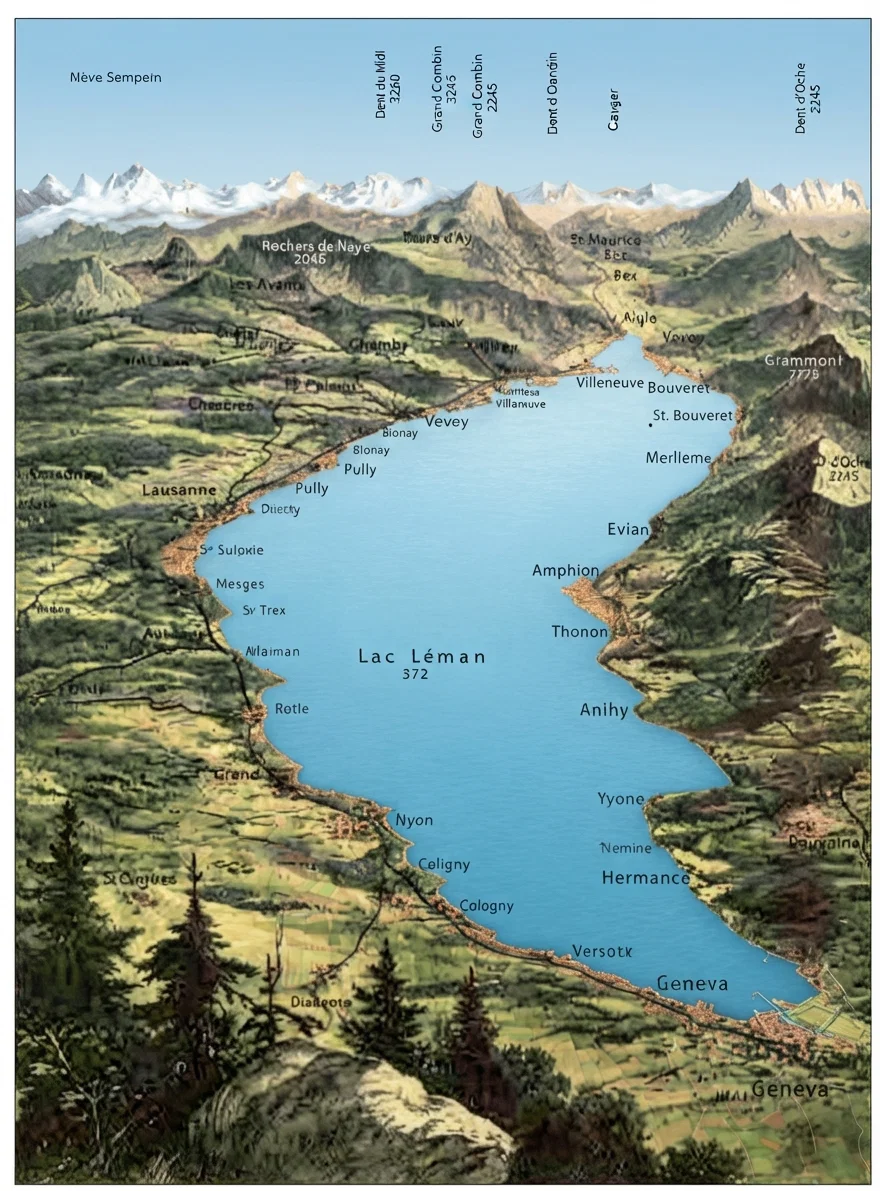
RELIEF-MAP OF LAKE GENEVA, OR LEMAN — THE CITY OF GENEVA AT THE FOOT
This year marks a new era in the demand for our literature in tract and book form. The first trial editions of 500 copies each of "Revelation" and "Bible Readings" in both the Mandarin and the Wen-li were sold out before the binder could get them on the book room shelves. Editions of five thousand of several of our tracts have been sold out in three months.
What we need and must have is consecrated educators to direct the efforts of our native colporteurs. Just one instance in point: A colporteur at Chang-Sha had been for months barely eking out an existence on three and four dollars a month. Brother Lillie, busy as he is with the multifarious details of station work, undertook to help him one afternoon, and the result of four and one half hours' work was sales to the amount of $7.50. Right here in Shanghai, Brother Stafford has had similar experiences with his men.
Our type room is now putting in type the new exposition of the prophecies of Daniel. There is a strong advance demand for this book. We are planning to have it off the press early next year.
W. E. GILLIS.
Victory over Bad Habits
By Bertha Selmon, M.D.
"I FEEL exceedingly grateful to you for your kind advice regarding cigarette smoking. I need such advice very much. I know the evil consequences of the habit, and I feel them very keenly. I realize that it is a shame for a young man like me to smoke. I feel the shame most when I am in the presence of men of high moral principles, and my conscience always hurts me when I think of this weakness, which, honestly speaking, has kept me from saying and doing many things I otherwise would have done. My soul therefore has been fighting a hard battle with my flesh, and so far the latter has been victorious. The advice you have given me, however, has greatly strengthened the former; and, strange to say, owing perhaps to some mental peculiarity, the cigarette has entirely lost its former taste; nay, it makes me very uncomfortable after a few puffs now. When I told this to my wife, she said, 'Dr. Selmon is praying for you.' I believe you do, and can assure you that before long I will stop smoking altogether. This is my determination, but I am weak. I would ask you to pray for me, and give me some suggestions as to what would be best to take to tone up my system a little."
The above is an extract from a letter just received from a young business man here in Shanghai. He has an excellent education, and, as will be seen from his letter, has good use of English. He has always been most grateful for service we have rendered in his home. In the matter of his tobacco habit, we have dealt with the moral side of it, and as a result he has several times made inquiry concerning the gospel and its power to keep a man from being the slave of bad habits.
BERTHA SELMON, M.D.
Cooperation Corner
By Editor
IN response to the request in our Cooperation Corner in our issue of January 27, two persons who appreciate the SIGNS OF THE TIMES have each sent a check for $10. This will be used in ways suggested in the appeal, namely, in furnishing the SIGNS to worthy persons who are recommended, in mission work among prisoners, for public reading-rooms, or in other ways in which help is needed. Through our Cooperation Corner we do indeed bring together those whose hearts are in such work, but whose opportunities may be limited, and others who have opportunity to use missionary material, and are thus supplied. One lady, in sending $10 for this work, says, "I want to thank you many, many times for the wonderful help I have received from reading the SIGNS OF THE TIMES." Possibly others who likewise have gained help would like to have a part in the Cooperation Corner work. Address Cooperation Corner, SIGNS OF THE TIMES, Mountain View, California.