WITH the name Rebekah there is associated a beautiful story of romance, love, and domestic happiness, a story of joy and sorrow, faith and unfaith, from which we may draw many a lesson.
First let us get the setting for our story. Nearly forty centuries ago, Abraham was called to separate himself from his kindred in Mesopotamia, and go, a missionary, to the land of Canaan. He went, and there became an old man before the son of divine promise was given him.
This son, Isaac, the heir of the world and the progenitor of Christ, also heir to the large temporal wealth of his father, was, when forty years old, still unmarried. In those days, the experienced, God-fearing parents usually made the choice of life companions for their children, though not against the wishes of the young people. So Abraham, feeling himself growing old and feeble, wished, before he should die, to see his son happily united to one of like faith,—to one who would maintain with him, in that idolatrous land, the pure, lofty worship of the true God. And his mind turned immediately to Mesopotamia, the land of his kindred.
Long years it was since he had left relatives and friends—so long that his name was there only a misty memory. And now, under solemn oath he sent his most trusted servant, Eliezer, on this important mission to the old home—a long, long journey—based on the faith that God would provide a wife for Isaac.
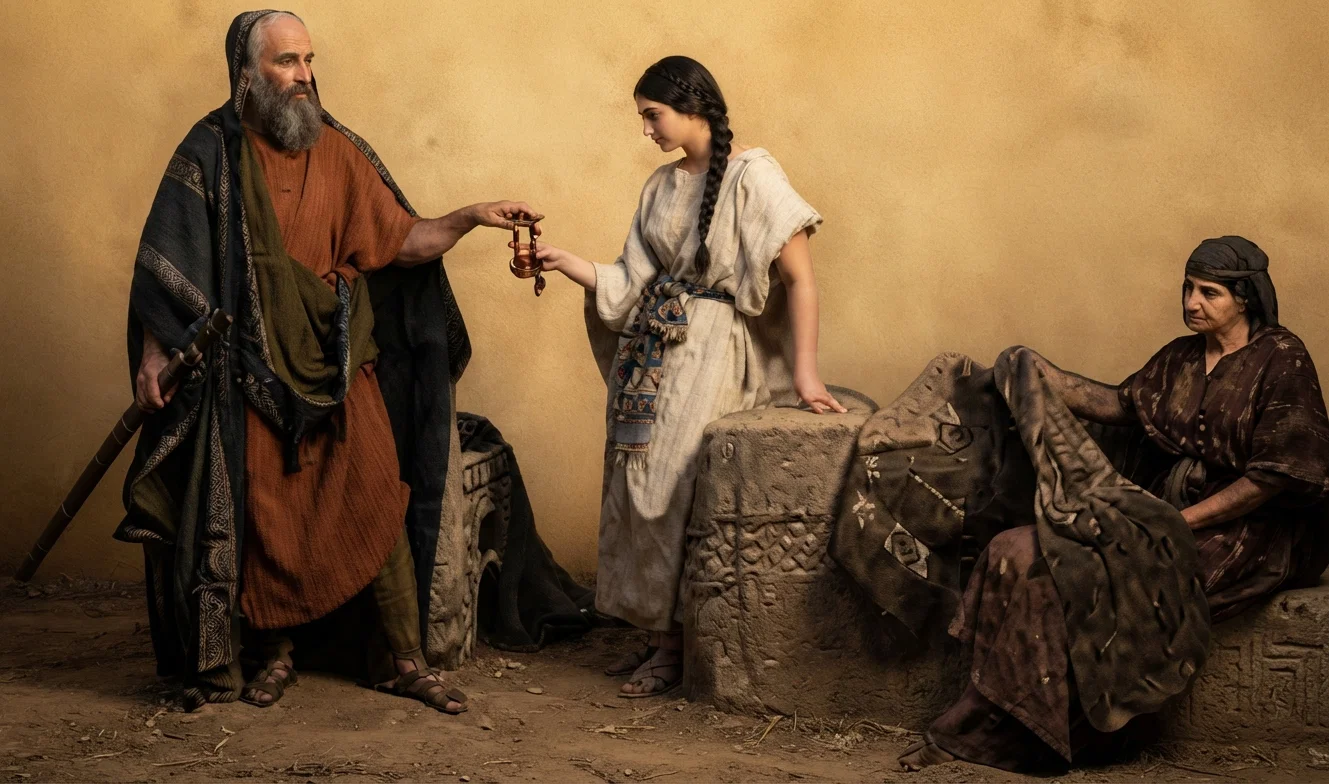
It is the beautiful sunset hour. Eliezer has alighted at the well just outside of Haran, and is praying,—praying that the great God will guide in this most delicate undertaking. His prayer ended, he rises, full of faith, and soon there comes a beautiful maiden to draw water from the well. In answer to a request from him, and showing the gracious courtesy and deference to years which is a part of her character, she not only gives him water to drink, but draws for his camels also,—the very tokens he had prayed might be given as a sign of God's approval.
Joy and thanksgiving fill his heart as he learns that the maiden's father is a nephew of his master Abraham, and he bestows upon her costly ornaments of gold. She hastens home, and tells with excitement the strange tale of the old man, rich and having many camels, who has given her these ornaments, and who wishes lodging in her father's house. Immediately her brother Laban goes out and greets
this servant of his great uncle Abraham with these words: "Come in, thou blessed of the Lord; wherefore standest thou without? for I have prepared the house, and room for the camels."
When provision has been made for his men and camels, Eliezer, faithful messenger that he is, can not rest until his mission is made known. So he tells first of the wonderful blessings and great riches bestowed by God upon Abraham; then of Isaac, the son of faith; and finally he relates the story of his own prayer at the well, and its remarkable answer; and he asks that Rebekah be allowed to go to become the wife of Isaac. Bethuel her father and her brother Laban both see God's hand leading, so dare not refuse, but say, "Behold, Rebekah is before thee, take her, and go, and let her be thy master's son's wife, as the Lord hath spoken." At these words, Eliezer reverently worships God.
His mission fulfilled, he is in haste to return home, and in the morning wishes to set out. Now the marriage custom is that a young woman shall remain at home for nearly a year after her betrothal, and Rebekah's mother and brother plead for her to remain. But Eliezer is unmoved; so Rebekah is called, and contrary to all custom, consents to go at once, for she feels that the call is from God. She realizes that her going means separation from home and relatives for a long time, perhaps forever; but her faith fails not, and she goes forth with gladness.
It is a long journey, and we can imagine what thoughts fill her heart during the weary days of travel. She wonders what the new home and life will be, and what love will be hers. But this is a journey of faith, so she goes with a heart full of trust for the future.
The heart of Isaac is filled with joyful anticipation and longing for the fair one of his dreams—and yet his dreams have never pictured one so fair as she who comes, his bride-to-be. He is out in the fields in the glow of the evening—praying. No doubt he is praying for the safe arrival of the precious caravan wending across the desert, for faith dwells in the heart of Isaac as in the heart of his father Abraham. As he lifts up his eyes, he sees the camels slowly approaching, and his heart thrills. As they draw near, Rebekah sees him, and alights from her camel, yet with maidenly modesty draws her veil over her face.
And the Book says, "And Isaac brought her into his mother Sarah's tent, and took Rebekah, and she became his wife; and he loved her." Those four small words connote much.
Very happy were Isaac and Rebekah, but their joy was not complete. For many years her arms ached for children. Their tent seemed lonely for the music of baby voices. At last, in answer to the earnest prayer of faith, twin sons were given them.
As the years went by, Rebekah's love grew stronger for Jacob, the boy of affectionate, home-loving disposition, while the heart of Isaac turned to Esau. We all know the story of the birthright and blessing, and how Rebekah aided Jacob to deceive his father. Here the chain of faith is broken. In her ardent mother-love, she did not leave it to God to untangle the knotted skein of circumstance, but for the time lost faith and failed.
This circumstance in the life of Rebekah and Jacob always fills one with sadness. Yet how many times we fail in the very same way!
As a consequence of Rebekah's failure, Jacob had to flee from home, and she95never again saw the son of her heart's delight. Poor mother! Her last days must have been filled with sorrow, all because of one rash act, one little time when faith was lost.
At the last hour, no loving son was there to smooth the brow of death. But as the heart clings longest to that most loved, this mother's heart still throbbed with love for the son of her hope, still held the sweet faith that she would look upon his face once more, even as death closed the curtain on the scene of life. So passed out the life of Rebekah the beautiful, and she was laid to rest in the Cave of Machpelah, "the tomb of the faithful."
It is a beautiful story, this of Rebekah, but so sad at the last, all because faith was lost just once. Faith is the tie that binds our hearts to heaven. When once it is severed by our failure—God never fails—sorrow and remorse—yea, and sin—are consequences. Let us not break one link in the golden chain. Let us be faithful.
The Land of Peace
By L. D. Santee
THERE is a land where ne'er a note of sadness
Shall mar the sweetness of its sacred bowers,
But every song shall thrill with rapturous gladness,
And mingle with the breath of fadeless flowers;
The land where every face shall shine immortal,
Where earth's rude, jarring sounds forever cease;
A land within whose angel-guarded portals
Are homes of beauty and of endless peace;
That dear home land within whose sacred border
Earth-weary souls find resting long and sweet.
The wondrous pearly gate, with angel warder,
Shall open wide to welcome pilgrim feet.
Long shall they rest, with no sad miserere.
Long shall they feel from pain a glad release;
Long, long enjoy the hours, never dreary,
In homes of beauty and of endless peace.
No doubting friends, no questions or surmising,
In that blest country far within the sky!
No faith is lost, no sinful thoughts arising,
To break the peace of those who dwell on high.
But loving ones shall meet with glad embraces,
Fearing no more earth's sickness or decease;
And joy shall beam on holy, happy faces,
In homes of beauty and of endless peace.
Though dull years pass, there seems no cheering token,
No welcoming message from the dear home land.
Still does the azure dome remain unbroken,
And still are brows by earthly breezes fanned.
But in God's own good time the joys of heaven
Will greet the white-robed throng, whose sorrows cease.
A palm and crown will to the saints be given,
In homes of beauty and of endless peace.
L. D. SANTEE.
COOKING WITHOUT MEAT
WITH "The Vegetarian Cook Book" you can discard meat from the table, and furnish a well-balanced diet without it. This is exactly what thousands of families would do if they knew how easy it is to do it.
For years Mr. E. G. Fulton, the author of "The Vegetarian Cook Book," has successfully carried on vegetarian work, and is now serving several thousand meatless meals a day in his cafeteria in Los Angeles. His 420 page work gives his best recipes adapted for use in the ordinary-sized family. Its departments are as follows:
Bakery and Breakfast Dishes; Beverages; Cake; Cereals; Dairy Dishes; Eggs; Entrées; Food Combinations; Fruits and Their Preparation; General Suggestions; Hygiene of Cooking; Ices and Sherbets; Liquid Foods; Nut Preparations; Pies; Puddings; Pudding Sauces; Salads; Salad Dressings; Sandwiches; Sauces for Vegetables, Entrées, etc.; Soups; Table Etiquette, and Rules for Waiters; Toasts; Utensils; Vegetables.
Whether or not desiring to adopt a wholly vegetarian diet, you will find this work a help worth to you many times its small cost of $1.00 post-paid (10% higher in Canada). Bound in substantial cloth.
Portland, Oregon Kansas City, Missouri Calgary, Alberta, Canada
For Sale
Or trade for California land, income home at Mountain View, Cal. House is up to date and furnished. Earns one per cent per month of price. Address A. V. Emmert, Waterman, Cal.
"Tormented Forever and Ever"
One of the most fearful utterances in the whole Bible regarding the wicked, a wrong conception of which has made men infidels. This tract presents an exposition of the text which is reasonable and just—a vindication of God's character. B. S. L. No. 111. Price $1.00 per hundred; single copies, 2 cents.
There is no one thing in the Scripture more illuminating, more comprehensive of all the teachings of the Word, than the subject of the sanctuary, revealing as it does the object and purpose of sacrifice, and the priesthood and work of our Lord Jesus Christ. This little pamphlet on this great subject is 10 cents.
to and from
Denver, Omaha, Kansas City
Chicago, and the East
Overland Limited de Luxe
63 Hours between San Francisco and Chicago
Pacific Limited
69 Hours between San Francisco and Chicago
San Francisco Limited
69½ Hours between San Francisco and Chicago
Luxurious High-Class Equipment
Protected throughout by Automatic Electric Block Safety Signals
For information write to Mr. C. S. Fee, Passenger Traffic Manager, San Francisco, or any agent
Southern Pacific Company
GREAT FEATS ACCOMPLISHED
AND
GRAND PRIZES WON
STAMP THE
UNDERWOOD
THE
LEADER
In the Typewriter Field, and in a class by itself. Here are a few of its victories:
Holder of the Elliott Cresson Medal awarded by the Franklin Institute of Pennsylvania.
Holder of every Grand Prize of importance awarded in the last twelve years.
Holder of every International Record for Speed, Accuracy, Stability.
UNDERWOOD
"THE MACHINE YOU WILL EVENTUALLY BUY"
International Peace
MR. CARNEGIE recently said that "the foulest blot remaining upon so-called civilized man, beyond question, is the killing of each other." Then he expresses the conviction that "there are influences at work which inspire the belief that this must soon cease," and announces himself as "strong in the faith that international peace is soon to prevail through several of the great powers agreeing to settle their disputes by arbitration under international law, the pen thus proving mightier than the sword."
We will all unite in affirming that peace is the desirable thing, and that war comes as the result of wrong-doing and wrong aggressions on the part of some nation or nations. But while agreeing to all these things, is there any prospect at all that we will ever have universal peace in this world? The question is not one of what we may desire, but of what we may expect.
The tendency is, when a line of thought becomes popular, that the people will seek to make themselves believe that the thing called for in the popular teaching actually exists. The doctrine of universal peace is becoming very popular. We have, in the Old World and the New, something above a hundred regular peace organizations, each one seeking to create sentiment in favor of world-wide peace. But it is one thing to create sentiment in favor of a world-wide peace, and it is quite another thing to make the change in our human, selfish hearts that will destroy the spirit of fighting. The power that comes to the individual heart from the Prince of peace is the only thing that can produce this desirable result.
It seems quite clear that the doctrine of universal peace, regardless of all-prevailing human depravity, is to be preached until it becomes so popular that the people all around the world will have been hypnotized into the unwarranted claim that we actually have peace. For, speaking of the days when the coming of Christ is at hand, the apostle says:
"For yourselves know perfectly that the day of the Lord so cometh as a thief in the night. When they are saying, Peace and safety, then sudden destruction cometh upon them, as travail upon a woman with child; and they shall in no wise escape. But ye, brethren, are not in darkness, that that day should overtake you as a thief: for ye are all sons of light, and sons of the day: we are not of the night, nor of darkness." 1 Thess. 5:2-5.
It is "when they are saying, Peace and safety," that "sudden destruction" comes upon them.
His Hour Not Yet Come
WHEN the Master was here in person He frequently stated that the Jewish nation were unable to do certain things to Him, because His hour had not yet come. All the powers that the demons could summon were brought against Him to overthrow Him, but to no avail, for His work was not finished.
He sends His followers to bear His great message to the ends of the earth, saying to them, "Lo, I am with you alway, even unto the end of the world." The Master could not be placed in the hands of the people for trial and crucifixion until His hour came. His divine power shielded Him. He says He is with each one who follows Him, and therefore all workers for Christ have the Master's own divine power for protection, so long as they will trust in Him. There is nothing that can overthrow them. What a glorious assurance this is, as one after another is commissioned to go into the most difficult and trying places to bear to the ends of the earth the great message of Christ's soon coming!
Centered in Himself
SPEAKING of the conditions that obtained in the eighth century, the historian Wylie says:
"The evils of the time were legion; but all flowed from one colossal error: the cardinal truth of Christianity, that salvation is of grace, was completely obscured. By the most plausible pretexts and the most subtle devices was man led away from God, and taught to center all his hopes in himself. Faith was overthrown, and works were put in its room. The sacrifice of Christ was neglected, and man became his own savior."
For man to save himself by his own works has ever been one of the dreams of every false religion that has arisen, and a time of great intellectual light is just as susceptible to such doctrines as a time of great intellectual darkness — yes, even more susceptible. Men who desire to be saved from the destruction of death and to live eternally, are shut up to just one hope, and that is the salvation of the Lord Jesus Christ. No other hope brings satisfaction, no other plan brings rest to the soul; but the individual who knows Christ and His saving grace, has found rest and peace. His face is toward the future, and joys that can not be described are flooding his soul.
Campaign Against Wood-Alcohol
By Editor
THE Journal of the American Medical Association suggests that there ought to be a vigorous campaign waged against the improper use of wood-alcohol. After speaking of the crusade by "The New York Committee for the Prevention of Blindness," against makers of bay rum and other toilet articles that sometimes contain wood-alcohol, the Journal states:
"Bay rum containing wood-alcohol may cause blindness. Power-house whisky which contains wood-alcohol may cause blindness or death. Soft drinks containing wood-alcohol may cause a withering of the optic nerve and consequent blindness. Workers in large vats who are obliged to shellac the inside of them become blind from inhaling the fumes of the wood-alcohol contained in the shellac."
It is probably news to most of us that "soft drinks" contain any alcohol of any kind, and it is certainly very highly important that we all should know that drinks served at the ordinary soda-fountain may contain wood-alcohol, and that this drug, by its action on the optic nerve, may cause blindness. It is also important that we should know that various toilet articles, such as bay rum, may contain wood-alcohol and be very injurious to our health.
In Line for Prohibition
By Editor
ONE of the most interesting and at the same time one of the most vitally important things before the people of the United States for the year 1914 will be the campaign in the state of California to put this great commonwealth within the ranks of the prohibition states.
The climate of California, and its many natural advantages, draw thousands of tourists, and make it a very desirable place to seek health and pleasure. The vendors of strong drinks would take advantage of this by working to keep it a "wide-open state." Debaucheries and revelings and drinkings and carousings would be made popular, and this sort of thing would be held up to us as essential to the pleasure and prosperity of the commonwealth.
But there are many thousands of the good people of California who see things in a different light; and a law has been introduced, through the initiative, to prohibit the sale and the manufacture of strong drink within the confines of this state. A well-organized campaign is under way, and notwithstanding the difficulties in overcoming the vote of such cities as San Francisco and Los Angeles, it is confidently hoped that the effort will be a success; for there is a large population in the smaller towns and country districts, as well as a great many people in the larger cities themselves, who know by experience and observation that the liquor traffic is a curse and only a curse, and they are sick of it and are willing to do all they can to blot it out.
All people who have the good of their fellow men, as well as their own good, at heart, should join in this movement most earnestly and heartily. It is a movement that should not only interest the state of California, but it should interest good people throughout the nation, for every state that can be added to the prohibition ranks makes the cause of temperance just that much the stronger.
Great Navies Insure Peace
By Editor
WE are gravely told by many people that the best insurance for peace is the greatest navies and the greatest armies. The more formidable the preparations for war, the better the insurance of peace. So they argue.
There have been times and places in this country, and in many other parts of the world, for that matter, when it was considered that the best way for a man to be sure of personal peace was to go about with two or three revolvers hanging from a belt, and to keep himself well practised in using them. But if we consider the individual to be warranted in going thus heavily armed, we will have to picture him in surroundings where the country is infested with a very lawless and possibly barbarous element. It is only when robberies and various kinds of outbreaks become quite general, that the private citizen thinks of going armed in order to meet attack.
Now if it is essential for the governments of the world to keep themselves so heavily armed in order to insure peace, have we reached the time of universal peace that we have been told about so much? Or are we in any sense bordering upon that time, if it is necessary for us to build greater and greater navies in order to keep the peace?
This old world of sin has been infested with wars ever since it violated God's order of things and started on its career of wickedness. The divine Book says that "evil men and seducers shall wax worse and worse," until the very end of time. The evidence is clear that the men who demand the building of the large navies will have plenty of arguments in their favor because of world conditions. Yet in the face of the clearest fact, there will also be thousands of men who will think that we may have peace, regardless of the elements of anarchy and strife that are becoming stronger and stronger everywhere.
News of the World
It is understood that Secretary-of-the-Navy Daniels, and possibly President Wilson himself, are in favor of building at least two of the largest battle-ships each year, and there are strong influences working to have this increased to four. The naval program for the coming year will probably be settled within a few weeks. It has been proposed, and the matter is urged strongly upon all the nations, by certain individuals, that there be a naval holiday of one year, in which no nation will build any new war-ships. But notwithstanding this proposition, there seems to be a determination among most of the nations to build more heavily than ever before.
AMONG the big things planned for the Panama-Pacific Exposition next year is a race clear around the world with air-ships. Plans are being arranged whereby ships at sea will patrol the course of the air-ships while they are flying over the waters. All nations are to participate. It has not been very many years since people were laughing at the idea that it would ever be possible for men to fly, but aerial craft and the handling of it have been so perfected that now this proposed around-the-world trip through the air does not seem so very marvelous.
PRESIDENT WILSON has removed the embargo from shipping arms into Mexico. Both sides to the war struggle can purchase arms freely anywhere in the United States that they may desire. Provisional President Huerta, it is said, is making a protest against this action on the part of the government. But his protest is not likely to have any weight. It is hoped by the government that this course will soon result in ending the strife that has been in progress in that country for so long.
EDWIN GINN, who recently died in Boston, has bequeathed one million dollars to the "World Peace Foundation" movement that he established in 1910. It is the plan of this peace organization to circulate literature, and otherwise disseminate information in regard to the barbarities of war, and its destruction of the blessings and benefits of orderly pursuits.
FRANCE is greatly augmenting her aerial navy by popular subscription. $1,200,000 was raised in this way, and with this fund 210 army aeroplanes will be provided and some 75 additional expert air-ship pilots will be trained. It is proposed to establish military "air ports" throughout the country.