The Youth’s Instructor, Vol. 43, No. 26.

MOUNT TABOR

The Youth’s Instructor

Jun 27, 1895

S. D. A. Publishing Association · Battle Creek, Mich. · Jun 27, 1895

MOUNT TABOR.
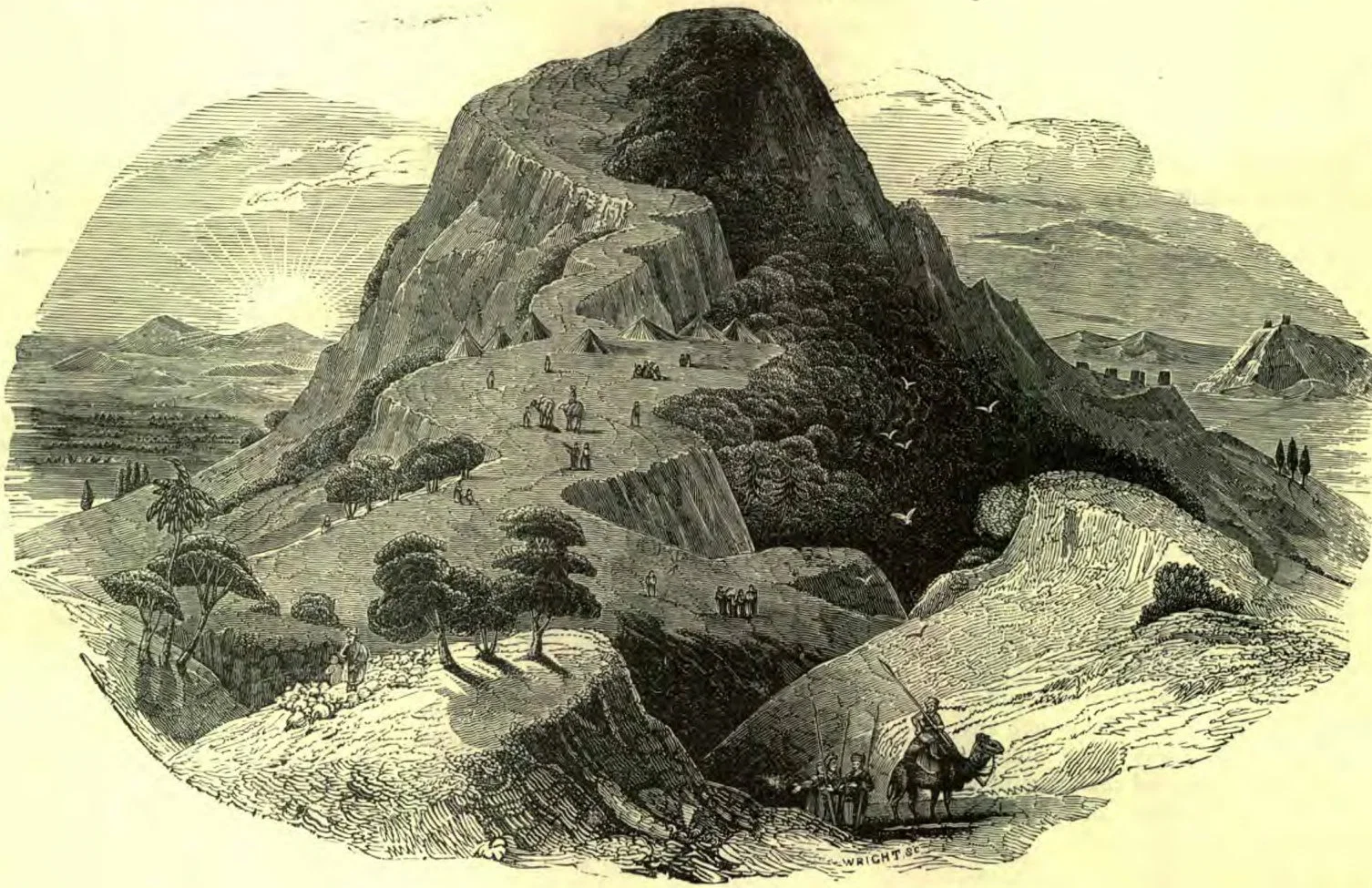
(Supposed to be the Mount of Transfiguration.)
FAIR mountain, rising from an Eastern plain, Thy summit doth to goodly height attain — A massive rock, which, towering to the sky, Attracts the gaze of every passer-by.
'T is said that thou art picturesque and grand. All this we credit, and can understand; But there is something more to make thee dear — A rare tradition, which we love to hear.
O sacred mount! thy name shall ever be A word to lift our hearts to God; for we Are told that Christ, our Saviour good and true, Ascended to thy heights, and in the view Of Peter, James, and John, one certain day, Was there transfigured; and the Scriptures say His face shone as the sun, and to the sight The brightness of his robe was as the light.
MOUNT TABOR.
MOUNT TABOR.
He went with them apart that day to pray; And as he prayed, in his most earnest way, His countenance was altered, grandly bright, And glistening was his raiment, snowy white.
But while they pondered over this strange scene, Behold there stood with him two men serene; For Moses and Elias talked with him When his disciples’ eyes with sleep were dim.
One represented, as we understand, The risen dead — a pure, immortal band. The other, those who live to see the end, And who, with Christ, will thus to heaven ascend.
'Twas then they spake to him of his decease To be accomplished,—blessed “Prince of peace,” Who gave his life for wicked, sinful man, To carry forward God’s determined plan!
And then a cloud o'ershadowed them; and, lo, There came a voice from heaven, even so: Saying, This is my well-beloved Son, O hear ye him! I'm pleased with what he's done.
Celestial vision! dear to mortal eye! What can we in thy mystery descry? Shall we some day, if faithful unto God, Be thus transfigured, changed from earthly clod,
And like the Master, of diviner mold, Live on forever, never growing old, But through the ages, with renewing strength, In heavenly mansions find sweet rest at length?
If so, O wheels of time, make no delay, But bring us swiftly to that joyful day, When we shall be like Christ, divine and pure, And shall throughout eternity endure!
ELIZABETH KELLOGG EDMONDS.

LET YOUR SPEECH BE ALWAY WITH GRACE.

“He that will love life, and see good days, let him refrain his tongue from evil, and his lips that they speak no guile: let him eschew evil, and do good; let him seek peace, and ensue it. For the eyes of the Lord are over the righteous, and his ears are open unto their prayers: but the face of the Lord is against them that do evil.” “Wherefore gird up the loins of your mind, be sober, and hope to the end for the grace that is to be brought unto you at the revelation of Jesus Christ; as obedient children, not fashioning yourselves according to the former lusts in your ignorance: but as he which hath called you is holy, so be ye holy in all manner of conversation; because it is written, Be ye holy; for I am holy.”
How is it that many who profess the name of Christ utter so many vain, idle words? Satan watches to obtain an advantage over those who speak in a reckless manner. Those who jest and joke and indulge in cheap conversation place themselves upon a level where Satan can gain access to them. He is playing the game of life for their souls. Can we wonder that the word of God cautions us, and warns us against sinning with our tongues?
We are to feed upon Christ, the living bread from heaven. Our souls are to thirst for the waters of salvation, and we are to study the Scriptures, and practise the truths they teach in our daily life. Those who do this will reveal the fact that they are feasting upon the bread of life, eating the flesh of the Son of God, and drinking daily of the waters of salvation. If we closely study the words of Christ, and take heed to his lessons, we shall feed upon his flesh; for the Word became flesh, and dwelt among us. Christ says: “The words that I speak unto you, they are spirit, and they are life.” When we utter meaningless and silly words, we encourage others to indulge in the same kind of conversation; but it is a great sin in the sight of God to allow ourselves to utter words that do not suggest pure, choice thoughts which will elevate, ennoble, and sanctify our characters and the characters of those who hear. The only words that come from our lips should be pure, clean words. No one can tell how much sin is created by careless, foolish, unmeaning words. The character of those who utter these senseless words is indexed by them. Sensible people are ashamed to listen to such words, and disgusted that their precious time should be wasted in listening to frivolous utterances.
O that every one of our youth would realize the evil of foolish conversation, and correct the habit of speaking idle words! Let every one who has indulged in this sin repent of it, confess it before God, and put it far from him. In speaking foolish words, you have dishonored the name of Christ; for you have misrepresented him in character. No word of guile was found in his lips, no word of prevarication or falsehood. The people that are described as making up the one hundred and forty-four thousand, have the Father’s name written in their foreheads, and of them it is said: “In their mouth was found no guile: for they are without fault before the throne of God.” If they had been speaking foolish, senseless, false words, they would not have been found without guile, and without fault before the throne of God. John also wrote, saying: “After this I beheld, and, lo, a great multitude, which no man could number, of all nations, and kindreds, and people, and tongues, stood before the throne, and before the Lamb, clothed with white robes, and palms in their hands; and cried with a loud voice, saying, Salvation to our God which sitteth upon the throne, and unto the Lamb. And all the angels stood round about the throne, and about the elders and the four beasts, and fell before the throne on their faces, and worshiped God, saying, Amen: Blessing, and glory, and wisdom, and thanksgiving, and honor, and power, and might, be unto our God for ever and ever, Amen. And one of the elders answered, saying unto me, What are these which are arrayed in white robes? and whence came they? And I said unto him, Sir, thou knowest. And he said to me, These are they which came out of great tribulation, and have washed their robes, and made them white in the blood of the Lamb. Therefore are they before the throne of God, and serve him day and night in his temple: and he that sitteth on the throne shall dwell among them. They shall hunger no more, neither thirst any more; neither shall the sun light on them, nor any heat. For the Lamb which is in the midst of the throne shall feed them, and shall lead them unto living fountains of waters: and God shall wipe away all tears from their eyes.”
O that all our youth would form characters after the divine similitude! O that Christ may be in you a well of water springing up unto everlasting life. Begin at once the work of soul-purification. Put from you all nonsense, and refrain from trifling words. Every word you speak is as a seed that will germinate and produce either good or bad fruit, according to its character. The words we utter encourage the feelings that prompted them. Exaggeration is a terrible sin. Passionate words sow seeds that produce a bad crop which no one will care to garner. Our own words have an effect upon our character, but they act still more powerfully upon the characters of others. The Infinite God alone can measure the mischief that is done by careless words. These words fall from our lips, and we do not perhaps mean any harm; yet they are the index of our inward thoughts, and work on the side of evil. What unhappiness has been produced by the speaking of thoughtless, unkind words in the family circle! Harsh words rankle in the mind, it may be for years, and never lose their sting. As professed Christians, we should consider the influence our words have upon those with whom we come into association, whether they are believers or unbelievers. Our words are watched, and mischief is done by thoughtless utterances. No after association with believers or unbelievers will wholly counteract the unfavorable influence of thoughtless, foolish words. Our words evidence the manner of food upon which the soul feeds.
MRS. E. G. WHITE.

THE SABBATH.

The sweetest thought that comes to me with each returning Sabbath, is that God the Father, and God the Son, by whom all things were created (John 1: 1-3), rested in that first seventh day after creation was finished, and sometimes I try to picture to my mind the character of that first Sabbath; but sin has so long darkened our minds, dimmed our spiritual vision, and weakened our powers, that we cannot catch a clear idea of what that day must have been.
We know by faith that everything came pure from the hands of God; and as the eve of the Sabbath “drew on,” not a discordant note could be heard. Every living thing was at peace with itself, at peace with its fellow, and at peace with its Creator.
What a day of joy and gladness must it have been to Adam! He had been created in the image and likeness of God (Gen. 1: 26); and with all the powers of his being in a state of perfection, he could look abroad upon nature, and up to the starry firmament, beholding everywhere the wisdom and love of God; but when the night was past, and the first rays of the rising sun began to tinge the eastern sky, and the orb of day rode forth in all its effulgent splendor, all the powers of his being must have united in praise to Him who made the heavens and the earth.
There man was in his purity. Untainted by sin, he could see the hand of God in every flower, in each spear of grass, in the tiniest insect, as well as in the majestic eagle that soared aloft. From everything animate and inanimate he could learn lessons of love and obedience.
But Adam was a scholar in the school of Christ. Why God, who is never weary, should rest all through the hours of that first seventh day, was doubtless a mystery to him; but when after the rest was passed, God “blessed the seventh day, and sanctified it: because that in it he had rested from all his work” (Gen. 2: 3), and told Adam that the Sabbath was made for man, that he might pause at the close of each week, and worship him who made all these things, Adam’s gratitude must have burst forth in a higher and sweeter song of praise.
Here we will leave Adam at the close of his first Sabbath, and before proceeding farther, will inquire the meaning of this act of sanctifying the seventh day. The day was already holy, made so by the presence of the Father and the Son; but some act was necessary by which man could know for a certainty which day of the seven was the “Lord’s day.” We read in Ex. 19: 13, 23, that when the Lord was about to come down upon Mt. Sinai, he told Moses to “set bounds about the mount, and sanctify it,” so that nothing unclean should touch it while his presence was there. Thus also in sanctifying the seventh day, the Lord set it apart from the other six working days as holy time, because of his presence which was in it, so that nothing unclean, or unholy, should come into that day.
Presumably not long after this first Sabbath sin entered into the world, and man could no longer enjoy the presence of God; therefore he could not keep the day made holy by the divine presence; but in process of time God called out a people from the nations of the earth, to prepare them for himself. He wanted them to be a “holy nation,” because through them Christ was to appear upon the earth as God-man,—the promised Saviour. Gen. 3: 15. On them he again enjoined his Sabbath; and after teaching them its significance by withholding the manna upon each Sabbath, he came down upon Mt. Sinai and commanded them to “remember the Sabbath day, to keep it holy,” thus referring them directly to that first seventh day after creation, and giving the same reason he then gave why it was set apart for a holy purpose.
Afterward God said to that people, “My Sabbaths ye shall keep; for it is a sign between me and you throughout your generations; that ye may know that I am the Lord that doth sanctify you.” By this we understand that a sanctified heart and God’s sanctified day are inseparable; that is, without Christ in the heart we cannot keep his holy day.
Thus it was with the Jews. As long as they had faith in Christ, who was their leader, they kept his Sabbath; but when they lost faith in him, the spirit and intent of the day were lost to them, and became a burdensome form; and when Christ appeared upon the earth, Sabbath-keeping had become idolatry,—they worshiped the day, instead of Christ in the day.
This is a sad picture. We may look back upon the failures of that people, and exclaim, How could they do so? but let us look in upon ourselves. Is the Sabbath a burden to us, or a delight? We have seen why the Israelites failed; if Christ is not in our hearts, we cannot keep the day that is made holy by his presence. We are placed in varied circumstances. There are but few families, comparatively, whose members are all united upon the Sabbath question; and, like the Jews in their captivity, some of us may be tempted to “hang our harps upon the willows,” and to say, How can we keep the Lord’s day in a strange land? But this will not do for us. Jesus is our Helper, and he will lead us on to victory, if we only follow him faithfully.
Many of our young people are, from necessity, called to work in families that are Sunday-keepers, or that keep no day. To these I would say, Do not start out with any feeling like this: “Well, I do not know how it will be about the Sabbath. I am afraid they will ask me to do something I would n't like to do on that day;” but go with a heart full of the love of Jesus. Show them by your unselfish acts that you are interested in their welfare, and you will be surprised to see how the way will be cleared before you; and when the Sabbath comes, the One who has been with you all the week will go with you through its sacred hours, and at its close you will say, This is the best Sabbath I ever spent. Why so?—Because you “left it all with Jesus.”
JULIA LOOMIS.

Character Compared to a Man's Shadow

A MAN’S character is like his shadow, which sometimes follows and sometimes precedes him, and which is occasionally longer, occasionally shorter, than he is.—From the French.

CHINA AND THE MISSIONARIES.

The people of China, finding at this late day that they have been beaten at the game of war by the “little dwarfs,” as they call the Japanese, are determined to hurt some one, and so they are threatening the lives of the foreign missionaries in some of the provinces of China. At one time lately a report of the massacre of many missionaries from this country was circulated, and there was much excitement over the matter; but later advices show that while there was much missionary property destroyed, the missionaries and their families were unharmed. It is understood that they took refuge in the houses of the officers of the government, who were bound to protect them.
It is quite likely that these officials hate the “foreign devils,” as John Chinaman persists in calling those who are not born in the Celestial Empire and of Mongolian stock, as much as the common herd hate them; but the officers understand the meaning of treaties better, and they also know that any failure on their part to protect the foreigners may cause the loss of their heads, both official and actual! So the Chinese officers generally afford protection to the foreigners, though they are not always able to protect their property.
It is an old adage that misfortunes never come singly, and this is as true of nations as it is of individuals. China is defeated and humiliated, and must pay a large sum of money to Japan. Her resources will be put to a severe test to do what she has agreed by treaty to do. When a nation is in debt, it must practise economy, just the same as a person should do in such circumstances; but here is all this mission property, which China will now have to pay for, since these missionaries are citizens of the great nations, and China is bound by treaties to respect them and their rights. China will soon hear some very energetic protests for what has been done; and instead of paying indemnity to one nation, she will be obliged to pay to several. When we see this cruel spirit of hatred which is still cherished among the Chinese against the people of all other countries, it seems probable that she may yet be obliged to receive some very severe national castigations before she will learn the rights and power of the other nations, which from the height of her ignorant arrogance she now calls barbarians.

Mohammedan Fanaticism.

The presence of British ships of war at Beyrout, backed up as they are by the fleets of Russia and France, has brought the Turk to time, and he is now promising like a blubbering school-boy over whom the master holds a birch rod. Some members of the sultan’s cabinet urged him to defy the powers, and it is said that one very belligerent member resigned because the sultan yielded. The Mohammedans have a great fear that the infidels(?) will, in some way, interfere with the ceremonies of their religion. For this reason they do not take very kindly to the foreign consuls. The sanitary regulations insisted upon by the powers, for fear of the spread of the cholera, are particularly disagreeable to the Bedouins.
It is ascertained that the cause of the vicious attack upon the officers of the foreign embassies at Jiddah by Bedouins was because of the new sanitary arrangements for the regulation of the pilgrims going to Mecca, which the Turkish government, under the stress laid upon it by the powers of Europe, has been compelled to make. Mohammedan pilgrimages have long been known to be productive of the plague, and even the holy (?) Zemzem water was found to be full of cholera germs. But the ignorant and superstitious pilgrims look upon any interference with their nastiness as an attack upon their religion, and they are very indignant accordingly.
There are a great number of ignorant and fanatical subjects of the sultan, who resent any deference to the so-called Christian powers, and so he is placed between two fires. Should he yield to the powers, he may have a rebellion on his hands, controlled by his otherwise most zealous adherents; and if, to please his own subjects, he rejects the demands of the powers, he must be prepared to fight. So it is evident that the sultan of Turkey and chief head of the religion of Islam has more thorns than roses on his pillow. A yielding to the powers, a new cabinet, and general promises to do better, will prolong the travesty of government known as the Ottoman Empire awhile longer.

A SUNDAY FISHERMAN.

We shall expect to see a general boiling over of the religious press of the country because President Cleveland went fishing Sunday, June 9. Not only did he go a fishing, but he actually caught fish, and that on Sunday, too. No president of the United States has ever been impeached, although an attempt was made to impeach Andrew Johnson; but here is an opportunity to impeach Mr. Cleveland. He may be charged with “high crimes and misdemeanors in office.” If Seventh-day Adventists are put in jail for setting out tomato plants on Sunday, should not the president of the United States be hanged, at least, as an example to evil doers, for fishing on that day? No doubt thousands of good Christians (?) would be glad to see him hung for it. Assuredly they will say, “Cleveland be hanged!”
But stop; there is a clause in that ancient document, known as the United States Constitution, which says that “no religious test shall ever be required as a qualification to any office or public trust under the United States.” So persons of any religion, or no religion at all, may be elected to the highest as well as to the lowest offices of the nation.
Now no one had any reason to believe, when Mr. Cleveland was elected, that he had any religion. He was not obliged to have any to be president, and he did not pretend to have any; and when, before his first election, some things which he had done that were of very doubtful propriety, to say the least, were reported, and he was asked by an anxious friend what could be said about the matter, “Tell the truth,” was the honest and blunt answer. O no; the president is too honest to pretend to have religion when he does not possess it. It is a great pity that this cannot be said of all men in public office.
But since he was elected twice as a man without religion, why should he be required or expected to act as a man who does have religion? Shall he add hypocrisy to his other sins? Keeping Sunday may be the badge of religion; it is even thought by some to be a sign of one’s belief in Christianity. Romanists say it is the distinguishing mark of the authority of that church to change the law of God. Whether or not it means any of these things, the president does not care, simply because he professes no religion, and never claimed to have any. He is an American citizen, fulfilling as well as he knows how the civil duties placed upon him, and showing the usual weaknesses and frailties of mankind. Keeping Sunday is not a part of the duties of his office.
One more point, and we are done. Religious papers and Sunday preachers repeat it again and again that every time Christ met with his disciples after his resurrection, it was upon Sunday. Now we are sure that this was not so; but allowing them to have their way about it, we will suppose that it was so. Then one time (see John 21) he met with them when they were fishing. Perhaps here is the secret of Mr. Cleveland’s fishing trip. May be he has heard a minister (he goes to church sometimes, when the fishing season is not prime) say that Christ met with his disciples after the resurrection always on Sunday, and putting that statement and John 21 together, he took it for granted that he had apostolic example for fishing on Sunday! If the religious press could take a view of his Sunday fishing in this charitable manner, they would save the flow of much indignant ink, and the reform preachers would spare themselves the effort required to make many brilliant periods of rhetoric! M. E. K.

CHINESE BARBARITY.

Not long since the whole civilized world was shocked by the report that the Japanese, upon entering Port Arthur, goaded by the sight of the dead bodies of their countrymen who had been tortured to death by the Chinese, could not be restrained, and attacked and killed the Chinese without mercy; but in this case the Japanese government promptly disavowed the action. On the other hand the Chinese authorities do not hesitate to offer rewards for the heads of the Japanese, and think they are going to the extremity of kindness by offering more money for live than for dead men. The Chinese governor of Formosa boldly defended his conduct in this respect to a correspondent of the Inter Ocean in this way:—
“It is impossible for me to do otherwise. It has been the custom for generations, and the soldiers expect it, and would not fight if this inducement was not held out. My people do not think they should enter such hazardous employment without good pay, and as we cannot afford to pay every soldier high wages, we make it up by rewards for special work done.”
When questioned in reference to offering a price for Japanese heads, he had this to say:—
“Yes, that is unfortunate, but it is the only method of proving that our men have really killed the man for whom they ask the reward. They cannot bring the body, but the heads they can easily carry. The last schedule of rewards was for the Japanese dead, but you will notice in my present proclamation I offer one hundred and fifty taels (one tael is seventy cents of United States money) for the capture of a private soldier alive, and only one hundred taels when dead; for a Japanese general six hundred taels when alive, and only five hundred taels when dead. I do this to encourage my men in capturing them alive, hoping in this way to avoid useless slaughter.”
The treasury of this governor will not be depleted by such gifts; for his soldiers became demoralized at the approach of the Japanese, and fled most precipitately, without stopping to cut off one Japanese head, and the governor made as good time as any of them! The prospect now is that he will lose his own head by the Chinese government for not giving up the island to Japan according to the treaty.

LOVE OF THE WORLD.

“Love not the world, neither the things that are in the world. If any man love the world, the love of the Father is not in him.” 1 John 2:15.
It may be that we have advanced to that degree in the spiritual life that we can say, “I do not love the world;” but have you carefully analyzed the text? After you have said, “I love not the world,” have you ever carefully repeated the next clause,—“neither the things that are in the world”? We may say we are tired of this world, and the next moment we find ourselves longing for some of the things that belong to it. “For all that is in the world, the lust of the flesh, and the lust of the eyes, and the pride of life, is not of the Father, but is of the world.” There are three divisions of the things that belong to the world. Let us consider them under these heads, and prayerfully study to know our relation to each.
1. “The lust of the flesh.”—The word “lust” may be considered as “desire.” Are there any good desires in the flesh? “I know that in me (that is, in my flesh,) dwelleth no good thing.” Then we need not expect any good desires in our flesh. The desires of the flesh are against the Spirit of God (Gal. 5:17); but that which is against the Holy Spirit brings men into condemnation. Rom. 8:1. It is carnal and enmity against God. “The works of the flesh are manifest, which are these: Adultery, fornication, uncleanness, lasciviousness, idolatry, witchcraft, hatred, variance, emulations, wrath, strife, seditions, heresies, envyings, murders, drunkenness, revelings, and such like.” It does not take all these to be serving the world; one point is enough. One of these sins will keep us out of heaven. If the innate affections of our human nature, which crave for the tangible and outward pleasures that gratify the senses, control us, we love the things of the world, and are going down to ruin.
2. “The lust of the eyes.”—This is manifested by a curiosity to see something new. Eve first had a curiosity to look upon the forbidden fruit. When her eyes were permitted to behold the fruit, the soul was not satisfied until it was eaten. David’s curiosity was not satisfied until he had committed murder. The young man who wants to go to the theater just once to see how it is conducted, will not stop there. The young woman who permits her curiosity to lead her to the ball-room will not stop there. If the eyes lead us to investigate that which God declares belongs to the world, we turn from the Creator to the created, and bind ourselves to the things of this world, which will soon be destroyed.
3. “The pride of life.”—This is the natural craving of the heart after the unreal. It is manifested in our dress and the decorations of our houses. Among the young the pride of life shows itself as much in the display of dress as in anything else. It is so easy to go to extremes. First we find ourselves studying how we can have our clothes of the latest fashion, and decorate our ears, fingers, and bodies with gold, silver, and other precious metals, in the form of jewelry. When condemned for this course, we are often led to take a man-made rule as our guide, and make ourselves look untidy. Then discouragement follows, when we vibrate back to the first extreme. The Bible should be our guide in all these matters.
In 1 Tim. 2:9 the instruction is given to adorn (arrange in order) ourselves in modest apparel. “Modest” means “decorous,” “well ordered.” A modest dress is not always according to man’s idea, but it is according to God’s idea. But the Lord’s plan is that we shall appear so that our clothing will not attract special attention, either for its gaudiness or its slovenliness. The character of the individual will be so prominent that the neat, plain apparel will help us to magnify God.
“The world passeth away, and the lust thereof: but he that doeth the will of God abideth forever.” If the world is so insecure and the word of God so safe, which will we choose? Will we take the Lord, and let him have our affections, and turn our backs on the things of the world? When this world, with all its lusts, shall go down into the fires of the last day, and God’s word stands secure, which side will we wish to be on? Let us choose now.

ABUNDANCE OF GRACE.

“GRACE” means “favor”; more than that, it means favor that is not deserved. Grace is an attribute of God’s character. He is the God of all grace; and that grace, or favor, he has manifested toward all the creatures he has made. To the angels in heaven, who never sinned, God is a loving Father, and they never weary of praising and serving him. They are ready to go at his bidding,—to say, “Here am I; send me.” When Daniel was in need of special instruction, the angel Gabriel, “being caused to fly swiftly,” gave him the information that he so much desired. God’s great love and beneficence toward them make them quick to serve him. The psalmist refers to the occupation of the angelic host when he exclaims: “Bless the Lord, ye his angels, that excel in strength, that do his commandments, hearkening unto the voice of his word.” They go on loving errands of mercy; for “are they not all ministering spirits, sent forth to minister for them who shall be heirs of salvation?”
But not alone upon those who have never sinned has God bestowed his grace; the greatest, richest exhibition of his grace is seen in his mercy toward the inhabitants of this world after they had separated themselves from him by sin; “for God so loved the world, that he gave his only begotten Son, that whosoever believeth in him should not perish, but have everlasting life.” Here was a manifestation of grace too great to be understood, but not too great to be believed. We may believe it; for we have the evidence that it is true. The Son of God has come into the world, that the world through him may be saved. God gave his Son, and Jesus, consenting, gave himself. That giving meant for the Father the surrender of his darling Son to the sufferings of an earth-born life and subjection to the power of wicked men; to the Son, separation from God, and, in bearing the sins of the world, his Father’s frown and a painful, ignominious death. More than that, the grace brought to us by Christ is not simply an incident in his history; centuries were required to consummate the work. He has so closely identified himself with us that in all our afflictions he is afflicted, and he will forever carry in his hands, feet, and side the cruel marks made in his flesh, when he bare our sins in his own body upon the tree. Zech. 13: 6.
This self-sacrifice of Christ was not to condemn the world,—the world was already condemned,—but it was to remove the condemnation, that the world might be saved. And who will be saved?—All those who believe,—believe that God sent his Son, that Jesus came to save sinners, and that they, being sinners and having no other way or hope of salvation, may be saved by him. But what have we to do to be saved?—Let Jesus answer. He says that God sent his Son “that whosoever believeth in him should not perish, but have everlasting life.” God desires us, on whom such great grace has been bestowed, to believe it, and, believing it, to receive it. The word of God declares that the record of Christ’s life on earth is written “that ye might believe that Jesus is the Christ, the Son of God; and that believing ye might have life through his name.”
To believe in Jesus is to accept him and the grace he offers, and to follow him in his life of sacrifice of self and obedience to the will of the Father. We cannot do this of ourselves; but just as freely as he gave his life to meet the demands of God’s law which we have transgressed, so freely he gives, in answer to our faith, grace that enables all who truly accept him to live as he lived, to enter into his spirit, to conquer through him, the Conqueror, and at last to enter into his joy and full redemption at the coming of Jesus.

THE MINNESOTA CAMP-MEETING.

When we reached the ground, the meeting was organized, and everything was moving off nicely. Elder Alway, assisted by other workers, had charge of the young people’s meetings, and there seemed to be a good interest from the first.
We were pleased to see an earnest desire to become fully consecrated to the Lord. In nearly every meeting there were young men and women bearing testimony to the goodness of God, and seeking for a better preparation for his work. Many that were unconverted when they came on the ground, gave their hearts to the Lord, and went home rejoicing.
There was a lively interest manifested in the subject of education. There is a fair prospect for a good representation in Union College from this conference the coming term. There were many expressions of a desire to prepare for usefulness in some part of the work. J. H. D.

M. E. K

It is related of Jesus that at his baptism “there came a voice from heaven, saying, Thou art my beloved Son, in whom I am well pleased.” Mark 1:11. This was just as his ministry for man in its earthly aspect was about to commence. Again, as that ministry was well under way, on the mount of transfiguration, that assuring word was repeated, “and a voice came out of the cloud, saying, This is my beloved Son.” Mark 9:7. Finally, near the close of his ministry, there came another voice from heaven (John 12:28–30) which could only be taken as a heavenly token of God’s approval of the work of his Son. We are, if we are Christians, the sons of God; and we may receive at times, as did Jesus, tokens of the divine favor. God speaks to his children by his word and by his Spirit. If the humble child of God hears and recognizes that voice, it is enough. Others may not know it, but that will not disturb the calm serenity of his peace. When the angel spoke to Jesus, some thought it was but thunder (John 12:29); others said it was an angel; but he knew it was the voice of his God, and was content.

M. E. K

LESSON 2.—THE DESIGN AND DAY OF THE SABBATH.

(July 13, 1895.)

REVIEW QUESTIONS.

1. When was the Sabbath made?
2. By what three steps was it instituted?
3. By whom was the Sabbath made?
4. For whom was the Sabbath made?
5. What is the meaning of the word “sanctify”?
1. What is said of God in the first verse of the Bible?
2. How is he distinguished from all false gods? Jer. 10:10–12.
3. Why cannot false gods make something? 1 Cor. 8:4.
4. By what means were all things created? Ps. 33:6, 9.
5. How long did it take to create the heavens and the earth? Genesis 1; Ex. 20:11, first part.
6. What was done next? Gen. 2:2; Ex. 20:11.
7. Was the Lord tired? Isa. 40:28.
8. Then how did he rest? Ex. 31:17. (See note.)
9. What is a memorial? (See Webster.)
10. Has God a memorial? Ps. 135:13.
11. Is there danger of forgetting God and his wonderful works? Deut. 6:10–12; 8:11.
12. What result will come to all who forget God? Ps. 9:17.
13. By what are God’s works kept in memory? Ex. 20:8, 11.
14. Do his works keep him in our mind? Isa. 40:25, 26.
15. Will, then, the memorial of his works keep him in our remembrance?
16. How long will his memorial exist? Ps. 135:13.
17. For whom is this memorial? Mark 2:27.
18. What else does true Sabbath-keeping bring to mind? Eze. 20:12.
19. How is the Sabbath to be kept? Ex. 20:8.
20. Before one can keep the Sabbath holy, what must be done for him?—He must be made holy.
21. How can God do this? 2 Cor. 5:17; Eph. 2:10; 4:24.
22. What, then, is sanctification, or redemption? Eph. 2:10.
23. Of what two great works, therefore, is the Sabbath a memorial, or sign?—Creation, and redemption, which is re-creation.

NOTE.

God’s delight.—The Scripture tells us that God rested and was refreshed. That is, when the six days’ work was done, God looked it all over, and was satisfied,—delighted for the sake of man,—even as the wise and loving parent is satisfied at the provision he makes for his children.

ADDITIONAL NOTES.

Creation week and the first Sabbath, which marked its termination, were passed when God blessed and sanctified the seventh day. He rested, or took delight in his work, during the day; but the words of blessing, and the sanctification, which must have been done by a command to Adam in reference to his use of the day, were after the first seventh day had passed. So the blessing and sanctification pertained to the future seventh days. The Sabbath rests upon the divine blessing. No other day can take the place of the day so blessed and sanctified, unless the blessing and sanctification shall be removed from this day and given to the other.
The fourth commandment is an authoritative statement of the power and attributes of the true God. He is the Creator; and as soon as the earth was created, God created, in the perpetual institution of the Sabbath, a memorial of his labors of creating. Other memorials have been instituted by God to commemorate certain national events pertaining to his chosen people; but had not the earth been created and the memorial of this great work ordained, there could have been no inferior memorials.
It is the wish of God that his people shall be a “peculiar people,” and this has always been the case in regard to his true followers; for the majority of mankind will not serve the Lord, and the majority always look upon those who will not do as they do as being peculiar. As Peter says: “But ye are a chosen generation, a royal priesthood, a holy nation, a peculiar people.” 1 Peter 2:9. And again: “Wherein they think it strange that ye run not with them to the same excess of riot, speaking evil of you.” Chapter 4:4. The observance of the Sabbath has always been something that has caused the children of God to be looked upon as peculiar. Let us thank God for the knowledge of his word which makes us seem peculiar to men. In the earth made new all will keep the Sabbath (Isa. 66:23), and this will not be peculiar there. M. E. K.
Continue reading: LITERARY INFLUENCE OF THE BIBLE