The Youth’s Instructor, Vol. 43, No. 26.

MOUNT TABOR
Earlier text: MOUNT TABOR

LITERARY INFLUENCE OF THE BIBLE.

BOOKSELLERS remark that every Christmas the sale of Bibles for the purpose of gifts grows larger. This is but one evidence of the awakening interest in the new form of Bible study, which does not confine itself wholly to the religious aspects of the book, but considers also the historical and literary aspects. Too little stress has been laid on the literary value of the Scriptures. The King James version is a monument of the purest and best English, and as such should be studied by every writer and reader in the land.
There was much wisdom in the old-fashioned custom of teaching children verses and chapters from the Bible. In his autobiography John Ruskin says that he owes his own appreciation of good style to his early habit of committing long passages of Scripture to memory. This is the greatest source of moral and literary culture that a child could have; for in the Bible alone the grandest truths are couched in the noblest words. The boys and girls who from childhood have been familiar with the music of the Psalms, with the magnificent imagery of Isaiah, with the poetry of Job, with the touching simplicity of the gospel narrative, have laid the finest foundation for mental culture.
An individual whose taste has been formed by the English of the Scriptures will be better fitted to appreciate Milton and Shakespeare and all the other great masters of our language. There is no fear that this aspect of Bible study will obscure its first and greatest purpose. The beauty of the words will never take away the glory of their meaning. The verses learned in childhood or studied for their literary value in youth, will come back in some hour of joy or sorrow fraught with a new meaning of comfort and inspiration.—Daily Press.

Do You Please God by Keeping Company

Do you please God by keeping the company you keep?

WHY DIDN'T I MIND MY MOTHER?

ONE morning in the summer of 1874 I parted from my friends in Montgomery county, Pa., and started for my home. Missing the regular connection, I was obliged to pass over a route with which I was not familiar, and I saw one of the saddest sights of my life.
As the train stopped at one of the stations, I noticed the passengers crowding to the windows of the carriage, and on looking out, I saw a young man lying on a wheelbarrow, his limbs crushed, severed, and bleeding, and his face bearing marks of intensest agony.
It seemed that he, with some half-dozen of his associates, had undertaken to steal a ride on the railroad, by secreting themselves beneath the carriages, and in some way he had fallen under the wheels, and his limbs had been crushed beneath them.
As he was borne along upon the wheelbarrow, to be placed in the baggage car and carried home, I caught an indistinct murmur from his lips.
“What did he say?” I inquired.
“He said, ‘Why didn’t I mind my mother?’”
It seemed that his mother had warned him against his wicked and foolhardy attempt, but he had refused to heed her counsel.
The train sped on its way to the next station, and there I saw the poor boy, lately so full of strength and pride, borne on a litter from the baggage car, and carried to his mother’s house.
My heart bled for the poor mother, and for the son whose single disobedience had made him a cripple for life, if, indeed, it did not result in his death. The train rushed on, and I saw and heard no more of the circumstance; but again and again his words have come back to me, “Why didn’t I mind my mother?”
Thousands of poor lost sons have refused a mother’s warning, and uttered, when too late, this sad lament. Young men, sunk in intemperance, in sin, in vice, in utter ruin, have looked back upon the paradise of home which they have lost, and around on the wreck and the ruin which is about them, and forward on the fearful doom that awaits them, and have said, “Why didn’t I mind my mother?”
Dear boys, remember the words of the Scriptures. “Honor thy father and thy mother: that thy days may be long upon the land which the Lord thy God giveth thee.” Ex. 20:12. You may not long enjoy a mother’s love, nor be blessed by a mother’s counsel. See to it that you so heed her warnings while you may, that you will escape the trouble that comes upon the disobedient, and not be led to say in bitterness at last: “Why didn’t I mind my mother?”—Light and Life.

WHAT CAN YOU DO?

You cannot set the world right, or the times, but you can do something for the truth; and all you can do will certainly tell if the work you do is for the Master, who gives you your share; and so the burden of responsibility is lifted off. This assurance makes peace, satisfaction, and repose possible even in the partial work done upon earth. Go to the man who is carving a stone for a building; ask him where that stone is going, to what part of the temple, and how he is going to get it into place; and what does he do? He points you to the builder’s plans. This is only one stone of many. So, when men shall ask where and how is your little achievement going into God’s plan, point them to your Master, who keeps the plans, and then go on doing your little service as faithfully as if the whole temple were yours to build.—Phillips Brooks.

THE DUET.

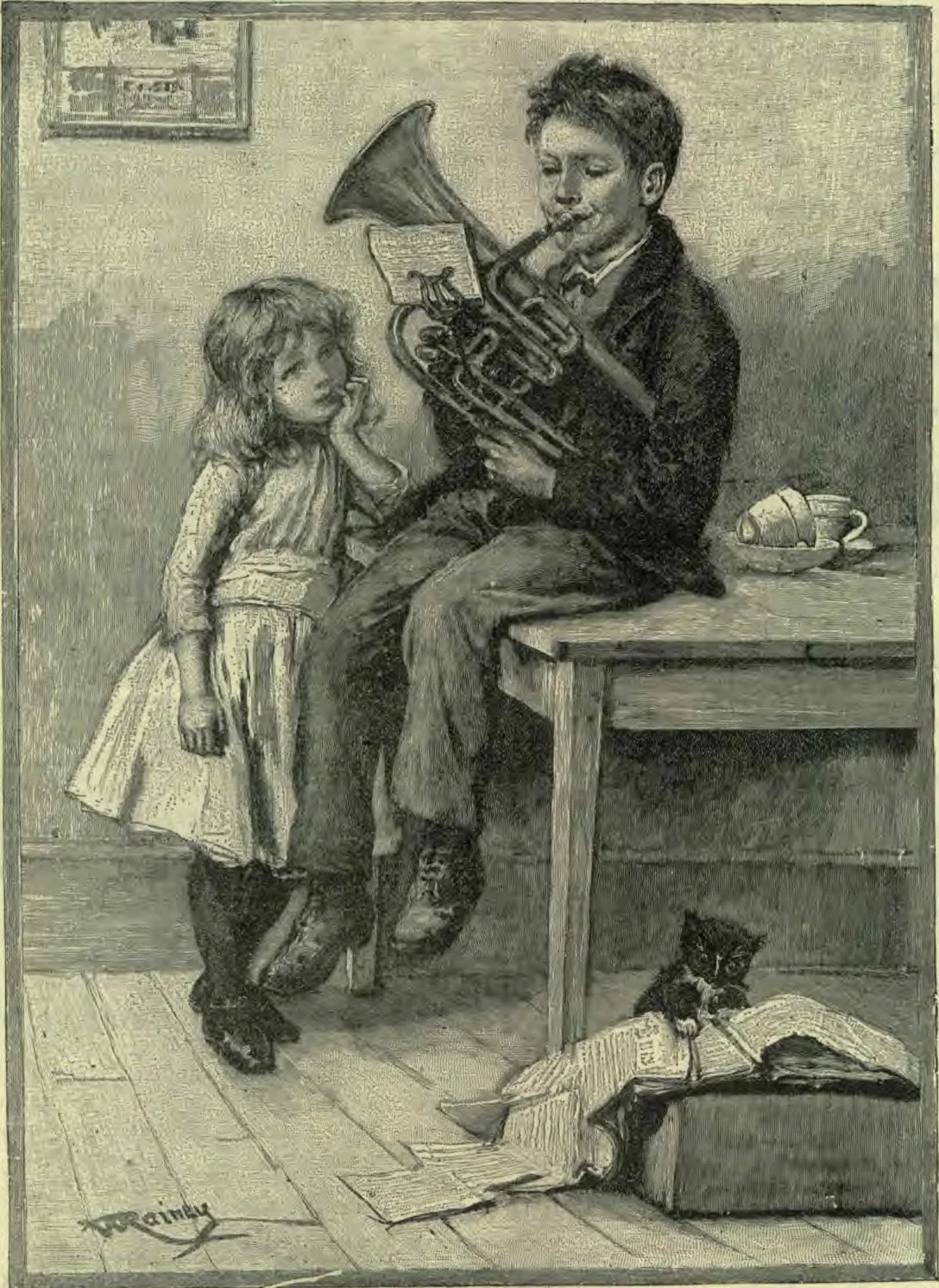
Young Bennie was tooting a wild serenade; Up and down in high glee flew the notes to the maid Who stood there entranced—gentle Mame. Ben music could read fast as a-b-c-d, And his notes—they just flew in hilarious glee.
(Said Miss Kit: "Two can play at this game!") So while Ben screeched his notes from the throat of his horn In a wild obligato, she, nothing forlorn, Scratched her notes out, as fast as they came!

PROMISING AND PERFORMING.

Years ago I was associated in school work with a very lovely young Scotch lady, whom I very soon learned to esteem most highly. I still regard her as one of the most winsome and agreeable persons I have ever met. She seemed to possess every sterling quality, and it was some time before I discovered the one grave fault that marred a nearly perfect character. She and the fair young sister to whom she stood in the place of mother, have long since passed away, and their name and place been forgotten, or I should not feel free to speak of them in this sketch.
Miss O’Connell, as I will call her (it was not her real name), taught in the literary department, while I was only teacher of music and Latin. She had a pleasant home in the outskirts of the city, with dear old grandparents, who lived on a small farm; while I had no home in the wide world outside of the boarding-hall, and no friends living near whom I could visit.
It was therefore a matter of almost envy with me when every Friday evening the old-fashioned carriage came for her and Elsie, and they drove away, not to return until early the next Monday morning.
As our acquaintance ripened into the intimacy of youth, Miss O’Connell used often to promise to take me home with her to make the acquaintance of the grandparents, who by her account of them must have been people worth knowing. The quaint, rambling old farm-house, with its weird, bat-haunted attic, of which she gave such a graphic description, also came in for a share of my longing interest; and it soon became a matter of keen disappointment that although my friend spoke of the projected visit at intervals all the week through, when Friday arrived it invariably seemed to slip her memory; and I was entirely too delicate to remind her of it. As the season for cherries and plums came round, she told of tree-climbing and fruit-gathering with Elsie, her sixteen-year-old sister, in a way that made both feet and hands twitch with longing.
Finally the long vacation took the two sisters back to the home I so much desired to see; while my elder sister and I were left to enjoy as best we could the solitude of the deserted boarding-hall, where we had decided to remain throughout the heated term.
It was therefore no small delight when, in the cool of a bright, beautiful morning, Miss O’Connell and Elsie came to invite me to spend a week with them at the old farm-house.
“Where is your vehicle?” I asked, noting that they were on foot.
“O, we left that at the market, where we took some butter and eggs for grandmother,” replied Miss O’Connell. “We also tucked a basket of June apples under the seat for you,” she added. “We wanted to be sure you should get a taste of them, in case it was not convenient for you to ride out with us. We shall be back with it inside of half an hour. Can you be ready by that time to drive out with us?”
I gladly promised that I would; but that half hour passed, and a good many more followed, before I could bring myself to believe that they were never coming back at all, either for me or with the apples; which I neither saw nor tasted,—except in imagination!
To this day I am ignorant of the hindrance, if indeed there was one. I saw the sisters but once afterward, and then they did not even mention the circumstance, much less make excuse for disappointing me; so I also did not refer to it, although I did some very energetic thinking.
Elsie soon after sickened and died, and Miss O’Connell did not return to the academy.
Subsequently the old people “fell on sleep,” and the home was broken up. Miss O’Connell returned to her native heath, and by and by she, too, died of the family disease,—consumption.
But the little incident remained indelibly fixed in my memory, and did more to teach me the importance of keeping my word than all the instruction that I ever had received on the subject; and I tell it to you, hoping to pass the impression on.
Make a business of always keeping your promises, my dears. No matter how unimportant the matter may seem,—or really be,—if you have passed your word, keep it! Let there be no thought of your doing anything else, be it ever so injurious or inconvenient to yourself. Never give a promise lightly or thoughtlessly; your word (especially if it is the word of a Christian, young or old) must be as good as your bond, every time! King David, in describing a citizen of Zion, says:—
“Who shall abide in thy tabernacle? who shall dwell in thy holy hill? He that walketh uprightly, and worketh righteousness, and speaketh the truth in his heart. . . . He that sweareth to his own hurt, and changeth not. . . . He that doeth these things shall never be moved.” HELEN A. STEINHAUER.

BEGINNING BUSINESS.

One morning little Susie Green called at Mrs. Brown’s door.
“Say, Mrs. Brown,” she said, “ma wants to know if she could borrow a dozen eggs. She wants to set ’em under a hen.”
“So you’ve got a hen that you’re setting, have you?” said Mrs. Brown. “I didn’t know you kept hens.”
“No’m, we don’t; but Mrs. Smith’s going to lend us a hen that wants to set, and ma thought that if you’d lend us some eggs, we’d find a nest ourselves!”—Selected.

THE GERMAN UNIVERSITIES.

(Concluded.)
ONE of the essentials to the idea of a university is the Lernfreiheit,—the freedom to learn,—to study or not to study, to “hear” lectures or not to hear them. If the results at the end of the student’s term of residence are satisfactory, the university puts its seal of approbation upon him in the form of a degree.
Equally important to perfect freedom of intellectual life is Lehrfreiheit,—the freedom to teach. It is in this direction that the principle of freedom reaches its best results, and exhibits its greatest advantages. The teacher is turned loose, so to speak, in the fields of knowledge, to roam where he will. He is trammeled by no traditions; there is no censorship of his work. True, he may gather tares as well as wheat; but it is believed that the truth must prevail, if only it has an equal chance. He often does gather tares. Socialism and infidelity have found the universities favorable soil; but so did the Reformation. If error finds no check, neither does truth. Both fight in the open field; the struggle is a fair one.
The venias docendi,—the call to teach,—is given to students who remain in the university several years after taking the doctor’s degree, if during that time they pursue special investigations and publish valuable results. The candidate submits a dissertation, and also announces ten or twelve propositions which he is prepared to defend against all comers. It was such theses as these which Luther nailed to the door of the church in Wittenberg. Having received permission to teach, the privat-docent announces a course of lectures or two in the university calendar, and delivers them to such as care to hear. He is guaranteed neither hearers nor pay. He must work for the former, and he is at liberty to collect the latter through the questor of the university, but he must not charge less for any given course of lectures than the regular professor. Apart from this, there is no restriction laid upon the privat-docent. He may offer the same courses that the professor does. He may compete with him, and generally does. If his lectures are better prepared, fresher, and more lucid than those of his superior, the empty benches of the latter, and the overflowing hall of the privat-docent, will proclaim the fact. In a few years, when he has published some work of striking scientific merit, he receives a call to the office of assistant-professor, with salary, in his own or some other university. If his unusual talents continue to assert themselves, he will probably end his career in the chair of a full professor.
There is free interchange between the universities both as to students and instructors. It is oftener that a professorship is filled from without than from within. Privat-docenten frequently shift from one university to another. Students very rarely remain in the same university until they graduate.
The university court is a feature unknown to the American institutions of learning. Its origin is in the middle ages. When the universities were founded, they were institutions of the church. They had the same standing before the law as the monasteries. In those times monasteries owned lands on almost the same terms as barons and earls. They exercised civil jurisdiction over their tenants just as the lords did over theirs. The universities held civil authority over their grounds and over their students, and since by another principle of feudal law the subject could not be dealt with in any court but that of his lord, no student, where the university jurisdiction still exists, can be arrested except by the beadles of the university, nor tried except by the university court. This court has full civil powers, and administers the university law as well. Its officers are members of the legal faculty. Grave offenses are passed on to superior courts, as in this country grave felonies are reported from the police to the circuit court.
This arrangement is by no means to be found in all the universities; probably the majority have done away with it. Where the custom still prevails, the carcer, or prison, is one of the most interesting places about the campus. Its walls have confined the miscreants of generation upon generation. They bear the scribbled autographs of names that history rings with. Some of the doggerel scratched upon their stones has occupied the tedious hours of princes—for the universities are absolutely democratic. At Göttingen is shown the table upon which Bismarck rested the mischievous head that was to shape the affairs of Germany, and its surface is still roughened by the carving of his name.
The candidate for admission to a German university must present a diploma of graduation from a gymnasium or Real-schule. The gymnasium is a preparatory school in which the same range of work is covered as in the average third-rate American college, though the pupils are much younger. The Real-schule differs from the gymnasium principally in devoting attention in the main to science, whereas the latter is a classical school. Foreigners, however, find admission a little easier in some of the universities. Those of Prussia are rather strict, but in south Germany they are still somewhat loose. It is not long since nothing was required for the admission of an American to many of the south German universities but his passport.
The expenses of the average student at these places is not so great as one would suppose, considering the reputation which they have. The matriculation fee averages about five or ten dollars, and the lecture courses cost, for a single course of five hours a week for a semester, or half year, about the same, and twice as much for a double course. Living expenses are low as compared with American prices. According to the latest and best authorities, the average total yearly expenses of students at German universities is from one thousand to two thousand marks, or from two hundred and fifty to five hundred dollars, which is no greater than students at most American colleges find necessary, and much less than many spend.
The immense reputation of the German universities draws students to them from all parts of the world. Many of them are Americans. In the case of our countrymen the results are excellent. American college and university faculties are filled with German doctors of philosophy, and these men seldom fail to push rapidly to the front. It is these magnificent results, and the excellent quality of the work done by these graduates, which, more than any traditional reputation, causes the American student to look to Germany as to the Mecca of the learned.
C. B. MORRILL.

THE ALASKAN GOLD REGIONS.

Last season’s yield of gold from the Yukon River district in Alaska was about two hundred and forty-nine thousand dollars, according to an estimate gathered from miners and business men in the district by the Alaska News. The returns are undoubtedly big, but the labor of getting the gold, as described by one of the oldest miners in the region, is very great. The Yukon district is remarkably difficult of access, and a great many adventurers who have started hopefully from Juneau have failed even to get near the gold region. It is an expensive journey, too. Then the character of the gold-mining and the limitations under which it must be done, have sent many fairly experienced miners back in despair.
In many districts the gold-bearing rock is twenty or more feet below the surface, and shafts must be sunk to that depth through ground frozen solid, and by a most laborious process. The prospect holes are usually about three and a half feet wide by six feet long. Enough wood must be cut to cover this space, and a rousing fire be kept up for almost a whole day before the ground is sufficiently thawed for the miner to get out about a foot or a foot and a half of gravel and soil. One man can burn a hole down about a foot a day. The work can be done only when all the surface water is frozen, otherwise it would drain into the prospect hole. In this region wells have been sunk seventy-five feet or more, all through frozen ground, and the miners say they never got below the frost line.
In other districts the work can be done only in the very brief summer,—from the middle of May until about the middle of September,—and usually for about ninety days only. In these regions the ground is not frozen so deep, and the gravel and soil can be washed from the bed rock. Flumes must be built from the creeks, and the water conducted to the claims. The bed rock is from ten to twenty-three feet below the surface, and all the overlying soil must be washed away before the gold is accessible. A working supply of water is rarely obtainable for more than ninety days of the year. Usually almost two entire seasons are consumed in this preliminary work before a sight of the gold is obtained, and the miner must have money as well as pluck to keep him going until he strikes pay gravel. The gravel needs to be remarkably rich to compensate for the arduous and tedious labor of reaching it.
The extent of the gold belt of northwestern Alaska and the Canadian Northwest Territory is still a matter of speculation. From the information brought by prospectors it is believed that the belt covers a district from seventy-five to a hundred miles wide, commencing at the head waters of the Hootalinqua River, in British Columbia, and following closely the course of the Yukon River to and beyond the Arctic Circle, a distance of about nine hundred miles. It is probable that dozens of tributary streams, as yet unmapped, many doubtless unknown, are rich in gold and silver. The vast region is practically unexplored. The mining at present going on is but nibbling on the edge of the rich region. But when the gold and silver mines are systematically opened up, it will be a region for the capitalist and not for the individual miner. The ground must be exceptionally rich in gold to pay one or two miners for working it for themselves. With capital, large districts could be worked in a systematic way, and big profits be realized. From all accounts, that is how the Yukon gold and silver region will be made to give up its riches.— Scientific American.

A NEW TELESCOPE.

ASTRONOMY was one of the earliest studies of the human race; and when we consider the distance of the heavenly bodies from the earth, it is indeed wonderful how much mankind has learned about them. But man is not satisfied; what he has learned has only increased his desire to know more of the secrets of the universe hidden so far away in illimitable space. The early astronomers had nothing to aid their vision; but the invention of the telescope has opened to the view of the modern astronomer many things that the ancients could not discover. There has been a constant increase in the size of telescopes, and at each increase of size those celestial bodies which are near enough to the earth to be magnified, like the planets of our system and the moon, are better understood by man.
In pursuance of this policy of increasing the size of the telescope, a new lens of great power for the Yerkes telescope, at Lake Geneva, Wis., has been made in Paris. The cost of this single lens was forty thousand dollars before it was brought to this country. As much more has been expended on it in polishing it at Cambridge, Mass. It is now about ready to be sent from Cambridge to Geneva. A special palace car will be provided for the lens and for those who have it in charge. The lens is forty inches in diameter, three inches thick in the middle, one and one-quarter inches at the outer edge, and weighs twelve hundred pounds. Despite its great thickness it is very fragile, and must be handled with the greatest care.

HOME, SWEET HOME.

Though parting sorrow bids us weep, Who from afar have come; Though many ties of friendship dear Have joined us in our sojourn here; Yet, when vacation's drawing near, We long for "home, sweet home."
Then fancy flies to those bright vales Wherein we used to roam— A land of love and dreamy thoughts, Of shimmering meads and shady spots, Of coolest, greenest, grassiest plots, O land of "home, sweet home"!
A spot that greets the wanderer, And bids him cease to roam— Our hearts turn back instinctively To that dear land of Used-to-be, Where all sounds blend in melody— Enchanted "home, sweet home"!
And when on summer eve we stroll 'Neath heaven's starry dome, We seem to hear the voices sweet Of those we daily used to greet Allure us back, again to meet In rare old "home, sweet home."
So, when we pore, at close of day, O'er some dull, musty tome, Why wonder that the time seems drear, And duty all devoid of cheer? Why wonder that we shed a tear For distant "home, sweet home"?
Ah, yes! where'er our pathways lead,— O'er land or ocean's foam,— Whate'er our sorrow, joy, or care, Whate'er the trials we must bear, Oft will we send to God a prayer For precious "home, sweet home."
Though here sweet nature smiles anew Where'er our steps may roam, Though kindly are the summer skies, And every beauty greets our eyes, Still, next our heavenly home, we prize Our dear old "home, sweet home."
L. T. Curtis.

HIS VERSE.

Years ago, when albums in which friends and acquaintances, and sometimes even strangers, were asked to “write a few lines” were scattered abroad through the land, many amusing specimens of impromptu versification found their way into print.
A clever writer, who was paying a short visit at a farmhouse, was handed by the daughter of the house a superannuated account-book, ruled for pounds, shillings, and pence, which had been converted into an album, and in which she requested him to “write something funny.”
He complied with her request by penning the following verse, which, after some bewilderment, she managed to read:—
£ s. d.
This world's a scene as dark as Styx,
Where hope is scarce worth 2 6
Our joys are borne so fleeting hence,
That they are dear at 18
And yet to stay here many are willing,
Although they may not have 1
— Youth's Companion.

BIRTH OF A HYMN.

In 1819 Reginald Heber, then a young man, and rector of a Shropshire church, went to pay a visit to his father-in-law, Dr. Shepley, the vicar of Wrexham. On Sunday, Dr. Shepley was to deliver a discourse in behalf of foreign missions, and on the previous afternoon he sat chatting upon the theme with a few of his friends. He knew of Mr. Heber’s gift in rapid composition, and suddenly said to him: “Write something for us to sing at the service to-morrow morning.”
The young man retired to another part of the room, and soon appeared again with three verses beginning with that familiar line, “From Greenland’s icy mountains.” He had made no change in them, except to alter “savage” in the seventh line of the second verse to “heathen.”
“There, there,” coolly remarked Dr. Shepley, on hearing them, “that will do very well.”
Mr. Heber was not satisfied. “No, no,” said he, “the sense is not complete.”
In spite of his father-in-law’s earnest protest, he withdrew again, and then returned to read the triumphant stanza:—
“Waft, waft, ye winds, his story, And you, ye waters, roll, Till like a sea of glory It spreads from pole to pole; Till o’er our ransomed nature The Lamb, for sinners slain,— Redeemer, King, Creator,— In bliss returns to reign.”
“What shall we sing to it?” said Dr. Shepley. Mr. Heber, who had a fine musical ear, suggested a popular air called “‘Twas When the Seas were Roaring.”
The others agreed in liking his choice, and next morning the people of Wrexham sang for the first time the words so familiar to our ears. The air has given place, in our American churches, to a tune composed by Dr. Lowell Mason. Tune and words are wedded to each other, and will probably never be separated. As for Reginald Heber, he sailed for India in 1823, and died there after three years of patient and loving toil among the heathen.— Youth’s Companion.

FOREIGN TITLES FOR CASH.

THE great eagerness of many American ladies to secure foreign titles is well known. It has been said that the Italian count and the Polish prince are not above picking cigar stubs from the gutters of American cities, and smoking them; but that of course is when they cannot get an American lady who will support them in better style. A foreign count has lately announced a novel way of getting rich, and at the same time giving ladies of small means an opportunity to secure a title. He will sell tickets of himself for a rouble a ticket until he has sold a million; he then will draw a ticket at random, and will give himself and title to whatever lady shall be lucky(?) enough to have her name drawn. That American ladies, or ladies anywhere, have by their anxiety for a title given occasion for such a ridiculous proposition as the above, is sufficient evidence of the follies that prevail in this time.

STATE HOME FOR MAIDEN LADIES.

THE State of Kentucky will build a home for aged and dependent women who have never been married. Many would-be funny comments are made upon this plan, but there is a serious side to this question which all have not given attention to. It is said that there are four hundred thousand unmarried women aged from forty to sixty years in the United States. Between the years 1860 and 1865 six hundred thousand men lost their lives in war, ninety-five per cent of whom were single men. It can readily be seen that if these men had not been killed, the larger part of them would have had wives and families, and the number of single women would be proportionally less. Many a gray-haired woman to-day well knows why she never was married. It is because the one she hoped to marry marched away to the sound of fife and drum, and never returned. The patriotism of both was stronger than love. This is the way the State of Kentucky looks at it, and in the erection and maintenance of this Home, the people of Kentucky feel that they are discharging a duty owed to those who gave up their dearest for the defense of their country.

THE TRANSFORMING LIFE.

EVERYBODY knows something of the power of life. A tree growing up in a crevice will displace tons of rock. Spiritual life is not only infinitely persistent; it is infinitely transforming. A line of an almost inspired poem speaks of the glory of Christ “that transfigures you and me;” and the best church is one in which souls are in close touch with souls and with the Master. Our mission in the world is to be torch-bearers; to carry the sacred fire. We are to be like him who is in the midst of the golden candlesticks, and holds the stars in his right hand. Christians may kindle other stars, till the whole sphere of earth is filled with this heavenly glow. “In him was life; and the life was the light of men.” When we translate the Christian life, it is power. Before it all other forces must give way. We are always thinking of organizations and majorities. We speak of strong and weak, of large and small; but we forget something. The lifting power is not dynamite; it is life. We are not bidden to make a noise. We are commanded to be alive. To fulfil our office in a world and a time like this we have only to possess and put to proof “the powers of the world to come.”—R. A. Sawyer, D. D.

You have reached the end of this edition.

The Youth’s Instructor · Jun 27, 1895