Your ShelfYour Projects

Signs of the Times, Vol. 41, No. 34.

EIGHT HUNDRED THOUSAND AUTOMOBILES
Earlier text: Pertinent Facts Regarding the Wine Grape Industry

No Drunkard Will Be There

By A. O. TAIT Editor "Signs of the Times"
No drunkard who neglects or refuses to be reformed will ever have eternal life. Of this there can be no question, for we read:
"Know ye not that the unrighteous shall not inherit the kingdom of God? Be not deceived: neither fornicators, nor idolaters, nor adulterers, nor effeminate, nor abusers of themselves with mankind, nor thieves, nor covetous, nor drunkards, nor revilers, nor extortioners, shall inherit the kingdom of God." 1 Cor. 6: 9, 10.
Observe particularly that "drunkards" are in the list of those who will not "inherit the kingdom of God." The apostle warns us to "be not deceived" in this matter. There is no appeal from this statement. The supreme Judge Himself declares it.
If we are tempted to think that the judgment is harsh, let us meditate for a little time on what strong drink does. Let us consider the murders, the thievery, the outraged chastity, and the wickedness of every other kind for which it is responsible. Let us think of the untold sorrows and suffering it has brought into the world. With all the evils of drunkenness before us, are we not glad that it will not be perpetuated in the world to come? No drunkard gets beyond the confines of this sinful life.
With these facts before us, how awful it is to think of perpetuating the drink traffic! What a terrible thing it is to assist in maintaining a business that not only ruins men for this life, but which cuts them off from all hope of a life beyond!
We should think of this matter very seriously before continuing to give our influence, either by our vote or otherwise, to the drink curse.
Men may advance their opinions upon this subject. But let us "be not deceived." God has spoken with authority, and His word is that no drunkard shall inherit the kingdom of God.

Responsibility of Parents

By HENRY S. SHAW
In Baby's Milk—From Mother's Hand
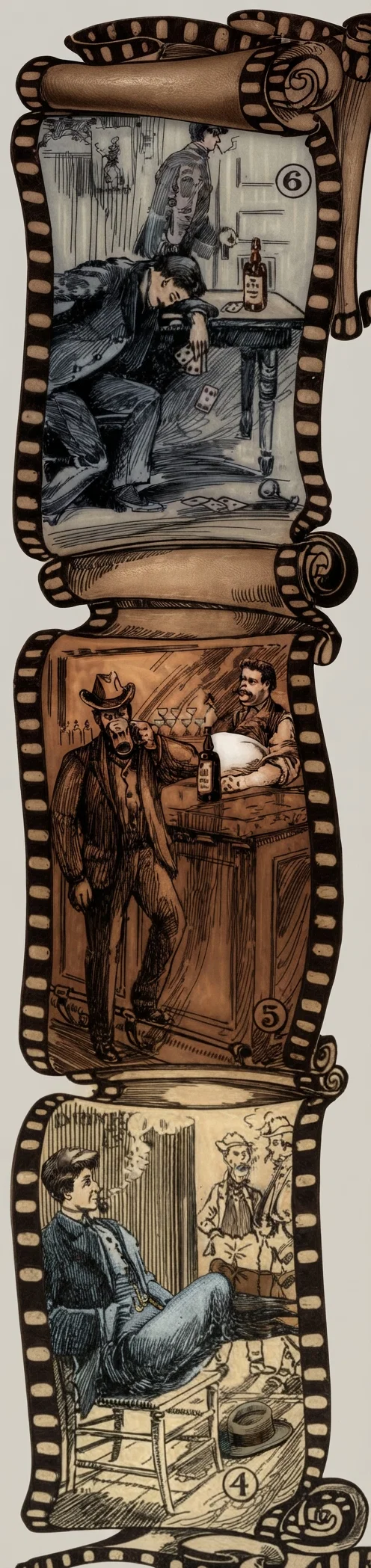
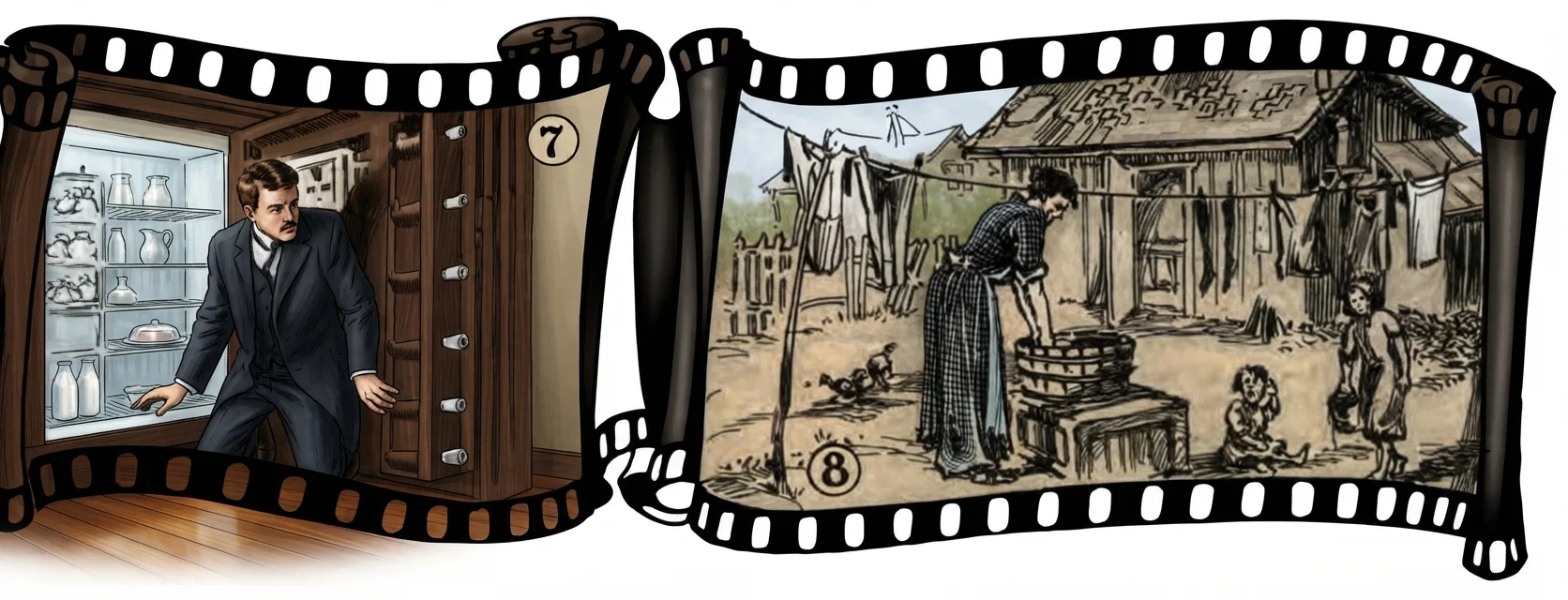
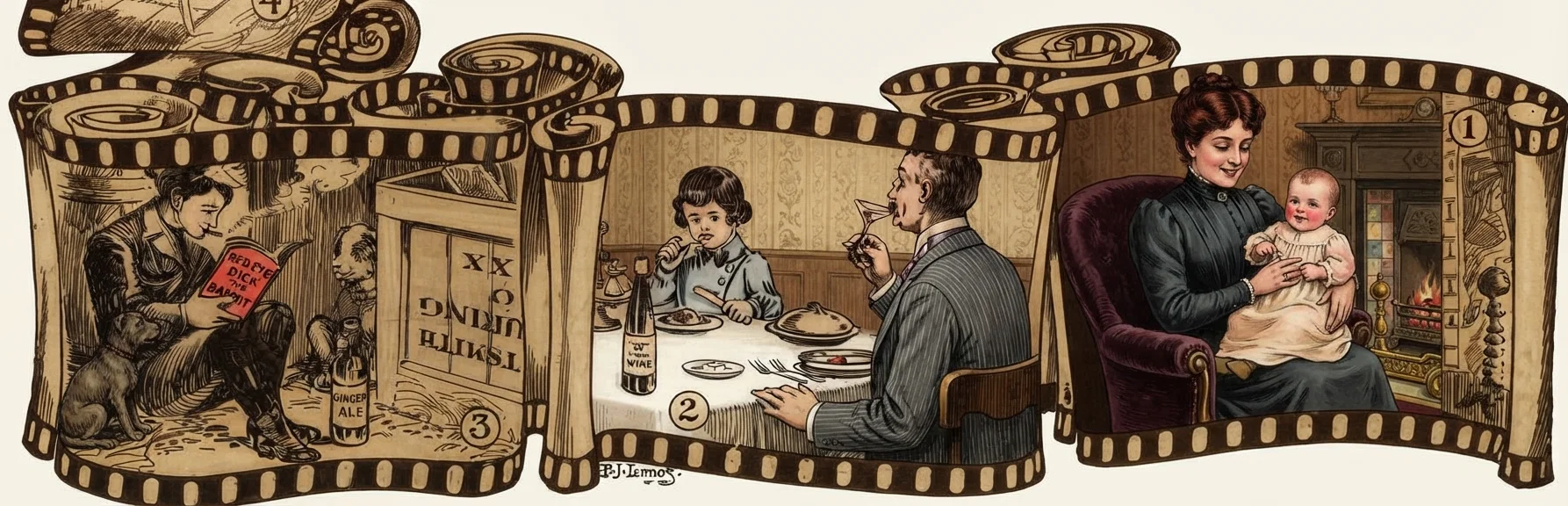
Suggestions for the arrangement of daily scenes in a film-strip drawing.
"WINE is a mocker, strong drink is raging: and whosoever is deceived thereby is not wise." Prov. 20: 1.
In their natural state, fruit juices are wholesome and nutritious. They are the life-blood of the fruit. The process of fermentation perverts the life, poisons it, and converts into the elements of death.

Whisky in Baby's Milk

Many fathers and mothers do not know this, and hence do not appreciate what is involved when they place the sparkling cup in the way of their sons and daughters. Not long ago a young man and his wife, with two small children, occupied a berth opposite mine in a railway sleeper. The children were fretful from the effects of the journey. The mother poured a large draft of whisky into each of the bottles of milk she had prepared for the babies, and gave them to them.
Soon both of the children had fallen into a deep sleep, and they remained in this drunken stupor for more than twelve hours. Being shocked by the circumstance, I talked with the parents about it. They said the practise was a common one where they lived. It is a custom, in many homes, to "soothe" the children with brandy or whisky or some other deadening drug, to keep them quiet.
Is it not time for every home to be made a wall of defense around the sons and daughters of this generation, to shield them against the inroads of the liquor habit? It is not enough simply to sing songs about temperance, and write about it, and attend temperance rallies. These are all good, and will do good, but the home is the fortress where the father and mother and their children must take their stand.

Mother Did It

"Tell me," said a gentleman to a poor drunkard, when urging him to give up the intoxicating cup, "where it was you took your first step in this intemperate course." "At my father's table," replied the unhappy young man. "The first drop I ever tasted, was handed me by my now broken-hearted mother." These parents were deceived. "Wine is a mocker, strong drink is raging: and whosoever is deceived thereby is not wise."

Why Don't You Join the Procession?

By MRS. L. D. AVERY-STUTTLE

Why Don't You Join the Procession?

A Sketch from Real Life

"WHAT makes you stand there? Why don't you join in the procession, mister?"
The man addressed turned his head. He was watching the long line of temperance people march down the street, with banners flying and drums beating.
Just before him stood a very little boy, his toes protruding from his shoes, his hands blue and bare, and his ragged coat flapping in the cold November wind.
"Why don't you join in the procession, mister?" again queried the child. "The 'drys' are doin' their best to help us out, don't you see? Why don't you join 'em?"
The man glanced curiously at the ragged mite of humanity before him, pulled his fur overcoat a little closer about his form, and replied carelessly: "Why, you see, kid, I don't join in the parade because the fact is I don't belong to the 'drys.' I vote the 'wet' ticket."
"You do?" questioned the shivering child, giving the man a glance of astonishment. "You don't look like it, one single bit," he continued, eying the warm, fur-lined overcoat and the spotless gloves.
"Why?" queried the gentleman, whose curiosity was becoming aroused. "Why?"
'Cause you don't look like my father. He votes 'wet,' too, and he wears rags. Mother says if he'd vote 'dry,' and stick to it, we could have warm clothes and good things to eat at our house. I wish he would," concluded the little preacher wistfully. "Don't you?"
"Why, of course I wish so, if it would help you any, my little man; but don't you see, sonny, that it would make hard times for everybody, if all the saloons were to shut up! Now you don't want any harder times than these, do you?"
"No, mister; but I don't believe the times would be any harder at our house, if father would only work, instead of stayin' at the saloon all day, and spendin' all he can get hold of on whisky. That's what I think," declared the child, turning his blue, pinched features a little more to the slanting light of the dim November afternoon.
"Yes, child, it may be so. But don't you see, if all the saloons were closed, there would be ever so many men out of employment, and then—"
"I don't know anything about the other men, but I know this much,—if the saloons was all closed, my father couldn't get in, and so maybe he would go to work. Mother thinks he would; and O, say, mister, she says, if the 'drys' beat this year, it won't be but a little while before she can get me a new suit of clothes! Don't you think I need 'em?"
The man brushed the back of his hand across his eyes, and remarked something about their being a little weak.
"Say, don't you think you'll vote 'dry' this year, mister, after all? 'Cause I want them new clothes so bad—do you see?"
"Yes, yes, I do see, my little man; and God helping me, I have cast my last vote in favor of the accursed traffic that takes the very clothes from the backs of helpless children, and food from the mouths of the hungry."

What Would You Do?

What Will You Do?

By ADELAIDE BEE EVANS
If kidnapers were carrying away the children of our town to hold them for a ransom, if wild beasts were infesting the paths they must take on their way to school, if wide-spread contagion threatened them with blight and deformity, what would happen? What would you do?
What occurs when one child is lured away, lost to its mother's caresses, its father's love?—Ten thousand voices are at once raised in its behalf; ten thousand pens take up the cry; all the machinery of the law, every agency at the command of the state, is set in operation to restore the child to its parents, and to punish those who through it have sought to enrich themselves.
The alcohol evil is particularly the enemy of the child—an enemy so cruel, so destructive, so blighting, that it should be fought by every means within the power of home-loving, child-loving men and women. It must be reached by strong laws; it must be antagonized and overcome; it must be bound and cast out. What will you do?

Alcohol and the Nervous System

By GEORGE THOMASON, M. D.
Medical Superintendent St. Helena Sanitarium, St. Helena, California
WHEN alcohol is taken into the body, there is no tissue that escapes its baneful influence. The more highly organized the tissue, the more susceptible it is to any poisonous agent. Therefore for the delicate cells of the nervous system alcohol has a special predilection. The more highly developed the instruments of precision for measuring the effects of alcohol upon the tissues, the more apparent it becomes that abnormal functions of the glands and organs, and irritation and degeneration of the cells of the body, are induced by even so-called moderate quantities of alcohol.

Alcohol and the Flow of Words

Because of the more ready flow of words following the imbibing of alcohol, there is a misconception that alcohol is a brain stimulant; but this result can be explained entirely upon the basis of paralysis. One of the very highest centers in the brain is the inhibitory center. The power of inhibition is the first to be paralyzed by alcohol. Thus the power to make the finer discriminations is gone, and the power of judgment and reflection disappears.
It is seldom that any conception of an alcoholized brain will bear the test of sober thought. Professor Cushney, a prominent authority and author, says: "Even the smallest quantities of alcohol tend to lessen the activities of the brain, the drug appearing to act most strongly, and therefore in the smallest quantity, on the most recently acquired faculties, to annihilate those qualities which have been built up through education and experience — the power of self-control and the sense of responsibility."
Upon this point, Dr. Tanci says: "Even in small doses alcohol exercises a paralytic action upon the higher psychic faculties. Inhibition, in its more complex and elevated manifestation — judgment, modesty, reserve, shame, and prudence — becomes weakened and suspended. Action follows thought with greater promptness but less deliberation."
Professor Krepaelin, who has for many years been an indefatigable experimenter in connection with the effects of alcohol upon the body, determined that eighty grams of alcohol — the amount contained in an ordinary bottle of wine — used each day for twelve successive days, lessened the working capacity of the mind from twenty-five to forty per cent. He found, further, that in some cases the power to memorize was reduced as much as seventy per cent.

Is Never Sober

Professor Aschaffenburg, commenting upon these experiments, points the obvious moral that the so-called "moderate drinker" who consumes his bottle of wine as a matter of course each day with his dinner, and who doubtless would declare that he is never under the influence of liquor, is, in reality, never actually sober from one week's end to another. Neither in bodily nor in mental activity is he ever up to what should be his normal level.

Terrible Effects on the Nerves

The terrible effects of alcohol upon the nervous system are strikingly apparent in the brain degeneracy it produces, as evidenced by insanity. In the past fifty years, insanity has increased in this country more than three hundred per cent. There are now more than three hundred thousand insane patients confined in the asylums in the United States — more than are to be found in all the colleges and universities in the land. The writer was recently informed by a prominent judge of California that in his many years' experience he had taken pains to ascertain the reason in each case where he was obliged to commit a patient to the asylum, and that he had found that alcohol was the cause of the insanity in sixty per cent of cases. Statistics gleaned from all parts of the world show positively that at least fifty per cent of all insanity is due to alcohol.

Alcohol and Feeble-Minded Children

One of the most unfortunate effects of alcohol is its hereditary effect. This is manifested, so far as the nervous system is concerned, in the production of idiocy, imbecility, St. Vitus's dance, infantile convulsions, and epilepsy. The vast multitude of these unfortunate and helpless victims appeals loudly for relief and deliverance. In England and Wales there are 125,000 feeble-minded children confined in institutions for this class of cases. Of these, 85,000 are physical as well as mental cripples. There are more than twice this number thus afflicted in this country. Investigation of 2,552 cases of such children at an institution in France developed the fact that forty-one per cent of the cases were the result of alcoholic parentage.
The Late Prof. Forbes Winslow, of England, during his life one of the greatest of authorities on nervous and mental diseases, said that when both the father and the mother were given to drink, the children were destined to become either drunkards, criminals, or lunatics.

A Decided Contrast

An investigation of ten alcoholic families has shown the following: There were fifty-seven children produced, of whom ten were deformed, six were idiotic, six had either St. Vitus's dance or epilepsy, twenty-five were still-born, and only ten children, or about seventeen per cent of the whole, were normal.
The ten abstaining families produced sixty-one children. Two were deformed, two were pronounced backward, although not suffering from disease, three were still-born, leaving fifty-four, or more than eighty-eight and five tenths per cent, normal.
A nation's greatest asset is its children. It is an inalienable right of every child to be well born. No man or woman has a right to form any habit without first considering its possible effect upon his or her offspring.
Compared with the consuming, degenerating, body and soul destroying results of alcohol, the financial and every other consideration connected with the liquor traffic sink into insignificance. The physical effect alone, upon both the parent and the child, is a tremendous appeal for a blotting out of this nefarious business in all territory of our country yet stained and polluted by the production of physical degenerates and moral perverts through the maintenance on his throne of King Alcohol.

Alcohol Not Needed in Medicine

By W. B. HOLDEN, M. D.
ALCOHOL is diluted and used for sponge baths. The alcohol does no good; it does no harm. Its discontinuance would work no hardship. A tepid sponge bath of warm water is just as efficient.
Alcohol is used to disinfect the surgeons' hands and the patients' skin before operations. There are many methods of disinfection equally good. Hence alcohol for this purpose is not an essential.
Alcohol is used in the preparation of many medicines. The tinctures and fluid extracts of medicines have from ten to twenty-five per cent of alcohol to preserve and keep the active principles in solution. As the dose of most fluid extracts and tinctures is from five to fifteen drops, the one to three drops of alcohol is quite inconsequential. The alkaloids and active principles of medicines can be more accurately administered in pill and tablet form.

Being Rapidly Discarded

Alcoholic preparations of medicine are rapidly being discarded by even those physicians who still rely largely upon drugs as curative measures. One of America's largest pharmaceutical houses confines its operations almost exclusively to the dry preparation of medicines. The elimination of alcohol in medicinal products would be no calamity.
Alcohol in the form of brandy, whisky, wines, and beer is used by many physicians for a great variety of conditions.
It is true that alcohol to the amount of about three ounces a day may be oxidized in the body. Gunpowder can be oxidized in a cook stove, but that does not prove that it makes a safe and satisfactory fuel.
The history of alcohol has been one of delusion, and its reputation for value in disease is only another illustration of its delusional qualities, in that it has deceived a large body of investigating men. However, many of the world's foremost physicians condemn the use of alcohol.

It Makes the White Blood Cells Drunk

Alcohol in medicinal doses lowers the resistance of the body to infection. The white blood cells are one of the body defenses against invading germs. The white blood cells will attack and destroy the bacteria. Alcohol definitely injures the white blood cells, and is as disastrous as drunkenness in an army on a battle-field. There is no physiologic action of alcohol that can not be duplicated more safely and more effectually by other means.
Should the absolute prohibition of alcohol in medicine be realized, the following effects would be noted: A considerable number of physicians would feel themselves hopelessly crippled; others would soon find substitutes that are better; many would never miss it; and the patients of all would be benefited.

"Dry" Pasadena

From an address by Pasadena's Board of Labor to the members of organized labor.
TO-DAY the amount of beer and other liquor consumed by the working class of this city is almost negligible, and would be still less if it were not that we are located but ten miles from Los Angeles, with its wide-open saloons.
But even with this disadvantage, our wage-earners' money—in some localities ordinarily spent for liquor—is used in our homes, on articles of necessity for the family.
Our wives and children are better fed, clothed, housed, and educated, and in all respects our men are better sons, fathers, and citizens.

Prohibition and Natural Rights

By HAMPTON W. COTTRELL
THE argument adduced most persistently by the men engaged in or in sympathy with the liquor traffic, is that to prohibit such traffic by civil law is an invasion of their personal liberty. But not so. Such conclusion, though apparently logically drawn, is deduced only by reasoning from the assumed premise that they have a natural right, for monetary gain, to engage in such business, notwithstanding alcohol is a cumulative poison to the consumer, and dethrones his reason, and hurls him to an untimely physical death and to an eternal loss of soul.

No Right to Poison Another

Among man's inalienable gifts from God are life and the normal use of mind. Surely no man has the inherent right to poison to the death his neighbor, his brother, or himself.
Men have, for monetary gain, poisoned other men with strychnin, bringing them to sudden death; but all recognize that no one has a right so to do. Yet other men, for monetary gain, are administering cumulative poison through this nefarious liquor business, to men and women morally helpless, and to many of the morally unestablished young men and women of our country, who also are powerless to stem the flood-tide of alcoholic environments.
Civil government should surely suppress this great menace to society. This is a part of its first duty to its citizens; for civil government was ordained of God to protect every man in the enjoyment of his inalienable rights, and to punish as a criminal the invader of any of these rights.

Ordained for No Such Purpose

Civil government never was ordained to legalize traffic in the bodies and souls of the boys and girls of our land; and as the personnel of that civil government would not have their individual rights wrenched from them, they should not, by legalizing this great system of evil, trench upon the rights of other men to remain sober.
Natural rights are God-given. They are neither created by man nor imparted by him to his fellow men. The primary object of civil government is to secure to every individual his inherent rights. Thus, and only thus, is protection assured to the household against a drunken, debauched husband and father; to the weak against the strong; to the minority against the majority.

Invading Rights of Women and Children

To legalize the traffic in alcoholic liquors is to give national life to a great evil, and is an invasion of human rights, which God ordained civil powers to protect. Any person who engages in the nefarious liquor business, be it legalized or not, is surely trespassing upon the natural rights of the wife and children of the consumer.

Has He a Right to Create Murderers?

The man who manufactures alcoholic liquors, or engages in any way in the business, should query with himself: "Has any man a right to deprive me of life, or of reasoning faculties? Has he a right to take these natural gifts from my wife or from any member of my family? Has he a right so to poison me, even by a cumulative method, that I will be crazed, and will bring degradation and perhaps death to some of my own dear ones, or blast the happy home of my neighbor?" Has any man this liberty?
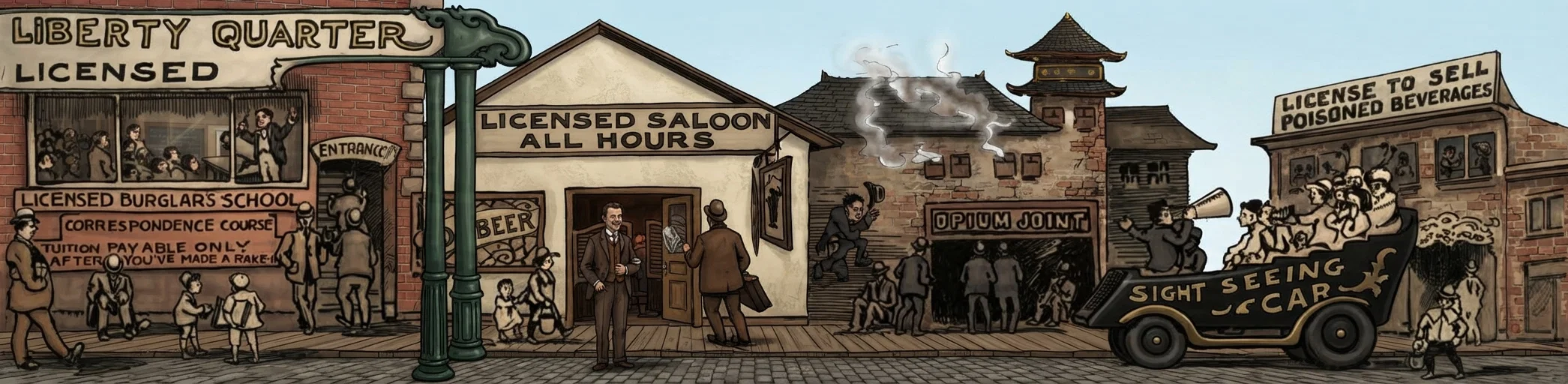
The state has no God-ordained right to license the liquor traffic; and no man has the right to deal out to his fellow men, even though the state grant him license so to do, the blasting, death-dealing poison.
Let all who believe in inherent, equal rights for all men, join hands at the polls in November, in every state where temperance is the issue, and by the ballot strike the demon alcohol upon the head, and put it forever out of commission, and thus protect the weak inebriate, and his helpless wife and children, and save the many downward-tending boys and girls.
We may say of alcohol personified, that he is an intruder. He thrusts himself upon many people and into the lives of many helpless ones, uninvited and unwelcomed. He is a demon. He visits only to destroy; and in the language of the prayer of another, "may it be banished beyond the bounds of time and space, into some unknown place, there to feed on the dry buds of nonentity, throughout the endless ages of eternity."
Every true lover of liberty should vote for the banishment of this invader.

What Prohibition Has Meant to Kansas

By GOV. GEORGE H. HODGES

For Thirty Years in Kansas

WHAT has thirty years of prohibition done for us in Kansas? The geography of years ago pictured Kansas as the great American Desert. Hardly a desert now, with thirty-four million acres in cultivation!
Very little indigence in Kansas, with an average of $132 on deposit in our banks for every person in the state! We have $3,000,000,000 worth of property on the tax-roll, assessed on not to exceed seventy per cent of the actual cash value of our resources. Our citizens pay taxes on $1,765 each, a little over $100 more than they paid on a year ago, even though last year was the worst drought season in our history.
Our agriculturists use the best for their own tables, and a plentiful supply of that; but after using all the butter, eggs, and poultry needed, they sold $22,000,000 worth last year—just a little revenue of $7,000,000 more than this government paid for about a third of the total acreage of these United States, the Louisiana purchase.
A great many of our farmers are complaining because they can't pay off their mortgages till they become due. They have decreased their recorded indebtedness from fifty-five per cent to forty-five per cent in the past ten years. At the same time, they have boosted the home-owned securities from $13,000,000 to $67,000,000. The men who own six million head of live stock think none the less of their carriage teams and saddle horses because they now own 35,000 automobiles, one to each forty-five persons in the state.
Every year our state creates new wealth; last year, a wealth of $2,000,000 a day was the record.
With a population of 1,690,000, we have an enrolment of 9,600 students in our state universities, and 7,500 in our denominational schools. Six thousand students attended our state university and agricultural college last year. This is a remarkable showing when compared with Missouri, which has 3,500,000 population and only 3,317 students in her university and agricultural college. Indiana, with about the same population, has 1,961 students in her combined schools.

Few in Jails and Penitentiary

We have only 724 inmates in our state penitentiary, only twelve of whom are women; while Colorado, with half our population, has 800. We have 214 boys in our state reformatory, and a vast majority of the inmates of both penal institutions were transient in our state when they committed their crime. In fact, in our state reformatory we have only eighty-four Kansas boys. The others were residents of other states. And in our Kansas penitentiary we have 152 native Kansans, and the remainder were citizens of other places, or those who had acquired a residence in Kansas.

Whole Counties Without Poor-Farms

Eighteen counties have no poor-farms; and one of our best counties, Barton, has no use for its poor-farm, but turns it into an asset by renting it. Twenty-nine counties have no inmates in their poor-farms. We had only 625 paupers in the state last year, and they are cared for in the poorhouses of seventy-six counties.
Our state has a total bonded indebtedness of $370,000, held by the permanent school fund. We have $169,000 of that indebtedness in cold cash already accumulated, and will have the balance ready to meet the obligation long before the obligation is due.
We boast of no millionaires, though we have billions of wealth, but a cleanly earned wealth more equitably distributed than that of any other state.
Something has contributed to our wonderful prosperity. Something out of the common run of affairs has given us a fifteen per cent increase in our population in the past few years, while older Middle Western states have practically stood still. We have analyzed ourselves, and we are satisfied that prohibition is largely responsible.

Prohibition and States' Rights

Some object to federal enactments, basing their opinion upon states' rights. The same objection was offered when the problem of slavery was being solved. The proposition that national prohibition is contrary to the whole spirit of our government, sounds like the slavery arguments of seventy-five years ago. Human rights and the welfare of humanity must have preference in the settling of the liquor question.
States' rights must not be permitted to interfere with or stand in the way of human rights, of moral rights and better citizenship. States' rights is a lame contention when balanced against the rights of mother and family, and against an endeavor that can only bring a better condition for the human race.

What to Do with the Distilleries

JUST a suggestion: In the enormous and accelerating increase of automobiles, auto-trucks, motorcycles, and their like, it is greatly feared that the supply of gasoline will run short. Why not supply denatured alcohol? It can be made cheaper than the pure spirits, made of anything that contains starch and sugar, made at a profit so as to compete with gasoline. There is no government duty on denatured alcohol, and it can be made for from eight to twelve cents a gallon. Use the distilleries to help along in life rather than to hinder; to help lift burdens and carry loads rather than to make them.

A Universal Public Menace

By F. L. HOMMEL
EVERYWHERE men are realizing more and more the great barrier the liquor traffic presents to advancement.
In the several provinces of the Dominion of Canada there is evident a great consensus of opinion that the bar is a public menace, and that every man ought to help in the effort to abolish it. In the name of decent civil government, and for the sake of humanity, the manufacture and sale of this destroyer of the race should be banished.
As stated by the Hon. Lloyd-George:
"Wherever you find these poor creatures whose brains are shattered, wherever you find human beings huddled together in wretchedness, wherever you find men living in a condition of vice and crime, they all bear testimony that drink is the prime agency in the creation of all these unsightly masses of pain and degradation; and I say this,—that the government would fail abjectly in its duties if, through any base fear of any force or combination of forces, they would shrink from doing all in their power to cut from the social organism this most malignant growth that drains the vitality of the nation."
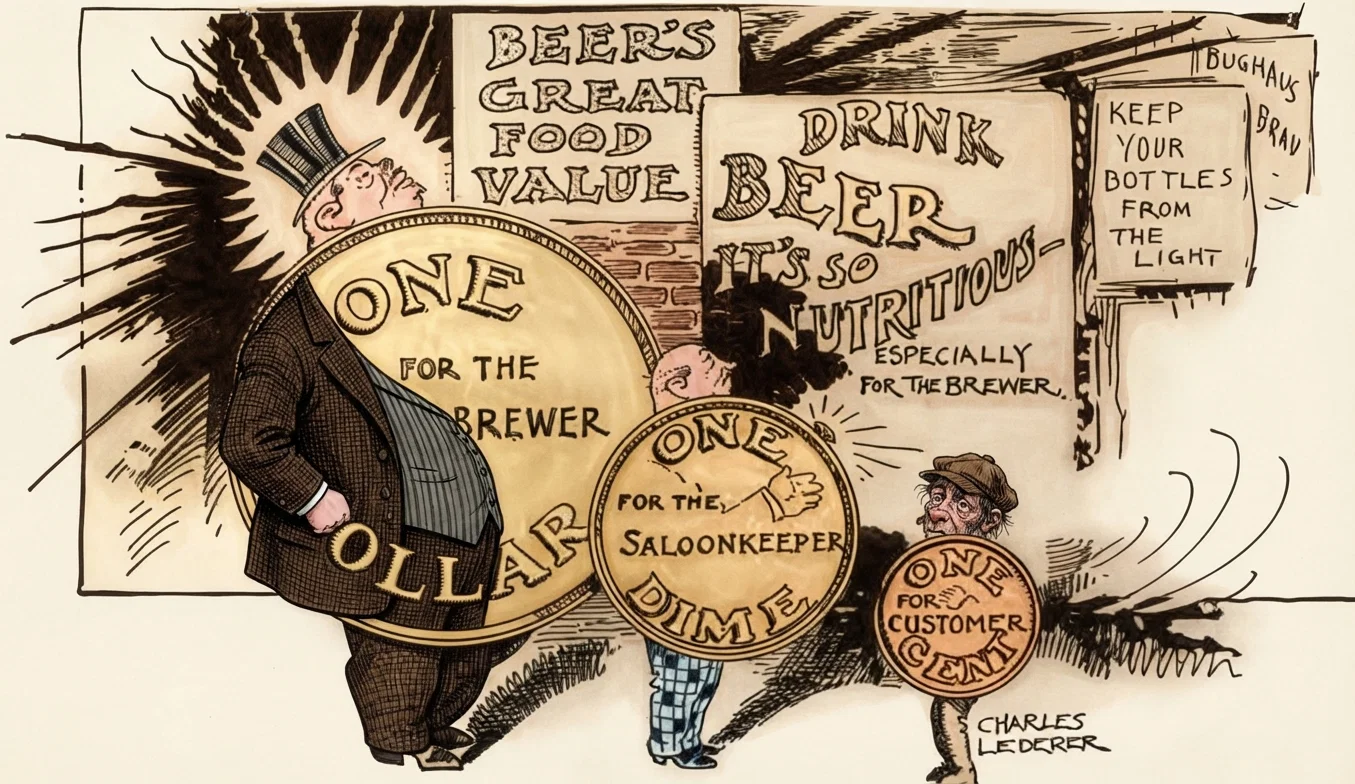
The consumer gets one cent of nutriment out of the $1.10 paid for beer, besides the poison. It was all in his pocket at first.
The latest statistics show that Canada has fourteen distilleries, twenty-eight malt-houses, sixty-four breweries, seventy-two tobacco manufactories, two hundred sixty-one cigar factories; and the numbers are still increasing. In a recent year there was in Canada an expenditure of $28,936,782 for liquor, $25,329,323 for tobacco, a total of $54,266,105.
It is said that this sum would cover the entire cost of operating our nine provincial governments for the same period. It would pay all the expenses in connection with the administration of justice; build our roads and bridges, wharves and ferries; provide bounties for hospitals; maintain asylums for the care of the insane; sustain the educational department; and pay all other expenses incurred in maintaining our nine provincial governments within the dominion; and would leave a surplus of more than $14,000,000, which would be sufficient to provide thirty-five thousand families with $400 each.
In view of this portrayal of facts, it must be self-evident that something should be done to arrest this condition of things and bring about a rapid and decided change.
Organized plans are being made for a strong campaign for temperance reform. Already the cause of temperance is gaining strength in Alberta, British Columbia, Manitoba, New Brunswick, Nova Scotia, Ontario, Quebec, and Saskatchewan. Many noble men and women have declared themselves determined to unite in a desperate effort to save the fair land of Canada from the curse of the liquor traffic.
In the Dominion Parliament the matter of temperance has been agitated by good men again this year. The papers say that the "Dominion Parliament was a few weeks ago given some figures of the liquor traffic in Canada that were of such serious proportions, that the minister of inland revenue was asked to furnish all the data at the disposal of his department in relation to the output of breweries and the consumption of liquor in general, so that if at all possible, Parliament might have an opportunity to consider seriously the whole question, not only in relation to excise, but also from the standpoint of the well-being of the Canadian citizen-hood."
Thank God for noble men and women whose natures revolt against the flood of intemperance that threatens the safety of their sons and daughters, and who are rising up in the name of the Lord to stand bravely in defense of the glorious cause of temperance.
Continue reading: What Governors of Various States Say