Your ShelfYour Projects

Signs of the Times, Vol. 41, No. 34.

EIGHT HUNDRED THOUSAND AUTOMOBILES
Earlier text: EIGHT HUNDRED THOUSAND AUTOMOBILES

Pertinent Facts Regarding the Wine Grape Industry
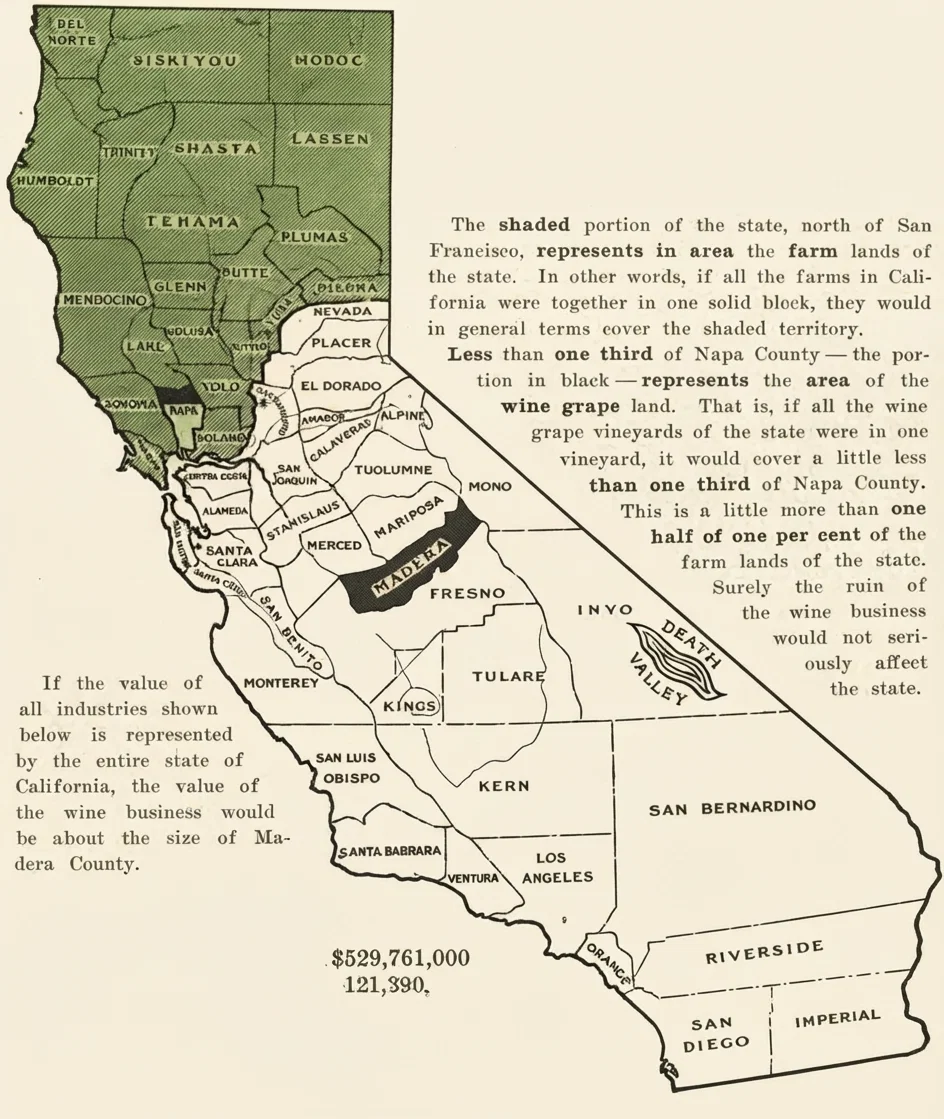
THERE are 320,000 acres in California in grape-vines. 170,000 acres are in wine grapes (Board of Agriculture says 160,000), 110,000 acres in raisin grapes, and 50,000 acres in table grapes.
The number of wineries in the state is 187.
The product of the raisin grapes (a short crop 1913) was valued at $4,840,275.
The value of the table grapes was $6,994,850.
The value of the wine grapes in the estimated value of the wine was $15,000,000; but to the wine grape grower, only $6,000,000.
The simple fact is that about the only wine grape vineyards that pay are those owned by the big wine and liquor corporations. These big companies have forced down the price of grapes till the grapes do not pay the individual grower. The wine grape industry has been ruined by the wine men.
This is what Prof. F. T. Bioletti, an authority at the state university, says:
"The average price received by producers [of wine grapes] for a series of years must be very close to the cost of production." This he proves by statistical tables.
He says further concerning the grape grower:
"Often nothing remains, or in other words, he is selling his grapes at cost and receiving nothing for his time and expenditure of energy. Not infrequently an examination of his balance-sheet will show that his profit is a minus quantity. In fact, there are many vineyards in the state, both large and small, which an accurate system of bookkeeping would prove to be conducted at an average annual loss. This is possible on a large vineyard only by foregoing a reasonable rate of interest on the money invested, or by paying the deficit from some other source, such as the increase of value of the land. On a small vineyard, where the owner does most of the work, this form of unselfishness can be carried still further. He may not only obtain no returns on any capital invested in his place, but he may fail to obtain even current rates of wages for his own time and labor. In other words, he would be better off financially if he gave his vineyard away and worked for the man he gave it to."
—Monthly Bulletins 2 and 3, March and April, 1913, page 483 and onward.
Mr. Frank T. Swett, of Martinez, quoted in the same document, intimates loss. He says:
"The actual cost of growing wine grapes in the interior, on average land, including interest on the investment, and taxes, is probably not less than
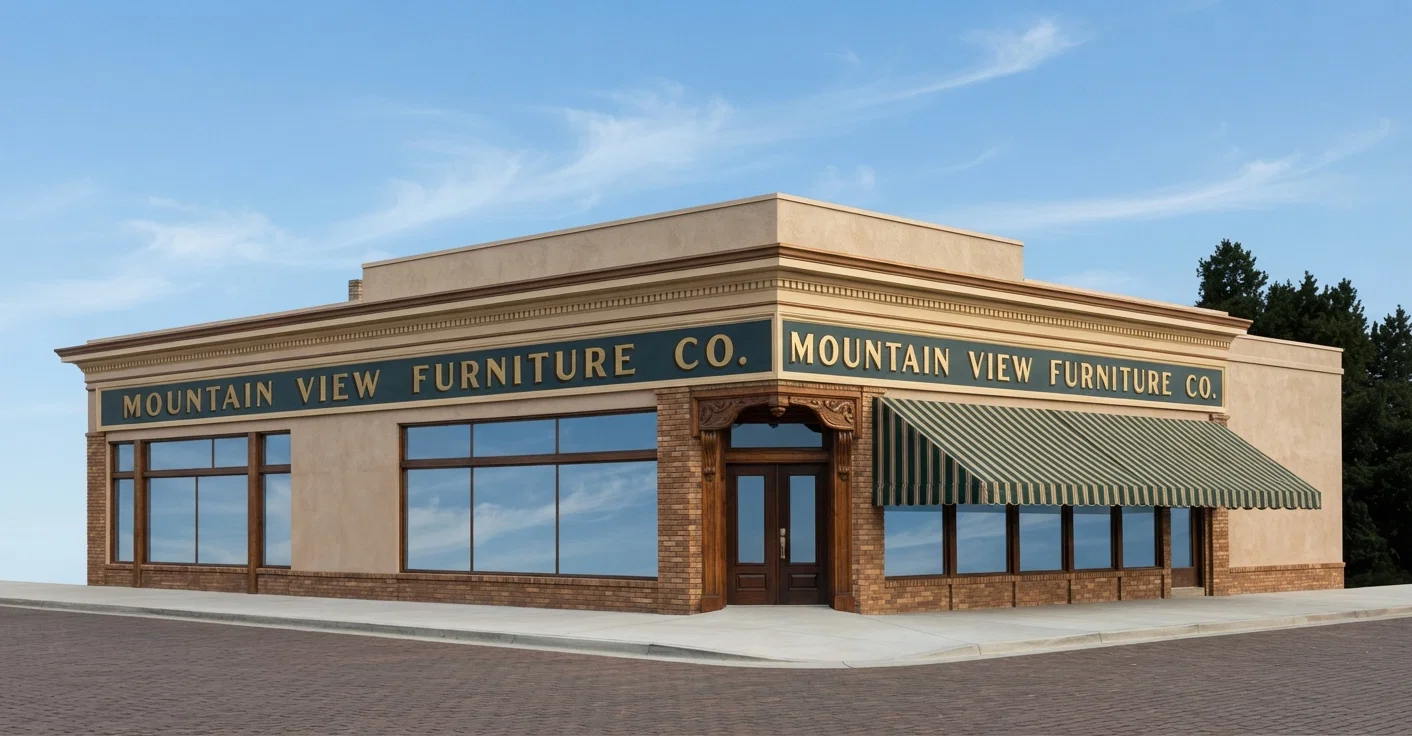
April 8, 1912, Mountain View, California, voted "dry." The saloons closed July 8, 1912. After the election, the leading saloon-keeper displayed in his windows in the above building a coffin draped in black, candles at the head and foot, with the legend, "Mountain View is Dead." The building is now the largest furniture store in town, an establishment which did not exist before. See tract, "Story of a Dry Town," if you wish to learn of its post mortem functions.
$12.00 a ton. At $6.00 a ton, the prevalent price, there is a heavy loss."
He also says (see Bulletin referred to above, page 497) that the grape grower "should hold himself free to dig out his vineyard and substitute some crop that will net a real profit if he decides to do so. If his vineyard bears only average crops, he may do better to gradually reduce his vineyard acreage and work into alfalfa and other lines of production."
Mr. H. F. Stoll, a leading wine man, commissioner at large on the State Board of Viticultural Commissioners, said: "One of the most serious difficulties which we must overcome if we hope to compete successfully with France, Italy, Germany, Spain, and Portugal in the wine market of the world is the labor problem. This fall, pickers were at a premium in the vineyards; and as a result, prohibitive prices had to be paid to Japs, Hindus, and other available help. But with the opening of the Panama Canal, it is expected that the influx of immigration from southern Europe will help adjust the vexing problem."
According to Mr. Stoll, his hope for wine grapes rests in what has been called pauper labor from Europe. These things were said a little before the "Dry Federation" movement of California had birth.
The wine grape industry is now used as a blind to save the liquor traffic. Do not be misled or deceived by sophistry and false claims.
Mr. C. T. Clark, an old resident of Napa County, one of the greatest wine grape counties in the state, himself a former grower of wine grapes, says:
"The well-informed would not invest in such property to-day. The business is a delusion and a snare. It if was what the wine interests represent, there would be no need to call on the legislature to give $35,000 a year to bolster up the business; and if it was an honest business, the United States revenue office would not be defrauded as it has been."
Wine grapes will make good grape juice or grape sirup. Wine grapes may be dried and fed to hogs at a greater profit than to make them into wine. Wine grape-vines may be grafted with table grapes at a profit. The loss by prohibition will be comparatively small. The gain will be gigantic.

The Grape Industry in California

By WILL D. GOULD
Attorney at Law, Los Angeles, California
REMEMBERING that God has established all economic laws on a moral base, we may divine the reason for the awakening that is giving voice to the humble, that is strengthening the weak, that is arousing the people in all civilized nations, and that is organizing for victory, local, state, national, and world-wide, in the conflict with alcohol.
The long delayed popular uprising has come. The tide of public opinion is rising with such force and power that no human hand can stay it. God's hour has struck, and the liquor traffic is doomed.

The Issue in California

Thus far the issue in California has centered upon the wine business, and speeches have been made and literature has been circulated, falsely declaring that the wine business is the "largest farming industry in California," that its destruction "means bankruptcy and ruin to many thousands of people," that "the people have invested their life earnings in the grape industry upon the invitation of both state and nation," that the wine industry "has been conducted on clean, high ground, free from abuses, promotive of general temperance, and a business in which any good man or woman might worthily engage," and that "this industry has brought only credit and glory to the state of California."
We answer back: The wine industry is not a very large farming industry, and the belief is general that more intoxicating counterfeit wine has been made in the cellars of our great cities than in all the vineyards of America.
At the best, we make no better wine than Noah made, and we make no better use of it. We submit that every family who has been long engaged in the "wine industry" in California has lost one or more members who have tarried too long at their own wine cup, who have drunk of the wine which "moveth itself aright," and which at last "biteth like a serpent, and stingeth like an adder."
We submit that intoxicating wine is made to drink, and that no one can drink it without harm. It shortens life and kills continually. And wo to him by whom the offense comes, who puts the bottle to his neighbor's lips, and makes him drunken also.

The Grape Industry

The grape industry is quite another matter. The grape food industry has no enemies, and it may be classed as one of our great farming industries. It is not a mocker or destroyer, and it will be promoted by the adoption of the proposed amendment—by making California "dry" this year.
The world wants food; and the cultivation and production of the table grapes—raisins, grape sirup, grape cakes, and unfermented grape juice, the pure wine, the fruit of the vine that God makes, and that always blesses and always cheers, but never inebriates—offers to California—and destiny points the way—greater industry, greater profits, and greater blessings than all the wine industry in all the world in all the ages.
I have lived in Los Angeles more than forty-two years, and have carefully studied economic and political questions; and I submit that the so-called "wine industry" has neither moral base nor economic value. It has tarnished the fair name of many people, and destroyed entire families in California, and is a constant blight upon our entire economic and political system.

The Greater Profits on Table Grapes

I have planted and own in this county a forty-acre vineyard of table grapes, and I sold my grapes last year for thirty-two dollars a ton on the vines, while my neighbors sold their wine grapes at ten dollars a ton delivered at the winery. My grapes went to feed the hungry. The wine grapes went to mock and curse and kill my fellows.
By and by we will have state aid in telling the truth about this matter, and thereby increase the grape industry. By and by we will turn the wineries and the breweries into bottling works to furnish pure wine, the unfermented grape juice, the blood of the grape—not a blood irritant, but blood food for both well and sick, young and old—and thus furnish an ever-increasing market for a most wholesome food, which we now obtain in small quantities at great expense.

Put It Out or Double Our Jails and Asylums

Our jails and penal institutions, our hospitals and insane asylums, are overflowing, and we must immediately double their capacity and increase our taxes if the liquor traffic remains. But if we put away the liquor traffic, and make California "dry" this year, we will not have to build another jail or prison or insane asylum or hospital in this state for fifty years.
Outraged public opinion has broken the bonds of partizanism, and this question now demands a non-partizan verdict at the ballot-box.
Men and women have no right to view with pride the wine industry in California, or elsewhere, when they remember the army of the fallen—the army of the down-and-out—the unmarked graves, the result of a traffic more deadly than famine, pestilence, and war combined—when they remember its brood of evils, the saloons, the tobacco shops, the opium dens, and the houses of infamy.
Why should we want to make San Francisco and our other great cities like Sodom and Gomorrah, inviting upon them the wrath of God and man? Why not clean up the whole Pacific coast this year, and invite the best men and women of all the world to come among us, to build homes, and to occupy the mighty land between the mountains and the sea, and make the Pacific coast the defender of national life, the land of liberty, the land of freedom, the land of plenty, and the land of sobriety and decency?

A Study of California and Wine Grapes

State Products
State Products
Wine business one and four tenths per cent of state products.
Wine grape returns to grower only $6,000,000, or five tenths of one per cent of products.

DEATH VALLEY WOULD CONTAIN THE WHOLE WINE BUSINESS

LET US BURY IT THERE BY VOTING "DRY" THIS YEAR
The land will be left for alfalfa, orchards, table grapes, and grapes for grape juice, etc.

America’s Drink Bill

The population of the United States in 1912 was, in round numbers, 95,000,000 — ninety-five million men, women, and children. We want to tell you what they consumed in intoxicating liquors that year. We have reckoned the retail price from actual figures given us by reliable druggists, from prices displayed in the windows of cut-rate drug stores, and from price-lists of large grocery firms. The full retail value of that which is sold over the bar is not given. For instance, a liquor circular before us declares that there are ninety drinks in a gallon of whisky. A gallon of four dollar whisky, selling at twenty-five cents a drink, would retail over the bar for $22.50; at fifteen cents, $13.50 a gallon; at ten cents, $9.00 a gallon. Ten cents a drink represents the cheapest whisky at the lowest price. That is what the drinker at the bar pays for his gallon. We have aimed to give the average gallon price. Beer can be bought for forty cents a gallon; but over the bar, men pay eighty cents a gallon, at five cents a glass. Wine of a sort may be bought for fifty cents a gallon, perhaps less; but sparkling wines and champagne sell as high as from six to ten dollars a gallon, or $1.50 to $2.50 a bottle. The well-informed will not consider our estimates exaggerated.
Below is a table in which the quantities of liquors consumed are taken from "The World Almanac and Encyclopedia" for 1914, certainly an unprejudiced authority. The average price per gallon is estimated on the figures given above. The aggregate gallons consumed, the average price per gallon, the cost in the aggregate, the quantity per capita, and the cost per capita are all given.
Kind of Liquor Gallons Consumed Price per Gallon Aggregate Cost to Consumers Gallons per Capita Cost per Capita
Domestic distilled spirits ... 135,951,410 $6.00 $ 815,708,460 1.43 $ 8.58
Imported distilled spirits .. 3,544,921 8.00 28,359,368 .03 .24
Domestic wines ............. 50,619,880 2.00 101,239,760 .53 1.07
Imported wines ............. 5,804,831 4.00 23,219,324 .03 .24
Domestic malt liquors ..... 1,925,361,507 .60 1,185,216,904 20.00 12.47
Imported malt liquors ..... 7,169,677 1.00 7,169,677 .07 .07
Totals ...................... 2,128,452,226 $2,160,913,493 22.12 $22.67
Study this table, friend. For your own sake, your family’s sake, your neighbor’s sake, your country’s sake, you ought to study it.
The people of the United States drink more than two billion gallons of intoxicants every year.
But not all drink. About forty-five million live in "dry" territory. There are many in "wet" territory who do not drink. Most of the children do not drink. Safely it may be said that less than half of the people of the United States consume more than two billions of gallons of intoxicants, an annual average of forty-five gallons each, at an average annual cost of forty dollars each to the drinkers.
Counting five as the average family, it costs each family in the United States more than $100 a year — that is, $100 a year paid for a deceptive curse. But half of the families do not drink. The rest of the families in the United States pay on the average $200 a year.
That sum would buy ten loaves of bread for each family, for every day in the year, with a fruit loaf thrown in now and then.
It would buy five quarts of milk each day for a year, for each of these families.
It would buy ten suits of clothes, at twenty dollars a suit.
It would buy fifty pairs of shoes, at four dollars a pair.
The average family drink bill for the drinkers of the United States, counting them at one half the population, could buy with the two hundred dollars spent for liquor: Four loaves of bread daily for a year, $73.00; 5 pairs of shoes, at $3.00 a pair, $15.00; 5 hats, at $2.00 each, $10.00; 5 suits of clothing, at $15.00 each, $75.00; and have a balance for other necessities of life of $27.00.
Why will not those who drink, many of whose families are in want and misery, stop the fearful drain, by putting the temptation out of the way forever, and spend their money for needed things? How the buying of more shoes, and clothes, and hats, and furniture, etc., would stimulate trade, and relieve business depression!
The preeminently overwhelming cause of hard times is the drink traffic.
All are interested in it, for it touches all somewhere.
It increases crime. It increases disease. It increases public expenses. It corrupts politics. It promotes inefficiency. It increases your taxation.
It demands more hospitals, and institutions for the insane, the inebriates, the defective, the diseased — the victims strewed in the path of alcohol.
It demands more jails, more police, more constables, more courts. And you have to help foot the bills.
It is destroying the young manhood and womanhood of America.
Directly or indirectly, or both, with all its voluminous and multitudinous and colossal curses, it touches you. But if not for your own sake, for the sake of the other man, for the sake of conscience and country, aye, for the sake of the liquor dealer himself, demand the prohibition of the liquor traffic.
Every principle of political economy, justice to the drunkard's wife, and to his more than orphaned children, demand the abolition of the liquor traffic.
Justice to the taxpayers of nation, state, county, and city demands the abolition of the liquor traffic.
Safety of the country politically demands the abolition of the liquor traffic, which has debauched politics, degraded statesmen, and put a thousand stains on the national escutcheon.
Regard for suffering humanity, some portion of which can only cry, in their rum-engendered suffering, demands that the traffic in curse-breeding alcoholic drink should be abolished, root and branch.
For the sake of humanity, help us to dethrone the monster.

Drink and Dollars

Some Striking Figures

THE people of the United States—practically, one third of the people of the United States—consume more than TWO AND ONE EIGHTH BILLION GALLONS of intoxicants yearly, at a cost of more than TWO BILLION DOLLARS. (See “America’s Drink Bill.”)
You can’t grasp these figures. No man can. One million is a thousand thousand. One billion is a thousand million. Two billion is two thousand million.
Counting at the rate of one hundred a minute, ten hours a day, three hundred days in a year, it would take more than fifty-five years to count a billion.
If the vast sum spent for liquor were in silver dollars, packed one upon another, ten to the inch, it would make a pile 3,156 miles high.
If these dollars were laid side by side, they would make a row 47,500 miles long, reaching almost twice around the earth.
If these dollars were melted down, they would make a block of silver weighing 58,967 tons. Carrying one hundred pounds to the load, five miles a day—as far as a man would care to carry such a burden—it would take one hundred thousand liquor men more than eleven days to convey the mass that distance.
If these dollars were in gold, they would weigh 7,711,058 pounds, or more than 3,855 tons.
Do we understand any better what the liquor traffic means?
That colossal sum of over Two Billion Dollars would give 1,000,000 young men $2,000 each to help them get an education.
That Two Billion Dollars would build 1,000,000 schoolhouses at $2,000 each.
It would build 500,000 churches at an average cost of $4,000.
It would build a great city capable of housing comfortably 400,000 persons.
THAT TWO BILLION DOLLARS WOULD BUILD, AT A COST OF $20,000 TO THE MILE, TWENTY LINCOLN BOULEVARDS ACROSS THE CONTINENT FROM THE ATLANTIC TO THE PACIFIC, AND WOULD PLACE UPON THESE GREAT HIGHWAYS 800,000 AUTOMOBILES AT AN AVERAGE COST OF $1,000 A CAR.
Think of this great country with such vast improvements as that. Yet the drink bill for one year—what men pay for intoxicating liquors in retail—would build these twenty highways and place upon them these 800,000 machines.
But all the tramps in the land, all the unemployed, could not do the work.
HARD TIMES! The curse and the cause of hard times is in the liquor traffic.
The drink bill for one year in the United States alone would put $1.25 into the hands of every man, woman, and child on the face of the earth, black and white, brown and red and yellow.
The drink bill would do a thousand and one other things that would bring blessing and work and prosperity to the laboring man.
Why can not sensible men see that it would be of immense value to the country, to the nation, to the people, economically, socially, mentally, and morally, to wipe out the curse of alcohol forever?
The country owes the traffic nothing. The traffic owes humanity an infinite debt, which it can never repay.
The very best thing that can be done for the victims that survive is to abolish it forever.

America’s Drink Tank

The people of the United States consume the following quantities of intoxicating liquors:
Distilled spirits . . . . . . . . . . . . . . . . . . 135,951,410 gallons Imported spirits . . . . . . . . . . . . . . . . . . . . 3,544,921 gallons Domestic wines . . . . . . . . . . . . . . . . . . . . . 50,619,880 gallons Imported wines . . . . . . . . . . . . . . . . . . . . . 5,804,831 gallons Domestic malt liquors . . . . . . . . . . . 1,925,361,507 gallons Imported malt liquors . . . . . . . . . . . . . . . 7,169,677 gallons
The total number of gallons is 2,128,452,226. So declares the “World Almanac and Encyclopedia” for 1914.
Think of it—more than two billion gallons poured down the throats of the drinkers! This does not include “moonshine” whisky, “near beer,” nor other illegal concoctions. If put together in one receptacle, these liquors would fill a vat five feet deep, five feet wide, and 2,150 miles long. It would reach from San Francisco to Chicago. Allowing two feet to each person, 5,675,872 men and women could stand on each side—11,351,744 in all—and look down into its turbid depths. If all were gifted with keen imagination and X-ray sight, they could not begin to see the wrecks of homes and hearts; the debased manhood and womanhood; the dead bodies of slain victims; the yet living and dying, struggling in a grasp which grips stronger than the treacherous quicksands; the eternally ruined hopes; the unutterable wo; the dark despair,—the horrors of the hell of that tank of poison. Reader, would you not like to destroy it forever, and put out of commission the stills and vats and brews that keep it filled? So many might be saved! Are you not willing to help?

License or Prohibition

By MRS. E. G. WHITE
IN these days when vice and crime of every form are rapidly increasing, there is a tendency to become so familiar with existing conditions that we lose sight of their cause and of their significance. More intoxicating liquors are used to-day than have ever been used heretofore. In the horrible details of revolting drunkenness and terrible crime, the newspapers give but a partial report of the story of the resultant lawlessness.

License Laws

The licensing of the liquor traffic is advocated by many as tending to restrict the drink evil. But the licensing of the traffic places it under the protection of law. The government sanctions its existence, and thus fosters the evil which it professes to restrict. Under the protection of license laws, breweries, distilleries, and wineries are planted all over the land, and the liquor seller plies his work beside our very doors.
Often he is forbidden to sell intoxicants to one who is drunk, or who is known to be a confirmed drunkard; but the work of making drunkards of the youth goes steadily forward. Upon the creating of the liquor appetite in the youth the very life of the traffic depends. The youth are led on, step by step, until the liquor habit is established, and the thirst is created that at any cost demands satisfaction. Less harmful would it be to grant liquor to the confirmed drunkard, whose ruin, in most cases, is already determined, than to permit the flower of our youth to be lured to destruction through this terrible habit.
By the licensing of the liquor traffic, temptation is kept constantly before those who are trying to reform. Institutions have been established where the victims of intemperance may be helped to overcome their appetite. This is a noble work; but so long as the sale of liquor is sanctioned by law, the intemperate receive but little benefit from inebriate asylums. They can not remain there always. They must again take their place in society. The appetite for intoxicating drink, though subdued, is not wholly destroyed; and when temptation assails them, as it does on every hand, they too often fall an easy prey.

Who Is Responsible?

The man who has a vicious beast, and who, knowing its disposition, allows it liberty, is by the laws of the land held accountable for the evil the beast may do. In the laws given to Israel, the Lord directed that when a beast known to be vicious caused the death of a human being, the life of the owner should pay the price of his carelessness or malignity. On the same principle, the government that licenses the liquor seller should be held responsible for the result of his traffic. And if it is a crime worthy of death to give liberty to a vicious beast, how much greater is the crime of sanctioning the work of the liquor seller!

The Liquor Traffic in San Francisco

For a time after the great earthquake along the coast of California, the authorities in San Francisco and in some of the smaller cities and towns ordered the closing of all liquor saloons. So marked were the effects of this strictly enforced ordinance, that the attention of thinking men throughout America, and notably on the Pacific coast, was directed to the advantages that would result from a permanent closing of all saloons.
During many weeks following the earthquake, very little drunkenness was seen in San Francisco. No intoxicating drinks were sold. The disorganized and unsettled state of affairs gave the city officials reason to expect an abnormal increase of disorder and crime, and they were greatly surprised to find the opposite true. Those from whom was expected much trouble, gave but little. This remarkable freedom from violence and crime was largely traceable to the disuse of intoxicants.
The editors of some of the leading dailies took the position that it would be for the permanent betterment of society and for the upbuilding of the best interests of the city, were the saloons forever to remain closed. But wise counsel was swept aside, and within a few short weeks permission was given the liquor dealers to reopen their places of business, upon the payment into the city treasury of a license tax considerably higher than had formerly been paid.
In the Outlook of November 3, 1906, the situation is thus described:
"During the two months and a half after April 18, San Francisco was probably the most orderly large city in the United States. Violence and crimes were practically unknown. During that time the saloons and liquor stores of the city were closed tight. About the middle of July the saloons were permitted to open again. This action of the city government was accompanied by the expectation on the part of many citizens of an outbreak of violence and disorder. Clergymen, and it is said even the police, advised men and women to carry firearms for their own protection. For the past three months San Francisco has been living under a reign of terror. In eighty days eighty-three murders, robberies, and assaults were registered on the police records. A despatch to Ridgway's, the new weekly periodical, reports the sale in San Francisco during one week in October of over six thousand revolvers. The police have been and are powerless to preserve order and protect the city—in the opinion of the best citizens of San Francisco because the heads of the force are corrupt and are doing the will of a corrupt government."
The honor of God, the stability of the nation, the well-being of the community, of the home, and of the individual, demand that every possible effort be made in arousing the people to the evil of intemperance. Soon we shall see the result of this terrible evil as we do not see it now. Who will put forth a determined effort to stay the work of destruction? As yet the contest has hardly begun. Let an army be found to stop the sale of the drugged liquors that are making men mad. Let the danger from the liquor traffic be made plain, and a public sentiment be created that shall demand its prohibition. Let the drink-maddened men be given an opportunity to escape from their thralldom. Let the voices of the nation demand of its lawmakers that a stop be put to this infamous traffic.

Alcoholism in Wine and Beer Countries

By D. M. GANDIER
State Superintendent of the California Anti-Saloon League
SOME good citizens seem to think that wine and beer are not seriously harmful, and that prohibition of the whole traffic in alcoholic beverages is too radical. We commend all such to a study of conditions in the great wine and beer drinking countries of the world. Nowhere else is the alcohol problem so acute to-day as it is in France and Belgium. France leads the world in its consumption of wine, Belgium in its consumption of beer.

The Most Drunken Nation on Earth

Speaking in the Sorbonne, January 3, 1910, M. Joseph Reinach, a member of the French House of Deputies, said:
"If France does not wish to die, she must burn out the cancer which gnaws within her, which is making greater ravages in the twentieth century than ever famine and the black death made in the middle ages. . . .
"We have become the most drunken nation on earth, and that, gentlemen, in thirty years. The number of drink shops has reached the frightful figure of 477,000, one for every thirty adults. In many of our great cities and seaport towns, the number of drinking places has, since 1880, doubled, nearly tripled. In hundreds of villages, one counts a saloon for every tenth, nay, every fourth or third house. And in spite of this supersaturation, the increase continues. More than six new saloons are on the average opened each day. Since 1880 our consumption of absolute alcohol has doubled, in some provinces sextupled. And the consequences of this immense poisoning — who does not know them? They are written in the flesh of the nation. Ask at the Ministry of Justice for the statistics of criminality; at the Ministry of the Interior for those of madness, of suicide, of tuberculosis; at the Ministry of War for the conscript lists. In ten departments the number of rejected conscripts has risen from six per cent to twenty per cent. In all France the number of suicides has doubled, of insane has advanced by a continual progression from 47,000 to 70,000. More than half the crimes against persons are committed by alcoholists."

Both Lines of Defense Broken

The country people constitute the natural first line of a nation's defense against alcohol; the women its second line. In France both are being broken through. M. Reinach says, "Alcoholism is destroying the peasantry of the healthiest and most beautiful regions by inducing tuberculosis."
Dr. Bourgon, writing of Normandy, says, "Eight out of ten working women drink, and their mistresses as well." When the women drink, the children drink, too. A French teacher tells of three-year-olds who drink a quart of wine a day, and another tells of children of twelve who drink a quart of brandy daily. In France, men, women, and children are sick with alcoholism; and unless something is done quickly to stay the ravages of drink in that land of wine, it will soon cease to rank among the great nations of the earth.

Italy's Great Danger

In Italy the Societa Umanitaria of Milan has recently published a little volume, the very name of which is suggestive — "Alcolisimo e un pericolo per Italia" (Alcoholism Italy's Great Danger). In that book we are told that investigation was made among 36,000 school children of Milan; and of the boys, twenty-five per cent admitted having been drunk on more than one occasion, while eleven per cent of the girls made the same confession.
The Milan prosecutor says, "It falls to my lot frequently to have to sum up the causes of a tragedy in two words — wine and knife." From Parma comes the warning, "The increase in wages and the cheapness of wine have led to a growth of drunkenness."
Insanity, too, is on the increase. Wine alcoholism is shown to be responsible for a large part of it. Wine has not saved Italy from the alcohol curse.

Beer Has Not Saved Germany

Beer has not saved Germany. That country consumes twice as much beer per capita as does America, and nearly five times as much wine. This, however, only whets the appetite for stronger drinks, and so we find that Germans consume one and one half times as much distilled liquor per capita as do the people of the United States.
Dr. Emil Muensterberg (brother of our own Professor Muensterberg of Harvard, who not long ago sounded the praises of beer to the American public) recently said: "The consumption of alcohol in Germany is exceptionally great. . . . Fifty thousand insane are in German asylums yearly whose sickness can be traced to alcohol."
Berlin has over 800 animierkneipen (beer dives), employing 1,786 "waitresses." Dr. Muensterberg says that in these places "thousands of fresh young women go to destruction in a short time and are rarely to be rescued." These girls drink with the men and so stimulate trade.
No wonder Von Moltke said, "Beer is a far more dangerous enemy of Germany than all the armies of France."
Nowhere is the alcohol problem more acute to-day than in these wine and beer lands. If the United States are to be saved from the curse of alcoholism, we must not compromise with either wine or beer, but must outlaw the whole liquor traffic as we have outlawed slavery; lotteries, polygamy, and race-track gambling. There will be no better time to clean up the whole Pacific coast than November 3, 1914. Let us do it.
Among the Regular Victims of the Liquor Traffic
Continue reading: No Drunkard Will Be There