THE workers on the pay-rolls of our various conferences in the United States and Canada, constitute quite an army of laborers. Over one thousand men and women of various ages are regularly employed in the work of the Lord.
The supreme purpose of this large body of workers is to teach the third angel’s message to this generation, to persuade men and women to receive Christ as their Saviour and to prepare for his soon coming.
We are organized into general, union, and local conferences for the specific purpose of utilizing the talents and directing the efforts of this band of workers, and to have their energies directed so as to accomplish the most possible good.
Whatever needs to be done in conference work, these workers are always ready and willing to undertake. Rarely has there been developed in any age a more independent, trained, united working force than this army of a thousand men and women. Scattered in every State and Territory in the United States and Canada, oftentimes not meeting one another in many years, this army of workers are as united in the accomplishment of a set purpose as any army that ever marched against a common foe.
Whatever work needs doing in the cause of God, to this task these laborers go with cheery hearts and a set purpose.
In the past great things have been accomplished by such a force as this. It is neither numbers nor wealth that leads to success in God’s cause; it is the manifest presence of Jehovah that brings results.
When Gideon had gathered thirty-two thousand men to fight the Midianites, the Lord said that the number was too great, because if they succeeded, Gideon’s army would take the glory to itself. This vast number of men were scattered and sent to their homes, until only a little band of three hundred remained, and it was with these three hundred brave hearts that God would smite the Midianites.
When the outpouring of the Spirit of God came on the disciples in the days of the apostles, and the Lord was filling the world with the gospel message of a crucified and risen Saviour, it was not the number of disciples that counted, and created this great stir, but it was God’s Spirit and power that won the hearts of the people.
So it was in the days of Martin Luther. When the great Reformation started, only a few at first embraced Luther’s message; yet such a mighty power attended the work which God wrought through him, that nations and kingdoms were stirred as they had not been stirred for a thousand years.
So it is in the work of the third angel’s message. The wide extension of this great gospel of the soon coming of Christ, and of the Sabbath and other kindred truths, has not gone to nearly every nation under heaven because of the power, wealth, or numbers in our ranks, but because we have been a united people, and our workers have been true to the accomplishment of the work of the third angel’s message.
I do not recall a single leading feature of our work during our denominational history to which this band of workers, scattered everywhere, and oftentimes laboring under very trying conditions, have not been true and loyal. Institution after institution has been built, not because of our great wealth, or numbers, nor because the means were available and ready at our command; but because when it has been agreed that a certain thing should be accomplished, the band of workers scattered wherever they may have been, have united their energies for the accomplishment of this work.
When the Review and Herald, the college, and the sanitarium at Battle Creek were started in the early days of our denominational history, it was all our people could do to compass the establishment of these enterprises, and to maintain them. Even this could not have been done, had not nearly every Seventh-day Adventist all over the land stood true and loyal to the interests, which, without their help, could not have been built up.
When the plans were laid that the headquarters of the General Conference and the Review and Herald should be moved from Battle Creek, there was a hearty, sympathetic co-operation on the part of our people everywhere in the wide world, enabling the officers of the General Conference to accomplish this purpose. Again and again have our people rallied to the raising of this money like valiant soldiers who were taking a stronghold of the enemy. Little did it matter what difficulties confronted us, or what obstacles were encountered, or what hindering causes arose, our people rallied to the charge again and again, and raised the fund that was called for, and so greatly needed.
Probably there is not a worker from Maine to California, or from Alaska on the north to Texas on the south, who does not rejoice in the fact of this removal, and who did not respond to this call for help in a most substantial way.
We have now undertaken to raise $150,000 for various enterprises. The General Conference Committee wrestled with this proposition of calling for this large sum of money month after month, not knowing just what to do. They had positive instruction from the Testimonies that they should proceed at once with some of these various enterprises and get them under way; and yet they did not wish to launch the call for so large a sum of money without the advice of our leading brethren. A council was held last September, and it was generally agreed that the call should be made.
There are various enterprises to be helped and built up by this large sum of money, which have long needed financial assistance. We have now set ourselves to the raising of this money, and this will require every worker in the whole field to use his energies for the accomplishment of this end. This fund is to be distributed among various enterprises throughout the field—to the west coast of South America, to England, to Skodsborg, to the Maritime Provinces, to the West Indian field, to the South, to the Sanitarium and the Review and Herald in Washington, and to the Pacific Press.
As before stated, we have one thousand workers in the employ of our various conferences and union conferences, who are directly engaged in the work of God for this time. If every worker would resolve that he would raise his quota of this large sum of money, we would soon have the whole amount raised; for if one thousand men and women should each raise one hundred and fifty dollars from various sources, we would have the $150,000 fund completed.
Every worker should set his heart to the accomplishment of the work of God in the earth with determination and zeal, and pray that the blessing of God may rest upon the labors bestowed.
We are more glad than we can tell for the almost universal co-operation that is manifested throughout the field in working out the plans that are laid for the accomplishment of the third angel’s message; and we believe that every worker will loyally and truly put himself to the task of helping in all these undertakings. To this end we solicit the sympathy and co-operation of our workers everywhere, and of our people scattered throughout the wide world.
Let us pray that God will give us his blessing, and bestow upon us a large measure of his Holy Spirit.
I. H. EVANS.
MRS. E. G. WHITE
By Ellen G. White
The Work in Oakland and San Francisco—No. 6
MRS. E. G. WHITE
The Oakland brethren have decided on a location for their new church building,—on Twenty-fifth Street, near Telegraph Avenue. After the baptism, I drove with Brother and Sister Rice to see this property. It seems to be well located.
Sunday night, December 16, Elder Simpson gave his last discourse in this series of meetings, and the following day the tent was taken down. It was reported that at this service there were fully one thousand persons present to listen to his presentation of the subject, The United States in Prophecy. Those who would refuse to render homage to the beast and his image, were asked to arise, and nearly all present responded.
The expenses connected with these meetings have been fully one thousand dollars. Collections have been taken in the congregation only once a week, but these, with donations that some have given privately, have been sufficient to meet all the expenses, so the effort has cost the conference only the salaries of workers.
The liberality of many from the outside has been surprising. Elder and Mrs. Haskell, on several occasions, received liberal gifts from strangers. One afternoon, after I had spoken in the church, a man handed Elder Haskell one hundred dollars, and then left the building quickly and could not afterward be found. On another occasion, a lady slipped two coins into Sister Haskell’s hand. These proved to be two twenty-dollar gold pieces. Sister Haskell afterward met the lady, but she did not wish to tell her name. These things have greatly encouraged our workers.
In these meetings, we have seen evidences of the deep moving of the Spirit of God. Truly the Lord has wrought on minds. Our people need now to be aroused from the lethargy that has come upon them. The language of every heart should be, Speak, Lord, for thy servant heareth.
There is much house-to-house work to be done by faithful laborers. Our efforts are not to cease because public meetings have been discontinued for a time. So long as there are interested ones, we must give them opportunity to learn the truth. And the new converts will need to be instructed by faithful teachers of God’s Word, that they may increase in a knowledge and love of the truth, and may grow to the full stature of men and women in Christ Jesus. They must now be surrounded by the influences most favorable to spiritual growth. The churches at Oakland and Berkeley should now purge out the old leaven of evil-speaking and hypocrisy, of jealousy and malice. The truth must be expressed in word and in spirit; every act should be a revelation of Christian refinement.
That there may be no cessation of effort during the rainy season, I have encouraged Elder S. N. Haskell and his wife to return to Oakland for a time. The Oakland brethren and sisters have offered them the use of the dwelling-house on the new church property. This will serve as a headquarters for city mission work and a Bible training-school.
The work in Oakland must not be cut short. For years I have pleaded that an earnest effort be put forth in this city, and now that this is being done, let us go straight forward in right lines. There is to be no variableness, neither shadow of turning, in the presentation of truth to the people in Oakland.
To my ministering brethren I would say: Every fresh display of the conviction of the grace of God upon the souls of unbelievers, is divine. Everything that you can do to bring souls to a knowledge of the truth, is a means of allowing the light to shine, the light of the glory of God, as it shines in the face of Jesus Christ. Direct the mind to him who guides and controls all things. Christ will be as manna and spiritual dew to these newly converted souls. In him is no darkness at all.
As faithful laborers of deep spiritual understanding conduct Bible studies with those who have accepted the Sabbath truth; as they instruct those new in the faith how to yield to the power of the Holy Spirit, that they may be fully and firmly established in the truth, the glory of God will be revealed.
In the discourses, let nothing of a theatrical nature be introduced, no sharp thrusts given. We can not expect that eyes that have been blind will be at once opened to see all things clearly. Let labor be put forth wisely for those who are interested. Show those who have seen the truth, how to experience its power in their hearts. Thus the truth imparted will be as a nail driven in a sure place. Many are ignorant of vital godliness—or truth in the life-practise. On the part of these uninstructed ones, there must be a practical reception of Bible truth. The Lord will work with power upon the hearts of all who seek him and who prayerfully study his Word.
The Lord Jesus sent a mighty angel to make plain to John, by the use of symbols, the things that were to come to pass until the coming of Christ. He was bidden to write the instruction in a book for the benefit of the seven churches. This writing we now have preserved in the book of Revelation, but this book is understood by only a very few. It contains the message for the last days, and we are to dwell much upon these prophecies.
Explaining scripture by scripture,—this is the work that should be done by all our ministers who are fully awake to the times in which we live. The Lord will guide his ministering servants. He will lead them in ways that they know not. They will bear aloft the lamp of life in the dark places of the earth, and hasten the coming of our King.
Christ's Presence with His Disciples
By Wm. Covert
The Spirit of God—No. 5
Christ's Presence with His Disciples
WM. COVERT
1. What words of comfort and promise did Jesus announce to his disciples near the time of his crucifixion?
“I am the true vine, and my Father is the husbandman. Every branch in me that beareth not fruit he taketh away: and every branch that beareth fruit, he purgeth it, that it may bring forth more fruit. Now ye are clean through the word which I have spoken unto you.” John 15: 1-3.
2. How did these words affect them?
“But now I go my way to him that sent me; and none of you asketh me, Whither goest thou? But because I have said these things unto you, sorrow hath filled your heart.” John 16: 5, 6.
3. What provision for the comfort of those who would believe on him did Jesus promise to make with the Father after ascending to heaven?
“I will pray the Father, and he shall give you another Comforter, that he may abide with you forever.” John 14: 16.
*4. What other words did Jesus use in describing the Comforter, and who9only can receive the comfort, and why?*
“Even the Spirit of truth; whom the world can not receive, because it seeth him not, neither knoweth him: but ye know him; for he dwelleth with you, and shall be in you. I will not leave you comfortless: I will come to you.” John 14: 17, 18.
5. How constantly and how long is the abiding presence of Jesus to be with his followers?
“I am with you alway, even unto the end of the world.” Matt. 28: 20.
6. What was David's experience concerning the presence of his Saviour?
“I have set the Lord always before me: because he is at my right hand, I shall not be moved.” Ps. 16: 8. “For David speaketh concerning him, I foresaw the Lord always before my face, for he is on my right hand, that I should not be moved.” Acts 2: 25.
7. To how many, and for what period of time, are these promises made?
“For the promise is unto you, and to your children, and to all that are afar off, even as many as the Lord our God shall call.” Acts 2: 39.
8. How did even the enemies of Christ witness to his presence with his disciples?
“Now when they saw the boldness of Peter and John, and perceived that they were unlearned and ignorant men, they marveled; and they took knowledge of them, that they had been with Jesus.” Acts 4: 13.
9. What optical view did Stephen have of his Saviour in the hour of severest trial?
“When they heard these things, they were cut to the heart, and they gnashed on him with their teeth. But he, being full of the Holy Ghost, looked up steadfastly into heaven, and saw the glory of God, and Jesus standing on the right hand of God, and said, Behold, I see the heavens opened, and the Son of man standing on the right hand of God.” Acts 7: 54-56.
10. Give an instance where Jesus called with audible voice to one who had been persecuting Christians.
“And it came to pass, that, as I made my journey, and was come nigh unto Damascus about noon, suddenly there shone from heaven a great light round about me. And I fell unto the ground, and heard a voice saying unto me, Saul, Saul, why persecutest thou me?” Acts 22: 6, 7.
Especially read this scripture from the Revised Version, and note that Jesus is himself directing his own work through the illumination of the Holy Spirit. He is ever present. He constantly watches over his work, and over his workers.
12. How much of our care, therefore, should we cast upon him?
“Humble yourselves therefore under the mighty hand of God, that he may exalt you in due time: casting all your care upon him; for he careth for you.” 1 Peter 5: 6, 7.
Chicago, Ill.
Is It Nothing to You?
By L. D. Santee
L. D. SANTEE
Is it nothing to you that the years fly so fast?
Is it nothing to you
That the summer will end, and the harvest be past?
Is it nothing to you
That Jesus no longer will cancel each stain,
But he that is filthy must filthy remain,
And prayers for forgiveness will then be in vain?
Is it nothing to you?
Is it nothing to you that the Saviour says come?
Is it nothing to you?
Died for you, pleads for you, welcomes you home—
Is it nothing to you?
Now while the seasons pass swiftly away,
Grieve not the Spirit; O hear him today;
While he beseeches, no longer delay;
Is it nothing to you?
Is it nothing to you that salvation is free?
Is it nothing to you
That Jesus says, “Weary ones, come unto me”?
Is it nothing to you?
For you the affliction, the pain, and the cross;
Dare you refuse? Have you counted the cost?
Too late, you may find, to your infinite loss,
It was something to you.
Chicago, Ill.
Some Earthquake Lessons
By GEO. F. ENOCH
GEO. F. ENOCH
Protection
“THE Lord . . . forsaketh not his saints.” Ps. 37: 28. In the experience of our people in the recent earthquake in Jamaica our hearts are impressed with the fulfilment of the preceding scripture. With more than four hundred of our people in the wrecked city, but one was missing. It was not that they are more worthy than any others; we felt that it could be only the direct providence of God. Our hearts are full of gratitude to him for the wonderful deliverance. Yet are we humbled, as we think of the one that is missing. No credit is due us because of the deliverance, but all praise is due him who did not forget those who had put their trust in him.
THE WRECKED MYRTLE BANK HOTEL
Guidance
“The Lord shall guide thee continually.” “In all thy ways acknowledge him, and he shall direct thy paths. . . . Then shalt thou walk in thy way safely, and thy foot shall not stumble.” Isa. 58: 11; Prov. 3: 6, 23.
In the events clustering around this experience, we had unmistakable evidence of God's guiding hand. The unexpected decision that the committee should visit the school farm the fateful day was made at the very last moment. Also, had the meeting not been appointed for the hour it was, many would have been in the business portion of the city. Then there was the preserving of those in the church from a panic, and the upholding of the walls of the church building.
Kept From Fear
“God is our refuge and strength, a very present help in trouble. Therefore will not we fear, though the earth be removed, and though the mountains be carried into the midst of the sea.” Ps. 46: 1, 2.
While the great majority were dazed by the awful calamity, and as quake after quake came, many were filled with a terror beyond description, yet those who knew the Bible teaching on these subjects, whose hearts had received God's message for this time, were calm in the midst of the ruin, and were kept from the dreadful fear that seized upon so many. The delegates of the conference voted unanimously to go on with the conference business, and it was the desire of all to complete the institute work. But the gaunt specter of famine, and perhaps pestilence, caused us to separate to our fields of labor as soon as all business was transacted. How different are the view-point of the world and of the child of God at such a time!
Prophecy Will Be Fulfilled
Earthquakes are frequently mentioned in the Bible. They are given by the Saviour as one sign of his coming. Luke 21: 11. A great earthquake shakes the earth at the time of the great hailstorm that closes the seventh plague. Rev. 16: 18-21. The higher critics and others question the literal fulfilment of these prophecies. To some they are simply symbolical, to others they mean nothing at all. In connection with that earthquake the record reads, “And the cities of the nations fell.” We believe this to be a statement in advance of events that shall be literally fulfilled. That this can be fulfilled, no one who has seen the city of Kingston since the disaster can doubt. The city of Kingston literally fell. Not two per cent of the houses were left habitable. The10entire business portion was a total wreck. What has happened to Kingston will happen to all the cities of the nations when the time comes. These fulfilments of prophecy should cause our hope to grow brighter, and strengthen our faith in the Word of God.
Insignificance of Man
In connection with that last great shaking of the earth, the prophet exclaimed, “Cease ye from man, whose breath is in his nostrils: for wherein is he to be accounted of?” Isa. 2:22.
I know of nothing in this world that can make puny man realize his utter insignificance more than to have the old earth quaking and heaving under him, and the buildings he has erected falling in every direction to the ground. It is a humbling experience. And the lesson is needed. We are too many times influenced in the wrong direction by our fellow men. It is hard to stand for principle alone—with God and his Word. Standing in the midst of such ruin, surrounded by hundreds of his fellow men, mangled or dead, who but a minute before were in the full enjoyment of all their senses, one can but exclaim, What is man, after all! We should learn this lesson from the daily procession to the cemetery, but we do not. Will we now learn it as we see sudden death coming to so many thousands? Man aside from God is vanity. All his works, all his reasoning, are vanity. It is only as we link up with God, and through the grace of our Lord Jesus Christ join our life to his life, that we really amount to anything at all.
Neglect of the Unevangelized World
“Go ye into all the world, and preach the gospel to every creature.” These last words of our Saviour formed the charter for the early church. Each one of those apostles became a missionary. From the beginning, every convert was imbued with the missionary idea. And the gospel message went to the world with power. But what is the attitude of the world to-day? There are hundreds of thousands of professed Christians, enjoying the benefits derived from Christianity, and the comforts and luxuries of modern civilization—what do these last words of Jesus mean to them? As the Saviour to-day beholds the great unevangelized portions of our earth; as he sees the misery, disease, and ignorance of those who are groping for the light as they perish in the darkness, and all the time those who profess his name, to whom he has committed the work of spreading his gospel message, are engrossed with the fleeting pleasures of this life—what more can God do to arouse men from their carnal security?
The Wrecked Lighthouses
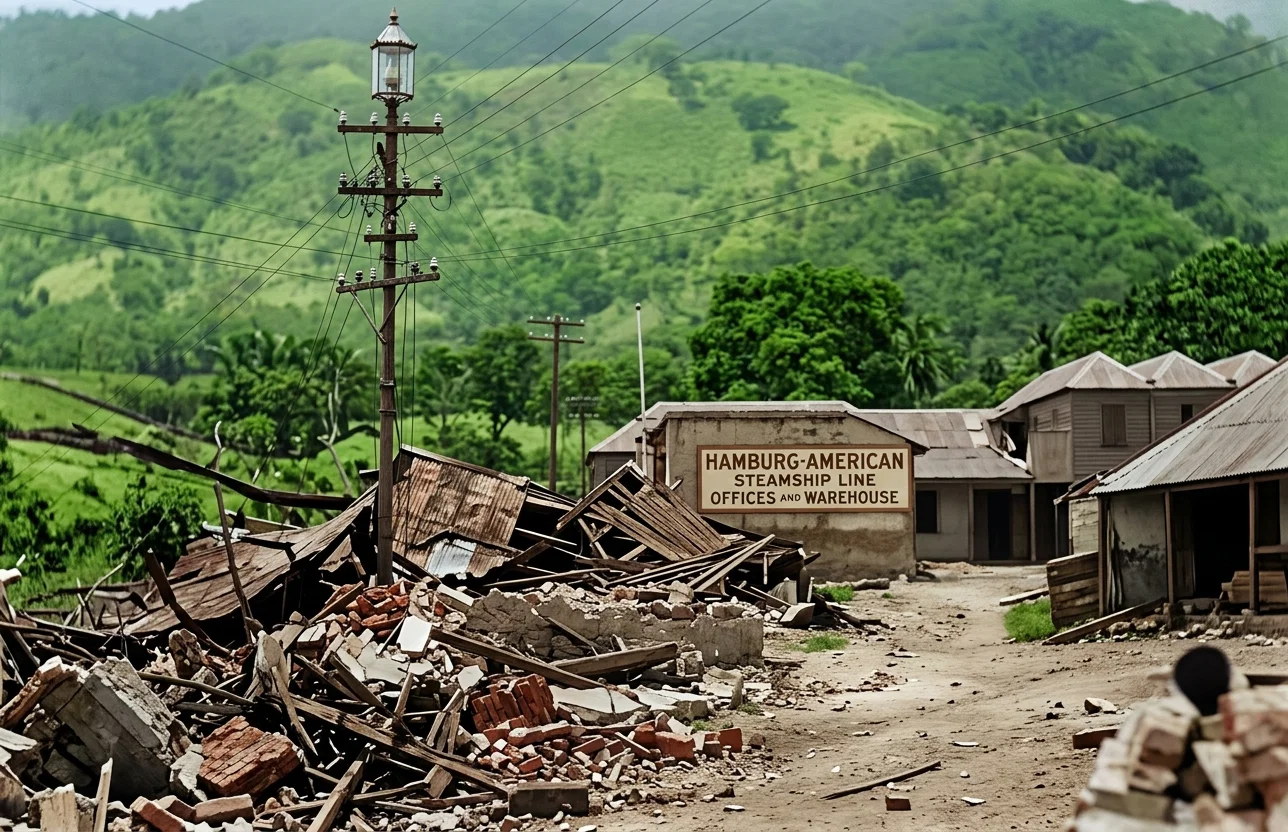
OFFICES AND WAREHOUSE OF HAMBURG-AMERICAN STEAMSHIP LINE
The two lighthouses that marked the approach to Kingston Harbor were completely wrecked. By their friendly light many a ship had been guided safely into the harbor on a stormy night. On Wednesday night, January 16,—two days after the earthquake,—the “Prince Waldemar,” a large Hamburg-American steamer, from the south, approached Kingston in the darkness. They knew nothing of the great calamity. In the darkness the dim outline of the island could be seen; but the captain was looking for the lighthouse, and not seeing it, supposed himself still far out to sea. Suddenly the watch cried, “Breakers ahead.” The engines were reversed, but it was too late. The beautiful ship, with its living freight, went onto the rocks.
There are many professed Christians like this lighthouse. Once there was a light; but some earthly shaking caused it to go out, and many a craft lies wrecked at their very feet. The professed Christian whose light has gone out is a greater factor for evil in this world than the infidel or the unbeliever who has never made a profession. My brother, my sister, how is your light?
Kingston, Jamaica.
The Struggle for Religious Liberty in Peru
By Eduardo F. Forga
EDUARDO F. FORGA
The fourth article of the Constitution of Peru says, “The Nation professes the Apostolic Roman Catholic religion; the State protects it, and does not permit the public worship of any other.”
One of the most evident results of the working of this law, so contrary to the true nature of religion, is strikingly apparent in Peru,—that with respect to the Christianity of that nation. It is difficult to say whether it is Christianity paganized or paganism Christianized. Moreover, since the foundation of the republic, noble spirits have not been lacking to fight against this obscuring religion, a characteristic relic of the medieval ages and of inquisitorial Rome.
Many notable Peruvians have been prominent in this combat, men of continental renown, as Vigil, Casós, Gonzáles Prada, and a considerable number of young men, who with their moral courage and patriotic ardor, have been the glory of their country.
Though the hour had struck in the march of time for the sun of religious liberty to shine on unfortunate Peru, clericalism continued to thrust itself forward throughout the country. Proud of her omnipotence, the church gloried above all in that Arequipa, the second city of Peru, with her convents, monasteries, religious institutions, etc., was “the Rome of Peru,” and one of the fortresses of the papal system in South America.
I was born in March, 1871, in that citadel of darkness. Having returned to my native land in March of 1896, after spending twelve years in educating myself in Switzerland and Germany, I resolved to do whatever I could for the liberty of my country and the good of South America. The study and reflection of many years had fully convinced me that the great moral, social, and economical unprogressiveness of the Peruvian nation in general, and the anarchic state of Spanish American republics, were first due to the evil influence of Romanism, which changed a religion of liberty, truth, and love—as that taught by Jesus—into a system of oppression, falsehood, and hypocrisy, and for so many centuries caused the anti-christian union of church and state. When I returned to Arequipa, the power of the clergy was still so great that a Bible colporteur was imprisoned before he could sell a half-dozen copies, and later was escorted to the railway station, and obliged to leave the place. Under such difficult circumstances, I did not know how to begin opposition11against Rome and take up the defense of liberty of thought and conscience.
Having received the title of Mining Engineer in Germany, I accepted a position as the director of a mine in the Andes, and in my spare moments began the translation into Spanish of a great number of articles against the plague of alcoholism, and also wrote in favor of modern hygiene, hydrotherapy, and especially vegetarianism, in order to gain the confidence of the people. Since 1898 nearly one hundred thousand tracts and pamphlets have been distributed throughout Latin America, the greater part having been reproduced in Peru, Chile, Bolivia, Argentina, Uruguay, Mexico, Cuba, and Spain.
Influenced by this propaganda, the government of Peru organized in 1903 a “National Anti-alcoholic Congress.” This was well represented from all parts of the country in the convention held at Lima during the entire month of February. As delegate from the municipality of Arequipa, I took an active part in the work of the association, and pleaded for the law of religious liberty.
During these years the Catholic cause was bitterly opposed by La Patria and El Ariete, the organs of the Radical Center and of the Liberal Party, two doctrinal political groups composed of patriots, intellectuals, and those of the working classes.
It seemed that the ruin of the clerical power in Arequipa was divinely decreed. A Catholic merchant and banker was very closely connected with the clergy. The priestly confessors of the church had accustomed their spiritual flock to deposit their small earnings with this good son of the holy mother—the Catholic Church. Influenced by the advice, hundreds, and perhaps thousands, left their small earnings with the happy merchant and good believer. However, it came to pass that he became bankrupt. Panic ensued, hundreds were reduced to beggary, and it was rumored that some trickery had been resorted to. For this reason Catholicism received a deadly wound in southern Peru.
Another event not less fatal occurred about the same time. A few years ago there was a citizen who had been president of a Catholic congress held in Peru, and who had the reputation of being one of the most conspicuous figures of the clerical party. He became a minister of state. As he had urgent need of funds for a particular business, and not having them at hand, he took money from the safe of the department, with the probable intention of replacing it later. This unscrupulous action came to the ears of the public, and the president, fearing that the indignation of the people might involve him in the fraud, turned him over to justice. This leader of the Catholics was imprisoned, thus causing great loss of prestige to the Roman Church throughout the entire republic.
After these blows had fallen, in 1904 it seemed necessary to dedicate all my energies to the work of reform, not because of the lessened vigor of the Liberal and Radical parties alone, but because they were both confounding the outrages of the Catholic Church with Christian principles, and as they fought, they spread anti-religious and atheistical ideas among the people.
In July I published the first pamphlet denouncing the great evils which the absolutism of the Roman Catholic Church has brought upon the unhappy Peruvian people, because of the union of church and state. It was necessary to make the public see that they, in conjunction with the government, should undertake a decided fight for religious liberty and the separation of church and state.
A ROMAN CATHOLIC CROSS IN PERU
An edition of one thousand copies, which had been announced in three thousand leaflets of free circulation, was sold in three days, producing a sensational effect. The clergy thundered in the pulpit and press. They preached and published such things as these: “He who blasphemes the name of God shall be killed;” “all people shall stone him.” A Catholic weekly which was edited by a nephew of the bishop, cited canon laws of the church with passages like the following, which should be applied to me because they were in force according to his opinion: “He shall be fastened some day to the door of the church with his hands tied behind his back.” “He shall be marked with a hot iron on his lips.” “His tongue shall be perforated.” “He shall be lashed publicly through the city.” “Then a gag shall be applied to the criminal. He shall be brought through the city tied to an iron.” “Nail his tongue.” “Cut out his tongue.” “Let him be fined one hundred ducats, and further banish him from the country.” But the best advice which the good agents of the Catholic Church could give to the fanatics was “to kill” me.
I answered those attacks by a second enlarged edition of the pamphlet, and with other leaflets, which were distributed throughout the city by the thousand.
In spite of the anger of the priests, in September of that year I helped to found the first evangelical church. The clergy did all they could to dissolve the new organization, and incited the faithful to throw stones at the windows of our place of worship, and forbade Catholics to sell anything to the members of the new church, or to buy of them, neither were they to give them occupation. All this was in vain, for they were protected by the hand of the Lord, and sheltered by public interest, and to-day the church is prospering.
The fight continued with thousands of tracts and monthly pamphlets. During this time and several months preceding, colporteurs of the British and Foreign Bible Society were selling large quantities of Bibles and New Testaments in the town.
The Catholic Church, having been unable to arouse the fanatical zeal of the people to kill me, and having failed to frighten me with their threatenings and persecutions, denounced the pamphlet which attacked the state church. The ecclesiastics used their entire influence on the judicial authorities, and compelled an order of imprisonment against me. The political power, which was called to carry out this order, declined because they represented a patriotic and semi-liberal government, and understood that my efforts were for a better civilization, and that the people would be wrought up at seeing me imprisoned, and thus the danger of a revolution would be increased.
Although practically a prisoner in my own home, I worked along the same lines with my literature, and published a monthly review called La Reforma (The Reformation), which was intended for the educated classes, likewise other tracts in editions of from four to ten thousand for the middle classes. The publications were sent regularly to the president, the ministers of state, senators, representatives, prefects of the departments and provinces, municipalities, public libraries, to the directors of the political parties, to the press, and to private citizens. We have about fifty agencies scattered throughout the principal cities of the republic, and some in Chile, Bolivia, Ecuador, and Colombia, where our literature is for sale and free distribution. The work of the central office and the agencies of La Reforma was a work of love, the money contributed being used for printing. Many friends, and even Catholic ladies, made gifts to support the work.