The above exclamation was uttered by a man in Dallas one Saturday night at the police prison when told that the fatal bullet from his pistol had resulted in the death of a former friend with whom he had just had an altercation in a barroom. After giving utterance to it, he clasped his hands and moaned piteously as he paced his cell and continued to cry out, “My God, is it possible? I have been praying that he might not die. I would a thousand times rather change places with him than be as I am. I have the blood of another man on my hands, and I am a ruined man!” Some distance, in another part of the city, sat a poor woman, his wife, and three children, deploring the fact that her husband and their father had taken the life of a fellow man and was in jail, stamped with the brand of a murderer. And just a few blocks away there wailed a broken-hearted widow, as her six children wept and refused to be comforted because there was a bloody corpse lying in a saloon—all that remained of a husband and father. Such is a record in part of the closing hours of the last Saturday in the year 1905 in the city of Dallas. What caused this tragedy?—Red liquor! Where did it occur?—In one of the saloons in the city! Both men ought to have been at home with their families; but instead of this they were in the liquor resort throwing dice for drinks. A trivial dispute arose, angry words followed, then came blows, and the crack of the deadly pistol put the climax to the altercation. A few moments before, they were in friendly converse, but a drink or two more of liquor turned the friends into deadly enemies, profanity and wicked epithets were hurled, and the pistol did the rest. Yet we are told that the best way to regulate the saloon is to license it and give it a monopoly of drunkenness, vice, immorality, and crime. May be so; but every day adds to the list of murders perpetrated by this demon of iniquity. The saloon is the meeting place for men where their wicked passions are aroused, their thirst for blood stimulated, and where their deeds of diabolism are consummated.
We are often told that, “If you let whisky alone, it will let you alone.” A more colossal falsehood never found articulate utterance. The wife and three children of the man who did this killing, and the wife and six children of the man killed, did not touch the accursed stuff. They never went about the saloon in their lives. Yet two women and nine innocent children are the real victims of the saloon. The man who did the killing suffers agony for his deed; while the dead man is beyond the suffering of this world; but eleven other people are heart-broken and refuse to be comforted. They are the ones who suffer most, and they suffer for the sins of the open saloon. Really, it is the people who let liquor alone who suffer the greatest agony because of its deeds of violence.
But the foregoing incident is only one of the hundreds that occur every year of the world. The saloon is the prolific soil, out of which spring up into the rankest growth murders, vices, immoralities, heartaches, and desolate homes. For more than fifty years it has glutted our appetite with blood and shame. It has brought about a condition in which murder is respectable, and murderers lift up their heads as honored citizens. It is next to impossible to justify and fully punish the man who takes his neighbor’s life. And the reason for it is that the barroom has made murder so common that nobody seems to attach any importance to the crime. When it is committed, we are shocked for the time being; but it passes from our thought, the murderer is vindicated by the courts, and the thing becomes a closed incident to the community. Yet we have a maudlin sentiment that the saloon is one of our leading institutions, that it must be protected by law, and that those who oppose it are narrow-minded and fanatical. But the saloon has almost filled up the cup of its iniquity, and the time is approaching when its death-knell will be sounded. Justice moves slowly, but it moves surely.—Texas Advocate.
Self
By ELIZA H. MORTON
ELIZA H. MORTON
HIDDEN, perchance, ’neath a smiling face,
Or cloak of what seems a Christian grace,
There lurks a foe with a venom dire
That eats the heart like a coal of fire:
It is self.
So subtle and sly this demon fierce,
That many a soul his arrows pierce.
You’ll know this foe by his boasting cry
Of “I and I; ah, yes, it is I.”
It is self.
Who wants all credit for what is done
In city or church beneath the sun?
Who wants his name to always appear,
And sets it up like an auctioneer?
It is self.
Who builds his bridges from man to man,
And grasps all ropes to strengthen his plan?
Who tramples the feelings of others low,
And laughs at their pain and their overthrow?
It is self.
There’s hope, sweet hope, for a soul thus bound;
In One that is mighty help is found.
No more the cry, “It is I, ’tis I.”
When self is ready to yield and die,
It is Christ.
North Deering, Maine.
Simple Willingness
“A SIMPLE willingness to serve the Master.” It was a petition in a good man’s prayer, which, falling on the ear of the writer, has long dwelt in her memory.
In this busy, hurrying age, when so many are working at fever heat, in the church as well as out of it; when our books and papers, the sermons we hear, even our intercourse with friends, all seem to stimulate to yet greater activity, that prayer for “simple willingness” falls like a soothing balm upon the overwrought.
There are some of us—not a few—whose hands are not idle, but who chafe and fret against the bounds of our appointed place, and look longingly toward what we deem a nobler, larger work. The words “mission,” “vocation,” “a higher sphere of activity,” so much on the lips nowadays, too often steal between us and a simple willingness.
We are too prone, “the daily task forgetting,” to look too eagerly beyond to some great work we should love to perform for the Master; while we count as “common” the work he himself has laid upon our hands. We pant to serve him in the throng, when he calls us to a desert place.
“Do not pray for strength to bear the tortures of the Inquisition,” says Spurgeon, “when what you need may be grace to uncomplainingly darn the family hose!”
We may fondly think how well we might serve the Master “in such and such a place.” “If I were free from such heavy, homely cares,” sighs one; “If I had only my once firm health,” moans another.
What we may need for service anywhere is the simple willingness to “do the next thing,” whatever that may be.
How would the church—aye, the world—grow in grace if the servants of Christ more frequently and sincerely lifted and practised this beautiful petition.—The Christian.
How the Saloons Pay
MARK TWAIN says a man bought a hog for one dollar and a half, and fed it forty dollars' worth of corn, and then sold the hog for nine dollars. He lost money on the corn, but made seven dollars and a half on the hog. This illustrates how the saloons, which cause most of the crime, pauperism, and insanity of the country, are increasing the taxes very heavily, but the tax-payers are getting some money from the saloon license fees.—The National Advocate.
En Route to Africa
By G. A. IRWIN
G. A. IRWIN
At the session of the General Conference Committee held in Washington, D. C., in the month of October, it was recommended that I attend the South African Union Conference, which was to be held in Cape Town, beginning Jan. 6, 1907. At the close of this conference it was planned for me to spend some time in visiting our different missions, and if time would permit, to visit Uganda and ascertain the prospects and best place for a mission in that portion of British East Africa.
It is now several years since a representative from the General Conference in America has visited this field. In the interval, South Africa—where the greater portion of our work in this great continent is being carried on at present—has passed through a most terrible war, which for the time affected our work very seriously in the established centers, and practically stopped its advance into new territory. A brighter day is now dawning, and the brethren in that field are calling for help to counsel and plan, and for men and means to assist in extending the work into new territory. My trip, I trust, is but the beginning of our response to this call.
In looking up my route, I found that I could go by way of Australia with only two weeks more time at sea, and an additional expense of one hundred dollars. To offset this, I would have three weeks’ time between boats to spend in Australia, visiting the institutions and some of the principal churches and centers of our work in this important field. In harmony with this arrangement, I sailed from San Francisco October 27 on the steamer “Ventura,” which was due in Sydney, Australia, November 16. On the following Sabbath after leaving San Francisco we arrived in Honolulu a little after midday, in the midst of a cold, blowy rain. After some trouble and delay I succeeded in finding the home of Elder Williams, who has charge of our work in the Hawaiian Islands, with headquarters in Honolulu. All those who have made the trip from America to Australia by this route, know that Honolulu is an important resting-place. I call to mind a number of times when I, with others, have been made comfortable and have enjoyed a brief respite from the horrors of sea life through the kind attentions of present and former residents, such as Sister Kerr, Brother Burgess, Brother and Sister Howell, Brother and Sister Carey, Brother and Sister Behrens, and Brother and Sister Colcord. The work in Honolulu has passed through many changes; only Sister Kerr of the afore-mentioned persons still remains; Brother Burgess has been laid away to rest, and the others have all returned to the States, where they are still engaged in the work, each in a different place and sphere.
The work in this field is at present under the direction of the North Pacific Union Conference, and is a part of the conference mission territory. Brother and Sister Williams were quite surprised to see me, in fact, did not recognize me until I told them my name. Not knowing that I was coming, they were taken off their guard, and thought I was one of the ministers of the city who had come to give them a berating for having captured some of his members. We passed two hours very pleasantly together, talking over the progress of our work in general, and the prospects of future success in Honolulu. The abandonment of the school and sanitarium work in the city and the withdrawal of the workers has left them very weak in numbers, and without any regular place of meeting. Quite an interest is being developed among the Japanese, and some among the Portuguese are becoming interested. Brother Williams believes that the time has come for them to have a church building of their own, and is going to make an effort to see how much can be raised in the city toward it. If this effort could be supplemented by a liberal donation from the home land, he thinks they might, in the near future, be in possession of a neat little house of worship of their own, and thus give their work some degree of permanency. At the conclusion of a nice supper, Brother Williams accompanied me back to the boat. On our way we called on Sister Kerr at her home. She seemed delighted to see me, and we spent some time answering questions relative to the many friends and acquaintances in the States, and as to the progress of the message in the home and other lands. When parting, in addition to her expressed well wishes for my safety on the voyage, she gave me two large pineapples and some beautiful oranges grown upon her own premises, to take with me to the boat for an occasional change from the sameness of the boat fare. To those of us who have been compelled to travel much by sea, these little meetings with those of like faith in the great ocean centers, are like so many oases in the great waste of waters over which we travel.
Nothing worthy of special note occurred on the passage from Honolulu to Auckland, New Zealand, only the failure of the boat’s machinery to do its proper work. Most of the time, only one engine was in operation, and several times both stopped, and we were left for the time at the mercy of the waves. Fortunately for us, however, we had good weather and a quiet sea, so that nothing more serious happened than the loss of seven days’ time. It was said by one of the engineers that when we sighted Auckland, the last bit of coal in the bunkers was being swept up, and if we had been an hour later, they would have had to tear down the partitions and use the lumber for fuel, or appropriate oil or bacon from the cargo, in order to get into port.
Directly after landing in Auckland, I was handed two letters and a telegram from Elder Olsen, requesting me to break my journey and come to Masterton, where the New Zealand Conference and camp-meeting was to be held November 8-18. This was impossible, as our boat was late. Later in the day I met Joseph Hare and his daughter Florence, who were on their way home from the meeting. From these friends I learned that notwithstanding the weather was rather cold and rainy, they had a good meeting. Sister Campbell and her daughter called at the boat and took me home with them to dinner, where I had a pleasant visit, and also met Maud, Sister Campbell’s daughter, who is one of the nurses at the Wahroonga Sanitarium in Australia. She had just returned home for a short rest and visit.
On Tuesday morning, November 20, we left Auckland for Sydney, Australia, where, after rather a stormy trip of four and one-half days across the Tasman Sea, we arrived Sabbath noon, November 24, eight days behind the advertised date of arrival. The “Sonoma” was still in port, having been held back to take the regular trip of the “Ventura,” thus giving her three weeks to go into dry-dock for repairs.
My son Walter and his wife came out on the tender to Neutral Bay, where we were anchored, and accompanied me to the regular dock at the quay, where we were met by Sister Graham and Brethren Hindson and Starr. As soon as my baggage arrived from the boat, and was passed by the customs officers, we went out to the sanitarium at Wahroonga, where I received a hearty welcome from all. As I looked into the familiar faces of the nurses, it did not seem possible that I had been away two full years. During that time, however, many changes and improvements have been made. On the road from the station to the sanitarium, which was mostly bush land when I left, clearings have been made, and a number of large brick houses have been built, and the road is assuming the aspect of a street. As the result, the sanitarium property is much more valuable now than when first purchased. The two new cottages built by Elder Olsen and Dr. Kress on opposite sides of the road just at the entrance to the grounds, have added much to the general appearance. The completion of the heart-shaped driveway in front, and the removal of some of the old fruit-trees and the substitution of ornamental trees and flower beds, give the place an appearance of order and14thrift. The erection of a new gymnasium and a neat cow barn has added much to the practical side of the institution. The old orchard, under the care of a practical orchardist, is springing into new life.
As I looked over and around this beautiful place, and attended the noonday and evening prayer-meetings, and witnessed the spirit that seemed to pervade all departments, I felt amply repaid for whatever sacrifice we had made in the way of means, labor, and anxious days and nights when the building was being erected and equipped for patients. I call to mind a remark made by a young man who had apostatized from the faith, as he watched some of us who had volunteered dig out the foundation for the bath-rooms. “Do you ever expect,” he said, “to finish this building? I predict that it will prove a white elephant on your hands.” It is true that we passed through many dark and trying experiences while it was being erected; many times we came to the end of our means, and there seemed to be no way out but to stop work. Then we remembered that the Lord had spoken definitely that there should be such an institution built in this field, and his own chosen servant assisted in selecting the place and urged the beginning of the enterprise. Constrained by this, we struggled on; means came in at the opportune moment, so that at no time did the work come to an entire standstill. As the result of perseverance, hard work, self-denial, and faith in the Testimonies, we have a medical institution in Australia that is a credit to our work, and is exerting a strong influence for good. Already thirty persons have accepted the truth as a direct result of the work of this institution, and its work has only begun,
Another gratifying feature of the work of this institution is the willingness and cheerfulness with which the physicians and nurses work in harmony with the ministry in evangelistic work, and also with the school in educational efforts. It is the aim of the sanitarium managers to train evangelical medical missionaries—rather than professional nurses—and place them at the disposal of conference boards for use in their regular conference work, their time to be audited and paid from the conference treasury, the same as other conference workers. I speak of the work of this institution thus in detail for the encouragement of others who may even now be struggling with similar problems and conditions. What has been done by faith and perseverance, can be done again. The same principles of co-operation between the educational, medical, and evangelical work that has operated so harmoniously and successfully here, can be made equally successful elsewhere if men will follow the Lord’s direction.
I remained at the sanitarium until Monday that I might secure my passage on the steamer “Medic” to Cape Town. In the meantime I visited some of the sick in the sanitarium, and called on the families outside the institution, and had several talks with Elders Gates and Fulton relative to their island mission work, besides speaking to the workers at their noonday meeting, and to the patients and helpers in the drawing-room Sunday evening.
Two New Conferences
By L. R. CONRADI
L. R. CONRADI
GERMANY, the home of the Reformation, is more and more proving the most fruitful field in Europe for the last great reform movement. Although it took us years to get any kind of start (as it was not until 1898 that the first conference could be organized), yet since that time the work has made rapid strides.
In 1901 Germany was divided into the East German Conference and the South German Mission, the West German Conference being regarded as the original organization. In 1902 the South German Mission became the South German Conference. In 1903 God's blessing had so been with the East German Conference that it was found best to organize out of its territory the Prussian Conference; and there had been such growth in western Germany that Rhenish Prussia could be formed into a separate conference. In 1905 the German Union District, taking in Hamburg-Altona and Friedensau, was severed from the West German field. Now, at the close of 1906, the Silesian Conference has come into being by once more dividing the East German Conference, and the North German Conference has been formed out of territory formerly belonging to the West German field—giving us eight distinct organizations in the German empire, with a total membership of about five thousand.
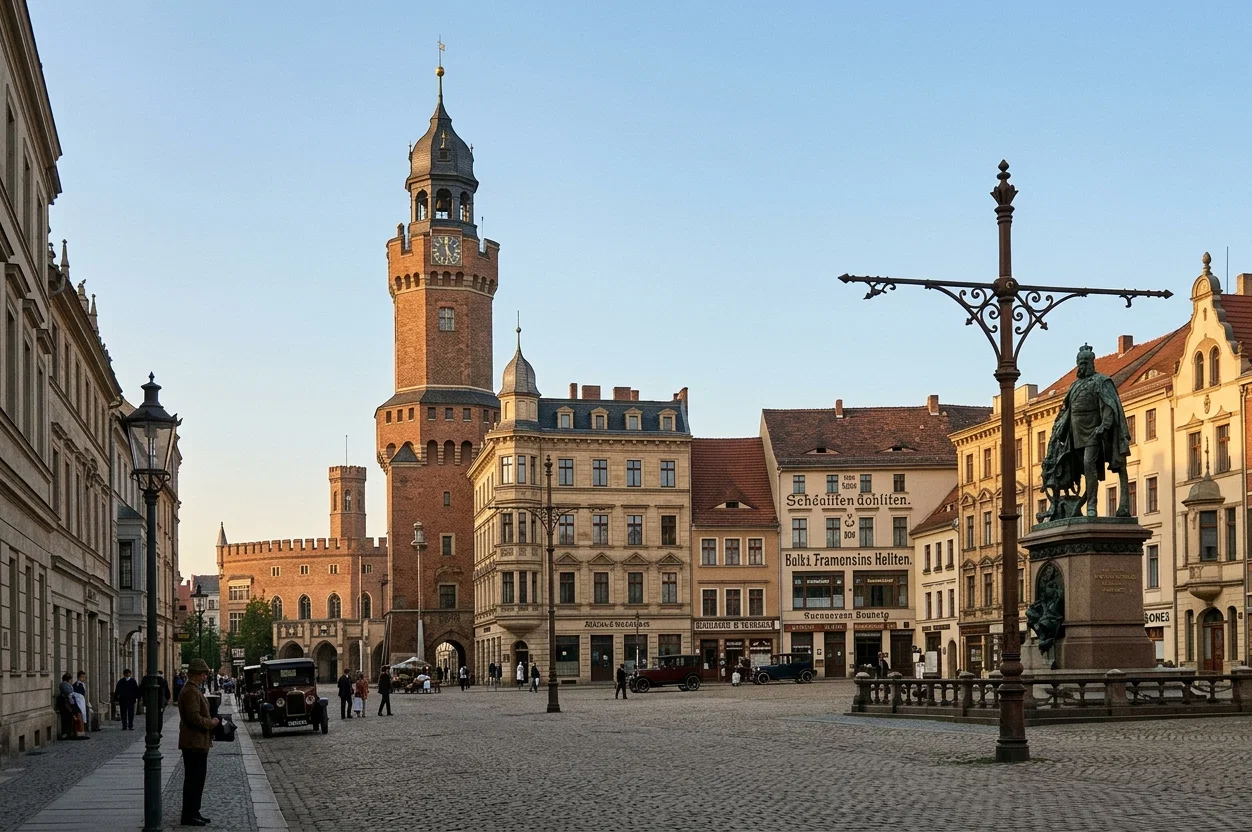
Goerlitz, Germany. Upper market with chief of police building and statue of Emperor William I. In first building to the right, our meetings were held.
To effect the organization of the Silesian Conference, we met December 13-16, at Goerlitz, a city of eighty-five thousand inhabitants. The provinces of Silesia and Posen comprise the territory of the Silesian Conference, and these two provinces have a membership of three hundred and forty, and a population of nearly seven millions.
Elders Frauchiger, Obländer, Schilling, and the writer, accompanied by the German Union Secretary, were present at this meeting. Best of all, the blessing of the Lord was with the ninety delegates, and there was harmony in all our deliberations. The brethren felt very anxious to do what they could to advance the Lord's work. Although their membership is not large, and they have a great field, yet they voted unanimously to give a second tithe to the union, as all the other German Conferences do. They willingly raised about eighty dollars toward the material fund for the “Ministry of Healing” in German, promising to begin right then and there to circulate that book in behalf of our philanthropic work. The accompanying cut shows where the meetings were held.
Elder J. H. Schilling was unanimously chosen president of the new conference, and he will be assisted by one ordained minister, two licentiates, five Bible workers, and fifteen canvassers. The largest church in this field is at Breslau (one hundred and five members), a city of nearly half a million inhabitants.
Goerlitz is near the old Moravian settlement of Niesky, their leading colony, where they have their mission school and preparatory college, as well as their deaconess' home. In their advanced course for missionaries I found but twelve students at the time I visited the place. The town has about twenty-five hundred inhabitants, perhaps two thirds of whom are Moravians. I noticed that the United Brethren Association, among other things, carried on an extensive trade in cigars and tobacco. Judging from what I saw, I thought that the old Moravian spirit seemed to be departing, although their income for missions is still about two hundred thousand dollars per annum.
December 20-23 the general meeting for the North German Conference was held at Harburg, about three miles from Hamburg. Harburg is a manufacturing city of fifty-six thousand inhabitants.15
As just organized, the North German Conference is comprised of the provinces of Hannover (excepting the southern part), and Schleswig-Holstein (excluding Altona), the two Mecklenburgs, Oldenburg, and the two free cities of Bremen and Lübeck (with a population of nearly five and a half millions) cut off from the West German Conference. There are nearly four hundred members in this field now.
Although it was near Christmas time, yet about eighty delegates came together, and the Lord's good Spirit was present at the meeting. Elder L. Mathe was chosen president of this new conference, which, like the other German Conferences, pledges two tithes to the union for use in the union mission fields. About the same sum was raised here as at the Silesian meeting toward the material fund for the German “Ministry of Healing,” and they at once began circulating this book. The largest church is Hannover-Minden, with ninety-six members. In the field are two ordained ministers, three licentiates, five Bible workers, and twenty-one canvassers.
The separation of these two new conferences dates from Jan. 1, 1907, so that the tithe will flow into the old treasuries until that date, and the work in the new fields will be audited by the old committees for the year 1906. The East German Conference still retains one thousand members, being by far the strongest conference in the union. In western Germany there are now six hundred members. Thus far every such separation has proved a strength to the old, as well as to the newly organized, field. When we remember that there are sixty-two millions of people in Germany, it will be seen that eight organizations are none too many, and we do not doubt but that as time goes on, further division will be necessary. We are thankful to God that from year to year we not only can organize growing churches, but also that he is so blessing us that we can form new conferences. May the Lord still give us greater blessings.
Hamburg.
France
By H. H. DEXTER
H. H. DEXTER
DECEMBER 13 I left Nîmes to spend a few weeks among the believers in central, northern, and eastern France. My first stop was at Clermont-Ferrand, a city of fifty-five thousand inhabitants, in central France, where Brethren Rey and Blarrzat are giving a series of lectures in a hall. These workers are realizing the truthfulness of the statement of Rev. 12:17. A young minister who for a short time favored our work has turned to be its bitterest opponent. Nevertheless four precious souls are walking in the light of this glorious message, two of whom are an ex-Baptist clergyman and his wife. These four will be ready for baptism in the spring.
The week of prayer was spent with the church at Paris, which now numbers thirty-five resident members. A meeting was held each evening, which nearly all the members attended. It was truly refreshing to unite with my brethren and sisters in Paris, during this special season of seeking God. From the earnest testimonies borne and the fervent prayers offered, it was very evident that there was a sincere desire on the part of this church to realize the fulness of the blessing of the Holy Spirit. The readings were carefully read and studied. All shared the sentiment that God desires that the inhabitants of this great metropolis shall soon be warned of its coming doom. It was gratifying, indeed, to see an earnest company of God-fearing commandment-keepers in this center of fashion and pride. While some of the members are from Switzerland, still the majority are Parisians, who have been brought to the light of the third angel’s message through the earnest and persevering labors of Evangelist Augsbourger, our only worker in that city.
During the week of prayer, several persons with whom Brother Augsbourger had been studying for some months gave their hearts to God, promising to leave all—position, home, friends—for their Saviour. Among the new converts are several intelligent, strong young men, who desire to consecrate themselves to the work of publishing the message to their countrymen. We praise the Lord for this victory.
Sabbath afternoon, December 22, we all repaired to the banks of the Marne River, a few miles above the city, where eight dear souls were buried by baptism in the likeness of Christ’s death. One other person had been received into the church some weeks before, upon his former baptism. This makes nine new accessions to the Paris company.
Leaving the capital, I proceeded to the frontier of Alsace-Lorraine, to Montbéliard, where Elder Gustave Roth has been laboring for one year. About ten members are here witnessing for the message. Owing to very cold weather and deep snows, our meetings were not well attended. As helpers, Brother Roth has a Bible worker and two canvassers. The faithful colporteurs are scattering silent messengers throughout the towns and villages in these parts of eastern France. The old tent used twenty-five years ago by Elder D. T. Bourdeau is pitched each summer in the towns of this section. It is needless to say that the tent has seen its best days, and soon will have seen its last.
My next stopping-place was Besancon, where six souls are holding up the banner of present truth. I had only time to visit and pray with each brother or sister.
Five hours by train took me to the small town of Brauge, where sixteen years ago Elder Bourdeau raised up a church. In spite of long distances and deep snow, the brethren came together Sabbath morning for the study of the Word of life. These brethren and sisters—about twenty in number—all love the message, as was evinced by their prayers and testimonies.
After an all-night’s ride by train, I landed at Lyons, a city of four hundred and seventy-two thousand, the third in size in France, Marseilles being second with five hundred and seventeen thousand. In the latter place we have not one soul to represent the message. At Lyons we have one, a dear, faithful brother, sixty-seven years of age, who has been praying for years that some one might come to his city to help hold up the banner. In the large cities of France there are hundreds of souls just as honest and good as those in the large cities of my home land, and when this everlasting gospel is presented with that power and fearlessness that is befitting such a message, these hungry souls will accept it. The Lord is demonstrating that in poor infidel France there are many men and women who are willing to sacrifice everything for the love of the Saviour. Where are the strong young men to enter the large cities of this great nation? Will not my brethren and sisters who have much more than they need of this world’s goods pour their gifts into the treasury of the General Conference, so that our needy field may receive its share of the financial help we so much need? We have some strong young men and women without means, who desire to prepare themselves for usefulness in this cause, but lack of funds is hindering the work.
Sunday, the thirtieth, was spent at Valencia, and the first day of the new year, found me at home in Nîmes with my family. Since the camp-meeting last summer, Brother Paul Steiner and I have held four meetings each week, in a large hall centrally located. The Lord has given us a good interest, and several have determined to obey.
Nîmes.
Appreciation Without Imitation
A MISSIONARY in China tells, in the Baptist Magazine, of a convert who, after having ferried a man across a river one dark night, found some bracelets worth four hundred dollars in his boat. The Christian boatman went with his native preacher to the mandarin, to seek for the owner:—
“Well,” said the mandarin, “I have never seen nor heard anything like this. Your religion must be a true religion, and your God a living God, thus to influence a poor man to give up wealth for conscience’ sake.” He praised the boatman, who went to his damp, mat hut on the banks of the river with a contented mind. The Christians had a special time of prayer and praise over the matter.
“A few days after, it was found that a wealthy Chinese had been robbed, and the man who crossed the river and dropped the bracelets was the thief. The owner received the bracelets very thankfully, and gave the mandarin twenty-four dollars reward for the finder. The official kept some, and sent the rest by his lieutenant to our convert. The lieutenant kept some, and sent the small remainder by a soldier, who kept the remnant himself, so our poor brother got no reward after all. Yet he did not lose the reward of a clean conscience, a peaceful heart, and the joy of having honored the Lord.”
The North Pacific Union Conference
By W. B. White
WE are glad to say that the work in this field is onward, and we have many reasons for encouragement. The past summer and fall have been busy months for us, and we have every reason to thank God for the prosperity of the work. All our summer and fall camp-meetings were precious seasons, and were a great encouragement to our people.
In consequence of recent developments among us, some were somewhat perplexed on certain points of faith, and while possibly not in a doubting frame of mind, were in a measure bewildered. Elder Irwin's series of lessons were of great value, and brought light and faith to many minds. God blessed them to the good of his people. Our small local camp-meetings later in the fall were also sweet and precious seasons with God, and were an inspiration to all who attended them.
In this union conference we have Walla Walla College, and seven intermediate schools scattered through the several conferences. The opening of the school year found more pupils in these schools than ever before. The number has steadily increased, and at this writing all our schools have about as many students as they can well care for. Nearly every room in Walla Walla College is full, and we are glad to say that we are having an excellent school.
Prof. M. E. Cady, with a strong, consecrated faculty, is doing good work for the young people, and an excellent influence is going out through the union conference. The intermediate schools are also doing excellent work, and many wish to obtain a preparation now for service, that they may enter the work a little later. We feel much encouraged by our educational prospects, and trust that through our schools many of our young people may be turned toward the work of God.
In the medical work advancement is being made also. The Portland Sanitarium is enjoying a good year, and is having an excellent winter patronage, the best in its history. At this writing (January 23), the house is well filled, a good class of young men and women are entering on the nurses' course, improvements are being made, and the future looks reasonably bright for the prosperity of the work.
At College Place, the little sanitarium established by the Upper Columbia Conference near the college is now fitted up for work, and is enjoying a reasonable patronage. Private medical enterprises are being conducted at Spokane, Seattle, Tacoma, Port Townsend, and North Yakima, which as far as we know are having a reasonable degree of success.
The book work of the union conference is steadily increasing, and the prospects are that a large number will enter the field the coming year. Our States are now quite well manned with State agents, but we are greatly in need of a strong man for our union conference general agent.
Referring again to Walla Walla College, I would say that its present debt is about twenty-three thousand dollars. Last spring a plan was laid to lift this burden, and during the summer and fall cash subscriptions were taken for this purpose, and it now looks as if our plans would be successful, for good substantial subscriptions to the amount of about fifteen thousand dollars are already in hand, and a very small part of the union conference has been solicited. From the first, God has blessed this effort, and we are certain that by another fall our college will be free from debt.
In the early winter ministerial institutes were held in the three large conferences—Upper Columbia, Western Oregon, and Western Washington. We believe these have been of great profit, and trust that others of like nature may be held.
The annual conference of the British Columbia field has just been held, and we are much encouraged with reference to the progress of the work in that field. The past year its tithe has nearly doubled, about forty new Sabbath-keepers have been added to our churches, and we believe that in another year or two it will reach the point of a self-supporting conference.
A new school building will be erected the coming summer on the school farm at Port Hammond, at a cost of about twenty thousand dollars. An Indian mission will also be established near Port Simpson, and a party in early spring will penetrate into what is known as the Ootsa Lake Country, where there are no missionaries of other denominations, and will endeavor to get in touch with the Indians of that region and establish a station.
It now looks as if a self-supporting conference with about four hundred members might soon be organized in southern Idaho. This is under advisement.
We are endeavoring to keep the unity of the Spirit in the bonds of peace. Our courage is good. We believe God is blessing our efforts, and to him we will give all the praise and glory for what has been and is being done, and with strength of heart press forward in the work.
W. B. WHITE.
India
By A. G. Watson
THE Lord helped me, in company with Brother Miller, to make an enjoyable trip to Babolmohal, one afternoon, and at noontide the following day three men and a woman—all Santals—were baptized in the river by Brother Miller, in the presence of a representative gathering of heathen Santals from the adjoining villages. The candidates had been prepared by Brother Barlow.
On the twenty-eighth of October the family went to Koro, a village some four miles distant from Karmatar. The road is a good one, and the bullock-cart ride out there seemed to be enjoyed by both the older and younger members. We camped in a pleasant grove, a few minutes' walk from the village.
After dinner a few of us visited the village, and spoke to a small congregation, and read to them from the Holy Scriptures. At the close of the meeting a goodly number of Bengali tracts were left among the villagers as silent witnesses for Jesus. The people appeared grateful for the visit, as they turned out quickly from their cottages when the evening hymn was being sung, listened attentively to the talk and reading, and eagerly accepted the literature that was distributed among them.
On the last day at Karmatar a man saluted me on the road opposite the schoolhouse. I returned his greeting, and as he seemed inclined to improve the acquaintanceship, I began to tell him of the love of God in sending his Son to die for us that we may be saved. “I was present,” he said, “when you people spoke the other day in the village of Pindaree. Your words pricked me.” (Pindaree is two miles from Karmatar; we had visited it the evening previous to our excursion to Koro.) The brother is a fisherman by profession. May the Lord make him a fisher of men.
I was glad of the help received from the older boys of the school in the village work. Their singing almost seemed essential to the services. The Lord bless them, and the work and workers in Karmatar and surrounding villages!