The Youth’s Instructor, Vol. 33, No. 14.

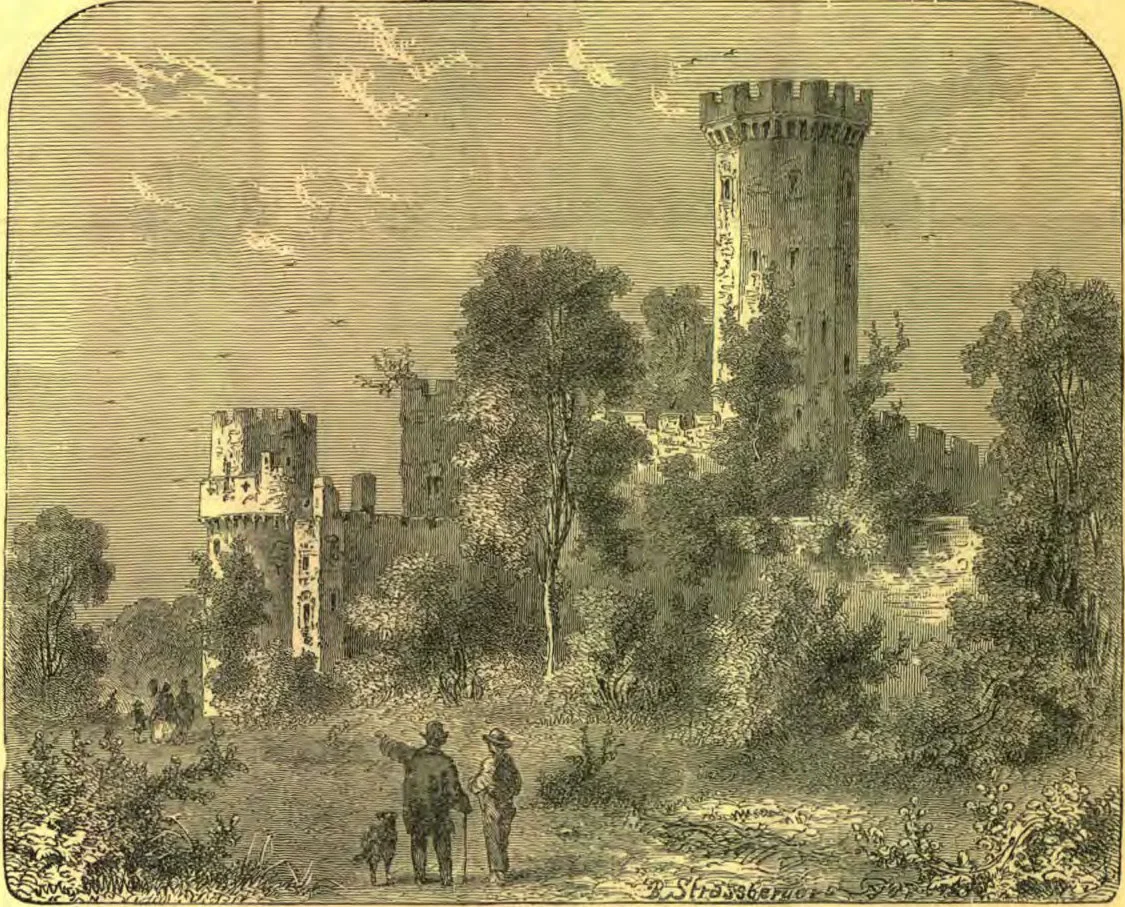
WARWICK CASTLE

The Youth’s Instructor

Apr 22, 1885

S. D. A. Publishing Association · Battle Creek, Mich. · Apr 22, 1885

WARWICK CASTLE

Written for THE INSTRUCTOR.

WARWICK CASTLE.

In the old days, a long, long while ago, the British Isles were peopled by a bold, hardy, warlike race of savages. The different tribes were often at war with one another. But their worst enemies came from over the channel and down from the north seas, ravaging the land, destroying the crops, and burning the towns and villages. The Britons withstood them bravely, but not always successfully; for their rude weapons did poor service in a close encounter.
They soon found it necessary to build strongholds, to protect themselves from their enemies. The ruins of some of these early fortresses may still be traced. They seem to have been nothing more than two circular walls, one inside of the other, and both surrounded by a deep, broad ditch. As the people became more civilized, they made improvements in their ways of building.
When the Normans came over from Normandy, and conquered the Saxons, they seized the land, and parceled it out among their own knights and nobles. But what they got by force they had to hold by force; so they were obliged to build strong castles all over the land to keep off the angry Saxons. In the reign of King Stephen, there were over a thousand of these castles. The Normans made the Saxons their subjects, and they were all the while rising up in rebellion, and trying to get back their rightful property.
Their castles were vastly stronger than the rude ones first made by the Saxons. They were inclosed by thick, high walls, and were surrounded by a deep ditch, or moat, frequently filled with water. They usually stood on some commanding eminence, or near a lake or stream of water, so that they could be the more easily defended. Leading over the moat was a drawbridge, so hung with weights and pulleys that it could be drawn up against the castle wall. In this way all communication with the outside world could be cut off, and the enemy hindered from entering the castle. The gate was very strong, cased with iron, and made extra secure by a portcullis, or grating, that slid down in grooves from above. On either side of the gate were high towers, where the archers and stone-slingers stood to defend the entrance.
The walls were flanked with tall towers, where the besieged might fling down missiles upon their assailants. Inside this strong outer wall were other ditches and walls that had to be crossed and scaled before an entrance to the castle could be obtained. Inside of the court-yard stood the castle, or keep, in itself almost impregnable, with its thick wall, heavy doors, and strong bolts and bars.
One of the oldest of these castles now in existence is found in Warwickshire. Warwick is a town beautifully situated on the banks of the River Avon. It suffered a great deal from the Danish invaders; but it was repaired afterward by Lady Ethelfleda, the daughter of good King Alfred.
The castle stands on a rocky eminence, and at its base flows the bright water. It was once the “special stronghold for the midland part of the kingdom,” and it was very necessary for the king’s peace that none but his friends should hold it. The castle and its earls have played an important part in English history.
The living rooms extend three hundred and thirty feet in length; and from the windows can be obtained an extensive and varied view of the surrounding country. In the castle may be seen fine old portraits, and the armor of lords long dead.
The most ancient portion of the building is known as Cæsar’s Tower. Guy’s house, another ancient part, was erected in 1394, and its walls of solid masonry are ten feet thick.
Sir Guy, earl of Warwick, is a famous fabulous person, supposed to have lived in the reign of the Saxon king, Athelstan, nearly a thousand years before Christ. According to a legend which probably had its origin in some Norman poet’s brain, the Danes were waging fierce war against the Saxon king. The result was to depend on a combat between two champions,—Colbran, the Danish champion, and Earl Guy, who had just returned, unknown, from a pilgrimage to the Holy Land. Guy killed the Dane, and then retired to a hermitage beside his own castle in Warwick.
“Sir Guy of Warwick, as was wreten In palmer wyse, as Colman hath it wryten; The battail toke on hym for England’s right, With the Colbrond in armes for to fight.”
Whether there ever was a Sir Guy, and whether he lived in this hermitage, we do not know; but it is certain that a hermit did live here in the reign of Henry IV.
In a room in the castle are shown what is said to be the sword, shield, and helmet of Sir Guy; and also his huge kettle of bell-metal, twenty-six feet wide, and holding one hundred and twenty gallons.
But if Sir Guy’s history adds romance to the place, the earls who came after him have made it famous. Here have lived the Newburghs, and the Beauchamps, and Richard Neville, known in history as “the king-maker;” and Sir Fulke Granville, who expended large sums of money in restoring the castle; besides many others of equal fame. It is a brave old place, moss-grown now, and mantled with rare old ivy.
“The stately homes of England! How beautiful they stand, Amidst the tall ancestral trees O’er all the pleasant land.” W. E. L.

BENNIE'S INVESTMENT.

It would never have happened if his mother had been home, or if that peddler had come an hour earlier or later, or if Susan had not gone into the garden to get berries for tea just at the moment she did, or if—but then, his mother was away; that peddler did come.
Bennie was sitting out on the gate-post, whittling a peg for the chicken-yard gate, when the peddler came up, and began the conversation.
“Say, Bub, don't you want to buy a gold watch-chain for ten cents?”
“Bub” did not even deign to look up, as he answered contemptuously, “You can't buy a gold watch-chain for ten cents.”
“Ten cents apiece at retail, fifty cents a dozen at wholesale; you buy at wholesale, and sell at retail, and, you see—”
Bennie saw in a moment; but he remarked gravely: “I shouldn't want to invest fifty cents.”
“Six for a quarter,” was the peddler's brief reply.
Now Bennie very much wanted a box of colored lead-pencils. They were drawing maps at school, and he needed those pencils. All the other boys had them, and their maps looked so nice, with delicate blue waves along the coast-line, deeper blue lakes, green lowlands, and bright red boundary lines.
Bennie's map looked, to use his own words, “as if it was in mourning.”
But he hadn't a cent to his name.
“If I could only borrow twenty-five cents,” he thought to himself, “I could invest in these chains, and so make enough to buy those lead-pencils, and then pay back what I borrowed.”
At last he thought of his little savings-bank, where he kept his Sabbath-school money.
“I can pay it back as soon as I sell the chains,” he argued to himself; “and if I sell all six, I will have ten cents over, after paying that back, and buying the pencils; and I could put that in too, for interest.”
So at last he said slowly, “I'll take six of them.”
When he came to shake the money out of the bank, his heart failed him for a moment; for he could hear his mother's voice so distinctly, saying, “Now, Bennie, all the money that goes into this bank is for the Sabbath-school; you are only holding it in trust; and it would be very dishonorable, to say the least, to take any of it for yourself.”
“But I'm not taking it, I'm only borrowing it,” he said to his conscience.
And he took the chains in triumph, as he thought of his “paying investment.”
Well, Bennie sold all of those chains except one. He paid back the borrowed money, with the five cents interest, bought his pencils, put on the unsold chain, already growing tarnished, and marched into the sitting-room. There, to his surprise, he saw his mother, who had returned a week earlier than she expected to.
The first greetings over, his mother exclaimed: “Why, Bennie, where did you get that chain?”
Bennie colored. “I—bought it—of a peddler.”
“I don't quite understand,” she answered, looking puzzled, as well she might.
So Bennie explained the whole matter.
“I am very sorry,” he said quietly, when he had finished.
“But—I needed the pencils,” he replied, falteringly.
“Ah, Bennie, no one ever needed anything so much that he had to do a dishonorable thing to get it.”
“But, mamma, I paid it all back with interest.”
“Yes; but suppose you had not been able to sell the chains, what then?”
Bennie was silent.
“You see, dear, you couldn't know, when you took the money, that you would be able to return it; you had to run the risk of that. Besides, the law is, ‘Thou shalt not steal,’ not, ‘You may steal, if you will return what you take.’ There are many people who have been guilty of using money intrusted to their care, who really intended to return all they took. You remember Mr. Brown, our neighbor, who used ten thousand dollars that didn't belong to him? When he was found out, he urged in excuse for what he had done, that he intended to pay it all back; but the law took no notice of that, and he was sent to prison. Of course you will say that he did wrong; but the sin of stealing is just the same, whether we take twenty-five cents, or twenty-five thousand dollars; and we are just as guilty if no one finds us out as if the whole world knew about it. It seems to me the very worst kind of stealing to use for ourselves that which has been intrusted to our care for others; for we are not only disobeying God's command, but we are betraying the confidence that has been placed in us. But there! I am not very much afraid that you will make any more such investments, are you?”
“No,” Bennie replied in a low tone.
The map which Bennie finished a few days later was really beautiful, with delicate blue waves along the coast-line, deeper blue lakes, green lowlands, and bright red boundary lines. The teacher praised it; but somehow Bennie was not so well satisfied as if it had been in “mourning.”—S. S. Classmate.

A PART OF THEE

Written for the Instructor.

A PART OF THEE.

The blue, as deep as airy oceans; The clouds, like fleets of fairy white; The golden atmosphere of heaven; The stars, that blossom out at night; The breeze, as sweet as south-flowers, blowing; The music of the wind and sea,— My soul, be sensitive to feel them, And make these beauties part of thee.
The roses, rich as love and passion; The lilies, pure as love and peace; The violets, like prayers half spoken; The daisies, with their golden fleece; The blue-eyed pansy, rich in velvet; The hyacinth, that perfume drew,— Like these, my soul, breathe in life's perfume, And make it some sweet part of you.
The sweet-souled friends that lean about you, Oh! prize them, heart, beyond all gold; Like rays of light is love diffusing; It bids pure thoughts, like leaves, unfold. From each true heart some lesson gather; Drink in sweet smiles like precious wine, And from the tears of sorrow gather Some consolation all divine.
The skies, the stars, the flowers, the sunshine, The friends of earth, are freely given, That we may lay up holy treasure, And build a character for heaven. And Jesus, chief among ten thousand, By faith thy dearest one may be. Oh! love his loveliness and meekness, And make his beauty part of thee.
The stars sing on their silvery praises, The birds trill out their songs of love, The flowers smile brightly up toward heaven; For blessing falls from God above, And shall our eyes look only earthward, Nor heed the flowers he smiles to see? Oh! love, my soul, as God loves all things, And make thy Father part of thee.
FANNIE BOLTON.

HENRI DUPRE, THE BOY SCULPTOR.

THERE lived, many years ago, in the beautiful city of Florence, a poor widow and her little son Henri, who was the sole comfort of her desolate life. The little fellow had never known any love save his mother's; and their only means of subsistence was what was furnished by her labor. Yet she did not complain, her only sorrow being her inability to educate her fair-haired boy; for the poor woman had seen better days, and appreciated the benefits of an education.
God, who is always kind to the friendless, seemed to take a special care of the widow's son, who, during his mother's absence at work, instead of playing with the rude boys of the street, found amusement in shaping little articles of various kinds from the soft dirt in the gutter, just as many children make mud pies and houses. As he grew older, he would sometimes gain admittance into the galleries of art, and there gaze spell-bound upon the works of the great masters; and then he would return to his garret, and work early and late at making models.
Years sped on. The boy grew into a noble youth, unaided in his efforts to become an artist save by a firmness of purpose that would not allow him to be discouraged.
At length, after a great amount of labor and many trials, the boy genius completed a work of which he was very proud. He confided to his aged mother his intention of applying for permission to show his statue in an exhibition of sculpture about to take place in Florence. His request was granted, but a new difficulty arose. The apartment in which the young sculptor lived was so small, and the stairway so narrow, that the work could not be removed until the partitions of the house were taken out. Upon hearing this, the gentlemen proposed to accompany him home, and see this wonderful creation of genius. The humble, poverty-stricken appearance of the dwelling seemed to surprise them, as they followed him to his little garret; and their amazement was boundless when he drew back a faded curtain, and revealed to their astonished gaze the recumbent figure, life size, of a dead man. So beautiful in death were the lineaments of that exquisite face, so faultless in conception, that these stern men of the world could not believe that it was the production of a poor, untaught child, devoid of an art education, and ignorant of the laws of anatomy. They at once expressed the notion that this youth had secretly murdered some passing stranger, who had then served him as a model.
The laws of Italy are very arbitrary; and although the innocent sculptor loudly protested, they were unmoved, and he was sent to prison to await the action of the proper authorities in the matter. This was indeed a sad termination to all his dreams of glory. But more particularly did this filial son mourn the crushing blow to his mother's hopes.
While in prison, Henri had quite a number of visitors, some from curiosity, others from sympathy. Among them were two distinguished-looking foreigners, who seemed very kind to the youth.
About this time, to the surprise of every one, Henri's mother moved into a handsome house, and was soon comfortably settled.
The day of trial arrived. The young artist had caused the statue, with another of like size, to be placed upon a stand. The question was asked as to who was his counsel.
“Honored sirs,” he replied, “I will defend myself. You doubted my ability to produce the representation of death. Here is one of life, executed in prison. The subject is, ‘The murder of Abel.’”
The statues were uncovered, and enthusiastic applause greeted the youth.
The news of this wonderful boy sculptor and his work was conveyed to the king, and he at once ordered the purchase of the statues for his palace.
“I regret, kind sirs, that it is not in my power to obey the wishes of my king. But the statues are the property of his royal highness, the Emperor of Russia. He has generously paid me in advance, else I never could have completed my work.”
Should any of our readers ever visit St. Petersburg, they may see the statues, and learn that the young sculptor's name was Dupre—a name which has a world-wide fame.
—Golden Days.

VALUE OF SMALL SAVINGS.

It is very often the small expenditures that keep a man poor. Such a one would be staggered at the thought of putting out a large sum of money for any single gratification. Yet he spends dime after dime with apparent recklessness, and is surprised to find himself so often with a lean purse.
The value of small economy is well illustrated by an English workingman, who, at the age of nineteen, resolved to stop drinking beer. His plan was to lay aside each day a sum equal to that which he had been accustomed to spend for his liquid refreshment. He kept it up for forty-five years, at which time he found himself the owner of three good cottages and gardens, purchased with the savings of his beer money.
This is an excellent temperance argument for all young men, but we have quoted it mainly to show how important are the petty spendings.—Selected.

WHEN SPRING BEGAN.

WHILE roaming in the woods one day, I asked the question, half in play. “Who can tell when spring began?” Straightway the answer came, “I can!” And robin redbreast cocked his head. “All right! Then pray proceed,” I said.
“I must,” said he, “express surprise That any one with two good eyes, Or even one, should fail to see Spring’s coming must depend on me. When I come, then will come the spring, And that’s the gist of the whole thing.”
“Ho, ho! He, he! Well, I declare!” A squirrel chuckled, high in air. “That is too droll—that you should bring, Instead of being brought by, spring. I hadn’t meant to boast, but now The cause of truth will not allow My silence; so I’ll merely state That spring for me must always wait. The thing admits not of a doubt: Spring can’t begin till I come out.”
“Well, bless my stars! For pure conceit,” Began the brook, “you two do beat All I have heard. As if ’twere true Spring never came at all till you Were born, and can’t come when you’re dead! I’m sorry, sir, you’ve been misled. But I can set you right. I know Spring comes when I begin to flow. When my ice melts, and not till then, Spring dares to venture forth again.”
“Whew!” sneered the breeze, in high disdain, “You’re wrong as they are, it is plain. When I first came, not long ago, I found you naught but ice and snow. ’Twas my warm breath, you thankless thing, That broke your bands, and brought the spring. The robins and the squirrels all Come only when they hear me call. In fact, I may assert with truth I am the spring itself, in sooth. Spring’s here because I’m here, and when I leave, you’ll have no spring again.”
—E. J. Wheeler.

OVER THE LINE.

One beautiful day, we made a short excursion into that part of old Mexico known in geography as the peninsula of Lower California. In going to the Mexican custom-house just over the line, we crossed three small rivers called Sweet-water, Otay, and Tia Juana.
From the custom-house we went three miles into Mexico, up the Tia Juana River, to the Hot Springs Hotel. Here, on the low bank of the river, is a spot of ground, perhaps ten rods square, where an abundance of hot sulphur water is found, only about four feet beneath the surface. The water is very clear, of the temperature of about 120 degrees, and needs to be cooled a little for bathing purposes. We were pleased to find on the center table at this hotel, a copy of “Sunshine at Home.” We left them a copy of Signs of the Times.
From the hotel, we went down the Tia Juana River, along the base of a mountain, to the Pacific Ocean. Here, on an eminence, marking the line between the United States and Mexico, stands a granite monument, perhaps fifteen feet in height. It is appropriately inscribed in the language of both nations; but it has been badly mutilated by visitors, eager to carry away a memento of the monument.
We had a magnificent view of the ocean from Monument Point, while the breakers lashed the shore at our feet.
Out in the ocean a little way from the shore, lies a small island, perhaps one mile in length, and projecting high out of the water. It resembles somewhat a colossal giant, lying flat on his back, with head to the north, and arms folded upon his breast. I imagined how he had quietly reposed here upon his ocean bed for thousands of years, undisturbed by the warring of the elements overhead, or the thundering roar of old ocean beating with tumultuous fury all around. I was not surprised to learn that the Mexicans call it the Dead Man’s Island.
In this day’s journey we traveled over acres of ice-plants, just such as many ladies east of the Rocky Mountains cultivate as house plants. They flourish here in great abundance, the surface of the uncultivated plains being literally covered with their bloom, in the flowering season.
Then there are other acres of cactus. We noticed two kinds, higher than a man’s head, and so thick and thorny that it seemed as if nothing but a bird or reptile could pass through them. Some were laden with a beautiful red fruit about the size of a walnut; while other plants were supporting large, lovely flowers. I have seen small specimens of both these species in pots among the house plants of eastern homes.
Here, both the ice-plant and the cactus are looked upon with disfavor by the settlers, as they are quite difficult to root out from the soil. They are no more respected by the Californian rancher, than is the rag-weed or Spanish-needle by the Eastern farmer. H. A. St. John.

Trusting Norway: Unlocked Doors and Honest Cloakrooms

In Norway the doors of rooms have for the most part no locks. We have found in some places locks, but the keys could be used only from the outside. In most private cottages the house-key is used only from the outside, in case the people are all absent for several weeks; but to lock a door and remain inside is to them foolishness. In Bergen, at the public concerts and entertainments, the outer garments are laid aside in an outer room, as elsewhere in Europe; but there is no checking system in Bergen; not even any one in attendance that I could find. After an entertainment we attended, the men went to a corner of umbrellas and canes, and each took his own. It must have been so, and must usually be so; otherwise such a system, or lack of system, would not exist. I took my hat, coat, and cane, and crept out, feeling as if I had stolen something, and longing to tell somebody officially that they were really mine.—Zion’s Herald.

Right-Doing: From Hard Duty to Delight

RIGHT-DOING is first hard, then easy, then delightful. Such is the history of each virtue in the race and in the individual. Its beauty may be hidden in the root of self-denial and effort, but it comes into full bloom when at length the effort has grown into a pleasure that we would not willingly forego.

IMPORTANT BIBLE SUBJECTS.

LESSON 41.—INHERITANCE OF THE SAINTS.

PROMISES TO ABRAHAM.

CONTINUED.

[NOTE TO THE STUDENT.—Do not consider the lesson learned until you can give at least the substance of every text, with the correct reference for each. The references in black letters indicate those texts that should be committed to memory. A little diligent application each day will enable you to do this.]
  1. Under what circumstances was the promise first made to Abraham?
  2. Repeat the promise. Gen. 12: 2, 3.
  3. What condition of things will exist when this is fulfilled?
  4. What scripture contains additional features of the promise? Gen. 13: 14-17.
  5. When was this promise made? Gen. 13: 14.
  6. What did the Lord promise at this time? Gen. 13: 14, 15.
  7. To whom besides Abraham was the land promised?
  8. How long was it said that they should have it?
  9. How numerous did the Lord say this seed should be? Gen. 13: 16.
  10. If his seed was to be “as the dust of the earth,” how much of the earth would it occupy?
  11. Then to what was this promise equivalent?
  12. How much territory does Paul say that the promise included? Rom. 4: 13.
  13. Why did the Lord make such great promises to Abraham? Gen. 18: 17-19.

NOTES.

As recorded in Gen. 13: 14, 15, the Lord promised to give to Abraham and his seed all the land which he could see. He also said that that seed should be as the dust of the earth. Verse 16. This being the case, of course his seed would fill the whole earth, and, consequently, it would require all the earth for them to live in. So, then, this promise was equivalent to saying that Abraham and his seed should have the whole earth. Rom. 4: 13 shows that this was the case. The student will note from this lesson, that when this promise is fulfilled, there will be none on the earth but Abraham and his seed.

A RUSSIAN FESTIVAL.

A WRITER in Harper’s Young People, after explaining what this festival means, gives an interesting description of one he attended in St. Petersburg. We give it entire, that you may know the condition of, and how to pity the millions of God’s creatures who, through the influence of false priests, are kept in ignorance and degradation. Can we expect God will hold any guiltless who, having the full light of the gospel, do not, by every means possible, seek to enlighten those in darkness? May our young friends ponder this question well, and decide, in the fear of God, to be earnest and faithful in their efforts for others.
“Upon the 18th of January is a great festival in Russia, called the ‘Christening of the Rivers.’ On that day a priest goes down to every great river, dips a cross into it through a hole cut in the ice, and pronounces a blessing, which is supposed to make the water holy. Then the poor, ignorant peasants, who think that this water will cure all their pains and sicknesses better than any medicine, rush in to fill their jugs and pots, and very often the water gets spilled in the scuffle, and the jugs get broken, and so (like many other people) they lose what they want through over-eagerness to get it.
“Some say that this festival is in memory of one of the first Russian Czars, a very savage and wild-looking fellow, very much like an Indian or a Zulu, who, instead of wearing fine clothes, and having a grand palace to live in, dressed in bear-skins, and lived in a log hut, floored with mud. When this man became a Christian, he and his warriors were baptized in the River Dnieper by an old Christian priest, who held a cross over them and blessed them and their river; and so, it is said, the custom began.
“I was at St. Petersburg once on the morning of this festival. The wide, frozen river, the snowy streets, the houses of all colors,—red, yellow, green, blue, or white,—the great golden domes and spires standing out against the cold, clear blue sky (all Russian church towers are plated with gold), made it look quite like a fairy city in a picture. It was a sight to behold the crowds who came to look at the show, among whom were smart young officers, all silver lace and shining buttons, with long swords clanking at their heels; stout merchants, whose great red faces, half buried in huge fur caps and collars, looked like a sunset in a pine forest; round-faced children, who waddled along in blue coats reaching down to their heels, and so thickly padded as to make them seem like cushions set up on end; long-haired priests in dark robes and high, black, tumbler-shaped caps; blue-frocked hackmen; nurses with pasteboard crowns; and peasants in greasy sheep-skins, with knee-high boots stuffed with hay, and ‘shined’ with tar instead of blacking.
“The Winter Palace itself was not very pretty, with its yellowish-brown color and the ornamental turrets and pinnacles stuck all over its roof. But half-way across the great square behind it stood one of the finest monuments in Russia, a pillar of polished granite, eighty-four feet high, erected in honor of the Czar Alexander I. The very night it was set up, a thunder-storm came on, and the lightning struck it down; but it was soon restored.
“Just at twelve o’clock, a gun was fired. Then the palace gate swung open, and out came a tall man, in a dark green uniform trimmed with gold lace. Up into the frosty air went a great shout,—for this man was the Czar himself,—and then all was still again.
“At the edge of the granite quay in front of the palace a little blue pavilion had been built, with a plank stair leading down to the frozen river, and here the Russian priests were awaiting the Czar. Between this building and the palace gate a carpet had been spread for him to walk on, and the passage was kept clear by two ranks of soldiers, who, standing motionless in their long overcoats of gray frieze, looked just like granite walls set with spikes of steel.
“As the Czar entered the pavilion, the chief priest, a tall, fine-looking man in a richly embroidered robe, with long hair flowing over his shoulders, took the cross in his hand, and going slowly down the stair to the spot where the ice had been cut, dipped the cross into the dark waters, and spoke the words of blessing. Then the Czar went back to the palace as he had come, the soldiers marched off, the crowd broke up and melted away, and the great show was over.”

THE TEACHER'S EYE.

It is with the eye that the teacher will most readily and accurately keep himself informed as to the degree of attention which his pupils are paying to the exercises in which they are engaged. You will see, at a glance, whether they are following you, or whether, through inability to understand your meaning, or through distraction, their minds are wandering. Your eye, then, is your sentinel. It is capable of much more than informing your mind of what is going on in your class. It will convey and emphasize your commands. Look what you mean when you give a command, and your words will be obeyed. Very often it will be needless to employ words at all. A look will suffice to express your wish and the intensity of the will that lies behind it. It will compel attention silently and promptly, without interruption of the exercises in hand, and without needless expenditure of physical energy. It will encourage and stimulate, admonish and rebuke, with delicacy far beyond the power of language. Perhaps the most effective of reproofs given by the Divine Teacher was that referred to in the words, “The Lord turned and looked upon Peter.”—Sel.

AN UNCONVERTED TEACHER.

How shall one teach if he have not been taught? How shall the blind lead the blind, without danger of both falling into the ditch? Said a friend to an unconverted teacher:—
“I do not ask you to stop teaching because you have an unholy heart. But I do ask you no longer to be so basely ungrateful as to cherish such a heart. You profess to teach the child what you do not understand; you try to make him love what you do not love yourself; you profess, by the art of teaching, to show the child that his soul is the great object of life, when you are indifferent about your own. This is wrong every way. Would the child pray? Your example is against him. Would he work out his own salvation with fear and trembling? Your example tells him that it is not necessary. Would he weep in secret places over his sins and a hard heart? He is afraid to tell his feelings to you, knowing that you are a stranger to them.”

Children Helping Pull the Life-Boat Rope

A LIFE-BOAT returning from a wreck and stranded outside the breakers, had thrown its rope ashore, but all the men and women on the beach failed to stir it from its place. The children, unasked, came and put their hands on the rope beside the large, rough hands of their parents, and then they pulled, long and strong, and all together, and the boat came off and was saved. In our work for God in rescuing men from death, we need the little hands on the rope with ours, the prayers and sympathies of childhood, and then we shall have grand success. They hardly need to be asked; we have only to “suffer them to come.”

THE WORLD ITSELF KEEPS EASTER DAY.

The world itself keeps Easter day, And Easter larks are singing, And Easter flowers are blooming gay, And Easter buds are springing. The Lord of all things lives anew, And all his works are rising too. Praise the Lord!
There stood three Marys by the tomb On Easter morning early, When day had scarcely chased the gloom, And dew was white and pearly; With loving but with erring mind, They came the Prince of Life to find. Praise the Lord!
But earlier still the angel sped, His words of comfort giving: “And why,” he said, “among the dead Thus seek ye for the living?” The risen Jesus lives again To save the souls of sinful men. Praise the Lord!
The world itself keeps Easter day, And Easter larks are singing, And Easter flowers are blooming gay, And Easter buds are springing. The Lord is risen, as all things tell; Good Christians, see ye rise as well. Praise the Lord!
—Anon.

CHINESE LITERATURE.

SOLOMON says, “Of making many books there is no end,” which seems literally true of the Chinese nation, if the following from the Pansy is reliable. But place on one side of the scales the full quota of Chinese literature, which is indeed very great, and then upon the opposite balance one Book which they have not, and how quickly the scales will turn. “Knowledge is power,” but is unsafe unless guided by the Book.
“Those who think that the making of books is mainly confined to the Caucasian race, will be surprised to learn that there are now in the British Museum, according to a recent catalogue, no less than twenty thousand Chinese volumes, divided into nearly ten thousand works. There are also three other libraries in London containing many Chinese works, so that it is not likely that Chinese scholars in England will suffer for want of literary supplies.”
“On what are called the classics, in Chinese literature alone, a modern scholar is said to have collected ten thousand volumes. One of the encyclopædias, called “The Imperial and Authentic Collection of Ancient and Modern Literature,” printed about A. D. 1648, comprises six thousand one hundred and nine volumes. The Chinese have been making dictionaries for seventeen centuries, and may well be supposed to have arrived at a high degree of proficiency. A general index of Chinese authors, finished a hundred and sixty years ago, is bound in one hundred and ten thick volumes. Even the prolific German writers are nowhere compared with the Chinese.”

THE GREATER GRIEVANCE.

“Have a hard time at school!” do you, boys and girls? and that, too, while you have all the advantages that modern ingenuity has devised to make the acquisition of knowledge easy? If you had lived a hundred or more years ago, in the days of Mrs. Sherwood, an English authoress of that time, you might have had greater cause for complaint. Read what she says of children’s grievances then, and it may be you will better appreciate your own privileges. Of the experience of a school-girl of that time, she writes:—
“It was the fashion then for children to wear iron collars around the neck, with a blackboard strapped over the shoulders; to one of these she was subjected from her sixth to her thirteenth year. It was put on in the morning, and seldom taken off till late in the evening; and she generally did all her lessons standing in the stocks, with this stiff collar around her neck. At the same time she had the plainest chair in her mother’s presence. Yet she was a very happy child; and when relieved from her collar, she not unfrequently manifested her delight by starting from their hall door, and taking a run of at least half a mile through the woods which adjoined their pleasure-grounds.”

SQUIRREL WISDOM.

SOLOMON, in his day, described “four things which are little in the earth, but exceeding wise;” the ant, the cony (a kind of rabbit), the locust, and the spider. If he had seen our squirrels, he might have added them to the number. In regard to one of the rarest exhibitions of the instinct of these animals, a Western paper has the following:—
Some one has deposited in our cabinet of curiosities a half-dozen butternut shells in the state in which they were left picked of their kernel by a squirrel. Attention is called to the economy of the little rodent, by pencil-marks on the paper under them, as follows:—
“It will be observed—
“1. That the opening is on the side of the nut which gives access to the flat side of the kernel.
“2. That the opening is nearest to the blunt end of the nut, where the most of the kernel lies.
“3. That the opening is no larger than is absolutely necessary,—less than half an inch square.
“4. That all of the kernel is extracted.”
How does the squirrel know, before trying, exactly, where and how the kernel lies? There is only one nut in a great hoard which shows a liability of the squirrel to make a mistake. On this, he began to gnaw on the wrong side, but he was evidently deceived by the unusual prominence of the line that passes around the nut at right angles to the mesial. He soon discovered his mistake, however, and worked around, and struck the kernel at the right spot. —Good Cheer.

LEARN ACCURACY, FOR ONE THING.

EVERY boy and girl should be accurate. In studying lessons, get the exact meaning; in talking, state the truth of the thing; in working, do everything just right.
I lately heard of two boys who worked in the same store. They were named John and James. Their duties were alike, and they were required to be at the store at half-past seven in the morning. John was always there to the minute, or a few minutes before time; James came the same number of minutes after time. When John arranged the goods in the window, they were accurately marked and priced; James forgot to put the number on, or priced them incorrectly.
These are only two of the things which marked the distinction between the two boys. But every day and week they grew farther apart. John did his work accurately, and therefore well; James slighted his all he conveniently could. The accurate boy grew up to be a self-made man. Men liked to deal with him; they were sure of being treated fairly. James tried several positions, but lost them on account of his inaccuracy in little things; and though he got through the world somehow, he had not the happiness and success which, with the same opportunities, John achieved.
There are many things which tend to make a noble character. Place accuracy high in the list.—Selected.
Continue reading: ONE UNSELFISH ACT